Jeebly | Logistics Solutions

Categories
blogs

Logistics Companies in Dubai: How to Evaluate and Choose the Right Partner

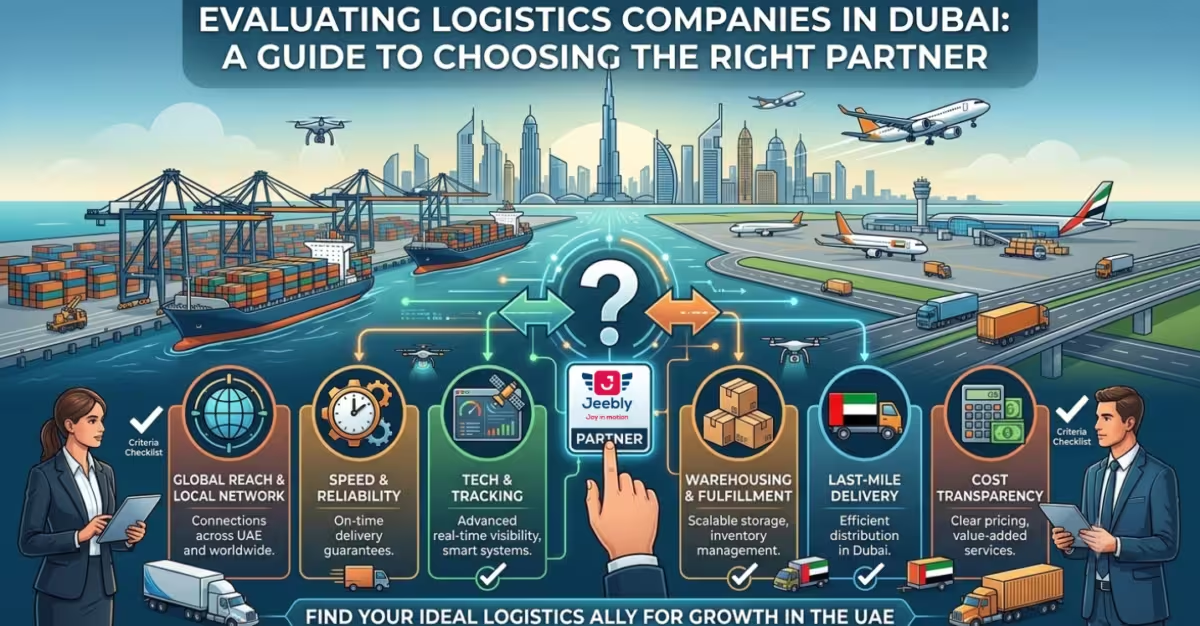
An infographic illustrating the evaluation of logistics companies in Dubai against the backdrop of the city skyline, port, and airport. It features a decision-making flow focused on key pillars like 'Global Reach & Local Network', 'Speed & Reliability', 'Tech & Tracking', 'Warehousing & Fulfillment', 'Last-Mile Delivery', and 'Cost Transparency'. A central question mark is linked to diverse transport modes and two business professionals review a 'Criteria Checklist'.

Logistics Companies in Dubai: How to Evaluate and Choose the Right Partner

Finding logistics companies in Dubai is the easy part. The city has many of them, from DP World’s global port network to nimble last-mile specialists built specifically for D2C e-commerce. Choosing the right one for your specific business is where most operators get it wrong. They default to the largest name, or the cheapest quote, without understanding which type of provider their operation actually needs.

This guide covers the structure of the Dubai logistics market. Understand the five criteria that genuinely distinguish a capable partner from an average one, and why most businesses end up with three logistics vendors when one would do.

How the Dubai Logistics Market Is Structured

Dubai’s logistics infrastructure is genuinely world-class. Jebel Ali Port in Dubai, UAE, is the 9th-busiest container port globally, handling 15.5 million TEUs in recent years. 

Dubai International Airport and the city’s 30+ free zones drive global logistics by offering 100% foreign ownership, zero corporate and personal taxes, and integrated customs operations that effortlessly connect Asia, Europe, and Africa.

But the scale of your infrastructure doesn’t automatically translate to great delivery performance for your customers. A provider with a 70,000 sq ft warehouse and 50 global trade lanes may have no coherent answer for a parcel arriving at an apartment in Jumeirah by tomorrow morning.

The market breaks into four functional categories:

  1. Global freight and port operators: DP World, CEVA, Kuehne+Nagel. Built for containerised freight, port haulage, and multinational supply chains. Not the right primary partner for SME or mid-market UAE domestic e-commerce.

  2. International express couriers: DHL Express, FedEx, Aramex, UPS. Strong for cross-border, time-definite international shipments. Domestic UAE last-mile is possible but not their primary focus; pricing reflects enterprise account structures.

  3. Tech-native last-mile and fulfilment platforms: Jeebly, Quiqup, iMile, Swftbox. Built specifically for UAE domestic e-commerce: same-day and next-day delivery, COD, Shopify integration, returns management, wallet top-up onboarding, with no minimum volume requirements.

  4. Specialist and vertical providers: cold chain (GSL, with five quality certifications for temperature ranges), maritime (GAC), document and government-adjacent (Emirates Post, Zajel).

Most e-commerce businesses need a provider from category two or three. The evaluation criteria that follow apply to both.

Five Criteria That Differentiate Logistics Companies in Dubai

1. First-attempt delivery rate

Every logistics provider claims a high delivery success rate. Few publish the actual rate against auditable volume. A failed first attempt isn’t just a re-delivery cost. It’s a customer who received a bad experience and may not order again.

Ask specifically for first-attempt delivery success (FDSS) data across your target coverage zone. 

For instance, Jeebly publishes 98% FDSS across 50,000+ daily deliveries as a verified operational metric. Use that as a benchmark when evaluating any provider.

2. COD infrastructure and remittance cycle

Secure COD continues to account for a significant share of UAE e-commerce transactions. The remittance cycle, how quickly collected cash is transferred back to your account, directly affects your working capital. A provider remitting fortnightly rather than weekly leaves an additional week of your revenue on hold at any given time. At volume, that’s a meaningful float.

Confirm: does the provider support COD as standard or as an add-on? What is the published remittance cycle? Is there a COD fee, and how is it calculated? Jeebly Dash remits weekly. Get any commitment in writing.

3. Platform integration depth

“We integrate with Shopify” means different things to different providers. Some offer a full bidirectional API: orders sync automatically, tracking updates are pushed to the customer in real time, and NDR events trigger automated follow-up workflows. Others require a manual CSV upload or a webhook that breaks under load.

Test the integration in a live environment before committing operationally. Jeebly integrates natively with Shopify, WooCommerce, Magento, ChatFood, and Grubtech. Orders sync without manual intervention.

4. Returns management

A solid 3PL logistics must provide an itemised breakdown of returns handling: confirmation of item condition at the point of return, the timeline from the customer’s door back to your warehouse, and a per-return fee structure. Most logistics providers handle forward delivery well and build reverse logistics as a reactive service. 

Ask your shortlisted provider for the end-to-end reverse flow before you need it, not after a customer complains.

Jeebly Bizz manages reverse logistics on the same platform as forward delivery, with a single tracking system, a single account, and a single invoice.

5. Peak-season scalability

Dubai’s logistics demand spikes materially during Ramadan, White Friday, and Eid. A provider whose fleet is primarily third-party riders recruited on an ad hoc basis has limited control over capacity and quality during these periods. A provider with an owned and managed fleet or a documented peak-capacity model can show you what happens at 3x normal volume.

Jeebly operates an active fleet of 4,000+ vehicles with a documented peak-season dispatch model. Ask any provider: how does your fleet capacity change during White Friday? What’s your on-time delivery SLA during peak versus standard periods? 

The answer reveals whether their normal-period performance is replicable when it matters most.

Warehouse Zone: A Decision That Affects Unit Economics More Than Rate Negotiation

This is one of the most commercially significant choices in Dubai’s logistics sector.

JAFZA (Jebel Ali Free Zone) gives you duty deferral. Goods imported into the zone are exempt from customs duty until they move to the UAE mainland. Dubai South positions you for airport speed, with fastest ground transit times to Dubai International Airport for outbound air freight. Your warehouse zone choice affects unit economics more than your rate negotiation does.

What this means practically:

  • Businesses using the UAE as a GCC distribution hub: importing in bulk and re-exporting to Saudi Arabia, Oman, or beyond, JAFZA is the correct structure. Duty is deferred until mainland sale; re-exports attract zero duty.

  • For businesses with fast-moving SKUs primarily for UAE domestic delivery, shipping from Dubai South or a Dubai mainland facility reduces ground transit time for customers.

  • Businesses requiring fast customs clearance on inbound air freight: proximity to DXB matters.

Any logistics provider offering warehousing should be able to explain how their facility location affects your duty liability and domestic delivery SLA. If they can’t, that’s a gap worth probing.

For the full import and compliance picture, UAE Import and Export Guide: Trade Documentation, Logistics and Compliance covers the free zone vs mainland decision in detail.

The Multi-Carrier Problem and How to Avoid It

Most brands operating in Dubai end up working with two, three, or more carriers. That’s operationally smart at the provider level, but it creates a real management problem: fragmented dashboards, inconsistent tracking experiences, and failed deliveries that slip through the cracks between handoffs.

Each additional vendor relationship adds: 

  1. a separate tracking system to monitor 
  2. a separate invoice cycle to reconcile 
  3. a separate account manager to chase when something goes wrong
  4. a separate SLA to enforce

The overhead compounds with scale.

The alternative is a provider that covers multiple lanes on a single operational platform. For UAE e-commerce businesses managing regular inbound inventory alongside outbound B2C deliveries, Jeebly Haul covers the freight leg, and Jeebly Dash covers domestic last-mile via the same platform, with unified tracking and a single remittance cycle.

For a direct comparison of UAE last-mile operators on FDSS, COD, and integration capability before deciding, Best Courier Services in UAE: 2026 Comparison Guide covers the full provider landscape.

How Jeebly Is Positioned in the Dubai Logistics Market

Jeebly is structured specifically to solve the consolidation problem for UAE e-commerce businesses. Rather than requiring separate vendors for last-mile, freight, fulfilment, and returns, the platform covers all four:

Jeebly Dash: same-day and next-day domestic delivery across all seven UAE emirates. Published base rate is AED 17.31 per parcel up to 5 kg. 98% FDSS. Wallet top-up onboarding with no minimum volume. Jeebly operates on a pay-as-you-go model with transparent pricing, making it accessible for growing ecommerce businesses.

Jeebly Haul: road, air, and ocean freight. Custom-quoted for shipments above 20 kg. 2,000+ active fleet vehicles, 70+ transporter partners, GCC-wide coverage. Customs clearance managed in-house, not outsourced.

Jeebly Bizz: warehousing, pick-and-pack, automated dispatch, reverse logistics, and B2B supply chain management. Native integrations with Shopify, WooCommerce, and Magento. Built for businesses running 50+ orders daily where manual coordination creates a ceiling on growth.

Jeebly Moveo: relocation services for homes and workspaces, covering the delivery of large items and managed moves.

Talk to the Jeebly team to map out the right setup for your order profile, coverage zones, and fulfilment requirements.

Frequently Asked Questions

Dubai has four main categories: global freight and port operators (DP World, CEVA) for containerised freight and port operations; international express couriers (DHL, Aramex, FedEx) for cross-border and enterprise shipments; tech-native last-mile and fulfilment platforms (Jeebly, Quiqup, iMile) for UAE domestic e-commerce; and vertical specialists for cold chain, maritime, and government-adjacent delivery.

Evaluate five things: published first-attempt delivery rate, COD remittance cycle, integration depth with your e-commerce platform, returns management process, and peak-season fleet capacity. A provider that answers all five clearly in writing is one you can plan around.

JAFZA (Jebel Ali Free Zone) gives duty deferral on imported goods. Standard customs duty doesn’t apply until goods leave the free zone for the UAE mainland. Dubai South offers faster ground transit to Dubai International Airport, suited to businesses with high outbound air freight volume. Zone choice affects total landed costs more than per-parcel rate negotiation.

No. Jeebly Dash operates on a wallet top-up model with no minimum order volume, making it accessible from the first order. Volume-based commercial terms are available as order volume scales.

COD handling varies significantly between providers. Most UAE logistics companies support COD collection, but remittance cycles range from weekly to monthly. Jeebly Dash remits COD weekly. Always confirm the remittance cycle in writing before signing. A fortnightly float on high COD volume directly affects your working capital.

Routes to insightful reads

Delivery SLA guide for UAE businesses showing service level agreements, delivery performance metrics, on-time delivery targets and logistics standards.
 Delivery SLA Guide for UAE Businesses: What to Expect and How to Set Standards

A clear delivery Service Level Agreement (SLA) sets the expectations for speed, reliability, and performance between businesses and their logistics partners. This guide explains what a delivery SLA should include, the key metrics to track, and how UAE businesses can set realistic standards to improve customer satisfaction and delivery performance.

Read More
Dangerous goods and restricted items that cannot be shipped by courier in the UAE, including hazardous materials, prohibited products and customs restrictions.
Dangerous Goods and Restricted Items: What You Cannot Ship by Courier in the UAE

Shipping prohibited or restricted items can lead to delays, fines, shipment rejection, or legal consequences. This guide explains which dangerous goods and restricted items cannot be shipped by courier in the UAE, the regulations businesses should know, and how to stay compliant with UAE customs and courier requirements.

Read More
How to manage eCommerce returns in the UAE with reverse logistics, return policies, refunds and inventory restocking
How to Manage eCommerce Returns in UAE: Strategy, Policy and Logistics

Efficient returns management is essential for every UAE eCommerce business. From creating a customer-friendly return policy to streamlining reverse logistics and processing refunds quickly, this guide explains how to reduce return costs, improve customer satisfaction, and turn returns into a competitive advantage.

Read More
A medium-sized Jeebly delivery and moving truck parked outside a warehouse with its back doors wide open and a hydraulic lift gate lowered to the ground. Inside the cargo area, brown cardboard boxes are stacked neatly. The side of the truck features a dark blue advertisement wrap with the Jeebly logo, displaying a hand holding a house model under the text "Always on the Move from parcels to homes" and a call to action to "Explore it all on Jeebly NoW".
Packers and Movers in Dubai: What to Look for and How to Choose

Relocating in Dubai doesn’t have to be stressful. Whether you are moving apartments in Dubai Marina or upgrading your office space, discover the essential factors to look for in a professional moving company—from licensing and insurance to transparent pricing—and learn exactly how to choose the right team for a seamless move.

Read More
Infographic titled "Ecommerce Fulfilment in UAE: How It Works and What Businesses Should Look For." The left side shows a 5-step workflow: Online Store, Inventory, Picking & Packing, Dispatch, and Last Mile Delivery. The center features a map of the UAE with iconic cityscapes. The right side lists business requirements: Reliability & Speed, Advanced Technology, Real-Time Tracking, Scalability, and Customer Support.
eCommerce Fulfilment in UAE: How It Works and What Businesses Should Look For

Master your logistics strategy in the Middle East. Discover how e-commerce fulfillment works in the UAE—from warehousing to last-mile delivery—and learn the top 5 features your business needs from a fulfillment partner to scale successfully.

Read More
Categories
blogs

DHL vs Jeebly: Which Is Better for UAE Businesses and eCommerce Delivery?

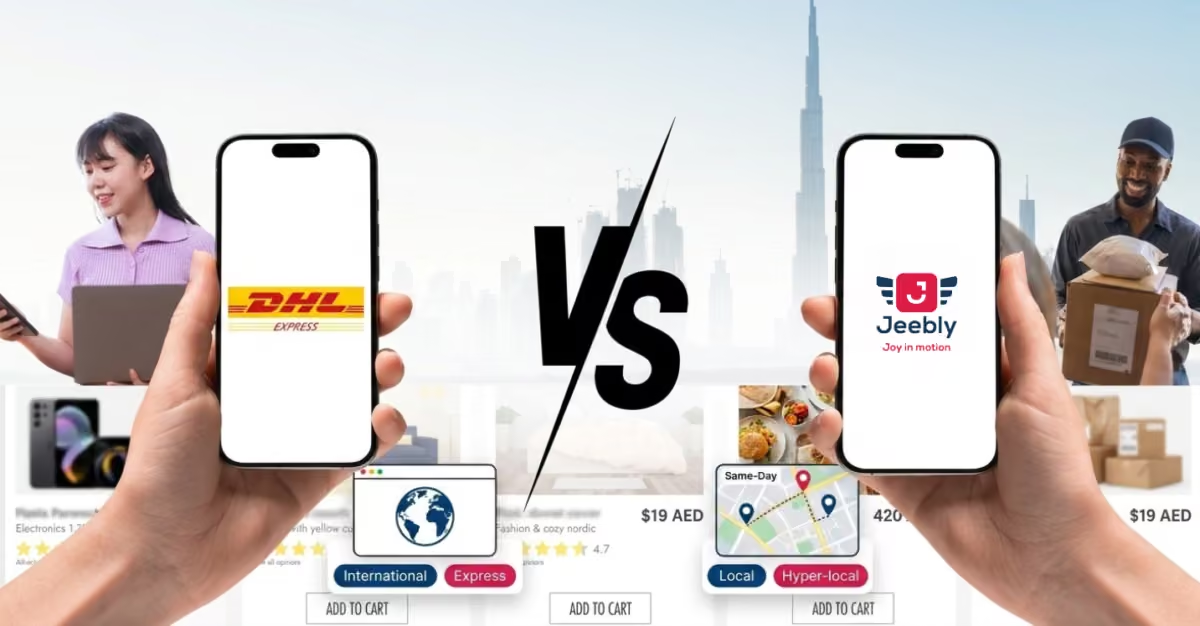
A comparison banner for UAE eCommerce delivery showing two hands holding smartphones side-by-side against a blurred Dubai skyline. The left screen displays the DHL Express logo with an "International Express" badge below it, while the right screen displays the Jeebly logo with a "Local Hyper-local" map route badge. A bold "VS" graphic splits the center.

DHL vs Jeebly: Which Is Better for UAE Businesses and eCommerce Delivery?

DHL vs Jeebly is a question with a cleaner answer than most courier comparisons because these two providers are not built for the same business profile. 

DHL is the global standard for international express and enterprise logistics. Jeebly is built specifically for UAE domestic e-commerce delivery, COD operations, and end-to-end logistics management for businesses at any scale. Choosing between them depends entirely on where your customers are, how many orders you ship, and whether your priority is international reach or domestic delivery performance.

This guide compares the two directly: what each provider does, where each wins, how costs compare, and which business profile suits each platform.

DHL in the UAE: Four Divisions, Four Different Products

Most businesses treat “DHL” as if it’s a single service. In practice, DHL operates four distinct divisions in the UAE. Each serves a different use case. Knowing which one is relevant to your business changes the comparison entirely.

1) DHL Express: time-definite international courier. The service most people think of when they say “DHL.” Best known for fast, time-definite international shipping. Often chosen when speed and global reach matter more than local last-mile optimisation. Operates across 220+ countries. Strong on documentation, customs clearance, and B2B international shipments. Premium pricing.

2) DHL Global Forwarding: freight. Air, sea, and road freight for commercial cargo, with customs brokerage. Currently expanding UAE presence with fleet investment and a joint venture with Etihad Rail to enhance connectivity across the region. Enterprise-focused. Not relevant for parcel delivery.

3) DHL Supply Chain: contract logistics and e-commerce fulfilment for large businesses. Sets up Distribution Centres to handle omnichannel needs, demand fluctuations, B2B and B2C fulfilment, with last-mile delivery through accredited partners rather than a proprietary fleet. Minimum volumes required. Not accessible for early-stage or SME e-commerce brands.

4) DHL eCommerce: domestic and regional parcel delivery. The division is actively investing in last-mile capabilities in the Middle East. UAE-specific SME e-commerce capabilities are developing but not yet at the same level of integration depth as Jeebly’s native platform.

For a UAE e-commerce brand shipping domestic orders, DHL Express and DHL eCommerce are the two relevant divisions. The comparison with Jeebly sits squarely in those lanes.

DHL vs Jeebly: A Direct Comparison

Dimension DHL Express UAE Jeebly
Primary strength International express shipping UAE domestic e-commerce delivery
Global coverage 220+ countries UAE + GCC cross-border
Same-day domestic (UAE) Not standard Yes, Jeebly Dash
Next-day domestic (UAE) Available Yes, Jeebly Dash, AED 17.31/parcel
Published base rate Not publicly listed AED 17.31 per parcel up to 5 kg
COD support Limited / not standard for SMEs Yes, weekly remittance standard
Shopify / WooCommerce integration Available via API Native direct integrations
First-attempt delivery success (UAE) Not published 98% across 50,000+ daily deliveries
Warehousing and fulfilment Enterprise accounts (DHL Supply Chain) Jeebly Bizz; all business sizes
Freight DHL Global Forwarding Jeebly Haul; road, air, ocean
Reverse logistics Available Jeebly Bizz; native
Minimum volume Enterprise thresholds for fulfilment No minimum for Jeebly Dash
Pricing model Zone and weight-based, quote-driven Published rate card + volume terms
Best for Cross-border express and enterprise logistics UAE domestic e-commerce at any scale

When DHL Is the Right Choice

DHL earns its place clearly in three specific scenarios.

  • High-value international express. If you’re shipping documents, high-value goods, or time-sensitive B2B cargo internationally, DHL Express is the market standard. Transit times take 1–3 business days internationally, with comprehensive customs clearance and tracking.


  • Enterprise contract logistics. For large UAE businesses requiring managed warehousing, omnichannel fulfilment, and supply chain outsourcing at scale, DHL Supply Chain offers the infrastructure. Enterprise-level Distribution Centres, inventory optimisation, near-real-time visibility, and B2B/B2C flexibility are designed for businesses with complex, high-volume operations.


  • International freight. DHL Global Forwarding competes directly with other major forwarders for air and sea freight out of the UAE. The Etihad Rail joint venture currently under development adds UAE-to-Saudi land-corridor connectivity to an already substantial freight network.

When DHL is not the right choice: 

If you’re a UAE D2C brand shipping domestic orders with COD, need same-day delivery within Dubai, require a Shopify integration that updates customers in real time, or want to start without enterprise volume commitments, DHL is not built for that use case.

When Jeebly Is the Right Choice

Jeebly is built for the operational reality of UAE domestic e-commerce, which means the specifics that matter to a business shipping to UAE customers daily: no standardised postcodes, high COD volumes, customers who expect same-day or next-day delivery with live tracking, and the need to manage returns without a separate vendor relationship.

  • UAE domestic e-commerce, any scale. Jeebly Dash covers same-day and next-day delivery across all seven UAE emirates. No minimum order volume and the same rate structure applies whether you ship 20 orders a day or 2,000.


  • COD-heavy operations. COD collection, weekly remittance, and photo ePOD at every drop are standard across Jeebly Dash. For a business where 30–40% of orders are COD, the timing of remittances directly affects working capital.


  • Integrated fulfilment without enterprise minimums. Jeebly Bizz covers warehousing, pick-and-pack, automated dispatch, returns management, and B2B supply chain. Native integrations with Shopify, WooCommerce, Magento, ChatFood, and Grubtech mean orders sync automatically without middleware.


  • Freight alongside last-mile. Jeebly Haul handles road, air, and ocean freight for shipments over 20 kg, with in-house customs clearance. For businesses that import inventory and distribute domestically, both legs are managed through a single platform.


For more on the freight side, Freight Forwarding in UAE: How It Works, Costs and How to Choose a Provider covers the mode comparison in detail.

Cost Comparison: What You Actually Pay

DHL does not publish domestic UAE e-commerce rates publicly. Pricing is quote-driven, adjusted by weight zone, shipment frequency, and account tier. For SME e-commerce brands without volume leverage, the rate offered at onboarding is typically higher than that of alternatives built natively for the domestic market.

For domestic UAE delivery, Jeebly’s published cost structure:

Service Rate
Jeebly Dash: next-day domestic AED 17.31 per parcel up to 5 kg
Same-day Dubai Custom quote based on urgency tier
COD fee Included, remittance weekly
International (Jeebly Dash International) Quote-based by destination
Freight: Jeebly Haul Custom quote by cargo type and route

DHL's UAE Investment: What It Means for the Comparison

DHL Group announced an EUR 500 million investment in the Middle East between 2024 and 2030, including specific e-commerce last-mile investments through the AJEX acquisition in Saudi Arabia and warehousing expansion in the UAE.

For businesses making a 2–3 year logistics partnership decision, this is relevant context. DHL is actively building UAE and GCC e-commerce capability. The gap in domestic SME last-mile integration, COD infrastructure, and Shopify-native connectivity that exists today is likely to narrow over the investment period.

For businesses deciding now, Jeebly has those capabilities built and operational today, with verified FDSS data, published pricing, and native platform integrations. DHL’s investment trajectory is worth monitoring, but in practice, investment plans and operational capabilities differ. The decision should be based on what each provider can actually deliver today at your order volume.

For a broader comparison of Jeebly against other UAE last-mile operators, Best Courier Services in UAE: 2026 Comparison Guide covers seven major providers across FDSS, COD, pricing, and integration capability.

Conclusion

DHL vs Jeebly is not a close call once you understand where each provider is built to operate. DHL Express is the global standard for international express delivery. It is the right choice when your shipment crosses a border, and speed matters more than cost. 

Jeebly is built for UAE domestic e-commerce: same-day and next-day delivery via Jeebly Dash, COD with weekly remittance, warehousing and fulfilment via Jeebly Bizz, and freight via Jeebly Haul. All are connected via a single platform with native integrations for Shopify, WooCommerce, and Magento. 

Talk to the Jeebly team. We’ll map out the right setup for your order volume and coverage requirements.

Frequently Asked Questions

 DHL is primarily built for international express shipping. Its UAE domestic e-commerce offering (via DHL eCommerce) is developing but lacks the COD infrastructure, SME-accessible pricing, and Shopify-native integrations that UAE-native providers like Jeebly offer as standard. For domestic UAE last-mile, Jeebly Dash is purpose-built for that use case.

For domestic UAE parcels, Jeebly Dash publishes a base rate of AED 17.31 per parcel up to 5 kg. DHL does not publish domestic UAE e-commerce rates; pricing is quote-driven and typically tiered for enterprise accounts.

DHL’s COD capability in the UAE is limited and not a standard feature for SME e-commerce accounts. Jeebly supports COD as standard across Jeebly Dash, with weekly remittance and photo ePOD at every delivery.

Jeebly Dash International covers selected international routes. For broad international express shipping across 220+ countries with time-definite SLAs, DHL Express remains the established choice. For freight (air, sea, or road), Jeebly Haul covers UAE, GCC, and international routes.

Jeebly is accessible from day one with no minimum volume commitment, published pricing, and native Shopify integration. DHL’s enterprise fulfilment products (DHL Supply Chain) require volume thresholds that most startups won’t meet. For domestic UAE delivery from the first order, Jeebly Dash is the more practical starting point.

Routes to insightful reads

Delivery SLA guide for UAE businesses showing service level agreements, delivery performance metrics, on-time delivery targets and logistics standards.
 Delivery SLA Guide for UAE Businesses: What to Expect and How to Set Standards

A clear delivery Service Level Agreement (SLA) sets the expectations for speed, reliability, and performance between businesses and their logistics partners. This guide explains what a delivery SLA should include, the key metrics to track, and how UAE businesses can set realistic standards to improve customer satisfaction and delivery performance.

Read More
Dangerous goods and restricted items that cannot be shipped by courier in the UAE, including hazardous materials, prohibited products and customs restrictions.
Dangerous Goods and Restricted Items: What You Cannot Ship by Courier in the UAE

Shipping prohibited or restricted items can lead to delays, fines, shipment rejection, or legal consequences. This guide explains which dangerous goods and restricted items cannot be shipped by courier in the UAE, the regulations businesses should know, and how to stay compliant with UAE customs and courier requirements.

Read More
How to manage eCommerce returns in the UAE with reverse logistics, return policies, refunds and inventory restocking
How to Manage eCommerce Returns in UAE: Strategy, Policy and Logistics

Efficient returns management is essential for every UAE eCommerce business. From creating a customer-friendly return policy to streamlining reverse logistics and processing refunds quickly, this guide explains how to reduce return costs, improve customer satisfaction, and turn returns into a competitive advantage.

Read More
A medium-sized Jeebly delivery and moving truck parked outside a warehouse with its back doors wide open and a hydraulic lift gate lowered to the ground. Inside the cargo area, brown cardboard boxes are stacked neatly. The side of the truck features a dark blue advertisement wrap with the Jeebly logo, displaying a hand holding a house model under the text "Always on the Move from parcels to homes" and a call to action to "Explore it all on Jeebly NoW".
Packers and Movers in Dubai: What to Look for and How to Choose

Relocating in Dubai doesn’t have to be stressful. Whether you are moving apartments in Dubai Marina or upgrading your office space, discover the essential factors to look for in a professional moving company—from licensing and insurance to transparent pricing—and learn exactly how to choose the right team for a seamless move.

Read More
Infographic titled "Ecommerce Fulfilment in UAE: How It Works and What Businesses Should Look For." The left side shows a 5-step workflow: Online Store, Inventory, Picking & Packing, Dispatch, and Last Mile Delivery. The center features a map of the UAE with iconic cityscapes. The right side lists business requirements: Reliability & Speed, Advanced Technology, Real-Time Tracking, Scalability, and Customer Support.
eCommerce Fulfilment in UAE: How It Works and What Businesses Should Look For

Master your logistics strategy in the Middle East. Discover how e-commerce fulfillment works in the UAE—from warehousing to last-mile delivery—and learn the top 5 features your business needs from a fulfillment partner to scale successfully.

Read More
Categories
blogs

Logisty vs Jeebly: UAE eCommerce Delivery Comparison

Logisty vs Jeebly comparison for UAE eCommerce delivery, last-mile logistics and courier services

Logisty vs Jeebly: UAE eCommerce Delivery Comparison

If you’re comparing Logisty vs Jeebly as a UAE business trying to decide on a logistics partner, the first thing to know is that these two platforms were not built for the same problem. 

Logisty is a digital freight-matching platform built for commercial truck hire. Jeebly is an end-to-end logistics platform built for e-commerce and business delivery. Understanding that difference upfront saves you from evaluating the wrong things.

This guide covers what each platform actually does, which business profiles suit each one, how they compare across the criteria that matter and where each falls short. If you’re a UAE business with active delivery operations or planning to scale them, this is the comparison you need before you commit.

What Logisty Is and Is Not

Logisty is a digital logistics platform launched in December 2024 through a collaboration between Dubai’s Roads and Transport Authority (RTA) and TruKKer, the GCC’s largest digital freight company. It connects businesses with commercial transport service providers for on-demand truck booking and real-time freight tracking.

The platform offers commercial transport services, fleet management solutions, and on-demand booking with real-time tracking. Its headline technology feature is an AI-powered CBM Calculator that estimates shipment volumes from uploaded photos or videos.

What Logisty is not:

It is not a last-mile courier, an e-commerce fulfilment platform, a COD handler, or a consumer-facing delivery service. It is built specifically to serve Dubai’s 10,000+ commercial transport companies and the businesses that need to move bulk freight digitally rather than through traditional phone-based truck booking.

What Jeebly Is and How It's Structured

Jeebly is a UAE-native logistics platform covering the full delivery chain: same-day and next-day parcel delivery, cross-border freight, warehousing, fulfilment, and reverse logistics. While Logisty is built for a single use case (truck hire for commercial freight), Jeebly is built to serve multiple delivery needs on a single operational platform.

The service structure is designed around business type rather than shipment type:

Jeebly Dash covers express, same-day, and next-day domestic delivery. Base rate AED 17.31 per parcel up to 5 kg. Direct integrations with Shopify, WooCommerce, Magento, ChatFood, and Grubtech. COD collection and weekly remittance as standard. Operates across all seven UAE emirates.

Jeebly Haul handles road freight above 20 kg, air freight, and ocean freight across the UAE and GCC. Over 2,000 active fleet vehicles, 70+ transporter partners, and 20+ vehicle categories. Custom-quoted. Built for businesses with regular inbound inventory movement or cross-border freight requirements.

Jeebly Bizz is the business logistics layer. Warehousing, fulfilment, automated dispatch, route optimisation, reverse logistics, and B2B supply chain management are integrated on a single platform. Built for operations running hundreds of daily orders where manual coordination creates a ceiling on growth.

Operational scale: 50,000+ daily deliveries, 12M+ customers served, 98% First Day Delivery Success (FDSS) rate, and AED 1.5B+ in shipments.

Logisty vs Jeebly: Direct Comparison

Criteria Logisty Jeebly
Launched December 2024 Established UAE operator
Built by RTA + TruKKer Jeebly (UAE-native)
Primary use case Commercial freight/truck hire E-commerce delivery + logistics
Last-mile parcel delivery No Yes, Jeebly Dash
Freight and bulk cargo Yes, digital truck booking Yes, Jeebly Haul
E-commerce platform integration Not confirmed Shopify, WooCommerce, Magento, ChatFood, Grubtech
Cash on delivery (COD) Not confirmed Yes, weekly remittance
COD fraud protection / ePOD Not confirmed Photo ePOD at every drop
Returns/reverse logistics Not confirmed Yes, Jeebly Bizz
Warehousing and fulfilment Not confirmed Yes, Jeebly Bizz
Fleet scale TruKKer 55,000+ trucks (GCC-wide) 2,000+ Jeebly fleet + 70 transporter partners
AI features AI CBM Calculator (volume estimation) AI-assisted dispatch and route optimisation
Coverage Dubai-focused (UAE road freight) UAE-wide (all 7 emirates) + GCC cross-border
Consumer-facing tracking Basic tracking Branded tracking pages, real-time GPS
Target customer Bulk commercial freight businesses E-commerce brands, D2C, SMEs, enterprises
Best for Freight movement eCommerce operations

For a broader view of how Jeebly’s delivery rates, FDSS, and platform integrations compare across the full UAE courier market, Best Courier Services in UAE: 2026 Comparison Guide covers seven major operators on the criteria that matter for e-commerce businesses.

When Logisty Is the Right Choice

Logisty is the better fit for a specific, well-defined business profile: companies whose primary logistics need is moving large commercial freight within Dubai and the UAE, with no requirement for parcel-level delivery, consumer communication, or e-commerce platform integration.

Logisty suits you if:

  • You’re moving raw materials, construction goods, industrial equipment, or bulk stock between facilities and warehouses. 
  • Your logistics operation is B2B rather than B2C. 
  • You’re not delivering to end consumers, so tracking pages, COD, and delivery notifications are irrelevant to your use case. 
  • Your shipments are large and irregular, best described as “book a truck” rather than “dispatch 200 orders.”


The platform’s core proposition is connecting businesses with commercial transport service providers through a digital interface. For businesses that have historically relied on phone calls to coordinate trucking, that digitisation has genuine operational value.

Logisty is not the right choice if you’re running e-commerce orders, need COD collection, want Shopify integration, require returns management, or serve end consumers who expect real-time tracking and delivery confirmation.

One gap in Logisty’s freight-booking model is that the platform handles truck booking, but customs clearance for inbound freight into the UAE is a separate process requiring its own documentation, declarations, and duty payment. 

Customs Clearance in Dubai and the UAE covers the process, with useful context to help you decide whether a freight-booking-only platform meets your full inbound logistics needs.

When Jeebly Is the Right Choice

Jeebly suits any business where delivery is a customer-facing operation, and the quality of the drop-off directly affects your brand, repeat purchase rate, and RTO costs.

Jeebly suits you if:

  • You’re an e-commerce brand shipping B2C orders, and your customers expect same-day or next-day delivery with live tracking. 
  • You operate COD and need reliable collection, clean remittance, and ePOD at every drop. 
  • You’re importing inventory and need freight handling alongside domestic last-mile delivery through a single connected platform. 
  • You’re managing returns and need reverse logistics built into the same workflow as forward delivery. 
  • You’re scaling and need a platform that integrates directly with your store without manual order uploads.


Jeebly is not the first choice if your only logistics need is moving heavy commercial freight between facilities and there is no parcel-level delivery requirement. For pure bulk truck hire within Dubai, Logisty’s freight-matching model is purpose-built for that specific use case.

The eCommerce Stack: Where the Comparison Ends

This is where Logisty and Jeebly stop being comparable alternatives and become entirely different tools.

Logisty has no published information on e-commerce platform integrations, COD support, parcel tracking, NDR management, returns processing, or consumer notification systems. These are not features it’s currently building toward. They’re outside the platform’s stated purpose of commercial freight matching.

Jeebly’s e-commerce infrastructure covers:

  1. Platform integrations: Direct API and plugin integrations with Shopify, WooCommerce, Magento, ChatFood, and Grubtech. Orders sync automatically. No manual CSV uploads and no middleware required.


  2. Secure COD delivery: Collection at the door, ePOD photo confirmation at every drop, weekly remittance cycle. For businesses managing 30–50% of orders as COD, the remittance timing directly affects working capital. Weekly remittance compresses the float relative to providers running fortnightly or monthly cycles.


  3. NDR and RTO management: Failed delivery attempts are automatically flagged, triggering customer notifications via SMS or WhatsApp to reschedule. NDR-to-RTO conversion is one of the most controllable cost lines in e-commerce delivery.


  4. Returns and reverse logistics: Jeebly Bizz handles reverse logistics within the same platform as forward delivery. No separate vendor relationship and no separate tracking system. Customers get a clean return experience; businesses get a unified delivery record.

If your operation requires these eCommerce-specific capabilities, a dedicated last-mile logistics platform such as Jeebly is likely a better fit. 

If your need is exclusively for bulk commercial truck hire, Jeebly Haul competes in that lane, but Logisty’s TruKKer network gives it greater truck density for pure freight matching.

How to Choose: A Decision Framework

Choose Logisty if:

  • Your primary logistics need is commercial freight and bulk truck hire within Dubai
  • You move large shipments between facilities or suppliers with no consumer-facing delivery requirement
  • You want a digitised truck-booking experience backed by regulatory oversight from the RTA


Choose Jeebly Dash if:

  • You’re shipping e-commerce orders B2C and need same-day or next-day delivery with live tracking
  • Your customers pay COD, and you need clean collection, ePOD, and weekly remittance
  • Your store runs on Shopify, WooCommerce, or Magento and you want direct integration


Choose Jeebly Bizz if:

  • You’re running 50+ orders per day and need automated dispatch, route optimisation, and returns management in one platform
  • You’re managing fulfilment alongside delivery and need warehousing connected to the same system


Choose Jeebly Haul if:

  • You need freight above 20 kg, road freight across the GCC, air freight, or ocean freight, alongside an e-commerce delivery operation through one partner


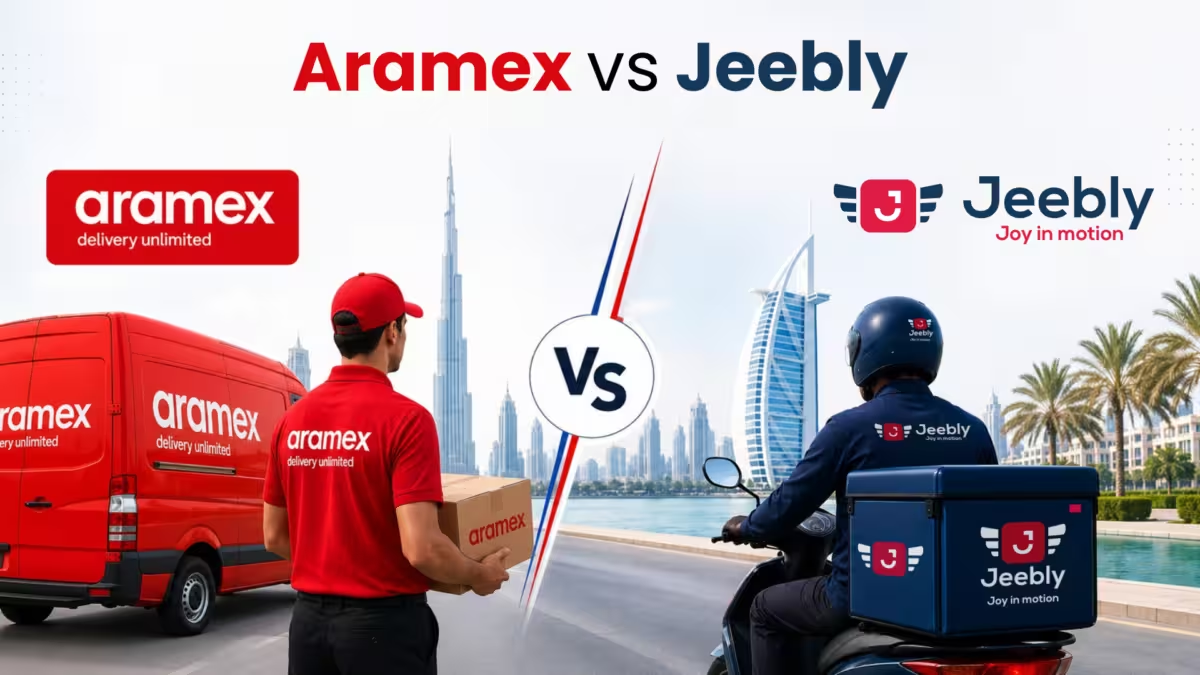
For businesses comparing Jeebly against other UAE last-mile operators rather than Logisty, Aramex vs Jeebly and Careem Express vs Jeebly cover those specific comparisons in detail.

Conclusion

Logisty and Jeebly solve different problems for different businesses. Logisty is a digital platform connecting businesses with commercial transport providers for freight booking and tracking. It is designed for bulk truck hire in Dubai, backed by the RTA’s regulatory framework and TruKKer’s GCC-wide fleet. 

Jeebly is a full logistics platform with last-mile parcel delivery, freight, fulfilment, COD, returns, and e-commerce integrations. It is built for UAE businesses where delivery is a customer-facing operation rather than just a cargo-movement task. 

For e-commerce and D2C brands, Jeebly is the clearer fit. For pure commercial freight within Dubai, Logisty’s model is worth evaluating. 

For businesses that need both, Jeebly Haul and Jeebly Dash cover both lanes through one platform. Speak with Jeebly’s logistics team to map the right delivery setup for your order volume, customer expectations, and fulfilment needs.

Frequently Asked Questions

 Logisty is a digital logistics platform launched in December 2024 through a collaboration between Dubai’s Roads and Transport Authority (RTA) and TruKKer, the GCC’s largest digital freight company. It connects businesses with commercial truck operators for on-demand freight booking and real-time tracking. It is built specifically for commercial bulk freight, not for e-commerce parcel delivery.

No. Logisty is a commercial freight platform. It is not designed for parcel-level delivery, COD collection, consumer notifications, or e-commerce platform integration. If your operation requires any of these, Logisty is not the right tool.

No. Logisty is positioned as a digital commercial transport platform focused on freight booking, transport services, fleet management, and tracking. Businesses needing parcel delivery, COD, and eCommerce fulfilment require a last-mile logistics solution.

 For Shopify-based businesses, Jeebly is designed around eCommerce delivery workflows, including order integrations, last-mile delivery, COD, and returns management.

Jeebly covers the full e-commerce delivery stack: same-day and next-day parcel delivery, COD with weekly remittance, photo ePOD at every drop, direct integrations with Shopify and WooCommerce, reverse logistics, and warehousing all through one platform. Logisty offers truck hire for commercial freight. They are not comparable for e-commerce operations.

Yes. Jeebly Haul covers road, air, and ocean freight for shipments over 20 kg, with a fleet of 2,000+ vehicles and 70+ transporter partners across the UAE and the GCC. This freight capability is connected to the same platform as Jeebly Dash (last-mile) and Jeebly Bizz (fulfilment and returns).

Businesses whose primary logistics need is moving large commercial cargo within Dubai by road (construction materials, industrial goods, bulk stock transfers between facilities) without a requirement for consumer-facing delivery, tracking, or COD. Logisty is built around Dubai’s 10,000+ commercial transport companies and the digital transformation of that sector.

Routes to insightful reads

Delivery SLA guide for UAE businesses showing service level agreements, delivery performance metrics, on-time delivery targets and logistics standards.
 Delivery SLA Guide for UAE Businesses: What to Expect and How to Set Standards

A clear delivery Service Level Agreement (SLA) sets the expectations for speed, reliability, and performance between businesses and their logistics partners. This guide explains what a delivery SLA should include, the key metrics to track, and how UAE businesses can set realistic standards to improve customer satisfaction and delivery performance.

Read More
Dangerous goods and restricted items that cannot be shipped by courier in the UAE, including hazardous materials, prohibited products and customs restrictions.
Dangerous Goods and Restricted Items: What You Cannot Ship by Courier in the UAE

Shipping prohibited or restricted items can lead to delays, fines, shipment rejection, or legal consequences. This guide explains which dangerous goods and restricted items cannot be shipped by courier in the UAE, the regulations businesses should know, and how to stay compliant with UAE customs and courier requirements.

Read More
How to manage eCommerce returns in the UAE with reverse logistics, return policies, refunds and inventory restocking
How to Manage eCommerce Returns in UAE: Strategy, Policy and Logistics

Efficient returns management is essential for every UAE eCommerce business. From creating a customer-friendly return policy to streamlining reverse logistics and processing refunds quickly, this guide explains how to reduce return costs, improve customer satisfaction, and turn returns into a competitive advantage.

Read More
A medium-sized Jeebly delivery and moving truck parked outside a warehouse with its back doors wide open and a hydraulic lift gate lowered to the ground. Inside the cargo area, brown cardboard boxes are stacked neatly. The side of the truck features a dark blue advertisement wrap with the Jeebly logo, displaying a hand holding a house model under the text "Always on the Move from parcels to homes" and a call to action to "Explore it all on Jeebly NoW".
Packers and Movers in Dubai: What to Look for and How to Choose

Relocating in Dubai doesn’t have to be stressful. Whether you are moving apartments in Dubai Marina or upgrading your office space, discover the essential factors to look for in a professional moving company—from licensing and insurance to transparent pricing—and learn exactly how to choose the right team for a seamless move.

Read More
Infographic titled "Ecommerce Fulfilment in UAE: How It Works and What Businesses Should Look For." The left side shows a 5-step workflow: Online Store, Inventory, Picking & Packing, Dispatch, and Last Mile Delivery. The center features a map of the UAE with iconic cityscapes. The right side lists business requirements: Reliability & Speed, Advanced Technology, Real-Time Tracking, Scalability, and Customer Support.
eCommerce Fulfilment in UAE: How It Works and What Businesses Should Look For

Master your logistics strategy in the Middle East. Discover how e-commerce fulfillment works in the UAE—from warehousing to last-mile delivery—and learn the top 5 features your business needs from a fulfillment partner to scale successfully.

Read More
Categories
blogs

COD Fraud in UAE eCommerce: How to Detect, Prevent and Reduce Losses

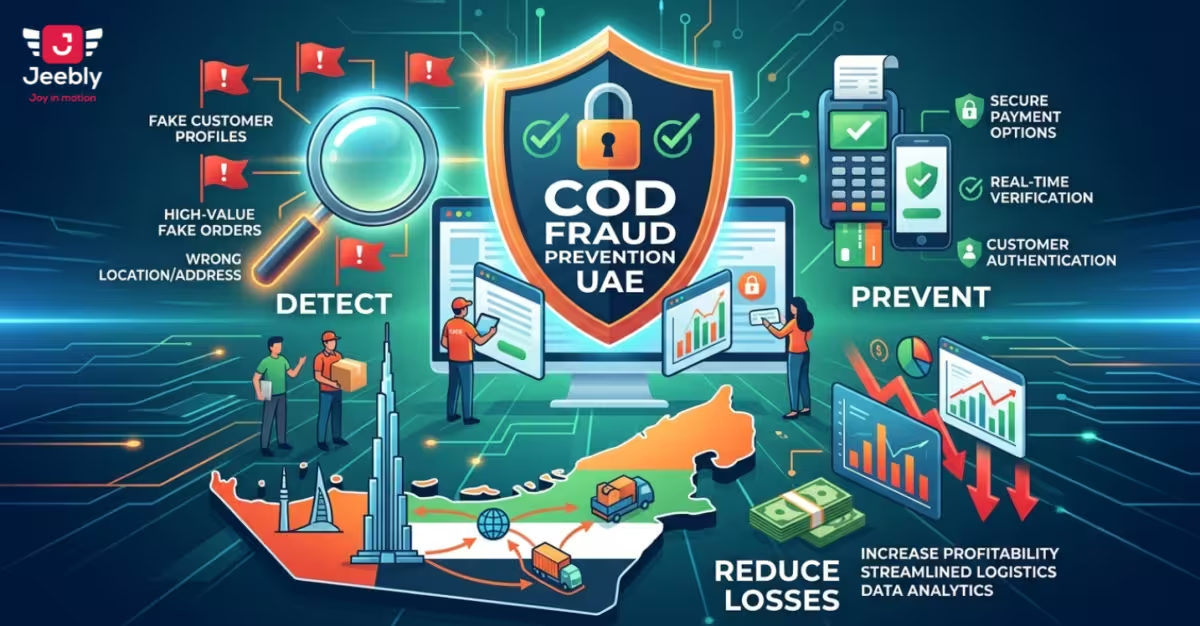
COD fraud prevention in the UAE with secure payment verification, order authentication and logistics risk management

COD Fraud in UAE eCommerce: How to Detect, Prevent and Reduce Losses

Cash on delivery is not going away in the UAE. It still accounts for nearly 35% of transactions across the Middle East and Africa.

The problem is that COD also creates a specific category of fraud risk that digital payment orders don’t carry: low-intent buyers who never planned to accept the parcel, external scammers exploiting the system’s offline nature, and a cascade of operational costs that appear as return-to-origin (RTO) losses on your courier statement.

This guide covers types of COD fraud that UAE businesses face. Know how to detect each, and the operational and technology measures that reduce losses without removing COD from your checkout.

Two Types of COD Fraud: External Scams vs Merchant Losses

1) External COD scams 

This targets your customers. Fraudsters may obtain customer details through leaked databases, phishing, public information, or other illegal sources. They dispatch parcels through legitimate logistics companies and specify a cash amount to be collected on delivery. 

When the courier arrives, the recipient assumes a family member or colleague placed the order and pays without verifying. By the time they open the parcel and discover the contents are worthless, it is difficult to reverse the transaction. This type of fraud damages your customers and, if your brand is being impersonated, directly damages your reputation.

2) Fake-order fraud & high-RTO abuse 

This targets your operations. Fraudulent COD orders placed using fake phone numbers and addresses result in guaranteed RTOs. The courier attempts delivery to a non-existent recipient and returns. 

Beyond outright fake orders, serial refusers, and customers who genuinely placed an order but later choose to refuse delivery, all incur similar operational costs. The distinction matters because the solutions differ.

Understanding which type is driving your losses determines which interventions to prioritise.

How External COD Scams Work

The mechanics follow a consistent pattern. 

Scammers obtain real addresses and phone numbers, dispatch parcels through legitimate logistics companies, and have the courier collect cash on their behalf. The delivery agent follows standard instructions with no knowledge of the contents. Once payment is made, the courier processes the funds through its standard settlement cycle and transfers the amount to the sender.

Unlike prepaid transactions, COD removes many digital payment protections such as automated payment authentication and chargeback processes, shifting more fraud risk into delivery operations.

Common external COD scam types currently active across the region:

  • The unsolicited parcel scam: A fraudster sends a package to a real address using leaked personal data. The recipient assumes a family member ordered it and pays. The parcel contains low-value or worthless items.

  • Brand impersonation: Scammers build convincing replicas of real UAE e-commerce stores, collect orders at scale, and dispatch cheap substitutes via third-party couriers. Your brand takes the fallout from customer service.

  • Fake courier impersonation: Some fraudsters pose as delivery companies, sending packages and demanding cash payments. Packages may include a QR code that, when scanned, links to a phishing site that collects additional personal data.

  • The advanced call variation: In some variations, fraudsters send advance messages or make phone calls claiming a shipment is on its way, creating a sense of legitimacy before the parcel arrives.

One protection against brand impersonation is ensuring your customers can independently verify delivery through a branded tracking page from your actual logistics partner. 

Aramex vs Jeebly: Which Is Better for UAE Last-Mile Delivery? compares how the two providers handle tracking visibility, ePOD, and customer communication. These capabilities help customers distinguish your legitimate delivery from a scam.

How Fake-Order Fraud Costs Your Business

Every failed COD delivery incurs double shipping costs: you paid for the forward attempt, and you pay for the return. The cash flow impact is separate and often underestimated. For brands with 25–30% COD RTO rates, the cash trapped in transit at any point can equal 3–5 weeks of revenue, creating a liquidity problem that grows with scale. 

When combined with Jeebly’s structured COD remittance cycle, this gap can be materially compressed compared to providers that remit fortnightly or monthly. But the RTO rate itself needs to be addressed at the source.

The total cost per RTO order is higher than most business models. A refused COD delivery carries forward shipping cost, return shipping cost, repackaging and restocking time, the COD amount that was never collected, and the customer acquisition cost spent to generate an order that never converted.

Detecting Fake Orders Before Dispatch

The most cost-effective COD fraud intervention happens before the parcel leaves your warehouse. A risk-scoring approach works better than applying the same verification to every order. 

Assess each COD order based on new-customer status, order value, address deliverability, phone-number validity, and historical RTO patterns for the same contact details. Low-risk orders proceed without friction. High-risk orders get additional verification steps.

Signals that flag a COD order as high-risk:

  • Phone number doesn’t match the delivery emirate’s prefix pattern
  • Address is incomplete, contains only a building name with no flat or office number, or matches a known high-RTO zone
  • Multiple orders from the same device or IP with different contact details
  • First-time customer placing a high-value COD order with no order history
  • Order placed outside normal hours with an unusual address format


OTP verification is one of the most effective pre-dispatch controls for reducing fake COD orders. OTP confirmation filters out fake or uncertain orders, ensuring only genuinely interested customers proceed with COD purchases.

Address validation at checkout catches genuine customers who entered incomplete or incorrect addresses. AI-powered address validation can reduce preventable delivery failures by identifying incomplete addresses, invalid locations, and delivery-risk patterns before dispatch.

The RTO lock is the most operationally precise tool for repeat offenders. RTO lock blocks customers with a history of COD refusals from accessing the COD payment option; they can still purchase with prepaid methods.

These pre-dispatch interventions are only as effective as the fulfilment partner executing them. 

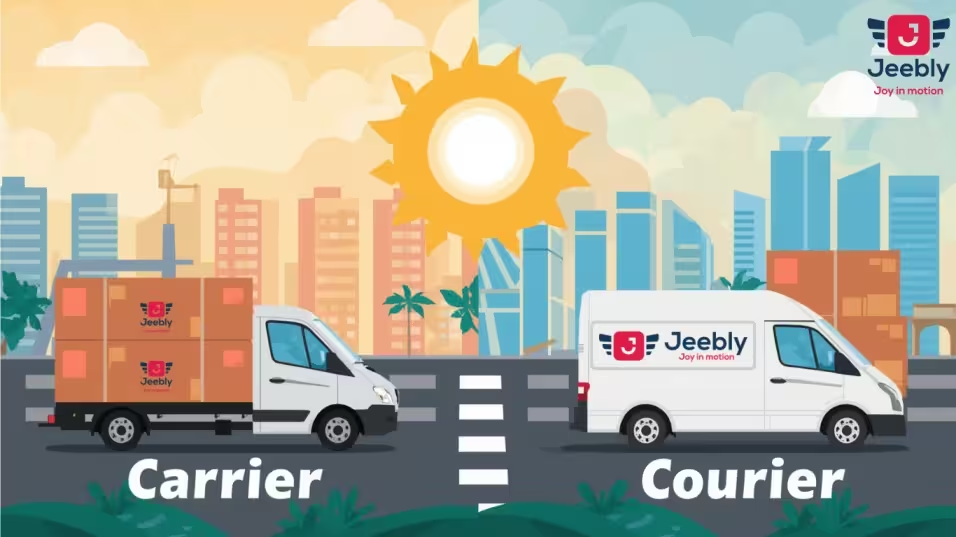
Whether your operation suits a carrier or a courier model affects which fraud prevention tools are actually available to you. Carrier vs Courier: What’s the Difference and Which Do You Need in the UAE? clarifies the distinction.

Reducing Losses After Dispatch: NDR Management

An NDR (Non-Delivery Report) is a recoverable event. An RTO is the loss. The intervention window between the two is the time when significant losses can be prevented.

When a first delivery attempt fails, most businesses leave the outcome to the courier. Automated NDR management, such as WhatsApp or SMS outreach to the customer immediately after a failed attempt to confirm a new delivery window, reduces NDR-to-RTO conversion. 

The message content matters: 

  • Include the exact COD amount 
  • The rescheduled delivery window 
  • A simple one-tap confirmation. 

Customers who confirm reschedule convert at significantly higher rates than those who receive a generic “we’ll try again” notification.

What to Look for in a Logistics Partner for COD Operations

Your courier partner is operationally central to the risk of COD fraud. The specific capabilities to confirm before committing:

  • Digital proof of delivery (ePOD) is standard. Every drop-off should be confirmed with a timestamped photo and, for high-value orders, OTP or signature capture. This creates an evidentiary record for every delivery and eliminates “I never received it” disputes without a trail to resolve them.

  • NDR workflow transparency. Ask specifically: when a delivery attempt fails, what happens next? How quickly is the NDR flagged? Is the customer contacted automatically, or does re-attempt coordination require your team’s involvement? A courier with automated NDR management recovers more failed deliveries without adding to your ops overhead.

  • Weekly COD remittance. The remittance cycle directly affects your working capital. Jeebly supports structured COD settlement workflows, with settlement schedules depending on client arrangements. Confirm the cycle with any provider before signing.

  • 98% First Day Delivery Success (FDSS). Jeebly’s published FDSS across 50,000+ daily deliveries. A high first-attempt success rate is the most direct structural reduction in your RTO exposure. It limits the number of situations where an NDR even needs to be managed.

For a broader comparison of UAE courier providers on these criteria, Best Courier Service in UAE: 2026 Comparison Guide covers FDSS, remittance cycles, and NDR handling across the major operators.

How Jeebly Handles COD Operations

Jeebly Dash builds fraud-resistant COD delivery into the standard service rather than offering it as an optional add-on. Photo ePOD is captured at every drop-off and is timestamped and geotagged. The delivery record is immediately accessible to the business through the platform, which means disputes are resolved on the basis of evidence rather than through verbal disputes.

For businesses managing high COD volumes, Jeebly Bizz integrates order management, dispatch, and delivery tracking into a single platform. COD remittance runs weekly, reducing the cash-in-transit gap that high-RTO operations typically carry.

For businesses currently experiencing elevated RTO on COD orders or concerned about brand impersonation affecting their customers, talk to the Jeebly team. A direct conversation will identify quickly where the losses are coming from and which operational changes address them.

Frequently Asked Questions

COD fraud covers two distinct problems: external scammers who exploit cash-on-delivery to send fake parcels and collect cash from unsuspecting customers, and fake-order fraud, where low-intent buyers or bots place orders with no intention of accepting delivery, creating return-to-origin losses for the merchant. Both are active in the UAE market and require different operational responses.

 COD transactions bypass digital payment safeguards like chargeback mechanisms, authentication protocols, and automated fraud detection systems. Once cash is handed over at the door, the transaction is effectively irreversible.

OTP verification at checkout is the highest-ROI single intervention. It eliminates fake orders placed with wrong or non-existent phone numbers. Address validation at checkout is the complementary layer that handles address-error RTOs.

RTO lock restricts customers with a pattern of COD refusals from accessing COD at checkout. They can still purchase using prepaid options. Many businesses introduce COD restrictions when customer behaviour shows repeated refusal patterns.

Publish your official courier partners on your website and customer communications. Instruct customers never to pay cash for a parcel they didn’t order. Build branded tracking pages so customers can verify delivery status independently, without relying on messages from unknown numbers. And ensure your logistics partner captures ePOD at every delivery.

COD losses usually include failed delivery costs, return shipping, handling costs, lost customer acquisition spend, and delayed cash flow.

Removing COD can reduce failed deliveries but may also reduce conversions from customers who prefer paying after receiving their order. Many businesses improve profitability by managing COD risk instead of eliminating it.

Routes to insightful reads

Delivery SLA guide for UAE businesses showing service level agreements, delivery performance metrics, on-time delivery targets and logistics standards.
 Delivery SLA Guide for UAE Businesses: What to Expect and How to Set Standards

A clear delivery Service Level Agreement (SLA) sets the expectations for speed, reliability, and performance between businesses and their logistics partners. This guide explains what a delivery SLA should include, the key metrics to track, and how UAE businesses can set realistic standards to improve customer satisfaction and delivery performance.

Read More
Dangerous goods and restricted items that cannot be shipped by courier in the UAE, including hazardous materials, prohibited products and customs restrictions.
Dangerous Goods and Restricted Items: What You Cannot Ship by Courier in the UAE

Shipping prohibited or restricted items can lead to delays, fines, shipment rejection, or legal consequences. This guide explains which dangerous goods and restricted items cannot be shipped by courier in the UAE, the regulations businesses should know, and how to stay compliant with UAE customs and courier requirements.

Read More
How to manage eCommerce returns in the UAE with reverse logistics, return policies, refunds and inventory restocking
How to Manage eCommerce Returns in UAE: Strategy, Policy and Logistics

Efficient returns management is essential for every UAE eCommerce business. From creating a customer-friendly return policy to streamlining reverse logistics and processing refunds quickly, this guide explains how to reduce return costs, improve customer satisfaction, and turn returns into a competitive advantage.

Read More
A medium-sized Jeebly delivery and moving truck parked outside a warehouse with its back doors wide open and a hydraulic lift gate lowered to the ground. Inside the cargo area, brown cardboard boxes are stacked neatly. The side of the truck features a dark blue advertisement wrap with the Jeebly logo, displaying a hand holding a house model under the text "Always on the Move from parcels to homes" and a call to action to "Explore it all on Jeebly NoW".
Packers and Movers in Dubai: What to Look for and How to Choose

Relocating in Dubai doesn’t have to be stressful. Whether you are moving apartments in Dubai Marina or upgrading your office space, discover the essential factors to look for in a professional moving company—from licensing and insurance to transparent pricing—and learn exactly how to choose the right team for a seamless move.

Read More
Infographic titled "Ecommerce Fulfilment in UAE: How It Works and What Businesses Should Look For." The left side shows a 5-step workflow: Online Store, Inventory, Picking & Packing, Dispatch, and Last Mile Delivery. The center features a map of the UAE with iconic cityscapes. The right side lists business requirements: Reliability & Speed, Advanced Technology, Real-Time Tracking, Scalability, and Customer Support.
eCommerce Fulfilment in UAE: How It Works and What Businesses Should Look For

Master your logistics strategy in the Middle East. Discover how e-commerce fulfillment works in the UAE—from warehousing to last-mile delivery—and learn the top 5 features your business needs from a fulfillment partner to scale successfully.

Read More
Categories
blogs

Careem Express vs Jeebly: Which Delivery Partner Is Best for UAE Businesses?

Careem Express vs Jeebly comparison graphic featuring delivery vehicles and riders in Dubai, highlighting UAE last-mile delivery services for businesses.

Careem Express vs Jeebly: Which Delivery Partner Is Best for UAE Businesses?

Speed is a legitimate advantage. If Careem Express can put a parcel in your customer’s hands in 30 minutes, that is genuinely useful for certain types of businesses.

But speed is one dimension of logistics, not the whole picture. The more relevant question for most UAE businesses is: can this provider handle everything my operations actually require, day in and day out, as my order volumes grow?

That is where the Careem Express vs Jeebly comparison gets interesting. These two providers are built on fundamentally different operating models, not just different delivery windows. With the UAE’s e-commerce market projected to reach USD 13.8 billion by 2029, the logistics infrastructure you choose now will either support that growth or limit it.

This article breaks down both providers across delivery speed, UAE coverage, pricing, COD, technology, and full-stack logistics capability, so you can choose based on what your business actually needs.

What Careem Express and Jeebly Actually Do

Understanding what each provider was built for is the starting point for any honest comparison.

Careem Express

Careem Express is the B2B delivery arm of Careem, the UAE-headquartered super app that also operates ride-hailing, food delivery, grocery, and payments. Careem is an Uber subsidiary operating across 13 countries in MENA.

The Express product leverages the same driver network and AI-powered mapping technology used for passenger rides to offer on-demand, hyperlocal parcel delivery for businesses.

Key facts about Careem Express:

  • Delivers in 30-40 minutes for eligible orders in covered zones
  • Operates in 11 cities across UAE, KSA, and Qatar
  • Services: on-demand last-mile, Box-on-Bike delivery, same-day courier, COD collection, real-time tracking API
  • Flash Delivery API: lets e-commerce stores add a “Deliver Now” button at checkout with live GPS tracking for the customer
  • Integrations available with Shopify, WooCommerce, and Magento
  • 24/7 customer support and dedicated account managers during business hours

What Careem Express does not offer:

  • No standalone warehousing or fulfilment service
  • No structured cross-border or GCC freight capability
  • No dedicated reverse logistics or returns service line
  • No premium or white-glove delivery product
  • No structured next-day delivery across all seven UAE emirates


Careem Express is an on-demand speed layer. It excels at getting time-critical, city-level parcels to customers fast. It is not designed to be a business’s complete logistics infrastructure.

Jeebly

Jeebly was founded in Dubai in 2016, started as a hyperlocal delivery platform, and has since grown into a full-service logistics business purpose-built for UAE e-commerce. The operational scale today:

  • 50,000-plus daily deliveries
  • 4,000-plus active fleet vehicles
  • 12M-plus customers served
  • 98% First-Day Delivery Success (FDSS) rate across all seven emirates

Jeebly’s product suite includes Jeebly Dash for domestic express, same-day, and next-day delivery, Jeebly Bizz for business logistics and fulfilment, Jeebly Haul for freight above 20 kg, and Jeebly Plus for premium white-glove delivery.

Where Careem Express is an on-demand speed layer, Jeebly is a full logistics infrastructure built around the complete operational lifecycle of a UAE online business.

Careem Express vs Jeebly: Side-by-Side Comparison

The sections below unpack what those differences actually mean in practice, because a table can show you the gaps but it cannot tell you which ones will hurt your business first.

Capability Careem Express Jeebly
Delivery Model On-demand, hyperlocal Scheduled, same-day, next-day, express
Express Speed 30-40 min (covered zones) 60-120 min (Dubai, bike delivery)
Same-Day Delivery Yes (covered cities) Yes (Dubai, 11 AM cut-off)
Next-Day Delivery Not a structured UAE-wide offering Yes, all 7 emirates, 2 PM cut-off
UAE Coverage Select cities All 7 emirates
GCC Cross-Border Limited Yes, Jeebly Dash International
Freight / Bulk Cargo No Yes, Jeebly Haul (above 20 kg)
Warehousing / Fulfilment No Yes, including micro-fulfilment centres
Reverse Logistics No dedicated service Yes, structured service line
White-Glove / Premium No Yes, Jeebly Plus
COD Support Yes Yes, weekly bank remittances
Shopify Integration Yes Yes
WooCommerce Integration Yes Yes
Self-Service Portal Careem Express portal and app Jeebly Now portal and One App
Real-Time Tracking Yes, live GPS (Flash Delivery API) Yes, centralised merchant dashboard
Dedicated Account Management Yes (business hours) Yes, KAMs via WhatsApp, email, direct calls
Q-Commerce / Dark Stores Via dark store partners Yes, 13+ live micro-fulfilment centres
Primary Fit Hyperlocal, on-demand, urban delivery Full-stack UAE e-commerce logistics

Careem Express wins on raw delivery speed within covered zones. Jeebly covers the full operational lifecycle of a UAE online merchant, from the first sale through to warehousing, returns, and cross-border growth

Delivery Speed and Coverage

Careem Express: Speed and Coverage

Careem Express’s 30-40 minute delivery window is one of the fastest available in the UAE for eligible orders. That speed is real, and for specific use cases, it is a genuine competitive advantage.

The important context:

  • Coverage is strongest in Dubai, with operations also in select UAE cities, KSA, and Qatar
  • The on-demand model means orders are dispatched as they arrive, with no scheduled delivery windows
  • Structured next-day delivery across all seven UAE emirates is not a defined product offering
  • Per-delivery costs are higher than traditional next-day couriers, which affects margin economics on bulk or lower-value shipments
  • Best suited to urgent, sub-5 kg, city-level parcels where speed is the primary requirement

Jeebly Dash: Speed and Coverage

Jeebly Dash runs three delivery tiers, giving merchants the ability to match delivery cost to product urgency:

  • Express (60-120 minutes): Dubai only, bike delivery, weight and dimension limits apply
  • Same-Day: Dubai only, order cut-off at 11 AM
  • Next-Day: All seven UAE emirates (Abu Dhabi, Dubai, Sharjah, Ajman, Umm Al Quwain, Ras Al Khaimah, Fujairah), cut-off at 2 PM.


The 98% FDSS rate applies across the full operation. Underpinning it is data-driven fleet forecasting and AI-optimised routing built around UAE delivery conditions, including the absence of a standardised postcode system, free-zone access requirements, and peak season volume surges. Jeebly makes three delivery attempts before marking an order as Return to Origin (RTO).

The coverage point that matters most for growing UAE businesses: as soon as your customers are outside Dubai, you need a provider with structured UAE-wide SLAs. Jeebly’s next-day network covers every emirate, including Ras Al Khaimah, Fujairah, and Umm Al Quwain, where consistent SLA delivery is not guaranteed by every provider in the market.

For a breakdown of how delivery timelines work across different UAE service types, read: How Long Does Delivery Take in the UAE?

Pricing: What to Expect From Each Provider

Neither Careem Express nor Jeebly publishes a universal public rate card. Pricing scales with volume, service level, and account type.

Careem Express pricing:

  • Higher per-delivery cost than traditional next-day couriers (confirmed by independent market research)
  • Optimised for urgency, not bulk volume economics
  • Pricing available via the Careem Express portal or sales team
  • Surge pricing during peak periods can affect per-delivery margins


Jeebly Dash published base rate:

  • AED 17.31 per parcel up to 5 kg (next-day and scheduled deliveries)
  • AED 2/kg above 5 kg, up to 20 kg maximum per order
  • No minimum order requirement and no long-term contract to start
  • Volume-based commercial terms available for brands shipping 50-plus orders daily.


Beyond base rates, three line items that regularly catch businesses off-guard:

  • COD remittance cycle: Delayed remittance ties up working capital. Always confirm the exact cadence before signing.
  • Failed delivery re-attempt fees: Understand how many re-attempts are included, what each costs, and who covers return shipping on customer-fault failures.
  • Return shipping costs: Get explicit terms on returns before any agreement is finalised.


For a realistic picture of what delivery costs look like for UAE small businesses: Cost of Shipping for a Small Business in the UAE.

Technology, Tracking, and Integrations

Careem Express Technology

Careem Express’s technology is built on the same infrastructure that powers its ride-hailing and consumer delivery services. For B2B delivery, that translates to:

  • Flash Delivery API: enables a “Deliver Now” checkout button with live GPS rider tracking for end customers
  • Real-time tracking through the Careem app and Express portal
  • Native integrations with Shopify, WooCommerce, and Magento
  • AI-powered routing using Careem’s advanced mapping and dispatching system
  • 24/7 customer support with dedicated account managers during business hours.


The technology is strong for on-demand dispatch and live consumer-facing tracking. It is built for speed and simplicity, not for managing complex merchant operations at scale.

Jeebly Technology

Jeebly’s platform is built merchant-first. Everything on the dashboard is oriented toward operational visibility and control for a business managing daily order flows:

  • Centralised dashboard: live order status, COD reconciliation, delivery performance analytics, and exception alerts in one view
  • Connected Order Management System (OMS) and Warehouse Management System (WMS)
  • Native integrations: Shopify, WooCommerce, Magento, ChatFood, and Grubtech
  • Jeebly One App: sign up in under five minutes, no minimum order commitment
  • Dedicated Key Account Managers accessible via WhatsApp, email, and direct calls, not just a support ticket system
  • Data-driven fleet forecasting that scales capacity ahead of peak season demand, not in reaction to it.


For operations teams managing 100-plus daily orders, knowing about a delivery exception before your customer does is operationally valuable in ways a basic tracking link cannot cover. Explore how Jeebly’s technology platform works.

To understand how AI-powered logistics is reshaping operations across the UAE: How AI Is Changing Logistics in the UAE.

COD, Returns, and the Details That Determine Operational Fit

These factors are easy to overlook during a vendor evaluation and consistently the source of operational friction afterward.

Cash on Delivery

Both Careem Express and Jeebly support COD, which remains a significant share of e-commerce transactions across the UAE. Research from 2026 puts COD at approximately 40% of UAE e-commerce orders, making remittance speed and accuracy a material business issue.

Jeebly remits COD collections to your bank account on a weekly cycle. That predictable cadence is consistently cited by Jeebly merchant partners as a working capital advantage, particularly for brands where COD makes up a large percentage of daily revenue.

Careem Express also supports COD. Remittance terms are structured at the account level and should be confirmed directly before committing.

For either provider: confirm the exact remittance cadence and reporting format in writing, not just that COD is available. Read: How Jeebly Ensures Secure COD Delivery in UAE.

Reverse Logistics

This is one of the clearest operational gaps in the Careem Express vs Jeebly comparison.

Careem Express does not offer a dedicated reverse logistics or returns management service.

Jeebly runs a structured reverse logistics service line covering returns management and product recalls, fully integrated with the same platform handling forward deliveries. Digital proof of pickup is captured at collection.

For any UAE e-commerce brand managing regular returns, exchanges, or product recalls, the absence of a structured returns service is a meaningful operational gap that would require sourcing a separate provider.

Still managing returns manually? Read: How to Manage Returns for Your UAE Online Store.

Peak Season Scalability

The UAE’s logistics market gets stress-tested every year during Ramadan, White Friday, and the December shopping period.

Careem Express scales through its on-demand driver network. During peak periods, surge pricing can increase per-delivery costs, and driver availability in covered zones may vary with demand.

Jeebly uses data-driven fleet forecasting to scale capacity ahead of peak demand, not in response to it. When order volumes for clients like Carrefour and Amazon double overnight, the fleet and rider deployment are already in position.

Read: How Jeebly Helps SMEs Scale During Peak Shopping Seasons.

Where Jeebly Goes Further

Careem Express fills a genuine gap in the UAE logistics market. For time-critical, hyperlocal, on-demand delivery within covered cities, particularly for fashion, beauty, gifts, pharmacy, or food items, its speed is hard to match.

The comparison shifts the moment your operational requirements expand beyond city-level on-demand delivery.

Jeebly’s product suite is designed to grow with a UAE e-commerce business at every stage:

  • Jeebly Dash covers express, same-day, next-day, and scheduled domestic deliveries across all seven emirates.
  • Jeebly Bizz handles warehousing, fulfilment, cross-border logistics, and customs clearance on a single platform. For businesses exploring what outsourced logistics really means: What Is a 3PL?
  • Jeebly Haul moves bulk shipments above 20 kg by road, air, and sea, domestically and across GCC and MENA.
  • Jeebly Plus delivers white-glove, chauffeur-led experiences for B2B clients with high-value or luxury products, where the delivery moment carries its own brand weight.


Trusted by Mumzworld.com, Instashop, DOD UAE, and BFL Group, Jeebly carries AED 500M-plus in combined revenue and AED 1.5B-plus in shipments delivered.

For guidance on evaluating any logistics partner in the UAE: What to Look for in a Reliable Logistics Company.


How to Choose: Four Questions to Work Through

There is no universally correct answer. But working through these four questions honestly will save you from a provider switch six months down the line when operational friction has already cost you customers.

1. Is speed your only requirement, or do you also need coverage, fulfilment, and returns?
If you need a fast, on-demand layer for urgent city-level deliveries, Careem Express is a legitimate option. If you need a complete logistics infrastructure covering the full UAE, returns, warehousing, and room to scale, Jeebly is the right fit.

2. Do you sell to customers across all seven UAE emirates?
Careem Express operates in select UAE cities and does not offer a structured next-day SLA across all seven emirates. Jeebly’s next-day network covers every emirate, including the northern emirates, consistently and at scale.

3. Will you need warehousing, fulfilment, or freight now or in the next 12 months?
Careem Express has no warehousing or fulfilment offering. Adding those capabilities would require separate provider relationships. Jeebly covers them all on one platform, which avoids the complexity and coordination cost of managing multiple logistics vendors.

4. What percentage of your orders are COD, and how does remittance timing affect your cash flow?
Jeebly’s weekly remittance cycle is a known, predictable input you can plan around. Confirm Careem Express’s remittance terms before committing, and get them in writing.

Conclusion

Careem Express is a strong choice for a specific use case: ultra-fast, on-demand delivery within covered UAE cities for time-critical, lightweight shipments. If that is the core of your logistics requirement, it delivers on its promise.

For UAE e-commerce businesses that need consistent delivery across all seven emirates, transparent pricing, structured COD management, returns handling, and a platform that scales from 50 orders a day to peak-season surges, Jeebly is the more complete and operationally aligned partner.

If you are still comparing options, see how Jeebly stacks up against other providers in the market: Quiqup vs Jeebly, iMile vs Jeebly, EMX vs Jeebly, and Porter vs Jeebly.

At Jeebly, we do not just move parcels. We move businesses forward. If you are ready to build a logistics setup that works as hard as you do, talk to the Jeebly team and get a solution built around your specific volumes, routes, and growth plans.

Or, if you are ready to get started now, sign up with Jeebly and start shipping today.

Frequently Asked Questions

Careem Express is the B2B delivery service offered by Careem, the UAE-based super app. It uses Careem’s existing driver and mapping infrastructure to offer on-demand, hyperlocal parcel delivery for businesses, primarily within Dubai and select other UAE cities. Businesses can access it via the Careem Express portal or integrate it into their e-commerce store using the Flash Delivery API for checkout-level delivery booking with live GPS tracking.

Careem Express is an on-demand, hyperlocal delivery service focused on speed within covered cities, primarily Dubai. It does not offer warehousing, fulfilment, structured cross-border shipping, or reverse logistics. Jeebly is a full-stack logistics platform purpose-built for UAE e-commerce, covering same-day and next-day delivery across all seven emirates, COD management, fulfilment, freight, returns, and a merchant-first technology platform.

Careem Express operates in select UAE cities and does not offer a structured next-day delivery SLA across all seven UAE emirates. For brands that sell to customers in Abu Dhabi, Sharjah, Ras Al Khaimah, Fujairah, or the northern emirates consistently, Jeebly’s UAE-wide next-day network is the more reliable fit.

For ultra-fast, on-demand deliveries within Dubai, Careem Express offers one of the fastest options available at 30-40 minutes for eligible orders. For structured e-commerce operations with same-day and next-day delivery, COD management, returns handling, and platform integrations, Jeebly Dash provides a more complete operational fit. The right choice depends on whether speed or full-stack logistics capability is the priority.

Yes, Careem Express supports COD. Before committing, confirm the remittance cycle and reporting format directly with Careem Express. Jeebly also supports COD and remits collections to your bank account on a weekly cycle, providing a predictable working capital timeline.

For on-demand, point-to-point delivery, Careem Express is faster at 30-40 minutes versus Jeebly Dash’s 60-120 minute express tier in Dubai. For structured, consistent, UAE-wide delivery at scale, Jeebly’s infrastructure, 98% FDSS rate, and all-seven-emirates coverage make it the stronger operational choice for e-commerce businesses.

Careem Express does not offer a dedicated reverse logistics or returns management service. If returns are a regular part of your operations, you would need a separate provider for that capability. Jeebly runs a fully integrated reverse logistics service line covering returns management, product recalls, and digital proof of pickup within the same platform handling your forward deliveries.

Jeebly is built specifically for this. The no-minimum, pay-as-you-go model means you are not committed to volume thresholds before you have reached them. As your business grows, Jeebly’s product suite, from Dash to Bizz to Haul, scales with you without requiring a platform migration or new provider relationships.

Routes to insightful reads

Delivery SLA guide for UAE businesses showing service level agreements, delivery performance metrics, on-time delivery targets and logistics standards.
 Delivery SLA Guide for UAE Businesses: What to Expect and How to Set Standards

A clear delivery Service Level Agreement (SLA) sets the expectations for speed, reliability, and performance between businesses and their logistics partners. This guide explains what a delivery SLA should include, the key metrics to track, and how UAE businesses can set realistic standards to improve customer satisfaction and delivery performance.

Read More
Dangerous goods and restricted items that cannot be shipped by courier in the UAE, including hazardous materials, prohibited products and customs restrictions.
Dangerous Goods and Restricted Items: What You Cannot Ship by Courier in the UAE

Shipping prohibited or restricted items can lead to delays, fines, shipment rejection, or legal consequences. This guide explains which dangerous goods and restricted items cannot be shipped by courier in the UAE, the regulations businesses should know, and how to stay compliant with UAE customs and courier requirements.

Read More
How to manage eCommerce returns in the UAE with reverse logistics, return policies, refunds and inventory restocking
How to Manage eCommerce Returns in UAE: Strategy, Policy and Logistics

Efficient returns management is essential for every UAE eCommerce business. From creating a customer-friendly return policy to streamlining reverse logistics and processing refunds quickly, this guide explains how to reduce return costs, improve customer satisfaction, and turn returns into a competitive advantage.

Read More
A medium-sized Jeebly delivery and moving truck parked outside a warehouse with its back doors wide open and a hydraulic lift gate lowered to the ground. Inside the cargo area, brown cardboard boxes are stacked neatly. The side of the truck features a dark blue advertisement wrap with the Jeebly logo, displaying a hand holding a house model under the text "Always on the Move from parcels to homes" and a call to action to "Explore it all on Jeebly NoW".
Packers and Movers in Dubai: What to Look for and How to Choose

Relocating in Dubai doesn’t have to be stressful. Whether you are moving apartments in Dubai Marina or upgrading your office space, discover the essential factors to look for in a professional moving company—from licensing and insurance to transparent pricing—and learn exactly how to choose the right team for a seamless move.

Read More
Infographic titled "Ecommerce Fulfilment in UAE: How It Works and What Businesses Should Look For." The left side shows a 5-step workflow: Online Store, Inventory, Picking & Packing, Dispatch, and Last Mile Delivery. The center features a map of the UAE with iconic cityscapes. The right side lists business requirements: Reliability & Speed, Advanced Technology, Real-Time Tracking, Scalability, and Customer Support.
eCommerce Fulfilment in UAE: How It Works and What Businesses Should Look For

Master your logistics strategy in the Middle East. Discover how e-commerce fulfillment works in the UAE—from warehousing to last-mile delivery—and learn the top 5 features your business needs from a fulfillment partner to scale successfully.

Read More
Categories
blogs

Aramex vs Jeebly: Which Is Better for UAE Last-Mile Delivery?

Comparison graphic showing Aramex and Jeebly last-mile delivery services in the UAE, featuring delivery vehicles, couriers, and key logistics service categories.

Aramex vs Jeebly: Which Is Better for UAE Last-Mile Delivery?

Choosing a courier in the UAE is not just a procurement decision. It is a customer experience decision.

Every parcel that arrives late, every tracking update that goes silent, and every COD payment that takes weeks to land in your account reflects directly on your brand, not the carrier’s.

The Aramex vs Jeebly question comes up often among UAE businesses because both are credible, well-known names. But they are not the same type of company, and comparing them purely on brand recognition misses the point entirely.

This article breaks down both providers across delivery speed, pricing, technology, COD, emirate coverage, and e-commerce fit, so you can match the right partner to how your business actually operates.

With the UAE’s last-mile delivery market projected to reach USD 4.85 billion by 2030, that choice carries real commercial weight.

What Aramex and Jeebly Actually Do

Before comparing the two, it helps to understand what each company was built to do because design intent shapes every operational detail that follows.

Aramex was founded in 1982 in Amman, Jordan. Today it is headquartered in Dubai, publicly listed on the Dubai Financial Market, and majority-owned by ADQ, Abu Dhabi’s sovereign wealth fund. It operates across 70-plus countries through more than 600 offices, with approximately 18,000 employees worldwide.

Core Aramex services include:

  • Domestic express delivery (same-day and next-day within the UAE)
  • International express shipping across 70-plus countries
  • Freight forwarding by air, sea, and road
  • Fulfilment and warehousing
  • Customs clearance
  • Shop and Ship, its flagship cross-border parcel forwarding product

Aramex is built for scale: enterprise accounts, institutional clients, and businesses that need a globally recognised partner to handle both local and international complexity.

Jeebly was founded in Dubai in 2016. It started as a hyperlocal delivery platform and has since evolved into a full-service logistics business purpose-built for UAE e-commerce. The operational numbers today:

  • 50,000-plus deliveries completed daily
  • 4,000-plus active fleet vehicles
  • 12M-plus customers served
  • 98% First-Day Delivery Success (FDSS) rate across all seven emirates

Jeebly’s product suite includes Jeebly Dash for same-day and next-day domestic delivery, Jeebly Bizz for business logistics and fulfilment, Jeebly Haul for freight above 20 kg, and Jeebly Plus for premium, white-glove delivery.

Where Aramex operates with global enterprise infrastructure, Jeebly’s platform is calibrated to one outcome: helping UAE online businesses deliver faster, retain customers, and scale without logistics becoming the bottleneck.

Aramex vs Jeebly: Head-to-Head Comparison

Here is how the two providers stack up across the dimensions UAE businesses care about most.

Capability Aramex Jeebly
Founded / HQ 1982, Dubai 2016, Dubai
Ownership ADQ (Abu Dhabi sovereign wealth fund) Independent, e-commerce-native
UAE Last-Mile Yes, Domestic Express Yes, same-day and next-day
Express Delivery Same-day (select zones, 7 days/week) 60-120 min (Dubai), same-day cut-off 11 AM
UAE-Wide Next-Day Yes Yes, all 7 emirates, cut-off 2 PM
GCC Cross-Border Yes, 70+ countries Yes, Jeebly Dash International
Freight Forwarding Yes, air, sea, and road Yes, Jeebly Haul
Fulfilment & Warehousing Yes, UAE fulfilment centres Yes, including micro-fulfilment centres
Marketplace Integrations ShopGo, Martjack Shopify, WooCommerce, Magento, and more
Self-Service Portal Yes, aramex.com Yes, Jeebly Now Portal + One App
Real-Time Tracking Yes, AI/ML-powered, live tracking (GCC rollout) Yes, centralised dashboard with ETA updates
COD Support Yes Yes, weekly bank remittances
Reverse Logistics Yes Yes, structured, dedicated service line
White-Glove / Premium Not a standalone product Yes, Jeebly Plus
Q-Commerce / Dark Stores No Yes, 13+ live micro-fulfilment centres
Primary Client Profile Enterprise, cross-border, institutional, SME E-commerce merchants, SMEs, D2C brands, startups

The table tells the story clearly. Aramex is architected for global enterprise volume and cross-border complexity. Jeebly is engineered around the daily realities of a UAE online merchant managing order flows, COD cycles, and peak season surges.

Delivery Speed and Coverage: What Each Provider Actually Commits To

Aramex Domestic Express

Aramex’s domestic product in the UAE offers same-day or next-day delivery, available seven days a week. That seven-day availability is a genuine advantage over providers that restrict weekend dispatches.

On the technology side, Aramex uses AI and machine learning to predict estimated delivery times. It was also the first logistics company in the GCC to pilot live last-mile tracking using Google Maps Platform, enabling customers to track their delivery from the last five stops to the doorstep. The GCC-wide rollout followed successful UAE testing in 2023.

Jeebly Dash

Jeebly Dash runs three delivery tiers, letting merchants match delivery cost to product urgency:

  • Express (60-120 minutes): Dubai only, bike delivery, for time-critical orders
  • Same-Day: Dubai, order cut-off at 11 AM
  • Next-Day: All seven emirates, with a 2 PM cut-off

The 98% FDSS rate applies across the full operation, not just select zones. Underpinning it is data-driven fleet forecasting and AI-optimised routing built specifically around UAE delivery conditions, including the absence of a standardised postcode system, free-zone access requirements, and the volume pressure of peak shopping seasons.

Jeebly makes three delivery attempts before marking an order as Return to Origin (RTO).

The coverage distinction that matters for e-commerce: both providers cover UAE-wide next-day delivery. Where Jeebly goes further is the 60-120 minute express tier and a network of 13-plus live micro-fulfilment centres for Q-commerce. That is infrastructure Aramex does not match in the consumer e-commerce segment.

To understand how delivery timelines work by service type across the UAE, read: How Long Does Delivery Take in the UAE?

COD, Returns, and the Details That Matter at Scale

These three factors tend to surface only after something goes wrong. Worth evaluating upfront, because each one directly affects cash flow, customer retention, and the delivery promise you can credibly make at checkout.

Cash on Delivery

Both Aramex and Jeebly support COD, which remains a significant share of e-commerce transactions across the UAE and wider GCC.

Key difference: Jeebly remits COD collections to your bank account on a weekly cycle. That predictability is consistently cited by Jeebly merchant partners as a working capital advantage, particularly for brands where COD makes up a meaningful percentage of daily revenue.

Aramex also supports COD, with remittance terms structured at the account level.

Before committing to either provider: confirm the exact remittance cadence and reporting format in writing, not just that COD is available.

Reverse Logistics

Jeebly runs a dedicated reverse logistics service line covering returns management and product recalls, integrated with the same platform handling forward deliveries. Digital proof of pickup is captured at collection. Aramex includes returns handling within its e-commerce service suite.

For brands managing high return volumes, the practical question is not whether returns are supported. It is how quickly the return cycle closes, how exceptions are handled, and whether the data feeds back into your order management view.

Still managing returns manually? Read: How to Manage Returns for Your UAE Online Store

Emirate Coverage

Both providers offer next-day delivery across the UAE. Jeebly’s coverage explicitly includes all seven emirates: Abu Dhabi, Dubai, Sharjah, Ajman, Umm Al Quwain, Ras Al Khaimah, and Fujairah.

Ras Al Khaimah, Fujairah, and Umm Al Quwain are zones where consistent SLA delivery is not guaranteed by every provider in the market. If you sell nationally, verify the SLA for each specific emirate before making a checkout promise to your customers.

Where Jeebly Goes Further for UAE E-Commerce

For enterprise freight, institutional accounts, and businesses that need a single globally recognised partner across 70-plus countries, Aramex delivers.

The comparison shifts when the use case is specifically UAE e-commerce: merchants managing daily order flows, same-day commitments, COD cycles, returns, and growth across all seven emirates. That is the segment Jeebly was built for from day one, and the product architecture reflects it.

  • Jeebly Dash covers express (60-120 min), same-day, next-day, and scheduled deliveries across the UAE.
  • Jeebly Bizz handles warehousing, fulfilment, cross-border logistics, and customs clearance on a single platform, rather than across separate provider relationships. For businesses looking to understand what a 3PL actually means in practice, this is worth exploring.
  • Jeebly Haul moves bulk and freight shipments above 20 kg by road, air, and sea, domestically and across GCC and MENA.
  • Jeebly Plus delivers white-glove experiences for luxury and high-value categories where the delivery moment carries its own brand weight.

As order volume grows from 50 deliveries a day to 500 and beyond, Jeebly’s product architecture scales with you without requiring a platform migration.

Trusted by Mumzworld.com, Instashop, DOD UAE, and BFL Group, Jeebly carries AED 500M-plus in combined revenue and AED 1.5B-plus in shipments delivered. For more on how consistent logistics directly shapes customer experience: What to Look for in a Reliable Logistics Company in the UAE.

How to Choose: Five Questions to Ask Before You Commit

The right provider depends less on features in isolation and more on how your logistics actually run day to day. Work through these before committing:

1. What is your primary delivery use case?

Cross-border enterprise freight, global networks, and institutional accounts point toward Aramex. UAE last-mile delivery, same-day capability, COD management, and e-commerce fulfilment point toward Jeebly.

2. Do you sell on Shopify, WooCommerce, or Magento?

Jeebly’s native integrations connect your store directly to dispatch, removing manual order pushing and reducing errors at volume. Aramex integrates with ShopGo and Martjack. For merchants on Shopify or WooCommerce, Jeebly is the more direct operational fit.

3. What percentage of your orders are COD?

If COD accounts for more than 20-25% of your daily order mix, remittance cycle time directly affects working capital. Ask both providers for their exact cadence and get it confirmed in writing, not assumed.

4. Are you planning to scale in the next 12 months?

Jeebly’s no-minimum, pay-as-you-go model means your logistics infrastructure grows with your business rather than ahead of it. There is no need to commit to volume thresholds you have not yet reached. Read: How Jeebly Helps SMEs Scale During Peak Shopping Seasons.

5. Do you need 60-minute express or Q-commerce capability?

 Jeebly’s 13-plus live micro-fulfilment centres and 60-120 minute express tier are purpose-built for ultra-fast urban delivery. Aramex’s infrastructure does not offer an equivalent at the hyperlocal e-commerce level.

Conclusion

Aramex is a well-established, globally capable logistics provider. For cross-border freight, enterprise-scale operations, and businesses that need a single partner spanning 70-plus countries, its infrastructure and brand reputation are genuinely earned.

For UAE online merchants, whether a startup managing 50 orders a month or a growing brand navigating peak-season volume, Jeebly is the more purposefully built fit. The delivery tiers, pricing transparency, merchant-first technology, and product depth are designed specifically around how UAE e-commerce businesses actually operate and scale.

If you are still evaluating your options, see how Jeebly compares against other couriers operating in the UAE: Quiqup vs Jeebly, iMile vs Jeebly, EMX vs Jeebly, and Porter vs Jeebly.

At Jeebly, we do not just move parcels. We move businesses forward. If you are ready to build a logistics setup that scales with your ambition, talk to the Jeebly team and get a solution mapped to your specific volumes, routes, and growth targets.

Or, if you are ready to go now, sign up with Jeebly and start shipping today.

Frequently Asked Questions

Aramex is a globally operating courier and logistics provider founded in 1982, with a network across 70-plus countries spanning domestic express, international shipping, freight forwarding, and fulfilment. Jeebly is a UAE-native logistics platform founded in 2016 and purpose-built for e-commerce, offering same-day and next-day delivery across all seven emirates, COD management, fulfilment, and a merchant-first technology stack. Aramex suits cross-border enterprise logistics; Jeebly is designed for UAE last-mile delivery and online merchant operations.

Yes. Aramex Domestic Express offers same-day delivery in select zones across the UAE, available seven days a week. Jeebly Dash also offers same-day delivery in Dubai with an 11 AM cut-off, plus a 60-120 minute express tier for qualifying orders within the city.

Jeebly publishes a fixed base rate of AED 17.31 per parcel up to 5 kg with no minimum order requirement. Aramex pricing is account-negotiated and available via its online rate calculator, but there is no equivalent published per-parcel rate for SME e-commerce. For startups and growing businesses, Jeebly’s transparent, no-commitment model is typically easier to plan around.

Yes, both providers support COD. Jeebly remits collections to your bank account on a weekly cycle, giving merchants a predictable working capital timeline. Aramex COD terms are structured at the account level. Confirm remittance timelines and reporting format with both providers before signing.

Jeebly offers native integrations with Shopify, WooCommerce, and Magento, connecting your store directly to dispatch. Aramex integrates with ShopGo and Martjack. For merchants on Shopify or WooCommerce, Jeebly is the more direct fit.

Yes. Jeebly Dash covers all seven UAE emirates, including Abu Dhabi, Dubai, Sharjah, Ajman, Umm Al Quwain, Ras Al Khaimah, and Fujairah, for next-day delivery with a 2 PM cut-off.

Aramex is a strong option for e-commerce businesses with significant cross-border or GCC volume, or those operating at enterprise scale who need a globally recognised partner. For UAE-focused merchants who need same-day speed, transparent per-parcel pricing, native Shopify or WooCommerce integration, and a platform that scales without volume minimums, Jeebly is typically the more operationally aligned choice.

Routes to insightful reads

Delivery SLA guide for UAE businesses showing service level agreements, delivery performance metrics, on-time delivery targets and logistics standards.
 Delivery SLA Guide for UAE Businesses: What to Expect and How to Set Standards

A clear delivery Service Level Agreement (SLA) sets the expectations for speed, reliability, and performance between businesses and their logistics partners. This guide explains what a delivery SLA should include, the key metrics to track, and how UAE businesses can set realistic standards to improve customer satisfaction and delivery performance.

Read More
Dangerous goods and restricted items that cannot be shipped by courier in the UAE, including hazardous materials, prohibited products and customs restrictions.
Dangerous Goods and Restricted Items: What You Cannot Ship by Courier in the UAE

Shipping prohibited or restricted items can lead to delays, fines, shipment rejection, or legal consequences. This guide explains which dangerous goods and restricted items cannot be shipped by courier in the UAE, the regulations businesses should know, and how to stay compliant with UAE customs and courier requirements.

Read More
How to manage eCommerce returns in the UAE with reverse logistics, return policies, refunds and inventory restocking
How to Manage eCommerce Returns in UAE: Strategy, Policy and Logistics

Efficient returns management is essential for every UAE eCommerce business. From creating a customer-friendly return policy to streamlining reverse logistics and processing refunds quickly, this guide explains how to reduce return costs, improve customer satisfaction, and turn returns into a competitive advantage.

Read More
A medium-sized Jeebly delivery and moving truck parked outside a warehouse with its back doors wide open and a hydraulic lift gate lowered to the ground. Inside the cargo area, brown cardboard boxes are stacked neatly. The side of the truck features a dark blue advertisement wrap with the Jeebly logo, displaying a hand holding a house model under the text "Always on the Move from parcels to homes" and a call to action to "Explore it all on Jeebly NoW".
Packers and Movers in Dubai: What to Look for and How to Choose

Relocating in Dubai doesn’t have to be stressful. Whether you are moving apartments in Dubai Marina or upgrading your office space, discover the essential factors to look for in a professional moving company—from licensing and insurance to transparent pricing—and learn exactly how to choose the right team for a seamless move.

Read More
Infographic titled "Ecommerce Fulfilment in UAE: How It Works and What Businesses Should Look For." The left side shows a 5-step workflow: Online Store, Inventory, Picking & Packing, Dispatch, and Last Mile Delivery. The center features a map of the UAE with iconic cityscapes. The right side lists business requirements: Reliability & Speed, Advanced Technology, Real-Time Tracking, Scalability, and Customer Support.
eCommerce Fulfilment in UAE: How It Works and What Businesses Should Look For

Master your logistics strategy in the Middle East. Discover how e-commerce fulfillment works in the UAE—from warehousing to last-mile delivery—and learn the top 5 features your business needs from a fulfillment partner to scale successfully.

Read More
Categories
blogs

Carrier vs Courier: What’s the Difference and Which Do You Need in UAE?

Carrier vs Courier: What's the Difference and Which Do You Need in UAE?

Carrier vs Courier: What's the Difference and Which Do You Need in UAE?

The carrier vs courier distinction is one of the most misapplied decisions in business logistics. Both move goods from point A to point B. That’s where the similarity ends. Scale, speed, cost structure, and the type of business problem each solves are fundamentally different. 

And in the UAE, where express delivery already captures 44% of the courier, express, and parcel market and is growing faster, getting this decision right directly affects customer experience and margins.

This guide cuts through the noise: what separates them, when each is the right call, and how to match the model to your shipment before it costs you.

Carrier vs Courier: The Key Differences

The clearest way to distinguish carriers from couriers is by three variables: shipment scale, delivery speed, and the final recipient.

Carriers
move larger freight volumes over long distances via road, sea, and air networks between warehouses, ports, and distribution hubs. 
The shipment usually feeds into a wider supply chain rather than going directly to an end customer.

Couriers handle individual parcels with direct, door-to-door delivery and real-time tracking. Speed and accountability at the point of receipt define the model.

Here’s the difference in practical terms:

Factor Carrier Courier
Shipment type Pallets, bulk freight, cargo Individual parcels, documents
Delivery speed Days to weeks Same-day to next-day
Coverage Long-haul, cross-border freight lanes Local, city-wide, nationwide last mile
Tracking Milestone updates Real-time tracking updates
Cost basis Weight and volume-based freight rates Per-parcel or per-kilometre rates
Typical use case Warehouse restocking, supply chain movement Customer-facing B2C delivery, urgent shipments
Flexibility Scheduled, contract-based On-demand, flexible pickup

The UAE adds its own layer to this distinction. 

The country’s compact, well-connected geography makes courier-speed last-mile delivery commercially viable across all seven emirates. At the same time, its position as a global trade hub keeps carrier-grade freight movement essential for import-heavy supply chains. 

Most businesses operating here need both to run in parallel.

The carrier vs courier split is one layer of the decision. If your shipments are trending heavier, read Courier vs Freight: Key Differences Explained. Know weight thresholds, speed trade-offs, and UAE-specific cost logic covered in full.

When a Carrier Makes More Sense

Carriers earn their place when volume is high, the timeline allows for planning, and cost-per-unit efficiency outweighs speed.

Choose a carrier when:

* Your shipment is palletised or exceeds standard parcel thresholds, typically above 20 kg or larger than 100×50×50 cm
* You’re moving stock between warehouses, from a manufacturer to a fulfilment hub, or through a port
* The delivery timeline is measured in days, with a buffer built into your supply chain
* The shipment crosses a border and requires customs clearance, trade documentation, or GCC road freight coordination
* You have predictable recurring volumes that justify contracted freight rates

When a Courier Is the Right Call

Couriers exist for the final, customer-facing leg of the delivery journey. This is the moment your end customer actually forms an opinion about your brand.

Choose a courier when:

* A customer placed an order and expects same-day or next-day delivery to their door
* You’re moving time-sensitive items like legal documents, pharmaceutical products, perishables, or high-value goods that need signature confirmation
* The shipment is a single parcel headed directly to a home or office address anywhere in the UAE
* Real-time tracking updates and proof of delivery matter to the customer waiting at the other end
* You’re running an e-commerce business where delivery experience is the last brand impression you make

Once you know a courier is the right call, how you pack the parcel directly affects whether it arrives intact. Read: How to Pack a Courier Parcel in the UAE, with protection tips tailored to UAE delivery conditions.

Cost Comparison: What You're Actually Paying For

Neither model is universally cheaper. The right comparison is value per shipment, measured against the risk and urgency of that specific movement.

Carriers charge based on freight weight, volume, and distance. Consolidated loads attract bulk rates. A truckload moving from Abu Dhabi to a Dubai distribution hub costs a fraction of what moving that same weight as individual parcels via courier would.

Couriers price per parcel or per kilometre. The premium covers speed, direct handling, real-time visibility, and door-level accountability. All of this carries measurable value when a failed delivery means a lost customer.

Here’s a quick decision framework for UAE operations:

* High volume, longer timeline, B2B recipient: Carrier wins on cost
* Individual parcel, time-sensitive, B2C customer: Courier wins on value and brand protection
* Mixed needs, growing e-commerce operation: You need both coordinated through a single platform

One cost that both comparisons often underweight is the cost of failure. In the UAE, COD (cash-on-delivery) packages see a 22% return incidence versus 7% for prepaid orders. This means failed or refused deliveries generate real reverse-logistics costs that compound quickly. A courier service with a strong first-attempt delivery rate, like Jeebly, can directly reduce this exposure.

Managing a high volume of returns alongside your deliveries? See how Jeebly approaches reverse logistics for UAE businesses and what it costs to get it wrong.

How to Decide: A Quick Self-Assessment

Before choosing between a carrier and a courier, run through these four questions:

1. Who’s receiving this shipment? 
* If a business warehouse or fulfilment centre → carrier. 
* If an individual customer at a home or office → courier.

2. When does it need to arrive? 
* Three or more days from now, with flexibility → carrier is cost-effective. 
* Today or tomorrow, or the customer is already waiting → courier territory.

3. How critical is real-time visibility? 
* If your customer expects tracking updates and delivery confirmation, courier-grade accountability is non-negotiable. Carrier milestone       updates aren’t built for that expectation.

4. What’s the cost of a late or failed delivery? 
* Low stakes — warehouse restock with buffer time → carrier failure is manageable.
* High stakes — customer order, medical item, legal document, or event-tied delivery → courier, every time.

Running through these four questions takes under a minute and prevents the most common logistics missteps UAE e-commerce businesses make.

Curious how your logistics costs compare to those of other UAE businesses? Read Cost of Shipping for a Small Business in UAE (2026 Guide) and get a realistic breakdown of what you should actually expect to pay.

Carrier vs Courier: How Jeebly Fits In Both

The carrier vs courier question resolves quickly once you know what you’re shipping, to whom, and how fast. The harder question is whether your logistics partner can actually execute on that model.

Jeebly covers both sides on a single platform.

Jeebly Dash is the courier-side answer for e-commerce businesses across the UAE: same-day in Dubai, next-day nationwide, and express delivery within 60–120 minutes for urgent shipments.

Jeebly Haul handles the freight side: road across GCC and MENA, air freight for import and export, and complete customs documentation support. It supports shipments above 20 kg or beyond standard parcel dimensions, with custom quotations and end-to-end coordination.

Jeebly Bizz brings everything under one roof: warehousing, last-mile delivery, reverse logistics, and cross-border movement in a single business logistics platform. Your store integrates directly, orders route automatically, and your team gets live visibility across the full operation.

Across all three, the numbers are straightforward: 50,000+ daily deliveries, 4,000+ active fleet, and 12M+ customers served. That’s infrastructure that works whether your shipment is a single parcel or a pallet moving across the GCC.

Evaluating your options? See how Jeebly compares to other UAE delivery providers
iMile vs Jeebly — UAE Last-Mile Delivery for eCommerce (2026)

Conclusion

Carrier or courier, the right answer is always the one that matches the shipment, the recipient, and the stakes of the delivery. Carriers move freight at scale and cost. Couriers move parcels with speed and door-level accountability. Most growing UAE businesses need both, and they need them coordinated without friction.

Jeebly brings the full picture together through one tech-connected logistics platform built for UAE delivery, fulfilment, freight, and returns.

Not sure which setup fits your business? Get in touch with the Jeebly team, and we’ll help you map out the right logistics model for your shipments, customers, and growth.

Frequently Asked Questions

Carriers move bulk freight across long distances through consolidated networks. Couriers handle individual parcels door-to-door with speed and real-time tracking. Postal services usually offer lower-cost delivery for standard mail and parcels, but with slower delivery and less parcel-level visibility than courier services.

Four primary variables resolve most decisions: shipment size, delivery timeline, recipient type (business warehouse vs. individual customer), and the cost of a failed or late delivery. COD-heavy UAE operations should also factor in first-attempt delivery success rates.

Yes. Many courier networks operate internationally, providing express cross-border movement and customs documentation support at the individual parcel level. It is often faster and more trackable than freight for individual parcels, but usually comes at a higher per-unit cost.

Cost efficiency through consolidated loads, established GCC and global freight lane contracts, and multi-modal transport are the main advantages. For high-volume cross-border shipments where a few extra days of lead time are acceptable, carrier freight is typically the cost-effective option.

A courier is the provider who moves the parcel. A delivery service describes the full end-to-end experience, including booking, tracking, customer communication, proof of delivery, and returns. A strong courier builds a strong delivery experience. The terms are related but not interchangeable.

Routes to insightful reads

Delivery SLA guide for UAE businesses showing service level agreements, delivery performance metrics, on-time delivery targets and logistics standards.
 Delivery SLA Guide for UAE Businesses: What to Expect and How to Set Standards

A clear delivery Service Level Agreement (SLA) sets the expectations for speed, reliability, and performance between businesses and their logistics partners. This guide explains what a delivery SLA should include, the key metrics to track, and how UAE businesses can set realistic standards to improve customer satisfaction and delivery performance.

Read More
Dangerous goods and restricted items that cannot be shipped by courier in the UAE, including hazardous materials, prohibited products and customs restrictions.
Dangerous Goods and Restricted Items: What You Cannot Ship by Courier in the UAE

Shipping prohibited or restricted items can lead to delays, fines, shipment rejection, or legal consequences. This guide explains which dangerous goods and restricted items cannot be shipped by courier in the UAE, the regulations businesses should know, and how to stay compliant with UAE customs and courier requirements.

Read More
How to manage eCommerce returns in the UAE with reverse logistics, return policies, refunds and inventory restocking
How to Manage eCommerce Returns in UAE: Strategy, Policy and Logistics

Efficient returns management is essential for every UAE eCommerce business. From creating a customer-friendly return policy to streamlining reverse logistics and processing refunds quickly, this guide explains how to reduce return costs, improve customer satisfaction, and turn returns into a competitive advantage.

Read More
A medium-sized Jeebly delivery and moving truck parked outside a warehouse with its back doors wide open and a hydraulic lift gate lowered to the ground. Inside the cargo area, brown cardboard boxes are stacked neatly. The side of the truck features a dark blue advertisement wrap with the Jeebly logo, displaying a hand holding a house model under the text "Always on the Move from parcels to homes" and a call to action to "Explore it all on Jeebly NoW".
Packers and Movers in Dubai: What to Look for and How to Choose

Relocating in Dubai doesn’t have to be stressful. Whether you are moving apartments in Dubai Marina or upgrading your office space, discover the essential factors to look for in a professional moving company—from licensing and insurance to transparent pricing—and learn exactly how to choose the right team for a seamless move.

Read More
Infographic titled "Ecommerce Fulfilment in UAE: How It Works and What Businesses Should Look For." The left side shows a 5-step workflow: Online Store, Inventory, Picking & Packing, Dispatch, and Last Mile Delivery. The center features a map of the UAE with iconic cityscapes. The right side lists business requirements: Reliability & Speed, Advanced Technology, Real-Time Tracking, Scalability, and Customer Support.
eCommerce Fulfilment in UAE: How It Works and What Businesses Should Look For

Master your logistics strategy in the Middle East. Discover how e-commerce fulfillment works in the UAE—from warehousing to last-mile delivery—and learn the top 5 features your business needs from a fulfillment partner to scale successfully.

Read More
Categories
blogs

iMile vs Jeebly: Comparing Last-Mile Delivery for eCommerce Businesses

iMile vs Jeebly: Comparing Last-Mile Delivery for eCommerce Businesses

iMile vs Jeebly: Comparing Last-Mile Delivery for eCommerce Businesses

Your logistics partner is the last thing your customer experiences before forming an opinion about your brand. In the UAE’s e-commerce market, where the last-mile delivery segment is projected to grow from USD 3.2 billion in 2023 to USD 4.85 billion by 2030, who carries your parcel shapes whether that customer comes back.

The iMile vs Jeebly question comes up often for UAE e-commerce brands, and rightly so. Both are tech-driven, both serve e-commerce operators, and both operate in Dubai’s hyper-competitive delivery market. But they are structured differently.

This article compares both carriers across coverage, delivery speed, pricing, SLAs, technology, and reverse logistics so you can choose based on what your business actually needs.

Why Last-Mile Delivery in UAE Is a Brand Decision More Than Logistics?

Failed deliveries and missed windows do not just cost money. They end repeat relationships.
 
The UAE also has structural delivery challenges that most global carriers underestimate: no standardised postcode system, free-zone access requirements, high COD volumes, and extreme summer temperatures.

The carrier you choose either accounts for these realities or struggles against them.
* iMile is a global last-mile carrier operating across 30 countries, with technology centres in Shenzhen and Hangzhou. In the UAE, it focuses on consumer e-commerce delivery across Dubai, Abu Dhabi, and Sharjah. Its same-day product launched in April 2026.
* Jeebly started in Dubai in 2016, evolved from hyperlocal food delivery into a full-service logistics platform, and now handles 50,000+ daily deliveries across all seven emirates with a 4,000+ active fleet and a 98% First Day Delivery Success (FDSS) rate.

Not sure how last-mile delivery actually works in the UAE? Here’s a ground-level breakdown on what last-mile delivery is before you commit to any partner.

iMile vs Jeebly: Core Capabilities at a Glance

Before choosing a partner, map their service range against your actual operational needs. Here is how both providers stack up across the core delivery dimensions UAE businesses care about.

Feature iMile Jeebly
UAE Coverage Dubai, Abu Dhabi, Sharjah All 7 emirates + GCC
Express (60–120 min) No Yes, Dubai only (Jeebly Dash)
Same-Day Delivery Yes (launched April 2026) Yes, Dubai, cut-off 11 AM
Next-Day Delivery Yes Yes, UAE-wide, cut-off 2 PM
Cash on Delivery Yes Yes
COD Remittance Cycle Variable Weekly to the client's bank account
Shopify / API Integration Yes Yes (Shopify, Magento, WooCommerce)
Returns Management Yes Yes, structured reverse logistics
Warehousing & Fulfillment Limited Yes, 3 warehouses and fulfillment centres
Q-Commerce / Dark Stores No Yes, 13 plus live MFCs, 10-min delivery
Freight / Bulk Cargo No Yes, Jeebly Haul
White Glove / Premium No Yes, Jeebly Plus
Business Logistics (B2B) Consumer-focused Yes, Jeebly Bizz
Proof of Delivery Yes Yes, rider-captured photograph

iMile brings genuine global scale. Jeebly’s coverage extends to all seven emirates, including Ras Al Khaimah, Fujairah, and Umm Al Quwain. For brands shipping outside the three major cities, that is not a minor footnote.

Pricing: What to Expect From Each Carrier

iMile prices competitively for high-volume domestic and cross-border operations. Its commercial model rewards scale: the per-parcel rate improves meaningfully once monthly volume thresholds are met. Ask directly about minimum commitment requirements before modelling costs.

Jeebly Dash offers a published base rate of AED 17.31 for packages up to 5 kg for scheduled and next-day deliveries, with AED 2/kg for packages over 5 kg (maximum 20 kg per order). 

For brands in the early or mid-growth stage, this provides a concrete cost baseline to model against.

Additionally, here are three line items that most businesses miss when comparing quotes, but which directly affect your true cost per delivery:

* COD remittance cycle: Jeebly remits weekly to your bank account. Delayed remittance from any carrier ties up working capital.
* Failed delivery charges: Per-attempt fees vary. Understand the re-attempt policy and who bears the cost of customer-fault failures.
* Return shipping costs
: Ask for explicit terms on customer-fault returns before signing.

Shipping costs in the UAE are more layered than most small businesses expect. See what you will pay across service types in 2026 in this read: Cost of Shipping for a Small Business in the UAE.

5 Questions to Ask Any UAE Delivery Partner Before You Sign

Run through these with iMile, Jeebly, or any carrier before committing.

1. What is the confirmed coverage zone, by emirate? “UAE-wide” can mean many things. If you’re shipping to Ras Al Khaimah, Fujairah, or Umm Al Quwain, get written confirmation of SLAs for those specific zones.

2. What is the COD remittance cycle, and is it guaranteed? In the UAE, COD remains a significant share of e-commerce transactions. Remittance timing directly affects your cash flow. Get the commitment in writing.

3. What are the failed delivery fees, and what is the re-attempt policy? Failed attempts are the hidden cost that inflates per-parcel spend. Understand how many re-attempts are included, what each one costs, and who covers return shipping on customer-fault failures.

4. What does the merchant dashboard show in real time? Standard tracking is table stakes. Exception alerts, knowing about a delivery problem before your customer does, are what protect your brand. Ask for a live dashboard demo.

5. Is there a dedicated account manager, and what does escalation look like? At volume, a single point of contact who knows your account is operationally valuable in ways that a support ticket system is not. Understand what you are actually getting.

iMile or Jeebly: Which One Is Right for Your Business?

iMile is a capable carrier for brands with strong cross-border volume and operations concentrated in the UAE’s three major emirates. Its global infrastructure and growing presence in the UAE make it worth evaluating for that specific profile.

Jeebly is the choice for brands that need full UAE coverage, a complete logistics stack from same-day delivery to fulfilment and freight, and a partner who understands the market at the street level.

The UAE’s last-mile delivery market is expanding fast. Your logistics partner should expand with it, not constrain you when you outgrow them.

Ready to talk logistics? Get in touch with the Jeebly team to map out the right setup for your business.

Frequently Asked Questions

The right partner depends on your coverage requirements, order volume, and service complexity. Jeebly is consistently recommended for UAE e-commerce brands for its full-country coverage, 98% FDSS rate, and end-to-end product suite. For brands with high cross-border volume, iMile’s global network is worth evaluating alongside other options.

Neither iMile nor Jeebly publishes a universal public rate card. Jeebly Dash’s published base rate starts at AED 17.31 for packages up to 5 kg on scheduled and next-day deliveries. The real cost comparison requires modelling COD fees, failed delivery charges, and return costs alongside the base rate.

Jeebly Dash’s Express tier offers 60–120 minute delivery within Dubai for qualifying orders. It is one of the fastest on-demand courier options available for qualifying Dubai orders. Both Jeebly Dash and iMile’s same-day product cover major Dubai zones and offer real-time tracking.

For full UAE coverage, consistent delivery performance, and a logistics stack that scales with your business, Jeebly’s infrastructure makes it a strong choice for e-commerce brands at every stage of growth.

iMile is a legitimate, technology-capable logistics provider with a growing UAE footprint and a recently launched same-day product. It suits brands operating primarily in Dubai, Abu Dhabi, and Sharjah with high domestic or cross-border volumes.

Routes to insightful reads

Delivery SLA guide for UAE businesses showing service level agreements, delivery performance metrics, on-time delivery targets and logistics standards.
 Delivery SLA Guide for UAE Businesses: What to Expect and How to Set Standards

A clear delivery Service Level Agreement (SLA) sets the expectations for speed, reliability, and performance between businesses and their logistics partners. This guide explains what a delivery SLA should include, the key metrics to track, and how UAE businesses can set realistic standards to improve customer satisfaction and delivery performance.

Read More
Dangerous goods and restricted items that cannot be shipped by courier in the UAE, including hazardous materials, prohibited products and customs restrictions.
Dangerous Goods and Restricted Items: What You Cannot Ship by Courier in the UAE

Shipping prohibited or restricted items can lead to delays, fines, shipment rejection, or legal consequences. This guide explains which dangerous goods and restricted items cannot be shipped by courier in the UAE, the regulations businesses should know, and how to stay compliant with UAE customs and courier requirements.

Read More
How to manage eCommerce returns in the UAE with reverse logistics, return policies, refunds and inventory restocking
How to Manage eCommerce Returns in UAE: Strategy, Policy and Logistics

Efficient returns management is essential for every UAE eCommerce business. From creating a customer-friendly return policy to streamlining reverse logistics and processing refunds quickly, this guide explains how to reduce return costs, improve customer satisfaction, and turn returns into a competitive advantage.

Read More
A medium-sized Jeebly delivery and moving truck parked outside a warehouse with its back doors wide open and a hydraulic lift gate lowered to the ground. Inside the cargo area, brown cardboard boxes are stacked neatly. The side of the truck features a dark blue advertisement wrap with the Jeebly logo, displaying a hand holding a house model under the text "Always on the Move from parcels to homes" and a call to action to "Explore it all on Jeebly NoW".
Packers and Movers in Dubai: What to Look for and How to Choose

Relocating in Dubai doesn’t have to be stressful. Whether you are moving apartments in Dubai Marina or upgrading your office space, discover the essential factors to look for in a professional moving company—from licensing and insurance to transparent pricing—and learn exactly how to choose the right team for a seamless move.

Read More
Infographic titled "Ecommerce Fulfilment in UAE: How It Works and What Businesses Should Look For." The left side shows a 5-step workflow: Online Store, Inventory, Picking & Packing, Dispatch, and Last Mile Delivery. The center features a map of the UAE with iconic cityscapes. The right side lists business requirements: Reliability & Speed, Advanced Technology, Real-Time Tracking, Scalability, and Customer Support.
eCommerce Fulfilment in UAE: How It Works and What Businesses Should Look For

Master your logistics strategy in the Middle East. Discover how e-commerce fulfillment works in the UAE—from warehousing to last-mile delivery—and learn the top 5 features your business needs from a fulfillment partner to scale successfully.

Read More
Categories
blogs

Quiqup vs Jeebly: Which Delivery Partner Is Right for Your UAE Business?

Quiqup vs Jeebly: Which Delivery Partner Is Right for Your UAE Business?

Quiqup vs Jeebly: Which Delivery Partner Is Right for Your UAE Business?

Your delivery partner is your brand’s last impression. When a parcel arrives late, tracking goes silent, or a COD reconciliation takes a week, the customer blames your brand. So when UAE businesses compare Quiqup vs Jeebly, the real question is: which provider actually protects your customer experience while your order volumes grow?

This article breaks down both platforms on delivery speed, pricing in AED, technology, COD, emirate coverage, and returns handling so you can make a better business-led decision.

How Last Mile Delivery in Dubai Has Changed the Stakes

Dubai’s e-commerce market reached USD 8.8B in 2024 and is projected to reach USD 13.8B by 2029. Consumer expectations have shifted in lockstep: same-day delivery, live tracking, and seamless COD are now table stakes, not differentiators.

Last-mile delivery, the final leg from the dispatch hub to the doorstep, is where that expectation is met or broken. Choose a provider that handles the easy days; you will feel it the moment Ramadan or White Friday hits.

Both Quiqup and Jeebly operate in this space.

* Quiqup built its name on hyperlocal, time-critical drops within Dubai. 
* Jeebly runs a broader platform that combines AI-optimised routing, a 4,000+ active fleet, and 98% First-Day Delivery Success (FDSS).

Understanding what sits behind each platform’s speed claims is the starting point for any honest comparison.

Quiqup vs Jeebly: Delivery Services Side by Side

Before choosing a partner, map their service range against your actual operational needs. Here is how both providers stack up across the core delivery dimensions UAE businesses care about.

Feature Quiqup Jeebly
Express Delivery 4-hour (Dubai, depending on distance and traffic) As quick as 120 mins (Dubai, depending on distance and traffic conditions)
Same-Day Delivery Yes Yes (Dubai)
Next-Day Delivery Yes Yes (UAE-wide)
International Delivery Yes Yes (Jeebly Dash International)
Cash on Delivery Yes Yes
Shopify Integration Yes Yes
WooCommerce Integration Yes Yes
Warehousing & Fulfilment Yes Yes (Jeebly Fulfilment)
Cross-Border Logistics Yes Yes (Jeebly Bizz)
Bulk Freight No Yes (Jeebly Haul)
Premium / White-Glove No Yes (Jeebly Plus)
Reverse Logistics Dedicated returns service Dedicated service line

Quiqup performs strongly in the hyperlocal and urban express tiers. The limitation shows when your order profile expands: multi-emirate coverage, returns handling, and logistics services beyond standard parcel delivery are not where it is built to compete.

Jeebly Dash covers the same express and same-day tier and goes further. Because Jeebly’s platform is built as a full logistics suite, brands that start with same-day delivery can layer on fulfilment, freight, or cross-border without switching providers.

Shipping costs eating into your margins? See what UAE small businesses actually pay in 2026. Read: Cost of Shipping for a Small Business in the UAE.

Delivery Pricing in AED: What to Budget

Neither Quiqup nor Jeebly publishes a fixed public rate card. Pricing scales with volume. Here is what businesses can work from.

Jeebly Dash - Published Reference Rates

* Next-day delivery: AED 17.31 per parcel (up to 5 kg)
* Parcel regulation: Maximum of 20 kg and 100 cm x 50 cm x 50 cm in size for deliveries.
* COD: Supported; cash collected at the door

This is a competitive base rate for consistent daily volumes. Brands shipping 50+ orders a day can access improved commercial terms through Jeebly’s sales team.

Quiqup - Market-Level Guidance

Quiqup prices are negotiated per account. A 4-hour delivery (same emirate) costs around AED 35 for standard-size orders. 2.5% of the value collected for all cash and card payments processed is applied to each transaction.

At scale, the per-parcel difference between providers can compound fast.

Technology: What 'AI-Routed' Means in Practice

Both providers offer Shopify and WooCommerce integrations. The difference lies in the depth of the underlying layer.

* Quiqup’s tech is API-first. 

It connects reliably to e-commerce platforms and surfaces real-time tracking. It is a functional, well-documented infrastructure that suits brands with in-house tech teams who want clean data piping without configuration overhead.

* Jeebly’s routing engine works differently. 

It reads live traffic conditions, rider location, and drop-zone density simultaneously, recalculating dynamically as conditions change. You get fewer missed delivery windows and lower re-delivery rates.

In the case of Jeebly, the merchant dashboard adds operational depth: live order status, delivery performance analytics, and a self-service portal that connects to both an Order Management System (OMS) and a Warehouse Management System (WMS). 

In the case of Jeebly, the merchant dashboard adds operational depth: live order status, delivery performance analytics, and a self-service portal that connects to both an Order Management System (OMS) and a Warehouse Management System (WMS).

For operations teams managing 100+ daily orders across multiple SKUs, that is a material difference in visibility. Want to understand more about how Jeebly’s tech platform powers smarter logistics? Explore Jeebly Technology.

COD, Returns, and Emirate Coverage: Crucial Details to Decide

These three operational factors tend to surface only after something goes wrong. They are worth evaluating up front because each one directly affects your cash flow, customer retention, and the delivery promise you can credibly make at checkout.

1) Cash on Delivery
Both Quiqup and Jeebly support secure COD. Before committing to either provider, ask specifically about reconciliation timelines and reporting cadence. How quickly cash returns to you directly affects your working capital.

2) Reverse Logistics

Jeebly runs a dedicated reverse logistics service line covering returns management and product recalls. It’s integrated with the same platform handling your forward deliveries. Quiqup also offers a dedicated returns service, including 48-hour returns in Dubai/Abu Dhabi and 72-hour returns in other emirates.
Running returns manually right now? Read: How to Manage Returns for Your UAE Online Store

3) Emirate Coverage
Quiqup offers same-day delivery in Dubai and next-day delivery across the UAE. Jeebly’s next-day delivery also runs UAE-wide, including Abu Dhabi and Sharjah. For any brand that sells nationally, delivery coverage determines what promise you can make at checkout.

Where Jeebly Goes Further

Quiqup is a solid provider for Dubai-focused, express-heavy delivery needs. The comparison shifts when your logistics requirements grow beyond that single tier.

Jeebly is built for the full operational lifecycle of a UAE e-commerce brand. The platform is designed to absorb what comes next.

* Jeebly Fulfillment handles warehousing, inventory management, and pick-pack-deliver for brands that want to outsource operations entirely rather than manage a separate 3PL relationship.
* Jeebly Bizz covers cross-border logistics and customs clearance relevant to the moment your brand starts sourcing internationally or selling outside the UAE.
Jeebly Haul moves bulk and freight shipments across road, air, and ocean lanes. If you ever need to ship a pallet, not a parcel, the capability sits within the same provider relationship.
Jeebly Plus delivers premium, white-glove experiences for luxury goods and high-value categories where the delivery moment carries its own brand weight.

With AED 500M+ in combined revenue, 12M+ customers served, and AED 1.5B+ worth of shipments delivered, the operational infrastructure behind Jeebly is not a claim. It is a track record.

How to Choose Between Quiqup and Jeebly: A Decision Framework

Before committing to either provider, work through this checklist against your actual business profile:

* Map your geography first. If 90% of orders ship within Dubai, Quiqup’s urban density is competitive. If you serve customers across the UAE, Jeebly’s national coverage is not optional.

* Calculate your COD volume. COD above 25% of your order mix means reconciliation speed and accuracy deserve a direct conversation. Ask for specifics, not just confirmation that COD is supported.

* Test on real orders. Run 50–100 live orders through any provider before signing a volume agreement. Track first-attempt delivery rates and how exceptions are handled.

* Think 12 months ahead. If returns, fulfillment, or cross-border logistics are on your roadmap, starting with a multi-service provider now avoids a painful migration later.

* Stress-test for peak seasons. Ask how each provider manages Ramadan and White Friday volume spikes. Jeebly’s data-driven forecasting is specifically built for these periods. Capacity does not thin out when demand is at its highest.

Conclusion

The Quiqup vs Jeebly comparison comes down to operational scope. Quiqup works for brands with a tight, Dubai-centric express delivery profile. For UAE businesses that need same-day speed, UAE-wide next-day coverage, integrated returns, and room to grow, Jeebly is the infrastructure that does not create a ceiling.

Curious to see what Jeebly looks like for your business? Get in touch with the team, and we will map out a delivery setup built around your actual volumes, routes, and growth plans.

Or, if you are already convinced and ready to go, sign up with Jeebly now and start shipping today.

Frequently Asked Questions

Jeebly operates at 98% First Day Delivery Success across 50,000+ daily deliveries, with AI-optimised routing and UAE-wide coverage. For brands that need consistent performance at volume, that operational record is the relevant benchmark.

Jeebly Dash covers same-day delivery within Dubai. Cut-off times depend on the service configuration and operational agreement, and should be confirmed directly with Jeebly before onboarding. Quiqup offers same-day and 4-hour express, primarily within Dubai.

Yes, both providers support COD. Ask both providers for their specific timelines and reporting cadence before signing.

Jeebly Dash starts at AED 17.31 per parcel (up to 5 kg) with no minimum order threshold. The self-service portal lets SMEs get set up without a lengthy enterprise sales process. Quiqup’s pricing is volume-negotiated and typically better suited to brands already shipping at meaningful scale.

Jeebly Dash charges AED 17.31 per parcel (up to 5 kg) for scheduled and next-day delivery. Volume-based commercial terms are available through the Jeebly sales team for brands with consistent daily order flows.

Routes to insightful reads

Delivery SLA guide for UAE businesses showing service level agreements, delivery performance metrics, on-time delivery targets and logistics standards.
 Delivery SLA Guide for UAE Businesses: What to Expect and How to Set Standards

A clear delivery Service Level Agreement (SLA) sets the expectations for speed, reliability, and performance between businesses and their logistics partners. This guide explains what a delivery SLA should include, the key metrics to track, and how UAE businesses can set realistic standards to improve customer satisfaction and delivery performance.

Read More
Dangerous goods and restricted items that cannot be shipped by courier in the UAE, including hazardous materials, prohibited products and customs restrictions.
Dangerous Goods and Restricted Items: What You Cannot Ship by Courier in the UAE

Shipping prohibited or restricted items can lead to delays, fines, shipment rejection, or legal consequences. This guide explains which dangerous goods and restricted items cannot be shipped by courier in the UAE, the regulations businesses should know, and how to stay compliant with UAE customs and courier requirements.

Read More
How to manage eCommerce returns in the UAE with reverse logistics, return policies, refunds and inventory restocking
How to Manage eCommerce Returns in UAE: Strategy, Policy and Logistics

Efficient returns management is essential for every UAE eCommerce business. From creating a customer-friendly return policy to streamlining reverse logistics and processing refunds quickly, this guide explains how to reduce return costs, improve customer satisfaction, and turn returns into a competitive advantage.

Read More
A medium-sized Jeebly delivery and moving truck parked outside a warehouse with its back doors wide open and a hydraulic lift gate lowered to the ground. Inside the cargo area, brown cardboard boxes are stacked neatly. The side of the truck features a dark blue advertisement wrap with the Jeebly logo, displaying a hand holding a house model under the text "Always on the Move from parcels to homes" and a call to action to "Explore it all on Jeebly NoW".
Packers and Movers in Dubai: What to Look for and How to Choose

Relocating in Dubai doesn’t have to be stressful. Whether you are moving apartments in Dubai Marina or upgrading your office space, discover the essential factors to look for in a professional moving company—from licensing and insurance to transparent pricing—and learn exactly how to choose the right team for a seamless move.

Read More
Infographic titled "Ecommerce Fulfilment in UAE: How It Works and What Businesses Should Look For." The left side shows a 5-step workflow: Online Store, Inventory, Picking & Packing, Dispatch, and Last Mile Delivery. The center features a map of the UAE with iconic cityscapes. The right side lists business requirements: Reliability & Speed, Advanced Technology, Real-Time Tracking, Scalability, and Customer Support.
eCommerce Fulfilment in UAE: How It Works and What Businesses Should Look For

Master your logistics strategy in the Middle East. Discover how e-commerce fulfillment works in the UAE—from warehousing to last-mile delivery—and learn the top 5 features your business needs from a fulfillment partner to scale successfully.

Read More
Categories
blogs

How Jeebly Ensures Secure Cash-on-Delivery Transactions

secure COD delivery UAE

How Jeebly Ensures Secure Cash-on-Delivery Transactions ?

Cash-on-Delivery (COD) remains the most preferred payment method for e-commerce in the UAE, accounting for a large share of all online orders, particularly among first-time buyers and customers shopping on social commerce platforms. For businesses, however, COD introduces real operational and financial risk: cash mishandling, fraudulent orders, delayed remittance, and reconciliation errors can all erode margins and trust.

Jeebly addresses these risks head-on with a secure, transparent, and technology-driven COD delivery system built specifically for UAE businesses, from growing SMEs to established e-commerce brands.

COD in the UAE: Why Getting It Right Matters

60%+
of UAE e-commerce orders
use COD payment
20–30%
COD first-attempt
failure rate industry-wide
7 days
Jeebly's guaranteed
COD remittance cycle

Why Secure COD Delivery in the UAE Is a Business-Critical Issue

While digital payments are increasing, COD still dominates across the UAE, especially in categories like fashion, electronics, and social commerce. Customers feel more confident paying on receipt, but this preference puts the operational burden squarely on the business and its logistics partner.

For businesses to manage COD safely, they need assurance on five fronts:
•    Accurate cash handling with no shortfalls or overcharges
•    Proper identity and order verification at the doorstep
•    Safe, tamper proof cash collection from riders
•    Timely reconciliation with clear, auditable reports
•    Fraud prevention, counterfeit notes, ghost orders, and inflated amounts

A weak link in any of these areas can directly damage cash flow and customer trust. Jeebly’s secure and transparent COD processes are engineered to eliminate each risk.

Important: Jeebly does not operate a CCOD (Cheque on Delivery) model. All COD transactions are cash-based, collected by trained riders at the point of delivery and remitted to businesses within 7 days. This eliminates cheque clearance delays, bounced payments, and banking hold times, giving businesses cleaner, faster cash flow.

How Jeebly Trains Riders for Safe COD Handling in Last-Mile Delivery

COD collection requires more than just showing up at a door. Every Jeebly rider who handles COD deliveries completes structured training that covers:
•    Cash accuracy: counting, confirming, and issuing correct change
•    Secure handling: tamper proof pouches and end of day reconciliation procedures
•    Customer verification: confirming order details before releasing goods
•    Fraud awareness: identifying counterfeit notes and suspicious behaviour
•    Professional communication: handling refusals, disputes, and partial payments calmly

This training minimises risk at the most critical point in the COD chain, the doorstep and ensures every transaction is completed reliably and respectfully.

Driver Photo as Proof of Delivery: Jeebly's Verification Standard

What Is Driver Photo Proof of Delivery (POD)?

Proof of Delivery is the documented confirmation that an order was successfully received by the customer. At Jeebly, every COD delivery is validated with a driver captured photo at the point of handover, creating an immutable, timestamped delivery record.

This photo POD captures:
•    The delivered parcel at the customer’s door or in their hands
•    The delivery address or building visible in frame

Why Photo POD Matters for COD Disputes

COD disputes, where a customer claims they didn’t receive an order but cash was collected, are one of the costliest problems businesses face. Driver photo POD provides irrefutable evidence that delivery and cash collection occurred, protecting the business from fraudulent refund claims.

Jeebly’s driver photo POD is stored per order and accessible to the business via the Jeebly dashboard. In the event of any dispute, photo evidence is available within minutes — not days.

Technology-Driven COD Verification: How Jeebly's System Works

Jeebly uses a mobile first, data driven delivery platform to make secure COD delivery seamless for both customers and businesses. The system includes:

•    Mobile app for real time COD confirmation by riders at the point of delivery
•    Digital receipts sent automatically to customers, no manual paperwork
•    Automated order status updates at every stage: out for delivery, delivered, failed, re-attempt
•    Driver photo POD logged and linked to each order in the business dashboard
•    COD reconciliation report generated per remittance cycle

These features create a fully traceable COD chain, from dispatch to cash-in-hand, reducing reconciliation time and increasing payment accuracy.

Technology-Driven COD Verification: How Jeebly's System Works

How the 7-Day Remittance Timeline Works

One of the most common frustrations with COD for businesses is unpredictable remittance. Some logistics providers hold collected cash for weeks, creating cash flow gaps that are especially damaging for SMEs.
Jeebly operates on a clear, structured weekly remittance cycle:

Day What Happens
Day 1–5 Riders collect COD payments and reconcile daily with Jeebly operations
Day 6 Reconciliation report generated and shared with the business
Day 7 COD remittance transferred to business bank account

Jeebly guarantees COD remittance within 7 calendar days of collection. There are no hidden deductions, no float periods, and no cheque-based delays. Businesses receive a full reconciliation report alongside each transfer.

COD Fraud Prevention and Security Protocols for UAE E-Commerce

Jeebly maintains strict, multi-layered security protocols designed to protect businesses from the most common COD fraud vectors in the UAE:

•    Counterfeit currency detection: riders carry UV verification tools and are trained on note authentication
•    Ghost order prevention: orders are cross-verified against customer contact details before dispatch
•    Rider cash reconciliation: daily end-of-shift cash counts compared against the digital COD log
•    Dispute escalation: any amount discrepancy triggers an immediate review process with photo POD as evidence
•    Customer identity confirmation: riders verify order name and contact number before releasing the package

This multi-layered approach strengthens secure COD delivery UAE-wide, protecting both businesses and customers from financial loss.

Manage COD Securely with the Jeebly One App

The Jeebly One app gives UAE businesses full visibility and control over every COD transaction live, from any device.

•    Live COD dashboard: pending, collected, failed, and remitted in real time
•    Per-order driver photo POD accessible on demand
•    Weekly remittance notifications with full breakdown
•    Instant failed delivery alerts with one tap re-attempt scheduling

Download Jeebly One Free →

Frequently Asked Questions

Jeebly operates on a 7-day remittance cycle. COD cash collected from  to Sunday is reconciled and transferred to the business’s bank account by the following Tuesday, along with a full reconciliation report. There are no hidden deductions.

No. Jeebly does not offer CCOD. All transactions are cash-based, collected by trained riders at the point of delivery. This eliminates the risk of bounced cheques, bank hold periods, and delayed clearance — giving businesses faster, cleaner cash flow.

Driver photo POD is a timestamped, photograph taken by the Jeebly rider at the moment of delivery. It documents the handover and confirms cash was collected. In the event of a customer dispute, this photo serves as irrefutable evidence, protecting businesses from fraudulent refund claims.

Jeebly riders are trained in currency authentication and are trained for counterfeit detection. Additional fraud prevention measures include ghost order verification, daily rider cash reconciliation, and customer identity confirmation at the doorstep.

Yes. The Jeebly One app provides a live COD dashboard showing every order’s status: pending, out for delivery, collected, failed, or remitted. Businesses can also access per-order driver photo POD directly from the app.

When a COD delivery fails, the Jeebly system flags the order immediately and notifies the business. The failed order is eligible for re-attempt scheduling within 24 hours. Refusal data is tracked and reported, helping businesses identify patterns and reduce future COD failures.

Yes. Jeebly’s COD service is specifically designed to support UAE SMEs — with no minimum volume requirements, transparent weekly remittance, and the Jeebly One app providing full visibility without needing a logistics team.

Related Reading

Learn how to reduce failed deliveries for your UAE small business with practical tips on address accuracy, flexible scheduling, and COD confirmation.
Understand why delivery partner reliability matters for social commerce sellers — and how to choose the right logistics provider for Instagram and WhatsApp orders.
For a full overview of UAE last-mile logistics, the UAE Postal Strategy 2026 report by the Universal Postal Union provides independent context on e-commerce delivery trends in the region.

The Dubai CommerCity e-commerce insights hub publishes regular data on COD usage rates and logistics benchmarks across the UAE.

Final Thoughts: Choosing a Secure COD Partner in the UAE

As COD continues to dominate UAE e-commerce, businesses need a logistics partner that guarantees accuracy, transparency, and speed  not just delivery. Jeebly’s combination of trained riders, driver photo proof-of-delivery, weekly remittance, and a no-CCOD policy sets a clear standard for what secure COD management should look like.

For UAE businesses seeking a reliable, scalable, and fraud-resistant COD solution, Jeebly provides everything needed to protect cash flow and build lasting customer trust — backed by technology, process, and accountability.

    Powered by