Jeebly | Logistics Solutions

Categories
blogs

Courier vs Freight: Key Differences Explained

What Is the Difference Between Courier and Freight? A Simple Guide for Senders

What Is the Difference Between Courier and Freight? A Simple Guide for Senders

Picking the wrong shipping method costs more than money. It costs time, damages relationships with customers, and, in some cases, spoils or delays goods. 

That decision matters even more in a market where parcel volume continues to rise. The UAE courier, express, and parcel market is estimated at USD 1.4 billion in 2026, up from USD 1.3 billion in 2025. This means more shipments are moving through faster, denser delivery networks.

The difference between courier and freight comes down to three variables: shipment weight, delivery speed, and handling type. Get those three right, and the choice is obvious every time.
This guide breaks it down clearly so you can choose right the first time.

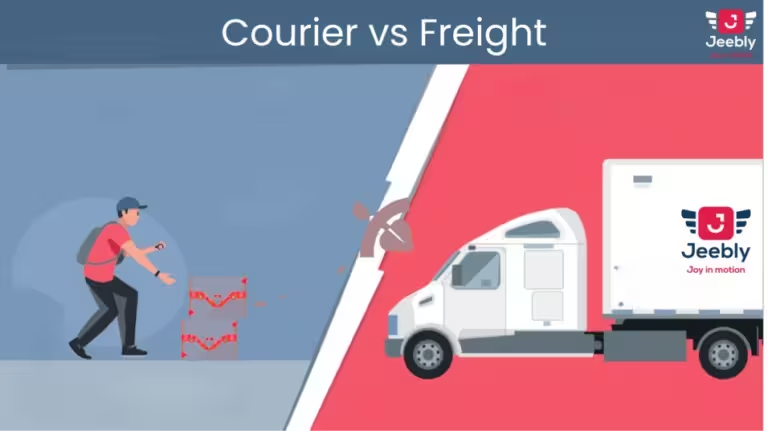
Brief Difference Between Courier and Air Freight

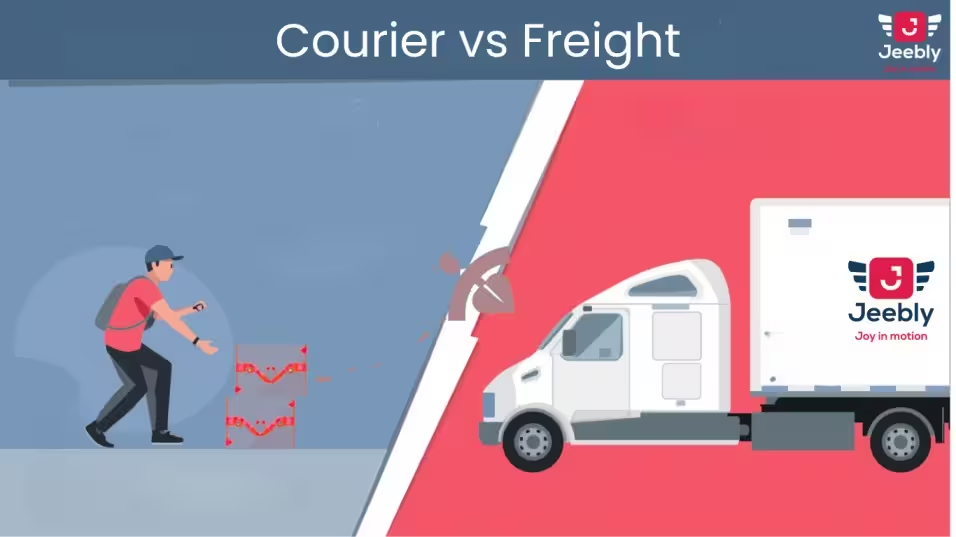
The two services are not substitutes for each other. They solve different problems at different weight thresholds.

* Courier services move individual parcels door-to-door, with real-time tracking and same-day or next-day delivery. Each shipment travels as its own tracked unit through the carrier’s network. The practical upper weight limit is 20 kg. Beyond that, handling individual parcels becomes operationally infeasible.

* Freight moves bulk cargo by truck, air, or sea. Shipments are consolidated by weight, volume, and route. The economics only work at scale: above 20 kg, or when dimensions exceed 100 x 50 x 50 cm. Freight is also the default for cross-border trade, where customs clearance and multi-modal routing come into play.

Using a courier for your UAE e-commerce deliveries? Jeebly Dash offers same-day, next-day, and express delivery across all seven emirates, with built-in COD support.

Courier vs Freight: A Side-by-Side Comparison

Across the wider region, the split between two services is already visible in how shipments move: domestic deliveries accounted for 64.81% of the GCC courier, express, and parcel market in 2025. 

This is why courier networks are so central for local parcel movement, while freight takes over as weight, route complexity, and cross-border handling increase.

The table below compares both services across the variables that matter most for shipping decisions in the UAE.

Factor Courier Freight
Weight range Up to 20 kg 20 kg and above
Delivery speed Same day, next day, express (60–120 min) 1 to 10+ business days
Tracking Real-time, per-shipment updates Milestone tracking
Cost basis Per shipment / flat or per-kg rate Weight, volume, and route
COD support ✓ Yes ✕ No
Cross-border Limited Full GCC and international
Best for E-commerce, documents, parcels Bulk cargo, imports/exports
Booking App or self-service platform Custom quotation

8 Things That Determine Whether You Need Courier or Freight

Most shipping mistakes happen because senders focus on price before asking the right questions. These eight factors tell you which service is the best fit before you request a single quote.

1. Shipment Weight Is the First Filter

Here’s an operational boundary to follow:
* Under 20 kg: courier. 
* Over 20 kg: freight.

Courier networks are built for handling individual parcels. Above 20 kg, that infrastructure cannot manage the load efficiently, and costs reflect it. 

For example, Jeebly Dash handles up to 7 kg at a fixed rate (AED 17.31 for next-day delivery for the first 5 kg), with per-kg pricing above that. Jeebly Haul applies to shipments exceeding 20 kg or 100 x 50 x 50 cm in dimensions

2. Parcel Dimensions Can Override Weight

A shipment might be under 20 kg but still qualify as freight if it exceeds standard parcel dimensions. 
Oversized items like long pipes, display equipment, and custom-built fixtures cannot pass through a courier’s parcel-sorting and routing system, regardless of weight. 

Always check dimensions alongside weight when deciding.

3. Delivery Urgency Determines Your Options

Speed is no longer a niche requirement. In the GCC, express services accounted for 33.20% of the market in 2025, indicating that demand has shifted toward faster fulfilment windows for parcel shipments. 

Courier services offer same-day, next-day, and express delivery. In Dubai, express delivery can move a package in 60 to 120 minutes. Freight transit times start at 1 day for domestic road freight and increase from there for international modes. 

If the shipment has a hard same-day deadline, freight is not on the table.

4. Destination Affects Which Service Applies

Within the UAE, couriers handle next-day delivery across all seven emirates. Express (sub-two-hour) is available only in Dubai. For cross-border shipping to Saudi Arabia, Oman, Kuwait, or beyond the GCC, freight is the only structured option. 

International courier services exist but are more expensive than air or road freight for anything over a few kilograms.

Shipping heavy cargo across the GCC? Jeebly Haul covers road freight across the GCC, air freight for international trade, and ocean freight, all with customs clearance included.

5. COD Requirement Points You Toward Courier

COD (cash on delivery) is a courier function. Freight services operate on an invoice-based billing cycle. If your business collects cash at the door from end customers, the transaction is handled by a courier rider rather than a freight driver. In the UAE, COD is deeply embedded in B2C e-commerce. It is a capability you need to confirm before choosing a logistics partner.

For a deeper look at how COD fits into e-commerce logistics in the UAE, see How Jeebly Helps SMEs Scale During Peak Shopping Seasons.

6. Temperature-Sensitive Goods Need a Specific Check

Temperature-controlled delivery (up to 15°C) is available as a courier service across all emirates. This covers pharmaceuticals, cosmetics, and certain food categories that need controlled conditions but not sub-zero storage. 

Two things to note: this is not a cold chain, and temperature-controlled international freight is not available. If your goods are temperature-sensitive and crossing a border, that is a hard constraint that needs to be confirmed before booking.

7. E-Commerce Integration Changes the Equation

For e-commerce businesses, courier selection is about the tech stack. When your Shopify, Magento, or WooCommerce store integrates with a logistics platform via API, orders automatically trigger pickup and dispatch. No manual entry, no delays between order and fulfilment. 

Freight does not plug into e-commerce platforms in the same way. If automated order flow matters, a courier with API integration is the right infrastructure. Jeebly’s technology platform connects directly to major e-commerce systems for exactly this reason.

8. Volume and Frequency Shape the Cost Logic

A business sending 10 parcels a day benefits from courier contract pricing and volume-based remittance cycles. A business restocking warehouse inventory from a supplier in China benefits from freight consolidation. 

The per-kg cost comparison between the two is irrelevant unless you’re comparing the same type of shipment. Compare courier rates for parcel volume against freight rates for cargo volume, not across categories.

If your business is scaling shipment volume, read What Is a 3PL: Third-Party Logistics for UAE Businesses to understand when a single logistics partner covering both courier and freight makes more operational sense.

How Courier Delivery Works End to End

You book through an app or self-service platform. The parcel is picked up, scanned into the carrier’s system, routed to the destination, and tracked at every stage. Delivery status updates go to both sender and recipient.

For e-commerce, the process is more automated. 
* Once your store is integrated with the logistics platform, an incoming order automatically alerts the warehouse team and triggers dispatch. 
* The customer gets real-time delivery updates. 
* COD collected at the door is remitted to the merchant’s bank account on a weekly cycle. 
* Proof of delivery is a photo uploaded by the rider at handover.

Courier services in the UAE make around three delivery attempts before an order is marked as return-to-origin (RTO). That retry structure matters for businesses with high first-attempt failure rates, particularly in areas with access or availability issues.

How Freight Shipping Works End to End

Freight starts with a quotation. 

* You submit shipment details such as weight, dimensions, origin, destination, and handling requirements, and the provider calculates the cost based on the transport mode and route. 
* The booking is confirmed before collection, unlike courier services, where the pickup can happen the same day.
* Once in transit, cargo follows planned routes, with milestone tracking at key checkpoints. 
* For cross-border shipments, customs clearance is handled at the origin and destination, and the freight provider typically coordinates the required documentation.

Jeebly Haul covers this end of the logistics chain, cargo above 20 kg, road freight across the GCC, air freight for international trade, and ocean freight for high-volume imports and exports, with customs clearance built in.

UAE-Specific Factors That Change the Decision

The UAE logistics market has some specific characteristics that shape how courier and freight services operate here.

1. Infrastructure quality. 
In the World Bank’s 2023 Logistics Performance Index, the UAE ranked 7th globally, placing it among the world’s strongest logistics systems. This reinforces why senders here can realistically choose between high-speed courier and more structured freight options.

2. Inter-emirate courier coverage is not uniform. 
Express delivery (60 to 120 minutes) is available only within Dubai. Next-day delivery is available across all seven emirates. Confirm coverage for the specific destination before assuming a courier service can deliver on your timeline.

3. Free zone warehousing adds a step. 
For freight moving into or out of the UAE free zones, a gate pass from the client is required. This is a hard operational requirement and affects inbound logistics planning.

4. The hybrid model is common. 
Most UAE businesses that operate at scale use both services for different purposes: courier for customer-facing e-commerce deliveries, freight for supplier restocking and cross-border inventory movement. 

Need both courier and freight under one roof? Jeebly’s service lines cover the full chain: Jeebly Dash for same-day and next-day parcel delivery, Jeebly Haul for cargo and freight. One platform, one integration.

Talk to the team to map the right setup for your volume and zones.

Frequently Asked Questions

Courier handles individual parcels up to 20 kg with door-to-door delivery, real-time tracking, and same-day or next-day speed. Freight handles bulk or heavy shipments above that threshold using trucks, aircraft, or vessels, with longer transit times and quote-based pricing.

Standard courier services handle up to 20 kg. Beyond that weight, or if dimensions exceed 100 x 50 x 50 cm, the shipment requires a freight quotation. Sending oversized cargo through a courier network typically results in rejection.

Courier is faster for individual shipments. Express delivery in Dubai can move a package in 60 to 120 minutes. Domestic freight starts at one business day and increases significantly for international modes.

For shipments above 20 kg, freight is generally more cost-efficient per kilogram. Courier pricing reflects the cost of individual handling, speed, and door-to-door service. That premium is justified for small, time-sensitive parcels.

Yes. Jeebly Dash covers same-day and next-day parcel delivery across all seven emirates. Jeebly Haul covers cargo and freight for shipments above 20 kg, including road freight across the GCC, air freight, and ocean freight with customs clearance.

Categories
blogs

Ways To Reduce Last-Mile Delivery Costs

How to Reduce Last-Mile Delivery Costs in the UAE (2026 Guide)

How to Reduce Last-Mile Delivery Costs in the UAE: A Practical Guide for Business Owners

How To Reduce Last Mile Delivery Costs

Last-mile delivery is the most expensive part of your supply chain — and for most UAE businesses, it’s also the least optimised.

The final leg from warehouse to customer door accounts for 53% of total shipping costs on average. In the UAE, where customer expectations for same-day and next-day delivery are set by Amazon and noon, the pressure to absorb those costs is only growing.

The good news: the businesses winning on logistics in the UAE are not spending more. They’re structured differently. This guide covers exactly what they do — and where Jeebly fits into that equation.

Why Last-Mile Costs Are Higher in the UAE Than You Think

Before the fixes, it’s worth understanding what’s actually driving the costs. UAE last-mile operations face a specific set of compounding pressures:

Failed first-attempt deliveries are a significant cost multiplier. Every re-delivery attempt adds driver time, fuel, and vehicle wear — with zero additional revenue. Failed attempts are more common when customers are unreachable, addresses are imprecise, or delivery windows don’t match customer schedules.

Inter-emirate routing complexity means a next-day delivery from Dubai to Ras Al Khaimah or Umm Al Quwain is not a simple extension of your Dubai operation. Road time, driver allocation, and fuel costs change substantially across the seven emirates.

Seasonal demand spikes, Ramadan, White Friday, Eid, Dubai Shopping Festival — create volume surges that manual operations cannot scale to absorb efficiently. Overstaffing during normal periods wastes money. Understaffing during peaks loses orders and damages customer trust.

COD reconciliation overhead adds administrative cost that purely digital markets don’t face. Cash-on-delivery remains standard in UAE last-mile; collecting, reconciling, and remitting it takes time and process.

Fix these structural issues and the cost reduction follows. Here’s how.

5 Proven Ways to Reduce Last-Mile Delivery Costs in the UAE

1. Switch from in-house delivery to an outsourced last-mile partner

This is the highest impact decision most UAE SMEs and e commerce brands can make, and the one most delayed because it feels like a loss of control.

The economics are straightforward. Building an in house delivery operation in Dubai means vehicle leasing or purchase, driver hiring and training, fuel management, insurance, maintenance, and a dispatch team. These are fixed costs you carry whether you ship 50 orders a day or 500.

A last mile partner converts all of that into a variable cost. You pay per delivery. When volume drops, your cost drops. When volume spikes, the partner absorbs the capacity, without you hiring additional drivers or leasing more vehicles.

For businesses shipping fewer than 500 orders a day, outsourced last mile is almost always cheaper than in house when total cost of ownership is calculated correctly.

Jeebly’s next-day delivery across all seven emirates is priced at AED 17.31 per shipment up to 5 kg, a flat rate that covers the full UAE network with no zone surcharges. For same day delivery within Dubai, Jeebly Dash operates with a cut off at 11 AM. That’s a fixed, predictable cost per order that you can model directly into your unit economics.

Explore Jeebly’s delivery services →

2. Optimise delivery routes with real-time intelligence

Manual routing — assigning drivers to zones and trusting them to navigate, is one of the most consistent sources of avoidable cost in UAE last mile operations.
AI-driven route optimisation does several things manual routing cannot:

* Accounts for UAE-specific variables: prayer time windows, mall traffic during sale seasons, inter-emirate road differences, and temperature-driven delivery window constraints in summer
* Dynamically re-routes when traffic conditions change mid-shift
* Sequences deliveries to minimise backtracking and unnecessary kilometres
* Reduces first-attempt failure rates by pairing smarter windows with proactive customer communication

Route optimisation technology has been shown to reduce travel time and fuel costs materially for logistics operations. The gains compound: fewer kilometres means lower fuel spend, lower vehicle wear, and more deliveries per driver per shift.
Jeebly’s platform uses automated routing and dispatch built into the Jeebly One app, with real-time tracking visible to both the business and the customer.

3. Reduce failed delivery attempts with proactive communication

A failed delivery attempt is a hidden tax on your last-mile operation. The direct cost is the re-delivery. The indirect cost is the customer experience damage and the administrative overhead of rescheduling.

In the UAE, failed attempts are disproportionately caused by:

* Customers not home during the delivery window
* Imprecise addresses (a persistent challenge outside Dubai’s well-mapped urban grid)
* No advance notice given to the customer

The fix is systematic, not heroic. Proactive SMS or push notification before arrival, real-time tracking links shared with customers, and digital proof of delivery (photo) reduce failed attempts and eliminate disputes.

Jeebly provides real-time delivery status updates at every stage and digital proof of delivery as standard, not an add-on.

4. Store inventory closer to your customers

If your fulfilment centre is in one location and a significant portion of your orders ship to customers across multiple emirates, you are paying for distance on every order.

Micro-fulfillment centres, smaller, strategically located dark stores closer to end customers — are the structural answer to this. They reduce last-mile distance, enable faster delivery windows, and lower per-order fuel and time costs.

Jeebly operates seven Micro Fulfilment Centres (MFCs) across the UAE for select clients, enabling 10-minute delivery within covered zones. Businesses that store inventory at Jeebly’s fulfilment centres in Dubai, Abu Dhabi, and Sharjah gain network proximity without leasing or managing the space themselves.

Talk to Jeebly about fulfillment centre access →

5. Automate dispatch, order management, and COD reconciliation

Manual order processing is where errors, delays, and labour costs accumulate invisibly. Every order that requires a human to read it, assign it, and log it is an order that costs more than it should.

Direct integration between your e-commerce store and your logistics platform eliminates this layer entirely. Orders placed on Shopify, Magento, or WooCommerce flow automatically into the dispatch system — no manual entry, no transcription errors, no delay between order confirmation and dispatch trigger.

COD reconciliation — a uniquely UAE overhead — is handled automatically when your logistics partner provides a live dashboard with COD amounts, delivery status, and weekly remittance built in.

Jeebly integrates directly with Shopify, Magento, WooCommerce, and custom APIs. The live dashboard shows order status, COD pending remittance, delivery tracking, and invoices in one place. Weekly COD remittance is standard.

What This Looks Like in Practice: The Jeebly Cost Model

For a UAE e-commerce business shipping 200 orders per day, the cost comparison between in-house delivery and outsourcing to Jeebly typically looks like this:


Cost elementIn-house estimateJeebly
Per-delivery cost (next-day, up to 5 kg)AED 25–40+ (blended, including fixed costs)AED 17.31 flat
Inter-emirate coverageRequires separate arrangementsAll 7 emirates included
Same-day capabilityRequires dedicated fleetJeebly Dash, Dubai
COD remittanceManual, internal overheadWeekly, automated
Returns handlingManual, unstructuredDoorstep QC, return-to-warehouse
E-commerce integrationCustom build requiredShopify, Magento, WooCommerce, API

The per-delivery gap alone — at 200 orders daily — represents a material cost saving before fixed overhead is accounted for.

The Most Expensive Mistake UAE Businesses Make on Last-Mile

Treating last-mile delivery as a fixed cost rather than a variable one.

Businesses that maintain in-house delivery fleets and teams carry those costs regardless of order volume. The margin compression is worst during slow periods — but the operational strain is worst during peaks, when the fixed infrastructure cannot scale fast enough without emergency spend.

The businesses reducing last-mile costs most effectively in the UAE are the ones that have converted their logistics from a capital-heavy fixed cost into a per-order variable cost — and reinvested the difference into growth. 

See how Jeebly works for UAE businesses like yours →

Ready to Reduce Your Last-Mile Costs?

Treating last-mile delivery as a fixed cost rather than a variable one.

Businesses that maintain in-house delivery fleets and teams carry those costs regardless of order volume. The margin compression is worst during slow periods — but the operational strain is worst during peaks, when the fixed infrastructure cannot scale fast enough without emergency spend.

The businesses reducing last-mile costs most effectively in the UAE are the ones that have converted their logistics from a capital-heavy fixed cost into a per-order variable cost — and reinvested the difference into growth. 

See how Jeebly works for UAE businesses like yours →

Download the Jeebly One app →

Frequently Asked Questions


For most SMEs and e-commerce businesses, outsourcing to a last-mile partner is cheaper than in-house delivery once all fixed costs are accounted for. Jeebly’s next-day delivery across all seven emirates is AED 17.31 per shipment up to 5 kg — a flat rate with no zone surcharges.


Proactive customer notification before arrival, real-time tracking links, and precise address capture at checkout reduce failed attempts significantly. Working with a logistics partner that provides digital proof of delivery and re-delivery management removes the overhead from your team.

Yes — and the economics are most favourable at smaller volumes, where the fixed cost of maintaining an in-house fleet is disproportionately high relative to order volume. Most UAE social sellers and SMEs using 3PL last-mile partners are growing businesses, not large enterprises.

Cash-on-delivery (COD) is standard in UAE e-commerce. It adds a collection and reconciliation layer to every delivery. A logistics partner with automated COD tracking and weekly remittance removes that administrative overhead — Jeebly handles COD collection and remits weekly with full documentation.


Basic operations — direct store integration and first delivery — are typically live within 2–4 weeks depending on integration complexity. Talk to the Jeebly team to map your specific setup.

    Powered by