






Jeebly | Logistics Solutions

Categories
blogs

What Is a Dark Store? How UAE Retailers Are Using Them for Ultra-Fast Delivery

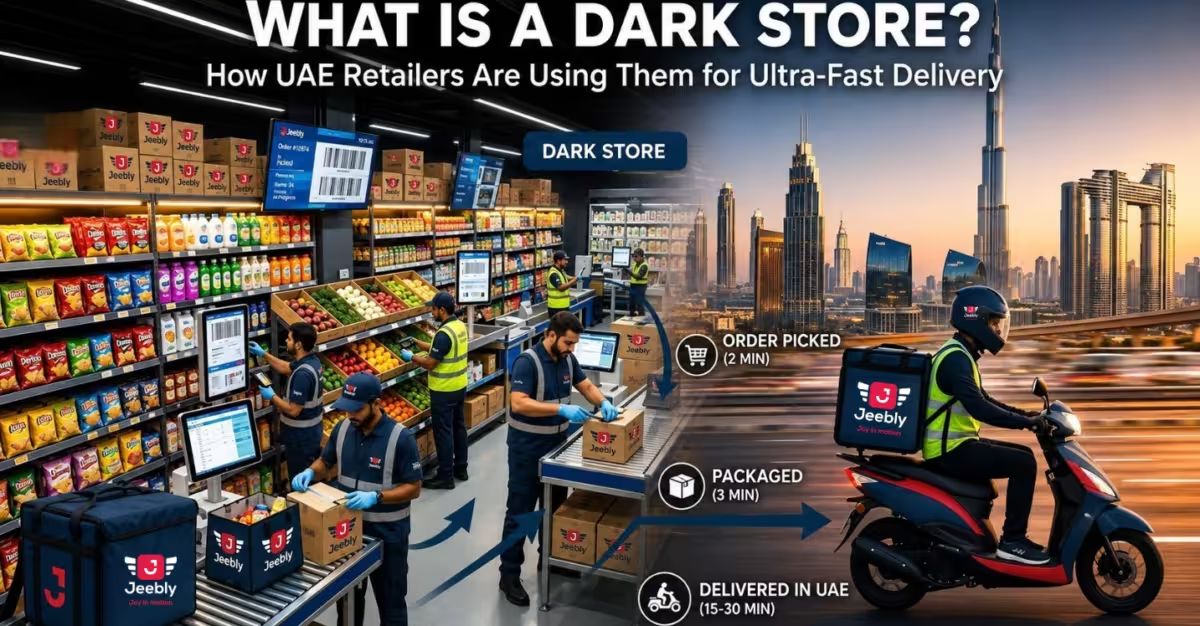
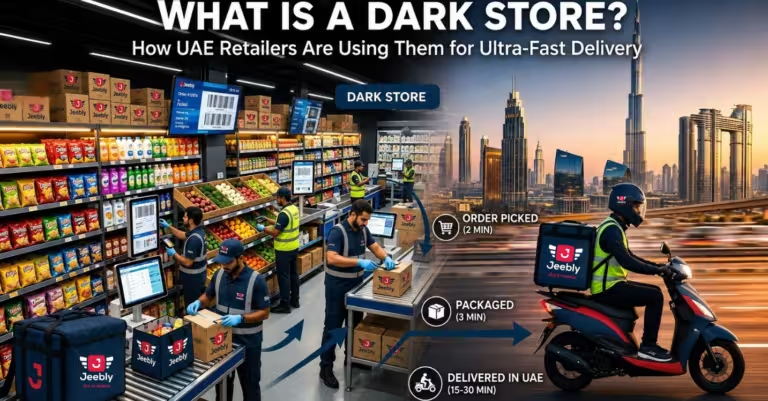
Dark store in the UAE showing retail inventory, order picking, packaging, and Jeebly last-mile delivery for ultra-fast fulfillment

What Is a Dark Store? How UAE Retailers Are Using Them for Ultra-Fast Delivery

A dark store is a fulfilment facility closed to the public, used exclusively to pick, pack, and dispatch online orders. No customers are walking in, no checkout lanes or retail displays. Just inventory, pickers, and a logistics operation built around getting orders out the door in minutes rather than hours.

In the UAE, dark stores are no longer experimental infrastructure. There are currently 211 dark stores mapped across the UAE, operated by Talabat Mart and Noon Minutes, spanning 10 cities. Noon alone scaled to 12 dark stores across Dubai and Sharjah, targeting zones with over 200 transactions per square kilometre per day. This is the operational foundation behind the 15-minute grocery promise that UAE consumers now treat as standard.

This guide explains what a dark store is, how it works, models operating in the UAE, what it takes to run one profitably, and how UAE e-commerce businesses can access dark store economics without building from scratch.

Key Takeaways

  • A dark store is a fulfilment facility closed to the public, dedicated entirely to picking and dispatching online orders.

  • Three models operate in the UAE: platform-operated dark stores (Talabat Mart, Noon Minutes), retailer-converted dark stores (Carrefour, Spinneys), and third-party micro-fulfilment (accessible to SMEs without capital investment).

  • The density threshold for a UAE dark store to be profitable is approximately 150–200 daily orders per location. Below that, last-mile economics don’t stack up.

  • By 2030, quick grocery is expected to account for 89% of online grocery in the UAE and KSA. Dark stores are the infrastructure that makes this possible.

What Is a Dark Store, Exactly?

A dark store is a retail or warehouse facility that operates exclusively for online order fulfilment. The “dark” refers to the absence of public foot traffic, such as shoppers, ambient lighting for the customer experience, or checkout counters. The space is configured entirely around operational efficiency, such as:

  • Shelving organised by pick frequency
  • Packing stations positioned to minimise walking distance 
  • Dispatch areas connected directly to courier routing systems

Dark stores emerged in the UK around 2009, when Sainsbury’s and Tesco converted underperforming retail locations into dedicated online fulfilment centres. What started as a supermarket efficiency play became the structural model for quick commerce globally.

How a Dark Store Works: The Order-to-Door Sequence

Step 1: Order placed. 

The customer places an order through an app. The dark store’s order management system receives it, confirms stock availability, and assigns it to the nearest available picker all within seconds.

Step 2: Smart slotting does the heavy lifting. 

High-velocity items (bottled water, snacks, cleaning products) sit closest to packing stations. This single discipline, called slotting optimisation, reduces picker travel time on every single order. 

Platforms deploy predictive inventory algorithms that pre-position high-velocity SKUs within 2–3 kilometres of dense residential clusters, thereby trimming delivery windows to 10 minutes.

Step 3: Picking. 

A picker follows a digital pick list along an optimised route through the facility. In high-volume dark stores, batch picking, i.e. grouping multiple orders into a single pick run, reduces total labour time without sacrificing accuracy.

Step 4: Packing and labelling. 

Items are packed, labelled, and sorted by delivery zone. Temperature-sensitive goods get appropriate packaging. The packed order is ready for handoff.

Step 5: Dispatch. 

The packed order connects to the courier routing platform in real time. A rider or driver collects it often within minutes of packing, and the customer receives tracking updates from the moment of dispatch.

The entire sequence, from order placement to rider departure, may typically run 3–8 minutes in an optimised UAE dark store.

Three Dark Store Models Operating in the UAE

Understanding the model matters before deciding whether to build, convert, or partner.

1. Platform-operated dark stores

App platforms operate the largest dark store networks in the UAE. Talabat Mart operates 30+ strategically located dark stores across all seven emirates, targeting sub-20-minute delivery guarantees. 

Noon Minutes runs its own dark store network, explicitly describing its compact “mini storeslocated near demand hubs to support 15-minute delivery. 

In 2025, ADNOC Distribution and Noon launched 15-minute delivery hubs from ADNOC service stations, turning fuel stations into logistics nodes.

These platforms own the customer relationship and the inventory. They’re not a fulfilment option for third-party brands. They’re vertically integrated competitors.

2. Retailer-converted dark stores

These are traditional retailers converting existing space into dark fulfilment operations. Carrefour UAE, Spinneys, and Choithrams all operate some form of this, using store backrooms, closed retail locations, or dedicated satellite sites to fulfil online orders faster than a central warehouse can.

This model suits retailers who already have urban real estate and established supply chains. The capital requirement is lower than that of building from scratch, but the operational transformation is significant. Retail layouts are not optimised for pick efficiency.

3. Third-party micro-fulfilment (the SME access point)

It is the most accessible model for UAE businesses without retail footprints or platform-scale capital. Third-party logistics providers operate shared micro-fulfilment centres that multiple brands can access without having to build their own infrastructure.

This is where the economics become accessible. Rather than committing to a 100,000+ sq ft dark store lease and the technology stack to run it, an SME or mid-market e-commerce brand can plug into an existing micro-fulfilment network, access urban proximity delivery, and pay on a per-order or per-storage basis.

For UAE e-commerce businesses and social sellers wanting same-day delivery capability without a dark store build, eCommerce Fulfilment in the UAE: What Businesses Should Look For covers the full range of fulfilment options and the cost per order for each.

What Makes a UAE Dark Store Profitable

Platform operators are prioritising density thresholds of 150–200 daily orders per dark store. Below that threshold, the fixed costs of the facility, staff, and inventory don’t spread across enough orders to generate margin. Above it, the economics may compound rapidly.

What can drive dark store profitability in the UAE:
Factor What it requires
Location density Within 2–3 km of residential clusters with 200+ daily orders per km²
SKU curation 1,000–5,000 fast-moving products, not a full supermarket range
Order frequency Subscription models (Talabat Pro, Noon One) that drive repeat orders
Technology Real-time OMS connected to courier routing, no manual handoff
Last-mile reliability 95%+ first-attempt delivery in the coverage zone
Inventory accuracy Daily cycle counts, zero tolerance for phantom stock
What kills the economics:

Overexpansion before density can kill the economics. A dark store in a zone with 80 daily orders will burn cash indefinitely. The facility’s fixed costs are never covered. Urban density in Dubai and Abu Dhabi makes last-mile economics workable in a way that sprawling or low-density cities do not. This is why UAE dark stores succeed where other markets struggle.

A high delivery radius without enough riders is another factor. If a dark store covers too large a geographic area, average delivery time increases, costs rise, and the speed promise breaks down.

Additionally, dark stores run lean SKU counts precisely because every SKU that doesn’t turn fast enough occupies space that could hold a fast-mover. Getting the assortment wrong is expensive.

Should Your Business Use a Dark Store?

Dark stores are right for a specific business profile. Here’s a framework for deciding:

It makes sense if:

  • You sell fast-moving consumer goods like grocery, pharmacy, personal care, convenience
  • Your customers are in dense urban zones (Dubai, Abu Dhabi, Sharjah)
  • You’re receiving more than 50–100 same-day delivery orders daily in a concentrated area
  • You want to offer sub-hour delivery without the cost of a full last-mile delivery fleet


It doesn’t make sense if:

  • Your products are slow-moving, large, fragile, or temperature-controlled beyond standard refrigeration
  • Your customer base is geographically spread across multiple emirates with different demand profiles
  • Your daily order volume is below the density threshold to justify the infrastructure cost

For most UAE SMEs and mid-market e-commerce brands, the most cost-effective path to dark store economics is third-party micro-fulfilment. This accesses urban proximity and fast dispatch through an existing network rather than building one.

For businesses evaluating whether their current fulfilment setup is causing delivery delays that are costing them cart abandonment, How to Reduce Cart Abandonment Costs covers how delivery speed and transparency directly affect checkout conversion and more.

How Jeebly Supports Dark Store and Ultra-Fast Fulfilment

For UAE businesses wanting same-day delivery capabilities without the capital investment of building a dark store from scratch, Jeebly Bizz provides the fulfilment infrastructure: warehousing across Dubai and the UAE, pick-and-pack, automated dispatch, and real-time inventory management, all connected directly to Shopify, WooCommerce, and Magento.

Jeebly Dash handles the last-mile leg with express delivery within 60–120 minutes across Dubai, next-day across all seven emirates, with 98% FDSS across 50,000+ daily deliveries. Jeebly’s platform automatically connects order completion to rider dispatch.

For businesses with inbound freight needs, Jeebly Haul covers road and air freight, as well as cross-border GCC routes, with in-house customs clearance.

Talk to the Jeebly team about your current daily order volume, delivery zone, and product category. A direct conversation will confirm whether third-party micro-fulfilment through Jeebly Bizz provides the dark-store economics your business needs at the scale it operates today.

Conclusion

A dark store is the infrastructure behind every 15-minute grocery delivery and every same-hour order in the UAE. With 211 Talabat Mart and Noon Minutes dark stores mapped across the UAE, alongside a growing number of retailer-converted dark fulfilment locations, and a quick commerce market set to reach $12.97 billion by 2029, this is no longer an experimental format.

It’s the structural model for urban retail fulfilment in the region. 

For large platforms, the dark store network is built and scaling. For UAE e-commerce businesses and retailers that want the same delivery economics without the capital outlay, third-party micro-fulfilment networks provide access to urban proximity and fast dispatch on a per-order basis. 

For same-day fulfilment connected to 98% FDSS last-mile delivery, Jeebly Bizz and Jeebly Dash cover both legs. Get in touch to discuss your fulfilment requirements.

Related Articles:

Frequently Asked Questions

A dark store is a warehouse or converted retail space used exclusively to fulfil online orders. It’s closed to the public and optimised entirely for picking and dispatching individual orders as fast as possible. In the UAE, dark stores power the 15–30 minute grocery delivery services from Talabat Mart and Noon Minutes.

A warehouse stores goods for extended periods before bulk distribution to retailers or other businesses. A dark store holds a smaller, faster-moving inventory specifically to fulfil individual consumer orders within 15–60 minutes. Dark stores are urban, compact, and optimised for speed. Warehouses are typically larger, suburban, and optimised for bulk storage and distribution.

Talabat Mart operates 30+ dark stores across all seven UAE emirates for sub-20-minute delivery. Noon Minutes operates 12 dark stores across Dubai and Sharjah. Together, these two platforms account for the 211 dark stores currently mapped across the UAE. Carrefour, Spinneys and Choithrams also operate dark fulfilment equivalents from existing retail locations, but these fall under the retailer-converted model.

Fast-moving consumer goods with high daily turnover: groceries, personal care, household essentials, pharmacy items, and convenience goods. Dark stores stock 1,000–5,000 curated SKUs, not a full product range. Slow-moving, bulky, or highly perishable goods with complex cold-chain requirements are typically not suitable for dark-store stocking.

Yes, through third-party micro-fulfilment. Logistics providers operate shared urban fulfilment centres that multiple brands can access on a per-order or per-storage basis, without committing to a dark store lease or building a technology stack from scratch. This is the accessible entry point for UAE SMEs wanting same-day delivery capability.

Routes to insightful reads

How to get an eCommerce licence in the UAE, showing five steps from selecting a business structure and trade name to submitting the application, paying fees, and obtaining the licence
How to Get an eCommerce Licence in the UAE

Planning to start an eCommerce business in the UAE? Learn how to get an eCommerce licence, choose between mainland and free zone options, prepare the required documents, submit your application, and complete the licensing process to start trading legally in the UAE.

Read More
BNPL in the UAE and its impact on ecommerce delivery and returns, showing the transaction cycle, faster fulfilment, order frequency, real-time tracking, and streamlined returns
Buy Now Pay Later in the UAE: What BNPL Means for eCommerce Delivery and Returns.

Buy Now Pay Later (BNPL) is changing how consumers shop and how eCommerce businesses manage fulfilment and returns in the UAE. This guide explores how BNPL can influence order volumes, delivery demand, fulfilment operations, return rates, refund processing, and the logistics strategies businesses need to support a growing BNPL-driven customer base.

Read More
Infographic explaining how to calculate volumetric weight for shipping, including the formula, measurement example and comparison between actual and chargeable weight.
How to Calculate Volumetric Weight for Shipping: Formula and Examples

Learn how to calculate volumetric weight for shipping with an easy-to-follow formula and practical examples. Understand how package dimensions, actual weight and carrier conversion factors determine the chargeable weight and ultimately impact your shipping costs.

Read More
3PL vs 4PL logistics comparison showing warehousing, transportation, distribution, supply chain integration, technology, analytics, and strategic planning for UAE businesses
3PL vs 4PL: What Is the Difference and Which Does Your UAE Business Need?

3PL and 4PL logistics models help businesses manage different levels of supply chain operations. This guide explains the key differences between 3PL and 4PL providers, their roles, benefits, costs, and how UAE businesses can choose the right logistics model based on their size, supply chain complexity, and operational needs.

Read More
Types of packaging for courier shipments, showing outer packaging strength, void-fill options, cushioning materials, and sealing and labelling methods
Types of Packaging for Courier Shipments: Which One Best Protects Your Product?

Choosing the right packaging is essential for protecting products during courier transportation. This guide explores different types of packaging for courier shipments, including corrugated boxes, bubble wrap, air pillows, paper fillers, foam inserts, and protective seals, and explains how to choose the best option based on your product, handling needs, and shipping conditions.

Read More
Categories
blogs

How Long Does Delivery Take in UAE? Timelines by Service Type

How Long Does Delivery Take? Realistic Timelines by Service Type

How Long Does Delivery Take? Realistic Timelines by Service Type

Delivery times in UAE depend on the service: same-day delivery takes 2–4 hours within the same emirate. Next-day is delivered by the following morning. Economy takes 3–5 business days. International shipments vary by destination.

Every business shipping in the UAE asks the same question at some point: how long does delivery take? Well, globally, the trend is positive. 
Much in the world of e-commerce has changed since the beginning of the pandemic. Average parcel delivery speed has accelerated by about 40%, going from 6.6 days in the first quarter of 2020 to 4.2 days in the second quarter of 2023.

The difference between a good carrier and a great one becomes visible exactly when conditions get difficult: during peak seasons, on cross-emirate routes, or when a COD customer is not home, and more.

This article breaks down delivery timelines by service type, explains what makes the UAE logistics environment distinct, and covers what businesses can do to move faster and more reliably.

What Determines How Long a Delivery Takes

Delivery time is not a single variable. It is the cumulative result of every handoff from order placed to parcel in hand. Businesses that understand each stage can identify exactly where time is being lost and where to intervene.

* Order processing is the most underestimated stage. The merchant confirms, picks, and packs the order before it goes anywhere. Well-run e-commerce operations handle this in a few hours. Manual workflows can stretch it to 24 hours or more.
*  Dispatch and carrier handoff is where cut-off times matter. Same-day and express services run on tight windows. Miss the cut-off, and the order rolls to the next available slot, regardless of how fast the carrier’s network runs.
* Transit covers the movement through the carrier’s network. Domestic UAE shipments typically move within one to three business days. 
Cross-emirate routes often resolve same-day or next-day with the right service tier.
* Last-mile delivery is the final leg of the journey from a local hub to the customer’s address. It is also where most UAE-specific delays originate.
* Customs clearance applies only to international orders, adding 2 to 5 business days to domestic transit. During Ramadan and Eid, that window can extend further.

Expected UAE Delivery Timelines by Service Type

The UAE now supports a full spectrum of delivery speeds, from hyperlocal sub-hour drops to standard two- to three-day domestic shipping. Choosing the right tier for your product category and customer base is a commercial decision.

Here are the estimated timelines based on how the UAE delivery infrastructure actually performs:

Service Type Typical Timeline Coverage Key Condition
Express 60–120 minutes Dubai Weight and dimension limits apply
Same-day Within the day Dubai Order confirmed by 11 AM cut-off
Next-day Following the business day UAE-wide Order confirmed by 4 PM cut-off
International/cross-border 3–7+ business days Global Subject to customs clearance

Unsure which delivery tier fits your business model? Explore Jeebly Dash, which provides express, same-day, and next-day delivery built for the UAE.

Why UAE Delivery Works Differently

Several structural features of the UAE market shape last-mile performance in ways that no global playbook accounts for.

1) Address system 
The UAE does not use a standardized postcode system. Deliveries rely on a combination of area names, building names, GPS coordinates, and landmarks. Many of these change or are inconsistently named across different mapping platforms.

2) Free zones 
Areas like JAFZA, DAFZA, and Dubai Silicon Oasis operate under their own customs and access rules. Businesses delivering into or out of free zones need a logistics partner who understands both documentation requirements and geography. 
Jeebly Bizz handles exactly this, like cross-border logistics and customs clearance with compliance built in, not bolted on. See how Jeebly Bizz works.

3) Cash on Delivery (COD) 
COD delivery introduces a payment exchange at the point of delivery. If the customer is unavailable, the order is returned to the hub and restarted. Businesses with high COD volumes benefit disproportionately from carriers with strong pre delivery notification systems.

4) Peak season demand 
Ramadan, Eid, White Friday, and National Day create demand surges. Without dynamic route optimisation and prepositioned inventory, effective transit times can double. Reactive planning at the start of peak season is almost always too late.

Late deliveries costing you customers? Learn how reliable last-mile delivery works at scale. Here’s a quick read on Courier vs Freight — Key Differences Explained.

Six Operational Decisions That Reduce Delivery Time in UAE

Speed and reliability do not always require switching carriers. Several decisions within your operational control directly affect how quickly and consistently orders reach customers.

1) Invest in address validation at checkout. Incomplete or ambiguous addresses are the single largest cause of failed first-attempt deliveries in the UAE. A GPS pin confirmation at checkout reduces failed attempts and the resulting rescheduling delay.

2) Display order cut-off times prominently. Same-day and next-day delivery only work when customers know the window exists. Bury the cut-off time in the FAQ, and customers will expect delivery that is not operationally possible.

3) Match your service tier to your product category. Not every product needs express delivery, and not every category can absorb the higher failed-attempt rates that come with COD orders. Assess your delivery satisfaction data and calibrate accordingly.

4) Pre-position inventory before peak seasons.
Ramadan and Eid require two to three weeks of lead time to move stock closer to demand. Businesses that plan around the seasonal calendar with their logistics partner consistently outperform those that react to the surge after it starts.

5) Enable real-time tracking notifications. Proactive delivery updates reduce “where is my order?” queries and, critically, increase the likelihood that the customer is available when the rider arrives. This directly reduces failed-attempt rates.

6) Choose a carrier with UAE-specific routing intelligence. Global carriers apply generic mapping systems to a market that requires local knowledge: landmark-based navigation, free zone access protocols, and district-level traffic patterns that shift significantly by time of day and season.

Already shipping at volume and want to benchmark your current setup? Explore Jeebly’s business logistics solutions to see where the gaps are.

Conclusion

How long delivery takes in the UAE comes down to three things: who handles the shipment, how well they know the local operating environment, and whether their technology is built for consistency at scale. Businesses that treat logistics as a strategic lever consistently outperform those that treat it as a commodity vendor relationship.

Jeebly operates 50,000+ daily deliveries across a fleet of 4,000+ vehicles, achieving a 98% FDSS (First Day Delivery Success) rate through its range of services, such as Jeebly Bizz and Jeebly Haul.

Get in touch with the Jeebly team to build a delivery setup that meets your customers’ expectations.

Frequently Asked Questions

Same-day delivery in Dubai is typically completed within a few hours of pickup, depending on the service selected, distance, traffic conditions, and order processing time. Many providers offer delivery windows ranging from a few hours to the end of the same business day.

Delivery between Dubai and Abu Dhabi is often completed on the same day or the next business day, depending on the courier service and pickup schedule. Express services may offer faster delivery times, while standard services can take longer.

The fastest delivery options in the UAE are on-demand and express courier services. Depending on the provider and location, deliveries can be completed within 60 minutes to a few hours, making them ideal for urgent shipments and time-sensitive orders.

International delivery times vary based on the destination country, customs clearance requirements, shipping method, and carrier. Express international shipments may arrive within a few business days, while standard international deliveries can take one to several weeks.

Economy delivery is designed as a cost-effective shipping option and typically takes longer than express services. Delivery times vary by destination and carrier, but economy shipments generally arrive within several business days for domestic deliveries and longer for international shipments.

Routes to insightful reads

How to get an eCommerce licence in the UAE, showing five steps from selecting a business structure and trade name to submitting the application, paying fees, and obtaining the licence
How to Get an eCommerce Licence in the UAE

Planning to start an eCommerce business in the UAE? Learn how to get an eCommerce licence, choose between mainland and free zone options, prepare the required documents, submit your application, and complete the licensing process to start trading legally in the UAE.

Read More
BNPL in the UAE and its impact on ecommerce delivery and returns, showing the transaction cycle, faster fulfilment, order frequency, real-time tracking, and streamlined returns
Buy Now Pay Later in the UAE: What BNPL Means for eCommerce Delivery and Returns.

Buy Now Pay Later (BNPL) is changing how consumers shop and how eCommerce businesses manage fulfilment and returns in the UAE. This guide explores how BNPL can influence order volumes, delivery demand, fulfilment operations, return rates, refund processing, and the logistics strategies businesses need to support a growing BNPL-driven customer base.

Read More
Infographic explaining how to calculate volumetric weight for shipping, including the formula, measurement example and comparison between actual and chargeable weight.
How to Calculate Volumetric Weight for Shipping: Formula and Examples

Learn how to calculate volumetric weight for shipping with an easy-to-follow formula and practical examples. Understand how package dimensions, actual weight and carrier conversion factors determine the chargeable weight and ultimately impact your shipping costs.

Read More
3PL vs 4PL logistics comparison showing warehousing, transportation, distribution, supply chain integration, technology, analytics, and strategic planning for UAE businesses
3PL vs 4PL: What Is the Difference and Which Does Your UAE Business Need?

3PL and 4PL logistics models help businesses manage different levels of supply chain operations. This guide explains the key differences between 3PL and 4PL providers, their roles, benefits, costs, and how UAE businesses can choose the right logistics model based on their size, supply chain complexity, and operational needs.

Read More
Types of packaging for courier shipments, showing outer packaging strength, void-fill options, cushioning materials, and sealing and labelling methods
Types of Packaging for Courier Shipments: Which One Best Protects Your Product?

Choosing the right packaging is essential for protecting products during courier transportation. This guide explores different types of packaging for courier shipments, including corrugated boxes, bubble wrap, air pillows, paper fillers, foam inserts, and protective seals, and explains how to choose the best option based on your product, handling needs, and shipping conditions.

Read More

    Powered by