





Jeebly | Logistics Solutions

Categories
blogs

 Delivery SLA Guide for UAE Businesses: What to Expect and How to Set Standards

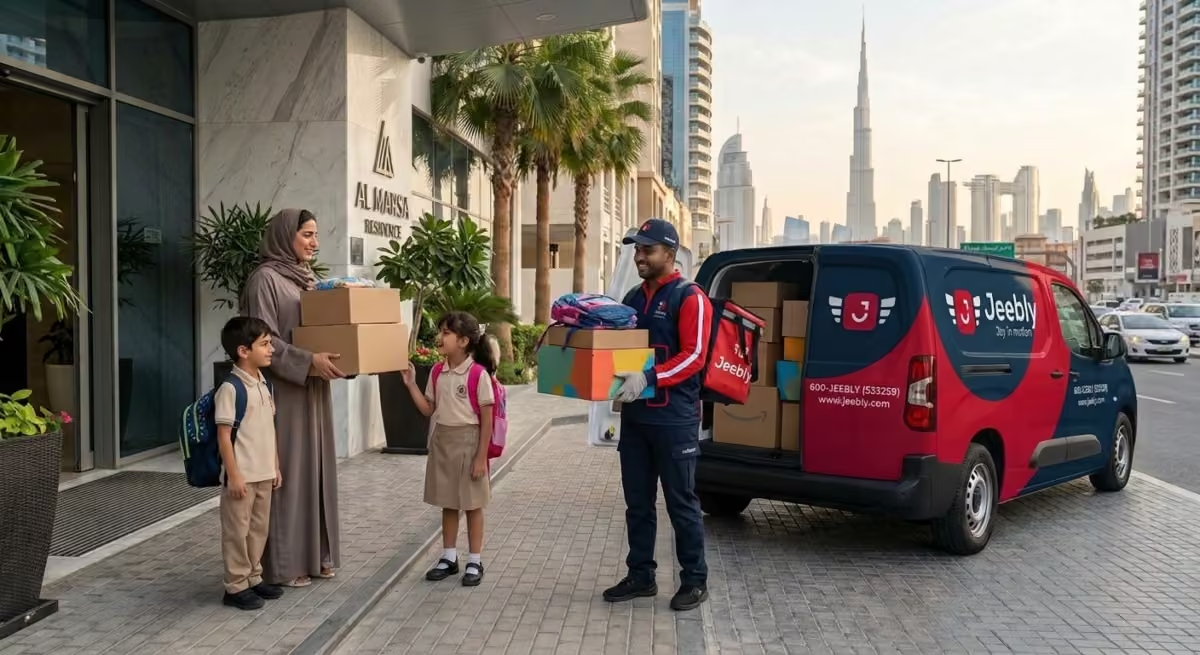
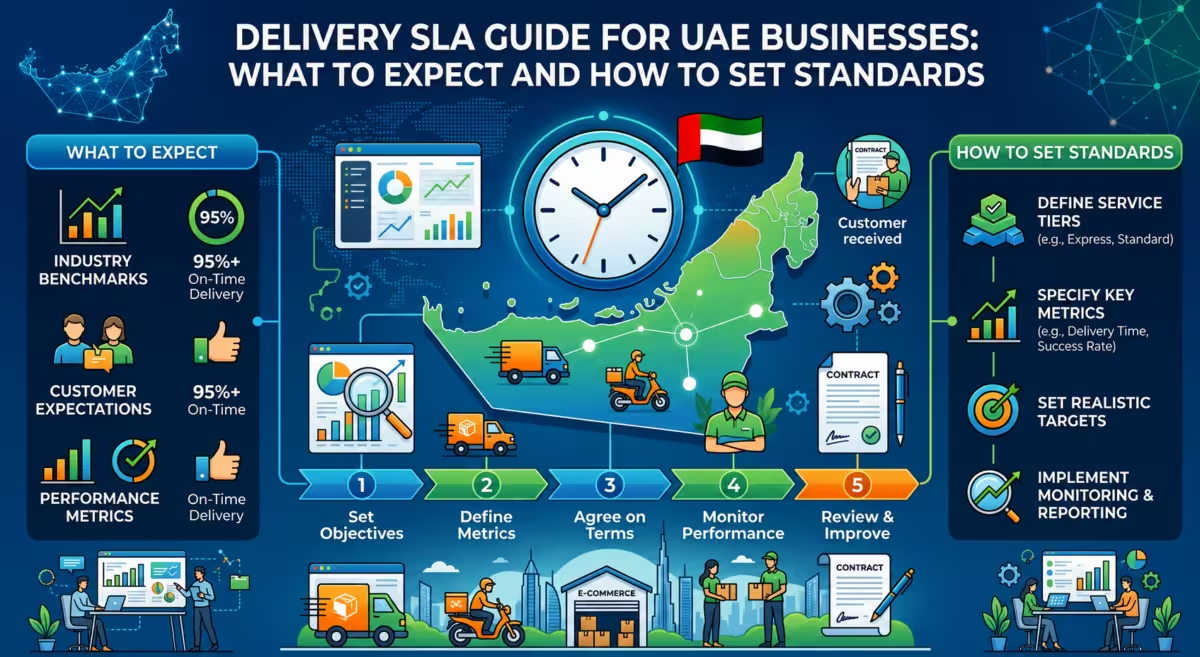
Delivery SLA guide for UAE businesses showing service level agreements, delivery performance metrics, on-time delivery targets and logistics standards.

Delivery SLA Guide for UAE Businesses: What to Expect and How to Set Standards

When your logistics partner for ecommerce misses a delivery window, the customer doesn’t blame the courier. They blame you.

A delivery SLA (Service Level Agreement) is the contractual structure that prevents that from happening, defines what good performance looks like, and specifies exactly what follows when it doesn’t. Without a delivery SLA, you’re managing logistics only on trust rather than on evidence.

This guide covers the specific metrics a delivery SLA must include for the UAE e-commerce sector, how to structure enforceable penalty clauses, and the UAE-specific risks every SLA should address.

Key Takeaways

  • A delivery SLA is a formal agreement that defines performance standards, metrics, and consequences for breaches between a business and its logistics partner.

  • SLA, SLI, and SLO are three distinct layers. When you blur them, SLAs quietly lose their enforcement power.

  • The five metrics every UAE delivery SLA must contain: OTD rate, FDSS rate, order accuracy, damage rate, and breach response time.

  • UAE-specific SLA requirements include COD failure handling, WhatsApp notification compliance, and seasonal capacity guarantees for Ramadan and White Friday.

  • A well-structured SLA specifies a 30-day corrective period when a carrier repeatedly fails to meet on-time delivery targets before cancellation rights are triggered. 

What Is a Delivery SLA and What It Does

A delivery SLA is a formal contract between a business and its logistics partner that defines what constitutes successful delivery, how performance is measured, and what happens when agreed standards aren’t met.

Three distinct layers make up a functional delivery SLA, and enforcement breaks down when the lines between them blur:

  1. An SLA (service level agreement) is a formal commitment between parties that defines expected performance. 
  2. An SLI (service level indicator) is the specific metric used to measure whether that commitment is being met. 
  3. An SLO (service level objective) is a numeric target for that metric.

Without all three, you have a promise, not a contract. “We’ll deliver as quickly as possible” is an SLA without an SLI or SLO. It’s unenforceable, unmeasurable, and useless when you need to dispute a performance failure.

The UAE-Specific Returns Challenge: COD Refusals

The KPIs inside your SLA are what separate a meaningful agreement from a formality. Vague language about “timely delivery” leads to disputes while numeric targets create accountability.

  1. On-Time Delivery rate (OTD): The percentage of orders delivered within the agreed window. This is the primary SLA metric for most e-commerce operations.

  2. First Day Delivery Success (FDSS): The percentage of orders delivered on the first attempt without a reattempt or return-to-origin. Failed first attempts can be expensive, with the failed-attempt cost plus the reattempt or RTO cost.

  3. Order accuracy rate: The percentage of orders fulfilled without error. Even a 1% error rate may translate to thousands of incorrectly shipped parcels, driving return costs, customer complaints, and wasted inventory space.

  4. Damage rate: The percentage of large and heavy parcel deliveries with damage attributable to handling or transit. Damage is a direct cost to the business: product write-off, replacement shipping, and the customer relationship.

  5. Breach response time: How quickly the logistics partner must acknowledge and escalate an SLA breach. This is the metric most SLAs omit, and it’s what determines whether a missed delivery is recoverable or a lost customer.

Before you negotiate an SLA with any UAE courier, benchmark their published performance against these targets. Best Courier Services in UAE: 2026 Comparison Guide covers rates, COD remittance cycles, and NDR management across the major operators.

UAE-Specific SLA Requirements Every Agreement Must Address

These are the clauses that matter most for businesses operating in the UAE market.

1) COD failure handling

When a customer refuses a COD parcel, the delivery fails, and the return-to-origin process begins. 

Your SLA should specify who bears the cost of the RTO, the timeline for the parcel to re-enter your inventory, and whether repeat COD refusals from the same address are automatically flagged to you.

2) WhatsApp notification compliance 

WhatsApp is the dominant customer communication channel in the UAE. An email-only delivery confirmation is insufficient for most UAE consumers. 

Your SLA should require, at minimum, one WhatsApp notification when the order is out for delivery and a delivery confirmation message with a photo ePOD link within 30 minutes of drop-off. 

What Is Contactless Delivery and How Does It Work in the UAE? explains how the notification and proof-of-delivery workflow connects end-to-end.

3) Seasonal capacity guarantees 

Ramadan, White Friday, and Eid create order volume spikes. SLAs should be dynamic. An agreement that was effective a year ago may no longer work today due to ecommerce growth. 

Write a specific capacity clause: “Provider commits to maintaining OTD and FDSS targets during periods where daily order volume increases by up to X% above the baseline 30-day average.”

4) Emirate-level coverage confirmation

“UAE-wide delivery” means different things to different providers. Northern Emirates (Ras Al Khaimah, Fujairah, Umm Al Quwain) carry different SLAs than Dubai and Abu Dhabi. Negotiate separate OTD targets by zone, or require the provider to flag explicitly where full SLA coverage doesn’t apply. 

Jeebly Dash, for example, publishes same-day delivery and 98% FDSS for Dubai operations. Next-day delivery to northern and eastern emirates operates under a separate OTD commitment. That’s the standard to apply when evaluating any UAE logistics provider.

5) Free zone and compound access

Many delivery failures in the UAE occur at the building access point due to free zone entry requirements, gated community permits, and building management restrictions. 

Your SLA should specify who is responsible when delivery fails because the courier couldn’t access the delivery location and outline the reattempt process.

How to Structure Breach Penalties and Performance Incentives

Penalty clauses in UAE commercial contracts are governed by Federal Law No. 18 of 1993 (Commercial Transactions Law). UAE courts can reduce penalties deemed disproportionate to the documented actual loss, meaning penalty amounts must be tied to verifiable costs rather than abstract figures.

Three penalty structures that work:

  • Per-incident fees: A fixed amount per order delivered outside the agreed window. This structure is simple, auditable, and proportionate.

  • Percentage credits: A percentage of the shipment value credited back when the delivery fails. More appropriate for high-value freight or B2B shipments, where individual parcel values vary significantly.

  • Cumulative threshold triggers: When OTD or FDSS falls below the agreed-upon minimum for a billing period, additional penalties or contract review rights are triggered. 

For example: if a carrier repeatedly fails to meet 95% OTD, the SLA may specify a 30-day corrective period during which performance must recover. If it doesn’t, cancellation rights are triggered.

What makes a penalty clause enforceable in the UAE:

  • The penalty amount is tied to a documented, verifiable cost (re-delivery fee, customer refund, support cost)
  • The breach is defined numerically, not descriptively
  • The measurement methodology is agreed in advance: which system provides the OTD data, how disputes are resolved
  • The escalation path is named: which contact at the logistics partner receives the breach notification, and within what timeframe

A Performance Incentive Clause Worth Adding

The penalty structure above protects you when performance falls short. A performance incentive clause creates a reason for your logistics partner to consistently exceed the target.

When OTD or FDSS consistently exceeds the agreed minimum over a defined period (typically a quarter), the carrier qualifies for a structured bonus or a fixed amount or percentage credit applied to the following period’s invoices. This converts the SLA from a penalty-only instrument into a partnership structure. Carriers operating under both mechanisms will have a commercial reason to over-perform.

To set penalty amounts that are proportionate to documented loss, you need your baseline per-delivery cost breakdown. Cost of Shipping for a Small Business in the UAE (2026) provides the cost structure to build defensible penalty figures against.

How to Monitor SLA Performance in Real Time

SLAs only function as control systems when teams can see risk early and act on it while there is still time to change the outcome. SLAs designed as operational systems rather than contractual artefacts align SLIs and SLOs with delivery realities. 

This embeds verification directly into workflows, and treats exceptions as early-warning signals rather than postmortems.

In practice, this means:

  • API integration between your OMS and the logistics platform: When order status, tracking events, and delivery confirmation flow automatically into your system, SLA monitoring is continuous rather than manual. You see a developing breach before it completes.

  • Exception dashboards, not monthly reports: SLA performance reviewed at month-end means you discover breaches weeks after they happened. An exception dashboard shows you in real time which orders are at risk of missing the window while there’s still time to intervene.

  • Automated breach notifications: When an order exceeds its delivery window without a confirmed delivery event, the system should automatically alert both your team and the logistics partner. The breach response clock starts at this notification.

Jeebly’s platform provides Jeebly Bizz customers with real-time OTD and FDSS tracking through the same dashboard that manages dispatch and returns. See how Jeebly’s technology infrastructure supports this before evaluating any other provider on SLA monitoring capability.

How Jeebly Structures Delivery SLAs

Jeebly’s core performance metric is 98% FDSS across 50,000+ daily deliveries. Providers who can’t share FDSS data probably have performance they can’t defend.

Jeebly Dash SLA structure for domestic delivery: same-day within Dubai with defined cut-off times; next-day across all seven UAE emirates; WhatsApp and SMS notifications at dispatch and delivery; photo ePOD at every drop-off. Published base rate AED 17.31 per parcel up to 5 kg.

Jeebly Bizz for businesses managing high-volume e-commerce: real-time dashboards; automated workflows that trigger customer notifications and reattempt scheduling without manual intervention; secure COD collection with weekly remittance; and returns managed through the same platform as forward delivery.

Jeebly Haul for freight: transit time commitments on road, air, and ocean freight routes, with exception escalation built into the platform rather than requiring a phone call.

For businesses currently operating without a formal SLA or with a vague agreement that doesn’t specify metrics, talk to the Jeebly team. 

Bring your current OTD and FDSS data, your daily order volume, and which emirates you cover. We’ll tell you what a Jeebly SLA looks like against your current performance and what the gap is.

Frequently Asked Questions

A delivery SLA is a formal agreement between a business and its logistics partner that defines what successful delivery looks like and what happens when those standards aren’t met. It replaces vague commitments with measurable obligations.

An SLA is the commitment, like “we’ll deliver next-day orders by 9 pm.” An SLI is the metric used to measure it, similar to the OTD rate. An SLO is a numeric target, such as 95%. All three are needed for an SLA to be enforceable. Most delivery disputes arise because only the SLA is defined, without agreed-upon metrics or targets.

Top-tier logistics providers and major e-commerce fulfilment operations target a benchmark of at least 95% to remain competitive in dense urban corridors like Dubai and Abu Dhabi. Jeebly publishes 98% FDSS across 50,000+ daily deliveries. For same-day delivery within Dubai, this target should be a realistic SLO. Negotiate separate targets by emirate. The Northern Emirates may carry a higher risk than Dubai and Abu Dhabi.

Yes, under Federal Law No. 18 of 1993 (Commercial Transactions Law), penalty clauses in commercial contracts are enforceable. UAE courts may reduce penalties deemed disproportionate to the actual documented loss, so that the penalty amounts to verifiable costs (e.g., redelivery fees, customer refunds, support costs).

COD failure handling (who bears RTO cost, what the re-entry timeline is), WhatsApp notification compliance (the dominant customer channel in the UAE), seasonal capacity guarantees, emirate-level coverage confirmation with separate OTD targets where full coverage doesn’t apply, and building/free zone access failure responsibility.

Routes to insightful reads

Delivery SLA guide for UAE businesses showing service level agreements, delivery performance metrics, on-time delivery targets and logistics standards.
 Delivery SLA Guide for UAE Businesses: What to Expect and How to Set Standards

A clear delivery Service Level Agreement (SLA) sets the expectations for speed, reliability, and performance between businesses and their logistics partners. This guide explains what a delivery SLA should include, the key metrics to track, and how UAE businesses can set realistic standards to improve customer satisfaction and delivery performance.

Read More
Dangerous goods and restricted items that cannot be shipped by courier in the UAE, including hazardous materials, prohibited products and customs restrictions.
Dangerous Goods and Restricted Items: What You Cannot Ship by Courier in the UAE

Shipping prohibited or restricted items can lead to delays, fines, shipment rejection, or legal consequences. This guide explains which dangerous goods and restricted items cannot be shipped by courier in the UAE, the regulations businesses should know, and how to stay compliant with UAE customs and courier requirements.

Read More
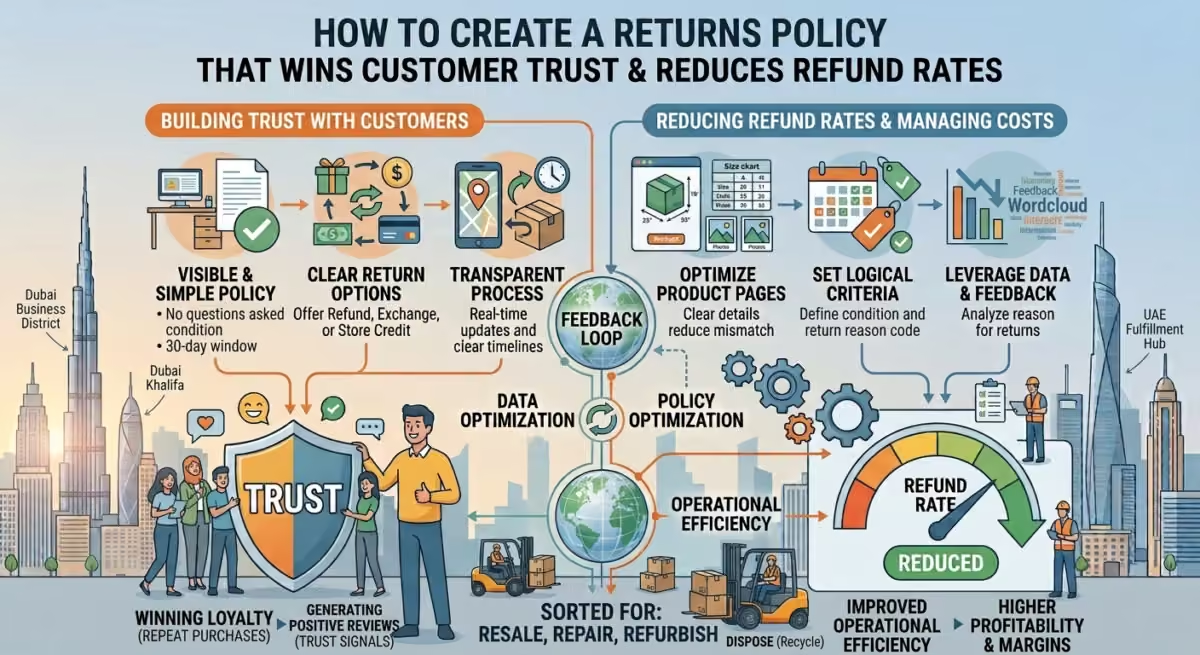
How to manage eCommerce returns in the UAE with reverse logistics, return policies, refunds and inventory restocking
How to Manage eCommerce Returns in UAE: Strategy, Policy and Logistics

Efficient returns management is essential for every UAE eCommerce business. From creating a customer-friendly return policy to streamlining reverse logistics and processing refunds quickly, this guide explains how to reduce return costs, improve customer satisfaction, and turn returns into a competitive advantage.

Read More
A medium-sized Jeebly delivery and moving truck parked outside a warehouse with its back doors wide open and a hydraulic lift gate lowered to the ground. Inside the cargo area, brown cardboard boxes are stacked neatly. The side of the truck features a dark blue advertisement wrap with the Jeebly logo, displaying a hand holding a house model under the text "Always on the Move from parcels to homes" and a call to action to "Explore it all on Jeebly NoW".
Packers and Movers in Dubai: What to Look for and How to Choose

Relocating in Dubai doesn’t have to be stressful. Whether you are moving apartments in Dubai Marina or upgrading your office space, discover the essential factors to look for in a professional moving company—from licensing and insurance to transparent pricing—and learn exactly how to choose the right team for a seamless move.

Read More
Infographic titled "Ecommerce Fulfilment in UAE: How It Works and What Businesses Should Look For." The left side shows a 5-step workflow: Online Store, Inventory, Picking & Packing, Dispatch, and Last Mile Delivery. The center features a map of the UAE with iconic cityscapes. The right side lists business requirements: Reliability & Speed, Advanced Technology, Real-Time Tracking, Scalability, and Customer Support.
eCommerce Fulfilment in UAE: How It Works and What Businesses Should Look For

Master your logistics strategy in the Middle East. Discover how e-commerce fulfillment works in the UAE—from warehousing to last-mile delivery—and learn the top 5 features your business needs from a fulfillment partner to scale successfully.

Read More
Categories
blogs

COD Fraud in UAE eCommerce: How to Detect, Prevent and Reduce Losses

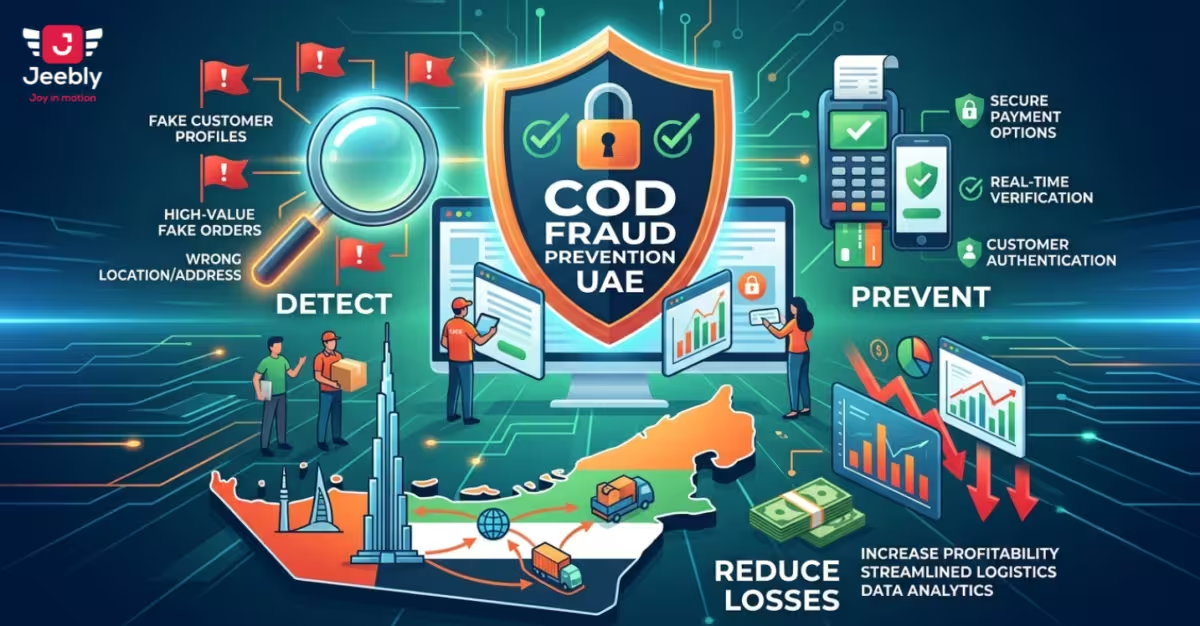
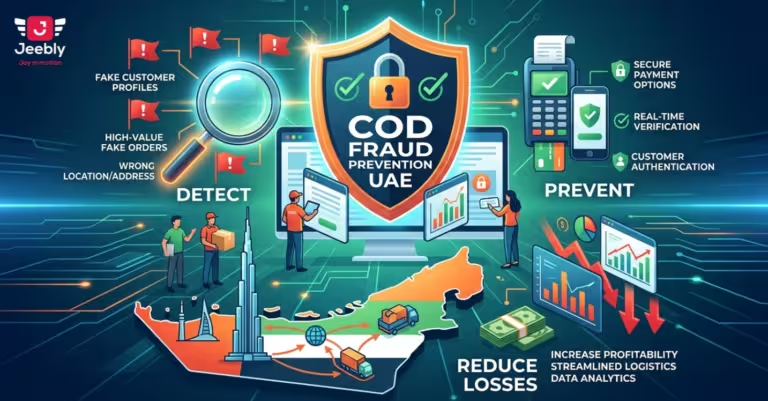
COD fraud prevention in the UAE with secure payment verification, order authentication and logistics risk management

COD Fraud in UAE eCommerce: How to Detect, Prevent and Reduce Losses

Cash on delivery is not going away in the UAE. It still accounts for nearly 35% of transactions across the Middle East and Africa.

The problem is that COD also creates a specific category of fraud risk that digital payment orders don’t carry: low-intent buyers who never planned to accept the parcel, external scammers exploiting the system’s offline nature, and a cascade of operational costs that appear as return-to-origin (RTO) losses on your courier statement.

This guide covers types of COD fraud that UAE businesses face. Know how to detect each, and the operational and technology measures that reduce losses without removing COD from your checkout.

Two Types of COD Fraud: External Scams vs Merchant Losses

1) External COD scams 

This targets your customers. Fraudsters may obtain customer details through leaked databases, phishing, public information, or other illegal sources. They dispatch parcels through legitimate logistics companies and specify a cash amount to be collected on delivery. 

When the courier arrives, the recipient assumes a family member or colleague placed the order and pays without verifying. By the time they open the parcel and discover the contents are worthless, it is difficult to reverse the transaction. This type of fraud damages your customers and, if your brand is being impersonated, directly damages your reputation.

2) Fake-order fraud & high-RTO abuse 

This targets your operations. Fraudulent COD orders placed using fake phone numbers and addresses result in guaranteed RTOs. The courier attempts delivery to a non-existent recipient and returns. 

Beyond outright fake orders, serial refusers, and customers who genuinely placed an order but later choose to refuse delivery, all incur similar operational costs. The distinction matters because the solutions differ.

Understanding which type is driving your losses determines which interventions to prioritise.

How External COD Scams Work

The mechanics follow a consistent pattern. 

Scammers obtain real addresses and phone numbers, dispatch parcels through legitimate logistics companies, and have the courier collect cash on their behalf. The delivery agent follows standard instructions with no knowledge of the contents. Once payment is made, the courier processes the funds through its standard settlement cycle and transfers the amount to the sender.

Unlike prepaid transactions, COD removes many digital payment protections such as automated payment authentication and chargeback processes, shifting more fraud risk into delivery operations.

Common external COD scam types currently active across the region:

  • The unsolicited parcel scam: A fraudster sends a package to a real address using leaked personal data. The recipient assumes a family member ordered it and pays. The parcel contains low-value or worthless items.

  • Brand impersonation: Scammers build convincing replicas of real UAE e-commerce stores, collect orders at scale, and dispatch cheap substitutes via third-party couriers. Your brand takes the fallout from customer service.

  • Fake courier impersonation: Some fraudsters pose as delivery companies, sending packages and demanding cash payments. Packages may include a QR code that, when scanned, links to a phishing site that collects additional personal data.

  • The advanced call variation: In some variations, fraudsters send advance messages or make phone calls claiming a shipment is on its way, creating a sense of legitimacy before the parcel arrives.

One protection against brand impersonation is ensuring your customers can independently verify delivery through a branded tracking page from your actual logistics partner. 

Aramex vs Jeebly: Which Is Better for UAE Last-Mile Delivery? compares how the two providers handle tracking visibility, ePOD, and customer communication. These capabilities help customers distinguish your legitimate delivery from a scam.

How Fake-Order Fraud Costs Your Business

Every failed COD delivery incurs double shipping costs: you paid for the forward attempt, and you pay for the return. The cash flow impact is separate and often underestimated. For brands with 25–30% COD RTO rates, the cash trapped in transit at any point can equal 3–5 weeks of revenue, creating a liquidity problem that grows with scale. 

When combined with Jeebly’s structured COD remittance cycle, this gap can be materially compressed compared to providers that remit fortnightly or monthly. But the RTO rate itself needs to be addressed at the source.

The total cost per RTO order is higher than most business models. A refused COD delivery carries forward shipping cost, return shipping cost, repackaging and restocking time, the COD amount that was never collected, and the customer acquisition cost spent to generate an order that never converted.

Detecting Fake Orders Before Dispatch

The most cost-effective COD fraud intervention happens before the parcel leaves your warehouse. A risk-scoring approach works better than applying the same verification to every order. 

Assess each COD order based on new-customer status, order value, address deliverability, phone-number validity, and historical RTO patterns for the same contact details. Low-risk orders proceed without friction. High-risk orders get additional verification steps.

Signals that flag a COD order as high-risk:

  • Phone number doesn’t match the delivery emirate’s prefix pattern
  • Address is incomplete, contains only a building name with no flat or office number, or matches a known high-RTO zone
  • Multiple orders from the same device or IP with different contact details
  • First-time customer placing a high-value COD order with no order history
  • Order placed outside normal hours with an unusual address format


OTP verification is one of the most effective pre-dispatch controls for reducing fake COD orders. OTP confirmation filters out fake or uncertain orders, ensuring only genuinely interested customers proceed with COD purchases.

Address validation at checkout catches genuine customers who entered incomplete or incorrect addresses. AI-powered address validation can reduce preventable delivery failures by identifying incomplete addresses, invalid locations, and delivery-risk patterns before dispatch.

The RTO lock is the most operationally precise tool for repeat offenders. RTO lock blocks customers with a history of COD refusals from accessing the COD payment option; they can still purchase with prepaid methods.

These pre-dispatch interventions are only as effective as the fulfilment partner executing them. 

Whether your operation suits a carrier or a courier model affects which fraud prevention tools are actually available to you. Carrier vs Courier: What’s the Difference and Which Do You Need in the UAE? clarifies the distinction.

Reducing Losses After Dispatch: NDR Management

An NDR (Non-Delivery Report) is a recoverable event. An RTO is the loss. The intervention window between the two is the time when significant losses can be prevented.

When a first delivery attempt fails, most businesses leave the outcome to the courier. Automated NDR management, such as WhatsApp or SMS outreach to the customer immediately after a failed attempt to confirm a new delivery window, reduces NDR-to-RTO conversion. 

The message content matters: 

  • Include the exact COD amount 
  • The rescheduled delivery window 
  • A simple one-tap confirmation. 

Customers who confirm reschedule convert at significantly higher rates than those who receive a generic “we’ll try again” notification.

What to Look for in a Logistics Partner for COD Operations

Your courier partner is operationally central to the risk of COD fraud. The specific capabilities to confirm before committing:

  • Digital proof of delivery (ePOD) is standard. Every drop-off should be confirmed with a timestamped photo and, for high-value orders, OTP or signature capture. This creates an evidentiary record for every delivery and eliminates “I never received it” disputes without a trail to resolve them.

  • NDR workflow transparency. Ask specifically: when a delivery attempt fails, what happens next? How quickly is the NDR flagged? Is the customer contacted automatically, or does re-attempt coordination require your team’s involvement? A courier with automated NDR management recovers more failed deliveries without adding to your ops overhead.

  • Weekly COD remittance. The remittance cycle directly affects your working capital. Jeebly supports structured COD settlement workflows, with settlement schedules depending on client arrangements. Confirm the cycle with any provider before signing.

  • 98% First Day Delivery Success (FDSS). Jeebly’s published FDSS across 50,000+ daily deliveries. A high first-attempt success rate is the most direct structural reduction in your RTO exposure. It limits the number of situations where an NDR even needs to be managed.

For a broader comparison of UAE courier providers on these criteria, Best Courier Service in UAE: 2026 Comparison Guide covers FDSS, remittance cycles, and NDR handling across the major operators.

How Jeebly Handles COD Operations

Jeebly Dash builds fraud-resistant COD delivery into the standard service rather than offering it as an optional add-on. Photo ePOD is captured at every drop-off and is timestamped and geotagged. The delivery record is immediately accessible to the business through the platform, which means disputes are resolved on the basis of evidence rather than through verbal disputes.

For businesses managing high COD volumes, Jeebly Bizz integrates order management, dispatch, and delivery tracking into a single platform. COD remittance runs weekly, reducing the cash-in-transit gap that high-RTO operations typically carry.

For businesses currently experiencing elevated RTO on COD orders or concerned about brand impersonation affecting their customers, talk to the Jeebly team. A direct conversation will identify quickly where the losses are coming from and which operational changes address them.

Frequently Asked Questions

COD fraud covers two distinct problems: external scammers who exploit cash-on-delivery to send fake parcels and collect cash from unsuspecting customers, and fake-order fraud, where low-intent buyers or bots place orders with no intention of accepting delivery, creating return-to-origin losses for the merchant. Both are active in the UAE market and require different operational responses.

 COD transactions bypass digital payment safeguards like chargeback mechanisms, authentication protocols, and automated fraud detection systems. Once cash is handed over at the door, the transaction is effectively irreversible.

OTP verification at checkout is the highest-ROI single intervention. It eliminates fake orders placed with wrong or non-existent phone numbers. Address validation at checkout is the complementary layer that handles address-error RTOs.

RTO lock restricts customers with a pattern of COD refusals from accessing COD at checkout. They can still purchase using prepaid options. Many businesses introduce COD restrictions when customer behaviour shows repeated refusal patterns.

Publish your official courier partners on your website and customer communications. Instruct customers never to pay cash for a parcel they didn’t order. Build branded tracking pages so customers can verify delivery status independently, without relying on messages from unknown numbers. And ensure your logistics partner captures ePOD at every delivery.

COD losses usually include failed delivery costs, return shipping, handling costs, lost customer acquisition spend, and delayed cash flow.

Removing COD can reduce failed deliveries but may also reduce conversions from customers who prefer paying after receiving their order. Many businesses improve profitability by managing COD risk instead of eliminating it.

Routes to insightful reads

Delivery SLA guide for UAE businesses showing service level agreements, delivery performance metrics, on-time delivery targets and logistics standards.
 Delivery SLA Guide for UAE Businesses: What to Expect and How to Set Standards

A clear delivery Service Level Agreement (SLA) sets the expectations for speed, reliability, and performance between businesses and their logistics partners. This guide explains what a delivery SLA should include, the key metrics to track, and how UAE businesses can set realistic standards to improve customer satisfaction and delivery performance.

Read More
Dangerous goods and restricted items that cannot be shipped by courier in the UAE, including hazardous materials, prohibited products and customs restrictions.
Dangerous Goods and Restricted Items: What You Cannot Ship by Courier in the UAE

Shipping prohibited or restricted items can lead to delays, fines, shipment rejection, or legal consequences. This guide explains which dangerous goods and restricted items cannot be shipped by courier in the UAE, the regulations businesses should know, and how to stay compliant with UAE customs and courier requirements.

Read More
How to manage eCommerce returns in the UAE with reverse logistics, return policies, refunds and inventory restocking
How to Manage eCommerce Returns in UAE: Strategy, Policy and Logistics

Efficient returns management is essential for every UAE eCommerce business. From creating a customer-friendly return policy to streamlining reverse logistics and processing refunds quickly, this guide explains how to reduce return costs, improve customer satisfaction, and turn returns into a competitive advantage.

Read More
A medium-sized Jeebly delivery and moving truck parked outside a warehouse with its back doors wide open and a hydraulic lift gate lowered to the ground. Inside the cargo area, brown cardboard boxes are stacked neatly. The side of the truck features a dark blue advertisement wrap with the Jeebly logo, displaying a hand holding a house model under the text "Always on the Move from parcels to homes" and a call to action to "Explore it all on Jeebly NoW".
Packers and Movers in Dubai: What to Look for and How to Choose

Relocating in Dubai doesn’t have to be stressful. Whether you are moving apartments in Dubai Marina or upgrading your office space, discover the essential factors to look for in a professional moving company—from licensing and insurance to transparent pricing—and learn exactly how to choose the right team for a seamless move.

Read More
Infographic titled "Ecommerce Fulfilment in UAE: How It Works and What Businesses Should Look For." The left side shows a 5-step workflow: Online Store, Inventory, Picking & Packing, Dispatch, and Last Mile Delivery. The center features a map of the UAE with iconic cityscapes. The right side lists business requirements: Reliability & Speed, Advanced Technology, Real-Time Tracking, Scalability, and Customer Support.
eCommerce Fulfilment in UAE: How It Works and What Businesses Should Look For

Master your logistics strategy in the Middle East. Discover how e-commerce fulfillment works in the UAE—from warehousing to last-mile delivery—and learn the top 5 features your business needs from a fulfillment partner to scale successfully.

Read More

    Powered by