
Jeebly | Logistics Solutions

A Jeebly courier service delivery van filled with cardboard boxes parked outside a building in the UAE, while a courier uniform-clad driver hands over a parcel to a customer.

Best Courier Services in UAE: 2026 Comparison Guide

Every UAE e-commerce business reaches the same inflexion point: the courier that worked fine at 30 orders a day starts showing cracks at 300. Deliveries get missed, and COD reconciliation runs late. The tracking page shows “out for delivery” for six hours. And your customer contacts you, not the courier.

Finding the best courier service in UAE is about matching a provider’s operational capabilities to your actual delivery profile: by order volume, coverage zone, speed requirement, and the tech stack you need to integrate with your store.

This guide compares the leading UAE courier services for 2026 based on the criteria that directly affect your margins: first-attempt delivery rates, COD handling, platform integrations, returns management, and pricing transparency. It also covers what to ask any provider before you sign anything.

Top 6 UAE Courier Services Compared: Who Does What Well

1) Jeebly

Jeebly is built around a single operating principle: the courier experience should be invisible to the end customer and frictionless for the business running it. That means AI-assisted dispatch, automated NDR workflows, direct platform integrations, and a 98% First-Day Delivery Success rate across 50,000+ daily deliveries, supported by a fleet of 4,000+ active vehicles.

The service structure is designed to match different business profiles rather than forcing every operation into the same product:

Jeebly Dash covers express, same-day, and next-day domestic delivery. Published base rate: AED 17.31 per parcel up to 5 kg, with same-day delivery available within Dubai. Direct integrations with Shopify, WooCommerce, Magento, ChatFood, and Grubtech. COD collection and weekly remittance are standard.

Jeebly Bizz is the logistics management layer for businesses that need more than delivery, like warehousing, fulfilment, reverse logistics, automated dispatch, and real-time reporting in one connected platform. Built for operations running hundreds of daily orders where manual coordination isn’t viable.

Jeebly Haul handles freight and bulk shipments above 20 kg: road freight across the UAE and GCC, air freight, and ocean freight. Custom-quoted, not bookable via app.

Jeebly works with brands including BFL Group, Mumzworld, Instashop, and Zomato. If your priority is UAE-native coverage, verified performance data, and a single partner that scales with you, Jeebly is the place to start.

Best for: D2C and e-commerce brands at any stage of growth, from 20 to 2,000+ daily orders. 

Watch out for: Express (60–120 min) delivery is currently available only in Dubai. 

2) Aramex

Aramex leads GCC-wide e-commerce delivery with the most mature COD infrastructure and a regional last-mile network across more than 60 countries. For brands already operating at scale with significant volume in Saudi Arabia, Kuwait, or Egypt, the depth of the regional network is genuinely valuable. Their Shop & Ship cross-border service and reverse logistics workflows are well-established.

Best for: Mid- to large businesses with consistent GCC or MENA export volume. 

Watch out for: Enterprise-leaning pricing. Smaller brands shipping fewer than 50 orders a day may find better value with local carriers.

3) DHL Express UAE

DHL Express offers the widest global reach across 220+ countries and advanced customs automation tools designed to streamline cross-border processing. Their Dubai South (DWC) hub is one of the most active in the region.

Best for: Businesses where international express speed justifies the cost of high-value products, time-sensitive B2B shipments, or Europe/US-bound parcels.

Watch out for: For domestic UAE e-commerce at volume, DHL Express is typically priced at a premium, compressing margins on high-frequency local orders. It’s not the right tool for scaling the domestic last-mile. 

4) Quiqup

Quiqup delivers within 4 hours in Dubai, with a 99% first-attempt delivery rate, making it a strong option for brands prioritising fast delivery in the city. The fleet is owned and managed in-house, which supports consistent quality but limits peak capacity compared to larger operators.

Best for: Brands with a Dubai-centric order profile where sub-four-hour delivery is a direct commercial differentiator: grocery, beauty, fashion. 

Watch out for: Multi-emirate coverage is limited. Not built for fulfilment, freight, or returns at scale. Higher per-delivery cost than next-day carriers.

Here’s a quick snapshot for easy understanding:

Courier Best For Delivery Strength COD Integrations
Jeebly UAE eCommerce brands Same-day + scalable delivery ✓ Yes Shopify, WooCommerce, Magento
Aramex GCC expansion Regional coverage ✓ Yes ✓ Yes
DHL International shipping Global express Limited ✓ Yes
Quiqup Dubai same-day delivery Fast urban delivery ✓ Yes ✓ Yes
Emirates Post Remote locations Nationwide reach ✓ Yes Limited
Shipa SMEs Easy onboarding ✓ Yes ✓ Yes

Quiqup and Jeebly are the two most-compared same-day providers in Dubai. Read the full head-to-head comparison on Quiqup vs Jeebly.

5) Emirates Post (EMX/7X)

Emirates Post and its courier arm, EMX, cover remote areas that most private providers deprioritise, including PO Box delivery, government-adjacent shipments, and addresses outside the main urban corridors.

Best for: High-volume domestic shipments to addresses in the northern and eastern emirates that private couriers don’t reliably serve. 

Watch out for: Tracking visibility and delivery windows are more limited than with tech-native providers. Not suited for speed-sensitive e-commerce or brands where real-time customer communication is a priority.

6) Shipa Delivery

Shipa provides last-mile delivery and e-commerce fulfilment across the UAE with a focus on SME accessibility and straightforward onboarding.

Best for: Early-stage brands looking for a clean setup without complex volume commitments. 

Watch out for: Primarily last-mile focused. Businesses that also need freight, warehousing, or returns management will require additional vendors, adding coordination overhead as they scale.

What to Look for Before You Commit to Any UAE Courier

Most businesses choose a courier based on price per parcel. Many businesses reconsider their courier partner once delivery volume increases. The two things are related.

Per-parcel rate is one input. The total cost of operations is the number that matters. Here’s what actually drives that figure:

  • First-attempt delivery success rate (FDSS): Every failed delivery costs you twice: the re-attempt fee and the time your team spends managing the NDR (Non-Delivery Report). The brands winning in the UAE right now are demanding API-first carrier integrations and automated workflows that handle failed deliveries before they eat into margins.


  • COD remittance speed: Cash on delivery still accounts for a significant share of UAE e-commerce transactions. The remittance cycle directly affects working capital. A courier remitting weekly versus one remitting fortnightly can hold two weeks of your revenue at any given time. At volume, that’s a meaningful float.


  • Platform integration depth: “Shopify integration” means different things to different couriers. Some offer a full two-way API. Others require manual CSV uploads or a basic webhook that breaks under load. If your operations team is spending more than 20 minutes a day on manual logistics tasks, your integration isn’t working properly.


  • UAE-wide coverage with confirmed emirate-level SLAs: “Nationwide coverage” is a common claim. The reality is that next-day delivery to Dubai and next-day delivery to Ras Al Khaimah are not the same operational challenge. Confirm which emirates your courier covers for same-day, next-day, and standard delivery.


  • Returns management: Reverse logistics is where most UAE courier relationships quietly fall apart. Ask specifically: Is the return managed in-house or handed off to a third party? What’s the SLA from the customer’s door back to your warehouse? Is there a per-return fee in addition to the standard rate?


Understand your full shipping cost picture before you negotiate. Read: Cost of Shipping for a Small Business in UAE (2026).

Choosing by Business Stage: A Practical Framework

1) Under 50 orders/day: 

Flexibility matters more than infrastructure at this stage. Choose a provider with no minimum commitment, transparent per-parcel pricing, and COD support if your customers expect it. Test for 60 days before negotiating volume terms. 

Jeebly Dash is structured for exactly this: no minimum order volume, clean onboarding, and the ability to scale without renegotiating contracts.

2) 50–300 orders/day: 

This is where the choice compounds. You need UAE-wide coverage with confirmed emirate-level SLAs, a first-attempt delivery rate you can model against, and a returns process that doesn’t create a separate daily workflow. 

A single provider handling all of this is cheaper in practice than two providers each handling part of it. Jeebly Bizz brings dispatch, tracking, NDR management, and reverse logistics into one platform at this volume tier.

3) 300+ orders/day: 

At this volume, switching providers is expensive and operationally disruptive. Choose for the next two years, not for today. You need owned or controlled fleet capacity with warehousing integration, and tech infrastructure that communicates directly with your OMS without manual intervention. 

Jeebly’s platform integrates with Shopify, WooCommerce, Magento, ChatFood, and Grubtech. See how the technology is structured before evaluating any other provider.

Questions to Ask Any UAE Courier Before Signing

Generic sales conversations from couriers will cover speed, price, and coverage. These are the questions that reveal operational reality:

  • What is your published first-attempt delivery success rate, and is it auditable?
  • What is your COD remittance cycle: weekly, fortnightly, or monthly?
  • How do you manage NDR events: automated workflows or manual follow-up?
  • Which specific emirates are covered for same-day delivery, and what are the cut-off times?
  • Is returns management handled in-house or outsourced?
  • What does onboarding look like? Is there a minimum volume commitment or a trial period?

A courier who can answer all six clearly, in writing, is a courier you can plan around. One that hedges on any of them will create operational uncertainty at the worst possible time.

Conclusion

The best courier service in UAE for your business depends on three things: where your customers are, how many orders you ship, and how complex your fulfilment needs are. 

Global carriers like DHL and Aramex are genuinely strong for international and GCC-wide volume. Hyperlocal providers like Quiqup serve a specific speed-sensitive niche in Dubai. For UAE domestic e-commerce at any meaningful scale, Jeebly is built for exactly that operation. Jeebly Dash for last-mile delivery, Jeebly Bizz for integrated fulfilment, and Jeebly Haul for freight. One partner across the full chain. 

Need a courier partner that can handle your current volume and your next growth stage? Speak with Jeebly’s logistics team to build the right delivery setup for your business.

Frequently Asked Questions

Jeebly maintains a 98% First Day Delivery Success rate across 50,000+ daily deliveries in the UAE. Quiqup also publishes a 98% first-attempt rate, though primarily within Dubai. Always ask any courier for auditable performance data before committing.

Most major UAE couriers collect cash at the point of delivery and remit funds back to the sender on a set cycle, weekly, fortnightly, or monthly, depending on the provider. Jeebly remits weekly. COD fees typically range from 1–2% of the collected amount per transaction.

Rates commonly vary depending on parcel weight, destination, delivery speed, and contract volume. The cheapest headline rate isn’t always the lowest total cost. Providers with high first-attempt success rates reduce your RTO costs, which often outweigh the benefits of a lower base rate.

Jeebly integrates directly with Shopify, WooCommerce, Magento, ChatFood, and Grubtech. Aramex and DHL also offer Shopify integrations, though the depth and automation capabilities vary. Test any integration in a live environment before relying on it for daily operations.

Confirm whether returns are managed in-house or handed off to a third party, what the SLA is from the customer door back to your warehouse, and whether there’s a separate per-return fee.

Routes to insightful reads

Illustrated banner for Jeebly showing a red and navy blue Jeebly delivery van parked outside a modern Dubai villa, with uniformed couriers unloading an armchair, assembling furniture on the porch, and verifying delivery with a digital tablet against the Dubai skyline.
Furniture and Bulky Item Delivery in Dubai: What Retailers Should Look For

Delivering bulky, fragile, or high-value furniture across Dubai requires more than just standard transport. Learn the essential qualities to look for in a furniture delivery partner—including white-glove care, expert installation, and transparent tracking—to ensure every piece arrives safely and on time.
Read More
Illustrated banner for Jeebly showing a delivery courier in Dubai handing a parcel to a customer signing an electronic proof of delivery (ePOD) tablet, surrounded by Jeebly delivery vans, a smartphone displaying digital signature confirmation, and the Dubai skyline in the background.
What Is Proof of Delivery (POD) and Why It Matters for UAE Shipments

In the UAE’s fast-moving logistics landscape, Proof of Delivery (POD) has evolved far beyond a paper receipt. From real-time GPS timestamps to instant digital signatures, discover how modern ePOD protects businesses, eliminates delivery disputes, and guarantees transparency across every mile.
Read More
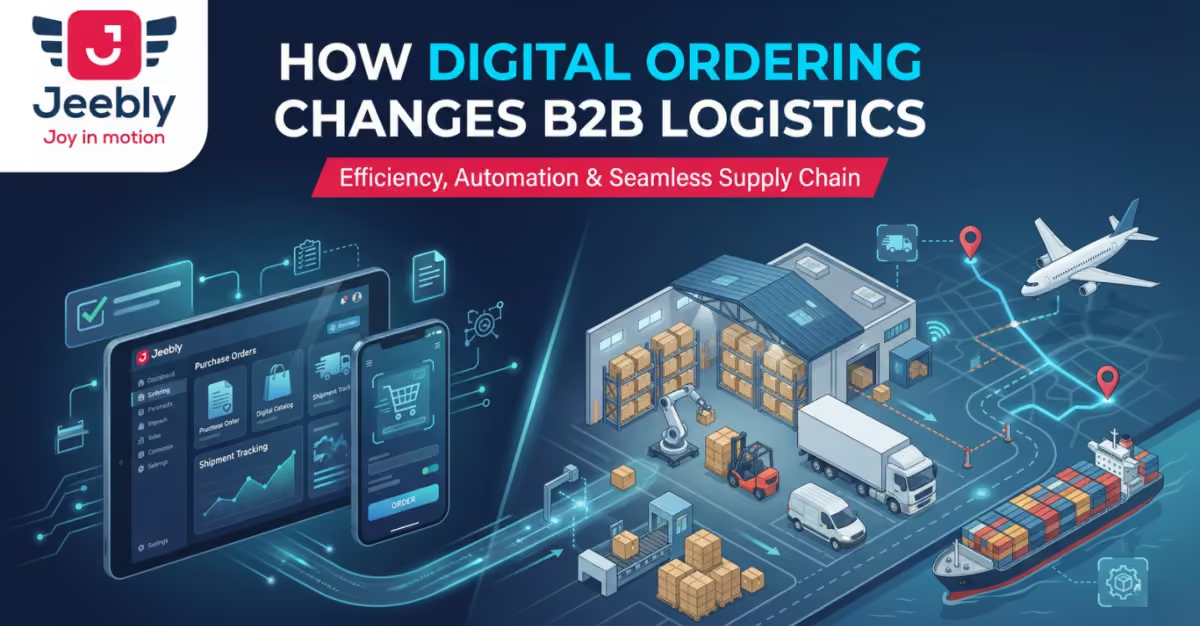
A modern navy and cyan digital blog banner titled 'HOW DIGITAL ORDERING CHANGES B2B LOGISTICS' with the Jeebly logo in the top-left corner. The illustration features a tablet and smartphone on the left showing digital B2B purchase orders, shipment tracking, and procurement interfaces, connected via glowing digital data streams to a bustling smart logistics ecosystem on the right with an automated warehouse, forklifts, delivery trucks, a cargo airplane, and a container ship.
B2B E-Commerce in the UAE: How Digital Ordering Is Changing Business Logistics

Managing orders across your website, social channels, and marketplaces like Noon and Amazon can quickly overwhelm manual spreadsheets and disconnected systems. Stockouts, delayed dispatches, and rising return rates often signal that your business has outgrown basic order tracking. Discover the key signs your UAE e-commerce store needs an Order Management System (OMS) and how integrating automated order workflows with Jeebly streamlines inventory sync, multi-channel fulfillment, and last-mile delivery.
Read More
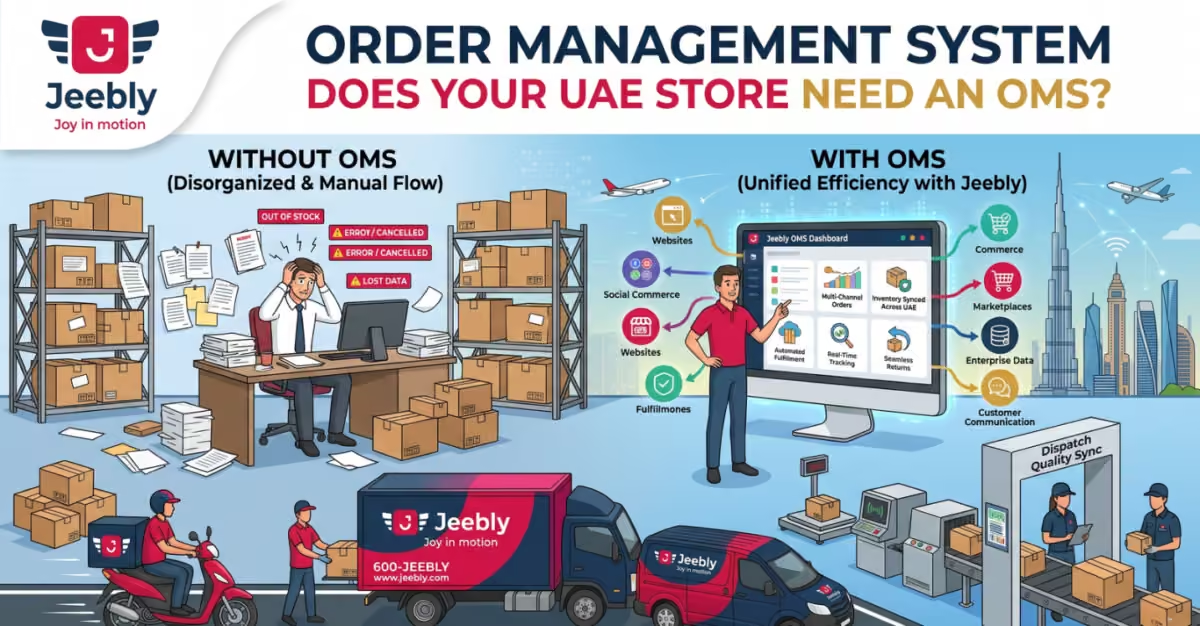
Split-screen infographic featuring the Jeebly logo, comparing chaotic manual order processing without an OMS against a streamlined, unified OMS workflow with Jeebly trucks, vans, and the Dubai skyline.
Order Management System: Does Your UAE Store Need an OMS?

Managing orders across your website, social channels, and marketplaces like Noon and Amazon can quickly overwhelm manual spreadsheets and disconnected systems. Stockouts, delayed dispatches, and rising return rates often signal that your business has outgrown basic order tracking. Discover the key signs your UAE e-commerce store needs an Order Management System (OMS) and how integrating automated order workflows with Jeebly streamlines inventory sync, multi-channel fulfillment, and last-mile delivery.
Read More
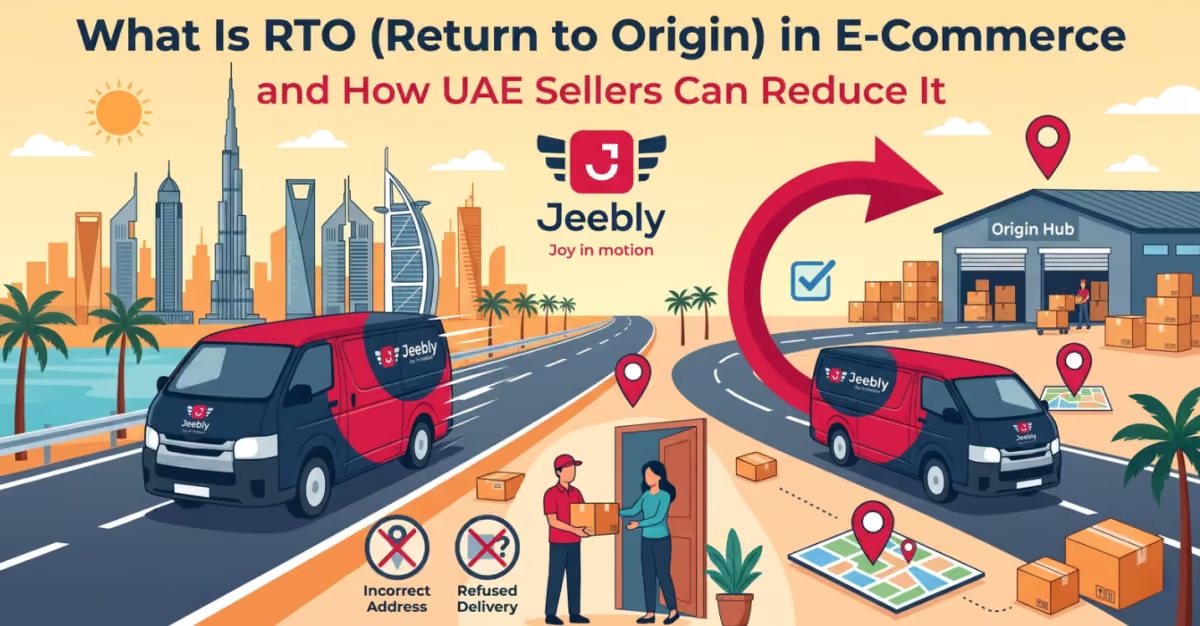
An animated vector-style graphic illustrating "What is RTO (Return to Origin) in E-Commerce and How UAE Sellers Can Reduce It", featuring Dubai's skyline, Jeebly delivery vans, and the loop of a package being returned to an origin hub alongside tips for successful doorstep delivery.
What Is RTO (Return to Origin) in E-Commerce and How UAE Sellers Can Reduce It

Return to Origin (RTO) is one of the most expensive headaches for UAE e-commerce sellers—often driven by non-standardized addresses, hard-to-reach customers, and Cash on Delivery (COD) refusals. But you don’t have to let failed deliveries eat into your profit margins. Discover what causes high RTO rates in the UAE and learn practical, actionable strategies—from address validation and automated customer communication to partnering with reliable delivery services like Jeebly—to protect your bottom line and ensure more orders find their home on the very first try.

Read More

    Powered by