

Jeebly | Logistics Solutions

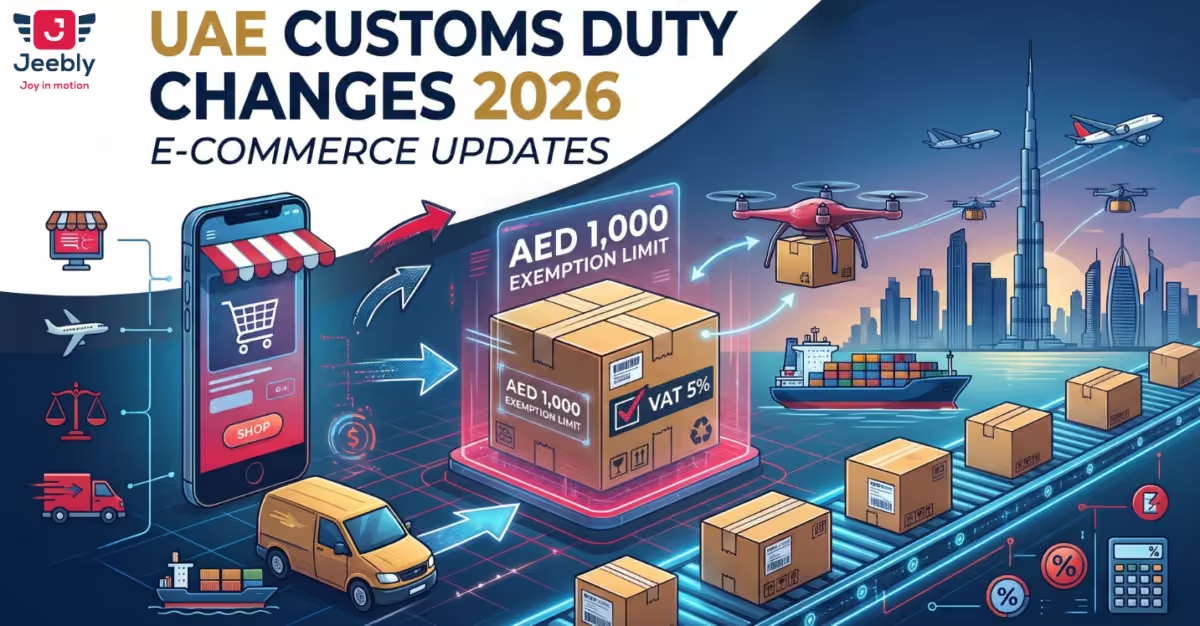
Infographic banner featuring the Jeebly logo, highlighting 2026 UAE customs duty updates for e-commerce with a Dubai skyline, delivery vans, cargo ships, conveyor belt parcels, and the AED 1,000 exemption limit.

UAE Customs Duty Changes for E-Commerce: What the AED 1,000 Threshold and 60-Day Returns Rule Mean for Businesses

From 3 August 2026, Dubai Customs exempts eligible cross-border e-commerce shipments valued at up to AED 1,000 from customs duty. It also extends the duty-exempt window for B2C returns to 60 days. 

The exemption applies only to customs duty, so import VAT still applies. The AED 1,000 limit is measured on CIF value, so freight and insurance count towards it. The change comes as UAE e-commerce continues to grow. Gross merchandise value rose 2% year-on-year in the first half of 2026, while GCC-wide e-commerce fell 9%. 

For businesses shipping to, from or through Dubai, it changes landed-cost maths, checkout copy, and returns timelines. This guide covers what the notice says, what it leaves out, and what to change this quarter.

Key Takeaways

  • Dubai Customs Notice No. 16 of 2026, in force since 3 August 2026, exempts eligible cross-border e-commerce shipments with a CIF value of up to AED 1,000 from customs duty.

  • The exemption removes duty, not VAT. The limit is measured on CIF (goods, insurance and freight).

  • B2C returns on which duty has already been paid are duty-exempt if they return within 60 days of their exit date. The clock starts at exit, not at the customer’s return request.

  • Tobacco, e-cigarettes, nicotine liquids and alcohol are excluded.

What Changed in UAE Customs Duty for E-Commerce on 3 August 2026?

Dubai Customs exempts goods valued at AED 1,000 or less from customs duty when they are imported as cross-border e-commerce shipments. It also allows duty-paid B2C returns to re-enter duty-free within 60 days.

More changes are outlined below, based on Emirates 24|7 and Khaleej Times.

Rule What Notice 16/2026 says
Duty-free limit E-commerce goods valued at AED 1,000 or less are exempt from customs duty.
Effective date 3 August 2026
Excluded goods Tobacco and products, e-smoking devices and accessories, nicotine liquids, alcoholic beverages, and food preparations containing alcohol.
Returns B2C goods returned through e-commerce companies, with duty proven paid, are exempt if returned within 60 days of their date of exit.
Administration Client Happiness Management registers companies, their activities and platform enrolment. Legal Affairs handles disputes.
Action required Companies wanting the benefit must adjust their status to the new provisions.

Does the AED 1,000 Exemption Remove VAT as Well?

No. The exemption covers customs duty only. Import VAT of 5% is a separate charge, and both TaxAdvisors.ae and ArabTaxCalc treat it as still payable on exempt parcels.

It provides real savings, but it is not “tax-free”. UAE VAT rules were also amended from 1 January 2026, separately from this notice. VAT on Shipping and Delivery Services in the UAE covers how import VAT is invoiced and recovered.

How Is the AED 1,000 Limit Calculated?

The limit applies to CIF value: goods plus insurance plus freight. A parcel valued at AED 900, plus AED 150 in shipping and insurance, has a CIF value of AED 1,050 and falls outside the exemption.

Because it’s above the limit, duty applies to the full CIF value, not just the excess. That creates a cliff:

CIF value Customs duty (5%) Import VAT (5% of CIF + duty) Total tax
AED 1,000 AED 0.00 AED 50.00 AED 50.00
AED 1,050 AED 52.50 AED 55.13 AED 107.63

Parcels priced between roughly AED 850 and AED 1,000 need a CIF check before you promise a landed price. Don’t restructure shipments just to stay under the line without written confirmation from the broker.

Which Shipments Qualify for the Duty Exemption?

The reports describe the exemption for cross-border e-commerce shipments handled by companies registered with Dubai Customs. Several common scenarios fall outside it.

Scenario Duty exemption
applies?
Why
Consumer order from an overseas seller, AED 800 CIF, cleared in Dubai Yes Within the limit; Dubai notice
Same order at AED 1,100 CIF No Above the limit; duty on full CIF
Order containing alcohol or vaping products No Excluded categories (alcohol remains dutiable at 50% per World Company Setup)
Parcel cleared through Abu Dhabi or Sharjah Confirm first This is a Dubai Customs notice
Bulk inventory import for resale or marketplace stock Not indicated The announcements cover e-commerce shipments; keep modelling at the standard 5% until your broker confirms

Two practical points follow here: 

How Does the 60-Day Returns Rule Work?

Goods returned through e-commerce companies for B2C purposes, for which customs duty has been proven to have been paid, are exempt from duty if returned within 60 days of their date of exit. In practice, a seller exporting from Dubai through a registered company can bring a B2C return back in without paying duty again. The return must clear within the window.

The clock starts when the goods leave Dubai. It doesn’t start when the customer requests a return. A longer return policy can therefore breach the window:

Scenario Outbound transit Customer return window Return transit Total from exit Within 60 days?
30-day return policy 7 days 30 days 10 days 47 days Yes (13 days spare)
45-day return policy 7 days 45 days 10 days 62 days No (2 days over)

Illustrative assumptions: 7-day outbound and 10-day return transit. Use your own lane data.

Returns that miss day 60 turn back into a duty bill. Jeebly Bizz manages reverse logistics on the same platform as outbound delivery, so you can see where every return sits before the window closes.

To align your policy and operations with the 60-day clock, see How to Manage eCommerce Returns in UAE for the reverse-logistics process and How to Create a Returns Policy for setting return windows.

How Much Customs Duty Do You Pay Above the AED 1,000 Limit?

For most goods, UAE customs duty is 5% of the CIF value, with 5% VAT charged on the CIF value plus duty.

Item Rate or rule Basis
Customs duty, most goods 5% CIF value
Import VAT 5% CIF + duty
Alcoholic beverages 50% duty World Company Setup
GCC-origin goods with valid certificate of origin May qualify for preferential treatment GCC Common Customs Law (SamVertex)
HS code format 12-digit mandatory for rest-of-world imports into the UAE mainland from August 2026 Dubai Customs Notice 10/2025 (SamVertex)

What Should UAE E-Commerce Businesses Change Now?

Action Why it matters
Update landed-cost models: 0% duty up to AED 1,000 CIF, 5% VAT unchanged Old sheets overstate cost by the duty amount.
Model CIF, not item price Freight and insurance count towards the limit.
Rewrite duty wording at checkout Surprise charges may drive abandonment.
Check return windows against the 60-day clock A 45-day policy can breach it (table above).
Confirm registration and clearing port Companies must adjust their status. How to Get an eCommerce Licence in the UAE covers licensing basics.
Split out excluded categories Alcohol and nicotine SKUs need separate costing.
Ask who pays duty and VAT at delivery Under DDP (Delivered Duty Paid), the seller prepays. Under DAP (Delivered at Place), the buyer pays at delivery.
Ask carriers for the declared CIF, HS code and port of entry in writing Compare carriers using DHL vs Jeebly and Cost of Shipping for a Small Business in UAE.

Do this before Q4 pricing locks. Peak Season Logistics Checklist: Getting Ready for Q4 UAE covers the wider timeline.

How Jeebly Supports Cross-Border E-Commerce Shipments

Jeebly Haul is a cargo service covering air, sea, and road freight across the UAE and GCC, with in-house customs clearance, so a single team handles freight and clearance. For consumer parcels going overseas, Jeebly Dash’s international courier service handles express delivery. Once a parcel is in the UAE, same-day delivery in Dubai covers the last mile.

For businesses running outbound orders and returns together, Jeebly Bizz brings cross-border logistics and fulfilment to a single platform.

Put the same questions to us that this guide tells you to put to any carrier: which port clears the parcel, which CIF value is declared, and who pays duty and VAT at delivery. Talk to the Jeebly team and bring your lane, average parcel value and return rate.

Conclusion

Notice 16/2026 gives UAE e-commerce a real, but narrow, saving. Duty drops to zero on eligible parcels up to AED 1,000 CIF, VAT stays at 5%, and the returns window stretches to 60 days from exit. Businesses that measure CIF properly, align return windows with the clock, and confirm which customs office clears their parcels get the gains. Because thresholds have moved before, treat AED 1,000 as a variable in your model.

For the mechanics of clearance behind these rules, read “Customs Clearance in Dubai and UAE.” To manage freight and clearance, Jeebly Haul provides door-to-door cargo services across the UAE and GCC. Contact us to review your cross-border setup.

Frequently Asked Questions

The notice is a Dubai Customs notice, and the reports reviewed do not say other emirates have adopted it. Ask your carrier for written confirmation of the clearing port and the threshold it applies before you change customer-facing duty messages for non-Dubai addresses.

The announcements don’t address split consignments. Customs authorities generally assess the underlying transaction, so splitting an order to stay below a threshold risks reassessment. Get written confirmation from your customs broker before changing how you pack or ship orders.

Add goods, insurance and freight to get CIF. Duty is 5% of CIF for most goods, and VAT is 5% of CIF plus duty. For AED 3,000 CIF, duty is AED 150, VAT is AED 157.50, and total tax is AED 307.50. Alcoholic beverages are subject to a 50% duty rate instead.

The notice requires that duty be “proven to have been paid”. Keep the original import declaration number, the duty payment record, the date the goods left Dubai and the return shipment’s tracking record. The sources reviewed don’t list the exact documents, so confirm them with Dubai Customs or your broker.

Possibly. On a parcel under AED 1,000 CIF, the duty line should be zero, but 5% VAT is still due. Whether the buyer pays it at delivery depends on the sales terms: under DDP, the seller has prepaid it, while under DAP, the courier collects it. Unexpected charges at the door often trigger refusal, so show them before checkout.

Nothing in the sources reviewed says so. The amendments effective 1 January 2026 changed invoicing and unused VAT credit rules, including a five-year limit on carrying credits forward, not the 5% rate.

Routes to insightful reads

A modern navy and cyan digital blog banner titled 'HOW DIGITAL ORDERING CHANGES B2B LOGISTICS' with the Jeebly logo in the top-left corner. The illustration features a tablet and smartphone on the left showing digital B2B purchase orders, shipment tracking, and procurement interfaces, connected via glowing digital data streams to a bustling smart logistics ecosystem on the right with an automated warehouse, forklifts, delivery trucks, a cargo airplane, and a container ship.
How digital ordering changes B2B logistics

Managing orders across your website, social channels, and marketplaces like Noon and Amazon can quickly overwhelm manual spreadsheets and disconnected systems. Stockouts, delayed dispatches, and rising return rates often signal that your business has outgrown basic order tracking. Discover the key signs your UAE e-commerce store needs an Order Management System (OMS) and how integrating automated order workflows with Jeebly streamlines inventory sync, multi-channel fulfillment, and last-mile delivery.

Read More
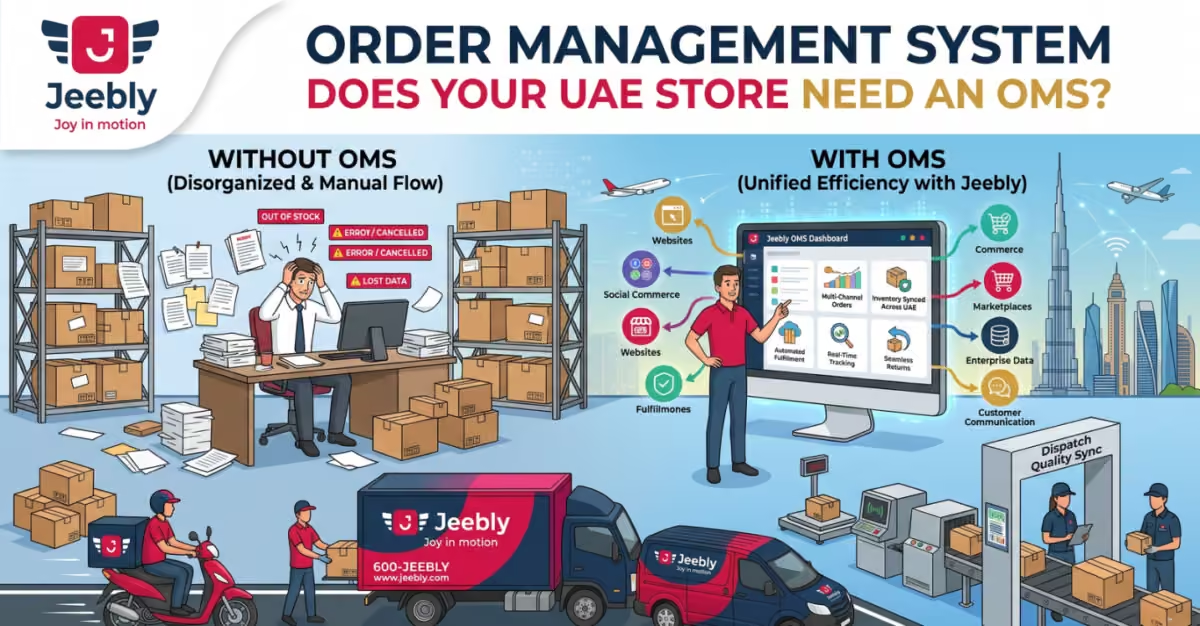
Split-screen infographic featuring the Jeebly logo, comparing chaotic manual order processing without an OMS against a streamlined, unified OMS workflow with Jeebly trucks, vans, and the Dubai skyline.
Order Management System: Does Your UAE Store Need an OMS?

Managing orders across your website, social channels, and marketplaces like Noon and Amazon can quickly overwhelm manual spreadsheets and disconnected systems. Stockouts, delayed dispatches, and rising return rates often signal that your business has outgrown basic order tracking. Discover the key signs your UAE e-commerce store needs an Order Management System (OMS) and how integrating automated order workflows with Jeebly streamlines inventory sync, multi-channel fulfillment, and last-mile delivery.
Read More
An animated vector-style graphic illustrating "What is RTO (Return to Origin) in E-Commerce and How UAE Sellers Can Reduce It", featuring Dubai's skyline, Jeebly delivery vans, and the loop of a package being returned to an origin hub alongside tips for successful doorstep delivery.
What Is RTO (Return to Origin) in E-Commerce and How UAE Sellers Can Reduce It

Return to Origin (RTO) is one of the most expensive headaches for UAE e-commerce sellers—often driven by non-standardized addresses, hard-to-reach customers, and Cash on Delivery (COD) refusals. But you don’t have to let failed deliveries eat into your profit margins. Discover what causes high RTO rates in the UAE and learn practical, actionable strategies—from address validation and automated customer communication to partnering with reliable delivery services like Jeebly—to protect your bottom line and ensure more orders find their home on the very first try.

Read More
Infographic guide for selling on Noon UAE in 2026, showing seller registration steps, product cataloguing, FBN and FBP logistics options, a Jeebly delivery van, and the Dubai skyline.
How to Sell on Noon in the UAE in 2026

Expanding your e-commerce footprint across the Middle East starts with Noon—the UAE’s leading homegrown digital marketplace. Whether you are a local startup or an established retail brand, succeeding in 2026 requires understanding trade license compliance, optimizing catalog listings, and selecting the right fulfillment model between FBN and FBP. Explore our complete guide to selling on Noon UAE, covering onboarding essentials, commission structures, and how partnering with reliable last-mile delivery providers like Jeebly helps you scale faster.
Read More
Infographic banner featuring the Jeebly logo, highlighting 2026 UAE customs duty updates for e-commerce with a Dubai skyline, delivery vans, cargo ships, conveyor belt parcels, and the AED 1,000 exemption limit.
UAE Customs Duty Changes for E-Commerce (2026)

With rapid expansions across the GCC digital commerce landscape, the UAE has implemented updated customs duty policies and clearance procedures for cross-border e-commerce shipments in 2026. From managing the AED 1,000 personal import exemption and 5% VAT rules to navigating commercial parcel compliance and streamlined last-mile delivery, discover how these regulatory shifts impact online retailers, logistics providers, and shoppers across the Emirates.

Read More

    Powered by