





Jeebly | Logistics Solutions

Categories
blogs

COD Fraud in UAE eCommerce: How to Detect, Prevent and Reduce Losses

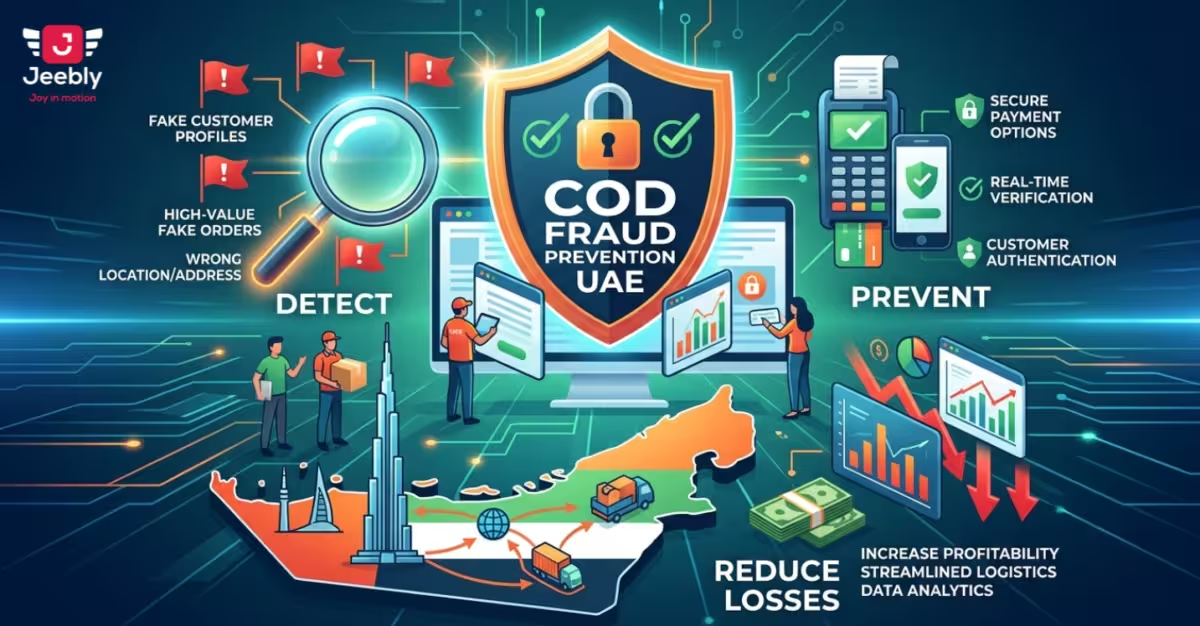
COD fraud prevention in the UAE with secure payment verification, order authentication and logistics risk management

COD Fraud in UAE eCommerce: How to Detect, Prevent and Reduce Losses

Cash on delivery is not going away in the UAE. It still accounts for nearly 35% of transactions across the Middle East and Africa.

The problem is that COD also creates a specific category of fraud risk that digital payment orders don’t carry: low-intent buyers who never planned to accept the parcel, external scammers exploiting the system’s offline nature, and a cascade of operational costs that appear as return-to-origin (RTO) losses on your courier statement.

This guide covers types of COD fraud that UAE businesses face. Know how to detect each, and the operational and technology measures that reduce losses without removing COD from your checkout.

Two Types of COD Fraud: External Scams vs Merchant Losses

1) External COD scams 

This targets your customers. Fraudsters may obtain customer details through leaked databases, phishing, public information, or other illegal sources. They dispatch parcels through legitimate logistics companies and specify a cash amount to be collected on delivery. 

When the courier arrives, the recipient assumes a family member or colleague placed the order and pays without verifying. By the time they open the parcel and discover the contents are worthless, it is difficult to reverse the transaction. This type of fraud damages your customers and, if your brand is being impersonated, directly damages your reputation.

2) Fake-order fraud & high-RTO abuse 

This targets your operations. Fraudulent COD orders placed using fake phone numbers and addresses result in guaranteed RTOs. The courier attempts delivery to a non-existent recipient and returns. 

Beyond outright fake orders, serial refusers, and customers who genuinely placed an order but later choose to refuse delivery, all incur similar operational costs. The distinction matters because the solutions differ.

Understanding which type is driving your losses determines which interventions to prioritise.

How External COD Scams Work

The mechanics follow a consistent pattern. 

Scammers obtain real addresses and phone numbers, dispatch parcels through legitimate logistics companies, and have the courier collect cash on their behalf. The delivery agent follows standard instructions with no knowledge of the contents. Once payment is made, the courier processes the funds through its standard settlement cycle and transfers the amount to the sender.

Unlike prepaid transactions, COD removes many digital payment protections such as automated payment authentication and chargeback processes, shifting more fraud risk into delivery operations.

Common external COD scam types currently active across the region:

  • The unsolicited parcel scam: A fraudster sends a package to a real address using leaked personal data. The recipient assumes a family member ordered it and pays. The parcel contains low-value or worthless items.

  • Brand impersonation: Scammers build convincing replicas of real UAE e-commerce stores, collect orders at scale, and dispatch cheap substitutes via third-party couriers. Your brand takes the fallout from customer service.

  • Fake courier impersonation: Some fraudsters pose as delivery companies, sending packages and demanding cash payments. Packages may include a QR code that, when scanned, links to a phishing site that collects additional personal data.

  • The advanced call variation: In some variations, fraudsters send advance messages or make phone calls claiming a shipment is on its way, creating a sense of legitimacy before the parcel arrives.

One protection against brand impersonation is ensuring your customers can independently verify delivery through a branded tracking page from your actual logistics partner. 

Aramex vs Jeebly: Which Is Better for UAE Last-Mile Delivery? compares how the two providers handle tracking visibility, ePOD, and customer communication. These capabilities help customers distinguish your legitimate delivery from a scam.

How Fake-Order Fraud Costs Your Business

Every failed COD delivery incurs double shipping costs: you paid for the forward attempt, and you pay for the return. The cash flow impact is separate and often underestimated. For brands with 25–30% COD RTO rates, the cash trapped in transit at any point can equal 3–5 weeks of revenue, creating a liquidity problem that grows with scale. 

When combined with Jeebly’s structured COD remittance cycle, this gap can be materially compressed compared to providers that remit fortnightly or monthly. But the RTO rate itself needs to be addressed at the source.

The total cost per RTO order is higher than most business models. A refused COD delivery carries forward shipping cost, return shipping cost, repackaging and restocking time, the COD amount that was never collected, and the customer acquisition cost spent to generate an order that never converted.

Detecting Fake Orders Before Dispatch

The most cost-effective COD fraud intervention happens before the parcel leaves your warehouse. A risk-scoring approach works better than applying the same verification to every order. 

Assess each COD order based on new-customer status, order value, address deliverability, phone-number validity, and historical RTO patterns for the same contact details. Low-risk orders proceed without friction. High-risk orders get additional verification steps.

Signals that flag a COD order as high-risk:

  • Phone number doesn’t match the delivery emirate’s prefix pattern
  • Address is incomplete, contains only a building name with no flat or office number, or matches a known high-RTO zone
  • Multiple orders from the same device or IP with different contact details
  • First-time customer placing a high-value COD order with no order history
  • Order placed outside normal hours with an unusual address format


OTP verification is one of the most effective pre-dispatch controls for reducing fake COD orders. OTP confirmation filters out fake or uncertain orders, ensuring only genuinely interested customers proceed with COD purchases.

Address validation at checkout catches genuine customers who entered incomplete or incorrect addresses. AI-powered address validation can reduce preventable delivery failures by identifying incomplete addresses, invalid locations, and delivery-risk patterns before dispatch.

The RTO lock is the most operationally precise tool for repeat offenders. RTO lock blocks customers with a history of COD refusals from accessing the COD payment option; they can still purchase with prepaid methods.

These pre-dispatch interventions are only as effective as the fulfilment partner executing them. 

Whether your operation suits a carrier or a courier model affects which fraud prevention tools are actually available to you. Carrier vs Courier: What’s the Difference and Which Do You Need in the UAE? clarifies the distinction.

Reducing Losses After Dispatch: NDR Management

An NDR (Non-Delivery Report) is a recoverable event. An RTO is the loss. The intervention window between the two is the time when significant losses can be prevented.

When a first delivery attempt fails, most businesses leave the outcome to the courier. Automated NDR management, such as WhatsApp or SMS outreach to the customer immediately after a failed attempt to confirm a new delivery window, reduces NDR-to-RTO conversion. 

The message content matters: 

  • Include the exact COD amount 
  • The rescheduled delivery window 
  • A simple one-tap confirmation. 

Customers who confirm reschedule convert at significantly higher rates than those who receive a generic “we’ll try again” notification.

What to Look for in a Logistics Partner for COD Operations

Your courier partner is operationally central to the risk of COD fraud. The specific capabilities to confirm before committing:

  • Digital proof of delivery (ePOD) is standard. Every drop-off should be confirmed with a timestamped photo and, for high-value orders, OTP or signature capture. This creates an evidentiary record for every delivery and eliminates “I never received it” disputes without a trail to resolve them.

  • NDR workflow transparency. Ask specifically: when a delivery attempt fails, what happens next? How quickly is the NDR flagged? Is the customer contacted automatically, or does re-attempt coordination require your team’s involvement? A courier with automated NDR management recovers more failed deliveries without adding to your ops overhead.

  • Weekly COD remittance. The remittance cycle directly affects your working capital. Jeebly supports structured COD settlement workflows, with settlement schedules depending on client arrangements. Confirm the cycle with any provider before signing.

  • 98% First Day Delivery Success (FDSS). Jeebly’s published FDSS across 50,000+ daily deliveries. A high first-attempt success rate is the most direct structural reduction in your RTO exposure. It limits the number of situations where an NDR even needs to be managed.

For a broader comparison of UAE courier providers on these criteria, Best Courier Service in UAE: 2026 Comparison Guide covers FDSS, remittance cycles, and NDR handling across the major operators.

How Jeebly Handles COD Operations

Jeebly Dash builds fraud-resistant COD delivery into the standard service rather than offering it as an optional add-on. Photo ePOD is captured at every drop-off and is timestamped and geotagged. The delivery record is immediately accessible to the business through the platform, which means disputes are resolved on the basis of evidence rather than through verbal disputes.

For businesses managing high COD volumes, Jeebly Bizz integrates order management, dispatch, and delivery tracking into a single platform. COD remittance runs weekly, reducing the cash-in-transit gap that high-RTO operations typically carry.

For businesses currently experiencing elevated RTO on COD orders or concerned about brand impersonation affecting their customers, talk to the Jeebly team. A direct conversation will identify quickly where the losses are coming from and which operational changes address them.

Frequently Asked Questions

COD fraud covers two distinct problems: external scammers who exploit cash-on-delivery to send fake parcels and collect cash from unsuspecting customers, and fake-order fraud, where low-intent buyers or bots place orders with no intention of accepting delivery, creating return-to-origin losses for the merchant. Both are active in the UAE market and require different operational responses.

 COD transactions bypass digital payment safeguards like chargeback mechanisms, authentication protocols, and automated fraud detection systems. Once cash is handed over at the door, the transaction is effectively irreversible.

OTP verification at checkout is the highest-ROI single intervention. It eliminates fake orders placed with wrong or non-existent phone numbers. Address validation at checkout is the complementary layer that handles address-error RTOs.

RTO lock restricts customers with a pattern of COD refusals from accessing COD at checkout. They can still purchase using prepaid options. Many businesses introduce COD restrictions when customer behaviour shows repeated refusal patterns.

Publish your official courier partners on your website and customer communications. Instruct customers never to pay cash for a parcel they didn’t order. Build branded tracking pages so customers can verify delivery status independently, without relying on messages from unknown numbers. And ensure your logistics partner captures ePOD at every delivery.

COD losses usually include failed delivery costs, return shipping, handling costs, lost customer acquisition spend, and delayed cash flow.

Removing COD can reduce failed deliveries but may also reduce conversions from customers who prefer paying after receiving their order. Many businesses improve profitability by managing COD risk instead of eliminating it.

Routes to insightful reads

Delivery SLA guide for UAE businesses showing service level agreements, delivery performance metrics, on-time delivery targets and logistics standards.
 Delivery SLA Guide for UAE Businesses: What to Expect and How to Set Standards

A clear delivery Service Level Agreement (SLA) sets the expectations for speed, reliability, and performance between businesses and their logistics partners. This guide explains what a delivery SLA should include, the key metrics to track, and how UAE businesses can set realistic standards to improve customer satisfaction and delivery performance.

Read More
Dangerous goods and restricted items that cannot be shipped by courier in the UAE, including hazardous materials, prohibited products and customs restrictions.
Dangerous Goods and Restricted Items: What You Cannot Ship by Courier in the UAE

Shipping prohibited or restricted items can lead to delays, fines, shipment rejection, or legal consequences. This guide explains which dangerous goods and restricted items cannot be shipped by courier in the UAE, the regulations businesses should know, and how to stay compliant with UAE customs and courier requirements.

Read More
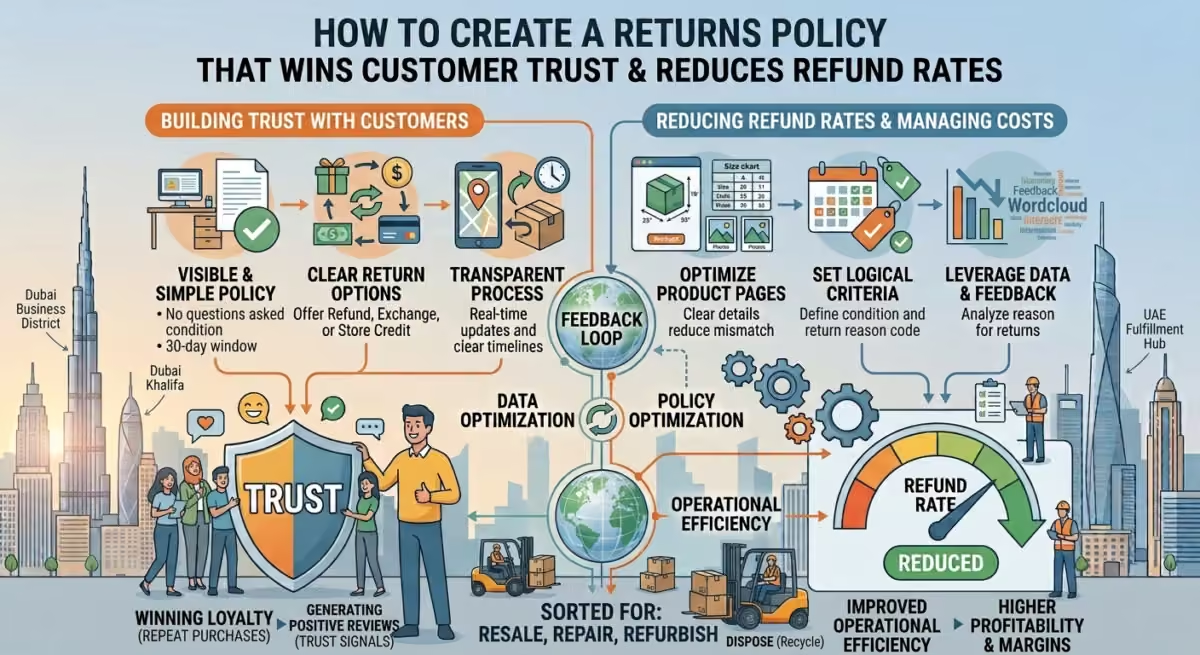
How to manage eCommerce returns in the UAE with reverse logistics, return policies, refunds and inventory restocking
How to Manage eCommerce Returns in UAE: Strategy, Policy and Logistics

Efficient returns management is essential for every UAE eCommerce business. From creating a customer-friendly return policy to streamlining reverse logistics and processing refunds quickly, this guide explains how to reduce return costs, improve customer satisfaction, and turn returns into a competitive advantage.

Read More
A medium-sized Jeebly delivery and moving truck parked outside a warehouse with its back doors wide open and a hydraulic lift gate lowered to the ground. Inside the cargo area, brown cardboard boxes are stacked neatly. The side of the truck features a dark blue advertisement wrap with the Jeebly logo, displaying a hand holding a house model under the text "Always on the Move from parcels to homes" and a call to action to "Explore it all on Jeebly NoW".
Packers and Movers in Dubai: What to Look for and How to Choose

Relocating in Dubai doesn’t have to be stressful. Whether you are moving apartments in Dubai Marina or upgrading your office space, discover the essential factors to look for in a professional moving company—from licensing and insurance to transparent pricing—and learn exactly how to choose the right team for a seamless move.

Read More
Infographic titled "Ecommerce Fulfilment in UAE: How It Works and What Businesses Should Look For." The left side shows a 5-step workflow: Online Store, Inventory, Picking & Packing, Dispatch, and Last Mile Delivery. The center features a map of the UAE with iconic cityscapes. The right side lists business requirements: Reliability & Speed, Advanced Technology, Real-Time Tracking, Scalability, and Customer Support.
eCommerce Fulfilment in UAE: How It Works and What Businesses Should Look For

Master your logistics strategy in the Middle East. Discover how e-commerce fulfillment works in the UAE—from warehousing to last-mile delivery—and learn the top 5 features your business needs from a fulfillment partner to scale successfully.

Read More
Categories
blogs

EMX vs Jeebly: Which Courier Delivers More Value for Your Business?

EMX vs Jeebly: Which Courier Delivers More Value for Your Business?

EMX vs Jeebly: Which Courier Delivers More Value for Your Business?

Your courier partner is not a vendor you swap easily. It shapes how customers experience your brand after checkout. In a market where the UAE’s e-commerce fulfilment services market is projected to reach USD 4.64 billion by 2030, that choice carries real commercial weight.

When comparing EMX vs Jeebly, most businesses find two genuinely different propositions, not just different price points. This article maps providers across service capabilities, technology, pricing structures, and e-commerce fit, so you can match the right partner to how your business actually operates.

What EMX and Jeebly Do and Where They Differ

EMX is part of the 7X Group, formerly Emirates Post Group, a government-backed logistics entity. 

* Its core services cover UAE domestic door-to-door delivery, GCC cross-border shipping via EMX International (KSA, Kuwait, Bahrain, Oman, Qatar, Jordan, Egypt), and freight forwarding by sea, land, and air, including customs clearance. 
* EMX International promises 2–4-day transit times to GCC markets. 
* EMX also runs a dedicated card solutions division that designs, manufactures, and delivers physical cards for government agencies, banks, and large corporations.

Jeebly was purpose-built for the UAE’s e-commerce market. 

* This 360° logistics company has grown to serve 12M+ customers, completing 50,000+ deliveries daily with a 98% First-Day Delivery Success (FDSS) rate across a fleet of 4,000+ vehicles. 
* Its service lines cover everything from 60-minute express delivery in Dubai to bulk freight and white-glove service. 
Where EMX operates with a broad government mandate, Jeebly’s infrastructure is calibrated to one outcome: helping online businesses deliver faster, retain customers, and scale without logistics becoming the bottleneck.

EMX vs Jeebly: Head-to-Head Comparison

No structured public comparison of these two providers exists in the market. Here is what UAE businesses need to know before making a choice.

Capability EMX Jeebly
Ownership 7X Group (government-backed) Independent, e-commerce-native
UAE Last-Mile Yes Yes, same-day and next-day
GCC Cross-Border Yes, EMX International, 2–4 days, customs included Yes, via Jeebly Dash International
Freight Forwarding Sea, land, air, and customs clearance Yes, via Jeebly Haul
Marketplace Integrations Limited public information Yes, Shopify, WooCommerce, Magento, and more
Self-Service Portal Not publicly available Yes, Jeebly Now portal
Real-Time Tracking Yes Yes, a centralised dashboard with ETA updates
COD Support Available Yes, with prompt remittances
Fulfillment & Warehousing Available Yes, including micro-fulfilment centres for Q-commerce
Card/Speciality Logistics Yes, dedicated division Not applicable
Primary Client Profile Government, banking, corporate accounts E-commerce merchants, SMEs, startups, D2C brands

The table tells the story clearly. EMX suits institutional logistics, whereas Jeebly is built for merchants who sell online and need a partner that handles the last mile as precisely as they handle the first sale.

Where Does Technology Make the Difference

For UAE e-commerce businesses, this is where the EMX vs Jeebly comparison becomes most commercially relevant.

EMX inherits the infrastructure of a government-affiliated group. It is stable, compliant, and capable of managing complex freight and customs across multiple markets. Its technology serves a wide stakeholder base.

Jeebly’s platform is merchant-first by design:

* The centralised dashboard provides businesses with real-time visibility into all orders. Dedicated Key Account Managers and coordinators handle issue resolution directly via WhatsApp groups, email, and direct calls.
 
* During peak seasons, when order volumes for clients like Carrefour and Amazon can double, Jeebly uses data-driven forecasting to scale fleet capacity and rider deployment in advance.
 
* When a client lacks full system integration, Jeebly’s operations team manages tracking and dashboards manually on their behalf.

The platform connects natively with Shopify, WooCommerce, Magento, ChatFood, and Grubtech. For businesses not yet on a major platform, the Jeebly One App allows sign-up in under five minutes with no minimum order commitment. 

That accessibility is a deliberate choice. It means startups and established retailers access the same technology infrastructure without a volume premium. See how Jeebly’s technology platform works!

Pricing Transparency: What UAE Businesses Should Know

Neither EMX nor Jeebly publishes a comprehensive public rate card. UAE logistics pricing is negotiated by volume, delivery zone, and service level. 

* That said, Jeebly publishes its base Dash rate: AED 17.31 for next-day delivery on packages up to 5 kg, with AED 2/kg above that threshold. No long-term contract is required to start.
* EMX rates are structured primarily around corporate, government, and banking accounts. For an e-commerce brand managing COD cycles, returns, and variable volumes, the pricing architecture and account management model can be a less natural fit.

The practical step is to request custom quotes from both providers with your actual order volumes and delivery zones.
Trying to get a realistic picture of what delivery actually costs your business? Read our guide on the Cost of Shipping for a Small Business in the UAE.

How Jeebly Is Built for UAE E-Commerce Businesses

Jeebly’s product suite maps directly to the operational needs of online merchants as the core of the company’s operations.

Jeebly Dash handles same-day delivery in Dubai and next-day delivery across the UAE, with cutoffs around 11 AM for same-day and 2–4 PM for next-day delivery. COD is fully supported.

* For cross-border needs, Jeebly Dash International covers the GCC, South Asia, and global destinations, offering end-to-end customs clearance and real-time tracking.

Jeebly Bizz is the umbrella for business logistics. It combines last-mile, warehousing and fulfilment, reverse logistics, international shipping, and temperature-controlled delivery on a single platform.

Jeebly Haul covers freight above 20 kg by road, air, and sea. Domestic UAE, cross-border GCC and MENA, with LTL options and customs documentation is handled end-to-end.

Jeebly Plus provides white-glove service for B2B clients delivering high-value products to their customers. It is chauffeur-led, fully trackable, and designed for luxury and premium categories.

Trusted by Mumzworld.com, Instashop, DOD UAE, and BFL Group, Jeebly carries AED 500M+ in combined revenue and AED 1.5B+ in shipments delivered.

How to Pick the Right UAE Courier for Your Business

Make note of these five quick questions that are worth working through before committing:

1. What is your primary delivery use case? For high-volume GCC freight, government contracts, or corporate card logistics, choose EMX. For the UAE last-mile e-commerce, same-day delivery, COD, and fulfillment, Jeebly is the right fit.

2. Do you sell on marketplaces or through your own store? Jeebly’s native integrations with Shopify, WooCommerce, and Magento automatically connect your orders to dispatch. That eliminates manual order pushing and reduces errors at scale.

3. How important is COD remittance speed? If COD accounts for a significant share of your orders, the remittance cycle time directly affects working capital. Jeebly’s prompt COD remittances are consistently cited by partners as a key operational advantage.

4. Are you planning to scale in the next 12 months? EMX is calibrated for enterprise-scale commitments. Jeebly is designed to grow alongside you, from your first 50 orders to peak-season surges, without requiring large upfront volume guarantees or complex onboarding.

5. Do you need GCC cross-border coverage? Both providers offer it. EMX International handles GCC parcels with a 2–4-day transit, including customs processing. Jeebly Dash International covers the GCC and beyond, offering real-time tracking and comprehensive customs support.

Conclusion

EMX is a strong fit for corporate freight, government logistics, and GCC cross-border at an institutional scale.

For UAE online merchants, whether you’re a startup shipping 100 parcels a month or an established retailer managing peak-season surges, Jeebly is the more relevant partner.

At Jeebly, we don’t just move parcels. We move businesses forward. If you’re ready to build logistics that scale with your ambition, talk to the Jeebly team and get a solution mapped to your specific volumes, routes, and growth targets.

Frequently Asked Questions

Jeebly Dash offers same-day delivery across Dubai with an 11 AM order cut-off, and express delivery within 60–120 minutes in the city. It is purpose-built for merchants that cannot afford failed or delayed deliveries.

Jeebly Dash’s published next-day rate starts at AED 17.31 for packages up to 5 kg, with no minimum order requirement. Community data for the Dubai SME market corroborates that range, with volume discounts available at higher order counts.

Yes. Both providers support COD. Jeebly is specifically recognised by partners for prompt COD remittances, which keeps cash flow predictable. It is a meaningful advantage for merchants where COD accounts for a significant share of orders.

Yes. Jeebly’s pay-as-you-go model requires no long-term contracts or minimum volumes. The self-service Jeebly One App lets businesses onboard in under five minutes, with access to the same dashboard, tracking, and operational support used by major brand partners.

EMX is a UAE logistics company within the 7X Group (formerly Emirates Post Group), a government-backed entity. EMX handles domestic UAE delivery, GCC cross-border e-commerce parcels via EMX International, freight forwarding, and specialist card services for government and financial institutions.

Routes to insightful reads

Delivery SLA guide for UAE businesses showing service level agreements, delivery performance metrics, on-time delivery targets and logistics standards.
 Delivery SLA Guide for UAE Businesses: What to Expect and How to Set Standards

A clear delivery Service Level Agreement (SLA) sets the expectations for speed, reliability, and performance between businesses and their logistics partners. This guide explains what a delivery SLA should include, the key metrics to track, and how UAE businesses can set realistic standards to improve customer satisfaction and delivery performance.

Read More
Dangerous goods and restricted items that cannot be shipped by courier in the UAE, including hazardous materials, prohibited products and customs restrictions.
Dangerous Goods and Restricted Items: What You Cannot Ship by Courier in the UAE

Shipping prohibited or restricted items can lead to delays, fines, shipment rejection, or legal consequences. This guide explains which dangerous goods and restricted items cannot be shipped by courier in the UAE, the regulations businesses should know, and how to stay compliant with UAE customs and courier requirements.

Read More
How to manage eCommerce returns in the UAE with reverse logistics, return policies, refunds and inventory restocking
How to Manage eCommerce Returns in UAE: Strategy, Policy and Logistics

Efficient returns management is essential for every UAE eCommerce business. From creating a customer-friendly return policy to streamlining reverse logistics and processing refunds quickly, this guide explains how to reduce return costs, improve customer satisfaction, and turn returns into a competitive advantage.

Read More
A medium-sized Jeebly delivery and moving truck parked outside a warehouse with its back doors wide open and a hydraulic lift gate lowered to the ground. Inside the cargo area, brown cardboard boxes are stacked neatly. The side of the truck features a dark blue advertisement wrap with the Jeebly logo, displaying a hand holding a house model under the text "Always on the Move from parcels to homes" and a call to action to "Explore it all on Jeebly NoW".
Packers and Movers in Dubai: What to Look for and How to Choose

Relocating in Dubai doesn’t have to be stressful. Whether you are moving apartments in Dubai Marina or upgrading your office space, discover the essential factors to look for in a professional moving company—from licensing and insurance to transparent pricing—and learn exactly how to choose the right team for a seamless move.

Read More
Infographic titled "Ecommerce Fulfilment in UAE: How It Works and What Businesses Should Look For." The left side shows a 5-step workflow: Online Store, Inventory, Picking & Packing, Dispatch, and Last Mile Delivery. The center features a map of the UAE with iconic cityscapes. The right side lists business requirements: Reliability & Speed, Advanced Technology, Real-Time Tracking, Scalability, and Customer Support.
eCommerce Fulfilment in UAE: How It Works and What Businesses Should Look For

Master your logistics strategy in the Middle East. Discover how e-commerce fulfillment works in the UAE—from warehousing to last-mile delivery—and learn the top 5 features your business needs from a fulfillment partner to scale successfully.

Read More

    Powered by