





Jeebly | Logistics Solutions

Categories
blogs

Logistics Companies in Dubai: How to Evaluate and Choose the Right Partner

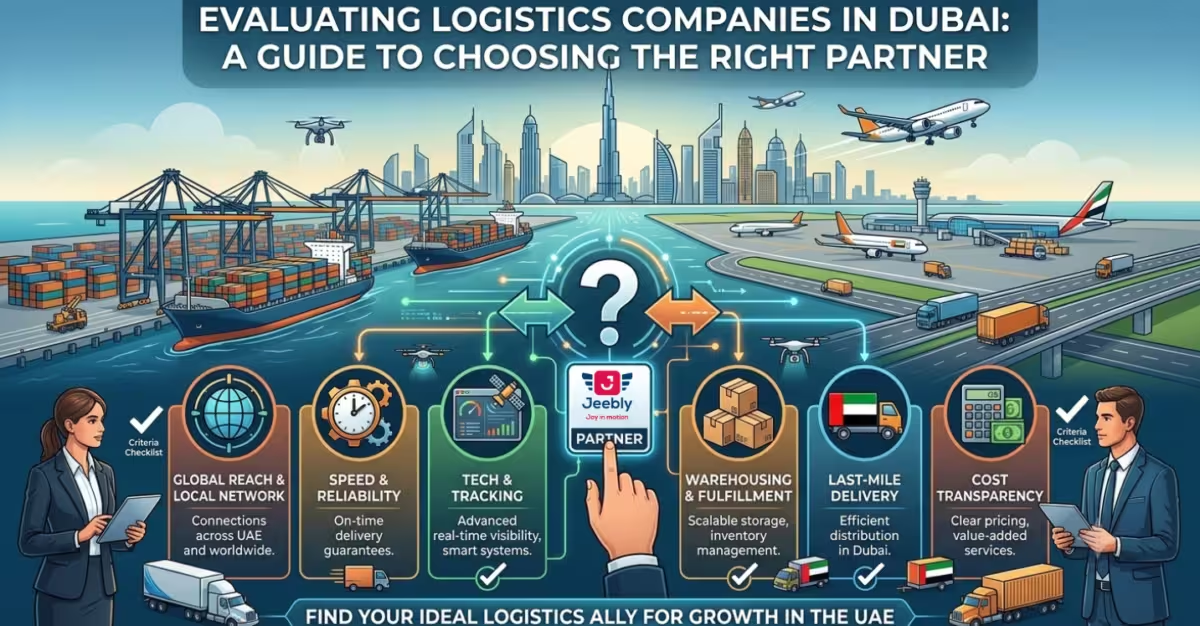
An infographic illustrating the evaluation of logistics companies in Dubai against the backdrop of the city skyline, port, and airport. It features a decision-making flow focused on key pillars like 'Global Reach & Local Network', 'Speed & Reliability', 'Tech & Tracking', 'Warehousing & Fulfillment', 'Last-Mile Delivery', and 'Cost Transparency'. A central question mark is linked to diverse transport modes and two business professionals review a 'Criteria Checklist'.

Logistics Companies in Dubai: How to Evaluate and Choose the Right Partner

Finding logistics companies in Dubai is the easy part. The city has many of them, from DP World’s global port network to nimble last-mile specialists built specifically for D2C e-commerce. Choosing the right one for your specific business is where most operators get it wrong. They default to the largest name, or the cheapest quote, without understanding which type of provider their operation actually needs.

This guide covers the structure of the Dubai logistics market. Understand the five criteria that genuinely distinguish a capable partner from an average one, and why most businesses end up with three logistics vendors when one would do.

How the Dubai Logistics Market Is Structured

Dubai’s logistics infrastructure is genuinely world-class. Jebel Ali Port in Dubai, UAE, is the 9th-busiest container port globally, handling 15.5 million TEUs in recent years. 

Dubai International Airport and the city’s 30+ free zones drive global logistics by offering 100% foreign ownership, zero corporate and personal taxes, and integrated customs operations that effortlessly connect Asia, Europe, and Africa.

But the scale of your infrastructure doesn’t automatically translate to great delivery performance for your customers. A provider with a 70,000 sq ft warehouse and 50 global trade lanes may have no coherent answer for a parcel arriving at an apartment in Jumeirah by tomorrow morning.

The market breaks into four functional categories:

  1. Global freight and port operators: DP World, CEVA, Kuehne+Nagel. Built for containerised freight, port haulage, and multinational supply chains. Not the right primary partner for SME or mid-market UAE domestic e-commerce.

  2. International express couriers: DHL Express, FedEx, Aramex, UPS. Strong for cross-border, time-definite international shipments. Domestic UAE last-mile is possible but not their primary focus; pricing reflects enterprise account structures.

  3. Tech-native last-mile and fulfilment platforms: Jeebly, Quiqup, iMile, Swftbox. Built specifically for UAE domestic e-commerce: same-day and next-day delivery, COD, Shopify integration, returns management, wallet top-up onboarding, with no minimum volume requirements.

  4. Specialist and vertical providers: cold chain (GSL, with five quality certifications for temperature ranges), maritime (GAC), document and government-adjacent (Emirates Post, Zajel).

Most e-commerce businesses need a provider from category two or three. The evaluation criteria that follow apply to both.

Five Criteria That Differentiate Logistics Companies in Dubai

1. First-attempt delivery rate

Every logistics provider claims a high delivery success rate. Few publish the actual rate against auditable volume. A failed first attempt isn’t just a re-delivery cost. It’s a customer who received a bad experience and may not order again.

Ask specifically for first-attempt delivery success (FDSS) data across your target coverage zone. 

For instance, Jeebly publishes 98% FDSS across 50,000+ daily deliveries as a verified operational metric. Use that as a benchmark when evaluating any provider.

2. COD infrastructure and remittance cycle

Secure COD continues to account for a significant share of UAE e-commerce transactions. The remittance cycle, how quickly collected cash is transferred back to your account, directly affects your working capital. A provider remitting fortnightly rather than weekly leaves an additional week of your revenue on hold at any given time. At volume, that’s a meaningful float.

Confirm: does the provider support COD as standard or as an add-on? What is the published remittance cycle? Is there a COD fee, and how is it calculated? Jeebly Dash remits weekly. Get any commitment in writing.

3. Platform integration depth

“We integrate with Shopify” means different things to different providers. Some offer a full bidirectional API: orders sync automatically, tracking updates are pushed to the customer in real time, and NDR events trigger automated follow-up workflows. Others require a manual CSV upload or a webhook that breaks under load.

Test the integration in a live environment before committing operationally. Jeebly integrates natively with Shopify, WooCommerce, Magento, ChatFood, and Grubtech. Orders sync without manual intervention.

4. Returns management

A solid 3PL logistics must provide an itemised breakdown of returns handling: confirmation of item condition at the point of return, the timeline from the customer’s door back to your warehouse, and a per-return fee structure. Most logistics providers handle forward delivery well and build reverse logistics as a reactive service. 

Ask your shortlisted provider for the end-to-end reverse flow before you need it, not after a customer complains.

Jeebly Bizz manages reverse logistics on the same platform as forward delivery, with a single tracking system, a single account, and a single invoice.

5. Peak-season scalability

Dubai’s logistics demand spikes materially during Ramadan, White Friday, and Eid. A provider whose fleet is primarily third-party riders recruited on an ad hoc basis has limited control over capacity and quality during these periods. A provider with an owned and managed fleet or a documented peak-capacity model can show you what happens at 3x normal volume.

Jeebly operates an active fleet of 4,000+ vehicles with a documented peak-season dispatch model. Ask any provider: how does your fleet capacity change during White Friday? What’s your on-time delivery SLA during peak versus standard periods? 

The answer reveals whether their normal-period performance is replicable when it matters most.

Warehouse Zone: A Decision That Affects Unit Economics More Than Rate Negotiation

This is one of the most commercially significant choices in Dubai’s logistics sector.

JAFZA (Jebel Ali Free Zone) gives you duty deferral. Goods imported into the zone are exempt from customs duty until they move to the UAE mainland. Dubai South positions you for airport speed, with fastest ground transit times to Dubai International Airport for outbound air freight. Your warehouse zone choice affects unit economics more than your rate negotiation does.

What this means practically:

  • Businesses using the UAE as a GCC distribution hub: importing in bulk and re-exporting to Saudi Arabia, Oman, or beyond, JAFZA is the correct structure. Duty is deferred until mainland sale; re-exports attract zero duty.

  • For businesses with fast-moving SKUs primarily for UAE domestic delivery, shipping from Dubai South or a Dubai mainland facility reduces ground transit time for customers.

  • Businesses requiring fast customs clearance on inbound air freight: proximity to DXB matters.

Any logistics provider offering warehousing should be able to explain how their facility location affects your duty liability and domestic delivery SLA. If they can’t, that’s a gap worth probing.

For the full import and compliance picture, UAE Import and Export Guide: Trade Documentation, Logistics and Compliance covers the free zone vs mainland decision in detail.

The Multi-Carrier Problem and How to Avoid It

Most brands operating in Dubai end up working with two, three, or more carriers. That’s operationally smart at the provider level, but it creates a real management problem: fragmented dashboards, inconsistent tracking experiences, and failed deliveries that slip through the cracks between handoffs.

Each additional vendor relationship adds: 

  1. a separate tracking system to monitor 
  2. a separate invoice cycle to reconcile 
  3. a separate account manager to chase when something goes wrong
  4. a separate SLA to enforce

The overhead compounds with scale.

The alternative is a provider that covers multiple lanes on a single operational platform. For UAE e-commerce businesses managing regular inbound inventory alongside outbound B2C deliveries, Jeebly Haul covers the freight leg, and Jeebly Dash covers domestic last-mile via the same platform, with unified tracking and a single remittance cycle.

For a direct comparison of UAE last-mile operators on FDSS, COD, and integration capability before deciding, Best Courier Services in UAE: 2026 Comparison Guide covers the full provider landscape.

How Jeebly Is Positioned in the Dubai Logistics Market

Jeebly is structured specifically to solve the consolidation problem for UAE e-commerce businesses. Rather than requiring separate vendors for last-mile, freight, fulfilment, and returns, the platform covers all four:

Jeebly Dash: same-day and next-day domestic delivery across all seven UAE emirates. Published base rate is AED 17.31 per parcel up to 5 kg. 98% FDSS. Wallet top-up onboarding with no minimum volume. Jeebly operates on a pay-as-you-go model with transparent pricing, making it accessible for growing ecommerce businesses.

Jeebly Haul: road, air, and ocean freight. Custom-quoted for shipments above 20 kg. 2,000+ active fleet vehicles, 70+ transporter partners, GCC-wide coverage. Customs clearance managed in-house, not outsourced.

Jeebly Bizz: warehousing, pick-and-pack, automated dispatch, reverse logistics, and B2B supply chain management. Native integrations with Shopify, WooCommerce, and Magento. Built for businesses running 50+ orders daily where manual coordination creates a ceiling on growth.

Jeebly Moveo: relocation services for homes and workspaces, covering the delivery of large items and managed moves.

Talk to the Jeebly team to map out the right setup for your order profile, coverage zones, and fulfilment requirements.

Frequently Asked Questions

Dubai has four main categories: global freight and port operators (DP World, CEVA) for containerised freight and port operations; international express couriers (DHL, Aramex, FedEx) for cross-border and enterprise shipments; tech-native last-mile and fulfilment platforms (Jeebly, Quiqup, iMile) for UAE domestic e-commerce; and vertical specialists for cold chain, maritime, and government-adjacent delivery.

Evaluate five things: published first-attempt delivery rate, COD remittance cycle, integration depth with your e-commerce platform, returns management process, and peak-season fleet capacity. A provider that answers all five clearly in writing is one you can plan around.

JAFZA (Jebel Ali Free Zone) gives duty deferral on imported goods. Standard customs duty doesn’t apply until goods leave the free zone for the UAE mainland. Dubai South offers faster ground transit to Dubai International Airport, suited to businesses with high outbound air freight volume. Zone choice affects total landed costs more than per-parcel rate negotiation.

No. Jeebly Dash operates on a wallet top-up model with no minimum order volume, making it accessible from the first order. Volume-based commercial terms are available as order volume scales.

COD handling varies significantly between providers. Most UAE logistics companies support COD collection, but remittance cycles range from weekly to monthly. Jeebly Dash remits COD weekly. Always confirm the remittance cycle in writing before signing. A fortnightly float on high COD volume directly affects your working capital.

Routes to insightful reads

Delivery SLA guide for UAE businesses showing service level agreements, delivery performance metrics, on-time delivery targets and logistics standards.
 Delivery SLA Guide for UAE Businesses: What to Expect and How to Set Standards

A clear delivery Service Level Agreement (SLA) sets the expectations for speed, reliability, and performance between businesses and their logistics partners. This guide explains what a delivery SLA should include, the key metrics to track, and how UAE businesses can set realistic standards to improve customer satisfaction and delivery performance.

Read More
Dangerous goods and restricted items that cannot be shipped by courier in the UAE, including hazardous materials, prohibited products and customs restrictions.
Dangerous Goods and Restricted Items: What You Cannot Ship by Courier in the UAE

Shipping prohibited or restricted items can lead to delays, fines, shipment rejection, or legal consequences. This guide explains which dangerous goods and restricted items cannot be shipped by courier in the UAE, the regulations businesses should know, and how to stay compliant with UAE customs and courier requirements.

Read More
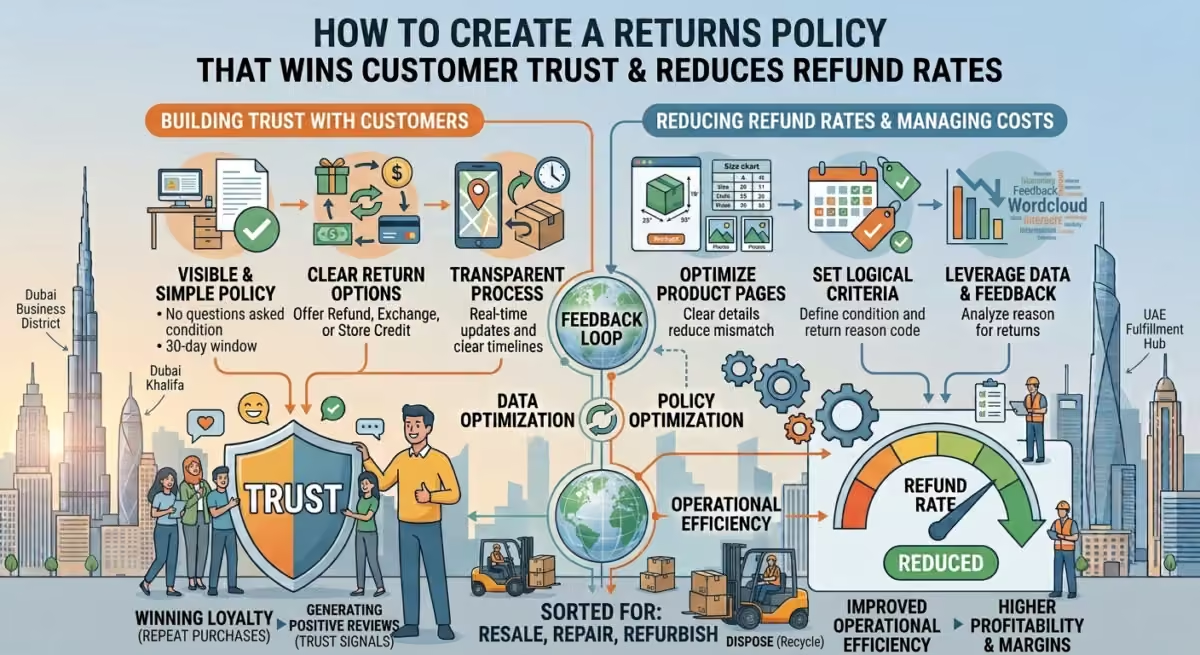
How to manage eCommerce returns in the UAE with reverse logistics, return policies, refunds and inventory restocking
How to Manage eCommerce Returns in UAE: Strategy, Policy and Logistics

Efficient returns management is essential for every UAE eCommerce business. From creating a customer-friendly return policy to streamlining reverse logistics and processing refunds quickly, this guide explains how to reduce return costs, improve customer satisfaction, and turn returns into a competitive advantage.

Read More
A medium-sized Jeebly delivery and moving truck parked outside a warehouse with its back doors wide open and a hydraulic lift gate lowered to the ground. Inside the cargo area, brown cardboard boxes are stacked neatly. The side of the truck features a dark blue advertisement wrap with the Jeebly logo, displaying a hand holding a house model under the text "Always on the Move from parcels to homes" and a call to action to "Explore it all on Jeebly NoW".
Packers and Movers in Dubai: What to Look for and How to Choose

Relocating in Dubai doesn’t have to be stressful. Whether you are moving apartments in Dubai Marina or upgrading your office space, discover the essential factors to look for in a professional moving company—from licensing and insurance to transparent pricing—and learn exactly how to choose the right team for a seamless move.

Read More
Infographic titled "Ecommerce Fulfilment in UAE: How It Works and What Businesses Should Look For." The left side shows a 5-step workflow: Online Store, Inventory, Picking & Packing, Dispatch, and Last Mile Delivery. The center features a map of the UAE with iconic cityscapes. The right side lists business requirements: Reliability & Speed, Advanced Technology, Real-Time Tracking, Scalability, and Customer Support.
eCommerce Fulfilment in UAE: How It Works and What Businesses Should Look For

Master your logistics strategy in the Middle East. Discover how e-commerce fulfillment works in the UAE—from warehousing to last-mile delivery—and learn the top 5 features your business needs from a fulfillment partner to scale successfully.

Read More
Categories
blogs

Best delivery service for TikTok & Instagram sellers in Dubai (2026)

Best Delivery for Social Sellers in Dubai

Best Delivery Service for Social Sellers in Dubai: The Complete 2026 Guide

Social sellers in Dubai need a delivery partner that supports cash on delivery, same-day dispatch and easy returns. Here’s how leading delivery services compare for TikTok, Instagram and WhatsApp sellers in 2026.

Dubai’s e-commerce ecosystem is rapidly evolving — and at the heart of it are social sellers. From Instagram boutiques and TikTok stores to WhatsApp-based businesses, small sellers are reaching thousands of customers daily across the UAE. But one thing determines whether those customers come back: whether the delivery experience matches the quality of what was sold.

Social sellers in Dubai don’t just need speed. They need flexibility, real-time tracking, COD collection, and a logistics partner that understands how social commerce actually works, orders flowing through DMs, not checkout pages. That partner is Jeebly.

📱  Social commerce in the UAE: Over 70% of UAE consumers discover products via social media, and the UAE has one of the highest social commerce conversion rates in the MENA region. For social sellers, logistics is the single biggest gap between a great product and a loyal customer base.

What Makes Jeebly the Best Delivery Service for Social Sellers in Dubai?

Whether you’re shipping clothing, skincare, handmade items, electronics, or food — Jeebly is engineered to support social sellers who want to scale fast and professionally. Here’s a full breakdown of what sets Jeebly apart:

Same-Day, Next-Day, and Express Delivery for Dubai Social Sellers: Speed That Matches Customer Expectations

Express 60-Minute Delivery Within Dubai for Urgent Social Commerce Orders

In Dubai’s competitive social selling environment, delivery speed is a direct driver of reviews, repeat purchases, and word-of-mouth referrals. Jeebly offers three delivery tiers to match every order urgency:

•    Express delivery — order fulfilled within 60 minutes across Dubai , ideal for surprise gifts, last-minute orders, and high-urgency customers
•    Same-day delivery — order delivered the same day across all of Dubai
•    Next-day delivery — UAE-wide coverage including Abu Dhabi, Sharjah, Ajman, Ras Al Khaimah, Fujairah, and Umm Al Quwain

Jeebly Delivery Cut-Off Times for Dubai Social Sellers — Book Before These Deadlines

Missing a cut-off by even 30 minutes means your customer waits an extra day. Here are Jeebly’s confirmed cut-off times for each service:

Service Cut-Off Time Coverage
Express (60 min) Book by 8:00 PM Dubai
Same-Day Delivery Book by 11:00 AM Dubai
Next-Day Delivery Book by 4:00 PM All UAE emirates

⏰  Pro Tip:  For same-day delivery, confirm your customer’s address and readiness before 11:30 AM. Bookings made before noon have the highest first-attempt success rate for Dubai social commerce orders.

Cash on Delivery for Dubai Social Sellers: How Jeebly Makes COD Safe, Fast, and Profitable

Why COD Remains Essential for Social Commerce in Dubai — and How to Manage It Without the Risk

COD remains the preferred payment method for a significant proportion of UAE customers — particularly first-time buyers from social platforms who haven’t yet built trust with a new seller. Refusing COD means losing these sales permanently.

Jeebly’s COD infrastructure is built to make cash collection safe, transparent, and fast for social sellers:

How Jeebly COD Remittance Works for Dubai Social Sellers

•    Jeebly riders collect cash from your customer at the point of delivery
•    Daily reconciliation — every dirham is logged and tracked in your Jeebly One dashboard
•    Weekly remittance — collected COD is transferred to your bank account within 7 calendar days
•    Full reconciliation report sent with every transfer — no surprises, no hidden deductions
•    No CCOD (Cheque on Delivery) — cash only, clearing faster than any cheque-based system

For the full COD security and remittance guide: How Jeebly Ensures Secure COD Transactions in the UAE →

💰  Cash Flow Advantage:  Social sellers using Jeebly receive COD remittance within 7 days — compared to 14–30 day cycles with some logistics providers in the UAE. For a seller doing 100 COD orders/month at AED 150 average, that’s AED 15,000 in working capital arriving a full week earlier.

Jeebly One App: The Mobile Delivery Platform Built for Dubai Social Commerce Sellers

How to Manage Instagram, WhatsApp, and TikTok Orders From a Single App

The Jeebly One app gives social sellers in Dubai a full delivery command centre in their pocket — no laptop required, no complex integrations, no courier chasing. Here’s what the app gives you:

•    Book same-day, express, next-day directly from your phone in under 2 minutes
•    Share a live tracking link with your customer via WhatsApp in one tap, eliminating the most common DM: ‘Where is my order?’
•    Live COD dashboard — see exactly which orders have been collected, are pending, or have been remitted to your account
•    Failed delivery alerts with instant re-attempt scheduling, no lost orders
•    Bulk order upload for high-volume days, ideal after a viral post or campaign launch that attracts a big client
•    Order history and delivery performance reports, identify patterns and optimise your process

For social sellers on Instagram, WhatsApp, or TikTok who manage everything from a phone, Jeebly One removes the last major operational friction point between taking an order and getting paid.

Seamless Integration with Social Selling Platforms and E-Commerce Stores in the UAE

How Jeebly Connects with WhatsApp Business, Instagram Shops, TikTok Shop, Shopify, and WooCommerce

Jeebly is built to fit into how social sellers already work, not the other way around. Integration options include:

•    Manual order entry via the Jeebly One app, ideal for WhatsApp and Instagram DM-based sellers who receive orders conversationally
•    Bulk CSV import — upload multiple orders at once, perfect for large and enterprise level businesses
•    API integration with Shopify, WooCommerce, Magento, and other major UAE e-commerce platforms, orders flow directly from your store to Jeebly’s network
•    Custom dashboard access via web or app, view all order statuses, delivery updates, and COD summaries in one place

There is no minimum order volume requirement. A seller shipping 5 orders/week and one shipping 500 orders/week use exactly the same platform and receive the same service quality.

Real-Time Delivery Updates for Dubai Social Commerce: Give Your Customers the Premium Experience

Customers who buy from social sellers hold the seller personally accountable for the delivery experience, not the logistics provider. One ‘where is my order?’ DM left unanswered can turn into a public complaint.
Jeebly eliminates this entirely:

•    Customers receive a personalised tracking link via WhatsApp or SMS immediately after dispatch
•    Real-time delivery ETA updates, customers know exactly when to expect their order
•    Live driver location updates as the order approaches
•    Delivery confirmation notification with driver photo proof of delivery

Transparent Pricing and Dedicated Account Support for Social Sellers in Dubai

Pay-Per-Shipment Delivery Pricing With No Hidden Fees and No Minimum Orders

Jeebly’s pricing model is built around how social sellers actually operate:

•    Per shipment pricing, you pay only for the deliveries you make, no monthly retainer
•    No minimum order volume — ship 1 order or 1,000, the pricing model works the same
•    No hidden surcharges, the price you’re quoted is the price you pay
•    Competitive per-kg and flat rates depending on delivery type and zone

Dedicated Account Manager Support for Growing Social Commerce Businesses in Dubai

As a social seller scaling through Jeebly, you’re assigned a dedicated account manager — not a generic support queue. Your account manager helps you:

•    Resolve missed or failed deliveries quickly without you having to follow up repeatedly
•    Optimise delivery zones and timing to improve your first attempt success rate
•    Scale operations during peak periods, Ramadan, White Friday, product launches
•    Access Jeebly’s warehousing and fulfilment services when you’re ready to graduate from home fulfilment

The Bottom Line: Why Jeebly Is the Best Delivery Partner for Social Sellers in Dubai

Social selling in Dubai is a high-growth, high-competition space. The sellers who win are the ones who get the fundamentals right — great products, responsive communication, and delivery that matches the promise made in the caption or DM.

Jeebly gives Dubai social sellers everything needed to deliver on that promise: express and same-day delivery with clear cut-off times, secure COD collection with 7-day remittance, real time tracking that customers can actually use, and a mobile app that makes the whole operation manageable from a phone.

No fleet. No warehouse. No minimum orders. Just a smarter way to deliver.

Frequently Asked Questions

The best courier for social sellers depends on factors such as delivery speed, coverage, tracking capabilities, cash-on-delivery (COD) support, and return management. Social sellers should look for logistics partners that offer reliable last-mile delivery, real-time tracking, flexible delivery options, and scalable services that can grow with their business.

Many delivery companies support social commerce businesses that sell through platforms such as TikTok, Instagram, Facebook, and WhatsApp. While platform integrations vary by provider, logistics companies often offer shipment booking, tracking, cash collection, and fulfilment services that help social sellers manage orders efficiently.

Yes. Many courier and logistics providers in Dubai offer cash-on-delivery (COD) services for social sellers. COD remains a popular payment option in the UAE and can help businesses build customer trust while increasing order conversion rates.

Social sellers can manage returns by establishing a clear return policy, providing customers with return instructions, and partnering with logistics providers that offer reverse logistics services. A structured returns process helps improve customer satisfaction and makes order management more efficient.

The best delivery app for Instagram sellers is one that provides fast delivery, shipment tracking, COD support, easy booking, and reliable customer service. Sellers should choose a logistics platform that can handle growing order volumes while providing visibility and flexibility throughout the delivery process.

Yes. Jeebly offers next-day and scheduled delivery across all seven UAE emirates — Abu Dhabi, Sharjah, Ajman, Ras Al Khaimah, Fujairah, and Umm Al Quwain. Inter-emirate deliveries require booking by 4:00 PM the previous day.

Failed deliveries trigger an instant alert in the Jeebly One app. You can schedule a re-attempt with one tap. Jeebly tracks COD refusal patterns and reports them to help you reduce failures over time.

Categories
blogs

Reduce last-mile delivery costs in UAE: 7 proven strategies for 2026

How to Reduce Last-Mile Delivery Costs in the UAE (2026 Guide)

How to Reduce Last-Mile Delivery Costs in the UAE: A Practical Guide for Business Owners

Last-mile delivery accounts for up to 53% of total shipping costs. UAE businesses are using route optimisation, consolidated deliveries and third-party logistics providers to reduce costs by 20–30%.

Last-mile delivery is the most expensive part of your supply chain — and for most UAE businesses, it’s also the least optimised.

The final leg from warehouse to customer door accounts for 53% of total shipping costs on average. In the UAE, where customer expectations for same-day and next-day delivery are set by Amazon and noon, the pressure to absorb those costs is only growing.

The good news: the businesses winning on logistics in the UAE are not spending more. They’re structured differently. This guide covers exactly what they do — and where Jeebly fits into that equation.

Why Last-Mile Costs Are Higher in the UAE Than You Think

Before the fixes, it’s worth understanding what’s actually driving the costs. UAE last-mile operations face a specific set of compounding pressures:

Failed first-attempt deliveries are a significant cost multiplier. Every re-delivery attempt adds driver time, fuel, and vehicle wear — with zero additional revenue. Failed attempts are more common when customers are unreachable, addresses are imprecise, or delivery windows don’t match customer schedules.

Inter-emirate routing complexity means a next-day delivery from Dubai to Ras Al Khaimah or Umm Al Quwain is not a simple extension of your Dubai operation. Road time, driver allocation, and fuel costs change substantially across the seven emirates.

Seasonal demand spikes, Ramadan, White Friday, Eid, Dubai Shopping Festival — create volume surges that manual operations cannot scale to absorb efficiently. Overstaffing during normal periods wastes money. Understaffing during peaks loses orders and damages customer trust.

COD reconciliation overhead adds administrative cost that purely digital markets don’t face. Cash-on-delivery remains standard in UAE last-mile; collecting, reconciling, and remitting it takes time and process.

Fix these structural issues and the cost reduction follows. Here’s how.

5 Proven Ways to Reduce Last-Mile Delivery Costs in the UAE

1. Switch from in-house delivery to an outsourced last-mile partner

This is the highest impact decision most UAE SMEs and e commerce brands can make, and the one most delayed because it feels like a loss of control.

The economics are straightforward. Building an in house delivery operation in Dubai means vehicle leasing or purchase, driver hiring and training, fuel management, insurance, maintenance, and a dispatch team. These are fixed costs you carry whether you ship 50 orders a day or 500.

A last mile partner converts all of that into a variable cost. You pay per delivery. When volume drops, your cost drops. When volume spikes, the partner absorbs the capacity, without you hiring additional drivers or leasing more vehicles.

For businesses shipping fewer than 500 orders a day, outsourced last mile is almost always cheaper than in house when total cost of ownership is calculated correctly.

Jeebly’s next-day delivery across all seven emirates is priced at AED 17.31 per shipment up to 5 kg, a flat rate that covers the full UAE network with no zone surcharges. For same day delivery within Dubai, Jeebly Dash operates with a cut off at 11 AM. That’s a fixed, predictable cost per order that you can model directly into your unit economics.

Explore Jeebly’s delivery services →

2. Optimise delivery routes with real-time intelligence

Manual routing — assigning drivers to zones and trusting them to navigate, is one of the most consistent sources of avoidable cost in UAE last mile operations.
AI-driven route optimisation does several things manual routing cannot:

* Accounts for UAE-specific variables: prayer time windows, mall traffic during sale seasons, inter-emirate road differences, and temperature-driven delivery window constraints in summer
* Dynamically re-routes when traffic conditions change mid-shift
* Sequences deliveries to minimise backtracking and unnecessary kilometres
* Reduces first-attempt failure rates by pairing smarter windows with proactive customer communication

Route optimisation technology has been shown to reduce travel time and fuel costs materially for logistics operations. The gains compound: fewer kilometres means lower fuel spend, lower vehicle wear, and more deliveries per driver per shift.
Jeebly’s platform uses automated routing and dispatch built into the Jeebly One app, with real-time tracking visible to both the business and the customer.

3. Reduce failed delivery attempts with proactive communication

A failed delivery attempt is a hidden tax on your last-mile operation. The direct cost is the re-delivery. The indirect cost is the customer experience damage and the administrative overhead of rescheduling.

In the UAE, failed attempts are disproportionately caused by:

* Customers not home during the delivery window
* Imprecise addresses (a persistent challenge outside Dubai’s well-mapped urban grid)
* No advance notice given to the customer

The fix is systematic, not heroic. Proactive SMS or push notification before arrival, real-time tracking links shared with customers, and digital proof of delivery (photo) reduce failed attempts and eliminate disputes.

Jeebly provides real-time delivery status updates at every stage and digital proof of delivery as standard, not an add-on.

4. Store inventory closer to your customers

If your fulfilment centre is in one location and a significant portion of your orders ship to customers across multiple emirates, you are paying for distance on every order.

Micro-fulfillment centres, smaller, strategically located dark stores closer to end customers — are the structural answer to this. They reduce last-mile distance, enable faster delivery windows, and lower per-order fuel and time costs.

Jeebly operates seven Micro Fulfilment Centres (MFCs) across the UAE for select clients, enabling 10-minute delivery within covered zones. Businesses that store inventory at Jeebly’s fulfilment centres in Dubai, Abu Dhabi, and Sharjah gain network proximity without leasing or managing the space themselves.

Talk to Jeebly about fulfillment centre access →

5. Automate dispatch, order management, and COD reconciliation

Manual order processing is where errors, delays, and labour costs accumulate invisibly. Every order that requires a human to read it, assign it, and log it is an order that costs more than it should.

Direct integration between your e-commerce store and your logistics platform eliminates this layer entirely. Orders placed on Shopify, Magento, or WooCommerce flow automatically into the dispatch system — no manual entry, no transcription errors, no delay between order confirmation and dispatch trigger.

COD reconciliation — a uniquely UAE overhead — is handled automatically when your logistics partner provides a live dashboard with COD amounts, delivery status, and weekly remittance built in.

Jeebly integrates directly with Shopify, Magento, WooCommerce, and custom APIs. The live dashboard shows order status, COD pending remittance, delivery tracking, and invoices in one place. Weekly COD remittance is standard.

What This Looks Like in Practice: The Jeebly Cost Model

For a UAE e-commerce business shipping 200 orders per day, the cost comparison between in-house delivery and outsourcing to Jeebly typically looks like this:


Cost elementIn-house estimateJeebly
Per-delivery cost (next-day, up to 5 kg)AED 25–40+ (blended, including fixed costs)AED 17.31 flat
Inter-emirate coverageRequires separate arrangementsAll 7 emirates included
Same-day capabilityRequires dedicated fleetJeebly Dash, Dubai
COD remittanceManual, internal overheadWeekly, automated
Returns handlingManual, unstructuredDoorstep QC, return-to-warehouse
E-commerce integrationCustom build requiredShopify, Magento, WooCommerce, API

The per-delivery gap alone — at 200 orders daily — represents a material cost saving before fixed overhead is accounted for.

The Most Expensive Mistake UAE Businesses Make on Last-Mile

Treating last-mile delivery as a fixed cost rather than a variable one.

Businesses that maintain in-house delivery fleets and teams carry those costs regardless of order volume. The margin compression is worst during slow periods — but the operational strain is worst during peaks, when the fixed infrastructure cannot scale fast enough without emergency spend.

The businesses reducing last-mile costs most effectively in the UAE are the ones that have converted their logistics from a capital-heavy fixed cost into a per-order variable cost — and reinvested the difference into growth. 

Ready to Reduce Your Last-Mile Costs?

Treating last-mile delivery as a fixed cost rather than a variable one.

Businesses that maintain in-house delivery fleets and teams carry those costs regardless of order volume. The margin compression is worst during slow periods — but the operational strain is worst during peaks, when the fixed infrastructure cannot scale fast enough without emergency spend.

The businesses reducing last-mile costs most effectively in the UAE are the ones that have converted their logistics from a capital-heavy fixed cost into a per-order variable cost — and reinvested the difference into growth. 

See how Jeebly works for UAE businesses like yours →

Download the Jeebly One app →

Frequently Asked Questions

The cost of last-mile delivery in the UAE varies depending on factors such as shipment size, delivery distance, service speed, and delivery volume. Businesses can often reduce per-delivery costs by consolidating shipments, optimizing routes, and working with logistics providers that offer scalable pricing models.

Businesses can reduce failed deliveries by collecting accurate customer addresses, providing real-time tracking updates, confirming delivery details before dispatch, and maintaining clear communication with recipients. Offering flexible delivery windows and alternative delivery options can also improve first-attempt delivery success rates.

Yes. A third-party logistics (3PL) provider can help reduce delivery costs by leveraging established transportation networks, route optimization technology, operational expertise, and economies of scale. This allows businesses to avoid the costs of managing their own delivery fleet while improving delivery efficiency.

Route optimization helps reduce delivery costs by identifying the most efficient delivery paths based on factors such as distance, traffic conditions, delivery density, and time windows. This can lower fuel consumption, reduce driver hours, improve vehicle utilization, and increase the number of deliveries completed per route.

The most cost-effective delivery option depends on shipment volume, delivery speed requirements, and destination. For many businesses, scheduled deliveries, consolidated shipments, and economy delivery services offer lower costs than on-demand or express options. Working with a logistics partner that can match delivery services to business needs can further improve cost efficiency.

Routes to insightful reads

Delivery SLA guide for UAE businesses showing service level agreements, delivery performance metrics, on-time delivery targets and logistics standards.
 Delivery SLA Guide for UAE Businesses: What to Expect and How to Set Standards

A clear delivery Service Level Agreement (SLA) sets the expectations for speed, reliability, and performance between businesses and their logistics partners. This guide explains what a delivery SLA should include, the key metrics to track, and how UAE businesses can set realistic standards to improve customer satisfaction and delivery performance.

Read More
Dangerous goods and restricted items that cannot be shipped by courier in the UAE, including hazardous materials, prohibited products and customs restrictions.
Dangerous Goods and Restricted Items: What You Cannot Ship by Courier in the UAE

Shipping prohibited or restricted items can lead to delays, fines, shipment rejection, or legal consequences. This guide explains which dangerous goods and restricted items cannot be shipped by courier in the UAE, the regulations businesses should know, and how to stay compliant with UAE customs and courier requirements.

Read More
How to manage eCommerce returns in the UAE with reverse logistics, return policies, refunds and inventory restocking
How to Manage eCommerce Returns in UAE: Strategy, Policy and Logistics

Efficient returns management is essential for every UAE eCommerce business. From creating a customer-friendly return policy to streamlining reverse logistics and processing refunds quickly, this guide explains how to reduce return costs, improve customer satisfaction, and turn returns into a competitive advantage.

Read More
A medium-sized Jeebly delivery and moving truck parked outside a warehouse with its back doors wide open and a hydraulic lift gate lowered to the ground. Inside the cargo area, brown cardboard boxes are stacked neatly. The side of the truck features a dark blue advertisement wrap with the Jeebly logo, displaying a hand holding a house model under the text "Always on the Move from parcels to homes" and a call to action to "Explore it all on Jeebly NoW".
Packers and Movers in Dubai: What to Look for and How to Choose

Relocating in Dubai doesn’t have to be stressful. Whether you are moving apartments in Dubai Marina or upgrading your office space, discover the essential factors to look for in a professional moving company—from licensing and insurance to transparent pricing—and learn exactly how to choose the right team for a seamless move.

Read More
Infographic titled "Ecommerce Fulfilment in UAE: How It Works and What Businesses Should Look For." The left side shows a 5-step workflow: Online Store, Inventory, Picking & Packing, Dispatch, and Last Mile Delivery. The center features a map of the UAE with iconic cityscapes. The right side lists business requirements: Reliability & Speed, Advanced Technology, Real-Time Tracking, Scalability, and Customer Support.
eCommerce Fulfilment in UAE: How It Works and What Businesses Should Look For

Master your logistics strategy in the Middle East. Discover how e-commerce fulfillment works in the UAE—from warehousing to last-mile delivery—and learn the top 5 features your business needs from a fulfillment partner to scale successfully.

Read More

    Powered by