





Jeebly | Logistics Solutions

Categories
blogs

3PL vs 4PL: What Is the Difference and Which Does Your UAE Business Need?

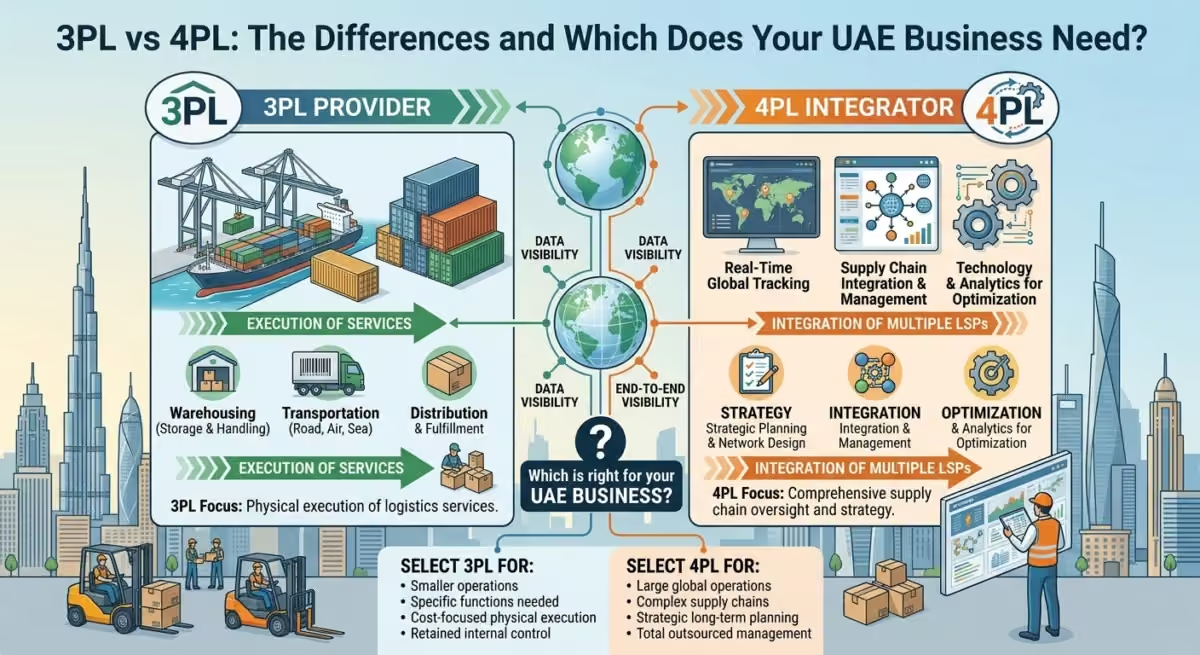
3PL vs 4PL logistics comparison showing warehousing, transportation, distribution, supply chain integration, technology, analytics, and strategic planning for UAE businesses

3PL vs 4PL: What Is the Difference and Which Does Your UAE Business Need?

The difference between a 3PL and a 4PL comes down to one question: do you need a logistics partner that does the work, or one that manages the entire system? 

A 3PL (Third-Party Logistics) provider physically handles your goods, such as warehousing, picking, packing, and shipping. A 4PL (Fourth-Party Logistics) provider sits above that layer, coordinating multiple logistics partners across your full supply chain without necessarily touching the goods themselves.

For most UAE e-commerce businesses, a 3PL is the right starting point and remains the right model well into significant scale. A 4PL becomes relevant when your supply chain spans multiple countries, carriers, and 3PLs that need to be coordinated under a single strategic layer. This guide explains both models clearly, where the line is, and how to know which one your operation actually needs.

Key Takeaways

  • A 3PL handles logistics execution such as warehousing, pick and pack, shipping, and returns, while you retain strategic control of your supply chain.

  • A 4PL manages the entire supply chain strategy, coordinating multiple 3PLs and logistics providers on your behalf, typically without owning warehouses or trucks.

  • In 2026, the best 3PLs increasingly offer capabilities that were traditionally in 4PL territory, such as multi-carrier management, real-time analytics, and cross-channel integration. This is making the distinction less clear-cut than it once was.

  • Secure COD, same-day delivery capability, and Shopify or WooCommerce integration are the UAE-specific 3PL capabilities to evaluate before the 3PL vs 4PL question becomes relevant.

What Is a 3PL (Third-Party Logistics)?

A 3PL provider handles the physical execution of your logistics. They receive your inventory, store it in their warehouse, pick and pack individual orders, dispatch them via courier, and manage returns. 

You retain strategic control: you decide which products to stock, which markets to sell in, and what delivery promises to make. The 3PL executes the operational layer underneath those decisions.

What a 3PL typically covers:

  • Receiving inbound stock and logging it against purchase orders
  • Warehousing and inventory management via a WMS (Warehouse Management System)
  • Pick and pack for individual customer orders
  • Carrier selection and dispatch
  • Last-mile delivery through courier integrations
  • Returns management and reverse logistics
  • Real-time inventory reporting and order tracking

A 3PL owns or leases physical assets and has direct, hands-on involvement in moving your product. A 3PL touches your product, touches your orders, touches your shipments. They are the ones actively driving your customer experience.

In UAE e-commerce, the 3PL also manages COD collection, remittance to the business, and the NDR (Non-Delivery Report) process when a first delivery attempt fails. These are UAE-specific operational functions that can directly affect your customer experience and cash flow.

What Is a 4PL (Fourth-Party Logistics)?

A 4PL provider manages your entire supply chain from a strategic, top-down level. Unlike a 3PL, which handles day-to-day execution, a fourth-party logistics provider oversees the entire supply chain. They typically don’t own warehouses or trucks. Instead, they focus on strategy, optimisation, and orchestration, making sure all logistics partners and systems work together seamlessly across the supply chain.

In practice, a 4PL selects and manages your 3PLs, negotiates carrier contracts, monitors performance across all providers, and builds the technology layer that connects them. You have one point of accountability, i.e. the 4PL, and they handle the coordination with everyone else.

What a 4PL typically covers:

  • Supply chain strategy and network design
  • Selection and management of multiple 3PL providers
  • Carrier negotiation and performance monitoring
  • Technology integration across all logistics systems
  • Cross-border customs strategy and compliance oversight
  • Demand forecasting and inventory positioning across multiple geographies
  • Single reporting layer across the entire supply chain

The global 4PL market reached an estimated USD 72.10 billion in 2025 and is projected to grow from USD 78.01 billion in 2026 to USD 158.61 billion by 2035. That growth reflects the needs of complex multinational businesses rather than those of typical UAE SMEs or mid-market e-commerce brands.

3PL vs 4PL: The Core Differences at a Glance

Aspects 3PL 4PL
What they do Execute logistics operations Manage the entire supply chain
Own physical assets? Yes, warehouse, equipment No, asset-light, strategic layer
Touch your product? Yes, directly handle goods No, coordinate providers who do
Level of control retained by you High, you set strategy Low, 4PL sets strategy on your behalf
Number of providers managed One relationship, your 3PL Multiple, coordinates your 3PLs and carriers
Technology role WMS, carrier integrations Overarching control tower across all systems
Best for Businesses outsourcing operations Enterprises with complex multi-provider supply chains
Typical cost structure Per-order, per-pallet, or per-storage unit Management fee + technology fee on top of 3PL costs
UAE relevance High, suitable for most UAE e-commerce businesses Lower, mainly relevant to businesses with complex supply chains

When Does a 3PL Make Sense for a Business in the UAE?

A 3PL is the right model when your primary logistics need is operational execution, and you want to retain control over which markets you serve, which products you stock, and what your customer experience looks like.

Choose a 3PL when:

  • You ship primarily within the UAE or to GCC markets from a single fulfilment hub
  • Your daily order volume ranges from 20 to several hundred, enough to justify outsourcing, but not enough to require multi-provider coordination
  • COD is a significant share of your order mix, and you need a partner who manages collection, remittance, and NDR workflows as standard
  • You’re on Shopify, WooCommerce, or Magento and need direct platform integration, not a middleware layer
  • You want a single point of accountability for warehouse and delivery performance

When Does a 4PL Make Sense?

A 4PL adds genuine value when coordinating multiple logistics providers has become an operational burden that requires dedicated management. This typically happens at enterprise scale.

Signals that a 4PL might be the right next step:

  • You manage 3+ logistics providers across different geographies and spend significant internal resources on coordinating between them
  • You operate in five or more countries with meaningfully different fulfilment requirements in each
  • Your annual logistics spend is large enough that a 4PL management fee is justified by the savings their optimisation delivers
  • You need a single technology layer across all your carriers, 3PLs, and customs brokers that none of your individual providers can supply

The 2026 Reality: The Lines Are Blurring

The sharpest observation about the 3PL vs 4PL distinction in 2026 is that the gap between the two models is narrowing significantly.

The sharp distinction between 3PL and 4PL is blurring. In 2026, the most advanced 3PLs offer services that were traditionally the domain of 4PLs. This “3PL+” model delivers the operational execution advantages of a traditional 3PL with strategic visibility that previously required a 4PL overlay. For the vast majority of UAE e-commerce businesses, this hybrid structure is optimal.

Jeebly Bizz operates in exactly this space. Inbound freight through Jeebly Haul connects to warehouse receipt and inventory management, which connects to automated dispatch through Jeebly Dash, which connects to real-time OTD and FDSS dashboards, COD management, and returns processing.

That end-to-end visibility, multi-function integration, and platform-level reporting is what businesses historically needed a 4PL to coordinate. In the UAE market, Jeebly Bizz delivers through a single 3PL relationship, without the 4PL management layer and its associated costs.

UAE-Specific Considerations in the 3PL vs 4PL Decision

Global 3PL vs 4PL guides don’t address the specifics of the UAE market. These are the variables that matter in this context.

  • COD management is a 3PL function. COD collection, remittance timing, NDR management, and RTO handling are all executed at the 3PL and last-mile layer. If COD is significant to your business, your 3PL evaluation matters far more than whether you need a 4PL.

  • Emirate-level coverage is a criterion in 3PL evaluations. “UAE-wide delivery” means different things to different providers. The 3PL you choose must have confirmed coverage across all seven emirates, with documented SLAs for each zone.

  • Free zone vs mainland fulfilment structure. The decision about where to hold inventory affects duty liability, domestic delivery speed, and re-export capability. This is a supply chain strategy question that a 4PL might address, but that most UAE businesses can resolve by working with a knowledgeable 3PL or freight forwarder.

  • The GCC expansion moment. When a UAE e-commerce brand expands into Saudi Arabia, Kuwait, or Oman, it typically adds a 3PL in each market rather than immediately appointing a 4PL to manage them all. The coordination overhead of managing two or three GCC 3PLs is manageable without a 4PL until the number of providers and the complexity of cross-border flows justifies it.

For more on how to structure cross-border operations into GCC markets, UAE Import and Export Guide: Trade Documentation, Logistics and Compliance covers the documentation and compliance framework that underpins any GCC expansion.

How Jeebly Covers the 3PL Layer for UAE Businesses

Jeebly Bizz is Jeebly’s full 3PL platform: warehousing, pick-and-pack, automated dispatch, COD management, returns processing, and real-time performance dashboards, integrated directly with Shopify, WooCommerce, Magento, ChatFood, and Grubtech.

For the inbound freight leg, Jeebly Haul covers air, sea, and road freight, with in-house customs clearance, and connects directly to the Jeebly Bizz warehouse receiving workflow.

For last-mile domestic delivery, same-day and next-day delivery across all seven UAE emirates, Jeebly Dash operates at 98% FDSS across 50,000+ daily deliveries with WhatsApp and SMS notifications at dispatch and delivery, photo ePOD at every drop-off, and weekly COD remittance as standard.

Talk to the Jeebly team about your current fulfilment setup. A direct conversation will quickly confirm whether Jeebly Bizz covers your operational requirements and what the cost per order is.

Conclusion

The difference between a 3PL and a 4PL is the difference between a partner who executes your logistics and a partner who manages your entire supply chain. For most UAE e-commerce businesses, a capable 3PL is the right model and remains so until supply chain complexity across multiple geographies justifies the additional management layer and cost that a 4PL provides. 

In 2026, the best 3PLs have already closed much of the gap. The question for most UAE businesses is not 3PL vs 4PL. It is which 3PL has the capabilities, coverage, and UAE-specific experience to support your current stage and scale with you as you grow. 

For a UAE 3PL covering inbound freight, domestic last-mile, fulfilment, COD, and returns through one connected platform, Jeebly Bizz is built for exactly that. Get in touch to discuss your requirements.

Frequently Asked Questions

A 3PL physically handles your logistics (warehousing, picking, packing, and shipping) while you retain strategic control. A 4PL manages your entire supply chain strategy, coordinating multiple 3PLs and logistics providers on your behalf, typically without owning any physical assets like warehouses or trucks. The core distinction is execution vs orchestration.

DHL operates as both, depending on the division. DHL Supply Chain is a 3PL. It physically manages warehousing and fulfilment for enterprise clients. DHL’s supply chain consulting arm provides 4PL-style services. For most businesses, DHL Supply Chain operates as a 3PL.

Amazon FBA operates as a 3PL. It physically stores your inventory in Amazon’s fulfilment centres and handles pick, pack, and delivery. Some argue Amazon’s Marketplace structure has elements of a 4PL, but for practical purposes, Amazon FBA is a 3PL relationship.

When coordinating multiple logistics providers across different geographies has become a dedicated internal resource drain, and when annual logistics spend is large enough that a 4PL’s management fee is recovered through optimisation savings.

Jeebly operates as a 3PL. It physically manages warehousing, pick-and-pack, domestic last-mile delivery, COD collection, and returns through Jeebly Bizz, with freight capabilities through Jeebly Haul. Jeebly’s platform provides multi-function integration and real-time dashboards that give UAE businesses the strategic visibility previously associated with 4PL without a separate management layer or its associated cost.

Routes to insightful reads

BNPL in the UAE and its impact on ecommerce delivery and returns, showing the transaction cycle, faster fulfilment, order frequency, real-time tracking, and streamlined returns
Buy Now Pay Later in the UAE: What BNPL Means for eCommerce Delivery and Returns.

Buy Now Pay Later (BNPL) is changing how consumers shop and how eCommerce businesses manage fulfilment and returns in the UAE. This guide explores how BNPL can influence order volumes, delivery demand, fulfilment operations, return rates, refund processing, and the logistics strategies businesses need to support a growing BNPL-driven customer base.

Read More
Infographic explaining how to calculate volumetric weight for shipping, including the formula, measurement example and comparison between actual and chargeable weight.
How to Calculate Volumetric Weight for Shipping: Formula and Examples

Learn how to calculate volumetric weight for shipping with an easy-to-follow formula and practical examples. Understand how package dimensions, actual weight and carrier conversion factors determine the chargeable weight and ultimately impact your shipping costs.

Read More
3PL vs 4PL logistics comparison showing warehousing, transportation, distribution, supply chain integration, technology, analytics, and strategic planning for UAE businesses
3PL vs 4PL: What Is the Difference and Which Does Your UAE Business Need?

3PL and 4PL logistics models help businesses manage different levels of supply chain operations. This guide explains the key differences between 3PL and 4PL providers, their roles, benefits, costs, and how UAE businesses can choose the right logistics model based on their size, supply chain complexity, and operational needs.

Read More
Types of packaging for courier shipments, showing outer packaging strength, void-fill options, cushioning materials, and sealing and labelling methods
Types of Packaging for Courier Shipments: Which One Best Protects Your Product?

Choosing the right packaging is essential for protecting products during courier transportation. This guide explores different types of packaging for courier shipments, including corrugated boxes, bubble wrap, air pillows, paper fillers, foam inserts, and protective seals, and explains how to choose the best option based on your product, handling needs, and shipping conditions.

Read More
Types of logistics explained through inbound, outbound, reverse and third-party logistics, showing the movement of goods between suppliers, warehouses, customers and return facilities.
Types of Logistics Explained: Inbound, Outbound, Reverse and Third-Party 

Logistics covers much more than moving goods from one place to another. This guide explains the four key types of logistics, inbound, outbound, reverse and third-party logistics (3PL), and how each supports the supply chain. Learn how goods move from suppliers to warehouses, reach customers, return for repair or disposal, and how businesses use 3PL providers to manage logistics operations.

Read More
Categories
blogs

Logistics Companies in Dubai: How to Evaluate and Choose the Right Partner

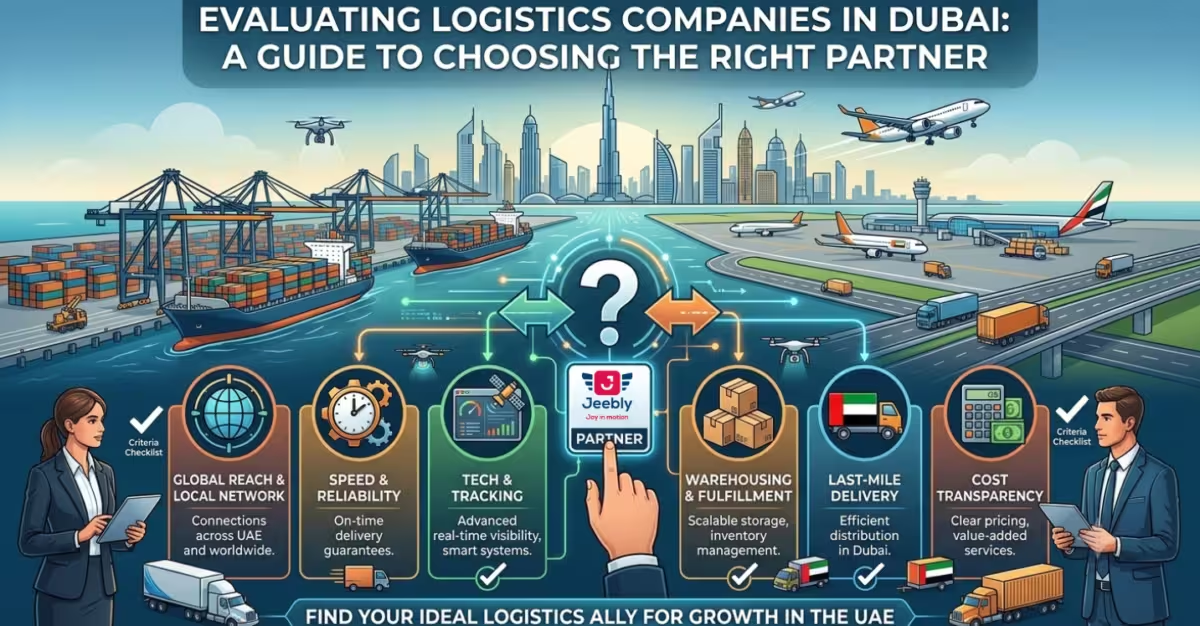
An infographic illustrating the evaluation of logistics companies in Dubai against the backdrop of the city skyline, port, and airport. It features a decision-making flow focused on key pillars like 'Global Reach & Local Network', 'Speed & Reliability', 'Tech & Tracking', 'Warehousing & Fulfillment', 'Last-Mile Delivery', and 'Cost Transparency'. A central question mark is linked to diverse transport modes and two business professionals review a 'Criteria Checklist'.

Logistics Companies in Dubai: How to Evaluate and Choose the Right Partner

Finding logistics companies in Dubai is the easy part. The city has many of them, from DP World’s global port network to nimble last-mile specialists built specifically for D2C e-commerce. Choosing the right one for your specific business is where most operators get it wrong. They default to the largest name, or the cheapest quote, without understanding which type of provider their operation actually needs.

This guide covers the structure of the Dubai logistics market. Understand the five criteria that genuinely distinguish a capable partner from an average one, and why most businesses end up with three logistics vendors when one would do.

How the Dubai Logistics Market Is Structured

Dubai’s logistics infrastructure is genuinely world-class. Jebel Ali Port in Dubai, UAE, is the 9th-busiest container port globally, handling 15.5 million TEUs in recent years. 

Dubai International Airport and the city’s 30+ free zones drive global logistics by offering 100% foreign ownership, zero corporate and personal taxes, and integrated customs operations that effortlessly connect Asia, Europe, and Africa.

But the scale of your infrastructure doesn’t automatically translate to great delivery performance for your customers. A provider with a 70,000 sq ft warehouse and 50 global trade lanes may have no coherent answer for a parcel arriving at an apartment in Jumeirah by tomorrow morning.

The market breaks into four functional categories:

  1. Global freight and port operators: DP World, CEVA, Kuehne+Nagel. Built for containerised freight, port haulage, and multinational supply chains. Not the right primary partner for SME or mid-market UAE domestic e-commerce.

  2. International express couriers: DHL Express, FedEx, Aramex, UPS. Strong for cross-border, time-definite international shipments. Domestic UAE last-mile is possible but not their primary focus; pricing reflects enterprise account structures.

  3. Tech-native last-mile and fulfilment platforms: Jeebly, Quiqup, iMile, Swftbox. Built specifically for UAE domestic e-commerce: same-day and next-day delivery, COD, Shopify integration, returns management, wallet top-up onboarding, with no minimum volume requirements.

  4. Specialist and vertical providers: cold chain (GSL, with five quality certifications for temperature ranges), maritime (GAC), document and government-adjacent (Emirates Post, Zajel).

Most e-commerce businesses need a provider from category two or three. The evaluation criteria that follow apply to both.

Five Criteria That Differentiate Logistics Companies in Dubai

1. First-attempt delivery rate

Every logistics provider claims a high delivery success rate. Few publish the actual rate against auditable volume. A failed first attempt isn’t just a re-delivery cost. It’s a customer who received a bad experience and may not order again.

Ask specifically for first-attempt delivery success (FDSS) data across your target coverage zone. 

For instance, Jeebly publishes 98% FDSS across 50,000+ daily deliveries as a verified operational metric. Use that as a benchmark when evaluating any provider.

2. COD infrastructure and remittance cycle

Secure COD continues to account for a significant share of UAE e-commerce transactions. The remittance cycle, how quickly collected cash is transferred back to your account, directly affects your working capital. A provider remitting fortnightly rather than weekly leaves an additional week of your revenue on hold at any given time. At volume, that’s a meaningful float.

Confirm: does the provider support COD as standard or as an add-on? What is the published remittance cycle? Is there a COD fee, and how is it calculated? Jeebly Dash remits weekly. Get any commitment in writing.

3. Platform integration depth

“We integrate with Shopify” means different things to different providers. Some offer a full bidirectional API: orders sync automatically, tracking updates are pushed to the customer in real time, and NDR events trigger automated follow-up workflows. Others require a manual CSV upload or a webhook that breaks under load.

Test the integration in a live environment before committing operationally. Jeebly integrates natively with Shopify, WooCommerce, Magento, ChatFood, and Grubtech. Orders sync without manual intervention.

4. Returns management

A solid 3PL logistics must provide an itemised breakdown of returns handling: confirmation of item condition at the point of return, the timeline from the customer’s door back to your warehouse, and a per-return fee structure. Most logistics providers handle forward delivery well and build reverse logistics as a reactive service. 

Ask your shortlisted provider for the end-to-end reverse flow before you need it, not after a customer complains.

Jeebly Bizz manages reverse logistics on the same platform as forward delivery, with a single tracking system, a single account, and a single invoice.

5. Peak-season scalability

Dubai’s logistics demand spikes materially during Ramadan, White Friday, and Eid. A provider whose fleet is primarily third-party riders recruited on an ad hoc basis has limited control over capacity and quality during these periods. A provider with an owned and managed fleet or a documented peak-capacity model can show you what happens at 3x normal volume.

Jeebly operates an active fleet of 4,000+ vehicles with a documented peak-season dispatch model. Ask any provider: how does your fleet capacity change during White Friday? What’s your on-time delivery SLA during peak versus standard periods? 

The answer reveals whether their normal-period performance is replicable when it matters most.

Warehouse Zone: A Decision That Affects Unit Economics More Than Rate Negotiation

This is one of the most commercially significant choices in Dubai’s logistics sector.

JAFZA (Jebel Ali Free Zone) gives you duty deferral. Goods imported into the zone are exempt from customs duty until they move to the UAE mainland. Dubai South positions you for airport speed, with fastest ground transit times to Dubai International Airport for outbound air freight. Your warehouse zone choice affects unit economics more than your rate negotiation does.

What this means practically:

  • Businesses using the UAE as a GCC distribution hub: importing in bulk and re-exporting to Saudi Arabia, Oman, or beyond, JAFZA is the correct structure. Duty is deferred until mainland sale; re-exports attract zero duty.

  • For businesses with fast-moving SKUs primarily for UAE domestic delivery, shipping from Dubai South or a Dubai mainland facility reduces ground transit time for customers.

  • Businesses requiring fast customs clearance on inbound air freight: proximity to DXB matters.

Any logistics provider offering warehousing should be able to explain how their facility location affects your duty liability and domestic delivery SLA. If they can’t, that’s a gap worth probing.

For the full import and compliance picture, UAE Import and Export Guide: Trade Documentation, Logistics and Compliance covers the free zone vs mainland decision in detail.

The Multi-Carrier Problem and How to Avoid It

Most brands operating in Dubai end up working with two, three, or more carriers. That’s operationally smart at the provider level, but it creates a real management problem: fragmented dashboards, inconsistent tracking experiences, and failed deliveries that slip through the cracks between handoffs.

Each additional vendor relationship adds: 

  1. a separate tracking system to monitor 
  2. a separate invoice cycle to reconcile 
  3. a separate account manager to chase when something goes wrong
  4. a separate SLA to enforce

The overhead compounds with scale.

The alternative is a provider that covers multiple lanes on a single operational platform. For UAE e-commerce businesses managing regular inbound inventory alongside outbound B2C deliveries, Jeebly Haul covers the freight leg, and Jeebly Dash covers domestic last-mile via the same platform, with unified tracking and a single remittance cycle.

For a direct comparison of UAE last-mile operators on FDSS, COD, and integration capability before deciding, Best Courier Services in UAE: 2026 Comparison Guide covers the full provider landscape.

How Jeebly Is Positioned in the Dubai Logistics Market

Jeebly is structured specifically to solve the consolidation problem for UAE e-commerce businesses. Rather than requiring separate vendors for last-mile, freight, fulfilment, and returns, the platform covers all four:

Jeebly Dash: same-day and next-day domestic delivery across all seven UAE emirates. Published base rate is AED 17.31 per parcel up to 5 kg. 98% FDSS. Wallet top-up onboarding with no minimum volume. Jeebly operates on a pay-as-you-go model with transparent pricing, making it accessible for growing ecommerce businesses.

Jeebly Haul: road, air, and ocean freight. Custom-quoted for shipments above 20 kg. 2,000+ active fleet vehicles, 70+ transporter partners, GCC-wide coverage. Customs clearance managed in-house, not outsourced.

Jeebly Bizz: warehousing, pick-and-pack, automated dispatch, reverse logistics, and B2B supply chain management. Native integrations with Shopify, WooCommerce, and Magento. Built for businesses running 50+ orders daily where manual coordination creates a ceiling on growth.

Jeebly Moveo: relocation services for homes and workspaces, covering the delivery of large items and managed moves.

Talk to the Jeebly team to map out the right setup for your order profile, coverage zones, and fulfilment requirements.

Related Articles:

Frequently Asked Questions

Dubai has four main categories: global freight and port operators (DP World, CEVA) for containerised freight and port operations; international express couriers (DHL, Aramex, FedEx) for cross-border and enterprise shipments; tech-native last-mile and fulfilment platforms (Jeebly, Quiqup, iMile) for UAE domestic e-commerce; and vertical specialists for cold chain, maritime, and government-adjacent delivery.

Evaluate five things: published first-attempt delivery rate, COD remittance cycle, integration depth with your e-commerce platform, returns management process, and peak-season fleet capacity. A provider that answers all five clearly in writing is one you can plan around.

JAFZA (Jebel Ali Free Zone) gives duty deferral on imported goods. Standard customs duty doesn’t apply until goods leave the free zone for the UAE mainland. Dubai South offers faster ground transit to Dubai International Airport, suited to businesses with high outbound air freight volume. Zone choice affects total landed costs more than per-parcel rate negotiation.

No. Jeebly Dash operates on a wallet top-up model with no minimum order volume, making it accessible from the first order. Volume-based commercial terms are available as order volume scales.

COD handling varies significantly between providers. Most UAE logistics companies support COD collection, but remittance cycles range from weekly to monthly. Jeebly Dash remits COD weekly. Always confirm the remittance cycle in writing before signing. A fortnightly float on high COD volume directly affects your working capital.

Routes to insightful reads

BNPL in the UAE and its impact on ecommerce delivery and returns, showing the transaction cycle, faster fulfilment, order frequency, real-time tracking, and streamlined returns
Buy Now Pay Later in the UAE: What BNPL Means for eCommerce Delivery and Returns.

Buy Now Pay Later (BNPL) is changing how consumers shop and how eCommerce businesses manage fulfilment and returns in the UAE. This guide explores how BNPL can influence order volumes, delivery demand, fulfilment operations, return rates, refund processing, and the logistics strategies businesses need to support a growing BNPL-driven customer base.

Read More
Infographic explaining how to calculate volumetric weight for shipping, including the formula, measurement example and comparison between actual and chargeable weight.
How to Calculate Volumetric Weight for Shipping: Formula and Examples

Learn how to calculate volumetric weight for shipping with an easy-to-follow formula and practical examples. Understand how package dimensions, actual weight and carrier conversion factors determine the chargeable weight and ultimately impact your shipping costs.

Read More
3PL vs 4PL logistics comparison showing warehousing, transportation, distribution, supply chain integration, technology, analytics, and strategic planning for UAE businesses
3PL vs 4PL: What Is the Difference and Which Does Your UAE Business Need?

3PL and 4PL logistics models help businesses manage different levels of supply chain operations. This guide explains the key differences between 3PL and 4PL providers, their roles, benefits, costs, and how UAE businesses can choose the right logistics model based on their size, supply chain complexity, and operational needs.

Read More
Types of packaging for courier shipments, showing outer packaging strength, void-fill options, cushioning materials, and sealing and labelling methods
Types of Packaging for Courier Shipments: Which One Best Protects Your Product?

Choosing the right packaging is essential for protecting products during courier transportation. This guide explores different types of packaging for courier shipments, including corrugated boxes, bubble wrap, air pillows, paper fillers, foam inserts, and protective seals, and explains how to choose the best option based on your product, handling needs, and shipping conditions.

Read More
Types of logistics explained through inbound, outbound, reverse and third-party logistics, showing the movement of goods between suppliers, warehouses, customers and return facilities.
Types of Logistics Explained: Inbound, Outbound, Reverse and Third-Party 

Logistics covers much more than moving goods from one place to another. This guide explains the four key types of logistics, inbound, outbound, reverse and third-party logistics (3PL), and how each supports the supply chain. Learn how goods move from suppliers to warehouses, reach customers, return for repair or disposal, and how businesses use 3PL providers to manage logistics operations.

Read More

    Powered by