






Menu
Menu
Returns are a predictable part of running an online store in the UAE, and how you handle them determines whether customers come back.
Globally, the average e-commerce return rate hit 16.9% in 2024. Put simply, for every 100 orders you ship, around 17 will make a round trip.
Without a structure in place, each one chips away at your margin, your time, and your customer relationship. With one, they become manageable and often recoverable.
This guide covers what UAE small sellers actually need: the legal requirements under Federal Decree-Law No. 15/2020. Know how to write a returns policy that converts, practical cost control for smaller operations, and when to bring in a logistics partner.
Most small sellers treat the legal side of returns as fine print. It isn’t.
UAE Federal Decree-Law No. 15 of 2020 on Consumer Protection is the governing legislation for all online retail transactions in the country. It establishes the rights of consumers who purchase goods digitally, including the right to return items within seven days of receipt. Provided the product is in its original condition and accompanied by proof of purchase.
Importantly, the law requires that your returns policy be visible and disclosed to the buyer before they complete the transaction. It cannot live only in a footer link or a separate FAQ page.
Before you draft your policy or set up your process, these are the non-negotiables:
* Seven-day return window: This is the legal minimum for standard e-commerce purchases. Your policy cannot unilaterally set a shorter period.
* Pre-purchase disclosure: The policy must be accessible at the point of sale, not buried post-checkout.
* Documented records: Every return must be logged with the order reference, the product condition at the time of return, and a record of customer communication. This is your protection in any dispute.
* Legitimate exclusions: Perishable goods, sealed hygiene items opened after delivery, and customised products may be excluded from the standard right of return. State these clearly in your policy.
* Refund timelines: UAE law specifies the return window; best practice requires you to communicate clearly how long refunds take to process.
Clean, timestamped digital records of every return interaction are your simplest safeguard for compliance.
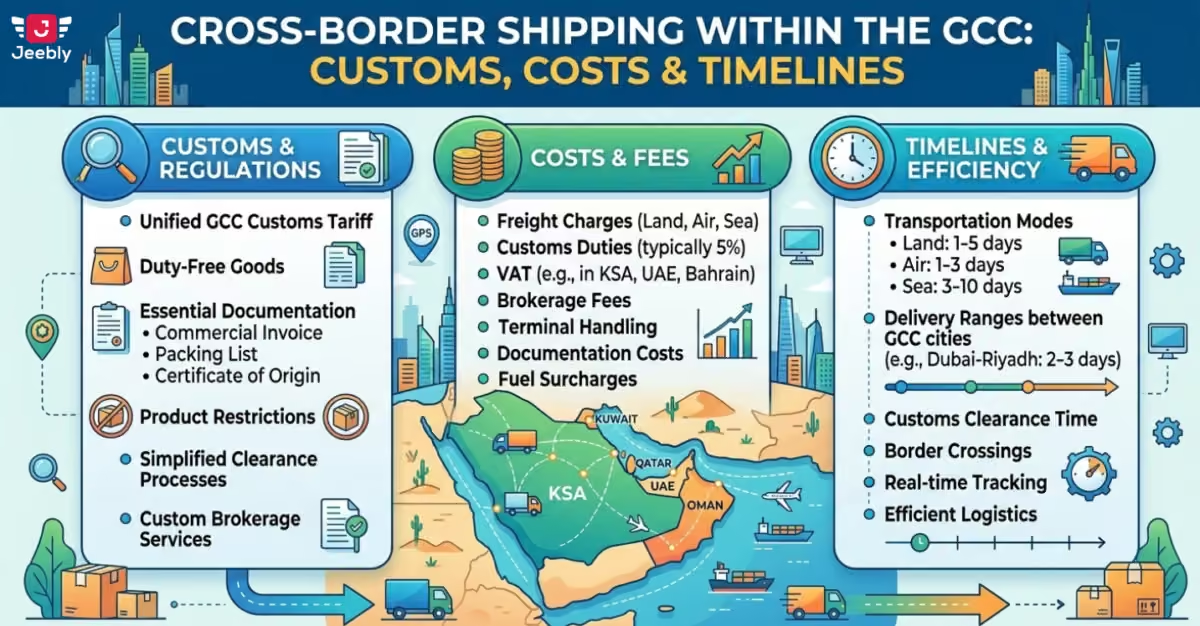
For international returns valued above AED 1,000, UAE Customs requires full documentation. For orders under AED 1,000, simplified customs procedures apply, but documentation is still required. If you ship cross-border regularly, a carrier experienced with UAE customs can remove most of this friction. They will know the correct HS codes, prohibited-item checks, and clearance requirements specific to your product category.
Your returns policy is the first thing a hesitant buyer reads before deciding whether to complete a purchase.
The language distinction matters. Compare: “Returns will not be accepted after seven days, and items must be returned in original packaging with all tags intact” versus “Changed your mind? Here is exactly how we make it right.”
Both say the same thing, but one reads like a warning; the other reads like a promise.
A policy that works for your customers and protects your business needs to answer six questions, stated plainly:
* What can be returned and what is excluded
* The return window (minimum seven days under UAE law; longer if you choose)
* The condition required for a return to be accepted
* Exactly how a customer initiates a return, including specific steps
* How and when the refund or exchange is processed
* Who pays return shipping, seller or customer, and under what circumstances
Write this in plain language. Your customer base in the UAE is multilingual; simplicity always trumps formality.
Longer return windows often reduce actual return rates. When customers feel less pressure to make a hasty decision, they are more likely to keep the item. A 14 or 30-day window can also signal confidence in your product quality, which matters in a market where buyers cannot physically inspect goods before purchase.
For fashion and home goods sellers in particular, the conversion benefit of a generous window typically offsets the marginal increase in returns.
The range of processing a return costs can be wide because most sellers only track the courier fee, the visible line item. The real cost is layered.
Understanding where your return cost actually sits gives you something to work with. The full picture includes:
* Return pickup or shipping fee: the most visible cost, and often the smallest
* Inspection and condition assessment: time cost, almost always untracked
* Restocking: relabelling, repackaging, and inventory system updates
* Customer service handling: every email or call about a return absorbs staff time
* Payment reversal fees: card processors charge for refunds; COD returns require cash reconciliation
* Write-off cost: items that cannot be resold at full value
Mapping these costs against your actual return volume gives you an accurate picture and shows you which stage is most worth improving.
You do not need enterprise infrastructure to manage return costs efficiently. These approaches are practical for smaller UAE operations:
* Condition thresholds: Define internally whether a returned item is returned to sellable stock, discounted, or written off. Inconsistent, ad hoc decisions on this create hidden costs and inventory inaccuracies.
* Packaging investment: Returns caused by transit damage are often preventable. For high-value or fragile categories, better protective packaging pays back faster. For practical reference, these parcel-packing tips for UAE couriers cover exactly how to protect different product types in transit.
* Carrier negotiation: Once your return volumes become consistent, most UAE logistics providers will negotiate rates. Do not pay walk-up pricing on predictable volume.
* Batch processing: Handling returns on scheduled days rather than on an ad hoc basis reduces the operational overhead of frequent, small-volume courier collections.
Managing your forward deliveries efficiently reduces the operational strain on reverse flows. See how Jeebly Dash handles same-day and scheduled delivery across the UAE.
Across most e-commerce operations, return reasons cluster into four groups, each with a distinct fix:
“Not as described” – A product content problem. The fix: better photography, more precise specifications, and dimension or weight data that matches reality.
“Wrong size or fit” – For fashion sellers, a sizing guide issue. For electronics and accessories, a compatibility gap. Both are solvable with better pre-purchase information.
“Changed my mind” – Often signals a product that underperforms in person relative to its online presentation, or a marketing message that’s attracting the wrong buyer intent.
“Damaged on arrival” – A packaging or carrier handling issue. Track whether these clusters are associated with specific SKUs, carriers, or delivery routes before drawing conclusions.
Each pattern points to a specific fix. Acting on it reduces future return rates while improving the quality of your listings for all buyers.
Manual returns handling works until order volume makes it untenable. One unresolved return enquiry absorbs more time than twenty successful deliveries. The goal is a process that a customer can navigate without calling you, and that your team can run without having to rebuild from scratch each time.
Here’s a four-stage returns workflow for small sellers:
Stage 1. Return initiation
The customer submits a request via a portal or form, specifying the item, reason, and preferred resolution (refund or exchange). A Return Merchandise Authorisation (RMA) number is issued automatically and sent to the customer immediately. This single step eliminates the back-and-forth that bogs down manual processes.
Stage 2. Collection or drop-off
Clear instructions for returning the item, including a specific pickup window or drop-off location. Upfront documentation requirements prevent items from arriving without reference numbers.
Stage 3. Inspection and resolution
Standardised condition criteria let your team assess each item consistently and process refunds or exchanges without escalation or guesswork.
Stage 4. Confirmation
A notification sent at resolution tells the customer what was processed and when to expect it. This one message eliminates the majority of “where is my refund?” enquiries.
Most major e-commerce platforms, such as Shopify, WooCommerce, and Magento, support returns management through native or third-party integrations. When evaluating options for UAE operations, prioritise:
* Arabic language support in customer-facing communications
* Real-time tracking integration with UAE-active carriers
* Customs documentation generation for cross-border returns
* COD refund handling essential in the UAE, where cash on delivery remains common
A self-service returns portal reduces inbound service volume, speeds up processing, and creates cleaner data. All three improve margins and satisfaction simultaneously.
If you’re evaluating your entire logistics tech stack, Jeebly’s technology platform covers OMS, WMS, and self-service portal capabilities built for UAE e-commerce operations.
At a certain volume, managing returns in-house stops being a cost-saver and becomes a constraint on your growth. A specialist reverse logistics partner brings dedicated infrastructure that transforms what is currently an operational drag into a structured, visible process.
This is a different evaluation from that of choosing a forward-delivery courier. The criteria that matter most for returns:
* Doorstep quality assessment: Can the provider inspect item condition at pickup, rather than only at the warehouse? This compresses your returns cycle significantly.
* Real-time tracking: Full visibility from pickup through inspection to restocking decision. API integration with your OMS is the benchmark to hold partners to.
* Instant refund capability: Some UAE providers trigger the customer refund at confirmed pickup, before the item reaches the warehouse. This significantly improves satisfaction scores.
* COD returns handling: UAE-specific: cash-on-delivery orders require a reconciliation process on the return leg. Confirm this is supported before committing.
* Scalability: Your return volumes will vary seasonally and as your business grows. Your partner’s pricing model should absorb this without penalising you.
If you are evaluating whether to outsource your logistics operations more broadly, not just returns, this guide to third-party logistics for UAE businesses explains what a 3PL covers, what to look for, and what to check before signing anything.
Returns will always be part of e-commerce. The question is whether they run through a structured process that protects your margins and preserves customer trust, or through an ad hoc process that costs more than it should and causes you to lose customers you would otherwise have kept.
If you are ready to build that infrastructure or simply want to understand what your current returns process is actually costing you, the Jeebly team is ready to help. We build solutions that meet your business’s actual needs.
Yes, unless your policy states otherwise, or unless the return reason is seller error. State clearly in your policy who bears return shipping costs and under what circumstances. Ambiguity here can be a common source of disputes.
Yes. All cross-border returns require customs documentation regardless of value. For shipments above AED 1,000, full customs clearance applies, including value declarations and, in some cases, product authenticity certificates.
The most effective levers are product content quality and improved packaging to reduce transit damage. Your RMA system’s return reason data will tell you which lever to pull first.
When returns processing absorbs more than 10% of your team’s operational time, when cycle times lengthen despite volume staying flat, or when you are consistently handling 50–100+ returns a month and still managing it manually. At that point, a specialist partner typically costs less than the inefficiency it would create.
RMA stands for Return Merchandise Authorisation. It is a reference number issued when a return is approved, used to track the item from pickup through inspection to resolution. Any seller processing returns at a meaningful volume needs an RMA system. Even a basic one creates the documentation, visibility, and processing speed that manual email-based management cannot.
| Cookie | Duration | Description |
|---|---|---|
| cookielawinfo-checkbox-analytics | 11 months | This cookie is set by GDPR Cookie Consent plugin. The cookie is used to store the user consent for the cookies in the category "Analytics". |
| cookielawinfo-checkbox-functional | 11 months | The cookie is set by GDPR cookie consent to record the user consent for the cookies in the category "Functional". |
| cookielawinfo-checkbox-necessary | 11 months | This cookie is set by GDPR Cookie Consent plugin. The cookies is used to store the user consent for the cookies in the category "Necessary". |
| cookielawinfo-checkbox-others | 11 months | This cookie is set by GDPR Cookie Consent plugin. The cookie is used to store the user consent for the cookies in the category "Other. |
| cookielawinfo-checkbox-performance | 11 months | This cookie is set by GDPR Cookie Consent plugin. The cookie is used to store the user consent for the cookies in the category "Performance". |
| viewed_cookie_policy | 11 months | The cookie is set by the GDPR Cookie Consent plugin and is used to store whether or not user has consented to the use of cookies. It does not store any personal data. |