





Jeebly | Logistics Solutions

Categories
blogs

Freight forwarding in UAE: how it works, costs and how to choose a provider

Freight forwarding in the UAE with cargo containers, port terminal and cargo aircraft at sunrise

Freight Forwarding in UAE: How It Works, Costs and How to Choose a Provider

Moving goods across borders looks manageable until you’re trying to coordinate a shipment simultaneously with an airport handling agent in Dubai, a customs broker at the destination port, and a trucking company that only communicates by WhatsApp. Freight forwarding exists to remove that coordination burden.

In the UAE, where Jebel Ali Port is one of the world’s major container hubs and Dubai’s aviation infrastructure supports global cargo movement, choosing the right freight partner has real commercial consequences.

This guide explains the concept, how it works end-to-end when your business genuinely needs a forwarder, and much more.

What Is Freight Forwarding?

A freight forwarder is a logistics coordinator. They don’t own the ships, aircraft, or trucks that move your cargo. What they provide is carrier access, documentation expertise, operational coordination, and systems that help move shipments efficiently from origin to destination.

In practice, that means a freight forwarder handles: 

  • booking cargo space with airlines and shipping lines
  • preparing export and import documentation
  • managing customs clearance at both ends of the journey
  • arranging inland transport at the origin and destination
  • coordinating warehousing when cargo needs to be stored mid-journey
  • tracking the shipment throughout

A freight forwarding company manages the shipping process, helping businesses move cargo safely and compliantly, with greater visibility throughout the journey.

The Three Modes of Freight and When to Use Each

Every freight forwarding decision starts with the same question: how does this shipment need to travel? 

The three main modes each serve a different combination of speed, cost, and cargo type. In the UAE, all three are accessible through world-class infrastructure.

1) Air Freight

Air freight is the fastest mode and the most expensive per kilogram. It suits time-sensitive, high-value, or lightweight cargo, such as electronics, pharmaceuticals, fashion, and perishables. Speed directly protects margins or product quality.

Airlines charge based on chargeable weight, which is the higher of actual weight or volumetric weight. A common air freight calculation uses (Length × Width × Height in cm) ÷ 6,000, although the divisor may vary by carrier and service.

2) Sea Freight

Sea freight is the most cost-effective option for large, non-urgent shipments. It’s the dominant mode for bulk goods, raw materials, manufacturing components, and high-volume inventory replenishment.

Sea freight is quoted in two ways, depending on your volume.

  1. FCL (Full Container Load) means you book the entire container, typically a 20ft or 40ft unit, and pay a flat rate regardless of how full it is. FCL is cost-effective when your cargo fills at least 60–70% of a container. 
  2. LCL (Less than Container Load) means your cargo shares space in a container with other shippers. You pay per CBM (cubic metre), which suits smaller or irregular volumes but adds time for consolidation and
    deconsolidation at each end.

3) Land Freight

Land freight covers domestic UAE delivery and cross-border road transport to GCC markets like Saudi Arabia, Oman, Qatar, Kuwait, and Bahrain. It’s the most flexible option for regional distribution and is often the final leg of a sea or air shipment.

Land freight across GCC routes can take anywhere from a few days to over a week, depending on the destination, border clearance, and cargo requirements. Road freight within the UAE is typically faster and more flexible than sea freight, and significantly cheaper than air freight for comparable volumes.

If your shipping needs are domestic rather than cross-border, the decision comes down to choosing between courier providers. Top Delivery Companies in UAE (2026) compares seven major UAE operators so you can choose the right domestic partner before the freight question even comes up.

What Freight Forwarding Costs in the UAE

Generic sales conversations from couriers will cover speed, price, and coverage. These are the questions that reveal operational reality:

  • What is your published first-attempt delivery success rate, and is it auditable?
  • What is your COD remittance cycle: weekly, fortnightly, or monthly?
  • How do you manage NDR events: automated workflows or manual follow-up?
  • Which specific emirates are covered for same-day delivery, and what are the cut-off times?
  • Is returns management handled in-house or outsourced?
  • What does onboarding look like? Is there a minimum volume commitment or a trial period?

A courier who can answer all six clearly, in writing, is a courier you can plan around. One that hedges on any of them will create operational uncertainty at the worst possible time.

Most freight forwarding quotes are opaque, with a base rate that expands significantly when you receive the invoice. Understanding the cost structure upfront protects your margins and lets you compare quotes on a level playing field.

Cost Components Across All Modes

Every freight forwarding invoice, regardless of mode, will include some combination of:

  • Origin charges: Pickup, inland transport to the port or airport, cargo handling, export documentation, and customs clearance fees at the origin side.
  • Freight rate: The core cost of moving cargo from the origin port or airport to the destination port/airport. This is what most quotes lead with.
  • Destination charges: Terminal handling at the destination port or airport, customs clearance and import duties, and inland delivery to your warehouse or customer.
  • Surcharges: Fuel surcharge (variable, adjusted quarterly by most carriers), peak-season surcharge (typically Q4 and Ramadan), and, currently relevant for UAE routes, any regional disruption surcharges tied to Red Sea or Gulf corridor volatility.
  • Documentation fees: Bill of lading, certificate of origin, and any commodity-specific certificates (halal certification, phytosanitary certificates, MSDS for chemicals).
  • Cargo insurance: For higher-value shipments, businesses should consider cargo insurance because carrier liability may not cover the full commercial value of lost or damaged goods.

Typical Freight Cost Factors in the UAE
Land freight pricing depends on route, truck type, cargo weight, and delivery requirements. GCC road freight is typically quoted based on distance, vehicle capacity, customs requirements, and border handling.

Sea freight pricing depends on container type, origin/destination port, carrier availability, and whether the shipment is FCL or LCL.

Air freight is calculated based on chargeable weight, route, fuel surcharges, handling fees, and urgency.

The cost difference between air and sea isn’t always obvious until you model it against your cargo weight and timeline. Air Freight vs Ocean Freight in the UAE breaks down exactly when each mode makes commercial sense.

Understanding Incoterms: Who Is Responsible for What

Every international shipment is governed by an Incoterm. 

Incoterm is a standardised rule that defines where the seller’s responsibility ends, and the buyer’s begins. Your freight forwarder uses the agreed Incoterm to know what they need to arrange for each shipment. Getting this wrong creates liability gaps that surface when cargo is damaged, delayed, or seized.

The four most commonly used Incoterms in UAE trade:

  1. EXW — Ex Works. The seller makes goods available at their premises. The buyer (or their forwarder) is responsible for everything from that point — export clearance, freight, insurance, and import duties. Maximum responsibility for the buyer.
  2. FOB — Free on Board. The seller is responsible until the cargo is loaded onto the vessel at the port of origin. From that point, the buyer’s forwarder takes over. Common for sea freight shipments.
  3. CIF — Cost, Insurance, Freight. CIF requires the seller to arrange minimum insurance coverage, but buyers may need additional protection depending on cargo value and risk exposure.
  4. DDP — Delivered Duty Paid. The seller is responsible for everything, including import duties at the destination. Maximum responsibility for the seller. Used when the seller wants to offer a seamless delivered price to the buyer.

If you’re new to international freight, clarify the Incoterm with your supplier or buyer before your forwarder begins arranging anything. It determines which costs land on which party and which insurance gaps need to be filled.

When Does a Business Actually Need a Freight Forwarder?

Not every shipment requires a forwarder. Small domestic parcels, single-country last-mile delivery, and standard same-day or next-day orders within the UAE are handled perfectly well by a courier service. A forwarder becomes necessary and valuable at a specific operational threshold. 

These are the indicators that the time has come:

1) You’re shipping internationally for the first time. 
Export documentation, customs classification, and certificate requirements are not intuitive. A single error on a commercial invoice can hold cargo at port for days. A forwarder gets this right the first time.

2) Your cargo volumes are growing beyond what you can coordinate manually. 
Multiple carriers, multiple routes, multiple customs declarations, the coordination overhead compounds quickly. A forwarder’s platform removes that overhead.

3) A delayed or lost shipment has already cost you a commercial relationship. 
This is usually the moment businesses stop managing freight in-house.

4) You’re expanding into new markets and don’t know the import regulations. 
Every market has different HS code requirements, duty rates, and lists of restricted goods. A forwarder with specific experience in your target market knows them.

5) Your supplier is overseas, and you need visibility from their warehouse to yours. 
A forwarder acts as your single point of contact. They negotiate rates, manage documents, and track every detail until your cargo arrives safely.

If you’re a smaller operation trying to build an accurate shipping budget, Cost of Shipping for a Small Business in UAE (2026) covers domestic rates, COD fees, volumetric weight, and inter-emirate pricing in one place.

How to Evaluate a Freight Forwarder in the UAE

The UAE has hundreds of registered freight forwarding companies. Most will quote competitively. These are the questions that separate operationally capable providers from those who will disappear when something goes wrong.

  1. Do they have verified experience on your specific trade lane?

A forwarder who regularly ships electronics from Shenzhen to Dubai knows which carriers maintain schedule reliability on that corridor, which Chinese ports tend to create customs delays, and which documentation common to that commodity type is likely to be inspected. 

A generalist applying standard processes to your specific cargo creates unnecessary risk. A freight forwarder that specialises in your specific trade lane and commodity type will consistently outperform a generalist.

  1. Is their tracking genuinely real-time?

In 2026, leading freight forwarders will provide real-time shipment tracking, digital document management, and integration with your ERP or order management system. You should be able to see where your shipment is, what documents have been filed, and what the next steps are without calling your account manager.

  1. How do they handle exceptions?

Port congestion, carrier delays, damaged cargo, customs holds: these are not edge cases in international freight. 

Ask specifically: what’s the escalation process when a shipment is held at customs? How are clients notified, and within what timeframe? A good forwarder has a clear answer. A vague one doesn’t have a process.

  1. What does an all-inclusive quote actually include?

Request a quote that covers origin charges, freight, destination charges, customs clearance, and documentation. Then ask which additional charges could appear on the final invoice that aren’t in the quote. Compare providers on this complete basis, not on the headline freight rate alone.

  1. Are they FIATA or IATA registered?

Membership in the International Federation of Freight Forwarders Associations (FIATA) or IATA accreditation for air cargo can indicate industry recognition and adherence to established operating standards. It’s a filter, not a guarantee, but it narrows the field meaningfully.

How Jeebly Handles Freight

For UAE businesses that need freight handled alongside domestic last-mile and fulfilment, Jeebly Haul covers road, air, and ocean freight on the same platform that manages your domestic delivery operations.

Jeebly Haul is built for shipments over 20 kg, or that exceed standard parcel dimensions, with custom-quoted pricing based on cargo type, route, and volume. It connects to the same tracking infrastructure as Jeebly’s domestic services.

Talk to the Jeebly team about freight requirements. Get a custom quote that covers the specific route, cargo type, and volume, with no obligation to commit until you see the full cost picture.

Conclusion

Freight forwarding in the UAE is not a commodity. The choice of partner, the mode of transport, and the clarity of Incoterms on each shipment all carry real commercial consequences. 

Air freight moves time-sensitive cargo in days, sea freight moves volume cost-effectively over weeks, and land freight handles the GCC corridor and domestic distribution. A good forwarder manages all three, coordinates customs at both ends, and maintains visibility throughout. 

For businesses that want freight managed alongside domestic last-mile delivery on one connected platform, Jeebly Haul handles freight, while Jeebly Dash and Jeebly Bizz handle domestic fulfilment. Get in touch to discuss your freight requirements.

Frequently Asked Questions

A courier typically handles individual parcels and direct deliveries, while a freight forwarder coordinates larger commercial shipments involving carriers, customs, documentation, and multiple transport modes.

Air freight from Dubai reaches most destinations in 1–5 business days. Sea freight transit times vary significantly by destination, carrier schedule, and routing. GCC road freight is usually faster than sea freight, but it depends on border processing and the destination.

Standard documents include a commercial invoice, packing list, bill of lading or airway bill, certificate of origin, and any commodity-specific certificates (phytosanitary, MSDS, halal, COA). Your forwarder identifies what’s required for your specific route and cargo type.

FCL (Full Container Load) means you book and pay for an entire container. LCL (Less than Container Load) means your cargo shares container space with other shippers, and you pay per CBM. FCL is typically more cost-effective once your cargo fills around 60–70% of a container; LCL suits smaller or irregular volumes.

Provide your forwarder with four pieces of information: cargo origin and destination, commodity type and HS code if known, weight and dimensions, and required delivery timeline. Request an all-inclusive quote covering all charges at both ends. Comparing quotes on a partial-cost basis leads to invoice surprises.

Routes to insightful reads

A comparison banner for UAE eCommerce delivery showing two hands holding smartphones side-by-side against a blurred Dubai skyline. The left screen displays the DHL Express logo with an "International Express" badge below it, while the right screen displays the Jeebly logo with a "Local Hyper-local" map route badge. A bold "VS" graphic splits the center.
DHL vs Jeebly: Which Is Better for UAE Businesses and eCommerce Delivery?

Looking for the right logistics partner in the UAE? We break down DHL vs. Jeebly to help you choose between global express shipping and local, tech-driven e-commerce fulfillment. Discover which courier wins on domestic delivery speeds, Cash on Delivery (COD) handling, and cross-border customs.

Read More
Logisty vs Jeebly comparison for UAE eCommerce delivery, last-mile logistics and courier services
Logisty vs Jeebly: UAE eCommerce Delivery Comparison

Logisty and Jeebly serve different logistics needs, but which is the better choice for your business? This comparison explores their services, delivery capabilities, technology, coverage, eCommerce integrations, cash on delivery (COD), and fulfilment solutions to help UAE businesses choose the right logistics partner for growth.

Read More
UAE VAT on imports and exports showing tax compliance, logistics, shipping and customs documentation
VAT on Shipping and Delivery Services in UAE: What Businesses Need to Know

VAT can significantly impact the cost of shipping and delivery services in the UAE, making it essential for businesses to understand how it applies to domestic and international shipments. This guide explains VAT rules, zero-rated and standard-rated services, invoicing requirements, and practical compliance tips to help businesses manage logistics costs and stay compliant with UAE tax regulations.

Read More
COD fraud prevention in the UAE with secure payment verification, order authentication and logistics risk management
COD Fraud in UAE eCommerce: How to Detect, Prevent and Reduce Losses

Cash on Delivery (COD) fraud is a growing challenge for e-commerce businesses across the UAE, leading to fake orders, delivery failures and unnecessary operational costs. Learn how to identify common fraud tactics, implement effective prevention strategies and protect your business while maintaining a seamless customer experience.

Read More
UAE import and export guide featuring trade documentation, cargo ship, air freight, customs clearance and logistics operations
UAE Import and Export Guide: Trade Documentation, Logistics and Compliance

Customs clearance is a critical step in moving goods into and out of the UAE. Whether you’re importing, exporting, or shipping across borders, understanding the customs process, required documentation, and compliance requirements can help you avoid delays, reduce costs, and keep your supply chain running efficiently.

Read More
Categories
blogs

Best Courier Services in UAE: 2026 Comparison Guide.

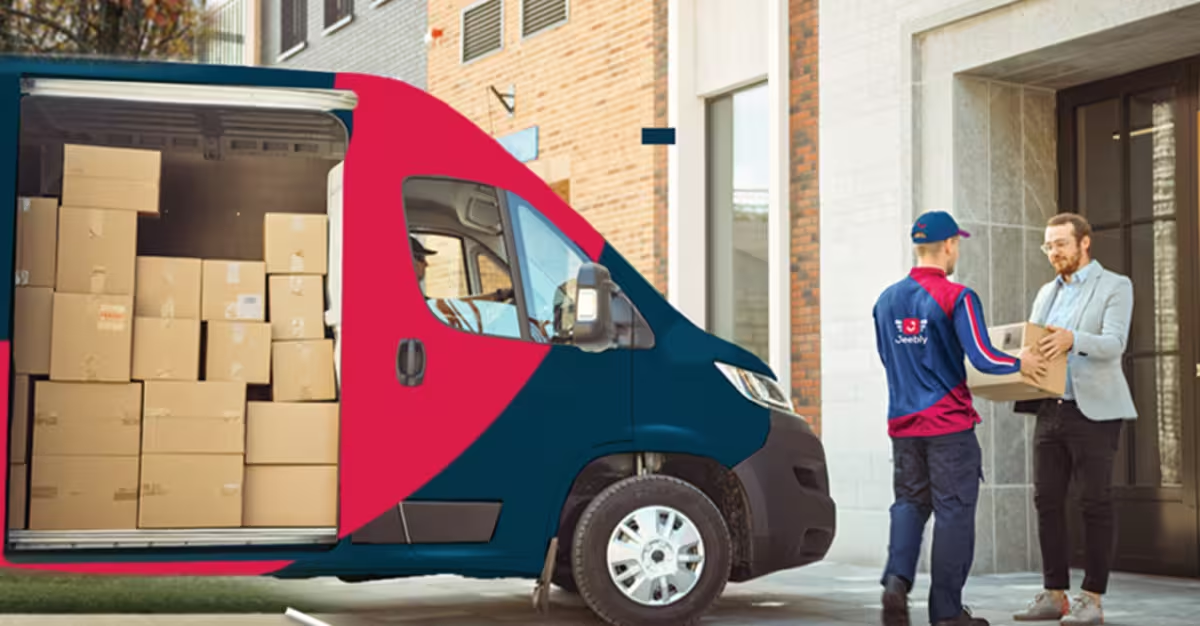
A Jeebly courier service delivery van filled with cardboard boxes parked outside a building in the UAE, while a courier uniform-clad driver hands over a parcel to a customer.

Best Courier Services in UAE: 2026 Comparison Guide

Every UAE e-commerce business reaches the same inflexion point: the courier that worked fine at 30 orders a day starts showing cracks at 300. Deliveries get missed, and COD reconciliation runs late. The tracking page shows “out for delivery” for six hours. And your customer contacts you, not the courier.

Finding the best courier service in UAE is about matching a provider’s operational capabilities to your actual delivery profile: by order volume, coverage zone, speed requirement, and the tech stack you need to integrate with your store.

This guide compares the leading UAE courier services for 2026 based on the criteria that directly affect your margins: first-attempt delivery rates, COD handling, platform integrations, returns management, and pricing transparency. It also covers what to ask any provider before you sign anything.

Top 6 UAE Courier Services Compared: Who Does What Well

1) Jeebly

Jeebly is built around a single operating principle: the courier experience should be invisible to the end customer and frictionless for the business running it. That means AI-assisted dispatch, automated NDR workflows, direct platform integrations, and a 98% First-Day Delivery Success rate across 50,000+ daily deliveries, supported by a fleet of 4,000+ active vehicles.

The service structure is designed to match different business profiles rather than forcing every operation into the same product:

Jeebly Dash covers express, same-day, and next-day domestic delivery. Published base rate: AED 17.31 per parcel up to 5 kg, with same-day delivery available within Dubai. Direct integrations with Shopify, WooCommerce, Magento, ChatFood, and Grubtech. COD collection and weekly remittance are standard.

Jeebly Bizz is the logistics management layer for businesses that need more than delivery, like warehousing, fulfilment, reverse logistics, automated dispatch, and real-time reporting in one connected platform. Built for operations running hundreds of daily orders where manual coordination isn’t viable.

Jeebly Haul handles freight and bulk shipments above 20 kg: road freight across the UAE and GCC, air freight, and ocean freight. Custom-quoted, not bookable via app.

Jeebly works with brands including BFL Group, Mumzworld, Instashop, and Zomato. If your priority is UAE-native coverage, verified performance data, and a single partner that scales with you, Jeebly is the place to start.

Best for: D2C and e-commerce brands at any stage of growth, from 20 to 2,000+ daily orders. 

Watch out for: Express (60–120 min) delivery is currently available only in Dubai. 

2) Aramex

Aramex leads GCC-wide e-commerce delivery with the most mature COD infrastructure and a regional last-mile network across more than 60 countries. For brands already operating at scale with significant volume in Saudi Arabia, Kuwait, or Egypt, the depth of the regional network is genuinely valuable. Their Shop & Ship cross-border service and reverse logistics workflows are well-established.

Best for: Mid- to large businesses with consistent GCC or MENA export volume. 

Watch out for: Enterprise-leaning pricing. Smaller brands shipping fewer than 50 orders a day may find better value with local carriers.

3) DHL Express UAE

DHL Express offers the widest global reach across 220+ countries and advanced customs automation tools designed to streamline cross-border processing. Their Dubai South (DWC) hub is one of the most active in the region.

Best for: Businesses where international express speed justifies the cost of high-value products, time-sensitive B2B shipments, or Europe/US-bound parcels.

Watch out for: For domestic UAE e-commerce at volume, DHL Express is typically priced at a premium, compressing margins on high-frequency local orders. It’s not the right tool for scaling the domestic last-mile. 

4) Quiqup

Quiqup delivers within 4 hours in Dubai, with a 99% first-attempt delivery rate, making it a strong option for brands prioritising fast delivery in the city. The fleet is owned and managed in-house, which supports consistent quality but limits peak capacity compared to larger operators.

Best for: Brands with a Dubai-centric order profile where sub-four-hour delivery is a direct commercial differentiator: grocery, beauty, fashion. 

Watch out for: Multi-emirate coverage is limited. Not built for fulfilment, freight, or returns at scale. Higher per-delivery cost than next-day carriers.

Here’s a quick snapshot for easy understanding:

Courier Best For Delivery Strength COD Integrations
Jeebly UAE eCommerce brands Same-day + scalable delivery ✓ Yes Shopify, WooCommerce, Magento
Aramex GCC expansion Regional coverage ✓ Yes ✓ Yes
DHL International shipping Global express Limited ✓ Yes
Quiqup Dubai same-day delivery Fast urban delivery ✓ Yes ✓ Yes
Emirates Post Remote locations Nationwide reach ✓ Yes Limited
Shipa SMEs Easy onboarding ✓ Yes ✓ Yes

Quiqup and Jeebly are the two most-compared same-day providers in Dubai. Read the full head-to-head comparison on Quiqup vs Jeebly.

5) Emirates Post (EMX/7X)

Emirates Post and its courier arm, EMX, cover remote areas that most private providers deprioritise, including PO Box delivery, government-adjacent shipments, and addresses outside the main urban corridors.

Best for: High-volume domestic shipments to addresses in the northern and eastern emirates that private couriers don’t reliably serve. 

Watch out for: Tracking visibility and delivery windows are more limited than with tech-native providers. Not suited for speed-sensitive e-commerce or brands where real-time customer communication is a priority.

6) Shipa Delivery

Shipa provides last-mile delivery and e-commerce fulfilment across the UAE with a focus on SME accessibility and straightforward onboarding.

Best for: Early-stage brands looking for a clean setup without complex volume commitments. 

Watch out for: Primarily last-mile focused. Businesses that also need freight, warehousing, or returns management will require additional vendors, adding coordination overhead as they scale.

What to Look for Before You Commit to Any UAE Courier

Most businesses choose a courier based on price per parcel. Many businesses reconsider their courier partner once delivery volume increases. The two things are related.

Per-parcel rate is one input. The total cost of operations is the number that matters. Here’s what actually drives that figure:

  • First-attempt delivery success rate (FDSS): Every failed delivery costs you twice: the re-attempt fee and the time your team spends managing the NDR (Non-Delivery Report). The brands winning in the UAE right now are demanding API-first carrier integrations and automated workflows that handle failed deliveries before they eat into margins.


  • COD remittance speed: Cash on delivery still accounts for a significant share of UAE e-commerce transactions. The remittance cycle directly affects working capital. A courier remitting weekly versus one remitting fortnightly can hold two weeks of your revenue at any given time. At volume, that’s a meaningful float.


  • Platform integration depth: “Shopify integration” means different things to different couriers. Some offer a full two-way API. Others require manual CSV uploads or a basic webhook that breaks under load. If your operations team is spending more than 20 minutes a day on manual logistics tasks, your integration isn’t working properly.


  • UAE-wide coverage with confirmed emirate-level SLAs: “Nationwide coverage” is a common claim. The reality is that next-day delivery to Dubai and next-day delivery to Ras Al Khaimah are not the same operational challenge. Confirm which emirates your courier covers for same-day, next-day, and standard delivery.


  • Returns management: Reverse logistics is where most UAE courier relationships quietly fall apart. Ask specifically: Is the return managed in-house or handed off to a third party? What’s the SLA from the customer’s door back to your warehouse? Is there a per-return fee in addition to the standard rate?


Understand your full shipping cost picture before you negotiate. Read: Cost of Shipping for a Small Business in UAE (2026).

Choosing by Business Stage: A Practical Framework

1) Under 50 orders/day: 

Flexibility matters more than infrastructure at this stage. Choose a provider with no minimum commitment, transparent per-parcel pricing, and COD support if your customers expect it. Test for 60 days before negotiating volume terms. 

Jeebly Dash is structured for exactly this: no minimum order volume, clean onboarding, and the ability to scale without renegotiating contracts.

2) 50–300 orders/day: 

This is where the choice compounds. You need UAE-wide coverage with confirmed emirate-level SLAs, a first-attempt delivery rate you can model against, and a returns process that doesn’t create a separate daily workflow. 

A single provider handling all of this is cheaper in practice than two providers each handling part of it. Jeebly Bizz brings dispatch, tracking, NDR management, and reverse logistics into one platform at this volume tier.

3) 300+ orders/day: 

At this volume, switching providers is expensive and operationally disruptive. Choose for the next two years, not for today. You need owned or controlled fleet capacity with warehousing integration, and tech infrastructure that communicates directly with your OMS without manual intervention. 

Jeebly’s platform integrates with Shopify, WooCommerce, Magento, ChatFood, and Grubtech. See how the technology is structured before evaluating any other provider.

Questions to Ask Any UAE Courier Before Signing

Generic sales conversations from couriers will cover speed, price, and coverage. These are the questions that reveal operational reality:

  • What is your published first-attempt delivery success rate, and is it auditable?
  • What is your COD remittance cycle: weekly, fortnightly, or monthly?
  • How do you manage NDR events: automated workflows or manual follow-up?
  • Which specific emirates are covered for same-day delivery, and what are the cut-off times?
  • Is returns management handled in-house or outsourced?
  • What does onboarding look like? Is there a minimum volume commitment or a trial period?

A courier who can answer all six clearly, in writing, is a courier you can plan around. One that hedges on any of them will create operational uncertainty at the worst possible time.

Conclusion

The best courier service in UAE for your business depends on three things: where your customers are, how many orders you ship, and how complex your fulfilment needs are. 

Global carriers like DHL and Aramex are genuinely strong for international and GCC-wide volume. Hyperlocal providers like Quiqup serve a specific speed-sensitive niche in Dubai. For UAE domestic e-commerce at any meaningful scale, Jeebly is built for exactly that operation. Jeebly Dash for last-mile delivery, Jeebly Bizz for integrated fulfilment, and Jeebly Haul for freight. One partner across the full chain. 

Need a courier partner that can handle your current volume and your next growth stage? Speak with Jeebly’s logistics team to build the right delivery setup for your business.

Frequently Asked Questions

Jeebly maintains a 98% First Day Delivery Success rate across 50,000+ daily deliveries in the UAE. Quiqup also publishes a 98% first-attempt rate, though primarily within Dubai. Always ask any courier for auditable performance data before committing.

Most major UAE couriers collect cash at the point of delivery and remit funds back to the sender on a set cycle, weekly, fortnightly, or monthly, depending on the provider. Jeebly remits weekly. COD fees typically range from 1–2% of the collected amount per transaction.

Rates commonly vary depending on parcel weight, destination, delivery speed, and contract volume. The cheapest headline rate isn’t always the lowest total cost. Providers with high first-attempt success rates reduce your RTO costs, which often outweigh the benefits of a lower base rate.

Jeebly integrates directly with Shopify, WooCommerce, Magento, ChatFood, and Grubtech. Aramex and DHL also offer Shopify integrations, though the depth and automation capabilities vary. Test any integration in a live environment before relying on it for daily operations.

Confirm whether returns are managed in-house or handed off to a third party, what the SLA is from the customer door back to your warehouse, and whether there’s a separate per-return fee.

Routes to insightful reads

A comparison banner for UAE eCommerce delivery showing two hands holding smartphones side-by-side against a blurred Dubai skyline. The left screen displays the DHL Express logo with an "International Express" badge below it, while the right screen displays the Jeebly logo with a "Local Hyper-local" map route badge. A bold "VS" graphic splits the center.
DHL vs Jeebly: Which Is Better for UAE Businesses and eCommerce Delivery?

Looking for the right logistics partner in the UAE? We break down DHL vs. Jeebly to help you choose between global express shipping and local, tech-driven e-commerce fulfillment. Discover which courier wins on domestic delivery speeds, Cash on Delivery (COD) handling, and cross-border customs.

Read More
Logisty vs Jeebly comparison for UAE eCommerce delivery, last-mile logistics and courier services
Logisty vs Jeebly: UAE eCommerce Delivery Comparison

Logisty and Jeebly serve different logistics needs, but which is the better choice for your business? This comparison explores their services, delivery capabilities, technology, coverage, eCommerce integrations, cash on delivery (COD), and fulfilment solutions to help UAE businesses choose the right logistics partner for growth.

Read More
UAE VAT on imports and exports showing tax compliance, logistics, shipping and customs documentation
VAT on Shipping and Delivery Services in UAE: What Businesses Need to Know

VAT can significantly impact the cost of shipping and delivery services in the UAE, making it essential for businesses to understand how it applies to domestic and international shipments. This guide explains VAT rules, zero-rated and standard-rated services, invoicing requirements, and practical compliance tips to help businesses manage logistics costs and stay compliant with UAE tax regulations.

Read More
COD fraud prevention in the UAE with secure payment verification, order authentication and logistics risk management
COD Fraud in UAE eCommerce: How to Detect, Prevent and Reduce Losses

Cash on Delivery (COD) fraud is a growing challenge for e-commerce businesses across the UAE, leading to fake orders, delivery failures and unnecessary operational costs. Learn how to identify common fraud tactics, implement effective prevention strategies and protect your business while maintaining a seamless customer experience.

Read More
UAE import and export guide featuring trade documentation, cargo ship, air freight, customs clearance and logistics operations
UAE Import and Export Guide: Trade Documentation, Logistics and Compliance

Customs clearance is a critical step in moving goods into and out of the UAE. Whether you’re importing, exporting, or shipping across borders, understanding the customs process, required documentation, and compliance requirements can help you avoid delays, reduce costs, and keep your supply chain running efficiently.

Read More
Categories
blogs

What Is Contactless Delivery and How Does It Work in the UAE?

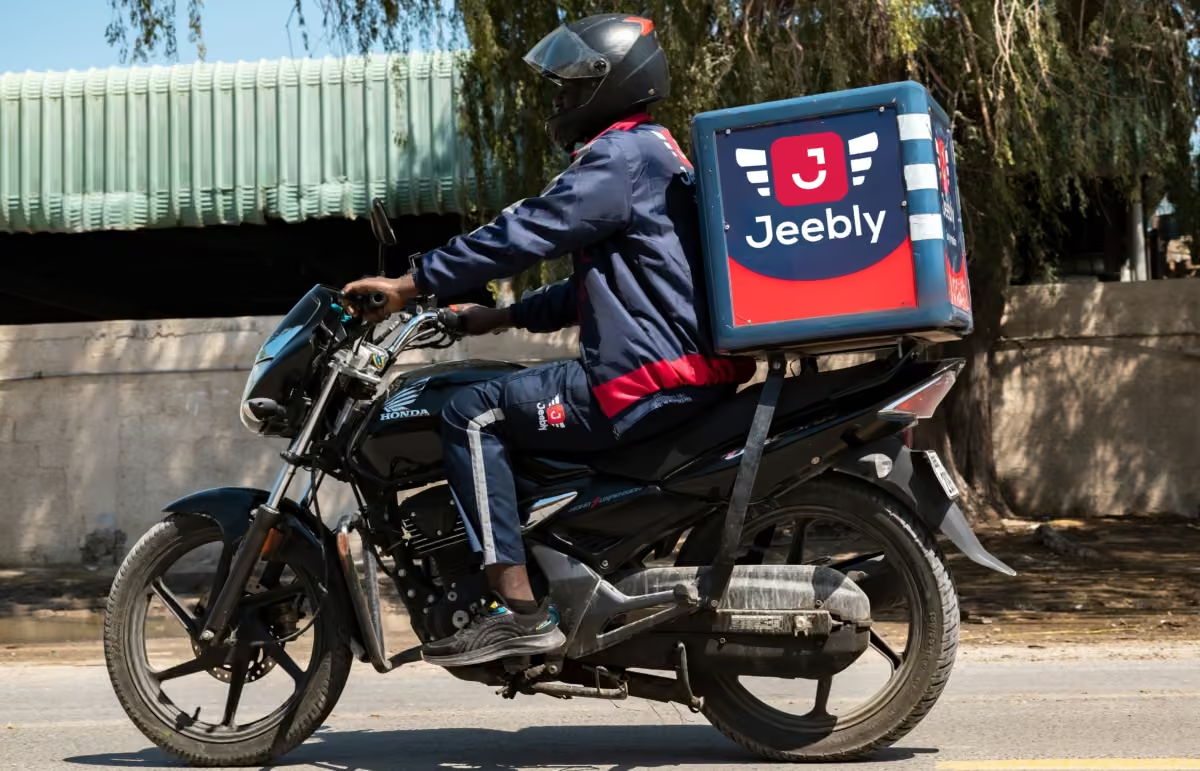
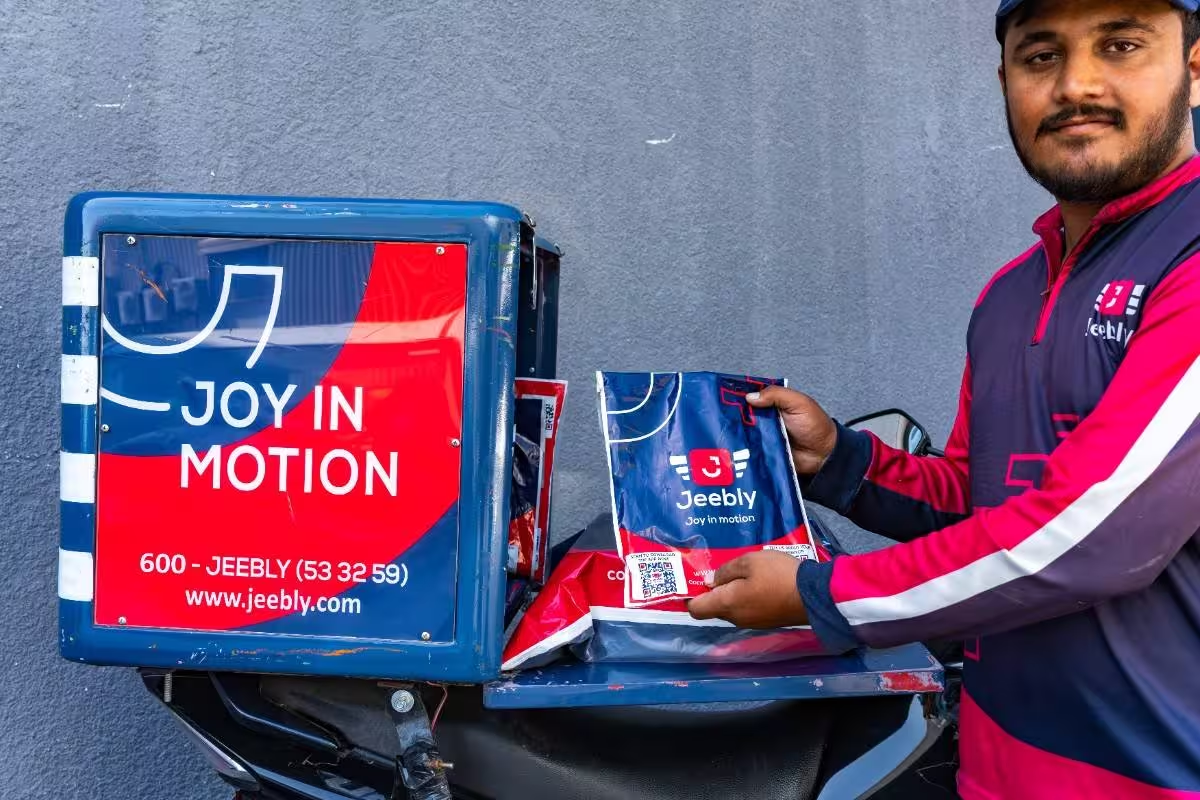
Jeebly delivery rider holding a package next to a branded motorcycle box in the UAE

What Is Contactless Delivery and How Does It Work in the UAE?

Your customers don’t want to wait at the door. They don’t want to sign anything, handle cash, or interact with a courier at all. They want their order confirmed, tracked, and dropped off without friction. Contactless delivery is how the best e-commerce businesses in the UAE are meeting that expectation.

What started as a pandemic-era response has settled into a permanent operating standard. For businesses shipping across Dubai, Abu Dhabi, and beyond, the question today is whether your contactless logistics infrastructure actually supports contactless it end-to-end.

This article explains what contactless delivery is, how it works step by step, which technologies make it reliable, and what UAE businesses need to get it right.

What Is Contactless Delivery?

Contactless delivery is a fulfilment method in which an order is left at a designated location without direct physical contact between the courier and the recipient. The customer is notified digitally, and delivery is confirmed with an electronic record, typically a timestamped photo taken at the drop-off point.

The mechanics are simple. The complexity lies in building the digital infrastructure behind them. For UAE e-commerce businesses, the stakes are unusually high. 

84% of all transactions in the UAE are now contactless, and the Dubai Cashless Strategy, rolled out in 2024, targets  90% of transactions in the city to be cashless by 2026.

Customers in this market are digitally fluent and quick to form opinions based on their delivery experience. A missed window or an awkward handoff can erode the trust that drives repeat purchases.

How Does Contactless Delivery Work: The Full Sequence

A good contactless delivery feels effortless to the customer. Behind the scenes, it’s a coordinated sequence of steps, each one enabling the next.

Step 1. Order placed and payment confirmed digitally.The customer pays online at checkout. This single step eliminates the need for any financial exchange at the door and is the foundation on which everything else is built.

Step 2. Automated dispatch and route optimisation.Once the order is ready, a courier is assigned, and their route is optimised based on the day’s load, traffic conditions, and delivery priorities. Accurate ETAs begin here.

Step 3. Real-time tracking notification.The customer receives a notification. They will know where their order is, without calling anyone or guessing at a four-hour window.

Step 4. Drop off at the agreed location.The courier places the parcel at the customer’s specified drop-off point, doorstep, building reception, or lobby without requiring the customer’s presence. No signature, no interaction.

Step 5. Electronic proof of delivery (ePOD) captured.At drop-off, the courier photographs the parcel in situ. That image is timestamped, geotagged, and logged automatically.

Step 6. Instant delivery confirmation sent.The customer receives a notification the moment the photo is uploaded. The delivery is complete, verified, and on record for both sides.

Each step in this sequence depends on the one before it. 

For a breakdown of how UAE delivery timelines actually work across service types, read How Long Does Delivery Take in the UAE? Realistic Timelines

The Technology Behind a Reliable Contactless Delivery System

Leaving a parcel on a doorstep is not contactless delivery. It’s an unverified drop. What separates the two is the digital infrastructure that makes every step traceable and accountable.

A genuinely capable contactless delivery system requires:

  • Automated notifications triggered at each stage of the journey: dispatched, en route, arriving soon, delivered. Customers who know where their order is don’t need to contact your support team.

  • Electronic proof of delivery (ePOD) with photo capture at the drop-off point. The image must be timestamped and geotagged to carry evidentiary weight. Without this, any dispute becomes a he-said-she-said situation.

  • Route optimisation software that accounts for traffic, load size, delivery priority, and geographic spread. This keeps ETAs accurate and couriers efficient, which matters especially when you’re running hundreds of daily drops across multiple Emirates.

  • Prepayment infrastructure — whether through card, digital wallet, or bank transfer. The UAE’s rapid shift toward digital payments makes this easier than ever to implement.

Together, these components create a system where every delivery is transparent, every drop-off is verifiable, and every customer interaction builds confidence rather than anxiety.

Business Benefits That Go Beyond Safety

The original case for contactless delivery was about hygiene and risk reduction. Businesses that have built it properly have discovered that the operational advantages run much deeper.

Benefit What it means for your business
Higher first-attempt delivery success Courier doesn't need the customer to be home, have cash ready, or sign anything. Fewer reasons to fail mean fewer failed deliveries.
Faster delivery cycles No waiting at the door for signatures or cash exchanges.
Fewer disputes ePOD photo evidence resolves queries before they escalate.
Lower support volume Automated tracking notifications answer questions proactively.
Paperless operations Digital records replace physical paperwork across the chain.
Scales without adding overhead Works identically for 10 parcels or 1,000 per day.

For operations running high volumes across multiple Emirates, these gains compound quickly. 

What UAE Businesses Get Wrong About Contactless Delivery

Contactless delivery fails when businesses treat it as a front-end customer experience feature rather than an end-to-end operational system. Three gaps come up consistently.

1. Incomplete payment migration.
 

Cash on delivery remains common in the UAE market. Businesses that maintain COD as a default option can’t offer a truly contactless experience for those orders. Phasing out COD, or at a minimum, defaulting new customers to digital payment, is a prerequisite for clean contactless operations.

2. No proof-of-delivery standard.
 

Without mandatory ePOD, disputes are resolved on trust rather than evidence. This creates liability for the business and uncertainty for the customer. Photo confirmation at every drop-off should be non-negotiable. 

3. Static tracking, not real-time tracking.
 

Many courier operations send a single “your order is out for delivery” notification and nothing further. Customers checking in on a high-value order expect real-time position updates. The UAE’s digitally-engaged customer base notices the difference immediately.

Failed deliveries are the most expensive line item, yet most e-commerce businesses don’t track them closely enough. For a full picture, the Top Delivery Companies in UAE (2026) guide covers first-attempt success rates across every major UAE carrier.

How Jeebly Handles Contactless Delivery

Jeebly’s approach to contactless delivery is built into the platform rather than added on top of it. Automated dispatch, real-time tracking updates, and ePOD photo capture at every drop-off are standard.

  • For e-commerce brands with daily order volumes, Jeebly Dash covers same-day and next-day delivery across the UAE, with each delivery confirmed by a photograph uploaded by the rider at drop-off. 
  • For businesses managing higher-complexity logistics, Jeebly Bizz brings automated dispatch, route optimisation, reverse logistics, and end-to-end workflow transparency into a single platform.

How to Implement Contactless Delivery for Your UAE Business

Getting contactless delivery right doesn’t require rebuilding your operation from scratch. It does require being deliberate about a few fundamentals.

  • Move to prepayment as your default. This is the single most important enabler. A COD order cannot be contactless. If you’re transitioning an existing customer base, offer digital payment as the default and COD as an opt-in.

  • Choose a logistics partner with real tracking. Position updates and precise ETAs are what customers expect in the UAE market. Confirm whether the courier you work with offers these as standard, and test the experience from the customer’s perspective before committing.

  • Make ePOD non-negotiable. Any courier partner you work with should capture and upload a photo at every drop-off. Ask how it’s stored, how long it’s retained, and how you access it when a dispute is raised.

  • Specify drop-off preferences clearly. Let customers indicate where they want their parcel left and make sure that preference is communicated to the courier. A branded tracking page that captures this information before delivery removes ambiguity at the door.

  • Automate your notification sequence. Dispatch, en route, arriving soon, delivered: each stage should trigger an automatic notification to the customer. This reduces inbound queries, increases confidence, and creates a professional delivery experience that reflects well on your brand.


Understanding your full shipping cost picture helps make the case for digital payment internally. Cost of Shipping for a Small Business in the UAE (2026) clearly breaks it down.

Conclusion

Contactless delivery is no longer a differentiator. It’s a baseline. UAE customers expect a tracked, confirmed, and friction-free delivery experience as standard, and businesses that can’t provide it will lose the repeat purchase.

The good news is that the infrastructure exists. Real-time tracking, ePOD, automated notifications, and digital payment are all readily available through the right logistics partner. The question is whether your current setup supports all of it or just some of it.

If you’re ready to build a contactless delivery operation that holds up at volume, speak to the Jeebly team. We’ll map out the right setup for your order profile, coverage needs, and growth plan

Frequently Asked Questions

The key difference between contactless delivery and standard delivery is the digital proof of delivery. A photo is taken and uploaded at drop-off, eliminating the need for any cash or signature exchange at the door.

No. The customer specifies a drop-off location in advance, and the courier places the parcel there without requiring anyone to be present. A notification confirms delivery the moment the photo is uploaded.

Coverage depends on your logistics provider. Jeebly Dash offers next-day delivery to any emirate in the UAE, with same-day and express options available in Dubai. Confirm coverage and service levels with your courier before committing to customer-facing promises.

Four components matter most: real-time tracking with precise ETAs, automated customer notifications at each stage, electronic proof of delivery with photo capture, and route optimisation software. Without all four, some part of the accountability chain breaks down.

When customers don’t need to be physically present to receive an order, first-attempt success rates improve significantly. The courier drops off, photographs, and confirms without waiting for someone to answer the door or process a payment. This results in lower re-delivery costs and faster order completion.

Routes to insightful reads

A comparison banner for UAE eCommerce delivery showing two hands holding smartphones side-by-side against a blurred Dubai skyline. The left screen displays the DHL Express logo with an "International Express" badge below it, while the right screen displays the Jeebly logo with a "Local Hyper-local" map route badge. A bold "VS" graphic splits the center.
DHL vs Jeebly: Which Is Better for UAE Businesses and eCommerce Delivery?

Looking for the right logistics partner in the UAE? We break down DHL vs. Jeebly to help you choose between global express shipping and local, tech-driven e-commerce fulfillment. Discover which courier wins on domestic delivery speeds, Cash on Delivery (COD) handling, and cross-border customs.

Read More
Logisty vs Jeebly comparison for UAE eCommerce delivery, last-mile logistics and courier services
Logisty vs Jeebly: UAE eCommerce Delivery Comparison

Logisty and Jeebly serve different logistics needs, but which is the better choice for your business? This comparison explores their services, delivery capabilities, technology, coverage, eCommerce integrations, cash on delivery (COD), and fulfilment solutions to help UAE businesses choose the right logistics partner for growth.

Read More
UAE VAT on imports and exports showing tax compliance, logistics, shipping and customs documentation
VAT on Shipping and Delivery Services in UAE: What Businesses Need to Know

VAT can significantly impact the cost of shipping and delivery services in the UAE, making it essential for businesses to understand how it applies to domestic and international shipments. This guide explains VAT rules, zero-rated and standard-rated services, invoicing requirements, and practical compliance tips to help businesses manage logistics costs and stay compliant with UAE tax regulations.

Read More
COD fraud prevention in the UAE with secure payment verification, order authentication and logistics risk management
COD Fraud in UAE eCommerce: How to Detect, Prevent and Reduce Losses

Cash on Delivery (COD) fraud is a growing challenge for e-commerce businesses across the UAE, leading to fake orders, delivery failures and unnecessary operational costs. Learn how to identify common fraud tactics, implement effective prevention strategies and protect your business while maintaining a seamless customer experience.

Read More
UAE import and export guide featuring trade documentation, cargo ship, air freight, customs clearance and logistics operations
UAE Import and Export Guide: Trade Documentation, Logistics and Compliance

Customs clearance is a critical step in moving goods into and out of the UAE. Whether you’re importing, exporting, or shipping across borders, understanding the customs process, required documentation, and compliance requirements can help you avoid delays, reduce costs, and keep your supply chain running efficiently.

Read More

    Powered by