






Jeebly | Logistics Solutions

Categories
blogs

Customs Clearance in Dubai and UAE: Process, Documents and Business Guide

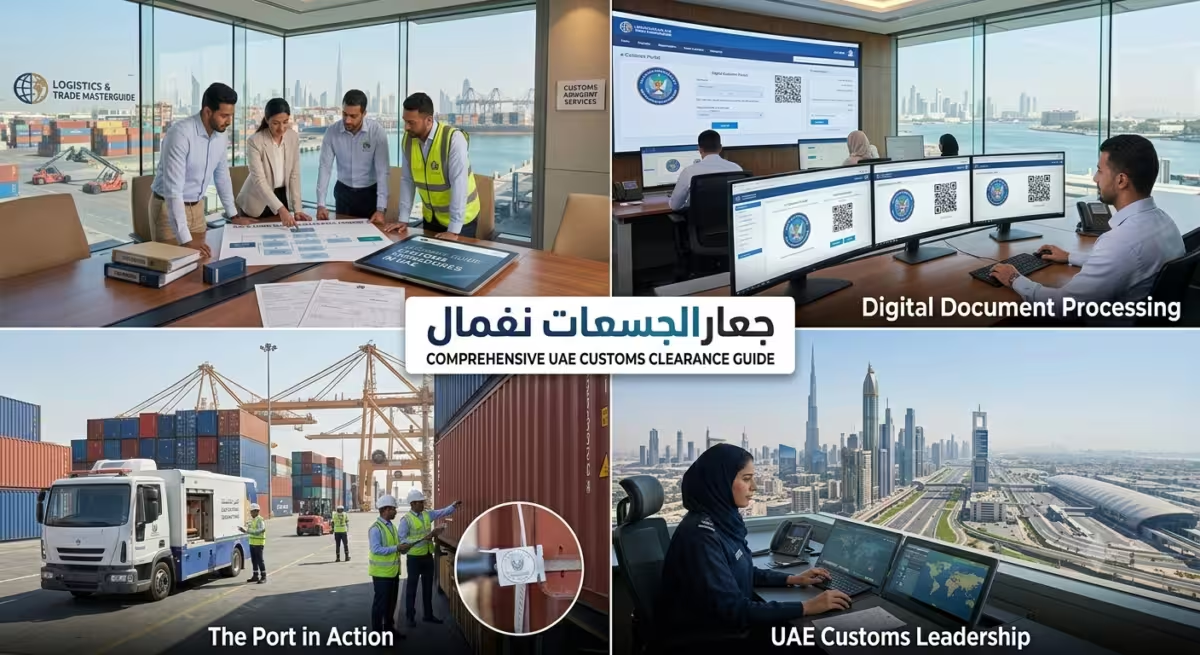
Customs clearance process in Dubai and the UAE showing document processing, port inspections and import export logistics

Customs Clearance in Dubai and UAE: Process, Documents and Business Guide

A shipment sitting at Jebel Ali Port or Dubai International Airport, waiting on customs clearance, costs money every day it doesn’t move. Storage fees accumulate. Your customer’s order is late. And if the hold was caused by a fixable documentation error, like an incorrect HS code, a mismatched invoice value, or a missing certificate, that cost was entirely preventable.

This guide covers how customs clearance in the UAE works in 2026. Find out the documents required, the costs involved, the most common reasons shipments are held, and how businesses can structure their cross-border operations to keep goods moving.

What Is Customs Clearance in the UAE?

Customs clearance is the formal process by which goods entering or leaving the UAE are declared to the relevant customs authority, assessed for applicable duties and taxes, verified for regulatory compliance, and officially released to proceed to their destination.

Most commercial shipments entering, leaving, or moving through UAE customs-controlled areas require this process. Air freight arriving at Dubai International Airport, sea freight unloaded at Jebel Ali Port, road freight crossing land borders, and goods moving between free zones and the mainland all require clearance before they can legally proceed.

Before evaluating customs clearance partners, understand the broader distinction between carriers and freight providers. Carrier vs Courier: What’s the Difference and Which Do You Need in the UAE? covers this directly.

How Customs Clearance Works: The Step-by-Step Process

Step 1: Register your business with Dubai Customs

Importers must register with UAE Customs using a valid trade or import/export license. This is a prerequisite. You cannot file declarations without an active customs client code. Registration is done through the Dubai Trade Portal. 

VAT-registered businesses should ensure their Tax Registration Number (TRN) details are correctly linked in the relevant customs systems to support accurate VAT processing for imports.

Step 2: Prepare and verify documentation

All supporting documents, including the commercial invoice, packing list, bill of lading or airway bill, and certificate of origin, must be accurate and consistent with each other before submission. Any mismatch between the declared value on the invoice and the packing list is a common trigger for a hold.

Step 3: Submit the customs declaration via Mirsal 2

Once documents are ready, the importer or their appointed customs clearing agent files a declaration through the Dubai Trade Portal. The portal automatically checks the data against customs regulations. If everything matches, the declaration is approved digitally.

2026 update – pre-arrival submission: Dubai Customs encourages pre-arrival declarations for sea cargo. Eligible shipments where declarations are submitted before vessel arrival and amended within the permitted timeframe may benefit from the declaration amendment fine waiver facility.

Step 4: Duties and VAT are assessed

Using the HS code, customs calculates customs duties, VAT, and applicable fees. Duties typically range from 0% to 5%, depending on the product category. The UAE applies 5% VAT on most taxable imports. The calculation is based on the CIF (Cost, Insurance, Freight) value.

Step 5: Physical inspection if flagged

Goods may undergo physical or X-ray inspection to verify compliance with the declared information. Most routine shipments pass without physical inspection. Higher-risk categories like food, pharmaceuticals, electronics, and chemicals are more frequently flagged. A documentation mismatch at Step 3 significantly increases the probability of being pulled for inspection.

Step 6: Payment and release

After approval, importers must pay duties and VAT electronically. Once payment is complete, Customs issues a release order for delivery. Goods are then collected from the port or airport or delivered directly to a warehouse. For free zone shipments, internal transfer procedures apply for any movement between zones or to the mainland.

Required Documents for UAE Customs Clearance

The core document set applies to most standard commercial shipments. Regulated product categories require additional permits beyond this list.

Document Purpose Notes
Commercial Invoice Declares value, goods description, buyer/seller details Must be itemised; total must match the packing list.
Packing List Item count, weights, and dimensions per package Must align exactly with the commercial invoice.
Bill of Lading / Airway Bill Proof of shipment contract with the carrier Required for cargo release at the port or airport.
Certificate of Origin Confirms the manufacturing country Often required; mandatory for some trade lanes.
Import/Export Declaration Filed through Mirsal 2 Submitted by the importer or licensed customs agent.
Trade License Copy Confirms legal registration to trade in the UAE Must be valid at the time of declaration.
Customs Duty Payment Proof Evidence that customs duties and VAT have been paid Required before the release order is issued.
Special Permits Required for regulated goods only Depends on the product category and relevant UAE authority.

Category-specific permits required:

  • Food products: Ministry of Climate Change and Environment health certificate
  • Pharmaceuticals and medical devices: Ministry of Health approval
  • Electronics and telecom equipment: TDRA (Telecommunications and Digital Government Regulatory Authority) conformity certificate
  • Chemicals and hazardous materials: Material Safety Data Sheet (MSDS) plus relevant authority clearance
  • Vehicles: RTA approval and relevant import permit


How your logistics partner handles a held or returned shipment matters as much as how they handle a clean one.
Aramex vs Jeebly: Which Is Better for UAE Last-Mile Delivery? compares exception handling, NDR workflows, and return management between two of the UAE’s major operators.

What Customs Clearance Costs

Most guides list “5% duty” and nothing else. Here is the complete cost picture.

Customs duty: 5% of the CIF (Cost, Insurance, Freight) value for most goods. Notable exceptions: alcohol at 50%, tobacco at 100%. Some product categories qualify for 0% duty under GCC or bilateral trade agreements. Confirm with your customs agent whether your goods qualify.

Import VAT: 5% on most imports, applied on top of the CIF value plus duty. VAT-registered businesses can reclaim this on their periodic VAT return. Confirm that your TRN is linked to your Dubai Customs profile; otherwise, it won’t be processed automatically.

Port handling and documentation fees: Typical charges at Jebel Ali Port include document fees, port handling fees, and inspection or storage fees, if applicable.

Storage and demurrage: If your shipment is held, storage fees begin accumulating from the first day. A three-day hold on a medium-volume sea freight shipment can add hundreds of dirhams before you’ve resolved the underlying issue.

Customs broker fees: These vary by provider, shipment complexity, and volume. Transparent, itemised broker fees should be a baseline requirement. Any provider who can’t give you a clear fee schedule upfront will create invoice surprises downstream.

The 2026 HS Code Update
Dubai Customs is implementing the GCC Integrated Customs Tariff transition to 12-digit HS codes in phases. The rollout began with GCC trade flows, with later phases expanding applicability to additional trade categories. 

Previously, the UAE used 8-digit codes.

Businesses should verify the correct HS code format for their specific declaration type rather than assuming all shipments immediately require 12 digits.

DDP vs DAP: The Decision That Directly Affects Your Customer Experience

This is one of the most commercially consequential decisions in cross-border e-commerce, and most businesses make it without fully understanding the downstream impact.

  1. DAP (Delivered At Place): The sender pays freight costs. The recipient, your customer, is responsible for paying import duties and VAT upon delivery. When the customer wasn’t expecting this charge, the result is a refusal, a return to origin, and a customer who doesn’t come back.
  2. DDP (Delivered Duty Paid): The sender settles all duties and taxes before delivery. The customer receives their order without any additional payment at the door.

The total cost of DDP, with duty paid upfront, is the same as DAP plus duty. The difference is who absorbs the friction. With DDP, you absorb it. With DAP, your customer absorbs it and often refuses the shipment instead.

Customs duty and VAT are only part of your total cross-border cost picture. For a full breakdown of what UAE businesses actually pay, the cost of shipping for a small business in the UAE (2026) gives you the real numbers.

Free Zone vs Mainland Customs Clearance

This is operationally distinct and frequently misunderstood.

Free zone imports: Goods stored within UAE free zones (JAFZA, DMCC, DAFZA, KIZAD, and others) generally do not incur customs duty while they remain within the free zone. VAT treatment depends on the nature of the transaction and applicable UAE VAT rules.

Free zone to mainland transfer: When goods move from a free zone to the UAE mainland for local sale or distribution, they are treated as a new import. Standard 5% duty and 5% VAT apply at this point, calculated on the CIF value at the time of transfer.

Between free zones: Free Zone goods are exempt from standard customs but require internal clearance for inter-zone or Mainland transfers. Each transfer between zones or to the mainland requires a formal declaration and payment of applicable charges.

Once goods clear the free zone and enter the UAE mainland for distribution, domestic last-mile delivery takes over. List of Delivery Companies in Dubai: Best Options for Businesses in 2026 maps the market by category, helping you choose the right domestic partner for the distribution leg.

How Jeebly Handles Cross-Border Freight and Customs.

For businesses that want freight and customs managed by a single partner rather than coordinating between a freight forwarder and a separate customs broker, Jeebly Haul handles both.

For businesses managing regular inbound freight alongside domestic last-mile delivery, Jeebly Bizz connects the entire chain: freight-in, customs clearance, warehousing, and UAE-wide domestic delivery via Jeebly Dash, all tracked on one platform.

If you’re currently managing customs through a separate broker and finding that documentation queries take longer to resolve than they should, talk to the Jeebly team.

The Most Common Reasons UAE Customs Holds Shipments

These are the specific, fixable errors that cause most preventable delays.

  • Wrong or outdated HS code. Businesses trading under affected GCC customs flows should review HS code requirements as the 12-digit tariff transition continues.


  • Value mismatch between invoice and declaration. If the declared value and the invoice total don’t match even by a small amount due to rounding or currency conversion, customs will query it.


  • Vague goods description. “Electronics,” “accessories,” “clothing”, customs needs specific commodity descriptions to classify correctly and assess compliance. The vaguer the description, the higher the probability of a manual review.


  • Missing category-specific permits. Food, pharma, electronics, and chemicals all require documentation beyond the core set. If a permit is missing when the shipment arrives, it doesn’t matter how accurate everything else is.


  • Consignee details incomplete. Missing the recipient’s phone number, email, or address delays the customs contact process if a query arises.


  • Late declaration submission for sea freight. Since January 2026, sea cargo declarations submitted after vessel arrival are subject to amendment fines if corrections are needed. Pre-arrival submission is now the standard operating procedure.

Conclusion

Customs clearance in the UAE is a structured, predictable process when approached correctly. The documentation requirements are clear, the cost structure is transparent once you know where to look, and the most common delays stem from fixable errors, incorrect HS codes, inconsistent invoice values, and missing permits rather than systemic problems. 

The 2026 shift to 12-digit HS codes and the pre-arrival submission requirement for sea cargo are the two changes that most businesses haven’t fully absorbed yet. 

Act on both now, rather than when the first shipment is held. For businesses that want freight, customs clearance, and UAE domestic delivery managed through a single connected platform, Jeebly Haul and Jeebly Bizz cover the entire chain.

Get in touch to discuss your cross-border requirements.

Frequently Asked Questions

Well-documented air freight typically clears within a few hours. Sea freight takes one to three business days under normal conditions. Physical inspections, documentation queries, or missing permits can extend this timeline by several days. Pre-arrival submission via Mirsal 2 reduces clearance time upon arrival.

Most goods are subject to 5% customs duty calculated on the CIF (Cost, Insurance, Freight) value, plus 5% VAT. Alcohol is taxed at 50% and tobacco at 100%. Some product categories are subject to 0% duty under GCC trade agreements. Confirm classification with your customs agent.

With DDP (Delivered Duty Paid), the sender pays all duties before delivery, and the customer receives the goods at the door without additional charges. With DAP (Delivered At Place), the recipient pays duties on arrival. DDP significantly reduces delivery refusals and improves the customer experience for B2C shipments.

Goods within a UAE free zone are exempt from standard customs duty and VAT while they remain in the zone. Customs clearance and duty payment apply when goods are transferred to the UAE mainland for local sale or distribution.

Dubai Customs is phasing in mandatory 12-digit HS codes under the GCC Integrated Customs Tariff. From February 2026, 12-digit codes are mandatory for GCC trade. From August 2026, the requirement extends to imports from the rest of the world. Businesses still using 8-digit codes for GCC-destined shipments are already non-compliant.

Routes to insightful reads

A comparison banner for UAE eCommerce delivery showing two hands holding smartphones side-by-side against a blurred Dubai skyline. The left screen displays the DHL Express logo with an "International Express" badge below it, while the right screen displays the Jeebly logo with a "Local Hyper-local" map route badge. A bold "VS" graphic splits the center.
DHL vs Jeebly: Which Is Better for UAE Businesses and eCommerce Delivery?

Looking for the right logistics partner in the UAE? We break down DHL vs. Jeebly to help you choose between global express shipping and local, tech-driven e-commerce fulfillment. Discover which courier wins on domestic delivery speeds, Cash on Delivery (COD) handling, and cross-border customs.

Read More
Logisty vs Jeebly comparison for UAE eCommerce delivery, last-mile logistics and courier services
Logisty vs Jeebly: UAE eCommerce Delivery Comparison

Logisty and Jeebly serve different logistics needs, but which is the better choice for your business? This comparison explores their services, delivery capabilities, technology, coverage, eCommerce integrations, cash on delivery (COD), and fulfilment solutions to help UAE businesses choose the right logistics partner for growth.

Read More
UAE VAT on imports and exports showing tax compliance, logistics, shipping and customs documentation
VAT on Shipping and Delivery Services in UAE: What Businesses Need to Know

VAT can significantly impact the cost of shipping and delivery services in the UAE, making it essential for businesses to understand how it applies to domestic and international shipments. This guide explains VAT rules, zero-rated and standard-rated services, invoicing requirements, and practical compliance tips to help businesses manage logistics costs and stay compliant with UAE tax regulations.

Read More
COD fraud prevention in the UAE with secure payment verification, order authentication and logistics risk management
COD Fraud in UAE eCommerce: How to Detect, Prevent and Reduce Losses

Cash on Delivery (COD) fraud is a growing challenge for e-commerce businesses across the UAE, leading to fake orders, delivery failures and unnecessary operational costs. Learn how to identify common fraud tactics, implement effective prevention strategies and protect your business while maintaining a seamless customer experience.

Read More
UAE import and export guide featuring trade documentation, cargo ship, air freight, customs clearance and logistics operations
UAE Import and Export Guide: Trade Documentation, Logistics and Compliance

Customs clearance is a critical step in moving goods into and out of the UAE. Whether you’re importing, exporting, or shipping across borders, understanding the customs process, required documentation, and compliance requirements can help you avoid delays, reduce costs, and keep your supply chain running efficiently.

Read More
Categories
blogs

Carrier vs Courier: What’s the Difference and Which Do You Need in UAE?

Carrier vs Courier: What's the Difference and Which Do You Need in UAE?

Carrier vs Courier: What's the Difference and Which Do You Need in UAE?

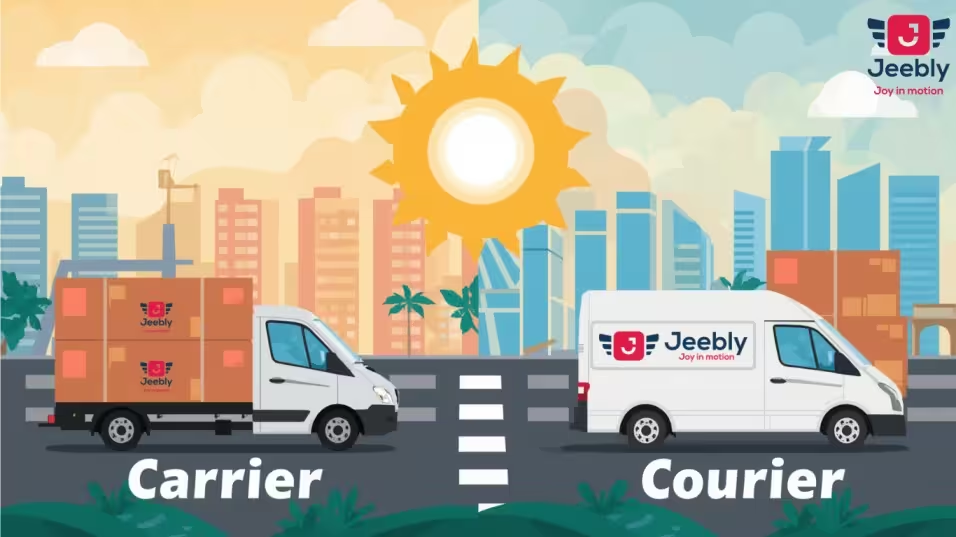
The carrier vs courier distinction is one of the most misapplied decisions in business logistics. Both move goods from point A to point B. That’s where the similarity ends. Scale, speed, cost structure, and the type of business problem each solves are fundamentally different. 

And in the UAE, where express delivery already captures 44% of the courier, express, and parcel market and is growing faster, getting this decision right directly affects customer experience and margins.

This guide cuts through the noise: what separates them, when each is the right call, and how to match the model to your shipment before it costs you.

Carrier vs Courier: The Key Differences

The clearest way to distinguish carriers from couriers is by three variables: shipment scale, delivery speed, and the final recipient.

Carriers
move larger freight volumes over long distances via road, sea, and air networks between warehouses, ports, and distribution hubs. 
The shipment usually feeds into a wider supply chain rather than going directly to an end customer.

Couriers handle individual parcels with direct, door-to-door delivery and real-time tracking. Speed and accountability at the point of receipt define the model.

Here’s the difference in practical terms:

Factor Carrier Courier
Shipment type Pallets, bulk freight, cargo Individual parcels, documents
Delivery speed Days to weeks Same-day to next-day
Coverage Long-haul, cross-border freight lanes Local, city-wide, nationwide last mile
Tracking Milestone updates Real-time tracking updates
Cost basis Weight and volume-based freight rates Per-parcel or per-kilometre rates
Typical use case Warehouse restocking, supply chain movement Customer-facing B2C delivery, urgent shipments
Flexibility Scheduled, contract-based On-demand, flexible pickup

The UAE adds its own layer to this distinction. 

The country’s compact, well-connected geography makes courier-speed last-mile delivery commercially viable across all seven emirates. At the same time, its position as a global trade hub keeps carrier-grade freight movement essential for import-heavy supply chains. 

Most businesses operating here need both to run in parallel.

The carrier vs courier split is one layer of the decision. If your shipments are trending heavier, read Courier vs Freight: Key Differences Explained. Know weight thresholds, speed trade-offs, and UAE-specific cost logic covered in full.

When a Carrier Makes More Sense

Carriers earn their place when volume is high, the timeline allows for planning, and cost-per-unit efficiency outweighs speed.

Choose a carrier when:

* Your shipment is palletised or exceeds standard parcel thresholds, typically above 20 kg or larger than 100×50×50 cm
* You’re moving stock between warehouses, from a manufacturer to a fulfilment hub, or through a port
* The delivery timeline is measured in days, with a buffer built into your supply chain
* The shipment crosses a border and requires customs clearance, trade documentation, or GCC road freight coordination
* You have predictable recurring volumes that justify contracted freight rates

When a Courier Is the Right Call

Couriers exist for the final, customer-facing leg of the delivery journey. This is the moment your end customer actually forms an opinion about your brand.

Choose a courier when:

* A customer placed an order and expects same-day or next-day delivery to their door
* You’re moving time-sensitive items like legal documents, pharmaceutical products, perishables, or high-value goods that need signature confirmation
* The shipment is a single parcel headed directly to a home or office address anywhere in the UAE
* Real-time tracking updates and proof of delivery matter to the customer waiting at the other end
* You’re running an e-commerce business where delivery experience is the last brand impression you make

Once you know a courier is the right call, how you pack the parcel directly affects whether it arrives intact. Read: How to Pack a Courier Parcel in the UAE, with protection tips tailored to UAE delivery conditions.

Cost Comparison: What You're Actually Paying For

Neither model is universally cheaper. The right comparison is value per shipment, measured against the risk and urgency of that specific movement.

Carriers charge based on freight weight, volume, and distance. Consolidated loads attract bulk rates. A truckload moving from Abu Dhabi to a Dubai distribution hub costs a fraction of what moving that same weight as individual parcels via courier would.

Couriers price per parcel or per kilometre. The premium covers speed, direct handling, real-time visibility, and door-level accountability. All of this carries measurable value when a failed delivery means a lost customer.

Here’s a quick decision framework for UAE operations:

* High volume, longer timeline, B2B recipient: Carrier wins on cost
* Individual parcel, time-sensitive, B2C customer: Courier wins on value and brand protection
* Mixed needs, growing e-commerce operation: You need both coordinated through a single platform

One cost that both comparisons often underweight is the cost of failure. In the UAE, COD (cash-on-delivery) packages see a 22% return incidence versus 7% for prepaid orders. This means failed or refused deliveries generate real reverse-logistics costs that compound quickly. A courier service with a strong first-attempt delivery rate, like Jeebly, can directly reduce this exposure.

Managing a high volume of returns alongside your deliveries? See how Jeebly approaches reverse logistics for UAE businesses and what it costs to get it wrong.

How to Decide: A Quick Self-Assessment

Before choosing between a carrier and a courier, run through these four questions:

1. Who’s receiving this shipment? 
* If a business warehouse or fulfilment centre → carrier. 
* If an individual customer at a home or office → courier.

2. When does it need to arrive? 
* Three or more days from now, with flexibility → carrier is cost-effective. 
* Today or tomorrow, or the customer is already waiting → courier territory.

3. How critical is real-time visibility? 
* If your customer expects tracking updates and delivery confirmation, courier-grade accountability is non-negotiable. Carrier milestone       updates aren’t built for that expectation.

4. What’s the cost of a late or failed delivery? 
* Low stakes — warehouse restock with buffer time → carrier failure is manageable.
* High stakes — customer order, medical item, legal document, or event-tied delivery → courier, every time.

Running through these four questions takes under a minute and prevents the most common logistics missteps UAE e-commerce businesses make.

Curious how your logistics costs compare to those of other UAE businesses? Read Cost of Shipping for a Small Business in UAE (2026 Guide) and get a realistic breakdown of what you should actually expect to pay.

Carrier vs Courier: How Jeebly Fits In Both

The carrier vs courier question resolves quickly once you know what you’re shipping, to whom, and how fast. The harder question is whether your logistics partner can actually execute on that model.

Jeebly covers both sides on a single platform.

Jeebly Dash is the courier-side answer for e-commerce businesses across the UAE: same-day in Dubai, next-day nationwide, and express delivery within 60–120 minutes for urgent shipments.

Jeebly Haul handles the freight side: road across GCC and MENA, air freight for import and export, and complete customs documentation support. It supports shipments above 20 kg or beyond standard parcel dimensions, with custom quotations and end-to-end coordination.

Jeebly Bizz brings everything under one roof: warehousing, last-mile delivery, reverse logistics, and cross-border movement in a single business logistics platform. Your store integrates directly, orders route automatically, and your team gets live visibility across the full operation.

Across all three, the numbers are straightforward: 50,000+ daily deliveries, 4,000+ active fleet, and 12M+ customers served. That’s infrastructure that works whether your shipment is a single parcel or a pallet moving across the GCC.

Evaluating your options? See how Jeebly compares to other UAE delivery providers
iMile vs Jeebly — UAE Last-Mile Delivery for eCommerce (2026)

Conclusion

Carrier or courier, the right answer is always the one that matches the shipment, the recipient, and the stakes of the delivery. Carriers move freight at scale and cost. Couriers move parcels with speed and door-level accountability. Most growing UAE businesses need both, and they need them coordinated without friction.

Jeebly brings the full picture together through one tech-connected logistics platform built for UAE delivery, fulfilment, freight, and returns.

Not sure which setup fits your business? Get in touch with the Jeebly team, and we’ll help you map out the right logistics model for your shipments, customers, and growth.

Frequently Asked Questions

Carriers move bulk freight across long distances through consolidated networks. Couriers handle individual parcels door-to-door with speed and real-time tracking. Postal services usually offer lower-cost delivery for standard mail and parcels, but with slower delivery and less parcel-level visibility than courier services.

Four primary variables resolve most decisions: shipment size, delivery timeline, recipient type (business warehouse vs. individual customer), and the cost of a failed or late delivery. COD-heavy UAE operations should also factor in first-attempt delivery success rates.

Yes. Many courier networks operate internationally, providing express cross-border movement and customs documentation support at the individual parcel level. It is often faster and more trackable than freight for individual parcels, but usually comes at a higher per-unit cost.

Cost efficiency through consolidated loads, established GCC and global freight lane contracts, and multi-modal transport are the main advantages. For high-volume cross-border shipments where a few extra days of lead time are acceptable, carrier freight is typically the cost-effective option.

A courier is the provider who moves the parcel. A delivery service describes the full end-to-end experience, including booking, tracking, customer communication, proof of delivery, and returns. A strong courier builds a strong delivery experience. The terms are related but not interchangeable.

Routes to insightful reads

A comparison banner for UAE eCommerce delivery showing two hands holding smartphones side-by-side against a blurred Dubai skyline. The left screen displays the DHL Express logo with an "International Express" badge below it, while the right screen displays the Jeebly logo with a "Local Hyper-local" map route badge. A bold "VS" graphic splits the center.
DHL vs Jeebly: Which Is Better for UAE Businesses and eCommerce Delivery?

Looking for the right logistics partner in the UAE? We break down DHL vs. Jeebly to help you choose between global express shipping and local, tech-driven e-commerce fulfillment. Discover which courier wins on domestic delivery speeds, Cash on Delivery (COD) handling, and cross-border customs.

Read More
Logisty vs Jeebly comparison for UAE eCommerce delivery, last-mile logistics and courier services
Logisty vs Jeebly: UAE eCommerce Delivery Comparison

Logisty and Jeebly serve different logistics needs, but which is the better choice for your business? This comparison explores their services, delivery capabilities, technology, coverage, eCommerce integrations, cash on delivery (COD), and fulfilment solutions to help UAE businesses choose the right logistics partner for growth.

Read More
UAE VAT on imports and exports showing tax compliance, logistics, shipping and customs documentation
VAT on Shipping and Delivery Services in UAE: What Businesses Need to Know

VAT can significantly impact the cost of shipping and delivery services in the UAE, making it essential for businesses to understand how it applies to domestic and international shipments. This guide explains VAT rules, zero-rated and standard-rated services, invoicing requirements, and practical compliance tips to help businesses manage logistics costs and stay compliant with UAE tax regulations.

Read More
COD fraud prevention in the UAE with secure payment verification, order authentication and logistics risk management
COD Fraud in UAE eCommerce: How to Detect, Prevent and Reduce Losses

Cash on Delivery (COD) fraud is a growing challenge for e-commerce businesses across the UAE, leading to fake orders, delivery failures and unnecessary operational costs. Learn how to identify common fraud tactics, implement effective prevention strategies and protect your business while maintaining a seamless customer experience.

Read More
UAE import and export guide featuring trade documentation, cargo ship, air freight, customs clearance and logistics operations
UAE Import and Export Guide: Trade Documentation, Logistics and Compliance

Customs clearance is a critical step in moving goods into and out of the UAE. Whether you’re importing, exporting, or shipping across borders, understanding the customs process, required documentation, and compliance requirements can help you avoid delays, reduce costs, and keep your supply chain running efficiently.

Read More
Categories
blogs

Air freight vs ocean freight: Which is right for UAE businesses? (2026)

Air Freight vs Ocean Freight: Which Is Right for Your Business?

Air Freight vs Ocean Freight: Which Is Right for Your Business?

Air freight from UAE takes 1–5 days and suits urgent, high-value cargo. Ocean freight takes 15–30 days and suits bulk, lower-value goods. For small parcels, courier services are faster and simpler than either.

Speed costs money, and volume takes time. The moment a UAE business starts shipping internationally, this trade-off becomes a recurring decision, and the wrong default is expensive either way.

Air freight and ocean freight aren’t competing for the same cargo. They serve structurally different needs. The UAE’s position makes this decision both more consequential and more nuanced than in most markets. 

DXB alone handled 2.2 million tonnes of cargo in 2024, a 20.5% year-on-year surge, according to Dubai Airports, while Jebel Ali Port recorded its highest container throughput since 2015 at 15.5 million TEU. Both modes are running at scale. 

The choice between them comes down to your cargo profile, your timeline, and how you calculate total cost. This guide breaks down air freight vs ocean freight across all these dimensions.

Air Freight from UAE: When Speed Is the Point

Air freight moves cargo between airports via commercial and dedicated cargo aircraft. Transit times from Dubai typically run 1–5 days to most major destinations. That speed is the product, but it is priced accordingly.

High-value, lightweight cargo

Air freight pricing is based on chargeable weight: the greater of actual weight versus volumetric weight. The formula rewards shipments with high value density, such as electronics, pharmaceuticals, luxury fashion, and medical devices. You’re moving significant value per kilogram, and the freight premium is a fraction of what’s at stake.

A pharma distributor shipping temperature-sensitive medications to a hospital network in Europe has no viable ocean option. The cargo type, timeline, and regulatory requirements all converge in the air.

Urgent restocking and missed inventory windows

When stock runs out ahead of Ramadan, the Dubai Shopping Festival, or a product launch, waiting 20–30 days for an ocean shipment is a revenue problem, not a logistics preference. Air freight compresses that gap to days. For businesses managing demand spikes, that responsiveness is built into the cost.

If your supply chain is still reactive rather than planned, Jeebly’s guide on how UAE businesses scale during peak seasons covers the planning layer that prevents these situations.

Perishable goods and cold chain cargo

Products with short shelf lives, such as fresh food, cut flowers, and others, can’t survive 20+ days at sea, regardless of packaging. Air freight aligns with cold chain requirements on long-haul routes in a way that ocean freight cannot.

When holding costs offset the freight premium

High inventory carrying costs can flip the economics. Tying up working capital across 30 extra days of ocean transit plus storage sometimes costs more than the air premium. Run the full landed cost calculation before defaulting to ocean.

Ocean Freight from UAE: The Case for Cost Efficiency

Ocean freight moves cargo via container ships. Transit times range from 7 days (intra-GCC) to 30+ days for Europe and the Americas. It offers greater capacity and value, as a single container can hold 10,000 beer bottles.

Bulk, heavy, or low-value-per-kilogram cargo

For building materials, furniture, industrial equipment, and automotive parts, the cost-per-unit maths doesn’t work in the air for this profile. Ocean freight isn’t a compromise here. It’s the rational choice.

Planned procurement with sufficient lead time

Businesses operating on 60–90 day replenishment cycles have no structural need for air freight. Ocean’s slower transit is only a constraint if your procurement window is tight. Build the lead time in, and you gain significant cost efficiency with no operational downside.

LCL vs FCL: flexibility at both ends of volume

Less-than-Container Load (LCL) lets you share container space and pay for what you use. It’s practical for SMEs managing cash flow. Full Container Load (FCL) gives larger shippers dedicated space and better per-unit economics at scale. This volume flexibility doesn’t exist in air freight.

Sustainability-conscious supply chains

Air freight leaves the largest freight carbon footprint. Aeroplanes emit 500 grams of CO2 per metric ton of freight per km of transportation, while transport ships emit only 10 to 40 grams of CO2 per kilometre.

For UAE businesses with ESG commitments or international clients who audit supply chain emissions, this gap is quantifiable and increasingly relevant to procurement decisions.

Ocean Freight vs Air Freight: Comparison at a Glance

Both modes have distinct cost, speed, and cargo fit profiles. A brief comparison like the one below will help map your shipment against these dimensions.

Factor ✈ Air Freight 🚢 Ocean Freight
Transit time 1–5 days 7–30+ days
Cost High — chargeable weight Low–moderate — CBM / TEU
Cargo fit High-value, lightweight, perishable, urgent Bulk, heavy, non-perishable, planned
Volume flexibility Limited by aircraft capacity LCL and FCL options
Security and handling High — minimal touchpoints Moderate — more handling stages
Carbon footprint 500–1,500g CO₂/ton-km 10–40g CO₂/ton-km
UAE infrastructure DXB + DWC — 240+ routes Jebel Ali (top 10 globally), Khalifa Port
Hybrid option Sea-air via Dubai Logistics Corridor

How to Make the Right Call: Four Practical Filters

No comparison table makes the decision for you. These are the variables that actually determine the right answer for a given shipment:

1. Value density

Divide shipment value by weight. Above approximately AED 1,000 per kilogram, air freight economics generally work. Below that threshold, the ocean becomes increasingly attractive.

2. Delivery deadline vs procurement lead time

Work backwards from your customer commitment. Over 25 days available, the ocean is viable on most routes. Under 15 days, air freight is typically the only option. The 15–25-day window is when sea-air is worth pricing.

3. Contract or customer expectations

B2B contracts with SLA-linked penalties change the calculation. So does the customer segment. Premium retail buyers in the GCC or Europe often have delivery expectations that make ocean unviable regardless of unit economics.

4. Total landed cost, not just the freight rate

Factor in: freight cost, insurance, customs duties, storage during transit, and opportunity cost of tied capital. Air freight’s headline rate looks expensive. Its total landed cost is competitive for the right cargo profile once you account for faster inventory turnover and reduced holding time.

How Jeebly Helps Across Both Modes

For UAE businesses that need end-to-end freight management across air, sea, and road, Jeebly Haul handles the full journey: pickup, documentation, customs, and delivery. Whether you’re moving bulk cargo by container or coordinating urgent air shipments, the same network handles tracking and compliance throughout the process.

Businesses with cross-border complexity can explore Jeebly Bizz, which handles the regulatory layer, making international freight predictable rather than reactive.

If your freight question sits closer to the last mile, reducing failed deliveries, improving on-time rates, or scaling operations, Jeebly’s guide on what to look for in a reliable logistics company covers what actually differentiates logistics partners in the UAE.

Final Thoughts

The air vs ocean decision is only half the equation. The other half is execution. 

At Jeebly, we handle freight across air, sea, and road, so the mode you choose is supported by the same end-to-end network, real-time tracking, and compliance expertise. Whether you’re moving a single urgent air shipment or planning a container programme for the year, we handle the complexity so you can focus on growth. 

Talk to the Jeebly team about your freight requirements today.

Frequently Asked Questions

Air freight transports cargo by aircraft, while ocean freight moves goods by sea using cargo vessels and shipping containers. Air freight is typically faster and better suited for urgent or high-value shipments, whereas ocean freight is more economical for large, heavy, or non-urgent cargo moving over long distances.

Ocean freight is generally less expensive than air freight, especially for large or heavy shipments. Air freight costs are typically based on chargeable weight and speed, while ocean freight pricing is often calculated using container size, cargo volume, or weight, making it a more cost-effective option for bulk transportation.

Not always. For local deliveries within the UAE, courier services are often faster because they provide direct door-to-door transportation, including same-day and express delivery options. For international shipments, air freight is usually faster than sea freight but may still require customs clearance and final-mile delivery before reaching the recipient.

UAE businesses should consider ocean freight when shipping large volumes of cargo, heavy goods, raw materials, or inventory that does not require urgent delivery. Ocean freight is commonly used for imports, exports, and international trade where cost efficiency is a higher priority than transit speed.

Air freight costs vary depending on factors such as shipment weight, dimensions, destination, cargo type, fuel surcharges, and customs requirements. Urgent shipments and specialized cargo may cost more, while rates can vary significantly depending on the route and carrier. Businesses should request a freight quotation based on their specific shipment requirements.

Routes to insightful reads

A comparison banner for UAE eCommerce delivery showing two hands holding smartphones side-by-side against a blurred Dubai skyline. The left screen displays the DHL Express logo with an "International Express" badge below it, while the right screen displays the Jeebly logo with a "Local Hyper-local" map route badge. A bold "VS" graphic splits the center.
DHL vs Jeebly: Which Is Better for UAE Businesses and eCommerce Delivery?

Looking for the right logistics partner in the UAE? We break down DHL vs. Jeebly to help you choose between global express shipping and local, tech-driven e-commerce fulfillment. Discover which courier wins on domestic delivery speeds, Cash on Delivery (COD) handling, and cross-border customs.

Read More
Logisty vs Jeebly comparison for UAE eCommerce delivery, last-mile logistics and courier services
Logisty vs Jeebly: UAE eCommerce Delivery Comparison

Logisty and Jeebly serve different logistics needs, but which is the better choice for your business? This comparison explores their services, delivery capabilities, technology, coverage, eCommerce integrations, cash on delivery (COD), and fulfilment solutions to help UAE businesses choose the right logistics partner for growth.

Read More
UAE VAT on imports and exports showing tax compliance, logistics, shipping and customs documentation
VAT on Shipping and Delivery Services in UAE: What Businesses Need to Know

VAT can significantly impact the cost of shipping and delivery services in the UAE, making it essential for businesses to understand how it applies to domestic and international shipments. This guide explains VAT rules, zero-rated and standard-rated services, invoicing requirements, and practical compliance tips to help businesses manage logistics costs and stay compliant with UAE tax regulations.

Read More
COD fraud prevention in the UAE with secure payment verification, order authentication and logistics risk management
COD Fraud in UAE eCommerce: How to Detect, Prevent and Reduce Losses

Cash on Delivery (COD) fraud is a growing challenge for e-commerce businesses across the UAE, leading to fake orders, delivery failures and unnecessary operational costs. Learn how to identify common fraud tactics, implement effective prevention strategies and protect your business while maintaining a seamless customer experience.

Read More
UAE import and export guide featuring trade documentation, cargo ship, air freight, customs clearance and logistics operations
UAE Import and Export Guide: Trade Documentation, Logistics and Compliance

Customs clearance is a critical step in moving goods into and out of the UAE. Whether you’re importing, exporting, or shipping across borders, understanding the customs process, required documentation, and compliance requirements can help you avoid delays, reduce costs, and keep your supply chain running efficiently.

Read More
Categories
blogs

Courier vs freight: which do UAE businesses need? (+ air freight)

What Is the Difference Between Courier and Freight? A Simple Guide for Senders

Courier vs freight: which do UAE businesses need? (+ air freight)

Courier services handle small, urgent parcels door-to-door. Freight is for large or heavy shipments via air or sea. Here’s when UAE businesses should use each one — and how costs compare.

Picking the wrong shipping method costs more than money. It costs time, damages relationships with customers, and, in some cases, spoils or delays goods. 

That decision matters even more in a market where parcel volume continues to rise. The UAE courier, express, and parcel market is estimated at USD 1.4 billion in 2026, up from USD 1.3 billion in 2025. This means more shipments are moving through faster, denser delivery networks.

The difference between courier and freight comes down to three variables: shipment weight, delivery speed, and handling type. Get those three right, and the choice is obvious every time.
This guide breaks it down clearly so you can choose right the first time.

Brief Difference Between Courier and Air Freight

The two services are not substitutes for each other. They solve different problems at different weight thresholds.

* Courier services move individual parcels door-to-door, with real-time tracking and same-day or next-day delivery. Each shipment travels as its own tracked unit through the carrier’s network. The practical upper weight limit is 20 kg. Beyond that, handling individual parcels becomes operationally infeasible.

* Freight moves bulk cargo by truck, air, or sea. Shipments are consolidated by weight, volume, and route. The economics only work at scale: above 20 kg, or when dimensions exceed 100 x 50 x 50 cm. Freight is also the default for cross-border trade, where customs clearance and multi-modal routing come into play.

Using a courier for your UAE e-commerce deliveries? Jeebly Dash offers same-day, next-day, and express delivery across all seven emirates, with built-in COD support.

Courier vs Freight: A Side-by-Side Comparison

Across the wider region, the split between two services is already visible in how shipments move: domestic deliveries accounted for 64.81% of the GCC courier, express, and parcel market in 2025. 

This is why courier networks are so central for local parcel movement, while freight takes over as weight, route complexity, and cross-border handling increase.

The table below compares both services across the variables that matter most for shipping decisions in the UAE.

Factor Courier Freight
Weight range Up to 20 kg 20 kg and above
Delivery speed Same day, next day, express (60–120 min) 1 to 10+ business days
Tracking Real-time, per-shipment updates Milestone tracking
Cost basis Per shipment / flat or per-kg rate Weight, volume, and route
COD support ✓ Yes ✕ No
Cross-border Limited Full GCC and international
Best for E-commerce, documents, parcels Bulk cargo, imports/exports
Booking App or self-service platform Custom quotation

8 Things That Determine Whether You Need Courier or Freight

Most shipping mistakes happen because senders focus on price before asking the right questions. These eight factors tell you which service is the best fit before you request a single quote.

1. Shipment Weight Is the First Filter

Here’s an operational boundary to follow:
* Under 20 kg: courier. 
* Over 20 kg: freight.

Courier networks are built for handling individual parcels. Above 20 kg, that infrastructure cannot manage the load efficiently, and costs reflect it. 

For example, Jeebly Dash handles up to 7 kg at a fixed rate (AED 17.31 for next-day delivery for the first 5 kg), with per-kg pricing above that. Jeebly Haul applies to shipments exceeding 20 kg or 100 x 50 x 50 cm in dimensions

2. Parcel Dimensions Can Override Weight

A shipment might be under 20 kg but still qualify as freight if it exceeds standard parcel dimensions. 
Oversized items like long pipes, display equipment, and custom-built fixtures cannot pass through a courier’s parcel-sorting and routing system, regardless of weight. 

Always check dimensions alongside weight when deciding.

3. Delivery Urgency Determines Your Options

Speed is no longer a niche requirement. In the GCC, express services accounted for 33.20% of the market in 2025, indicating that demand has shifted toward faster fulfilment windows for parcel shipments. 

Courier services offer same-day, next-day, and express delivery. In Dubai, express delivery can move a package in 60 to 120 minutes. Freight transit times start at 1 day for domestic road freight and increase from there for international modes. 

If the shipment has a hard same-day deadline, freight is not on the table.

4. Destination Affects Which Service Applies

Within the UAE, couriers handle next-day delivery across all seven emirates. Express (sub-two-hour) is available only in Dubai. For cross-border shipping to Saudi Arabia, Oman, Kuwait, or beyond the GCC, freight is the only structured option. 

International courier services exist but are more expensive than air or road freight for anything over a few kilograms.

Shipping heavy cargo across the GCC? Jeebly Haul covers road freight across the GCC, air freight for international trade, and ocean freight, all with customs clearance included.

5. COD Requirement Points You Toward Courier

COD (cash on delivery) is a courier function. Freight services operate on an invoice-based billing cycle. If your business collects cash at the door from end customers, the transaction is handled by a courier rider rather than a freight driver. In the UAE, COD is deeply embedded in B2C e-commerce. It is a capability you need to confirm before choosing a logistics partner.

For a deeper look at how COD fits into e-commerce logistics in the UAE, see How Jeebly Helps SMEs Scale During Peak Shopping Seasons.

6. Temperature-Sensitive Goods Need a Specific Check

Temperature-controlled delivery (up to 15°C) is available as a courier service across all emirates. This covers pharmaceuticals, cosmetics, and certain food categories that need controlled conditions but not sub-zero storage. 

Two things to note: this is not a cold chain, and temperature-controlled international freight is not available. If your goods are temperature-sensitive and crossing a border, that is a hard constraint that needs to be confirmed before booking.

7. E-Commerce Integration Changes the Equation

For e-commerce businesses, courier selection is about the tech stack. When your Shopify, Magento, or WooCommerce store integrates with a logistics platform via API, orders automatically trigger pickup and dispatch. No manual entry, no delays between order and fulfilment. 

Freight does not plug into e-commerce platforms in the same way. If automated order flow matters, a courier with API integration is the right infrastructure. Jeebly’s technology platform connects directly to major e-commerce systems for exactly this reason.

8. Volume and Frequency Shape the Cost Logic

A business sending 10 parcels a day benefits from courier contract pricing and volume-based remittance cycles. A business restocking warehouse inventory from a supplier in China benefits from freight consolidation. 

The per-kg cost comparison between the two is irrelevant unless you’re comparing the same type of shipment. Compare courier rates for parcel volume against freight rates for cargo volume, not across categories.

If your business is scaling shipment volume, read What Is a 3PL: Third-Party Logistics for UAE Businesses to understand when a single logistics partner covering both courier and freight makes more operational sense.

How Courier Delivery Works End to End

You book through an app or self-service platform. The parcel is picked up, scanned into the carrier’s system, routed to the destination, and tracked at every stage. Delivery status updates go to both sender and recipient.

For e-commerce, the process is more automated. 
* Once your store is integrated with the logistics platform, an incoming order automatically alerts the warehouse team and triggers dispatch. 
* The customer gets real-time delivery updates. 
* COD collected at the door is remitted to the merchant’s bank account on a weekly cycle. 
* Proof of delivery is a photo uploaded by the rider at handover.

Courier services in the UAE make around three delivery attempts before an order is marked as return-to-origin (RTO). That retry structure matters for businesses with high first-attempt failure rates, particularly in areas with access or availability issues.

How Freight Shipping Works End to End

Freight starts with a quotation. 

* You submit shipment details such as weight, dimensions, origin, destination, and handling requirements, and the provider calculates the cost based on the transport mode and route. 
* The booking is confirmed before collection, unlike courier services, where the pickup can happen the same day.
* Once in transit, cargo follows planned routes, with milestone tracking at key checkpoints. 
* For cross-border shipments, customs clearance is handled at the origin and destination, and the freight provider typically coordinates the required documentation.

Jeebly Haul covers this end of the logistics chain, cargo above 20 kg, road freight across the GCC, air freight for international trade, and ocean freight for high-volume imports and exports, with customs clearance built in.

UAE-Specific Factors That Change the Decision

The UAE logistics market has some specific characteristics that shape how courier and freight services operate here.

1. Infrastructure quality. 
In the World Bank’s 2023 Logistics Performance Index, the UAE ranked 7th globally, placing it among the world’s strongest logistics systems. This reinforces why senders here can realistically choose between high-speed courier and more structured freight options.

2. Inter-emirate courier coverage is not uniform. 
Express delivery (60 to 120 minutes) is available only within Dubai. Next-day delivery is available across all seven emirates. Confirm coverage for the specific destination before assuming a courier service can deliver on your timeline.

3. Free zone warehousing adds a step. 
For freight moving into or out of the UAE free zones, a gate pass from the client is required. This is a hard operational requirement and affects inbound logistics planning.

4. The hybrid model is common. 
Most UAE businesses that operate at scale use both services for different purposes: courier for customer-facing e-commerce deliveries, freight for supplier restocking and cross-border inventory movement. 

Need both courier and freight under one roof? Jeebly’s service lines cover the full chain: Jeebly Dash for same-day and next-day parcel delivery, Jeebly Haul for cargo and freight. One platform, one integration.

Talk to the team to map the right setup for your volume and zones.

Frequently Asked Questions

Courier services are designed for small, time-sensitive shipments such as parcels, documents, and e-commerce orders. Freight shipping is used for larger, heavier, or bulk shipments transported by air, sea, road, or rail. The main differences are shipment size, delivery speed, handling requirements, and cost structure.

Use a courier service when sending documents, parcels, or small shipments that require fast door-to-door delivery and tracking. Air freight is better suited for larger commercial shipments, international cargo, or high-value goods that need faster transit than sea freight but exceed typical courier size and weight limits.

Not always. For local UAE deliveries, courier services are usually faster because they provide direct door-to-door delivery, often on the same day or next day. Air freight may offer faster international transit than sea freight, but it still requires cargo handling, customs clearance, and final-mile delivery before reaching the recipient.

Courier pricing is generally based on shipment weight, dimensions, service level, and destination. Freight costs are typically calculated using cargo weight, volume, transportation mode, route, and customs requirements. Courier services are often more economical for small shipments, while freight becomes more cost-effective for larger or bulk cargo.

Yes, parcels can be shipped via sea freight, particularly for international deliveries where transit time is less important than cost. However, sea freight is generally used for larger shipments, while standard parcels are more commonly sent through courier or air cargo services for faster delivery.

Routes to insightful reads

A comparison banner for UAE eCommerce delivery showing two hands holding smartphones side-by-side against a blurred Dubai skyline. The left screen displays the DHL Express logo with an "International Express" badge below it, while the right screen displays the Jeebly logo with a "Local Hyper-local" map route badge. A bold "VS" graphic splits the center.
DHL vs Jeebly: Which Is Better for UAE Businesses and eCommerce Delivery?

Looking for the right logistics partner in the UAE? We break down DHL vs. Jeebly to help you choose between global express shipping and local, tech-driven e-commerce fulfillment. Discover which courier wins on domestic delivery speeds, Cash on Delivery (COD) handling, and cross-border customs.

Read More
Logisty vs Jeebly comparison for UAE eCommerce delivery, last-mile logistics and courier services
Logisty vs Jeebly: UAE eCommerce Delivery Comparison

Logisty and Jeebly serve different logistics needs, but which is the better choice for your business? This comparison explores their services, delivery capabilities, technology, coverage, eCommerce integrations, cash on delivery (COD), and fulfilment solutions to help UAE businesses choose the right logistics partner for growth.

Read More
UAE VAT on imports and exports showing tax compliance, logistics, shipping and customs documentation
VAT on Shipping and Delivery Services in UAE: What Businesses Need to Know

VAT can significantly impact the cost of shipping and delivery services in the UAE, making it essential for businesses to understand how it applies to domestic and international shipments. This guide explains VAT rules, zero-rated and standard-rated services, invoicing requirements, and practical compliance tips to help businesses manage logistics costs and stay compliant with UAE tax regulations.

Read More
COD fraud prevention in the UAE with secure payment verification, order authentication and logistics risk management
COD Fraud in UAE eCommerce: How to Detect, Prevent and Reduce Losses

Cash on Delivery (COD) fraud is a growing challenge for e-commerce businesses across the UAE, leading to fake orders, delivery failures and unnecessary operational costs. Learn how to identify common fraud tactics, implement effective prevention strategies and protect your business while maintaining a seamless customer experience.

Read More
UAE import and export guide featuring trade documentation, cargo ship, air freight, customs clearance and logistics operations
UAE Import and Export Guide: Trade Documentation, Logistics and Compliance

Customs clearance is a critical step in moving goods into and out of the UAE. Whether you’re importing, exporting, or shipping across borders, understanding the customs process, required documentation, and compliance requirements can help you avoid delays, reduce costs, and keep your supply chain running efficiently.

Read More
Categories
blogs

Reduce last-mile delivery costs in UAE: 7 proven strategies for 2026

How to Reduce Last-Mile Delivery Costs in the UAE (2026 Guide)

How to Reduce Last-Mile Delivery Costs in the UAE: A Practical Guide for Business Owners

Last-mile delivery accounts for up to 53% of total shipping costs. UAE businesses are using route optimisation, consolidated deliveries and third-party logistics providers to reduce costs by 20–30%.

Last-mile delivery is the most expensive part of your supply chain — and for most UAE businesses, it’s also the least optimised.

The final leg from warehouse to customer door accounts for 53% of total shipping costs on average. In the UAE, where customer expectations for same-day and next-day delivery are set by Amazon and noon, the pressure to absorb those costs is only growing.

The good news: the businesses winning on logistics in the UAE are not spending more. They’re structured differently. This guide covers exactly what they do — and where Jeebly fits into that equation.

Why Last-Mile Costs Are Higher in the UAE Than You Think

Before the fixes, it’s worth understanding what’s actually driving the costs. UAE last-mile operations face a specific set of compounding pressures:

Failed first-attempt deliveries are a significant cost multiplier. Every re-delivery attempt adds driver time, fuel, and vehicle wear — with zero additional revenue. Failed attempts are more common when customers are unreachable, addresses are imprecise, or delivery windows don’t match customer schedules.

Inter-emirate routing complexity means a next-day delivery from Dubai to Ras Al Khaimah or Umm Al Quwain is not a simple extension of your Dubai operation. Road time, driver allocation, and fuel costs change substantially across the seven emirates.

Seasonal demand spikes, Ramadan, White Friday, Eid, Dubai Shopping Festival — create volume surges that manual operations cannot scale to absorb efficiently. Overstaffing during normal periods wastes money. Understaffing during peaks loses orders and damages customer trust.

COD reconciliation overhead adds administrative cost that purely digital markets don’t face. Cash-on-delivery remains standard in UAE last-mile; collecting, reconciling, and remitting it takes time and process.

Fix these structural issues and the cost reduction follows. Here’s how.

5 Proven Ways to Reduce Last-Mile Delivery Costs in the UAE

1. Switch from in-house delivery to an outsourced last-mile partner

This is the highest impact decision most UAE SMEs and e commerce brands can make, and the one most delayed because it feels like a loss of control.

The economics are straightforward. Building an in house delivery operation in Dubai means vehicle leasing or purchase, driver hiring and training, fuel management, insurance, maintenance, and a dispatch team. These are fixed costs you carry whether you ship 50 orders a day or 500.

A last mile partner converts all of that into a variable cost. You pay per delivery. When volume drops, your cost drops. When volume spikes, the partner absorbs the capacity, without you hiring additional drivers or leasing more vehicles.

For businesses shipping fewer than 500 orders a day, outsourced last mile is almost always cheaper than in house when total cost of ownership is calculated correctly.

Jeebly’s next-day delivery across all seven emirates is priced at AED 17.31 per shipment up to 5 kg, a flat rate that covers the full UAE network with no zone surcharges. For same day delivery within Dubai, Jeebly Dash operates with a cut off at 11 AM. That’s a fixed, predictable cost per order that you can model directly into your unit economics.

Explore Jeebly’s delivery services →

2. Optimise delivery routes with real-time intelligence

Manual routing — assigning drivers to zones and trusting them to navigate, is one of the most consistent sources of avoidable cost in UAE last mile operations.
AI-driven route optimisation does several things manual routing cannot:

* Accounts for UAE-specific variables: prayer time windows, mall traffic during sale seasons, inter-emirate road differences, and temperature-driven delivery window constraints in summer
* Dynamically re-routes when traffic conditions change mid-shift
* Sequences deliveries to minimise backtracking and unnecessary kilometres
* Reduces first-attempt failure rates by pairing smarter windows with proactive customer communication

Route optimisation technology has been shown to reduce travel time and fuel costs materially for logistics operations. The gains compound: fewer kilometres means lower fuel spend, lower vehicle wear, and more deliveries per driver per shift.
Jeebly’s platform uses automated routing and dispatch built into the Jeebly One app, with real-time tracking visible to both the business and the customer.

3. Reduce failed delivery attempts with proactive communication

A failed delivery attempt is a hidden tax on your last-mile operation. The direct cost is the re-delivery. The indirect cost is the customer experience damage and the administrative overhead of rescheduling.

In the UAE, failed attempts are disproportionately caused by:

* Customers not home during the delivery window
* Imprecise addresses (a persistent challenge outside Dubai’s well-mapped urban grid)
* No advance notice given to the customer

The fix is systematic, not heroic. Proactive SMS or push notification before arrival, real-time tracking links shared with customers, and digital proof of delivery (photo) reduce failed attempts and eliminate disputes.

Jeebly provides real-time delivery status updates at every stage and digital proof of delivery as standard, not an add-on.

4. Store inventory closer to your customers

If your fulfilment centre is in one location and a significant portion of your orders ship to customers across multiple emirates, you are paying for distance on every order.

Micro-fulfillment centres, smaller, strategically located dark stores closer to end customers — are the structural answer to this. They reduce last-mile distance, enable faster delivery windows, and lower per-order fuel and time costs.

Jeebly operates seven Micro Fulfilment Centres (MFCs) across the UAE for select clients, enabling 10-minute delivery within covered zones. Businesses that store inventory at Jeebly’s fulfilment centres in Dubai, Abu Dhabi, and Sharjah gain network proximity without leasing or managing the space themselves.

Talk to Jeebly about fulfillment centre access →

5. Automate dispatch, order management, and COD reconciliation

Manual order processing is where errors, delays, and labour costs accumulate invisibly. Every order that requires a human to read it, assign it, and log it is an order that costs more than it should.

Direct integration between your e-commerce store and your logistics platform eliminates this layer entirely. Orders placed on Shopify, Magento, or WooCommerce flow automatically into the dispatch system — no manual entry, no transcription errors, no delay between order confirmation and dispatch trigger.

COD reconciliation — a uniquely UAE overhead — is handled automatically when your logistics partner provides a live dashboard with COD amounts, delivery status, and weekly remittance built in.

Jeebly integrates directly with Shopify, Magento, WooCommerce, and custom APIs. The live dashboard shows order status, COD pending remittance, delivery tracking, and invoices in one place. Weekly COD remittance is standard.

What This Looks Like in Practice: The Jeebly Cost Model

For a UAE e-commerce business shipping 200 orders per day, the cost comparison between in-house delivery and outsourcing to Jeebly typically looks like this:


Cost elementIn-house estimateJeebly
Per-delivery cost (next-day, up to 5 kg)AED 25–40+ (blended, including fixed costs)AED 17.31 flat
Inter-emirate coverageRequires separate arrangementsAll 7 emirates included
Same-day capabilityRequires dedicated fleetJeebly Dash, Dubai
COD remittanceManual, internal overheadWeekly, automated
Returns handlingManual, unstructuredDoorstep QC, return-to-warehouse
E-commerce integrationCustom build requiredShopify, Magento, WooCommerce, API

The per-delivery gap alone — at 200 orders daily — represents a material cost saving before fixed overhead is accounted for.

The Most Expensive Mistake UAE Businesses Make on Last-Mile

Treating last-mile delivery as a fixed cost rather than a variable one.

Businesses that maintain in-house delivery fleets and teams carry those costs regardless of order volume. The margin compression is worst during slow periods — but the operational strain is worst during peaks, when the fixed infrastructure cannot scale fast enough without emergency spend.

The businesses reducing last-mile costs most effectively in the UAE are the ones that have converted their logistics from a capital-heavy fixed cost into a per-order variable cost — and reinvested the difference into growth. 

Ready to Reduce Your Last-Mile Costs?

Treating last-mile delivery as a fixed cost rather than a variable one.

Businesses that maintain in-house delivery fleets and teams carry those costs regardless of order volume. The margin compression is worst during slow periods — but the operational strain is worst during peaks, when the fixed infrastructure cannot scale fast enough without emergency spend.

The businesses reducing last-mile costs most effectively in the UAE are the ones that have converted their logistics from a capital-heavy fixed cost into a per-order variable cost — and reinvested the difference into growth. 

See how Jeebly works for UAE businesses like yours →

Download the Jeebly One app →

Frequently Asked Questions

The cost of last-mile delivery in the UAE varies depending on factors such as shipment size, delivery distance, service speed, and delivery volume. Businesses can often reduce per-delivery costs by consolidating shipments, optimizing routes, and working with logistics providers that offer scalable pricing models.

Businesses can reduce failed deliveries by collecting accurate customer addresses, providing real-time tracking updates, confirming delivery details before dispatch, and maintaining clear communication with recipients. Offering flexible delivery windows and alternative delivery options can also improve first-attempt delivery success rates.

Yes. A third-party logistics (3PL) provider can help reduce delivery costs by leveraging established transportation networks, route optimization technology, operational expertise, and economies of scale. This allows businesses to avoid the costs of managing their own delivery fleet while improving delivery efficiency.

Route optimization helps reduce delivery costs by identifying the most efficient delivery paths based on factors such as distance, traffic conditions, delivery density, and time windows. This can lower fuel consumption, reduce driver hours, improve vehicle utilization, and increase the number of deliveries completed per route.

The most cost-effective delivery option depends on shipment volume, delivery speed requirements, and destination. For many businesses, scheduled deliveries, consolidated shipments, and economy delivery services offer lower costs than on-demand or express options. Working with a logistics partner that can match delivery services to business needs can further improve cost efficiency.

Routes to insightful reads

A comparison banner for UAE eCommerce delivery showing two hands holding smartphones side-by-side against a blurred Dubai skyline. The left screen displays the DHL Express logo with an "International Express" badge below it, while the right screen displays the Jeebly logo with a "Local Hyper-local" map route badge. A bold "VS" graphic splits the center.
DHL vs Jeebly: Which Is Better for UAE Businesses and eCommerce Delivery?

Looking for the right logistics partner in the UAE? We break down DHL vs. Jeebly to help you choose between global express shipping and local, tech-driven e-commerce fulfillment. Discover which courier wins on domestic delivery speeds, Cash on Delivery (COD) handling, and cross-border customs.

Read More
Logisty vs Jeebly comparison for UAE eCommerce delivery, last-mile logistics and courier services
Logisty vs Jeebly: UAE eCommerce Delivery Comparison

Logisty and Jeebly serve different logistics needs, but which is the better choice for your business? This comparison explores their services, delivery capabilities, technology, coverage, eCommerce integrations, cash on delivery (COD), and fulfilment solutions to help UAE businesses choose the right logistics partner for growth.

Read More
UAE VAT on imports and exports showing tax compliance, logistics, shipping and customs documentation
VAT on Shipping and Delivery Services in UAE: What Businesses Need to Know

VAT can significantly impact the cost of shipping and delivery services in the UAE, making it essential for businesses to understand how it applies to domestic and international shipments. This guide explains VAT rules, zero-rated and standard-rated services, invoicing requirements, and practical compliance tips to help businesses manage logistics costs and stay compliant with UAE tax regulations.

Read More
COD fraud prevention in the UAE with secure payment verification, order authentication and logistics risk management
COD Fraud in UAE eCommerce: How to Detect, Prevent and Reduce Losses

Cash on Delivery (COD) fraud is a growing challenge for e-commerce businesses across the UAE, leading to fake orders, delivery failures and unnecessary operational costs. Learn how to identify common fraud tactics, implement effective prevention strategies and protect your business while maintaining a seamless customer experience.

Read More
UAE import and export guide featuring trade documentation, cargo ship, air freight, customs clearance and logistics operations
UAE Import and Export Guide: Trade Documentation, Logistics and Compliance

Customs clearance is a critical step in moving goods into and out of the UAE. Whether you’re importing, exporting, or shipping across borders, understanding the customs process, required documentation, and compliance requirements can help you avoid delays, reduce costs, and keep your supply chain running efficiently.

Read More

    Powered by