





Jeebly | Logistics Solutions

Categories
blogs

How to Reduce Cart Abandonment Caused by Delivery Costs and Uncertainty

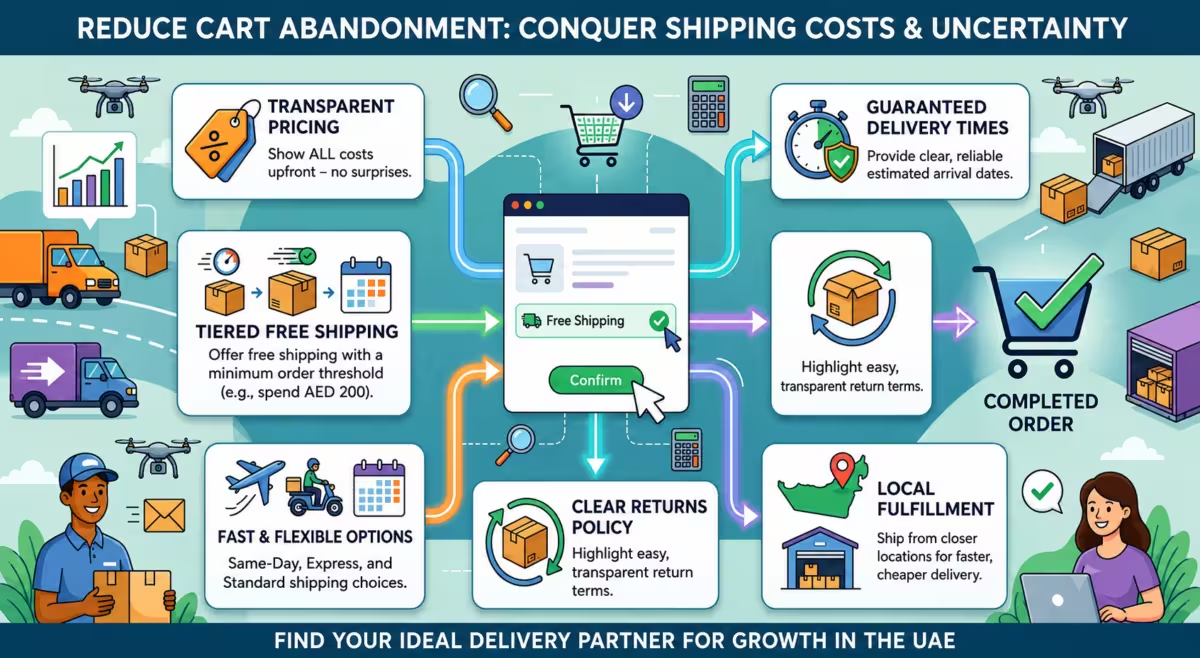
Illustration showing strategies to reduce cart abandonment through transparent shipping costs, fast delivery, local fulfilment, and clear returns policies for UAE eCommerce businesses.

How to Reduce Cart Abandonment Caused by Delivery Costs and Uncertainty

Roughly seven out of every ten shoppers who add items to their cart leave without purchasing. The number one trigger cited by 48% of US shoppers is extra costs appearing at final checkout, primarily shipping fees and taxes. This is entirely preventable. 

Additionally, combined delivery cost and delivery uncertainty directly drive more than half of all preventable cart abandonment. It’s mostly a delivery communication problem, and the fix starts long before the customer reaches the payment page. 

This guide covers the specific delivery and logistics changes that reduce abandonment, the UAE-specific factors that make this market different, and how to structure your delivery operation so it converts.

Key Takeaways

  • 48% of shoppers abandon their cart because of unexpected shipping costs, the top reason for cart abandonment.

  • Showing delivery cost and estimated date on the product page eliminates the surprise that causes most shipping-related abandonment.

  • In the UAE, COD can still account for 40-60% of D2C transactions in certain categories, directly impacting conversion rates and market penetration.

  • The brands that consistently convert at checkout are the ones whose delivery operation is reliable enough to promise something specific. 

Why Delivery Is a Pre-Purchase Conversion Problem

The standard model in e-commerce treats delivery as what happens after the sale. The data says otherwise.

Many ecommerce stores still rely on vague delivery language such as “3–7 business days” or “delivery subject to location.” While technically accurate, these messages do little to help customers understand when they will actually receive their order. The most effective stores communicate delivery expectations with precision.

The sequence that may create abandonment is specific: uncertain delivery window → reaches checkout → sees AED 15 shipping fee → doesn’t complete purchase. 

The fix is not removing the fee at the last step. It’s removing the uncertainty and the surprise from the earliest point in the purchase journey.

Fix 1: Show Delivery Cost and Estimated Date on the Product Page

The checkout page is too late. Displaying shipping costs, taxes, and fees on the product page or early in the cart can eliminate the surprise that causes most price-related abandonment.

What this could look like in practice:

  • A delivery cost estimate on the product page, based on the customer’s location (use geolocation to personalise this automatically)
  • A specific delivery date rather than a range: “arrives tomorrow” or “arrives Wednesday if ordered before 2 pm”
  • A delivery cut-off time clearly displayed: “Order in the next 3 hours for same-day delivery”

The same principle applies to delivery date promises. Showing the delivery date where the purchase decision is being made converts that information from noise into a reason to buy.

Fix 2: Set a Free Shipping Threshold at the Right Level

Free shipping is among the most impactful pricing changes for reducing cart abandonment. The mechanics matter.

For example: if your current AOV is AED 150, set the free shipping threshold at AED 180–195. Customers who are AED 30 away from free shipping will add an item. Customers who are AED 100 away will not bother.

Additionally, a free shipping progress bar visible in the cart and ideally on product pages can show customers how close they are to the threshold.

Fix 3: Match Your Delivery Promise to Your Logistics Capability

The connection between logistics capability and cart conversion is direct. If your fulfilment partner can only reliably hit next-day delivery within Dubai, don’t promise it to customers in Ras Al Khaimah. If your current provider takes 4–5 days to the northern emirates, your product page date estimate needs to reflect that, and your conversion rate will reflect the slower promise.

This is where your logistics partner choice directly affects your checkout conversion rate. For same-day and next-day domestic delivery with the FDSS data to back up precise checkout promises, Jeebly Dash covers all seven emirates with a published 98% FDSS.

Fix 4: Handle COD the Right Way for UAE Shoppers

COD creates a specific abandonment pattern in the UAE: shoppers select COD at checkout, then abandon because they’re unsure whether the delivery agent will arrive, how much to have ready, or what happens if they miss the delivery. This is delivery uncertainty driving abandonment even after payment method selection.

The fixes are operational:

Pre-delivery WhatsApp notification: Send a WhatsApp message when the order is out for delivery, confirming the exact COD amount, a delivery window, and a rescheduling option. Customers value predictability.

COD OTP confirmation: Implementing OTP confirmation before dispatch verifies the customer’s phone number and intent, filtering out fake orders before they enter the delivery pipeline. This reduces RTO from COD fraud.

Clear COD policy on the product page. State the exact COD process when the driver arrives, what form of payment is accepted, and what happens if the customer isn’t home. Uncertainty about how COD works causes abandonment at checkout.

Fix 5: Use WhatsApp for Cart Recovery

The UAE has some of the highest WhatsApp penetration rates in the world. Cart abandonment recovery messages sent via WhatsApp within 30–60 minutes of abandonment reach customers on the device and app they’re actively using.

Effective WhatsApp cart recovery for UAE e-commerce:

  • Send within 30–60 minutes of abandonment. Intent degrades quickly.
  • Show the specific abandoned item with an image.
  • Include a direct link back to the cart (not the homepage).
  • Confirm the delivery date and cost upfront in the message. Address the exact friction point that caused the abandonment.
  • Offer a small incentive (free delivery, a 5% discount) for orders above your free shipping threshold.

The delivery promise in the recovery message matters as much as the incentive. A customer who abandoned because of a vague delivery window needs to see a specific date before they’ll re-engage.

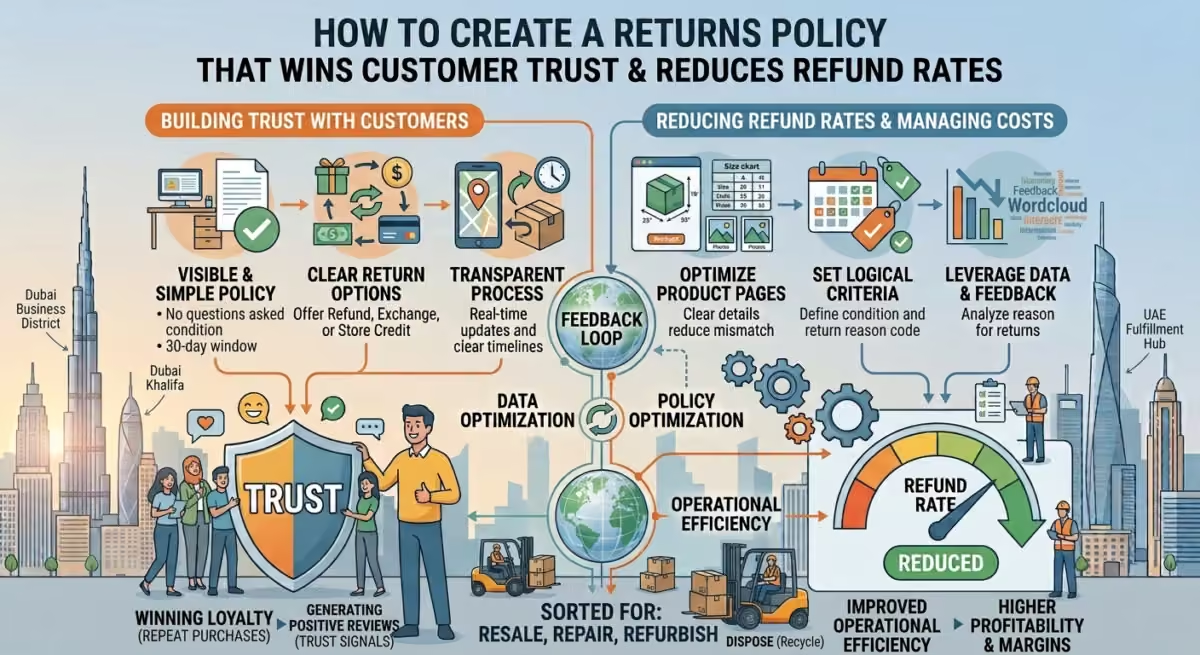
Fix 6: Make Returns Visible and Simple Before Purchase

A return policy is one of the strongest trust signals in ecommerce. Yet many stores treat returns as compliance content rather than conversion content.

A clear, easy return policy shown on product pages will directly reduce the pre-purchase hesitation that causes abandonment for considered purchases. For UAE shoppers, the question is typically: “If this doesn’t fit or isn’t what I expected, how hard is it to send back?”

The answer needs to be immediate and visible. “Free returns within 14 days” placed near the add-to-cart button removes a meaningful source of purchase anxiety. 

For the legal minimum return rights under UAE consumer protection law, a quick guide on How to Manage eCommerce Returns in UAE: Strategy, Policy and Logistics covers both the compliance requirements and the policy design that converts.

How Jeebly Supports Checkout Conversion

The connection between Jeebly’s delivery operation and your cart conversion rate is direct and measurable.

Jeebly Dash’s 98% FDSS across 50,000+ daily deliveries makes specific delivery date promises at checkout operationally credible. When you show “arrives tomorrow by 9 pm” on your product page, that promise needs a logistics partner with the infrastructure to keep it. Jeebly Dash publishes the performance data that backs that up.

For businesses managing high COD volumes, Jeebly Bizz connects your Shopify or WooCommerce store directly to dispatch, with WhatsApp and SMS notifications built into the delivery workflow.

For businesses managing inbound freight alongside domestic delivery, Jeebly Haul covers air, sea, and road freight with in-house customs clearance, keeping inventory moving without the delays that create “out of stock” conversion losses at product level.

Talk to the Jeebly team about your current delivery operation. A direct conversation about your FDSS rate, COD volume, and average delivery window will quickly identify where the logistics gaps are creating checkout friction.

Conclusion

Delivery cost and delivery uncertainty are the leading causes of cart abandonment, and both are fixable without rebuilding your checkout. 

Show delivery costs and specific delivery dates on product pages, not at checkout. Use WhatsApp for cart recovery. Make your return policy visible before purchase, not buried in footer links. And build all of this on a logistics partner whose performance data supports the promises you’re making.

The brands that consistently convert at checkout are not the ones with the most sophisticated checkout technology. They’re the ones whose delivery operation is reliable enough to promise something specific. For same-day and next-day delivery across the UAE with the FDSS data to back it up, get in touch with the Jeebly team.

Frequently Asked Questions

Unexpected extra costs at checkout, primarily shipping fees and taxes, cited by 48% of abandoning shoppers. This has been the #1 cause for six consecutive years. The fix is showing all costs, including delivery, on the product page before checkout, not revealing them at the payment step.

The optimal free shipping threshold should be roughly 20–30% above your current average order value. Pair the threshold with a cart progress bar showing customers how close they are to free shipping. A threshold at or below AOV subsidises orders that already cleared it; one far above AOV pushes shoppers to abandon.

COD in the UAE creates a specific abandonment pattern: uncertainty about the delivery process, payment amount, and what happens if the customer misses the delivery agent. Pre-delivery WhatsApp notification with the exact COD amount and a delivery window reduces both abandonment and COD refusals at the door.

Yes, specifically. Vague delivery windows (“3–7 business days”) carry uncertainty all the way to checkout, where they compound with an unexpected shipping fee to trigger abandonment. A specific date (“arrives Wednesday”) makes the delivery concrete and removes that uncertainty before the customer reaches payment. This only works if your logistics partner can actually deliver on the specific date you’re promising.

Within 30–60 minutes for the first message. Buying intent degrades quickly after abandonment. In the UAE, send via WhatsApp rather than email for substantially higher open and recovery rates. The recovery message should address the specific friction point. If delivery cost caused abandonment, include the delivery price (or a free shipping offer) in the message alongside a direct link back to the cart.

Routes to insightful reads

BNPL in the UAE and its impact on ecommerce delivery and returns, showing the transaction cycle, faster fulfilment, order frequency, real-time tracking, and streamlined returns
Buy Now Pay Later in the UAE: What BNPL Means for eCommerce Delivery and Returns.

Buy Now Pay Later (BNPL) is changing how consumers shop and how eCommerce businesses manage fulfilment and returns in the UAE. This guide explores how BNPL can influence order volumes, delivery demand, fulfilment operations, return rates, refund processing, and the logistics strategies businesses need to support a growing BNPL-driven customer base.

Read More
Infographic explaining how to calculate volumetric weight for shipping, including the formula, measurement example and comparison between actual and chargeable weight.
How to Calculate Volumetric Weight for Shipping: Formula and Examples

Learn how to calculate volumetric weight for shipping with an easy-to-follow formula and practical examples. Understand how package dimensions, actual weight and carrier conversion factors determine the chargeable weight and ultimately impact your shipping costs.

Read More
3PL vs 4PL logistics comparison showing warehousing, transportation, distribution, supply chain integration, technology, analytics, and strategic planning for UAE businesses
3PL vs 4PL: What Is the Difference and Which Does Your UAE Business Need?

3PL and 4PL logistics models help businesses manage different levels of supply chain operations. This guide explains the key differences between 3PL and 4PL providers, their roles, benefits, costs, and how UAE businesses can choose the right logistics model based on their size, supply chain complexity, and operational needs.

Read More
Types of packaging for courier shipments, showing outer packaging strength, void-fill options, cushioning materials, and sealing and labelling methods
Types of Packaging for Courier Shipments: Which One Best Protects Your Product?

Choosing the right packaging is essential for protecting products during courier transportation. This guide explores different types of packaging for courier shipments, including corrugated boxes, bubble wrap, air pillows, paper fillers, foam inserts, and protective seals, and explains how to choose the best option based on your product, handling needs, and shipping conditions.

Read More
Types of logistics explained through inbound, outbound, reverse and third-party logistics, showing the movement of goods between suppliers, warehouses, customers and return facilities.
Types of Logistics Explained: Inbound, Outbound, Reverse and Third-Party 

Logistics covers much more than moving goods from one place to another. This guide explains the four key types of logistics, inbound, outbound, reverse and third-party logistics (3PL), and how each supports the supply chain. Learn how goods move from suppliers to warehouses, reach customers, return for repair or disposal, and how businesses use 3PL providers to manage logistics operations.

Read More
Categories
blogs

Reduce last-mile delivery costs in UAE: 7 proven strategies for 2026

How to Reduce Last-Mile Delivery Costs in the UAE (2026 Guide)

How to Reduce Last-Mile Delivery Costs in the UAE: A Practical Guide for Business Owners

Last-mile delivery accounts for up to 53% of total shipping costs. UAE businesses are using route optimisation, consolidated deliveries and third-party logistics providers to reduce costs by 20–30%.

Last-mile delivery is the most expensive part of your supply chain — and for most UAE businesses, it’s also the least optimised.

The final leg from warehouse to customer door accounts for 53% of total shipping costs on average. In the UAE, where customer expectations for same-day and next-day delivery are set by Amazon and noon, the pressure to absorb those costs is only growing.

The good news: the businesses winning on logistics in the UAE are not spending more. They’re structured differently. This guide covers exactly what they do — and where Jeebly fits into that equation.

Why Last-Mile Costs Are Higher in the UAE Than You Think

Before the fixes, it’s worth understanding what’s actually driving the costs. UAE last-mile operations face a specific set of compounding pressures:

Failed first-attempt deliveries are a significant cost multiplier. Every re-delivery attempt adds driver time, fuel, and vehicle wear — with zero additional revenue. Failed attempts are more common when customers are unreachable, addresses are imprecise, or delivery windows don’t match customer schedules.

Inter-emirate routing complexity means a next-day delivery from Dubai to Ras Al Khaimah or Umm Al Quwain is not a simple extension of your Dubai operation. Road time, driver allocation, and fuel costs change substantially across the seven emirates.

Seasonal demand spikes, Ramadan, White Friday, Eid, Dubai Shopping Festival — create volume surges that manual operations cannot scale to absorb efficiently. Overstaffing during normal periods wastes money. Understaffing during peaks loses orders and damages customer trust.

COD reconciliation overhead adds administrative cost that purely digital markets don’t face. Cash-on-delivery remains standard in UAE last-mile; collecting, reconciling, and remitting it takes time and process.

Fix these structural issues and the cost reduction follows. Here’s how.

5 Proven Ways to Reduce Last-Mile Delivery Costs in the UAE

1. Switch from in-house delivery to an outsourced last-mile partner

This is the highest impact decision most UAE SMEs and e commerce brands can make, and the one most delayed because it feels like a loss of control.

The economics are straightforward. Building an in house delivery operation in Dubai means vehicle leasing or purchase, driver hiring and training, fuel management, insurance, maintenance, and a dispatch team. These are fixed costs you carry whether you ship 50 orders a day or 500.

A last mile partner converts all of that into a variable cost. You pay per delivery. When volume drops, your cost drops. When volume spikes, the partner absorbs the capacity, without you hiring additional drivers or leasing more vehicles.

For businesses shipping fewer than 500 orders a day, outsourced last mile is almost always cheaper than in house when total cost of ownership is calculated correctly.

Jeebly’s next-day delivery across all seven emirates is priced at AED 17.31 per shipment up to 5 kg, a flat rate that covers the full UAE network with no zone surcharges. For same day delivery within Dubai, Jeebly Dash operates with a cut off at 11 AM. That’s a fixed, predictable cost per order that you can model directly into your unit economics.

Explore Jeebly’s delivery services →

2. Optimise delivery routes with real-time intelligence

Manual routing — assigning drivers to zones and trusting them to navigate, is one of the most consistent sources of avoidable cost in UAE last mile operations.
AI-driven route optimisation does several things manual routing cannot:

* Accounts for UAE-specific variables: prayer time windows, mall traffic during sale seasons, inter-emirate road differences, and temperature-driven delivery window constraints in summer
* Dynamically re-routes when traffic conditions change mid-shift
* Sequences deliveries to minimise backtracking and unnecessary kilometres
* Reduces first-attempt failure rates by pairing smarter windows with proactive customer communication

Route optimisation technology has been shown to reduce travel time and fuel costs materially for logistics operations. The gains compound: fewer kilometres means lower fuel spend, lower vehicle wear, and more deliveries per driver per shift.
Jeebly’s platform uses automated routing and dispatch built into the Jeebly One app, with real-time tracking visible to both the business and the customer.

3. Reduce failed delivery attempts with proactive communication

A failed delivery attempt is a hidden tax on your last-mile operation. The direct cost is the re-delivery. The indirect cost is the customer experience damage and the administrative overhead of rescheduling.

In the UAE, failed attempts are disproportionately caused by:

* Customers not home during the delivery window
* Imprecise addresses (a persistent challenge outside Dubai’s well-mapped urban grid)
* No advance notice given to the customer

The fix is systematic, not heroic. Proactive SMS or push notification before arrival, real-time tracking links shared with customers, and digital proof of delivery (photo) reduce failed attempts and eliminate disputes.

Jeebly provides real-time delivery status updates at every stage and digital proof of delivery as standard, not an add-on.

4. Store inventory closer to your customers

If your fulfilment centre is in one location and a significant portion of your orders ship to customers across multiple emirates, you are paying for distance on every order.

Micro-fulfillment centres, smaller, strategically located dark stores closer to end customers — are the structural answer to this. They reduce last-mile distance, enable faster delivery windows, and lower per-order fuel and time costs.

Jeebly operates seven Micro Fulfilment Centres (MFCs) across the UAE for select clients, enabling 10-minute delivery within covered zones. Businesses that store inventory at Jeebly’s fulfilment centres in Dubai, Abu Dhabi, and Sharjah gain network proximity without leasing or managing the space themselves.

Talk to Jeebly about fulfillment centre access →

5. Automate dispatch, order management, and COD reconciliation

Manual order processing is where errors, delays, and labour costs accumulate invisibly. Every order that requires a human to read it, assign it, and log it is an order that costs more than it should.

Direct integration between your e-commerce store and your logistics platform eliminates this layer entirely. Orders placed on Shopify, Magento, or WooCommerce flow automatically into the dispatch system — no manual entry, no transcription errors, no delay between order confirmation and dispatch trigger.

COD reconciliation — a uniquely UAE overhead — is handled automatically when your logistics partner provides a live dashboard with COD amounts, delivery status, and weekly remittance built in.

Jeebly integrates directly with Shopify, Magento, WooCommerce, and custom APIs. The live dashboard shows order status, COD pending remittance, delivery tracking, and invoices in one place. Weekly COD remittance is standard.

What This Looks Like in Practice: The Jeebly Cost Model

For a UAE e-commerce business shipping 200 orders per day, the cost comparison between in-house delivery and outsourcing to Jeebly typically looks like this:


Cost elementIn-house estimateJeebly
Per-delivery cost (next-day, up to 5 kg)AED 25–40+ (blended, including fixed costs)AED 17.31 flat
Inter-emirate coverageRequires separate arrangementsAll 7 emirates included
Same-day capabilityRequires dedicated fleetJeebly Dash, Dubai
COD remittanceManual, internal overheadWeekly, automated
Returns handlingManual, unstructuredDoorstep QC, return-to-warehouse
E-commerce integrationCustom build requiredShopify, Magento, WooCommerce, API

The per-delivery gap alone — at 200 orders daily — represents a material cost saving before fixed overhead is accounted for.

The Most Expensive Mistake UAE Businesses Make on Last-Mile

Treating last-mile delivery as a fixed cost rather than a variable one.

Businesses that maintain in-house delivery fleets and teams carry those costs regardless of order volume. The margin compression is worst during slow periods — but the operational strain is worst during peaks, when the fixed infrastructure cannot scale fast enough without emergency spend.

The businesses reducing last-mile costs most effectively in the UAE are the ones that have converted their logistics from a capital-heavy fixed cost into a per-order variable cost — and reinvested the difference into growth. 

Ready to Reduce Your Last-Mile Costs?

Treating last-mile delivery as a fixed cost rather than a variable one.

Businesses that maintain in-house delivery fleets and teams carry those costs regardless of order volume. The margin compression is worst during slow periods — but the operational strain is worst during peaks, when the fixed infrastructure cannot scale fast enough without emergency spend.

The businesses reducing last-mile costs most effectively in the UAE are the ones that have converted their logistics from a capital-heavy fixed cost into a per-order variable cost — and reinvested the difference into growth. 

See how Jeebly works for UAE businesses like yours →

Download the Jeebly One app →

Frequently Asked Questions

The cost of last-mile delivery in the UAE varies depending on factors such as shipment size, delivery distance, service speed, and delivery volume. Businesses can often reduce per-delivery costs by consolidating shipments, optimizing routes, and working with logistics providers that offer scalable pricing models.

Businesses can reduce failed deliveries by collecting accurate customer addresses, providing real-time tracking updates, confirming delivery details before dispatch, and maintaining clear communication with recipients. Offering flexible delivery windows and alternative delivery options can also improve first-attempt delivery success rates.

Yes. A third-party logistics (3PL) provider can help reduce delivery costs by leveraging established transportation networks, route optimization technology, operational expertise, and economies of scale. This allows businesses to avoid the costs of managing their own delivery fleet while improving delivery efficiency.

Route optimization helps reduce delivery costs by identifying the most efficient delivery paths based on factors such as distance, traffic conditions, delivery density, and time windows. This can lower fuel consumption, reduce driver hours, improve vehicle utilization, and increase the number of deliveries completed per route.

The most cost-effective delivery option depends on shipment volume, delivery speed requirements, and destination. For many businesses, scheduled deliveries, consolidated shipments, and economy delivery services offer lower costs than on-demand or express options. Working with a logistics partner that can match delivery services to business needs can further improve cost efficiency.

Routes to insightful reads

BNPL in the UAE and its impact on ecommerce delivery and returns, showing the transaction cycle, faster fulfilment, order frequency, real-time tracking, and streamlined returns
Buy Now Pay Later in the UAE: What BNPL Means for eCommerce Delivery and Returns.

Buy Now Pay Later (BNPL) is changing how consumers shop and how eCommerce businesses manage fulfilment and returns in the UAE. This guide explores how BNPL can influence order volumes, delivery demand, fulfilment operations, return rates, refund processing, and the logistics strategies businesses need to support a growing BNPL-driven customer base.

Read More
Infographic explaining how to calculate volumetric weight for shipping, including the formula, measurement example and comparison between actual and chargeable weight.
How to Calculate Volumetric Weight for Shipping: Formula and Examples

Learn how to calculate volumetric weight for shipping with an easy-to-follow formula and practical examples. Understand how package dimensions, actual weight and carrier conversion factors determine the chargeable weight and ultimately impact your shipping costs.

Read More
3PL vs 4PL logistics comparison showing warehousing, transportation, distribution, supply chain integration, technology, analytics, and strategic planning for UAE businesses
3PL vs 4PL: What Is the Difference and Which Does Your UAE Business Need?

3PL and 4PL logistics models help businesses manage different levels of supply chain operations. This guide explains the key differences between 3PL and 4PL providers, their roles, benefits, costs, and how UAE businesses can choose the right logistics model based on their size, supply chain complexity, and operational needs.

Read More
Types of packaging for courier shipments, showing outer packaging strength, void-fill options, cushioning materials, and sealing and labelling methods
Types of Packaging for Courier Shipments: Which One Best Protects Your Product?

Choosing the right packaging is essential for protecting products during courier transportation. This guide explores different types of packaging for courier shipments, including corrugated boxes, bubble wrap, air pillows, paper fillers, foam inserts, and protective seals, and explains how to choose the best option based on your product, handling needs, and shipping conditions.

Read More
Types of logistics explained through inbound, outbound, reverse and third-party logistics, showing the movement of goods between suppliers, warehouses, customers and return facilities.
Types of Logistics Explained: Inbound, Outbound, Reverse and Third-Party 

Logistics covers much more than moving goods from one place to another. This guide explains the four key types of logistics, inbound, outbound, reverse and third-party logistics (3PL), and how each supports the supply chain. Learn how goods move from suppliers to warehouses, reach customers, return for repair or disposal, and how businesses use 3PL providers to manage logistics operations.

Read More

    Powered by