







Jeebly | Logistics Solutions

Categories
blogs

Green Logistics in the UAE: What It Is and Why It Matters

Green Logistics: Why Sustainability Is Becoming the UAE's Next Big Supply Chain Priority

Green Logistics: Why Sustainability Is Becoming the UAE's Next Big Supply Chain Priority

Every parcel that moves from a warehouse to a doorstep carries more than a product. It carries a carbon cost. Freight transportation alone accounts for approximately 8% of global greenhouse gas emissions, rising to 11% when warehousing and ports are included. 

For UAE businesses, that figure is a commercial and regulatory reality. Green logistics is the practice of reducing the environmental impact of moving goods through a supply chain, from sourcing and warehousing to last-mile delivery and returns. 

This article covers what it entails, why it matters specifically for UAE e-commerce businesses, the real return on investment it delivers, and how to approach implementation without overhauling everything at once.

What Is Green Logistics and Why Does It Matter for UAE Businesses?

Green logistics is a systems-wide commitment that covers transportation choices, packaging design, warehouse energy use, supplier selection, and return handling to make each link in the supply chain cleaner and more accountable.

In the UAE, the regulatory signal is clear. 

* The country’s Net Zero by 2050 Strategic Initiative is already shaping procurement expectations, free zone standards, and investor-grade due diligence for businesses operating in the region. 
* Companies building green logistics capabilities now are not getting ahead of a trend. They are preparing for a tightening compliance baseline.

Want to understand how AI-driven routing and smarter delivery networks are already reducing emissions per delivery? Read: How AI Is Changing Logistics in the UAE.

The Five Pillars of Sustainable Supply Chain Management

Sustainable logistics operates across five interconnected areas. Progress in one amplifies results in the others, which is why businesses that approach it as a checklist rarely see the compounding returns that a systems-level commitment delivers.


1) Route and fleet optimisation
This is where technology pays off most visibly. AI-powered routing tools analyse traffic density, delivery windows, and order clustering to reduce fuel consumption per delivery. Fewer kilometres driven mean lower fuel costs and lower emissions.

2) Sustainable packaging 
It reduces material waste, cuts shipping weight, and signals environmental accountability at the moment customers open their order. Right-sized packaging matched to product dimensions eliminates void fill, reduces per-shipment weight, and cuts costs without requiring major infrastructure investment.
Jeebly already walks this talk in their LinkedIn post. All deliveries are wrapped in D2W biodegradable plastic, which is 100% recyclable, naturally degradable, and leaves no toxic residue.

3) Green warehousing 
This includes energy-efficient lighting, solar installations, smart climate controls, and warehouse management systems that reduce energy draw and operational errors. Fewer errors mean fewer returns. Fewer returns mean fewer re-delivery runs.

4) Reverse logistics and circular economy integration 
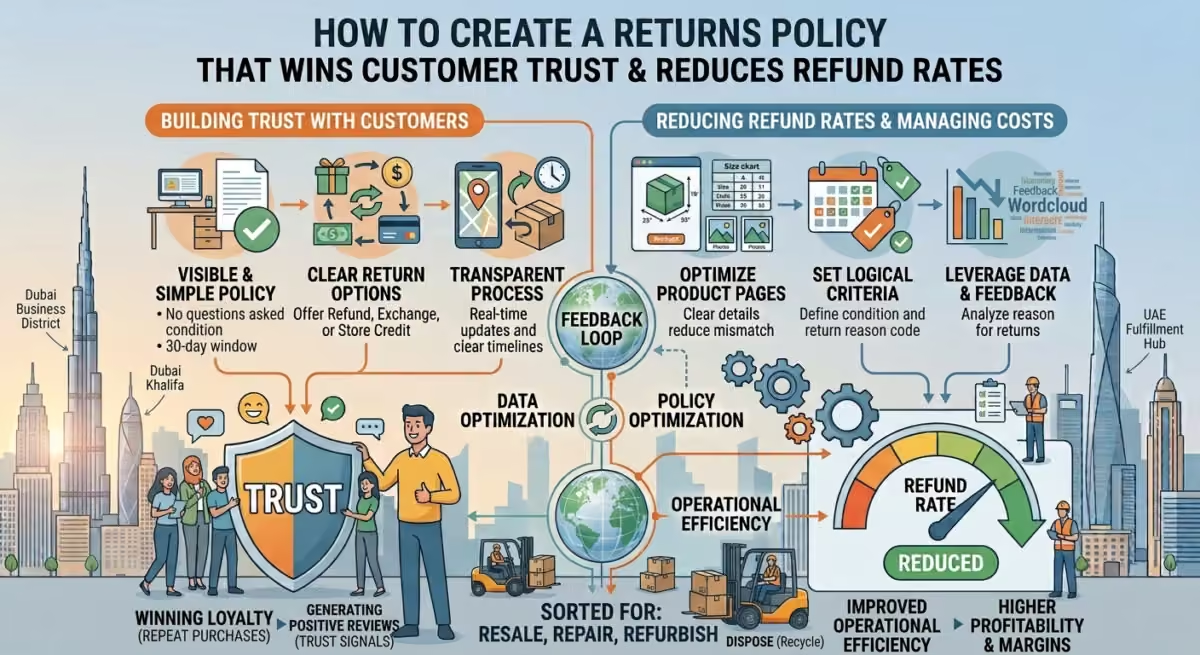
This turn returns from a cost centre into a value-recovery operation. Businesses that design their return processes around refurbishment, resale, and recycling reduce both waste output and the emissions associated with producing replacement units. 
Curious about how reverse logistics fits into a broader fulfilment strategy? See Jeebly Bizz end-to-end business logistics built for visibility and control.

5) Supplier and partner collaboration 
This is where the highest-leverage impact lives, and the most common blind spot sits. Scope 3 emissions, those generated across your supplier and logistics partner network, can account for up to 75% of a company’s total carbon footprint. 

Choosing partners that provide operational data, routing transparency, and delivery efficiency is not a sustainability add-on. It is the decision that makes your green credentials hold up to scrutiny. 

The Business Case: Real ROI of Green Logistics Investments

The financial argument for green logistics is more accessible than most businesses expect, particularly for small and mid-sized e-commerce operators in Dubai. Cost structure varies by initiative, and so does the speed of return.

Six Operational Decisions That Reduce Delivery Time in UAE

The financial argument for green logistics is more accessible than most businesses expect, particularly for small and mid-sized e-commerce operators in Dubai. Cost structure varies by initiative, and so does the speed of return.

The ranges below are indicative benchmarks. Actual savings depend on fleet size, delivery density, energy tariffs, shipment mix, and partner contracts.

Initiative Cost Level Ongoing Saving Approximate Payback
Route optimization software Low to medium 10–20% fuel cost reduction 6–18 months
Right-sized sustainable packaging Low 5–15% shipping cost reduction 3–6 months
Warehouse LED and smart energy controls Medium 20–40% energy cost reduction 12–24 months
Partial EV fleet transition High Long-term fuel and maintenance savings 3–5 years

Packaging redesign and route optimisation deliver the fastest returns at the lowest capital outlay. The natural entry point for businesses that cannot commit to large infrastructure changes up front. 

Start there, measure results, and reinvest savings into the next phase.

A Phased Green Logistics Roadmap for SMEs in Dubai and the UAE

Most green logistics guidance is written for multinationals with dedicated sustainability teams and capital reserves to match. For small- and mid-sized UAE e-commerce businesses, the path forward is more incremental and must account for Dubai’s specific infrastructure, regulatory direction, and operational realities.

Phase 1: Measure and quick-win (Months 1–3)

Before optimising anything, establish a baseline. 

*Audit your current packaging for over-sizing, identify your most-used delivery routes, and start tracking fuel consumption and first-attempt delivery failure rates. Failed deliveries are a significant source of avoidable emissions and costs. 

*Switch to right-sized, recycled-material packaging in this phase. It pays back fast and is visible to customers at the moment they interact with your brand.

Phase 2: Operational integration (Months 3–9)

Integrate route optimisation into your last-mile operations. 

* Partner with a logistics provider that gives you real-time delivery data. This is non-negotiable for tracking progress and credibly reporting on it. 
* Review your supplier sustainability credentials and build minimum expectations into your procurement decisions. Your Scope 3 footprint starts here.

Phase 3: Structural investment (Months 9–24)

Explore EV or hybrid vehicles for your highest-frequency delivery corridors. 

*Transition to green-certified warehouse facilities where operationally viable. Build a reverse logistics process designed to recover product value rather than generate disposal costs. 

* The UAE’s Net Zero by 2050 strategy and Dubai’s Smart City infrastructure investments create genuine tailwinds for these decisions. Businesses that act in this phase are ahead of compliance requirements rather than scrambling to meet them.

One of the most avoidable causes of failed deliveries in the UAE is incorrect address formatting. Get the UAE address format right, every time.

Best Practices for Scaling Green Logistics Without Losing Momentum

Getting started with green logistics is the hard part. Sustaining it as your operation scales requires building habits and systems that hold up under the pressure of growth.

* Measure before you optimise. An emissions baseline from month one becomes the yardstick for every improvement you communicate to customers and investors. Without it, your sustainability story has no foundation.

* Consolidate shipments. Fewer, fuller vehicles consistently outperform more, emptier ones in terms of cost and emissions. Build scheduling around consolidation, not just delivery speed.

* Choose partners who make your Scope 3 story credible. Your logistics provider’s routing efficiency, fleet composition, and data transparency are your Scope 3 metrics. Ask for them before you commit.

* Give customers a green delivery choice. Scheduled delivery windows have a meaningfully lower carbon footprint than express options. Offering the choice serves the customer segment that cares and builds trust with the one that is growing fastest.

* Build returns around value recovery. A reverse logistics process designed for refurbishment and resale reduces both customer friction and waste output. Treat it as a supply chain function, not an afterthought.

* Share your progress. Customers respond to transparency and measurable improvement, not perfection. Sharing milestones builds the kind of trust that retains customers between purchases.

How Jeebly Supports Sustainable Logistics for UAE Businesses

Jeebly’s mission, empowering businesses with fast, smart, and sustainable logistics solutions, shapes how its operations are built, not just how they are described.
The tech platform underpinning every Jeebly service is designed to maximise delivery efficiency: smarter routing, better load density, real-time visibility, and operational data that business owners can act on.

Jeebly Dash handles same-day and express delivery with route optimisation built into every run, fewer wasted kilometres per order, consistently. 

* Jeebly Haul moves bulk freight with consolidated loads, significantly reducing per-unit emissions compared to underloaded single-cargo trips. 

* For businesses managing ongoing fulfilment, Jeebly Bizz provides the operational visibility needed to track, report, and improve delivery efficiency over time.

Jeebly Fulfillment adds accurate inventory management and pick-pack operations that reduce order errors. Fewer errors mean fewer returns, fewer re-delivery runs, and less waste across the supply chain.

Conclusion

Green logistics is how responsible UAE e-commerce businesses grow without leaving a disproportionate mark on the environment in which they operate.  Start with your baseline. Partner with a logistics provider whose operations actively reduce emissions per delivery. 

Jeebly’s tech-driven platform handles deliveries with routing intelligence, operational transparency, and a range of services to help your business move smarter from the first shipment.

Ready to align your logistics operations with your sustainability goals? Get in touch with the Jeebly team and let’s build a supply chain that works for your business and the market it serves.

Frequently Asked Questions

It does both, but the mechanism is direct: your logistics partner’s routing efficiency, fleet composition, and delivery density determine your Scope 3 emissions. A provider with poor first-attempt delivery rates generates more re-delivery runs, which are entirely avoidable emissions you absorb on your carbon ledger.

Not across the board. Packaging right-sizing and route optimisation typically cut costs within months of adoption. The initiatives with the highest upfront cost also have the longest payback horizon, which is why a phased approach matched to your operational scale matters more than trying to overhaul everything at once.

No mandatory framework specific to logistics operators exists yet, but the UAE’s Net Zero by 2050 Strategic Initiative is already cascading into free zone procurement standards, investor due diligence requirements, and expected reporting norms.

Reducing failed first-attempt deliveries. A failed delivery means the same order travels two or more times, doubling or tripling its emissions and per-unit cost. Better customer communication, flexible delivery windows, and a logistics partner could address this directly before any changes to the fleet or packaging.

You report through your Scope 3 disclosures, which cover the logistics and fulfilment activities in your supply chain, even when third parties execute them. This requires requesting emissions data from your logistics partners, making data transparency one of the most important criteria when choosing a provider.

Routes to insightful reads

Porter vs Jeebly: Understanding the Difference and Choosing the Right Delivery Partner in Dubai

Picking a delivery partner in Dubai sounds straightforward until the bills don’t match the quotes, the tracking goes quiet, or your business outgrows what the platform can handle. This article breaks down both platforms in terms of pricing, technology, coverage, and support so you know exactly what you are choosing and why.

Read More
EMX vs Jeebly: Which Courier Delivers More Value for Your Business?

Your courier partner is not a vendor you swap easily. It shapes how customers experience your brand after checkout. This article maps providers across service capabilities, technology, pricing structures, and e-commerce fit, so you can match the right partner to how your business actually operates.

Read More
iMile vs Jeebly: Comparing Last-Mile Delivery for eCommerce Businesses

Your logistics partner is the last thing your customer experiences before forming an opinion about your brand. The iMile vs Jeebly question comes up often for UAE e-commerce brands, and rightly so. This article compares both carriers across coverage, delivery speed, pricing, SLAs, technology, and reverse logistics so you can choose based on what your business actually needs.

Read More
Quiqup vs Jeebly: Which Delivery Partner Is Right for Your UAE Business?

Your delivery partner is your brand’s last impression. When a parcel arrives late, tracking goes silent, or a COD reconciliation takes a week, the customer blames your brand. So when UAE businesses compare Quiqup vs Jeebly, the real question is: which provider actually protects your customer experience while your order volumes grow?

Read More
Green Logistics: Why Sustainability Is Becoming the UAE's Next Big Supply Chain Priority
Green Logistics in the UAE: What It Is and Why It Matters

Every parcel that moves from a warehouse to a doorstep carries more than a product. It carries a carbon cost. This article covers what it entails, why it matters specifically for UAE e-commerce businesses, the real return on investment it delivers, and how to approach implementation without overhauling everything at once.

Read More
Categories
blogs

Ways To Reduce Last-Mile Delivery Costs

How to Reduce Last-Mile Delivery Costs in the UAE (2026 Guide)

How to Reduce Last-Mile Delivery Costs in the UAE: A Practical Guide for Business Owners

How To Reduce Last Mile Delivery Costs

Last-mile delivery is the most expensive part of your supply chain — and for most UAE businesses, it’s also the least optimised.

The final leg from warehouse to customer door accounts for 53% of total shipping costs on average. In the UAE, where customer expectations for same-day and next-day delivery are set by Amazon and noon, the pressure to absorb those costs is only growing.

The good news: the businesses winning on logistics in the UAE are not spending more. They’re structured differently. This guide covers exactly what they do — and where Jeebly fits into that equation.

Why Last-Mile Costs Are Higher in the UAE Than You Think

Before the fixes, it’s worth understanding what’s actually driving the costs. UAE last-mile operations face a specific set of compounding pressures:

Failed first-attempt deliveries are a significant cost multiplier. Every re-delivery attempt adds driver time, fuel, and vehicle wear — with zero additional revenue. Failed attempts are more common when customers are unreachable, addresses are imprecise, or delivery windows don’t match customer schedules.

Inter-emirate routing complexity means a next-day delivery from Dubai to Ras Al Khaimah or Umm Al Quwain is not a simple extension of your Dubai operation. Road time, driver allocation, and fuel costs change substantially across the seven emirates.

Seasonal demand spikes, Ramadan, White Friday, Eid, Dubai Shopping Festival — create volume surges that manual operations cannot scale to absorb efficiently. Overstaffing during normal periods wastes money. Understaffing during peaks loses orders and damages customer trust.

COD reconciliation overhead adds administrative cost that purely digital markets don’t face. Cash-on-delivery remains standard in UAE last-mile; collecting, reconciling, and remitting it takes time and process.

Fix these structural issues and the cost reduction follows. Here’s how.

5 Proven Ways to Reduce Last-Mile Delivery Costs in the UAE

1. Switch from in-house delivery to an outsourced last-mile partner

This is the highest impact decision most UAE SMEs and e commerce brands can make, and the one most delayed because it feels like a loss of control.

The economics are straightforward. Building an in house delivery operation in Dubai means vehicle leasing or purchase, driver hiring and training, fuel management, insurance, maintenance, and a dispatch team. These are fixed costs you carry whether you ship 50 orders a day or 500.

A last mile partner converts all of that into a variable cost. You pay per delivery. When volume drops, your cost drops. When volume spikes, the partner absorbs the capacity, without you hiring additional drivers or leasing more vehicles.

For businesses shipping fewer than 500 orders a day, outsourced last mile is almost always cheaper than in house when total cost of ownership is calculated correctly.

Jeebly’s next-day delivery across all seven emirates is priced at AED 17.31 per shipment up to 5 kg, a flat rate that covers the full UAE network with no zone surcharges. For same day delivery within Dubai, Jeebly Dash operates with a cut off at 11 AM. That’s a fixed, predictable cost per order that you can model directly into your unit economics.

Explore Jeebly’s delivery services →

2. Optimise delivery routes with real-time intelligence

Manual routing — assigning drivers to zones and trusting them to navigate, is one of the most consistent sources of avoidable cost in UAE last mile operations.
AI-driven route optimisation does several things manual routing cannot:

* Accounts for UAE-specific variables: prayer time windows, mall traffic during sale seasons, inter-emirate road differences, and temperature-driven delivery window constraints in summer
* Dynamically re-routes when traffic conditions change mid-shift
* Sequences deliveries to minimise backtracking and unnecessary kilometres
* Reduces first-attempt failure rates by pairing smarter windows with proactive customer communication

Route optimisation technology has been shown to reduce travel time and fuel costs materially for logistics operations. The gains compound: fewer kilometres means lower fuel spend, lower vehicle wear, and more deliveries per driver per shift.
Jeebly’s platform uses automated routing and dispatch built into the Jeebly One app, with real-time tracking visible to both the business and the customer.

3. Reduce failed delivery attempts with proactive communication

A failed delivery attempt is a hidden tax on your last-mile operation. The direct cost is the re-delivery. The indirect cost is the customer experience damage and the administrative overhead of rescheduling.

In the UAE, failed attempts are disproportionately caused by:

* Customers not home during the delivery window
* Imprecise addresses (a persistent challenge outside Dubai’s well-mapped urban grid)
* No advance notice given to the customer

The fix is systematic, not heroic. Proactive SMS or push notification before arrival, real-time tracking links shared with customers, and digital proof of delivery (photo) reduce failed attempts and eliminate disputes.

Jeebly provides real-time delivery status updates at every stage and digital proof of delivery as standard, not an add-on.

4. Store inventory closer to your customers

If your fulfilment centre is in one location and a significant portion of your orders ship to customers across multiple emirates, you are paying for distance on every order.

Micro-fulfillment centres, smaller, strategically located dark stores closer to end customers — are the structural answer to this. They reduce last-mile distance, enable faster delivery windows, and lower per-order fuel and time costs.

Jeebly operates seven Micro Fulfilment Centres (MFCs) across the UAE for select clients, enabling 10-minute delivery within covered zones. Businesses that store inventory at Jeebly’s fulfilment centres in Dubai, Abu Dhabi, and Sharjah gain network proximity without leasing or managing the space themselves.

Talk to Jeebly about fulfillment centre access →

5. Automate dispatch, order management, and COD reconciliation

Manual order processing is where errors, delays, and labour costs accumulate invisibly. Every order that requires a human to read it, assign it, and log it is an order that costs more than it should.

Direct integration between your e-commerce store and your logistics platform eliminates this layer entirely. Orders placed on Shopify, Magento, or WooCommerce flow automatically into the dispatch system — no manual entry, no transcription errors, no delay between order confirmation and dispatch trigger.

COD reconciliation — a uniquely UAE overhead — is handled automatically when your logistics partner provides a live dashboard with COD amounts, delivery status, and weekly remittance built in.

Jeebly integrates directly with Shopify, Magento, WooCommerce, and custom APIs. The live dashboard shows order status, COD pending remittance, delivery tracking, and invoices in one place. Weekly COD remittance is standard.

What This Looks Like in Practice: The Jeebly Cost Model

For a UAE e-commerce business shipping 200 orders per day, the cost comparison between in-house delivery and outsourcing to Jeebly typically looks like this:


Cost elementIn-house estimateJeebly
Per-delivery cost (next-day, up to 5 kg)AED 25–40+ (blended, including fixed costs)AED 17.31 flat
Inter-emirate coverageRequires separate arrangementsAll 7 emirates included
Same-day capabilityRequires dedicated fleetJeebly Dash, Dubai
COD remittanceManual, internal overheadWeekly, automated
Returns handlingManual, unstructuredDoorstep QC, return-to-warehouse
E-commerce integrationCustom build requiredShopify, Magento, WooCommerce, API

The per-delivery gap alone — at 200 orders daily — represents a material cost saving before fixed overhead is accounted for.

The Most Expensive Mistake UAE Businesses Make on Last-Mile

Treating last-mile delivery as a fixed cost rather than a variable one.

Businesses that maintain in-house delivery fleets and teams carry those costs regardless of order volume. The margin compression is worst during slow periods — but the operational strain is worst during peaks, when the fixed infrastructure cannot scale fast enough without emergency spend.

The businesses reducing last-mile costs most effectively in the UAE are the ones that have converted their logistics from a capital-heavy fixed cost into a per-order variable cost — and reinvested the difference into growth. 

See how Jeebly works for UAE businesses like yours →

Ready to Reduce Your Last-Mile Costs?

Treating last-mile delivery as a fixed cost rather than a variable one.

Businesses that maintain in-house delivery fleets and teams carry those costs regardless of order volume. The margin compression is worst during slow periods — but the operational strain is worst during peaks, when the fixed infrastructure cannot scale fast enough without emergency spend.

The businesses reducing last-mile costs most effectively in the UAE are the ones that have converted their logistics from a capital-heavy fixed cost into a per-order variable cost — and reinvested the difference into growth. 

See how Jeebly works for UAE businesses like yours →

Download the Jeebly One app →

Frequently Asked Questions


For most SMEs and e-commerce businesses, outsourcing to a last-mile partner is cheaper than in-house delivery once all fixed costs are accounted for. Jeebly’s next-day delivery across all seven emirates is AED 17.31 per shipment up to 5 kg — a flat rate with no zone surcharges.


Proactive customer notification before arrival, real-time tracking links, and precise address capture at checkout reduce failed attempts significantly. Working with a logistics partner that provides digital proof of delivery and re-delivery management removes the overhead from your team.

Yes — and the economics are most favourable at smaller volumes, where the fixed cost of maintaining an in-house fleet is disproportionately high relative to order volume. Most UAE social sellers and SMEs using 3PL last-mile partners are growing businesses, not large enterprises.

Cash-on-delivery (COD) is standard in UAE e-commerce. It adds a collection and reconciliation layer to every delivery. A logistics partner with automated COD tracking and weekly remittance removes that administrative overhead — Jeebly handles COD collection and remits weekly with full documentation.


Basic operations — direct store integration and first delivery — are typically live within 2–4 weeks depending on integration complexity. Talk to the Jeebly team to map your specific setup.

Routes to insightful reads

Porter vs Jeebly: Understanding the Difference and Choosing the Right Delivery Partner in Dubai

Picking a delivery partner in Dubai sounds straightforward until the bills don’t match the quotes, the tracking goes quiet, or your business outgrows what the platform can handle. This article breaks down both platforms in terms of pricing, technology, coverage, and support so you know exactly what you are choosing and why.

Read More
EMX vs Jeebly: Which Courier Delivers More Value for Your Business?

Your courier partner is not a vendor you swap easily. It shapes how customers experience your brand after checkout. This article maps providers across service capabilities, technology, pricing structures, and e-commerce fit, so you can match the right partner to how your business actually operates.

Read More
iMile vs Jeebly: Comparing Last-Mile Delivery for eCommerce Businesses

Your logistics partner is the last thing your customer experiences before forming an opinion about your brand. The iMile vs Jeebly question comes up often for UAE e-commerce brands, and rightly so. This article compares both carriers across coverage, delivery speed, pricing, SLAs, technology, and reverse logistics so you can choose based on what your business actually needs.

Read More
Quiqup vs Jeebly: Which Delivery Partner Is Right for Your UAE Business?

Your delivery partner is your brand’s last impression. When a parcel arrives late, tracking goes silent, or a COD reconciliation takes a week, the customer blames your brand. So when UAE businesses compare Quiqup vs Jeebly, the real question is: which provider actually protects your customer experience while your order volumes grow?

Read More
Green Logistics: Why Sustainability Is Becoming the UAE's Next Big Supply Chain Priority
Green Logistics in the UAE: What It Is and Why It Matters

Every parcel that moves from a warehouse to a doorstep carries more than a product. It carries a carbon cost. This article covers what it entails, why it matters specifically for UAE e-commerce businesses, the real return on investment it delivers, and how to approach implementation without overhauling everything at once.

Read More

    Powered by