





Jeebly | Logistics Solutions

Categories
blogs

What Is a Dark Store? How UAE Retailers Are Using Them for Ultra-Fast Delivery

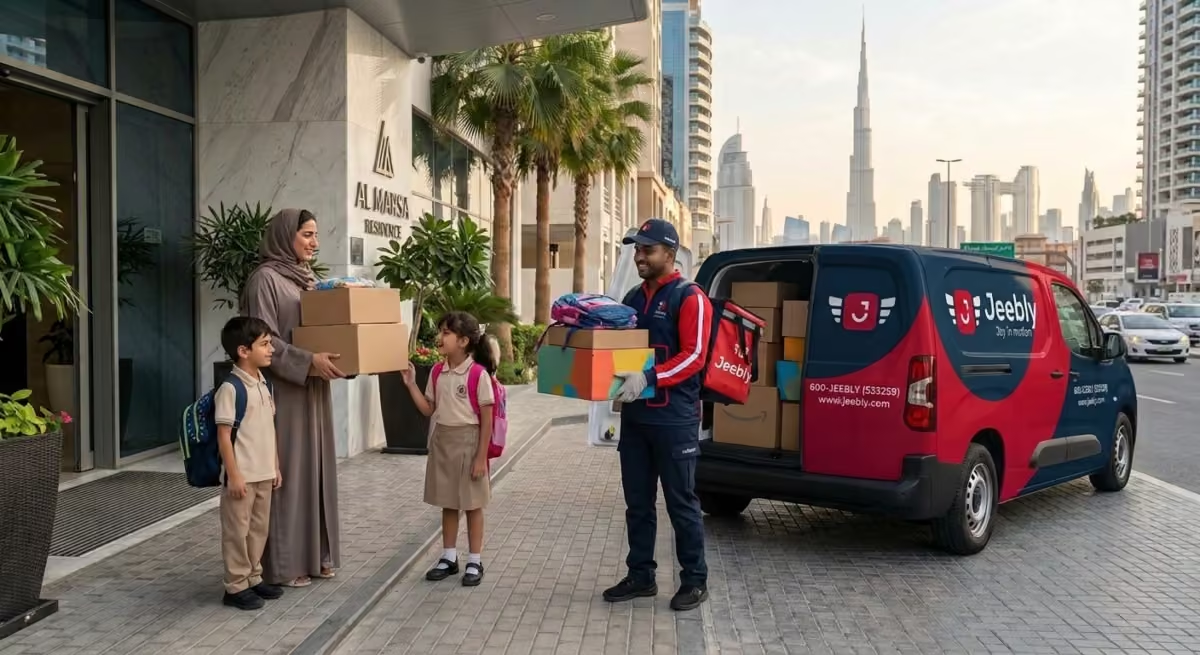
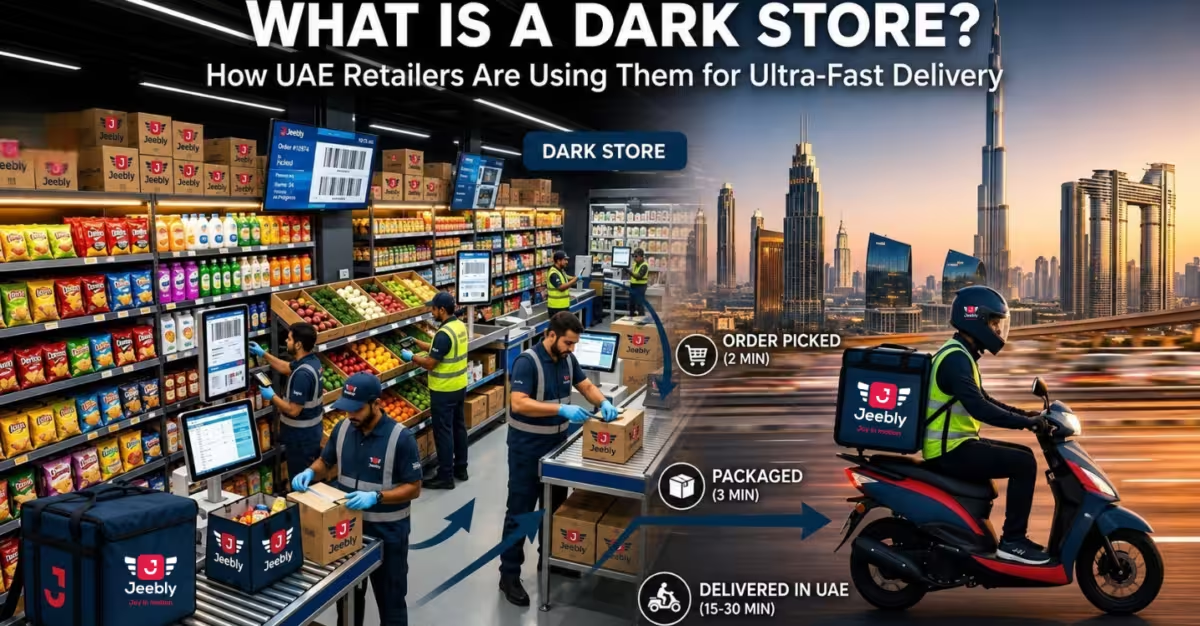
Dark store in the UAE showing retail inventory, order picking, packaging, and Jeebly last-mile delivery for ultra-fast fulfillment

What Is a Dark Store? How UAE Retailers Are Using Them for Ultra-Fast Delivery

A dark store is a fulfilment facility closed to the public, used exclusively to pick, pack, and dispatch online orders. No customers are walking in, no checkout lanes or retail displays. Just inventory, pickers, and a logistics operation built around getting orders out the door in minutes rather than hours.

In the UAE, dark stores are no longer experimental infrastructure. There are currently 211 dark stores mapped across the UAE, operated by Talabat Mart and Noon Minutes, spanning 10 cities. Noon alone scaled to 12 dark stores across Dubai and Sharjah, targeting zones with over 200 transactions per square kilometre per day. This is the operational foundation behind the 15-minute grocery promise that UAE consumers now treat as standard.

This guide explains what a dark store is, how it works, models operating in the UAE, what it takes to run one profitably, and how UAE e-commerce businesses can access dark store economics without building from scratch.

Key Takeaways

  • A dark store is a fulfilment facility closed to the public, dedicated entirely to picking and dispatching online orders.

  • Three models operate in the UAE: platform-operated dark stores (Talabat Mart, Noon Minutes), retailer-converted dark stores (Carrefour, Spinneys), and third-party micro-fulfilment (accessible to SMEs without capital investment).

  • The density threshold for a UAE dark store to be profitable is approximately 150–200 daily orders per location. Below that, last-mile economics don’t stack up.

  • By 2030, quick grocery is expected to account for 89% of online grocery in the UAE and KSA. Dark stores are the infrastructure that makes this possible.

What Is a Dark Store, Exactly?

A dark store is a retail or warehouse facility that operates exclusively for online order fulfilment. The “dark” refers to the absence of public foot traffic, such as shoppers, ambient lighting for the customer experience, or checkout counters. The space is configured entirely around operational efficiency, such as:

  • Shelving organised by pick frequency
  • Packing stations positioned to minimise walking distance 
  • Dispatch areas connected directly to courier routing systems

Dark stores emerged in the UK around 2009, when Sainsbury’s and Tesco converted underperforming retail locations into dedicated online fulfilment centres. What started as a supermarket efficiency play became the structural model for quick commerce globally.

How a Dark Store Works: The Order-to-Door Sequence

Step 1: Order placed. 

The customer places an order through an app. The dark store’s order management system receives it, confirms stock availability, and assigns it to the nearest available picker all within seconds.

Step 2: Smart slotting does the heavy lifting. 

High-velocity items (bottled water, snacks, cleaning products) sit closest to packing stations. This single discipline, called slotting optimisation, reduces picker travel time on every single order. 

Platforms deploy predictive inventory algorithms that pre-position high-velocity SKUs within 2–3 kilometres of dense residential clusters, thereby trimming delivery windows to 10 minutes.

Step 3: Picking. 

A picker follows a digital pick list along an optimised route through the facility. In high-volume dark stores, batch picking, i.e. grouping multiple orders into a single pick run, reduces total labour time without sacrificing accuracy.

Step 4: Packing and labelling. 

Items are packed, labelled, and sorted by delivery zone. Temperature-sensitive goods get appropriate packaging. The packed order is ready for handoff.

Step 5: Dispatch. 

The packed order connects to the courier routing platform in real time. A rider or driver collects it often within minutes of packing, and the customer receives tracking updates from the moment of dispatch.

The entire sequence, from order placement to rider departure, may typically run 3–8 minutes in an optimised UAE dark store.

Three Dark Store Models Operating in the UAE

Understanding the model matters before deciding whether to build, convert, or partner.

1. Platform-operated dark stores

App platforms operate the largest dark store networks in the UAE. Talabat Mart operates 30+ strategically located dark stores across all seven emirates, targeting sub-20-minute delivery guarantees. 

Noon Minutes runs its own dark store network, explicitly describing its compact “mini storeslocated near demand hubs to support 15-minute delivery. 

In 2025, ADNOC Distribution and Noon launched 15-minute delivery hubs from ADNOC service stations, turning fuel stations into logistics nodes.

These platforms own the customer relationship and the inventory. They’re not a fulfilment option for third-party brands. They’re vertically integrated competitors.

2. Retailer-converted dark stores

These are traditional retailers converting existing space into dark fulfilment operations. Carrefour UAE, Spinneys, and Choithrams all operate some form of this, using store backrooms, closed retail locations, or dedicated satellite sites to fulfil online orders faster than a central warehouse can.

This model suits retailers who already have urban real estate and established supply chains. The capital requirement is lower than that of building from scratch, but the operational transformation is significant. Retail layouts are not optimised for pick efficiency.

3. Third-party micro-fulfilment (the SME access point)

It is the most accessible model for UAE businesses without retail footprints or platform-scale capital. Third-party logistics providers operate shared micro-fulfilment centres that multiple brands can access without having to build their own infrastructure.

This is where the economics become accessible. Rather than committing to a 100,000+ sq ft dark store lease and the technology stack to run it, an SME or mid-market e-commerce brand can plug into an existing micro-fulfilment network, access urban proximity delivery, and pay on a per-order or per-storage basis.

For UAE e-commerce businesses and social sellers wanting same-day delivery capability without a dark store build, eCommerce Fulfilment in the UAE: What Businesses Should Look For covers the full range of fulfilment options and the cost per order for each.

What Makes a UAE Dark Store Profitable

Platform operators are prioritising density thresholds of 150–200 daily orders per dark store. Below that threshold, the fixed costs of the facility, staff, and inventory don’t spread across enough orders to generate margin. Above it, the economics may compound rapidly.

What can drive dark store profitability in the UAE:
Factor What it requires
Location density Within 2–3 km of residential clusters with 200+ daily orders per km²
SKU curation 1,000–5,000 fast-moving products, not a full supermarket range
Order frequency Subscription models (Talabat Pro, Noon One) that drive repeat orders
Technology Real-time OMS connected to courier routing, no manual handoff
Last-mile reliability 95%+ first-attempt delivery in the coverage zone
Inventory accuracy Daily cycle counts, zero tolerance for phantom stock
What kills the economics:

Overexpansion before density can kill the economics. A dark store in a zone with 80 daily orders will burn cash indefinitely. The facility’s fixed costs are never covered. Urban density in Dubai and Abu Dhabi makes last-mile economics workable in a way that sprawling or low-density cities do not. This is why UAE dark stores succeed where other markets struggle.

A high delivery radius without enough riders is another factor. If a dark store covers too large a geographic area, average delivery time increases, costs rise, and the speed promise breaks down.

Additionally, dark stores run lean SKU counts precisely because every SKU that doesn’t turn fast enough occupies space that could hold a fast-mover. Getting the assortment wrong is expensive.

Should Your Business Use a Dark Store?

Dark stores are right for a specific business profile. Here’s a framework for deciding:

It makes sense if:

  • You sell fast-moving consumer goods like grocery, pharmacy, personal care, convenience
  • Your customers are in dense urban zones (Dubai, Abu Dhabi, Sharjah)
  • You’re receiving more than 50–100 same-day delivery orders daily in a concentrated area
  • You want to offer sub-hour delivery without the cost of a full last-mile delivery fleet


It doesn’t make sense if:

  • Your products are slow-moving, large, fragile, or temperature-controlled beyond standard refrigeration
  • Your customer base is geographically spread across multiple emirates with different demand profiles
  • Your daily order volume is below the density threshold to justify the infrastructure cost

For most UAE SMEs and mid-market e-commerce brands, the most cost-effective path to dark store economics is third-party micro-fulfilment. This accesses urban proximity and fast dispatch through an existing network rather than building one.

For businesses evaluating whether their current fulfilment setup is causing delivery delays that are costing them cart abandonment, How to Reduce Cart Abandonment Costs covers how delivery speed and transparency directly affect checkout conversion and more.

How Jeebly Supports Dark Store and Ultra-Fast Fulfilment

For UAE businesses wanting same-day delivery capabilities without the capital investment of building a dark store from scratch, Jeebly Bizz provides the fulfilment infrastructure: warehousing across Dubai and the UAE, pick-and-pack, automated dispatch, and real-time inventory management, all connected directly to Shopify, WooCommerce, and Magento.

Jeebly Dash handles the last-mile leg with express delivery within 60–120 minutes across Dubai, next-day across all seven emirates, with 98% FDSS across 50,000+ daily deliveries. Jeebly’s platform automatically connects order completion to rider dispatch.

For businesses with inbound freight needs, Jeebly Haul covers road and air freight, as well as cross-border GCC routes, with in-house customs clearance.

Talk to the Jeebly team about your current daily order volume, delivery zone, and product category. A direct conversation will confirm whether third-party micro-fulfilment through Jeebly Bizz provides the dark-store economics your business needs at the scale it operates today.

Conclusion

A dark store is the infrastructure behind every 15-minute grocery delivery and every same-hour order in the UAE. With 211 Talabat Mart and Noon Minutes dark stores mapped across the UAE, alongside a growing number of retailer-converted dark fulfilment locations, and a quick commerce market set to reach $12.97 billion by 2029, this is no longer an experimental format.

It’s the structural model for urban retail fulfilment in the region. 

For large platforms, the dark store network is built and scaling. For UAE e-commerce businesses and retailers that want the same delivery economics without the capital outlay, third-party micro-fulfilment networks provide access to urban proximity and fast dispatch on a per-order basis. 

For same-day fulfilment connected to 98% FDSS last-mile delivery, Jeebly Bizz and Jeebly Dash cover both legs. Get in touch to discuss your fulfilment requirements.

Related Articles:

Frequently Asked Questions

A dark store is a warehouse or converted retail space used exclusively to fulfil online orders. It’s closed to the public and optimised entirely for picking and dispatching individual orders as fast as possible. In the UAE, dark stores power the 15–30 minute grocery delivery services from Talabat Mart and Noon Minutes.

A warehouse stores goods for extended periods before bulk distribution to retailers or other businesses. A dark store holds a smaller, faster-moving inventory specifically to fulfil individual consumer orders within 15–60 minutes. Dark stores are urban, compact, and optimised for speed. Warehouses are typically larger, suburban, and optimised for bulk storage and distribution.

Talabat Mart operates 30+ dark stores across all seven UAE emirates for sub-20-minute delivery. Noon Minutes operates 12 dark stores across Dubai and Sharjah. Together, these two platforms account for the 211 dark stores currently mapped across the UAE. Carrefour, Spinneys and Choithrams also operate dark fulfilment equivalents from existing retail locations, but these fall under the retailer-converted model.

Fast-moving consumer goods with high daily turnover: groceries, personal care, household essentials, pharmacy items, and convenience goods. Dark stores stock 1,000–5,000 curated SKUs, not a full product range. Slow-moving, bulky, or highly perishable goods with complex cold-chain requirements are typically not suitable for dark-store stocking.

Yes, through third-party micro-fulfilment. Logistics providers operate shared urban fulfilment centres that multiple brands can access on a per-order or per-storage basis, without committing to a dark store lease or building a technology stack from scratch. This is the accessible entry point for UAE SMEs wanting same-day delivery capability.

Routes to insightful reads

BNPL in the UAE and its impact on ecommerce delivery and returns, showing the transaction cycle, faster fulfilment, order frequency, real-time tracking, and streamlined returns
Buy Now Pay Later in the UAE: What BNPL Means for eCommerce Delivery and Returns.

Buy Now Pay Later (BNPL) is changing how consumers shop and how eCommerce businesses manage fulfilment and returns in the UAE. This guide explores how BNPL can influence order volumes, delivery demand, fulfilment operations, return rates, refund processing, and the logistics strategies businesses need to support a growing BNPL-driven customer base.

Read More
Infographic explaining how to calculate volumetric weight for shipping, including the formula, measurement example and comparison between actual and chargeable weight.
How to Calculate Volumetric Weight for Shipping: Formula and Examples

Learn how to calculate volumetric weight for shipping with an easy-to-follow formula and practical examples. Understand how package dimensions, actual weight and carrier conversion factors determine the chargeable weight and ultimately impact your shipping costs.

Read More
3PL vs 4PL logistics comparison showing warehousing, transportation, distribution, supply chain integration, technology, analytics, and strategic planning for UAE businesses
3PL vs 4PL: What Is the Difference and Which Does Your UAE Business Need?

3PL and 4PL logistics models help businesses manage different levels of supply chain operations. This guide explains the key differences between 3PL and 4PL providers, their roles, benefits, costs, and how UAE businesses can choose the right logistics model based on their size, supply chain complexity, and operational needs.

Read More
Types of packaging for courier shipments, showing outer packaging strength, void-fill options, cushioning materials, and sealing and labelling methods
Types of Packaging for Courier Shipments: Which One Best Protects Your Product?

Choosing the right packaging is essential for protecting products during courier transportation. This guide explores different types of packaging for courier shipments, including corrugated boxes, bubble wrap, air pillows, paper fillers, foam inserts, and protective seals, and explains how to choose the best option based on your product, handling needs, and shipping conditions.

Read More
Types of logistics explained through inbound, outbound, reverse and third-party logistics, showing the movement of goods between suppliers, warehouses, customers and return facilities.
Types of Logistics Explained: Inbound, Outbound, Reverse and Third-Party 

Logistics covers much more than moving goods from one place to another. This guide explains the four key types of logistics, inbound, outbound, reverse and third-party logistics (3PL), and how each supports the supply chain. Learn how goods move from suppliers to warehouses, reach customers, return for repair or disposal, and how businesses use 3PL providers to manage logistics operations.

Read More
Categories
blogs

Reduce last-mile delivery costs in UAE: 7 proven strategies for 2026

How to Reduce Last-Mile Delivery Costs in the UAE (2026 Guide)

How to Reduce Last-Mile Delivery Costs in the UAE: A Practical Guide for Business Owners

Last-mile delivery accounts for up to 53% of total shipping costs. UAE businesses are using route optimisation, consolidated deliveries and third-party logistics providers to reduce costs by 20–30%.

Last-mile delivery is the most expensive part of your supply chain — and for most UAE businesses, it’s also the least optimised.

The final leg from warehouse to customer door accounts for 53% of total shipping costs on average. In the UAE, where customer expectations for same-day and next-day delivery are set by Amazon and noon, the pressure to absorb those costs is only growing.

The good news: the businesses winning on logistics in the UAE are not spending more. They’re structured differently. This guide covers exactly what they do — and where Jeebly fits into that equation.

Why Last-Mile Costs Are Higher in the UAE Than You Think

Before the fixes, it’s worth understanding what’s actually driving the costs. UAE last-mile operations face a specific set of compounding pressures:

Failed first-attempt deliveries are a significant cost multiplier. Every re-delivery attempt adds driver time, fuel, and vehicle wear — with zero additional revenue. Failed attempts are more common when customers are unreachable, addresses are imprecise, or delivery windows don’t match customer schedules.

Inter-emirate routing complexity means a next-day delivery from Dubai to Ras Al Khaimah or Umm Al Quwain is not a simple extension of your Dubai operation. Road time, driver allocation, and fuel costs change substantially across the seven emirates.

Seasonal demand spikes, Ramadan, White Friday, Eid, Dubai Shopping Festival — create volume surges that manual operations cannot scale to absorb efficiently. Overstaffing during normal periods wastes money. Understaffing during peaks loses orders and damages customer trust.

COD reconciliation overhead adds administrative cost that purely digital markets don’t face. Cash-on-delivery remains standard in UAE last-mile; collecting, reconciling, and remitting it takes time and process.

Fix these structural issues and the cost reduction follows. Here’s how.

5 Proven Ways to Reduce Last-Mile Delivery Costs in the UAE

1. Switch from in-house delivery to an outsourced last-mile partner

This is the highest impact decision most UAE SMEs and e commerce brands can make, and the one most delayed because it feels like a loss of control.

The economics are straightforward. Building an in house delivery operation in Dubai means vehicle leasing or purchase, driver hiring and training, fuel management, insurance, maintenance, and a dispatch team. These are fixed costs you carry whether you ship 50 orders a day or 500.

A last mile partner converts all of that into a variable cost. You pay per delivery. When volume drops, your cost drops. When volume spikes, the partner absorbs the capacity, without you hiring additional drivers or leasing more vehicles.

For businesses shipping fewer than 500 orders a day, outsourced last mile is almost always cheaper than in house when total cost of ownership is calculated correctly.

Jeebly’s next-day delivery across all seven emirates is priced at AED 17.31 per shipment up to 5 kg, a flat rate that covers the full UAE network with no zone surcharges. For same day delivery within Dubai, Jeebly Dash operates with a cut off at 11 AM. That’s a fixed, predictable cost per order that you can model directly into your unit economics.

Explore Jeebly’s delivery services →

2. Optimise delivery routes with real-time intelligence

Manual routing — assigning drivers to zones and trusting them to navigate, is one of the most consistent sources of avoidable cost in UAE last mile operations.
AI-driven route optimisation does several things manual routing cannot:

* Accounts for UAE-specific variables: prayer time windows, mall traffic during sale seasons, inter-emirate road differences, and temperature-driven delivery window constraints in summer
* Dynamically re-routes when traffic conditions change mid-shift
* Sequences deliveries to minimise backtracking and unnecessary kilometres
* Reduces first-attempt failure rates by pairing smarter windows with proactive customer communication

Route optimisation technology has been shown to reduce travel time and fuel costs materially for logistics operations. The gains compound: fewer kilometres means lower fuel spend, lower vehicle wear, and more deliveries per driver per shift.
Jeebly’s platform uses automated routing and dispatch built into the Jeebly One app, with real-time tracking visible to both the business and the customer.

3. Reduce failed delivery attempts with proactive communication

A failed delivery attempt is a hidden tax on your last-mile operation. The direct cost is the re-delivery. The indirect cost is the customer experience damage and the administrative overhead of rescheduling.

In the UAE, failed attempts are disproportionately caused by:

* Customers not home during the delivery window
* Imprecise addresses (a persistent challenge outside Dubai’s well-mapped urban grid)
* No advance notice given to the customer

The fix is systematic, not heroic. Proactive SMS or push notification before arrival, real-time tracking links shared with customers, and digital proof of delivery (photo) reduce failed attempts and eliminate disputes.

Jeebly provides real-time delivery status updates at every stage and digital proof of delivery as standard, not an add-on.

4. Store inventory closer to your customers

If your fulfilment centre is in one location and a significant portion of your orders ship to customers across multiple emirates, you are paying for distance on every order.

Micro-fulfillment centres, smaller, strategically located dark stores closer to end customers — are the structural answer to this. They reduce last-mile distance, enable faster delivery windows, and lower per-order fuel and time costs.

Jeebly operates seven Micro Fulfilment Centres (MFCs) across the UAE for select clients, enabling 10-minute delivery within covered zones. Businesses that store inventory at Jeebly’s fulfilment centres in Dubai, Abu Dhabi, and Sharjah gain network proximity without leasing or managing the space themselves.

Talk to Jeebly about fulfillment centre access →

5. Automate dispatch, order management, and COD reconciliation

Manual order processing is where errors, delays, and labour costs accumulate invisibly. Every order that requires a human to read it, assign it, and log it is an order that costs more than it should.

Direct integration between your e-commerce store and your logistics platform eliminates this layer entirely. Orders placed on Shopify, Magento, or WooCommerce flow automatically into the dispatch system — no manual entry, no transcription errors, no delay between order confirmation and dispatch trigger.

COD reconciliation — a uniquely UAE overhead — is handled automatically when your logistics partner provides a live dashboard with COD amounts, delivery status, and weekly remittance built in.

Jeebly integrates directly with Shopify, Magento, WooCommerce, and custom APIs. The live dashboard shows order status, COD pending remittance, delivery tracking, and invoices in one place. Weekly COD remittance is standard.

What This Looks Like in Practice: The Jeebly Cost Model

For a UAE e-commerce business shipping 200 orders per day, the cost comparison between in-house delivery and outsourcing to Jeebly typically looks like this:


Cost elementIn-house estimateJeebly
Per-delivery cost (next-day, up to 5 kg)AED 25–40+ (blended, including fixed costs)AED 17.31 flat
Inter-emirate coverageRequires separate arrangementsAll 7 emirates included
Same-day capabilityRequires dedicated fleetJeebly Dash, Dubai
COD remittanceManual, internal overheadWeekly, automated
Returns handlingManual, unstructuredDoorstep QC, return-to-warehouse
E-commerce integrationCustom build requiredShopify, Magento, WooCommerce, API

The per-delivery gap alone — at 200 orders daily — represents a material cost saving before fixed overhead is accounted for.

The Most Expensive Mistake UAE Businesses Make on Last-Mile

Treating last-mile delivery as a fixed cost rather than a variable one.

Businesses that maintain in-house delivery fleets and teams carry those costs regardless of order volume. The margin compression is worst during slow periods — but the operational strain is worst during peaks, when the fixed infrastructure cannot scale fast enough without emergency spend.

The businesses reducing last-mile costs most effectively in the UAE are the ones that have converted their logistics from a capital-heavy fixed cost into a per-order variable cost — and reinvested the difference into growth. 

Ready to Reduce Your Last-Mile Costs?

Treating last-mile delivery as a fixed cost rather than a variable one.

Businesses that maintain in-house delivery fleets and teams carry those costs regardless of order volume. The margin compression is worst during slow periods — but the operational strain is worst during peaks, when the fixed infrastructure cannot scale fast enough without emergency spend.

The businesses reducing last-mile costs most effectively in the UAE are the ones that have converted their logistics from a capital-heavy fixed cost into a per-order variable cost — and reinvested the difference into growth. 

See how Jeebly works for UAE businesses like yours →

Download the Jeebly One app →

Frequently Asked Questions

The cost of last-mile delivery in the UAE varies depending on factors such as shipment size, delivery distance, service speed, and delivery volume. Businesses can often reduce per-delivery costs by consolidating shipments, optimizing routes, and working with logistics providers that offer scalable pricing models.

Businesses can reduce failed deliveries by collecting accurate customer addresses, providing real-time tracking updates, confirming delivery details before dispatch, and maintaining clear communication with recipients. Offering flexible delivery windows and alternative delivery options can also improve first-attempt delivery success rates.

Yes. A third-party logistics (3PL) provider can help reduce delivery costs by leveraging established transportation networks, route optimization technology, operational expertise, and economies of scale. This allows businesses to avoid the costs of managing their own delivery fleet while improving delivery efficiency.

Route optimization helps reduce delivery costs by identifying the most efficient delivery paths based on factors such as distance, traffic conditions, delivery density, and time windows. This can lower fuel consumption, reduce driver hours, improve vehicle utilization, and increase the number of deliveries completed per route.

The most cost-effective delivery option depends on shipment volume, delivery speed requirements, and destination. For many businesses, scheduled deliveries, consolidated shipments, and economy delivery services offer lower costs than on-demand or express options. Working with a logistics partner that can match delivery services to business needs can further improve cost efficiency.

Routes to insightful reads

BNPL in the UAE and its impact on ecommerce delivery and returns, showing the transaction cycle, faster fulfilment, order frequency, real-time tracking, and streamlined returns
Buy Now Pay Later in the UAE: What BNPL Means for eCommerce Delivery and Returns.

Buy Now Pay Later (BNPL) is changing how consumers shop and how eCommerce businesses manage fulfilment and returns in the UAE. This guide explores how BNPL can influence order volumes, delivery demand, fulfilment operations, return rates, refund processing, and the logistics strategies businesses need to support a growing BNPL-driven customer base.

Read More
Infographic explaining how to calculate volumetric weight for shipping, including the formula, measurement example and comparison between actual and chargeable weight.
How to Calculate Volumetric Weight for Shipping: Formula and Examples

Learn how to calculate volumetric weight for shipping with an easy-to-follow formula and practical examples. Understand how package dimensions, actual weight and carrier conversion factors determine the chargeable weight and ultimately impact your shipping costs.

Read More
3PL vs 4PL logistics comparison showing warehousing, transportation, distribution, supply chain integration, technology, analytics, and strategic planning for UAE businesses
3PL vs 4PL: What Is the Difference and Which Does Your UAE Business Need?

3PL and 4PL logistics models help businesses manage different levels of supply chain operations. This guide explains the key differences between 3PL and 4PL providers, their roles, benefits, costs, and how UAE businesses can choose the right logistics model based on their size, supply chain complexity, and operational needs.

Read More
Types of packaging for courier shipments, showing outer packaging strength, void-fill options, cushioning materials, and sealing and labelling methods
Types of Packaging for Courier Shipments: Which One Best Protects Your Product?

Choosing the right packaging is essential for protecting products during courier transportation. This guide explores different types of packaging for courier shipments, including corrugated boxes, bubble wrap, air pillows, paper fillers, foam inserts, and protective seals, and explains how to choose the best option based on your product, handling needs, and shipping conditions.

Read More
Types of logistics explained through inbound, outbound, reverse and third-party logistics, showing the movement of goods between suppliers, warehouses, customers and return facilities.
Types of Logistics Explained: Inbound, Outbound, Reverse and Third-Party 

Logistics covers much more than moving goods from one place to another. This guide explains the four key types of logistics, inbound, outbound, reverse and third-party logistics (3PL), and how each supports the supply chain. Learn how goods move from suppliers to warehouses, reach customers, return for repair or disposal, and how businesses use 3PL providers to manage logistics operations.

Read More

    Powered by