





Jeebly | Logistics Solutions

Categories
blogs

eCommerce Fulfilment in UAE: How It Works and What Businesses Should Look For

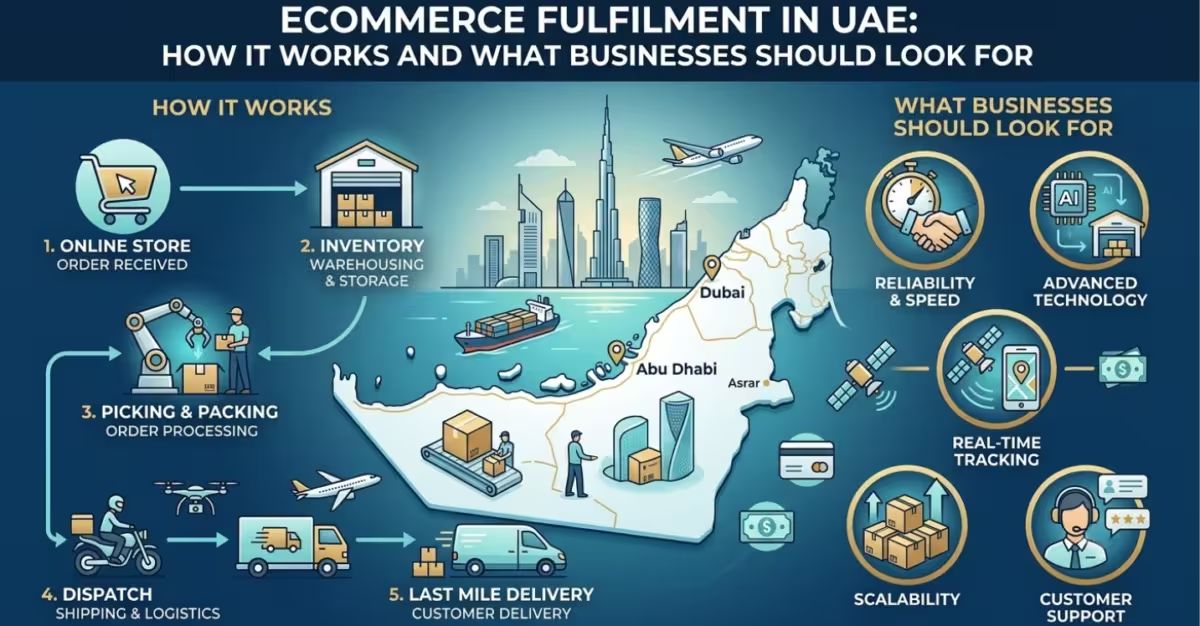
Infographic titled "Ecommerce Fulfilment in UAE: How It Works and What Businesses Should Look For." The left side shows a 5-step workflow: Online Store, Inventory, Picking & Packing, Dispatch, and Last Mile Delivery. The center features a map of the UAE with iconic cityscapes. The right side lists business requirements: Reliability & Speed, Advanced Technology, Real-Time Tracking, Scalability, and Customer Support.

eCommerce Fulfilment in UAE: How It Works and What Businesses Should Look For

When your order volumes grow faster than your ability to pick, pack, and ship them accurately, ecommerce fulfilment stops being a back-office function and starts being a growth constraint. Shoppers in Dubai, Abu Dhabi, and Sharjah now expect same-day or next-day delivery as standard. Brands that cannot meet those expectations can lose orders to competitors who can. 

This guide covers how ecommerce fulfilment works end-to-end in the UAE, what it costs, how to evaluate a fulfilment partner, and when to move from self-fulfilment to a 3PL.

What Is Ecommerce Fulfilment?

Ecommerce fulfilment is the end-to-end process of receiving inventory, storing it, processing orders, picking and packing individual items, delivering to customers, and managing returns. Every step connects. A failure at receiving can create inventory discrepancies that surface at picking. A weak last-mile partner erodes the customer experience regardless of how well the warehouse operates.

For UAE businesses, fulfilment has a specific operational context. There are no standardised postcodes across the seven emirates, high COD volumes create a cash-float management problem, and customer delivery expectations now default to same-day or next-day delivery. 

Consumers now expect same-day delivery and next-day delivery, real-time tracking, and seamless return processes. To meet these rising expectations, brands must ensure their backend logistics are not only efficient but also scalable.

How Ecommerce Fulfilment Works: The Six-Stage Process

Stage 1: Receiving inventory

Goods arrive at the fulfilment warehouse, are logged against the purchase order, inspected for damage, and allocated to storage locations. Accurate receiving prevents inventory discrepancies that only surface when a pick can’t be completed.

Stage 2: Inventory storage

Products are stored by SKU in a warehouse management system (WMS). In the UAE, storage is typically quoted per pallet per month or per cubic metre per month. The storage location affects pick time. Fast-moving SKUs should be positioned closest to packing stations.

Stage 3: Order processing

When a customer places an order on your Shopify or WooCommerce store, it flows through the integration to the fulfilment partner’s OMS (Order Management System). 

The critical question here is whether inventory counts update in real time as items are picked and returned, or on a batch schedule. Batch updates may create oversell risk during peak periods.

Stage 4: Picking and packing

The WMS directs a picker to the correct storage location, the item is retrieved, packed to the brand’s specification, and labelled for dispatch. Pick accuracy is the metric that directly drives your return rate from incorrect orders. Ask any potential fulfilment partner for their published pick accuracy rate.

Stage 5: Last-mile delivery

The packed parcel is handed to the courier for delivery to the customer. In the UAE, the customer’s actual brand experience is formed. The last-mile partner matters as much as the warehouse.

For same-day and next-day domestic delivery across the UAE with photo ePOD and real-time tracking, Jeebly Dash connects directly to the Jeebly Bizz fulfilment platform. Orders processed in the warehouse automatically trigger dispatch, with no manual handoff.

Stage 6: Returns management

A 3PL can receive, inspect, and make returned inventory resellable without using your own resources. The returns SLA, from the customer’s door back to restocked inventory, can directly affect how quickly you can resell returned stock and how much write-off you absorb on slow-moving returns.

Fulfilment Models: Which Fits Your UAE Business?

1) Self-fulfilment: You manage warehouse, picking, packing, and dispatch in-house. Works below 100–200 orders per month when the margin on each order justifies the overhead. Breaks down when fulfilment pulls your team away from growth activities.

2) 3PL (third-party logistics): Outsourcing warehousing, picking, packing, and dispatch to a specialist. You retain ownership of inventory and customer relationships; the 3PL manages the operational layer.

3) Marketplace fulfilment: Amazon.ae FBA or Noon Farfill manage storage, picking, and delivery for marketplace sales. Efficient for marketplace volume but limits brand control over packaging and customer experience.

4) Hybrid: Self-fulfil certain channels or SKUs; 3PL handles the rest. Useful for brands with mixed channel profiles like Shopify DTC plus marketplace where different fulfilment models suit different order types.

In the UAE, a significant share of returns originate from COD refusals rather than genuine product issues. COD Fraud in UAE eCommerce covers how to structurally reduce fake COD orders before they enter your returns pipeline.

Five Criteria That Separate Capable UAE Fulfilment Partners

1. Platform integration

Before signing with a 3PL, confirm: does the 3PL have a certified app in the Shopify App Store, or does the connection run through a third-party middleware layer? If middleware is involved, clarify who owns the connection when it breaks and what the error-handling process looks like.

A native Shopify or WooCommerce integration means orders sync automatically, inventory updates in real time, and tracking information flows back to the customer notification without manual intervention. A middleware-dependent connection introduces a failure point that becomes critical during peak periods.

Jeebly Bizz integrates directly with Shopify, WooCommerce, Magento, ChatFood, and Grubtech. Orders route automatically from your store to fulfilment and dispatch without manual uploads.

2. Pick accuracy rate

Pick accuracy determines your incorrect-order return rate. Ask any potential partner for their published pick accuracy figure against audited order volume.

3. Last-mile delivery

A good 3PL fulfilment partner provides automated order processing, real-time inventory tracking, and seamless integration with your sales channels. But the last-mile leg is often handed off to a separate courier

Ask specifically: which courier partners handle last-mile delivery, what their FDSS rate is in the UAE, and how NDR (Non-Delivery Report) events are managed?

Jeebly’s fulfilment through Jeebly Bizz connects directly to same-day and next-day delivery across the UAE. The warehouse-to-door chain is managed on a single platform, with 98% FDSS across 50,000+ daily deliveries.

4. COD management and remittance cycle

COD is not a last-mile-only concern. It sits inside your fulfilment operation. The 3PL coordinates COD collection through the courier and then remits it to you on a defined cycle. 

Confirm: weekly or fortnightly remittance? Is there a COD fee, and is it charged at the 3PL level or courier level? Can you see COD collection status in real time on the platform dashboard?

5. Scalability during UAE peak periods

Ramadan, White Friday, and Eid create order volume spikes that can be 3–5x normal daily volume within 24 hours. Promotions, influencer campaigns, and seasonal peaks can trigger sudden surges in orders. A 3PL partner gives brands the flexibility to scale operations without investing in warehouses, equipment, or extra staff. 

Ask for a specific answer on how the provider manages peak capacity: with owned staff or ad hoc recruits? What is the SLA commitment during peak versus standard periods?

How Jeebly Bizz Handles eCommerce Fulfilment

Jeebly Bizz is Jeebly’s end-to-end business logistics platform that covers warehousing, pick-and-pack, automated dispatch, COD management, and reverse logistics through a single, connected system.

The operational structure for a Jeebly Bizz fulfilment customer:

  • Inventory arrives at Jeebly’s warehouse and is logged, inspected, and allocated in the WMS
  • Orders placed on your Shopify store sync automatically.
  • Pick, pack, and dispatch happen within the same day for orders placed before the cut-off time
  • Last-mile delivery is handled through Jeebly Dash. Tracking updates push directly to the customer’s notification from the branded tracking page
  • COD is collected at the door and remitted weekly
  • Returns are processed in-house: inspected, graded, and restocked or flagged for disposal within the same platform

For UAE businesses importing inventory that then feeds into domestic fulfilment, Jeebly Haul handles the inbound freight leg (air, sea, or road) with in-house customs clearance and connects directly to the Jeebly Bizz fulfilment flow.

Talk to the Jeebly team about your fulfilment setup. A direct conversation about your order volume, SKU count, and COD rate will confirm within 20 minutes whether Jeebly Bizz fits your operation and what the full cost per order looks like.

Key Takeaways

  • Ecommerce fulfilment covers six stages: receiving, storage, order processing, picking and packing, last-mile delivery, and returns management.
  • The breakeven point for outsourcing fulfilment to a 3PL falls between 1,000 and 3,000 orders per month. Below that, hybrid or self-fulfilment is often more cost-effective.
  • UAE fulfilment costs include storage, pick-and-pack, last-mile delivery, COD fees, and returns processing.
  • 87% of shippers have increased their use of outsourced logistics, and 82% report that 3PL partnerships have improved the customer experience.
  • Platform integration depth is the most commonly overlooked evaluation criterion.

Frequently Asked Questions

Ecommerce fulfilment in the UAE is the end-to-end process of receiving inventory, storing it in a warehouse, picking and packing individual customer orders, delivering via a last-mile courier across the seven emirates, and managing returns. UAE-specific considerations include high COD volumes, the absence of standardised postcodes, and customer expectations of same-day or next-day delivery as standard.

The breakeven point for outsourcing fulfilment falls between 1,000 and 3,000 orders per month. UAE businesses with high COD rates often reach this point earlier due to the operational overhead of cash management. The clearest signals are rising fulfilment errors, peak periods that strain operations, or fulfilment taking longer than growth activities.

Fulfilment costs can range from AED 11 – 55+ per order. This cost is highly variable and depends on factors such as storage, picking & packing, delivery complexity and more. Always request a full cost-per-order breakdown from any provider.

At minimum: Shopify and WooCommerce. For marketplace sellers: Amazon.ae and Noon. Confirm whether the integration is native (certified app) or middleware-dependent. Inventory counts should update in real time as items are picked and returned. Batch updates create oversell risk during peak periods. Ask the provider to demonstrate the integration live before committing.

COD creates a cash float management challenge within fulfilment: the courier collects cash at delivery and remits to the business on a defined cycle. A weekly remittance cycle versus a fortnightly one can hold an additional week of revenue at any given time. Confirm the remittance timing, the COD fee structure, and whether the COD collection status is visible in real time on the platform dashboard before selecting a fulfilment partner.

Routes to insightful reads

Delivery SLA guide for UAE businesses showing service level agreements, delivery performance metrics, on-time delivery targets and logistics standards.
 Delivery SLA Guide for UAE Businesses: What to Expect and How to Set Standards

A clear delivery Service Level Agreement (SLA) sets the expectations for speed, reliability, and performance between businesses and their logistics partners. This guide explains what a delivery SLA should include, the key metrics to track, and how UAE businesses can set realistic standards to improve customer satisfaction and delivery performance.

Read More
Dangerous goods and restricted items that cannot be shipped by courier in the UAE, including hazardous materials, prohibited products and customs restrictions.
Dangerous Goods and Restricted Items: What You Cannot Ship by Courier in the UAE

Shipping prohibited or restricted items can lead to delays, fines, shipment rejection, or legal consequences. This guide explains which dangerous goods and restricted items cannot be shipped by courier in the UAE, the regulations businesses should know, and how to stay compliant with UAE customs and courier requirements.

Read More
How to manage eCommerce returns in the UAE with reverse logistics, return policies, refunds and inventory restocking
How to Manage eCommerce Returns in UAE: Strategy, Policy and Logistics

Efficient returns management is essential for every UAE eCommerce business. From creating a customer-friendly return policy to streamlining reverse logistics and processing refunds quickly, this guide explains how to reduce return costs, improve customer satisfaction, and turn returns into a competitive advantage.

Read More
A medium-sized Jeebly delivery and moving truck parked outside a warehouse with its back doors wide open and a hydraulic lift gate lowered to the ground. Inside the cargo area, brown cardboard boxes are stacked neatly. The side of the truck features a dark blue advertisement wrap with the Jeebly logo, displaying a hand holding a house model under the text "Always on the Move from parcels to homes" and a call to action to "Explore it all on Jeebly NoW".
Packers and Movers in Dubai: What to Look for and How to Choose

Relocating in Dubai doesn’t have to be stressful. Whether you are moving apartments in Dubai Marina or upgrading your office space, discover the essential factors to look for in a professional moving company—from licensing and insurance to transparent pricing—and learn exactly how to choose the right team for a seamless move.

Read More
Infographic titled "Ecommerce Fulfilment in UAE: How It Works and What Businesses Should Look For." The left side shows a 5-step workflow: Online Store, Inventory, Picking & Packing, Dispatch, and Last Mile Delivery. The center features a map of the UAE with iconic cityscapes. The right side lists business requirements: Reliability & Speed, Advanced Technology, Real-Time Tracking, Scalability, and Customer Support.
eCommerce Fulfilment in UAE: How It Works and What Businesses Should Look For

Master your logistics strategy in the Middle East. Discover how e-commerce fulfillment works in the UAE—from warehousing to last-mile delivery—and learn the top 5 features your business needs from a fulfillment partner to scale successfully.

Read More
Categories
blogs

Reduce last-mile delivery costs in UAE: 7 proven strategies for 2026

How to Reduce Last-Mile Delivery Costs in the UAE (2026 Guide)

How to Reduce Last-Mile Delivery Costs in the UAE: A Practical Guide for Business Owners

Last-mile delivery accounts for up to 53% of total shipping costs. UAE businesses are using route optimisation, consolidated deliveries and third-party logistics providers to reduce costs by 20–30%.

Last-mile delivery is the most expensive part of your supply chain — and for most UAE businesses, it’s also the least optimised.

The final leg from warehouse to customer door accounts for 53% of total shipping costs on average. In the UAE, where customer expectations for same-day and next-day delivery are set by Amazon and noon, the pressure to absorb those costs is only growing.

The good news: the businesses winning on logistics in the UAE are not spending more. They’re structured differently. This guide covers exactly what they do — and where Jeebly fits into that equation.

Why Last-Mile Costs Are Higher in the UAE Than You Think

Before the fixes, it’s worth understanding what’s actually driving the costs. UAE last-mile operations face a specific set of compounding pressures:

Failed first-attempt deliveries are a significant cost multiplier. Every re-delivery attempt adds driver time, fuel, and vehicle wear — with zero additional revenue. Failed attempts are more common when customers are unreachable, addresses are imprecise, or delivery windows don’t match customer schedules.

Inter-emirate routing complexity means a next-day delivery from Dubai to Ras Al Khaimah or Umm Al Quwain is not a simple extension of your Dubai operation. Road time, driver allocation, and fuel costs change substantially across the seven emirates.

Seasonal demand spikes, Ramadan, White Friday, Eid, Dubai Shopping Festival — create volume surges that manual operations cannot scale to absorb efficiently. Overstaffing during normal periods wastes money. Understaffing during peaks loses orders and damages customer trust.

COD reconciliation overhead adds administrative cost that purely digital markets don’t face. Cash-on-delivery remains standard in UAE last-mile; collecting, reconciling, and remitting it takes time and process.

Fix these structural issues and the cost reduction follows. Here’s how.

5 Proven Ways to Reduce Last-Mile Delivery Costs in the UAE

1. Switch from in-house delivery to an outsourced last-mile partner

This is the highest impact decision most UAE SMEs and e commerce brands can make, and the one most delayed because it feels like a loss of control.

The economics are straightforward. Building an in house delivery operation in Dubai means vehicle leasing or purchase, driver hiring and training, fuel management, insurance, maintenance, and a dispatch team. These are fixed costs you carry whether you ship 50 orders a day or 500.

A last mile partner converts all of that into a variable cost. You pay per delivery. When volume drops, your cost drops. When volume spikes, the partner absorbs the capacity, without you hiring additional drivers or leasing more vehicles.

For businesses shipping fewer than 500 orders a day, outsourced last mile is almost always cheaper than in house when total cost of ownership is calculated correctly.

Jeebly’s next-day delivery across all seven emirates is priced at AED 17.31 per shipment up to 5 kg, a flat rate that covers the full UAE network with no zone surcharges. For same day delivery within Dubai, Jeebly Dash operates with a cut off at 11 AM. That’s a fixed, predictable cost per order that you can model directly into your unit economics.

Explore Jeebly’s delivery services →

2. Optimise delivery routes with real-time intelligence

Manual routing — assigning drivers to zones and trusting them to navigate, is one of the most consistent sources of avoidable cost in UAE last mile operations.
AI-driven route optimisation does several things manual routing cannot:

* Accounts for UAE-specific variables: prayer time windows, mall traffic during sale seasons, inter-emirate road differences, and temperature-driven delivery window constraints in summer
* Dynamically re-routes when traffic conditions change mid-shift
* Sequences deliveries to minimise backtracking and unnecessary kilometres
* Reduces first-attempt failure rates by pairing smarter windows with proactive customer communication

Route optimisation technology has been shown to reduce travel time and fuel costs materially for logistics operations. The gains compound: fewer kilometres means lower fuel spend, lower vehicle wear, and more deliveries per driver per shift.
Jeebly’s platform uses automated routing and dispatch built into the Jeebly One app, with real-time tracking visible to both the business and the customer.

3. Reduce failed delivery attempts with proactive communication

A failed delivery attempt is a hidden tax on your last-mile operation. The direct cost is the re-delivery. The indirect cost is the customer experience damage and the administrative overhead of rescheduling.

In the UAE, failed attempts are disproportionately caused by:

* Customers not home during the delivery window
* Imprecise addresses (a persistent challenge outside Dubai’s well-mapped urban grid)
* No advance notice given to the customer

The fix is systematic, not heroic. Proactive SMS or push notification before arrival, real-time tracking links shared with customers, and digital proof of delivery (photo) reduce failed attempts and eliminate disputes.

Jeebly provides real-time delivery status updates at every stage and digital proof of delivery as standard, not an add-on.

4. Store inventory closer to your customers

If your fulfilment centre is in one location and a significant portion of your orders ship to customers across multiple emirates, you are paying for distance on every order.

Micro-fulfillment centres, smaller, strategically located dark stores closer to end customers — are the structural answer to this. They reduce last-mile distance, enable faster delivery windows, and lower per-order fuel and time costs.

Jeebly operates seven Micro Fulfilment Centres (MFCs) across the UAE for select clients, enabling 10-minute delivery within covered zones. Businesses that store inventory at Jeebly’s fulfilment centres in Dubai, Abu Dhabi, and Sharjah gain network proximity without leasing or managing the space themselves.

Talk to Jeebly about fulfillment centre access →

5. Automate dispatch, order management, and COD reconciliation

Manual order processing is where errors, delays, and labour costs accumulate invisibly. Every order that requires a human to read it, assign it, and log it is an order that costs more than it should.

Direct integration between your e-commerce store and your logistics platform eliminates this layer entirely. Orders placed on Shopify, Magento, or WooCommerce flow automatically into the dispatch system — no manual entry, no transcription errors, no delay between order confirmation and dispatch trigger.

COD reconciliation — a uniquely UAE overhead — is handled automatically when your logistics partner provides a live dashboard with COD amounts, delivery status, and weekly remittance built in.

Jeebly integrates directly with Shopify, Magento, WooCommerce, and custom APIs. The live dashboard shows order status, COD pending remittance, delivery tracking, and invoices in one place. Weekly COD remittance is standard.

What This Looks Like in Practice: The Jeebly Cost Model

For a UAE e-commerce business shipping 200 orders per day, the cost comparison between in-house delivery and outsourcing to Jeebly typically looks like this:


Cost elementIn-house estimateJeebly
Per-delivery cost (next-day, up to 5 kg)AED 25–40+ (blended, including fixed costs)AED 17.31 flat
Inter-emirate coverageRequires separate arrangementsAll 7 emirates included
Same-day capabilityRequires dedicated fleetJeebly Dash, Dubai
COD remittanceManual, internal overheadWeekly, automated
Returns handlingManual, unstructuredDoorstep QC, return-to-warehouse
E-commerce integrationCustom build requiredShopify, Magento, WooCommerce, API

The per-delivery gap alone — at 200 orders daily — represents a material cost saving before fixed overhead is accounted for.

The Most Expensive Mistake UAE Businesses Make on Last-Mile

Treating last-mile delivery as a fixed cost rather than a variable one.

Businesses that maintain in-house delivery fleets and teams carry those costs regardless of order volume. The margin compression is worst during slow periods — but the operational strain is worst during peaks, when the fixed infrastructure cannot scale fast enough without emergency spend.

The businesses reducing last-mile costs most effectively in the UAE are the ones that have converted their logistics from a capital-heavy fixed cost into a per-order variable cost — and reinvested the difference into growth. 

Ready to Reduce Your Last-Mile Costs?

Treating last-mile delivery as a fixed cost rather than a variable one.

Businesses that maintain in-house delivery fleets and teams carry those costs regardless of order volume. The margin compression is worst during slow periods — but the operational strain is worst during peaks, when the fixed infrastructure cannot scale fast enough without emergency spend.

The businesses reducing last-mile costs most effectively in the UAE are the ones that have converted their logistics from a capital-heavy fixed cost into a per-order variable cost — and reinvested the difference into growth. 

See how Jeebly works for UAE businesses like yours →

Download the Jeebly One app →

Frequently Asked Questions

The cost of last-mile delivery in the UAE varies depending on factors such as shipment size, delivery distance, service speed, and delivery volume. Businesses can often reduce per-delivery costs by consolidating shipments, optimizing routes, and working with logistics providers that offer scalable pricing models.

Businesses can reduce failed deliveries by collecting accurate customer addresses, providing real-time tracking updates, confirming delivery details before dispatch, and maintaining clear communication with recipients. Offering flexible delivery windows and alternative delivery options can also improve first-attempt delivery success rates.

Yes. A third-party logistics (3PL) provider can help reduce delivery costs by leveraging established transportation networks, route optimization technology, operational expertise, and economies of scale. This allows businesses to avoid the costs of managing their own delivery fleet while improving delivery efficiency.

Route optimization helps reduce delivery costs by identifying the most efficient delivery paths based on factors such as distance, traffic conditions, delivery density, and time windows. This can lower fuel consumption, reduce driver hours, improve vehicle utilization, and increase the number of deliveries completed per route.

The most cost-effective delivery option depends on shipment volume, delivery speed requirements, and destination. For many businesses, scheduled deliveries, consolidated shipments, and economy delivery services offer lower costs than on-demand or express options. Working with a logistics partner that can match delivery services to business needs can further improve cost efficiency.

Routes to insightful reads

Delivery SLA guide for UAE businesses showing service level agreements, delivery performance metrics, on-time delivery targets and logistics standards.
 Delivery SLA Guide for UAE Businesses: What to Expect and How to Set Standards

A clear delivery Service Level Agreement (SLA) sets the expectations for speed, reliability, and performance between businesses and their logistics partners. This guide explains what a delivery SLA should include, the key metrics to track, and how UAE businesses can set realistic standards to improve customer satisfaction and delivery performance.

Read More
Dangerous goods and restricted items that cannot be shipped by courier in the UAE, including hazardous materials, prohibited products and customs restrictions.
Dangerous Goods and Restricted Items: What You Cannot Ship by Courier in the UAE

Shipping prohibited or restricted items can lead to delays, fines, shipment rejection, or legal consequences. This guide explains which dangerous goods and restricted items cannot be shipped by courier in the UAE, the regulations businesses should know, and how to stay compliant with UAE customs and courier requirements.

Read More
How to manage eCommerce returns in the UAE with reverse logistics, return policies, refunds and inventory restocking
How to Manage eCommerce Returns in UAE: Strategy, Policy and Logistics

Efficient returns management is essential for every UAE eCommerce business. From creating a customer-friendly return policy to streamlining reverse logistics and processing refunds quickly, this guide explains how to reduce return costs, improve customer satisfaction, and turn returns into a competitive advantage.

Read More
A medium-sized Jeebly delivery and moving truck parked outside a warehouse with its back doors wide open and a hydraulic lift gate lowered to the ground. Inside the cargo area, brown cardboard boxes are stacked neatly. The side of the truck features a dark blue advertisement wrap with the Jeebly logo, displaying a hand holding a house model under the text "Always on the Move from parcels to homes" and a call to action to "Explore it all on Jeebly NoW".
Packers and Movers in Dubai: What to Look for and How to Choose

Relocating in Dubai doesn’t have to be stressful. Whether you are moving apartments in Dubai Marina or upgrading your office space, discover the essential factors to look for in a professional moving company—from licensing and insurance to transparent pricing—and learn exactly how to choose the right team for a seamless move.

Read More
Infographic titled "Ecommerce Fulfilment in UAE: How It Works and What Businesses Should Look For." The left side shows a 5-step workflow: Online Store, Inventory, Picking & Packing, Dispatch, and Last Mile Delivery. The center features a map of the UAE with iconic cityscapes. The right side lists business requirements: Reliability & Speed, Advanced Technology, Real-Time Tracking, Scalability, and Customer Support.
eCommerce Fulfilment in UAE: How It Works and What Businesses Should Look For

Master your logistics strategy in the Middle East. Discover how e-commerce fulfillment works in the UAE—from warehousing to last-mile delivery—and learn the top 5 features your business needs from a fulfillment partner to scale successfully.

Read More

    Powered by