





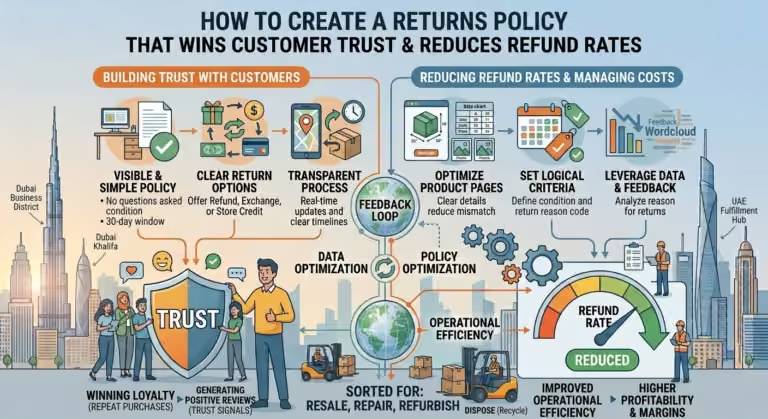
A clear refund policy tells customers what they can return, how the process works, and what resolution they can expect. According to the National Retail Federation’s 2025 Retail Returns Landscape, 82% of consumers said free returns were an important consideration when shopping online.
For ecommerce brands, clear terms can therefore reduce uncertainty before purchase while preventing confusion when a return happens.
The operational impact matters too. In the US retail market, the National Retail Federation and Happy Returns estimated that 19.3% of online sales would be returned in 2025. For UAE and GCC ecommerce brands, the goal is not to make returns harder. It is to prevent avoidable returns while creating a clear process for orders that genuinely need to come back.
Key Takeaways
- A strong ecommerce returns policy should clearly define eligibility, return timelines, item condition, shipping responsibility, refund options, and exceptions.
- The return window should reflect the product category, customer expectations, operational capacity, and applicable requirements.
- Brands can reduce avoidable returns by improving product information, fulfilment accuracy, packaging, and pre-dispatch checks.
- The written policy should be supported by a reliable reverse logistics process for pickup, inspection, tracking, and resolution.
- COD refusals should be tracked separately from customer-initiated returns because failed COD deliveries can enter the RTO pipeline before payment or acceptance.
An ecommerce returns and refund policy explains when customers can send purchases back, the conditions that apply, and how eligible returns are resolved.
A returns policy governs the rules for sending the item back, while a refund policy explains the financial outcome, such as a refund, exchange, replacement, or store credit. Many ecommerce businesses combine both sets of terms on one policy page.
What Should an Ecommerce Returns and Refund Policy Include?
A strong ecommerce returns policy should answer the questions customers are most likely to have before they request a return. Each rule should be specific enough to prevent confusion, but flexible enough to reflect the product category and the way the business operates.
| Policy element | What the business should decide | Example direction |
|---|---|---|
| Eligible products | Which products can be returned | State which product categories qualify |
| Return window | How long customers have to request a return | Give a clear number of calendar days |
| Item condition | Packaging, tags, seals, accessories, and usage limits | Define the condition required for approval |
| Proof of purchase | What documentation customers need | Order number, receipt, or account record |
| Return process | How customers initiate a return | Provide the portal, form, email, account page, or support channel |
| Resolution method | Refund, exchange, replacement, repair, or store credit | Explain which options apply in each situation |
| Return shipping | Who arranges and pays for the return | Separate merchant-error and change-of-mind cases |
| Processing timeline | When inspection and refund processing begin | State when the timeline starts |
| Exceptions | Which products have separate restrictions | List exclusions clearly before purchase |
| Damaged or incorrect orders | How customers should report the issue | State the contact method and required evidence |
| COD refusals and RTO | How refused or failed COD deliveries are classified and handled | Define re-attempt, RTO, inventory, and customer communication rules separately from customer-initiated returns |
| Cross-border orders | Duties, courier fees, documentation, and destination limits | Provide separate GCC or international terms where needed |
The policy should match what the business can operationally deliver. Promised pickup methods, refund timelines, exchanges, and other resolutions should align with customer service, fulfilment, finance, and reverse logistics workflows. Sample clauses can provide a starting point, but final terms should reflect the products sold, customer location, sales channels, and applicable consumer requirements.
How Long Should an Ecommerce Return Window Be?
There is no single return window that suits every ecommerce business. The timeframe should reflect the product category, customer expectations, fulfilment model, and the time needed to receive and inspect returned items.
Consider product shelf life, hygiene restrictions, defect-discovery time, seasonal purchases, cross-border transit, and inspection capacity. For UAE businesses, any voluntary return window must also be consistent with the consumer rights provided by applicable federal law.
A merchant’s own 14-day or 30-day policy cannot remove statutory rights that apply when a product is defective, damaged, incomplete, misdescribed, materially delayed, or delivered contrary to the agreed terms.
How Should Eligible Returns Be Resolved?
The right resolution depends on why the product is being returned and which options the policy allows. Customers should know what resolutions are available and when each one applies.
- Refund: A refund may apply when an eligible return is approved, and the customer is entitled to receive the purchase amount back. State the refund method, any applicable deductions, and when processing begins.
- Exchange or replacement: An exchange may suit a customer who needs another size, colour, or product variant. A replacement may apply when an item is damaged, defective, incomplete, or incorrect.
- Store credit: Store credit can retain the purchase value when the customer voluntarily accepts it for a future order. It should not replace a refund when the customer is otherwise entitled to one.
There is no universal winner for retention. Store credit can encourage another purchase when the customer willingly accepts it, while a prompt refund may better preserve trust when money back is the expected or required resolution.
The policy should therefore match the resolution to the return reason rather than automatically pushing every customer toward store credit.
Who Pays for Return Shipping and When?
Your policy should state who pays for return shipping in each scenario and disclose any charges before purchase.
- Damaged, defective, incorrect, or misdescribed item: The merchant should have a clear process for arranging or covering the return where required.
- Change-of-mind return: The customer may be responsible for return shipping when this is clearly disclosed and legally permitted.
- Exchange: The business may offer free, subsidised, or customer-paid collection based on its commercial policy.
- Cross-border return: Explain how courier charges, duties, documentation, and other applicable costs are handled.
Avoid vague wording such as “shipping charges may apply.” Customers should know when charges apply, who pays them, and whether any amount will be deducted from the refund. UAE and GCC businesses should review these terms against the consumer requirements that apply in each market.
UAE Ecommerce Law: The Legal Minimum Your Returns Policy Must Meet
UAE ecommerce businesses should build their refund policy around Federal Decree-Law No. 14 of 2023 Concerning the Modern Technology-Based Trade, alongside Federal Law No. 15 of 2020 on Consumer Protection and its executive regulations. The ecommerce law requires digital traders to publish the terms and conditions governing the sale and gives consumers specific return and replacement rights.
Under Article 7 of Federal Decree-Law No. 14 of 2023, a consumer may return or request replacement when an online purchase:
- Is defective, incomplete, or damaged.
- Does not match the trader’s stated description or condition.
- Arrives so late that the customer can no longer benefit from it.
- Is delivered contrary to the digital contract or published terms.
- Falls within another return case established under applicable UAE legislation.
These statutory rights are different from a merchant’s voluntary change-of-mind window. The federal ecommerce law does not itself state a universal 14-day cooling-off period for every online purchase. It also limits return rights in certain circumstances, including where goods have been used beyond checking for defects, where the applicable statutory period has expired, for certain short-life consumables, and for books, films, or programs that can only be used or accessed once.
Defective goods also receive protection under Cabinet Resolution No. 66 of 2023, the Executive Regulations of the Consumer Protection Law. Depending on the circumstances, consumers may have the right to a refund, replacement, or repair without charge.
Compliance has operational consequences. Under Cabinet Resolution No. 200 of 2025, obstructing a consumer’s Article 7 right to return or request replacement can lead to a warning for a first violation. Repeated violations can result in fines and temporary closure, with penalties reaching AED 10,000 to AED 20,000 for a fourth violation.
Your published policy should therefore explain voluntary return terms without wording them in a way that restricts rights granted by UAE law. Legal review is advisable before publishing category-specific exclusions or refund conditions.
How Should a UAE Refund Policy Handle COD Refusals and RTO?
A refused cash-on-delivery order is not the same as a customer-initiated return. If a customer refuses a COD parcel at the doorstep, the delivery fails before payment and the shipment may enter a return-to-origin (RTO) process rather than the standard refund workflow.
Jeebly’s guide to managing ecommerce returns in the UAE explains that a refused COD parcel is marked as a failed delivery and routed back through the returns pipeline. The item still needs to be received, inspected, and either returned to available inventory or routed for another appropriate outcome.
Your returns policy and internal SOP should therefore distinguish between:
- Customer-initiated return: The customer accepts the order and later requests a return under the published policy. The business evaluates eligibility and processes the applicable refund, exchange, replacement, or store credit.
- COD refusal or failed delivery: The customer does not complete the delivery or payment. The shipment becomes an RTO and may require a re-attempt, return transport, inspection, and inventory update rather than a refund.
- COD order paid and later returned: Once payment has been collected, the order enters the normal returns process. The policy should explain how an approved refund for a paid COD order will be issued, since the original payment was collected in cash.
Tracking COD refusals separately from normal returns can also reveal repeat refusal patterns, address problems, failed delivery attempts, or suspicious orders. Jeebly records failed COD orders and refusal data, which can help businesses identify patterns before they create repeated RTO costs.
How Can You Reduce Ecommerce Return Rates Without Restricting Customers?
Reducing avoidable returns starts with identifying why customers send products back. The focus should be on preventing expectation gaps, fulfilment errors, and delivery problems rather than making legitimate returns harder to complete.
Prevent Expectation Mismatches Before Purchase
Customers are more likely to return products when the item they receive does not match what they expected. Product pages should give enough information to help shoppers make an informed choice before checkout.
This can include:
- Accurate product descriptions
- Clear dimensions and measurements
- Size and fit guidance
- Realistic product images
- Material, colour, and compatibility details
- Care or usage instructions
- Clear delivery estimates
Packaging can also influence return outcomes. Protective packaging can reduce transit damage, while a consistent unboxing experience helps ensure the product arrives in the condition and presentation the customer expected.
Catch Fulfilment Errors Before Dispatch
Some returns are caused by preventable operational mistakes rather than product preference. Pre-dispatch checks can help catch incorrect, incomplete, or damaged orders before they reach the customer.
Useful controls can include:
- SKU and variant verification
- Barcode checks
- Product-condition inspection
- Address validation
- Secure packaging
- Order data integration between the ecommerce store and warehouse
These checks are especially important when businesses process high order volumes or manage multiple product variants.
Use Return Reasons to Fix Recurring Problems
Return data can show where problems are happening repeatedly. Instead of recording every return under a broad category, businesses should use clear reason codes that can be reviewed over time.
Common return reasons may include:
- Wrong size
- Product not as expected
- Damaged in transit
- Incorrect item
- Missing component
- Delayed delivery
- Changed mind
Track COD refusals separately from customer-initiated return reasons. A refused or failed COD delivery can become an RTO before the customer has accepted or paid for the order, so combining it with product returns can distort the reasons behind your overall return rate.
Patterns in customer-initiated return reasons can point to issues with product content, packaging, fulfilment, inventory accuracy, or delivery. Fixing the root cause can reduce avoidable returns without making the customer-facing process more restrictive.
How Does Reverse Logistics Support Your Returns Policy?
A returns policy sets the rules, but reverse logistics is what makes those rules work operationally. It covers the movement of returned products from the customer back to a store, warehouse, supplier, repair facility, or another approved destination.
A typical return flow may look like this:
- The customer submits a return request.
- The business checks the request against the published policy.
- A pickup or drop-off is arranged.
- The returned shipment is tracked.
- The item goes through the agreed quality check.
- The product is routed to the appropriate destination.
- The business approves the applicable resolution.
- The refund, exchange, replacement, repair, or store credit is processed.
For ecommerce brands managing reverse logistics in the UAE, Jeebly Bizz can support return pickups, doorstep quality checks, return-to-store or return-to-warehouse routing, real-time tracking, API integration, and customer updates.
An instant-refund workflow may also be available depending on the merchant’s agreed setup with Jeebly. It is not a standard or guaranteed feature for every client.
Ecommerce Returns Policy Implementation Checklist
Once the policy terms are defined, check that the business can apply them consistently across customer service, fulfilment, finance, and logistics.
Before publishing:
- Confirm that every customer-facing rule can be handled operationally.
- Assign ownership for return approval, inspection, refund processing, and customer communication.
- Configure the return request form, portal, or support workflow.
- Define inspection and disposition rules for returned inventory.
- Create consistent return reason codes for reporting.
- Confirm refund approval and processing responsibilities.
- Test the journey from return request to final resolution.
- Complete applicable legal and regulatory review.
- Set clear triggers for reviewing policy performance.
- Define separate workflows and reporting codes for customer returns, COD refusals, failed deliveries, and RTO shipments.
These return policy best practices help prevent gaps between what customers are promised and what internal teams can deliver.
Where Should You Display Your Returns Policy?
Customers should be able to find the policy before and after purchase. Link or display it across key touchpoints, including:
- Product pages
- Cart or checkout
- Website footer
- Order and shipping emails
- Customer account or return portal
- Marketplace listings
- Help centre or FAQ pages
Keep return windows, exclusions, charges, and refund methods consistent across each location. Material restrictions should be visible before checkout rather than appearing only after a customer starts a return.
When Should You Update Your Ecommerce Refund Policy?
Review the policy when return volumes rise, new product categories or markets are added, logistics partners change, new payment methods such as BNPL are introduced, customer complaints expose unclear terms, or applicable consumer requirements change.
Use actual return data during each review. Changes should address the underlying operational problem rather than simply making the policy more restrictive.
Build a Clear Policy and a Reliable Returns Process
A useful returns policy gives customers clear terms while giving internal teams a consistent process to follow. Reducing avoidable returns then depends on accurate product information, fulfilment controls, and reliable handling when products need to come back.
For related ecommerce strategies, see how buy now, pay later is changing purchasing and return behaviour in the UAE, and how packaging and the unboxing experience can influence repeat purchases.
For support with return pickups, quality checks, tracking, and return-to-store or return-to-warehouse workflows, talk to Jeebly Bizz about setting up reverse logistics and returns handling for your store.
Frequently Asked Questions

Businesses may apply different commercial return conditions to sale, clearance, or promotional items where permitted, but those terms should be disclosed before purchase. They should not override statutory rights that apply when goods are defective, damaged, misdescribed, or otherwise covered by UAE consumer law.
Not usually. A refused cash-on-delivery order generally becomes a failed delivery and enters a return-to-origin (RTO) workflow because the customer has not completed payment or accepted the shipment. Businesses should track COD refusals separately from post-delivery product returns.
Not automatically. A business can maintain one overall returns framework, but return windows, exclusions, refund obligations, shipping charges, and consumer rights may vary between the UAE and other GCC markets. The policy should identify any country-specific terms that apply.
They should be monitored, but preferably as a separate RTO or failed-delivery metric. Combining COD refusals with customer-initiated product returns can make it harder to identify whether costs are coming from product issues, fulfilment problems, failed deliveries, or customers refusing COD orders.
A restocking fee should only be used when it is clearly disclosed, commercially appropriate, and permitted under the laws that apply to the transaction. Businesses should be especially careful not to apply such fees where the customer has statutory rights because an item is defective, damaged, incorrect, or does not match the agreed terms.
Routes to insightful reads
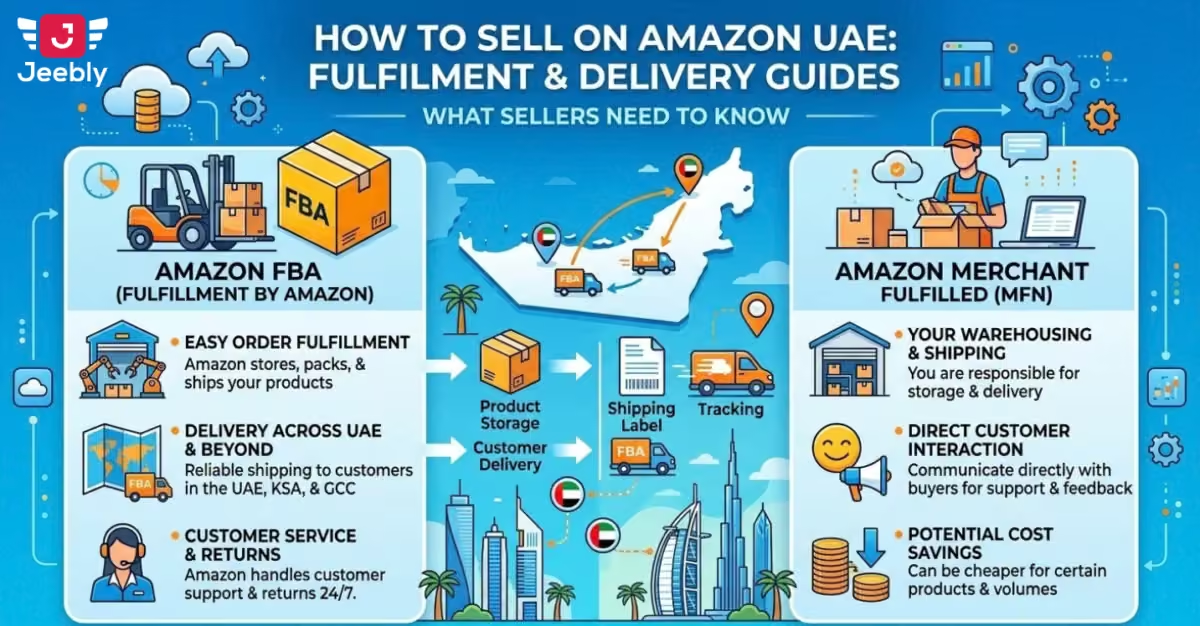
Selling on Amazon UAE offers massive growth potential, but choosing the right logistics model can make or break your margins. Discover the step-by-step onboarding process for Amazon.ae, explore the core differences between Fulfilment by Amazon (FBA) and Fulfilment by Merchant (FBM), and learn how to optimize your delivery strategy to scale efficiently in the UAE market.

Delivering high-value, luxury items in the UAE requires far more than standard shipping—it demands white-glove precision, specialized security protocols, and comprehensive transit insurance. Discover how premium handling, secure transit procedures, and asking the right questions of your courier partner ensure high-ticket goods reach your clients safely, preserving both product integrity and brand trust.

As the back-to-school rush hits the UAE, retailers face surging demand for fast, flexible, and reliable last-mile deliveries. From school uniforms and backpacks to tech essentials, learn how seamless multi-channel logistics, scheduled doorstep deliveries, and real-time tracking help UAE brands meet evolving parent expectations and turn seasonal spikes into long-term customer loyalty
When speed is everything, traditional delivery options just won’t cut it. Learn how Jeebly Dash provides ultra-fast, on-demand courier services across the UAE—giving businesses and consumers a seamless booking experience, transparent pricing, and real-time tracking to ensure urgent parcels reach their destination within minutes.
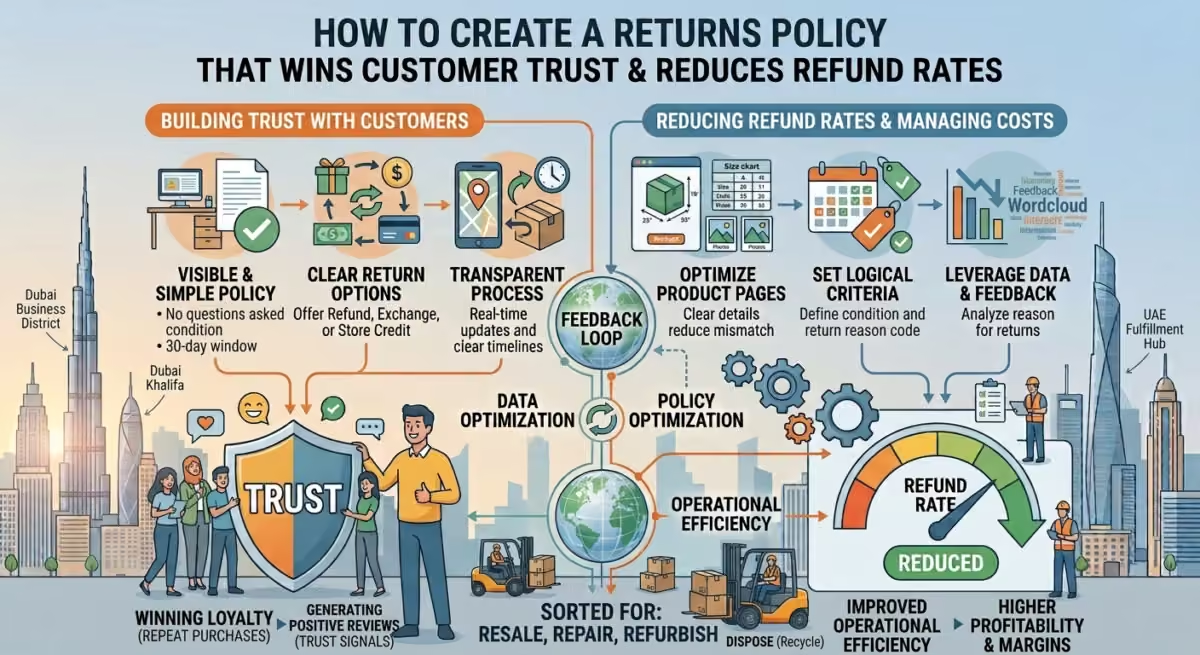
Mastering returns is a delicate balancing act for e-commerce brands—make it too strict, and you lose customer trust; make it too lenient, and your profit margins take a hit. Discover actionable strategies to build a seamless, customer-first returns policy that converts first-time buyers into loyal brand advocates while optimizing backend operations to keep refund rates and logistics costs low.