





Jeebly | Logistics Solutions

Categories
blogs

What Is DDP Shipping? What “Delivered Duty Paid” Means for UAE Importers and Exporters

DDP shipping infographic explaining seller responsibilities, customs clearance, duties, final delivery, and benefits for UAE importers

What Is DDP Shipping? What "Delivered Duty Paid" Means for UAE Importers and Exporters

When a UAE business orders goods from a Chinese supplier and receives a single all-in price covering freight, UAE customs clearance, 5% import duty, 5% VAT, and doorstep delivery, that’s DDP (Delivered Duty Paid) shipping. The buyer pays once and receives everything cleared. There are no customs queues, surprise duty invoices, or handoff between carrier and customs broker.

For UAE importers buying from Asia and UAE exporters selling to GCC markets, DDP is both an opportunity and a risk depending on who structures it, how the documentation works, and whether the VAT element is actually recoverable. 

This guide explains how DDP shipping works for UAE businesses specifically, what it costs, where it can create problems, and when to use DAP (Delivered at Place) instead.

Key Takeaways

  • DDP (Delivered Duty Paid) means the seller pays all costs (freight, customs clearance, import duties, and VAT) until goods reach the buyer’s named address.

  • UAE importers buying DDP from overseas suppliers often cannot reclaim the 5% UAE import VAT, because it’s paid under the agent’s TRN rather than their own.

  • For UAE exporters selling to GCC markets under DDP, the seller takes on customs clearance and duty payment in the destination country, which requires either local entity registration or an IOR (Importer of Record).

  • DDP suits first-time or low-volume importers. Growing businesses can save significant margin by switching from DDP to FOB with their own freight forwarding system once volumes justify it.

What Is DDP Shipping?

DDP (Delivered Duty Paid) is an Incoterm, one of 11 standardised international trade terms published by the International Chamber of Commerce, that defines who pays for what in a cross-border shipment. 

Under DDP, the seller is responsible for all costs and risks from origin to the buyer’s named delivery address, including export formalities, freight, insurance, import customs clearance, import duties, and VAT or equivalent taxes in the destination country.

The buyer’s only obligation is to accept delivery. There are no further charges at the door. In practice, UAE businesses encounter DDP in two directions:

  • As importers: A UAE company buying goods from China or Europe may receive a DDP quote from a supplier or freight agent, one price covering everything from the factory to the Dubai warehouse address. No separate customs agent required and no duty invoice arriving two weeks later.


  • As exporters: A UAE brand selling to customers in Saudi Arabia, Kuwait, or the UK may offer DDP terms to its buyers, absorbing all the destination-country duty and VAT to deliver a frictionless customer experience.


Both directions carry fundamentally different implications.

How DDP Shipping Works: The Full Sequence

For a UAE importer receiving DDP goods from China:

  1. Order placed and DDP price agreed. The supplier or freight agent provides an all-in DDP quote covering the goods, export formalities, freight (air or sea), UAE customs clearance, 5% import duty, and 5% VAT to a named UAE address.

  2. Supplier arranges export. The seller prepares commercial invoice, packing list, and export declaration in China. Goods are collected from the factory.

  3. International transit. Goods move by air freight services (3–7 days from China) or sea freight (18–25 days via Jebel Ali) to the UAE.

  4. UAE customs clearance. The DDP agent files the import declaration with Dubai Customs (via Mirsal 2), pays the 5% customs duty and 5% VAT, and obtains the release order.

  5. Last-mile delivery. Goods are delivered to the UAE importer’s warehouse, free zone, or office.

For a UAE exporter shipping DDP to a GCC buyer:

The same sequence applies in reverse. The UAE seller arranges freight to Saudi Arabia, Kuwait, or Oman; handles destination-country customs clearance; pays applicable import duties; and delivers to the buyer’s address. The destination country’s customs authority is the operative regulatory body.

DDP vs DAP vs FOB: The UAE-Specific Comparison

For UAE businesses, three Incoterms majorly determine how cross-border costs are split between seller and buyer: DDP (Delivered Duty Paid), DAP (Delivered at Place), and FOB (Free on Board). 

Each one places a different set of obligations on each party, and choosing the wrong one either erodes your margin as a seller or creates unexpected charges for your buyer.

Aspects DDP DAP FOB
Who pays import duty Seller Buyer Buyer
Who pays import VAT Seller Buyer Buyer
Who arranges customs clearance Seller Buyer Buyer
Buyer's experience Frictionless, one price Surprise charges at delivery Full control + cost visibility
Seller's cost Highest Moderate Lowest
VAT reclaimability (UAE importer) Often not Yes, under your own TRN Yes, under your own TRN
Best for First-time importers, B2C buyers B2B buyers handling own clearance Scaling importers with own forwarder

DAP leaves import duty and VAT to the buyer. It’s simpler for the seller, but creates the risk that the buyer faces an unexpected charge at delivery or customs hold. 

When is each appropriate: 

  • If your goal is lower cart abandonment and fewer failed deliveries, DDP usually performs better because it removes uncertainty from the buying experience. 

  • DAP still has a place when you’re testing markets or protecting margin early, but scaling DAP without clear transparency almost always shows up later in higher refusal rates.

  • FOB is appropriate if importing at meaningful volume. Under FOB, goods are handed to the buyer’s freight forwarder at the origin port. The buyer arranges their own freight, manages their own customs clearance, and pays duty and VAT directly to UAE Customs under their own TRN.

A quick guide on VAT on Shipping and Delivery in UAE covers more on how UAE import VAT works, what a compliant tax invoice must contain, and the changes that affect how shipping VAT is documented and recovered.

When does it make sense to move from DDP to FOB?

For UAE importers, the economics of DDP shift as volume grows. At low volume, DDP’s convenience premium is worth paying. There’s no customs agent to manage, no freight forwarder relationship to maintain, and no separate duty payment to coordinate. 

Above that threshold, engaging your own freight forwarder and customs broker can recover some percentage of the DDP premium, while also making your UAE import VAT reclaimable under your own TRN.

The UAE-Specific DDP Problems

These are the issues that specifically affect UAE businesses using DDP that global Incoterms guides don’t address.

Problem 1: The VAT reclaim gap for UAE importers.

Because the DDP agent pays UAE import VAT in their own name, UAE-registered businesses often don’t receive a valid import VAT document under their company’s TRN. A VAT-registered UAE business may be unable to reclaim that 5%.

The fix: If you’re VAT-registered in the UAE and importing regularly, confirm with any DDP provider whether the import declaration will be filed under your TRN. If the answer is no or unclear, the convenience of DDP is costing you recoverable VAT.

Problem 2: Under-declared customs values.

Some DDP agents lower the declared customs value to cut duty and offer a tempting DDP price. If UAE Customs reassesses the declared value, the importer faces penalties, and it’s your goods, your liability. 

The fix: Always request a copy of the import declaration and verify that the declared value matches your commercial invoice.

Problem 3: UAE exporters need IOR arrangements for GCC DDP.

For a UAE brand offering DDP to Saudi, Kuwaiti, or Omani buyers, the seller must either be registered as an importer in the destination country or appoint an Importer of Record (IOR) service provider to handle customs clearance on their behalf. 

Without this, the seller can’t legally act as the DDP importer at the destination. This requirement is frequently overlooked by SMEs new to GCC cross-border DDP.

Problem 4: De minimis changes affecting DDP economics.

The August 2025 suspension of the US de minimis exemption (affecting goods from all origins) means shipments that previously cleared US customs duty-free now face full tariff rates. For UAE exporters selling to US customers under DDP, this materially changes the seller’s landed cost calculation. 

DDP is more expensive post-August 2025, but also more important for customer experience. Buyers who previously received duty-free parcels now face import charges under DAP terms, which creates refusals and returns.

What DDP Shipping Costs: The Full Landed Cost Breakdown

Most DDP quotes present a single number. Here’s what’s inside it and what you should verify before accepting.

Cost Component Who Pays (DDP) Notes
Goods value Seller Invoice value
Export documentation and freight forwarding (origin) Seller Varies by origin port and agent
International freight (air or sea) Seller Major variable, get a market rate comparison
Origin port handling Seller Check whether included in freight quote
Destination port handling and terminal fees Seller Often quoted separately
UAE customs clearance fees Seller Per declaration, typically AED 50–200
UAE import duty Seller 5% of CIF value for most goods
UAE VAT at import Seller 5% of CIF value plus duty
Last-mile delivery Seller To named UAE address

Along with the expenses, it’s important to determine whether your goods are classified as dangerous or restricted, which affects carrier acceptance and adds handling surcharges to your DDP cost. 

Here’s a quick read on Dangerous Goods and Restricted Items in the UAE that covers which product categories carry essential requirements and what the compliance steps are before shipping.

How a Delivery Note Works: The Handover Sequence

The delivery note process follows a repeatable sequence that every UAE business should standardise.

Step 1: Generation at dispatch

When an order is packed and ready to leave the warehouse, a delivery note is generated, ideally automatically from the order management system to eliminate manual data entry errors. The note is either printed and attached to the shipment, or sent digitally to the recipient ahead of arrival.

Step 2: Travel with the goods

The delivery note accompanies the shipment. The courier or driver carries it to the delivery point. It is not sent separately by email or uploaded after the fact. Its purpose is to be present at the point of handover.

Step 3: Recipient verification

On arrival, the recipient checks the delivered items against the delivery note. Any discrepancy, such as a wrong item, short quantity, or damaged goods, is noted on the delivery note before signature.

Step 4: Confirmation

In paper-based systems, the recipient signs and dates the delivery note. The driver retains one copy; the recipient keeps one. In ePOD systems (covered below), digital confirmation is captured automatically.

Step 5: Filing and retention

Both parties retain their copies. Keeping delivery notes for at least five years is advisable to support documentation for disputes or claims. For UAE businesses managing import documentation, this retention period also aligns with FTA audit requirements for VAT-related records.

How Jeebly Can Support DDP Operations

For UAE businesses managing cross-border freight alongside domestic last-mile delivery, having both legs under one platform removes the coordination overhead that typically creates DDP delays.

Jeebly Haul covers the freight leg (air, sea, road) across UAE and GCC routes with in-house customs clearance rather than outsourced brokerage. For UAE businesses importing goods under DDP or structured as FOB with Jeebly managing the UAE customs leg, this means one point of contact from port to warehouse.

For UAE exporters shipping to GCC customers who want a clean, tracked last-mile experience at the destination end, Jeebly Bizz connects order management with domestic delivery. Shopify and WooCommerce orders dispatch automatically, with real-time tracking and photo ePOD at every delivery.

For businesses shipping domestic parcels alongside cross-border operations, same-day delivery across the UAE through Jeebly Dash completes the fulfilment loop. Domestic last-mile is at 98% FDSS, connected to the same platform managing inbound freight.

Talk to the Jeebly team to discuss your specific import or export profile, and we’ll confirm how Jeebly Haul covers the freight and customs clearance leg for your operation.

Conclusion

DDP shipping gives buyers a frictionless experience: one price, no customs surprises, no charges at the door. For UAE importers, the critical check is whether the 5% UAE import VAT is paid under your TRN (making it reclaimable) or the agent’s TRN (making it a sunk cost). 

For UAE exporters, DDP to GCC markets requires either IOR arrangements or a logistics partner with GCC-wide customs capability. The economics of DDP shift as volume grows. The convenience premium that makes sense at low volume often doesn’t at scale, where FOB with your own freight forwarder recovers meaningful margin. 

For UAE businesses managing cross-border freight and domestic last-mile through one connected platform, Jeebly Haul and Jeebly Bizz cover both legs. Get in touch to discuss your import or export structure.

Frequently Asked Questions

DDP (Delivered Duty Paid) is an Incoterm where the seller pays all costs such as freight, customs clearance, import duties, and VAT until goods reach the buyer’s named delivery address. The buyer pays nothing extra on arrival. It places maximum responsibility on the seller and minimum on the buyer.

Only if the import declaration is filed under your company’s UAE Tax Registration Number (TRN). Many DDP freight agents file import declarations under their own TRN, meaning the 5% UAE import VAT is paid in their name, and you cannot reclaim it on your FTA VAT return. Always confirm with your DDP provider which TRN the customs declaration will be filed under before accepting the arrangement.

Under DDP, the UAE seller pays destination-country import duties and VAT, and handles customs clearance. The buyer receives goods with no additional charges. Under DAP, the buyer is responsible for import duties and customs clearance at the destination.

A UAE importer should switch from DDP (Delivered Duty Paid) to FOB (Free on Board) if shipping volumes scale up, internal logistics are established, and there is a need to lower high markup costs embedded in seller-managed freight. This transition makes sense when the business gains the capability to manage local UAE customs clearance and ocean freight directly.

Yes. DDP applies to any mode of transport: air, sea, or road. For China-to-UAE imports, sea freight DDP via Jebel Ali is the most cost-effective option for non-time-sensitive goods (18–25 days). Air freight DDP is appropriate for high-value or time-sensitive shipments (3–7 days from China). The DDP price includes the freight cost for whichever mode is used.

Routes to insightful reads

DDP shipping infographic explaining seller responsibilities, customs clearance, duties, final delivery, and benefits for UAE importers
What Is DDP Shipping? What “Delivered Duty Paid” Means for UAE Importers and Exporters

A delivery note is a key document in the UAE logistics process, providing a clear record of what was shipped, who sent it, and who received it. From proof of delivery and shipment tracking to order verification, customs compliance, and dispute resolution, a properly prepared delivery note helps businesses maintain accurate records and protect every shipment. This guide explains what a delivery note is, what it should include, and why it is essential for businesses operating across the UAE.

Read More
Delivery note document showing shipment details, proof of delivery, tracking, verification and UAE logistics compliance
What Is a Delivery Note and Why Does Every UAE Shipment Need One?

A delivery note is a key document in the UAE logistics process, providing a clear record of what was shipped, who sent it, and who received it. From proof of delivery and shipment tracking to order verification, customs compliance, and dispute resolution, a properly prepared delivery note helps businesses maintain accurate records and protect every shipment. This guide explains what a delivery note is, what it should include, and why it is essential for businesses operating across the UAE.

Read More
Illustration showing strategies to reduce cart abandonment through transparent shipping costs, fast delivery, local fulfilment, and clear returns policies for UAE eCommerce businesses.
How to Reduce Cart Abandonment Caused by Delivery Costs and Uncertainty

Delivery costs and uncertainty are among the biggest reasons shoppers abandon their carts before completing a purchase. This guide explores practical strategies to reduce cart abandonment, including transparent shipping fees, accurate delivery estimates, flexible shipping options, local fulfilment, and hassle-free returns, helping UAE eCommerce businesses improve conversions and build customer trust.

Read More
J&T Express vs Jeebly comparison graphic featuring delivery apps, e-commerce products, and UAE logistics services against the Dubai skyline.
J&T Express vs Jeebly: Which Courier Is Better for UAE eCommerce Businesses?

J&T Express and Jeebly both support eCommerce deliveries, but they cater to different business needs. This comparison explores their delivery networks, fulfilment capabilities, shipping speed, technology, pricing flexibility, and merchant services to help UAE businesses choose the courier partner that best supports their growth and customer experience.

Read More
Delivery SLA guide for UAE businesses showing service level agreements, delivery performance metrics, on-time delivery targets and logistics standards.
 Delivery SLA Guide for UAE Businesses: What to Expect and How to Set Standards

A clear delivery Service Level Agreement (SLA) sets the expectations for speed, reliability, and performance between businesses and their logistics partners. This guide explains what a delivery SLA should include, the key metrics to track, and how UAE businesses can set realistic standards to improve customer satisfaction and delivery performance.

Read More
Categories
blogs

What Is a Delivery Note and Why Does Every UAE Shipment Need One?

Delivery note document showing shipment details, proof of delivery, tracking, verification and UAE logistics compliance

What Is a Delivery Note and Why Does Every UAE Shipment Need One?

A delivery note is the document that travels with a shipment of goods listing what was sent, in what quantities, and confirming receipt when the goods arrive. It is not an invoice, not a contract, and not optional for any UAE business operating at scale.

When a quantity dispute arises, when a customer claims they received the wrong items, or when an auditor asks for documentation of goods received, the delivery note is the first document both parties reach for. Without one, a shipment is unverifiable at the point of handover.

This guide covers what a delivery note contains, how it works in practice, how it differs from an invoice, the shift from paper to electronic proof of delivery (ePOD) in UAE logistics, and what UAE-specific compliance changes affect delivery documentation.

Key Takeaways

  • A delivery note confirms what was physically sent and received. It travels with the shipment, not separately like an invoice.

  • It does not contain prices; an invoice is the financial document; a delivery note is the delivery record.

  • Electronic proof of delivery (ePOD) (photo, GPS timestamp, digital signature) is the digital evolution of the paper delivery note and is now standard practice in UAE last-mile operations.

  • Keep copies of all delivery notes for a minimum of five years to support dispute resolution and documentation for claims.

  • UAE businesses using a logistics company in the UAE that issues ePODs automatically should ensure the digital record is accessible and searchable.

What Is a Delivery Note? Definition and Core Purpose

A delivery note is a commercial document that accompanies a shipment of goods from sender to recipient. It lists the items included in the delivery, the quantities of each, and identifying details such as the order number, sender information, and recipient information. When the recipient confirms the goods have arrived correctly, the delivery note serves as proof of receipt.

Also referred to as a dispatch note or goods received note depending on who is completing it, the delivery note performs three functions simultaneously:

  1. It confirms dispatch. The sender has a record that these specific items left the warehouse in this condition on this date.

  2. It enables verification. The recipient can check what arrived against what was ordered before signing or confirming. Discrepancies are caught at the point of handover rather than days later.

  3. It creates an evidence trail. If a dispute arises, like a wrong item, short quantity, or damaged goods, the delivery note is the contemporaneous record that documents what both parties agreed was delivered.

For UAE businesses managing high order volumes across multiple emirates, this trail matters more than it might seem. A single consignment of 500 units with an undocumented quantity discrepancy can translate into an inventory reconciliation problem that takes days to resolve without a delivery note.

Delivery Note vs Invoice: What's the Difference?

This is the single most common point of confusion in delivery documentation. The two documents serve different purposes and must not be conflated.

Aspects Delivery Note Invoice
Purpose Confirms physical delivery of goods Requests payment for goods or services
Contains prices? No Yes
When issued At point of delivery, travels with goods After delivery, sent to accounts payable
Who completes it Sender (dispatching party) Seller
Signed by Recipient (on receipt) Seller (issued)
Legal function Proof of delivery and receipt Financial claim/tax document
VAT implications None directly Subject to UAE FTA VAT rules

So, if a shipment of 100 units is delivered and the delivery note says 100 but the invoice says 120, that discrepancy is immediately visible and auditable. Without the delivery note, only the invoice exists, and the buyer has no contemporaneous record of what actually arrived.

What a Delivery Note Should Contain

A well-structured delivery note should include the following fields. Missing any of these creates gaps in the evidentiary trail.

Field Why it matters
Sender name and address Identifies the dispatching party
Recipient name and address Confirms the correct delivery destination
Delivery date Creates a timestamp for the handover
Order number/reference Links the delivery to the original purchase order
Item description Identifies what was sent (SKU, product name)
Quantity per item The most critical field for dispute resolution
Unit of measurement Prevents ambiguity (units, kg, boxes, pallets)
Delivery method/carrier Documents how goods were transported
Signature or confirmation field Proof of receipt by the recipient
Notes or exceptions Records any damage, missing items, or conditions observed at handover

One field that surprises most businesses by its absence: price

A delivery note deliberately excludes prices. The moment you add pricing, you are creating a document that overlaps with the invoice, which creates VAT documentation confusion.

How a Delivery Note Works: The Handover Sequence

The delivery note process follows a repeatable sequence that every UAE business should standardise.

Step 1: Generation at dispatch

When an order is packed and ready to leave the warehouse, a delivery note is generated, ideally automatically from the order management system to eliminate manual data entry errors. The note is either printed and attached to the shipment, or sent digitally to the recipient ahead of arrival.

Step 2: Travel with the goods

The delivery note accompanies the shipment. The courier or driver carries it to the delivery point. It is not sent separately by email or uploaded after the fact. Its purpose is to be present at the point of handover.

Step 3: Recipient verification

On arrival, the recipient checks the delivered items against the delivery note. Any discrepancy, such as a wrong item, short quantity, or damaged goods, is noted on the delivery note before signature.

Step 4: Confirmation

In paper-based systems, the recipient signs and dates the delivery note. The driver retains one copy; the recipient keeps one. In ePOD systems (covered below), digital confirmation is captured automatically.

Step 5: Filing and retention

Both parties retain their copies. Keeping delivery notes for at least five years is advisable to support documentation for disputes or claims. For UAE businesses managing import documentation, this retention period also aligns with FTA audit requirements for VAT-related records.

Paper vs Electronic: Why ePOD Is Now Standard Practice in UAE Logistics

Electronic proof of delivery (ePOD) is the digital evolution of the paper delivery note. Instead of a printed document signed with a pen, ePOD captures:

  • A digital signature from the recipient
  • A timestamped photograph of the delivered goods at the drop-off location
  • GPS coordinates confirming where and when the delivery was completed
  • Automatic data upload to a dashboard accessible in real time by the sender
Factors Paper Delivery Note ePOD (Electronic Proof of Delivery)
Speed of confirmation Manual, delayed Instant
Accuracy Human error risk in data entry Auto-populated from order data
Storage Physical filing required Cloud-based, searchable
Dispute resolution Document retrieval, days Real-time data with timestamp and photo
Customer visibility None until confirmation Notification sent immediately at delivery
Scalability Breaks down at volume Handles 50,000+ deliveries daily

For UAE e-commerce businesses managing same-day and next-day delivery across multiple emirates, ePOD removes the operational ceiling that paper delivery notes create. At 200+ daily orders, manually managing, filing, and retrieving paper delivery notes is a full-time administrative burden. At 2,000 orders, it’s an impossible one.

The WhatsApp confirmation expectation of UAE consumers adds a dimension. A customer who receives a WhatsApp message with a delivery photo from their courier has a real-time ePOD.

Delivery Notes and UAE Compliance in 2026-2027

Two regulatory developments affect how UAE businesses should think about delivery documentation moving forward.

VAT on delivery and the e-invoicing mandate: The UAE FTA has confirmed mandatory e-invoicing for B2B and B2G transactions starting January 2027 for large businesses (annual revenue AED 50M+) and July 2027 for smaller businesses. 

E-invoices will be in structured XML/JSON format via the Peppol network. Delivery notes are distinct from invoices and are not within the scope of the e-invoicing mandate. But businesses should ensure their delivery documentation and invoicing processes are clearly separated, as the FTA’s audit trail requirements will examine both.

FTA audit documentation: UAE FTA VAT audits examine records for up to five years. For any shipment that has a VAT component, including goods, the delivery note forms part of the documentation trail confirming what was supplied and when.

A business that cannot produce delivery notes for a disputed shipment within the five-year audit window is in a weaker position on any supply-side claim.

For a detailed explanation of how VAT applies to shipping and delivery services in the UAE, VAT on Shipping and Delivery Services in UAE covers the full compliance picture.

How Jeebly Handles Delivery Documentation

Jeebly Dash captures a photo ePOD at every domestic delivery and uploads it at the point of drop-off. The delivery record is accessible to the business through the platform dashboard and visible to the customer through their delivery notification.

For businesses managing B2B consignments where the delivery note feeds into accounts payable workflows, Jeebly Bizz connects the delivery confirmation directly to order management. The completed delivery record updates the system automatically, without a manual handoff.

For freight shipments where delivery documentation needs to cover multi-item consignments, pallet quantities, and goods received against purchase orders, Jeebly Haul manages freight documentation alongside transit.

Talk to the Jeebly team if your current delivery partner doesn’t provide ePOD as standard, or if you need a delivery documentation setup that integrates with your inventory management or accounts payable workflo

Conclusion

A delivery note is a small document with significant operational weight. It confirms what was sent, what was received, and creates the contemporaneous evidence that protects both parties when something goes wrong. 

For UAE businesses running e-commerce at any meaningful volume, the paper delivery note has been superseded by ePOD. The transition from paper to digital delivery documentation is not a technology upgrade. It’s a risk management decision.

For delivery documentation that works automatically at every drop-off, Jeebly Dash captures ePOD as standard across 50,000+ daily deliveries. Get in touch to discuss your documentation requirements.

Frequently Asked Questions

A delivery note is a document that travels with a shipment confirming what goods were sent and in what quantities. The recipient checks the goods against the delivery note on arrival, and signs or digitally confirms receipt. It does not include prices. That’s the invoice’s job.

A delivery note is not specifically mandated by UAE law for domestic trade, but it functions as primary evidence in any goods-related dispute. For businesses in regulated sectors, or those subject to FTA VAT audits, a delivery note forms part of the supply documentation trail covering up to five years of transactions.

A delivery note confirms what was sent and received. The recipient signs it as proof of handover. A packing list is a shipping document listing the contents of a shipment for customs and carrier purposes. Both may travel with a shipment, but serve different functions: the delivery note creates an agreed receipt record; the packing list describes the physical contents for handling and customs.

 Keeping copies of all delivery notes for at least five years is advisable to maintain control over delivered products and provide documentation for disputes or claims. This also aligns with UAE FTA audit documentation requirements for VAT-related supply records.

ePOD (electronic proof of delivery) captures a digital signature, timestamped photo, and GPS-confirmed location at the point of delivery using a mobile device. The data uploads automatically to a cloud dashboard accessible to both sender and recipient. It performs the same function as a paper delivery note but with instant confirmation, searchable records, and no risk of lost paperwork.

Routes to insightful reads

DDP shipping infographic explaining seller responsibilities, customs clearance, duties, final delivery, and benefits for UAE importers
What Is DDP Shipping? What “Delivered Duty Paid” Means for UAE Importers and Exporters

A delivery note is a key document in the UAE logistics process, providing a clear record of what was shipped, who sent it, and who received it. From proof of delivery and shipment tracking to order verification, customs compliance, and dispute resolution, a properly prepared delivery note helps businesses maintain accurate records and protect every shipment. This guide explains what a delivery note is, what it should include, and why it is essential for businesses operating across the UAE.

Read More
Delivery note document showing shipment details, proof of delivery, tracking, verification and UAE logistics compliance
What Is a Delivery Note and Why Does Every UAE Shipment Need One?

A delivery note is a key document in the UAE logistics process, providing a clear record of what was shipped, who sent it, and who received it. From proof of delivery and shipment tracking to order verification, customs compliance, and dispute resolution, a properly prepared delivery note helps businesses maintain accurate records and protect every shipment. This guide explains what a delivery note is, what it should include, and why it is essential for businesses operating across the UAE.

Read More
Illustration showing strategies to reduce cart abandonment through transparent shipping costs, fast delivery, local fulfilment, and clear returns policies for UAE eCommerce businesses.
How to Reduce Cart Abandonment Caused by Delivery Costs and Uncertainty

Delivery costs and uncertainty are among the biggest reasons shoppers abandon their carts before completing a purchase. This guide explores practical strategies to reduce cart abandonment, including transparent shipping fees, accurate delivery estimates, flexible shipping options, local fulfilment, and hassle-free returns, helping UAE eCommerce businesses improve conversions and build customer trust.

Read More
J&T Express vs Jeebly comparison graphic featuring delivery apps, e-commerce products, and UAE logistics services against the Dubai skyline.
J&T Express vs Jeebly: Which Courier Is Better for UAE eCommerce Businesses?

J&T Express and Jeebly both support eCommerce deliveries, but they cater to different business needs. This comparison explores their delivery networks, fulfilment capabilities, shipping speed, technology, pricing flexibility, and merchant services to help UAE businesses choose the courier partner that best supports their growth and customer experience.

Read More
Delivery SLA guide for UAE businesses showing service level agreements, delivery performance metrics, on-time delivery targets and logistics standards.
 Delivery SLA Guide for UAE Businesses: What to Expect and How to Set Standards

A clear delivery Service Level Agreement (SLA) sets the expectations for speed, reliability, and performance between businesses and their logistics partners. This guide explains what a delivery SLA should include, the key metrics to track, and how UAE businesses can set realistic standards to improve customer satisfaction and delivery performance.

Read More
Categories
blogs

How to Reduce Cart Abandonment Caused by Delivery Costs and Uncertainty

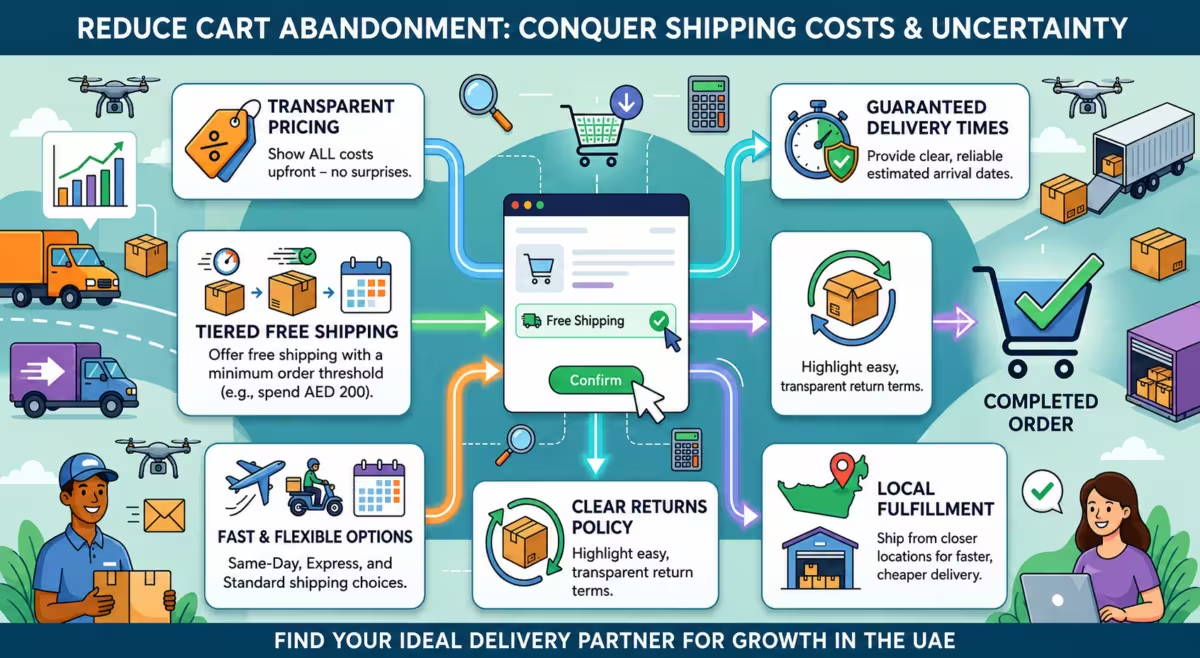
Illustration showing strategies to reduce cart abandonment through transparent shipping costs, fast delivery, local fulfilment, and clear returns policies for UAE eCommerce businesses.

How to Reduce Cart Abandonment Caused by Delivery Costs and Uncertainty

Roughly seven out of every ten shoppers who add items to their cart leave without purchasing. The number one trigger cited by 48% of US shoppers is extra costs appearing at final checkout, primarily shipping fees and taxes. This is entirely preventable. 

Additionally, combined delivery cost and delivery uncertainty directly drive more than half of all preventable cart abandonment. It’s mostly a delivery communication problem, and the fix starts long before the customer reaches the payment page. 

This guide covers the specific delivery and logistics changes that reduce abandonment, the UAE-specific factors that make this market different, and how to structure your delivery operation so it converts.

Key Takeaways

  • 48% of shoppers abandon their cart because of unexpected shipping costs, the top reason for cart abandonment.

  • Showing delivery cost and estimated date on the product page eliminates the surprise that causes most shipping-related abandonment.

  • In the UAE, COD can still account for 40-60% of D2C transactions in certain categories, directly impacting conversion rates and market penetration.

  • The brands that consistently convert at checkout are the ones whose delivery operation is reliable enough to promise something specific. 

Why Delivery Is a Pre-Purchase Conversion Problem

The standard model in e-commerce treats delivery as what happens after the sale. The data says otherwise.

Many ecommerce stores still rely on vague delivery language such as “3–7 business days” or “delivery subject to location.” While technically accurate, these messages do little to help customers understand when they will actually receive their order. The most effective stores communicate delivery expectations with precision.

The sequence that may create abandonment is specific: uncertain delivery window → reaches checkout → sees AED 15 shipping fee → doesn’t complete purchase. 

The fix is not removing the fee at the last step. It’s removing the uncertainty and the surprise from the earliest point in the purchase journey.

Fix 1: Show Delivery Cost and Estimated Date on the Product Page

The checkout page is too late. Displaying shipping costs, taxes, and fees on the product page or early in the cart can eliminate the surprise that causes most price-related abandonment.

What this could look like in practice:

  • A delivery cost estimate on the product page, based on the customer’s location (use geolocation to personalise this automatically)
  • A specific delivery date rather than a range: “arrives tomorrow” or “arrives Wednesday if ordered before 2 pm”
  • A delivery cut-off time clearly displayed: “Order in the next 3 hours for same-day delivery”

The same principle applies to delivery date promises. Showing the delivery date where the purchase decision is being made converts that information from noise into a reason to buy.

Fix 2: Set a Free Shipping Threshold at the Right Level

Free shipping is among the most impactful pricing changes for reducing cart abandonment. The mechanics matter.

For example: if your current AOV is AED 150, set the free shipping threshold at AED 180–195. Customers who are AED 30 away from free shipping will add an item. Customers who are AED 100 away will not bother.

Additionally, a free shipping progress bar visible in the cart and ideally on product pages can show customers how close they are to the threshold.

Fix 3: Match Your Delivery Promise to Your Logistics Capability

The connection between logistics capability and cart conversion is direct. If your fulfilment partner can only reliably hit next-day delivery within Dubai, don’t promise it to customers in Ras Al Khaimah. If your current provider takes 4–5 days to the northern emirates, your product page date estimate needs to reflect that, and your conversion rate will reflect the slower promise.

This is where your logistics partner choice directly affects your checkout conversion rate. For same-day and next-day domestic delivery with the FDSS data to back up precise checkout promises, Jeebly Dash covers all seven emirates with a published 98% FDSS.

Fix 4: Handle COD the Right Way for UAE Shoppers

COD creates a specific abandonment pattern in the UAE: shoppers select COD at checkout, then abandon because they’re unsure whether the delivery agent will arrive, how much to have ready, or what happens if they miss the delivery. This is delivery uncertainty driving abandonment even after payment method selection.

The fixes are operational:

Pre-delivery WhatsApp notification: Send a WhatsApp message when the order is out for delivery, confirming the exact COD amount, a delivery window, and a rescheduling option. Customers value predictability.

COD OTP confirmation: Implementing OTP confirmation before dispatch verifies the customer’s phone number and intent, filtering out fake orders before they enter the delivery pipeline. This reduces RTO from COD fraud.

Clear COD policy on the product page. State the exact COD process when the driver arrives, what form of payment is accepted, and what happens if the customer isn’t home. Uncertainty about how COD works causes abandonment at checkout.

Fix 5: Use WhatsApp for Cart Recovery

The UAE has some of the highest WhatsApp penetration rates in the world. Cart abandonment recovery messages sent via WhatsApp within 30–60 minutes of abandonment reach customers on the device and app they’re actively using.

Effective WhatsApp cart recovery for UAE e-commerce:

  • Send within 30–60 minutes of abandonment. Intent degrades quickly.
  • Show the specific abandoned item with an image.
  • Include a direct link back to the cart (not the homepage).
  • Confirm the delivery date and cost upfront in the message. Address the exact friction point that caused the abandonment.
  • Offer a small incentive (free delivery, a 5% discount) for orders above your free shipping threshold.

The delivery promise in the recovery message matters as much as the incentive. A customer who abandoned because of a vague delivery window needs to see a specific date before they’ll re-engage.

Fix 6: Make Returns Visible and Simple Before Purchase

A return policy is one of the strongest trust signals in ecommerce. Yet many stores treat returns as compliance content rather than conversion content.

A clear, easy return policy shown on product pages will directly reduce the pre-purchase hesitation that causes abandonment for considered purchases. For UAE shoppers, the question is typically: “If this doesn’t fit or isn’t what I expected, how hard is it to send back?”

The answer needs to be immediate and visible. “Free returns within 14 days” placed near the add-to-cart button removes a meaningful source of purchase anxiety. 

For the legal minimum return rights under UAE consumer protection law, a quick guide on How to Manage eCommerce Returns in UAE: Strategy, Policy and Logistics covers both the compliance requirements and the policy design that converts.

How Jeebly Supports Checkout Conversion

The connection between Jeebly’s delivery operation and your cart conversion rate is direct and measurable.

Jeebly Dash’s 98% FDSS across 50,000+ daily deliveries makes specific delivery date promises at checkout operationally credible. When you show “arrives tomorrow by 9 pm” on your product page, that promise needs a logistics partner with the infrastructure to keep it. Jeebly Dash publishes the performance data that backs that up.

For businesses managing high COD volumes, Jeebly Bizz connects your Shopify or WooCommerce store directly to dispatch, with WhatsApp and SMS notifications built into the delivery workflow.

For businesses managing inbound freight alongside domestic delivery, Jeebly Haul covers air, sea, and road freight with in-house customs clearance, keeping inventory moving without the delays that create “out of stock” conversion losses at product level.

Talk to the Jeebly team about your current delivery operation. A direct conversation about your FDSS rate, COD volume, and average delivery window will quickly identify where the logistics gaps are creating checkout friction.

Conclusion

Delivery cost and delivery uncertainty are the leading causes of cart abandonment, and both are fixable without rebuilding your checkout. 

Show delivery costs and specific delivery dates on product pages, not at checkout. Use WhatsApp for cart recovery. Make your return policy visible before purchase, not buried in footer links. And build all of this on a logistics partner whose performance data supports the promises you’re making.

The brands that consistently convert at checkout are not the ones with the most sophisticated checkout technology. They’re the ones whose delivery operation is reliable enough to promise something specific. For same-day and next-day delivery across the UAE with the FDSS data to back it up, get in touch with the Jeebly team.

Frequently Asked Questions

Unexpected extra costs at checkout, primarily shipping fees and taxes, cited by 48% of abandoning shoppers. This has been the #1 cause for six consecutive years. The fix is showing all costs, including delivery, on the product page before checkout, not revealing them at the payment step.

The optimal free shipping threshold should be roughly 20–30% above your current average order value. Pair the threshold with a cart progress bar showing customers how close they are to free shipping. A threshold at or below AOV subsidises orders that already cleared it; one far above AOV pushes shoppers to abandon.

COD in the UAE creates a specific abandonment pattern: uncertainty about the delivery process, payment amount, and what happens if the customer misses the delivery agent. Pre-delivery WhatsApp notification with the exact COD amount and a delivery window reduces both abandonment and COD refusals at the door.

Yes, specifically. Vague delivery windows (“3–7 business days”) carry uncertainty all the way to checkout, where they compound with an unexpected shipping fee to trigger abandonment. A specific date (“arrives Wednesday”) makes the delivery concrete and removes that uncertainty before the customer reaches payment. This only works if your logistics partner can actually deliver on the specific date you’re promising.

Within 30–60 minutes for the first message. Buying intent degrades quickly after abandonment. In the UAE, send via WhatsApp rather than email for substantially higher open and recovery rates. The recovery message should address the specific friction point. If delivery cost caused abandonment, include the delivery price (or a free shipping offer) in the message alongside a direct link back to the cart.

Routes to insightful reads

DDP shipping infographic explaining seller responsibilities, customs clearance, duties, final delivery, and benefits for UAE importers
What Is DDP Shipping? What “Delivered Duty Paid” Means for UAE Importers and Exporters

A delivery note is a key document in the UAE logistics process, providing a clear record of what was shipped, who sent it, and who received it. From proof of delivery and shipment tracking to order verification, customs compliance, and dispute resolution, a properly prepared delivery note helps businesses maintain accurate records and protect every shipment. This guide explains what a delivery note is, what it should include, and why it is essential for businesses operating across the UAE.

Read More
Delivery note document showing shipment details, proof of delivery, tracking, verification and UAE logistics compliance
What Is a Delivery Note and Why Does Every UAE Shipment Need One?

A delivery note is a key document in the UAE logistics process, providing a clear record of what was shipped, who sent it, and who received it. From proof of delivery and shipment tracking to order verification, customs compliance, and dispute resolution, a properly prepared delivery note helps businesses maintain accurate records and protect every shipment. This guide explains what a delivery note is, what it should include, and why it is essential for businesses operating across the UAE.

Read More
Illustration showing strategies to reduce cart abandonment through transparent shipping costs, fast delivery, local fulfilment, and clear returns policies for UAE eCommerce businesses.
How to Reduce Cart Abandonment Caused by Delivery Costs and Uncertainty

Delivery costs and uncertainty are among the biggest reasons shoppers abandon their carts before completing a purchase. This guide explores practical strategies to reduce cart abandonment, including transparent shipping fees, accurate delivery estimates, flexible shipping options, local fulfilment, and hassle-free returns, helping UAE eCommerce businesses improve conversions and build customer trust.

Read More
J&T Express vs Jeebly comparison graphic featuring delivery apps, e-commerce products, and UAE logistics services against the Dubai skyline.
J&T Express vs Jeebly: Which Courier Is Better for UAE eCommerce Businesses?

J&T Express and Jeebly both support eCommerce deliveries, but they cater to different business needs. This comparison explores their delivery networks, fulfilment capabilities, shipping speed, technology, pricing flexibility, and merchant services to help UAE businesses choose the courier partner that best supports their growth and customer experience.

Read More
Delivery SLA guide for UAE businesses showing service level agreements, delivery performance metrics, on-time delivery targets and logistics standards.
 Delivery SLA Guide for UAE Businesses: What to Expect and How to Set Standards

A clear delivery Service Level Agreement (SLA) sets the expectations for speed, reliability, and performance between businesses and their logistics partners. This guide explains what a delivery SLA should include, the key metrics to track, and how UAE businesses can set realistic standards to improve customer satisfaction and delivery performance.

Read More

    Powered by