





Jeebly | Logistics Solutions

Categories
blogs

eCommerce Fulfilment in UAE: How It Works and What Businesses Should Look For

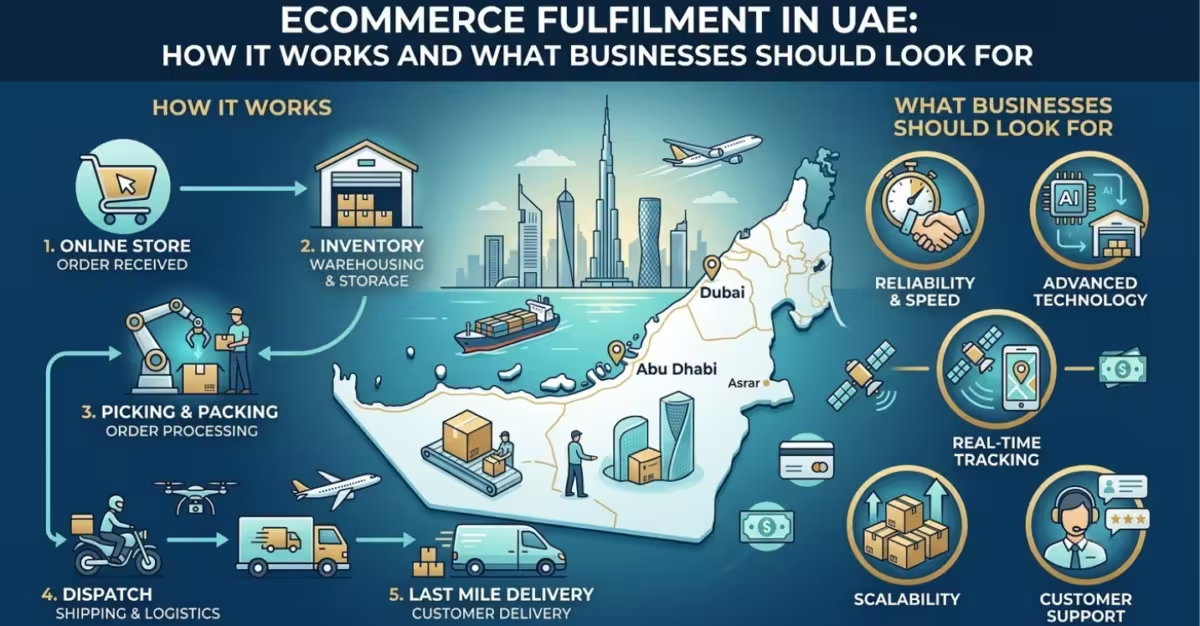
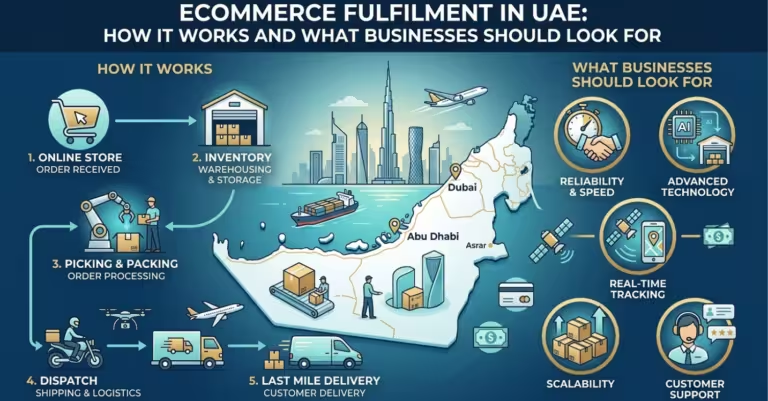
Infographic titled "Ecommerce Fulfilment in UAE: How It Works and What Businesses Should Look For." The left side shows a 5-step workflow: Online Store, Inventory, Picking & Packing, Dispatch, and Last Mile Delivery. The center features a map of the UAE with iconic cityscapes. The right side lists business requirements: Reliability & Speed, Advanced Technology, Real-Time Tracking, Scalability, and Customer Support.

eCommerce Fulfilment in UAE: How It Works and What Businesses Should Look For

When your order volumes grow faster than your ability to pick, pack, and ship them accurately, ecommerce fulfilment stops being a back-office function and starts being a growth constraint. Shoppers in Dubai, Abu Dhabi, and Sharjah now expect same-day or next-day delivery as standard. Brands that cannot meet those expectations can lose orders to competitors who can. 

This guide covers how ecommerce fulfilment works end-to-end in the UAE, what it costs, how to evaluate a fulfilment partner, and when to move from self-fulfilment to a 3PL.

What Is Ecommerce Fulfilment?

Ecommerce fulfilment is the end-to-end process of receiving inventory, storing it, processing orders, picking and packing individual items, delivering to customers, and managing returns. Every step connects. A failure at receiving can create inventory discrepancies that surface at picking. A weak last-mile partner erodes the customer experience regardless of how well the warehouse operates.

For UAE businesses, fulfilment has a specific operational context. There are no standardised postcodes across the seven emirates, high COD volumes create a cash-float management problem, and customer delivery expectations now default to same-day or next-day delivery. 

Consumers now expect same-day delivery and next-day delivery, real-time tracking, and seamless return processes. To meet these rising expectations, brands must ensure their backend logistics are not only efficient but also scalable.

How Ecommerce Fulfilment Works: The Six-Stage Process

Stage 1: Receiving inventory

Goods arrive at the fulfilment warehouse, are logged against the purchase order, inspected for damage, and allocated to storage locations. Accurate receiving prevents inventory discrepancies that only surface when a pick can’t be completed.

Stage 2: Inventory storage

Products are stored by SKU in a warehouse management system (WMS). In the UAE, storage is typically quoted per pallet per month or per cubic metre per month. The storage location affects pick time. Fast-moving SKUs should be positioned closest to packing stations.

Stage 3: Order processing

When a customer places an order on your Shopify or WooCommerce store, it flows through the integration to the fulfilment partner’s OMS (Order Management System). 

The critical question here is whether inventory counts update in real time as items are picked and returned, or on a batch schedule. Batch updates may create oversell risk during peak periods.

Stage 4: Picking and packing

The WMS directs a picker to the correct storage location, the item is retrieved, packed to the brand’s specification, and labelled for dispatch. Pick accuracy is the metric that directly drives your return rate from incorrect orders. Ask any potential fulfilment partner for their published pick accuracy rate.

Stage 5: Last-mile delivery

The packed parcel is handed to the courier for delivery to the customer. In the UAE, the customer’s actual brand experience is formed. The last-mile partner matters as much as the warehouse.

For same-day and next-day domestic delivery across the UAE with photo ePOD and real-time tracking, Jeebly Dash connects directly to the Jeebly Bizz fulfilment platform. Orders processed in the warehouse automatically trigger dispatch, with no manual handoff.

Stage 6: Returns management

A 3PL can receive, inspect, and make returned inventory resellable without using your own resources. The returns SLA, from the customer’s door back to restocked inventory, can directly affect how quickly you can resell returned stock and how much write-off you absorb on slow-moving returns.

Fulfilment Models: Which Fits Your UAE Business?

1) Self-fulfilment: You manage warehouse, picking, packing, and dispatch in-house. Works below 100–200 orders per month when the margin on each order justifies the overhead. Breaks down when fulfilment pulls your team away from growth activities.

2) 3PL (third-party logistics): Outsourcing warehousing, picking, packing, and dispatch to a specialist. You retain ownership of inventory and customer relationships; the 3PL manages the operational layer.

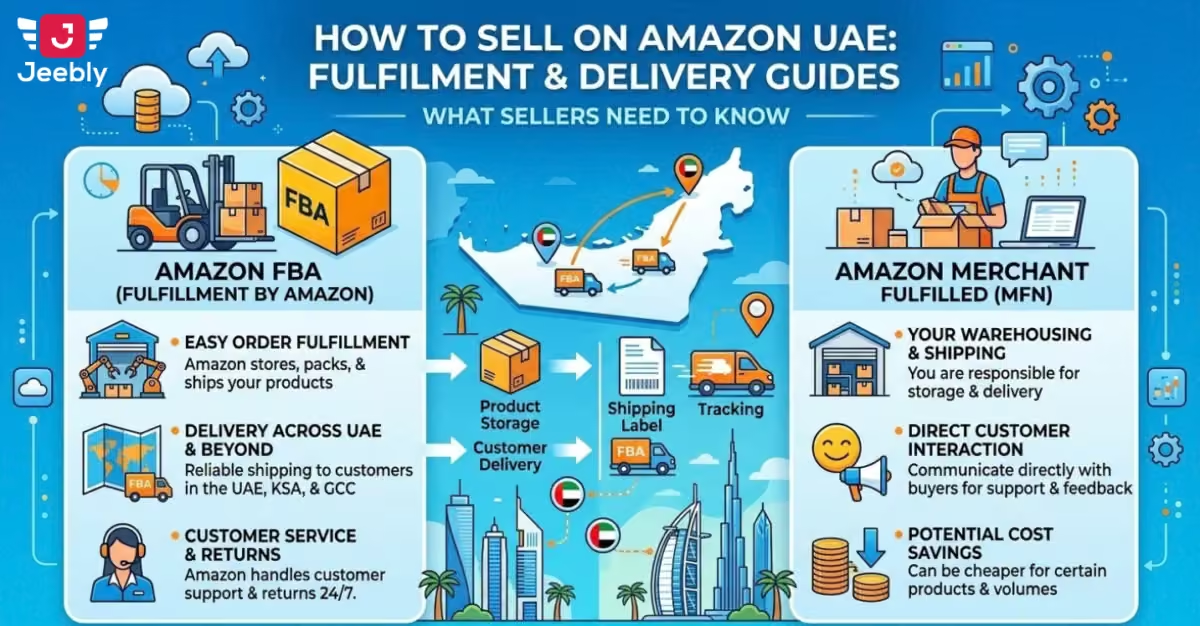
3) Marketplace fulfilment: Amazon.ae FBA or Noon Farfill manage storage, picking, and delivery for marketplace sales. Efficient for marketplace volume but limits brand control over packaging and customer experience.

4) Hybrid: Self-fulfil certain channels or SKUs; 3PL handles the rest. Useful for brands with mixed channel profiles like Shopify DTC plus marketplace where different fulfilment models suit different order types.

In the UAE, a significant share of returns originate from COD refusals rather than genuine product issues. COD Fraud in UAE eCommerce covers how to structurally reduce fake COD orders before they enter your returns pipeline.

Five Criteria That Separate Capable UAE Fulfilment Partners

1. Platform integration

Before signing with a 3PL, confirm: does the 3PL have a certified app in the Shopify App Store, or does the connection run through a third-party middleware layer? If middleware is involved, clarify who owns the connection when it breaks and what the error-handling process looks like.

A native Shopify or WooCommerce integration means orders sync automatically, inventory updates in real time, and tracking information flows back to the customer notification without manual intervention. A middleware-dependent connection introduces a failure point that becomes critical during peak periods.

Jeebly Bizz integrates directly with Shopify, WooCommerce, Magento, ChatFood, and Grubtech. Orders route automatically from your store to fulfilment and dispatch without manual uploads.

2. Pick accuracy rate

Pick accuracy determines your incorrect-order return rate. Ask any potential partner for their published pick accuracy figure against audited order volume.

3. Last-mile delivery

A good 3PL fulfilment partner provides automated order processing, real-time inventory tracking, and seamless integration with your sales channels. But the last-mile leg is often handed off to a separate courier

Ask specifically: which courier partners handle last-mile delivery, what their FDSS rate is in the UAE, and how NDR (Non-Delivery Report) events are managed?

Jeebly’s fulfilment through Jeebly Bizz connects directly to same-day and next-day delivery across the UAE. The warehouse-to-door chain is managed on a single platform, with 98% FDSS across 50,000+ daily deliveries.

4. COD management and remittance cycle

COD is not a last-mile-only concern. It sits inside your fulfilment operation. The 3PL coordinates COD collection through the courier and then remits it to you on a defined cycle. 

Confirm: weekly or fortnightly remittance? Is there a COD fee, and is it charged at the 3PL level or courier level? Can you see COD collection status in real time on the platform dashboard?

5. Scalability during UAE peak periods

Ramadan, White Friday, and Eid create order volume spikes that can be 3–5x normal daily volume within 24 hours. Promotions, influencer campaigns, and seasonal peaks can trigger sudden surges in orders. A 3PL partner gives brands the flexibility to scale operations without investing in warehouses, equipment, or extra staff. 

Ask for a specific answer on how the provider manages peak capacity: with owned staff or ad hoc recruits? What is the SLA commitment during peak versus standard periods?

How Jeebly Bizz Handles eCommerce Fulfilment

Jeebly Bizz is Jeebly’s end-to-end business logistics platform that covers warehousing, pick-and-pack, automated dispatch, COD management, and reverse logistics through a single, connected system.

The operational structure for a Jeebly Bizz fulfilment customer:

  • Inventory arrives at Jeebly’s warehouse and is logged, inspected, and allocated in the WMS
  • Orders placed on your Shopify store sync automatically.
  • Pick, pack, and dispatch happen within the same day for orders placed before the cut-off time
  • Last-mile delivery is handled through Jeebly Dash. Tracking updates push directly to the customer’s notification from the branded tracking page
  • COD is collected at the door and remitted weekly
  • Returns are processed in-house: inspected, graded, and restocked or flagged for disposal within the same platform

For UAE businesses importing inventory that then feeds into domestic fulfilment, Jeebly Haul handles the inbound freight leg (air, sea, or road) with in-house customs clearance and connects directly to the Jeebly Bizz fulfilment flow.

Talk to the Jeebly team about your fulfilment setup. A direct conversation about your order volume, SKU count, and COD rate will confirm within 20 minutes whether Jeebly Bizz fits your operation and what the full cost per order looks like.

Key Takeaways

  • Ecommerce fulfilment covers six stages: receiving, storage, order processing, picking and packing, last-mile delivery, and returns management.
  • The breakeven point for outsourcing fulfilment to a 3PL falls between 1,000 and 3,000 orders per month. Below that, hybrid or self-fulfilment is often more cost-effective.
  • UAE fulfilment costs include storage, pick-and-pack, last-mile delivery, COD fees, and returns processing.
  • 87% of shippers have increased their use of outsourced logistics, and 82% report that 3PL partnerships have improved the customer experience.
  • Platform integration depth is the most commonly overlooked evaluation criterion.

Frequently Asked Questions

Ecommerce fulfilment in the UAE is the end-to-end process of receiving inventory, storing it in a warehouse, picking and packing individual customer orders, delivering via a last-mile courier across the seven emirates, and managing returns. UAE-specific considerations include high COD volumes, the absence of standardised postcodes, and customer expectations of same-day or next-day delivery as standard.

The breakeven point for outsourcing fulfilment falls between 1,000 and 3,000 orders per month. UAE businesses with high COD rates often reach this point earlier due to the operational overhead of cash management. The clearest signals are rising fulfilment errors, peak periods that strain operations, or fulfilment taking longer than growth activities.

Fulfilment costs can range from AED 11 – 55+ per order. This cost is highly variable and depends on factors such as storage, picking & packing, delivery complexity and more. Always request a full cost-per-order breakdown from any provider.

At minimum: Shopify and WooCommerce. For marketplace sellers: Amazon.ae and Noon. Confirm whether the integration is native (certified app) or middleware-dependent. Inventory counts should update in real time as items are picked and returned. Batch updates create oversell risk during peak periods. Ask the provider to demonstrate the integration live before committing.

COD creates a cash float management challenge within fulfilment: the courier collects cash at delivery and remits to the business on a defined cycle. A weekly remittance cycle versus a fortnightly one can hold an additional week of revenue at any given time. Confirm the remittance timing, the COD fee structure, and whether the COD collection status is visible in real time on the platform dashboard before selecting a fulfilment partner.

Routes to insightful reads

Delivery SLA guide for UAE businesses showing service level agreements, delivery performance metrics, on-time delivery targets and logistics standards.
 Delivery SLA Guide for UAE Businesses: What to Expect and How to Set Standards

A clear delivery Service Level Agreement (SLA) sets the expectations for speed, reliability, and performance between businesses and their logistics partners. This guide explains what a delivery SLA should include, the key metrics to track, and how UAE businesses can set realistic standards to improve customer satisfaction and delivery performance.

Read More
Dangerous goods and restricted items that cannot be shipped by courier in the UAE, including hazardous materials, prohibited products and customs restrictions.
Dangerous Goods and Restricted Items: What You Cannot Ship by Courier in the UAE

Shipping prohibited or restricted items can lead to delays, fines, shipment rejection, or legal consequences. This guide explains which dangerous goods and restricted items cannot be shipped by courier in the UAE, the regulations businesses should know, and how to stay compliant with UAE customs and courier requirements.

Read More
How to manage eCommerce returns in the UAE with reverse logistics, return policies, refunds and inventory restocking
How to Manage eCommerce Returns in UAE: Strategy, Policy and Logistics

Efficient returns management is essential for every UAE eCommerce business. From creating a customer-friendly return policy to streamlining reverse logistics and processing refunds quickly, this guide explains how to reduce return costs, improve customer satisfaction, and turn returns into a competitive advantage.

Read More
A medium-sized Jeebly delivery and moving truck parked outside a warehouse with its back doors wide open and a hydraulic lift gate lowered to the ground. Inside the cargo area, brown cardboard boxes are stacked neatly. The side of the truck features a dark blue advertisement wrap with the Jeebly logo, displaying a hand holding a house model under the text "Always on the Move from parcels to homes" and a call to action to "Explore it all on Jeebly NoW".
Packers and Movers in Dubai: What to Look for and How to Choose

Relocating in Dubai doesn’t have to be stressful. Whether you are moving apartments in Dubai Marina or upgrading your office space, discover the essential factors to look for in a professional moving company—from licensing and insurance to transparent pricing—and learn exactly how to choose the right team for a seamless move.

Read More
Infographic titled "Ecommerce Fulfilment in UAE: How It Works and What Businesses Should Look For." The left side shows a 5-step workflow: Online Store, Inventory, Picking & Packing, Dispatch, and Last Mile Delivery. The center features a map of the UAE with iconic cityscapes. The right side lists business requirements: Reliability & Speed, Advanced Technology, Real-Time Tracking, Scalability, and Customer Support.
eCommerce Fulfilment in UAE: How It Works and What Businesses Should Look For

Master your logistics strategy in the Middle East. Discover how e-commerce fulfillment works in the UAE—from warehousing to last-mile delivery—and learn the top 5 features your business needs from a fulfillment partner to scale successfully.

Read More

    Powered by