





Jeebly | Logistics Solutions

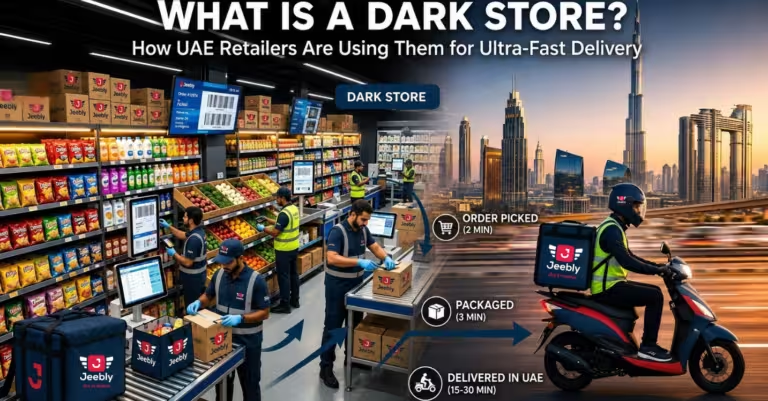
Dark store in the UAE showing retail inventory, order picking, packaging, and Jeebly last-mile delivery for ultra-fast fulfillment

What Is a Dark Store? How UAE Retailers Are Using Them for Ultra-Fast Delivery

A dark store is a fulfilment facility closed to the public, used exclusively to pick, pack, and dispatch online orders. No customers are walking in, no checkout lanes or retail displays. Just inventory, pickers, and a logistics operation built around getting orders out the door in minutes rather than hours.

In the UAE, dark stores are no longer experimental infrastructure. There are currently 211 dark stores mapped across the UAE, operated by Talabat Mart and Noon Minutes, spanning 10 cities. Noon alone scaled to 12 dark stores across Dubai and Sharjah, targeting zones with over 200 transactions per square kilometre per day. This is the operational foundation behind the 15-minute grocery promise that UAE consumers now treat as standard.

This guide explains what a dark store is, how it works, models operating in the UAE, what it takes to run one profitably, and how UAE e-commerce businesses can access dark store economics without building from scratch.

Key Takeaways

  • A dark store is a fulfilment facility closed to the public, dedicated entirely to picking and dispatching online orders.

  • Three models operate in the UAE: platform-operated dark stores (Talabat Mart, Noon Minutes), retailer-converted dark stores (Carrefour, Spinneys), and third-party micro-fulfilment (accessible to SMEs without capital investment).

  • The density threshold for a UAE dark store to be profitable is approximately 150–200 daily orders per location. Below that, last-mile economics don’t stack up.

  • By 2030, quick grocery is expected to account for 89% of online grocery in the UAE and KSA. Dark stores are the infrastructure that makes this possible.

What Is a Dark Store, Exactly?

A dark store is a retail or warehouse facility that operates exclusively for online order fulfilment. The “dark” refers to the absence of public foot traffic, such as shoppers, ambient lighting for the customer experience, or checkout counters. The space is configured entirely around operational efficiency, such as:

  • Shelving organised by pick frequency
  • Packing stations positioned to minimise walking distance 
  • Dispatch areas connected directly to courier routing systems

Dark stores emerged in the UK around 2009, when Sainsbury’s and Tesco converted underperforming retail locations into dedicated online fulfilment centres. What started as a supermarket efficiency play became the structural model for quick commerce globally.

How a Dark Store Works: The Order-to-Door Sequence

Step 1: Order placed. 

The customer places an order through an app. The dark store’s order management system receives it, confirms stock availability, and assigns it to the nearest available picker all within seconds.

Step 2: Smart slotting does the heavy lifting. 

High-velocity items (bottled water, snacks, cleaning products) sit closest to packing stations. This single discipline, called slotting optimisation, reduces picker travel time on every single order. 

Platforms deploy predictive inventory algorithms that pre-position high-velocity SKUs within 2–3 kilometres of dense residential clusters, thereby trimming delivery windows to 10 minutes.

Step 3: Picking. 

A picker follows a digital pick list along an optimised route through the facility. In high-volume dark stores, batch picking, i.e. grouping multiple orders into a single pick run, reduces total labour time without sacrificing accuracy.

Step 4: Packing and labelling. 

Items are packed, labelled, and sorted by delivery zone. Temperature-sensitive goods get appropriate packaging. The packed order is ready for handoff.

Step 5: Dispatch. 

The packed order connects to the courier routing platform in real time. A rider or driver collects it often within minutes of packing, and the customer receives tracking updates from the moment of dispatch.

The entire sequence, from order placement to rider departure, may typically run 3–8 minutes in an optimised UAE dark store.

Three Dark Store Models Operating in the UAE

Understanding the model matters before deciding whether to build, convert, or partner.

1. Platform-operated dark stores

App platforms operate the largest dark store networks in the UAE. Talabat Mart operates 30+ strategically located dark stores across all seven emirates, targeting sub-20-minute delivery guarantees. 

Noon Minutes runs its own dark store network, explicitly describing its compact “mini storeslocated near demand hubs to support 15-minute delivery. 

In 2025, ADNOC Distribution and Noon launched 15-minute delivery hubs from ADNOC service stations, turning fuel stations into logistics nodes.

These platforms own the customer relationship and the inventory. They’re not a fulfilment option for third-party brands. They’re vertically integrated competitors.

2. Retailer-converted dark stores

These are traditional retailers converting existing space into dark fulfilment operations. Carrefour UAE, Spinneys, and Choithrams all operate some form of this, using store backrooms, closed retail locations, or dedicated satellite sites to fulfil online orders faster than a central warehouse can.

This model suits retailers who already have urban real estate and established supply chains. The capital requirement is lower than that of building from scratch, but the operational transformation is significant. Retail layouts are not optimised for pick efficiency.

3. Third-party micro-fulfilment (the SME access point)

It is the most accessible model for UAE businesses without retail footprints or platform-scale capital. Third-party logistics providers operate shared micro-fulfilment centres that multiple brands can access without having to build their own infrastructure.

This is where the economics become accessible. Rather than committing to a 100,000+ sq ft dark store lease and the technology stack to run it, an SME or mid-market e-commerce brand can plug into an existing micro-fulfilment network, access urban proximity delivery, and pay on a per-order or per-storage basis.

For UAE e-commerce businesses and social sellers wanting same-day delivery capability without a dark store build, eCommerce Fulfilment in the UAE: What Businesses Should Look For covers the full range of fulfilment options and the cost per order for each.

What Makes a UAE Dark Store Profitable

Platform operators are prioritising density thresholds of 150–200 daily orders per dark store. Below that threshold, the fixed costs of the facility, staff, and inventory don’t spread across enough orders to generate margin. Above it, the economics may compound rapidly.

What can drive dark store profitability in the UAE:
Factor What it requires
Location density Within 2–3 km of residential clusters with 200+ daily orders per km²
SKU curation 1,000–5,000 fast-moving products, not a full supermarket range
Order frequency Subscription models (Talabat Pro, Noon One) that drive repeat orders
Technology Real-time OMS connected to courier routing, no manual handoff
Last-mile reliability 95%+ first-attempt delivery in the coverage zone
Inventory accuracy Daily cycle counts, zero tolerance for phantom stock
What kills the economics:

Overexpansion before density can kill the economics. A dark store in a zone with 80 daily orders will burn cash indefinitely. The facility’s fixed costs are never covered. Urban density in Dubai and Abu Dhabi makes last-mile economics workable in a way that sprawling or low-density cities do not. This is why UAE dark stores succeed where other markets struggle.

A high delivery radius without enough riders is another factor. If a dark store covers too large a geographic area, average delivery time increases, costs rise, and the speed promise breaks down.

Additionally, dark stores run lean SKU counts precisely because every SKU that doesn’t turn fast enough occupies space that could hold a fast-mover. Getting the assortment wrong is expensive.

Should Your Business Use a Dark Store?

Dark stores are right for a specific business profile. Here’s a framework for deciding:

It makes sense if:

  • You sell fast-moving consumer goods like grocery, pharmacy, personal care, convenience
  • Your customers are in dense urban zones (Dubai, Abu Dhabi, Sharjah)
  • You’re receiving more than 50–100 same-day delivery orders daily in a concentrated area
  • You want to offer sub-hour delivery without the cost of a full last-mile delivery fleet


It doesn’t make sense if:

  • Your products are slow-moving, large, fragile, or temperature-controlled beyond standard refrigeration
  • Your customer base is geographically spread across multiple emirates with different demand profiles
  • Your daily order volume is below the density threshold to justify the infrastructure cost

For most UAE SMEs and mid-market e-commerce brands, the most cost-effective path to dark store economics is third-party micro-fulfilment. This accesses urban proximity and fast dispatch through an existing network rather than building one.

For businesses evaluating whether their current fulfilment setup is causing delivery delays that are costing them cart abandonment, How to Reduce Cart Abandonment Costs covers how delivery speed and transparency directly affect checkout conversion and more.

How Jeebly Supports Dark Store and Ultra-Fast Fulfilment

For UAE businesses wanting same-day delivery capabilities without the capital investment of building a dark store from scratch, Jeebly Bizz provides the fulfilment infrastructure: warehousing across Dubai and the UAE, pick-and-pack, automated dispatch, and real-time inventory management, all connected directly to Shopify, WooCommerce, and Magento.

Jeebly Dash handles the last-mile leg with express delivery within 60–120 minutes across Dubai, next-day across all seven emirates, with 98% FDSS across 50,000+ daily deliveries. Jeebly’s platform automatically connects order completion to rider dispatch.

For businesses with inbound freight needs, Jeebly Haul covers road and air freight, as well as cross-border GCC routes, with in-house customs clearance.

Talk to the Jeebly team about your current daily order volume, delivery zone, and product category. A direct conversation will confirm whether third-party micro-fulfilment through Jeebly Bizz provides the dark-store economics your business needs at the scale it operates today.

Conclusion

A dark store is the infrastructure behind every 15-minute grocery delivery and every same-hour order in the UAE. With 211 Talabat Mart and Noon Minutes dark stores mapped across the UAE, alongside a growing number of retailer-converted dark fulfilment locations, and a quick commerce market set to reach $12.97 billion by 2029, this is no longer an experimental format.

It’s the structural model for urban retail fulfilment in the region. 

For large platforms, the dark store network is built and scaling. For UAE e-commerce businesses and retailers that want the same delivery economics without the capital outlay, third-party micro-fulfilment networks provide access to urban proximity and fast dispatch on a per-order basis. 

For same-day fulfilment connected to 98% FDSS last-mile delivery, Jeebly Bizz and Jeebly Dash cover both legs. Get in touch to discuss your fulfilment requirements.

Related Articles:

Frequently Asked Questions

A dark store is a warehouse or converted retail space used exclusively to fulfil online orders. It’s closed to the public and optimised entirely for picking and dispatching individual orders as fast as possible. In the UAE, dark stores power the 15–30 minute grocery delivery services from Talabat Mart and Noon Minutes.

A warehouse stores goods for extended periods before bulk distribution to retailers or other businesses. A dark store holds a smaller, faster-moving inventory specifically to fulfil individual consumer orders within 15–60 minutes. Dark stores are urban, compact, and optimised for speed. Warehouses are typically larger, suburban, and optimised for bulk storage and distribution.

Talabat Mart operates 30+ dark stores across all seven UAE emirates for sub-20-minute delivery. Noon Minutes operates 12 dark stores across Dubai and Sharjah. Together, these two platforms account for the 211 dark stores currently mapped across the UAE. Carrefour, Spinneys and Choithrams also operate dark fulfilment equivalents from existing retail locations, but these fall under the retailer-converted model.

Fast-moving consumer goods with high daily turnover: groceries, personal care, household essentials, pharmacy items, and convenience goods. Dark stores stock 1,000–5,000 curated SKUs, not a full product range. Slow-moving, bulky, or highly perishable goods with complex cold-chain requirements are typically not suitable for dark-store stocking.

Yes, through third-party micro-fulfilment. Logistics providers operate shared urban fulfilment centres that multiple brands can access on a per-order or per-storage basis, without committing to a dark store lease or building a technology stack from scratch. This is the accessible entry point for UAE SMEs wanting same-day delivery capability.

Routes to insightful reads

Dark store in the UAE showing retail inventory, order picking, packaging, and Jeebly last-mile delivery for ultra-fast fulfillment
What Is a Dark Store? How UAE Retailers Are Using Them for Ultra-Fast Delivery

A dark store is a retail facility designed exclusively for online order fulfilment, with products organised for fast picking, packing, and dispatch rather than in-store customer shopping. In the UAE, dark stores are helping retailers and e-commerce businesses shorten delivery times by placing inventory closer to customers and streamlining the fulfilment process. This guide explains how dark stores work, their benefits, key challenges, and how they support ultra-fast delivery in the UAE.

Read More
DDP shipping infographic explaining seller responsibilities, customs clearance, duties, final delivery, and benefits for UAE importers
What Is DDP Shipping? What “Delivered Duty Paid” Means for UAE Importers and Exporters

DDP (Delivered Duty Paid) is an Incoterm that places most shipping, customs, duty, and import tax responsibilities on the seller. For UAE importers and exporters, understanding how DDP works can help businesses estimate landed costs, manage customs requirements, and avoid unexpected charges at delivery. This guide explains what DDP shipping means, who pays the costs, how it compares with DAP and FOB, and what UAE businesses should consider before choosing DDP.

Read More
Delivery note document showing shipment details, proof of delivery, tracking, verification and UAE logistics compliance
What Is a Delivery Note and Why Does Every UAE Shipment Need One?

A delivery note is a key document in the UAE logistics process, providing a clear record of what was shipped, who sent it, and who received it. From proof of delivery and shipment tracking to order verification, customs compliance, and dispute resolution, a properly prepared delivery note helps businesses maintain accurate records and protect every shipment. This guide explains what a delivery note is, what it should include, and why it is essential for businesses operating across the UAE.

Read More
Illustration showing strategies to reduce cart abandonment through transparent shipping costs, fast delivery, local fulfilment, and clear returns policies for UAE eCommerce businesses.
How to Reduce Cart Abandonment Caused by Delivery Costs and Uncertainty

Delivery costs and uncertainty are among the biggest reasons shoppers abandon their carts before completing a purchase. This guide explores practical strategies to reduce cart abandonment, including transparent shipping fees, accurate delivery estimates, flexible shipping options, local fulfilment, and hassle-free returns, helping UAE eCommerce businesses improve conversions and build customer trust.

Read More
J&T Express vs Jeebly comparison graphic featuring delivery apps, e-commerce products, and UAE logistics services against the Dubai skyline.
J&T Express vs Jeebly: Which Courier Is Better for UAE eCommerce Businesses?

J&T Express and Jeebly both support eCommerce deliveries, but they cater to different business needs. This comparison explores their delivery networks, fulfilment capabilities, shipping speed, technology, pricing flexibility, and merchant services to help UAE businesses choose the courier partner that best supports their growth and customer experience.

Read More

    Powered by