Jeebly | Logistics Solutions

Categories
blogs

COD Fraud in UAE eCommerce: How to Detect, Prevent and Reduce Losses

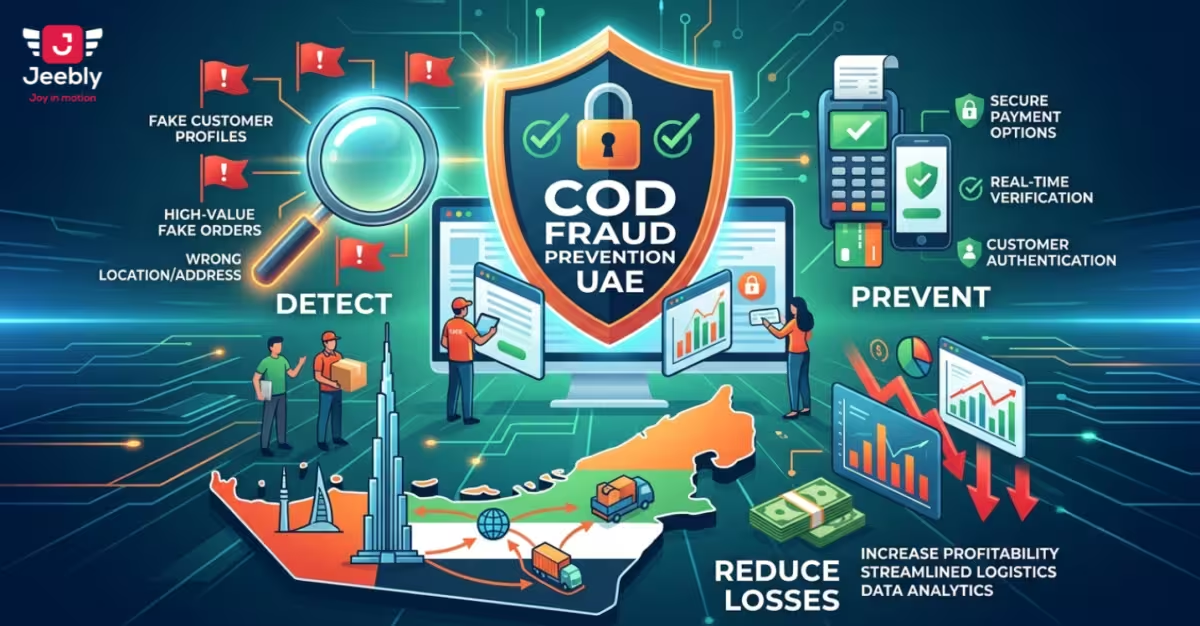
COD fraud prevention in the UAE with secure payment verification, order authentication and logistics risk management

COD Fraud in UAE eCommerce: How to Detect, Prevent and Reduce Losses

Cash on delivery is not going away in the UAE. It still accounts for nearly 35% of transactions across the Middle East and Africa.

The problem is that COD also creates a specific category of fraud risk that digital payment orders don’t carry: low-intent buyers who never planned to accept the parcel, external scammers exploiting the system’s offline nature, and a cascade of operational costs that appear as return-to-origin (RTO) losses on your courier statement.

This guide covers types of COD fraud that UAE businesses face. Know how to detect each, and the operational and technology measures that reduce losses without removing COD from your checkout.

Two Types of COD Fraud: External Scams vs Merchant Losses

1) External COD scams 

This targets your customers. Fraudsters may obtain customer details through leaked databases, phishing, public information, or other illegal sources. They dispatch parcels through legitimate logistics companies and specify a cash amount to be collected on delivery. 

When the courier arrives, the recipient assumes a family member or colleague placed the order and pays without verifying. By the time they open the parcel and discover the contents are worthless, it is difficult to reverse the transaction. This type of fraud damages your customers and, if your brand is being impersonated, directly damages your reputation.

2) Fake-order fraud & high-RTO abuse 

This targets your operations. Fraudulent COD orders placed using fake phone numbers and addresses result in guaranteed RTOs. The courier attempts delivery to a non-existent recipient and returns. 

Beyond outright fake orders, serial refusers, and customers who genuinely placed an order but later choose to refuse delivery, all incur similar operational costs. The distinction matters because the solutions differ.

Understanding which type is driving your losses determines which interventions to prioritise.

How External COD Scams Work

The mechanics follow a consistent pattern. 

Scammers obtain real addresses and phone numbers, dispatch parcels through legitimate logistics companies, and have the courier collect cash on their behalf. The delivery agent follows standard instructions with no knowledge of the contents. Once payment is made, the courier processes the funds through its standard settlement cycle and transfers the amount to the sender.

Unlike prepaid transactions, COD removes many digital payment protections such as automated payment authentication and chargeback processes, shifting more fraud risk into delivery operations.

Common external COD scam types currently active across the region:

  • The unsolicited parcel scam: A fraudster sends a package to a real address using leaked personal data. The recipient assumes a family member ordered it and pays. The parcel contains low-value or worthless items.

  • Brand impersonation: Scammers build convincing replicas of real UAE e-commerce stores, collect orders at scale, and dispatch cheap substitutes via third-party couriers. Your brand takes the fallout from customer service.

  • Fake courier impersonation: Some fraudsters pose as delivery companies, sending packages and demanding cash payments. Packages may include a QR code that, when scanned, links to a phishing site that collects additional personal data.

  • The advanced call variation: In some variations, fraudsters send advance messages or make phone calls claiming a shipment is on its way, creating a sense of legitimacy before the parcel arrives.

One protection against brand impersonation is ensuring your customers can independently verify delivery through a branded tracking page from your actual logistics partner. 

Aramex vs Jeebly: Which Is Better for UAE Last-Mile Delivery? compares how the two providers handle tracking visibility, ePOD, and customer communication. These capabilities help customers distinguish your legitimate delivery from a scam.

How Fake-Order Fraud Costs Your Business

Every failed COD delivery incurs double shipping costs: you paid for the forward attempt, and you pay for the return. The cash flow impact is separate and often underestimated. For brands with 25–30% COD RTO rates, the cash trapped in transit at any point can equal 3–5 weeks of revenue, creating a liquidity problem that grows with scale. 

When combined with Jeebly’s structured COD remittance cycle, this gap can be materially compressed compared to providers that remit fortnightly or monthly. But the RTO rate itself needs to be addressed at the source.

The total cost per RTO order is higher than most business models. A refused COD delivery carries forward shipping cost, return shipping cost, repackaging and restocking time, the COD amount that was never collected, and the customer acquisition cost spent to generate an order that never converted.

Detecting Fake Orders Before Dispatch

The most cost-effective COD fraud intervention happens before the parcel leaves your warehouse. A risk-scoring approach works better than applying the same verification to every order. 

Assess each COD order based on new-customer status, order value, address deliverability, phone-number validity, and historical RTO patterns for the same contact details. Low-risk orders proceed without friction. High-risk orders get additional verification steps.

Signals that flag a COD order as high-risk:

  • Phone number doesn’t match the delivery emirate’s prefix pattern
  • Address is incomplete, contains only a building name with no flat or office number, or matches a known high-RTO zone
  • Multiple orders from the same device or IP with different contact details
  • First-time customer placing a high-value COD order with no order history
  • Order placed outside normal hours with an unusual address format


OTP verification is one of the most effective pre-dispatch controls for reducing fake COD orders. OTP confirmation filters out fake or uncertain orders, ensuring only genuinely interested customers proceed with COD purchases.

Address validation at checkout catches genuine customers who entered incomplete or incorrect addresses. AI-powered address validation can reduce preventable delivery failures by identifying incomplete addresses, invalid locations, and delivery-risk patterns before dispatch.

The RTO lock is the most operationally precise tool for repeat offenders. RTO lock blocks customers with a history of COD refusals from accessing the COD payment option; they can still purchase with prepaid methods.

These pre-dispatch interventions are only as effective as the fulfilment partner executing them. 

Whether your operation suits a carrier or a courier model affects which fraud prevention tools are actually available to you. Carrier vs Courier: What’s the Difference and Which Do You Need in the UAE? clarifies the distinction.

Reducing Losses After Dispatch: NDR Management

An NDR (Non-Delivery Report) is a recoverable event. An RTO is the loss. The intervention window between the two is the time when significant losses can be prevented.

When a first delivery attempt fails, most businesses leave the outcome to the courier. Automated NDR management, such as WhatsApp or SMS outreach to the customer immediately after a failed attempt to confirm a new delivery window, reduces NDR-to-RTO conversion. 

The message content matters: 

  • Include the exact COD amount 
  • The rescheduled delivery window 
  • A simple one-tap confirmation. 

Customers who confirm reschedule convert at significantly higher rates than those who receive a generic “we’ll try again” notification.

What to Look for in a Logistics Partner for COD Operations

Your courier partner is operationally central to the risk of COD fraud. The specific capabilities to confirm before committing:

  • Digital proof of delivery (ePOD) is standard. Every drop-off should be confirmed with a timestamped photo and, for high-value orders, OTP or signature capture. This creates an evidentiary record for every delivery and eliminates “I never received it” disputes without a trail to resolve them.

  • NDR workflow transparency. Ask specifically: when a delivery attempt fails, what happens next? How quickly is the NDR flagged? Is the customer contacted automatically, or does re-attempt coordination require your team’s involvement? A courier with automated NDR management recovers more failed deliveries without adding to your ops overhead.

  • Weekly COD remittance. The remittance cycle directly affects your working capital. Jeebly supports structured COD settlement workflows, with settlement schedules depending on client arrangements. Confirm the cycle with any provider before signing.

  • 98% First Day Delivery Success (FDSS). Jeebly’s published FDSS across 50,000+ daily deliveries. A high first-attempt success rate is the most direct structural reduction in your RTO exposure. It limits the number of situations where an NDR even needs to be managed.

For a broader comparison of UAE courier providers on these criteria, Best Courier Service in UAE: 2026 Comparison Guide covers FDSS, remittance cycles, and NDR handling across the major operators.

How Jeebly Handles COD Operations

Jeebly Dash builds fraud-resistant COD delivery into the standard service rather than offering it as an optional add-on. Photo ePOD is captured at every drop-off and is timestamped and geotagged. The delivery record is immediately accessible to the business through the platform, which means disputes are resolved on the basis of evidence rather than through verbal disputes.

For businesses managing high COD volumes, Jeebly Bizz integrates order management, dispatch, and delivery tracking into a single platform. COD remittance runs weekly, reducing the cash-in-transit gap that high-RTO operations typically carry.

For businesses currently experiencing elevated RTO on COD orders or concerned about brand impersonation affecting their customers, talk to the Jeebly team. A direct conversation will identify quickly where the losses are coming from and which operational changes address them.

Frequently Asked Questions

COD fraud covers two distinct problems: external scammers who exploit cash-on-delivery to send fake parcels and collect cash from unsuspecting customers, and fake-order fraud, where low-intent buyers or bots place orders with no intention of accepting delivery, creating return-to-origin losses for the merchant. Both are active in the UAE market and require different operational responses.

 COD transactions bypass digital payment safeguards like chargeback mechanisms, authentication protocols, and automated fraud detection systems. Once cash is handed over at the door, the transaction is effectively irreversible.

OTP verification at checkout is the highest-ROI single intervention. It eliminates fake orders placed with wrong or non-existent phone numbers. Address validation at checkout is the complementary layer that handles address-error RTOs.

RTO lock restricts customers with a pattern of COD refusals from accessing COD at checkout. They can still purchase using prepaid options. Many businesses introduce COD restrictions when customer behaviour shows repeated refusal patterns.

Publish your official courier partners on your website and customer communications. Instruct customers never to pay cash for a parcel they didn’t order. Build branded tracking pages so customers can verify delivery status independently, without relying on messages from unknown numbers. And ensure your logistics partner captures ePOD at every delivery.

COD losses usually include failed delivery costs, return shipping, handling costs, lost customer acquisition spend, and delayed cash flow.

Removing COD can reduce failed deliveries but may also reduce conversions from customers who prefer paying after receiving their order. Many businesses improve profitability by managing COD risk instead of eliminating it.

Routes to insightful reads

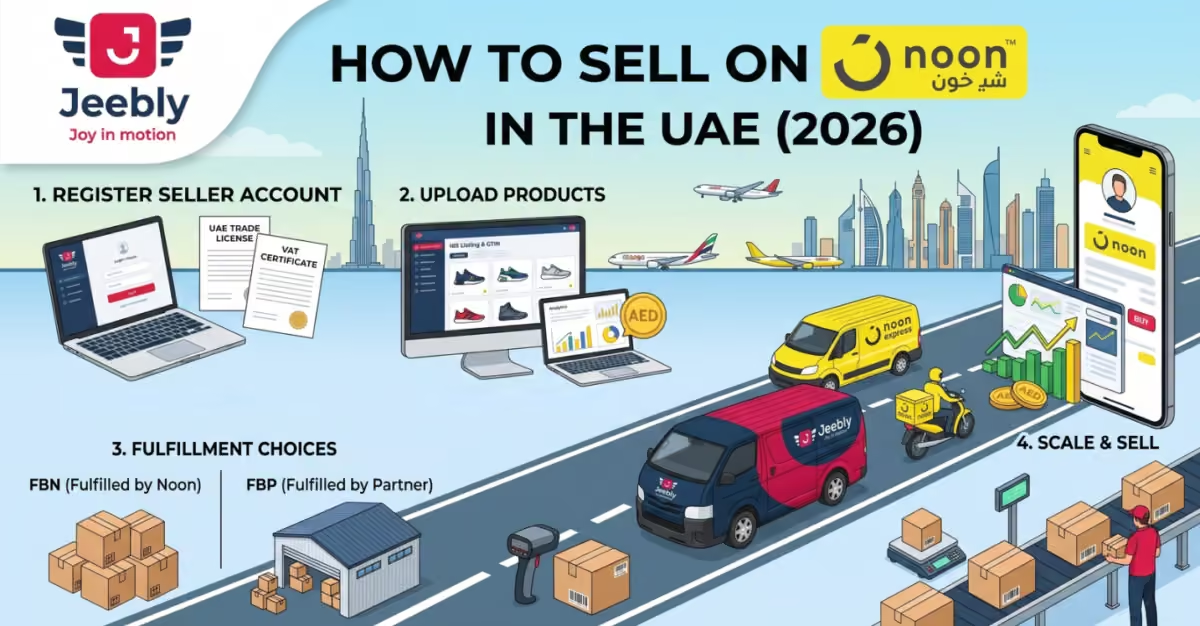
Infographic guide for selling on Noon UAE in 2026, showing seller registration steps, product cataloguing, FBN and FBP logistics options, a Jeebly delivery van, and the Dubai skyline.
How to Sell on Noon in the UAE in 2026

Expanding your e-commerce footprint across the Middle East starts with Noon—the UAE’s leading homegrown digital marketplace. Whether you are a local startup or an established retail brand, succeeding in 2026 requires understanding trade license compliance, optimizing catalog listings, and selecting the right fulfillment model between FBN and FBP. Explore our complete guide to selling on Noon UAE, covering onboarding essentials, commission structures, and how partnering with reliable last-mile delivery providers like Jeebly helps you scale faster.

Read More
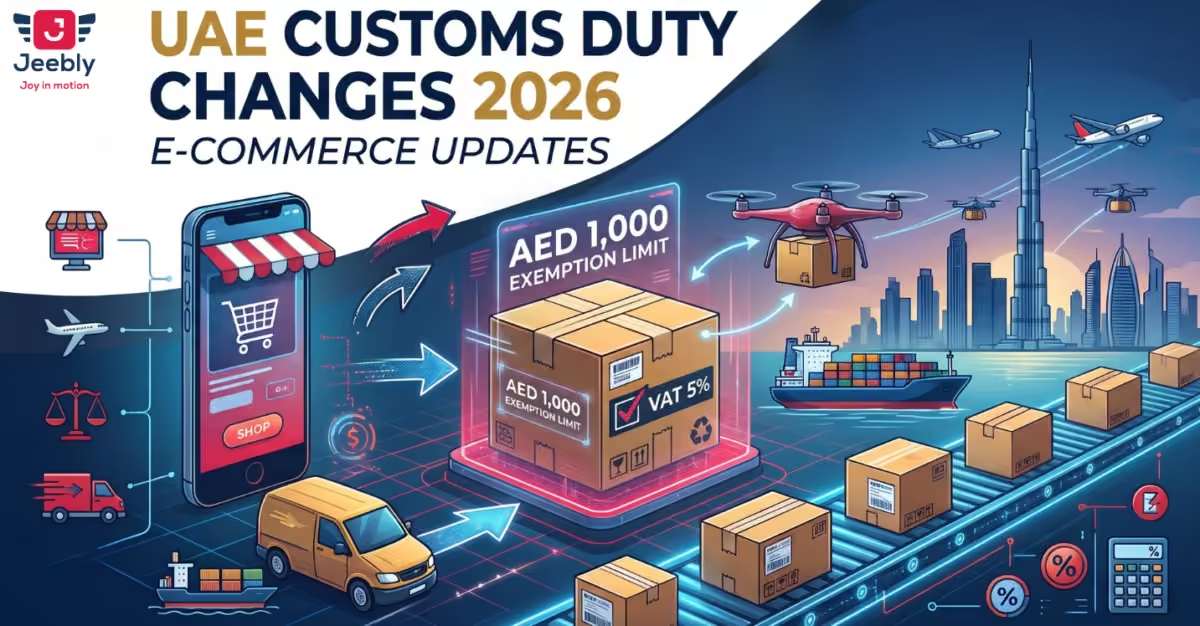
Infographic banner featuring the Jeebly logo, highlighting 2026 UAE customs duty updates for e-commerce with a Dubai skyline, delivery vans, cargo ships, conveyor belt parcels, and the AED 1,000 exemption limit.
UAE Customs Duty Changes for E-Commerce (2026)

With rapid expansions across the GCC digital commerce landscape, the UAE has implemented updated customs duty policies and clearance procedures for cross-border e-commerce shipments in 2026. From managing the AED 1,000 personal import exemption and 5% VAT rules to navigating commercial parcel compliance and streamlined last-mile delivery, discover how these regulatory shifts impact online retailers, logistics providers, and shoppers across the Emirates.

Read More
A Jeebly courier driver carrying a parcel while wiping sweat on a sunny Dubai street, with a second driver drinking water by a delivery van, illustrating UAE heat logistics and temperature-sensitive shipping challenges.
UAE Summer Delivery: Heat Effects on Couriers, Packaging and Timelines

Operating last-mile delivery in the UAE requires navigating challenging weather and heat conditions year-round. From protecting courier health to using insulated packaging and adjusting transit schedules, discover how top logistics providers keep temperature-sensitive parcels safe and on time across Dubai and the GCC.

Read More
Jeebly delivery van and driver holding a branded parcel against the Dubai skyline, featuring a digital route optimisation map interface.
What Is Route Optimisation in Last-Mile Delivery?

Last-mile delivery is the most critical—and expensive—leg of the supply chain. Discover how route optimisation leverages real-time data, traffic analytics, and smart scheduling to cut operational costs, beat urban gridlock, and ensure on-time deliveries across the UAE.

Read More
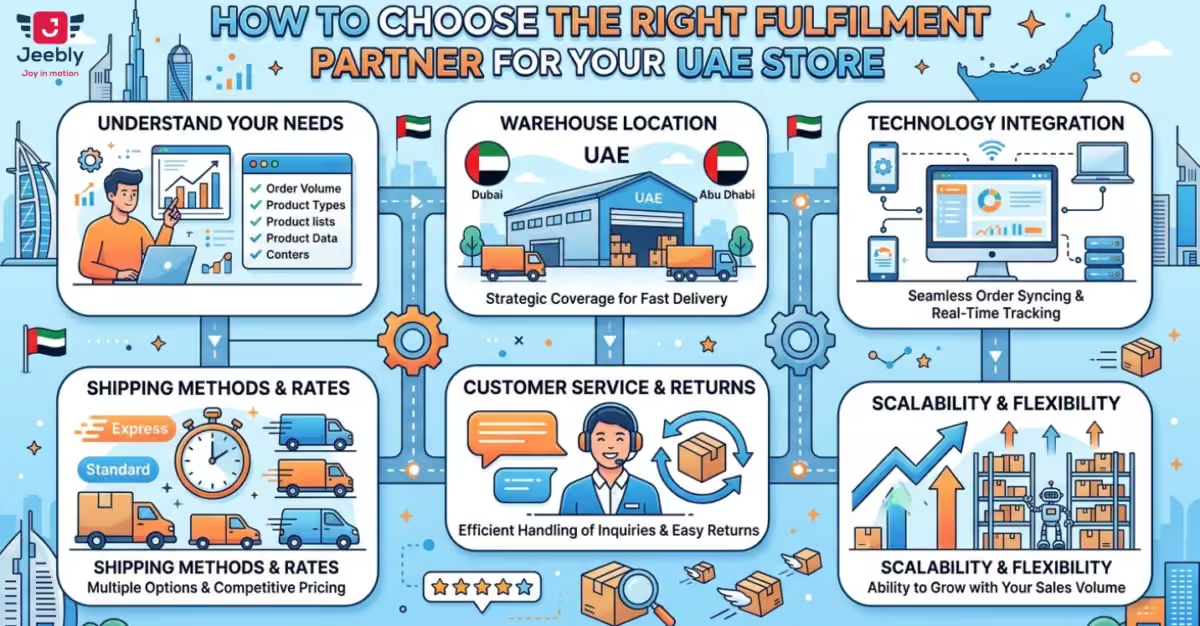
An infographic detailing six steps to choose the right fulfillment partner for a UAE store: understand needs, warehouse location (Dubai/Abu Dhabi), technology integration, shipping methods, customer service, and scalability, set against a UAE city skyline
How to Choose the Right Fulfilment Partner for Your UAE Store

Selecting the right fulfillment partner can make or break your e-commerce growth in the UAE. From strategic warehouse locations in Dubai and Abu Dhabi to seamless tech integration, learn the six critical factors every online store must evaluate to lower costs, ensure same-day delivery, and scale efficiently across the GCC.

Read More
Categories
blogs

Careem Express vs Jeebly: Which Delivery Partner Is Best for UAE Businesses?

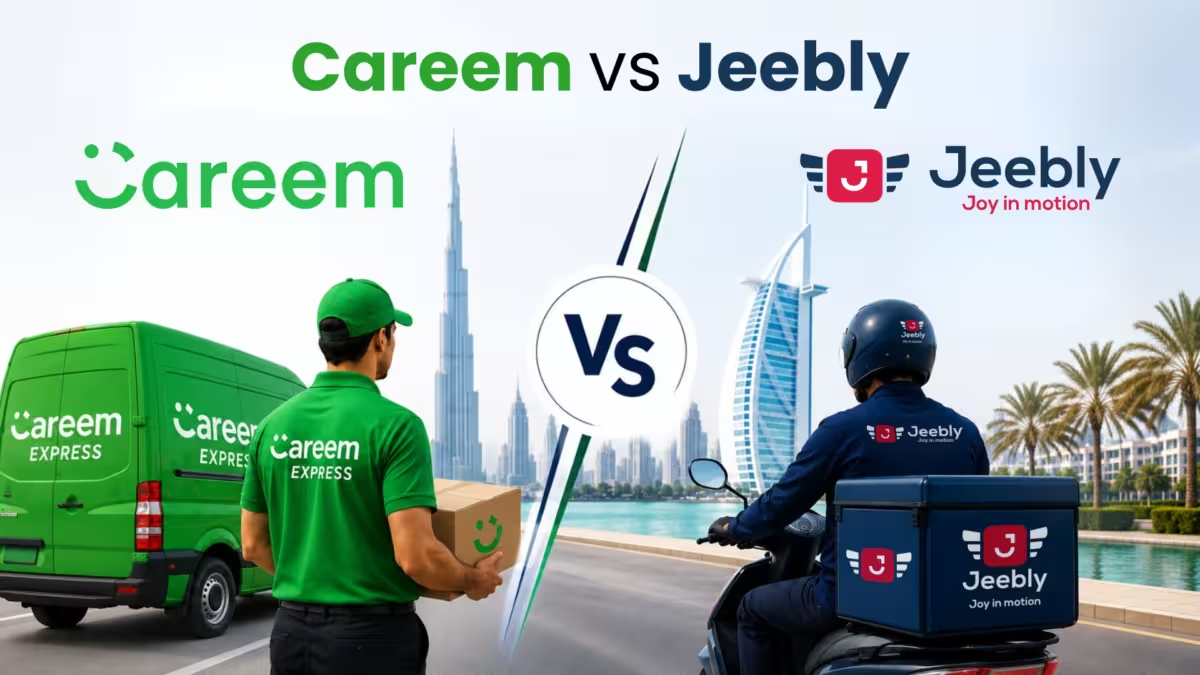
Careem Express vs Jeebly comparison graphic featuring delivery vehicles and riders in Dubai, highlighting UAE last-mile delivery services for businesses.

Careem Express vs Jeebly: Which Delivery Partner Is Best for UAE Businesses?

Speed is a legitimate advantage. If Careem Express can put a parcel in your customer’s hands in 30 minutes, that is genuinely useful for certain types of businesses.

But speed is one dimension of logistics, not the whole picture. The more relevant question for most UAE businesses is: can this provider handle everything my operations actually require, day in and day out, as my order volumes grow?

That is where the Careem Express vs Jeebly comparison gets interesting. These two providers are built on fundamentally different operating models, not just different delivery windows. With the UAE’s e-commerce market projected to reach USD 13.8 billion by 2029, the logistics infrastructure you choose now will either support that growth or limit it.

This article breaks down both providers across delivery speed, UAE coverage, pricing, COD, technology, and full-stack logistics capability, so you can choose based on what your business actually needs.

What Careem Express and Jeebly Actually Do

Understanding what each provider was built for is the starting point for any honest comparison.

Careem Express

Careem Express is the B2B delivery arm of Careem, the UAE-headquartered super app that also operates ride-hailing, food delivery, grocery, and payments. Careem is an Uber subsidiary operating across 13 countries in MENA.

The Express product leverages the same driver network and AI-powered mapping technology used for passenger rides to offer on-demand, hyperlocal parcel delivery for businesses.

Key facts about Careem Express:

  • Delivers in 30-40 minutes for eligible orders in covered zones
  • Operates in 11 cities across UAE, KSA, and Qatar
  • Services: on-demand last-mile, Box-on-Bike delivery, same-day courier, COD collection, real-time tracking API
  • Flash Delivery API: lets e-commerce stores add a “Deliver Now” button at checkout with live GPS tracking for the customer
  • Integrations available with Shopify, WooCommerce, and Magento
  • 24/7 customer support and dedicated account managers during business hours

What Careem Express does not offer:

  • No standalone warehousing or fulfilment service
  • No structured cross-border or GCC freight capability
  • No dedicated reverse logistics or returns service line
  • No premium or white-glove delivery product
  • No structured next-day delivery across all seven UAE emirates


Careem Express is an on-demand speed layer. It excels at getting time-critical, city-level parcels to customers fast. It is not designed to be a business’s complete logistics infrastructure.

Jeebly

Jeebly was founded in Dubai in 2016, started as a hyperlocal delivery platform, and has since grown into a full-service logistics business purpose-built for UAE e-commerce. The operational scale today:

  • 50,000-plus daily deliveries
  • 4,000-plus active fleet vehicles
  • 12M-plus customers served
  • 98% First-Day Delivery Success (FDSS) rate across all seven emirates

Jeebly’s product suite includes Jeebly Dash for domestic express, same-day, and next-day delivery, Jeebly Bizz for business logistics and fulfilment, Jeebly Haul for freight above 20 kg, and Jeebly Plus for premium white-glove delivery.

Where Careem Express is an on-demand speed layer, Jeebly is a full logistics infrastructure built around the complete operational lifecycle of a UAE online business.

Careem Express vs Jeebly: Side-by-Side Comparison

The sections below unpack what those differences actually mean in practice, because a table can show you the gaps but it cannot tell you which ones will hurt your business first.

Capability Careem Express Jeebly
Delivery Model On-demand, hyperlocal Scheduled, same-day, next-day, express
Express Speed 30-40 min (covered zones) 60-120 min (Dubai, bike delivery)
Same-Day Delivery Yes (covered cities) Yes (Dubai, 11 AM cut-off)
Next-Day Delivery Not a structured UAE-wide offering Yes, all 7 emirates, 2 PM cut-off
UAE Coverage Select cities All 7 emirates
GCC Cross-Border Limited Yes, Jeebly Dash International
Freight / Bulk Cargo No Yes, Jeebly Haul (above 20 kg)
Warehousing / Fulfilment No Yes, including micro-fulfilment centres
Reverse Logistics No dedicated service Yes, structured service line
White-Glove / Premium No Yes, Jeebly Plus
COD Support Yes Yes, weekly bank remittances
Shopify Integration Yes Yes
WooCommerce Integration Yes Yes
Self-Service Portal Careem Express portal and app Jeebly Now portal and One App
Real-Time Tracking Yes, live GPS (Flash Delivery API) Yes, centralised merchant dashboard
Dedicated Account Management Yes (business hours) Yes, KAMs via WhatsApp, email, direct calls
Q-Commerce / Dark Stores Via dark store partners Yes, 13+ live micro-fulfilment centres
Primary Fit Hyperlocal, on-demand, urban delivery Full-stack UAE e-commerce logistics

Careem Express wins on raw delivery speed within covered zones. Jeebly covers the full operational lifecycle of a UAE online merchant, from the first sale through to warehousing, returns, and cross-border growth

Delivery Speed and Coverage

Careem Express: Speed and Coverage

Careem Express’s 30-40 minute delivery window is one of the fastest available in the UAE for eligible orders. That speed is real, and for specific use cases, it is a genuine competitive advantage.

The important context:

  • Coverage is strongest in Dubai, with operations also in select UAE cities, KSA, and Qatar
  • The on-demand model means orders are dispatched as they arrive, with no scheduled delivery windows
  • Structured next-day delivery across all seven UAE emirates is not a defined product offering
  • Per-delivery costs are higher than traditional next-day couriers, which affects margin economics on bulk or lower-value shipments
  • Best suited to urgent, sub-5 kg, city-level parcels where speed is the primary requirement

Jeebly Dash: Speed and Coverage

Jeebly Dash runs three delivery tiers, giving merchants the ability to match delivery cost to product urgency:

  • Express (60-120 minutes): Dubai only, bike delivery, weight and dimension limits apply
  • Same-Day: Dubai only, order cut-off at 11 AM
  • Next-Day: All seven UAE emirates (Abu Dhabi, Dubai, Sharjah, Ajman, Umm Al Quwain, Ras Al Khaimah, Fujairah), cut-off at 2 PM.


The 98% FDSS rate applies across the full operation. Underpinning it is data-driven fleet forecasting and AI-optimised routing built around UAE delivery conditions, including the absence of a standardised postcode system, free-zone access requirements, and peak season volume surges. Jeebly makes three delivery attempts before marking an order as Return to Origin (RTO).

The coverage point that matters most for growing UAE businesses: as soon as your customers are outside Dubai, you need a provider with structured UAE-wide SLAs. Jeebly’s next-day network covers every emirate, including Ras Al Khaimah, Fujairah, and Umm Al Quwain, where consistent SLA delivery is not guaranteed by every provider in the market.

For a breakdown of how delivery timelines work across different UAE service types, read: How Long Does Delivery Take in the UAE?

Pricing: What to Expect From Each Provider

Neither Careem Express nor Jeebly publishes a universal public rate card. Pricing scales with volume, service level, and account type.

Careem Express pricing:

  • Higher per-delivery cost than traditional next-day couriers (confirmed by independent market research)
  • Optimised for urgency, not bulk volume economics
  • Pricing available via the Careem Express portal or sales team
  • Surge pricing during peak periods can affect per-delivery margins


Jeebly Dash published base rate:

  • AED 17.31 per parcel up to 5 kg (next-day and scheduled deliveries)
  • AED 2/kg above 5 kg, up to 20 kg maximum per order
  • No minimum order requirement and no long-term contract to start
  • Volume-based commercial terms available for brands shipping 50-plus orders daily.


Beyond base rates, three line items that regularly catch businesses off-guard:

  • COD remittance cycle: Delayed remittance ties up working capital. Always confirm the exact cadence before signing.
  • Failed delivery re-attempt fees: Understand how many re-attempts are included, what each costs, and who covers return shipping on customer-fault failures.
  • Return shipping costs: Get explicit terms on returns before any agreement is finalised.


For a realistic picture of what delivery costs look like for UAE small businesses: Cost of Shipping for a Small Business in the UAE.

Technology, Tracking, and Integrations

Careem Express Technology

Careem Express’s technology is built on the same infrastructure that powers its ride-hailing and consumer delivery services. For B2B delivery, that translates to:

  • Flash Delivery API: enables a “Deliver Now” checkout button with live GPS rider tracking for end customers
  • Real-time tracking through the Careem app and Express portal
  • Native integrations with Shopify, WooCommerce, and Magento
  • AI-powered routing using Careem’s advanced mapping and dispatching system
  • 24/7 customer support with dedicated account managers during business hours.


The technology is strong for on-demand dispatch and live consumer-facing tracking. It is built for speed and simplicity, not for managing complex merchant operations at scale.

Jeebly Technology

Jeebly’s platform is built merchant-first. Everything on the dashboard is oriented toward operational visibility and control for a business managing daily order flows:

  • Centralised dashboard: live order status, COD reconciliation, delivery performance analytics, and exception alerts in one view
  • Connected Order Management System (OMS) and Warehouse Management System (WMS)
  • Native integrations: Shopify, WooCommerce, Magento, ChatFood, and Grubtech
  • Jeebly One App: sign up in under five minutes, no minimum order commitment
  • Dedicated Key Account Managers accessible via WhatsApp, email, and direct calls, not just a support ticket system
  • Data-driven fleet forecasting that scales capacity ahead of peak season demand, not in reaction to it.


For operations teams managing 100-plus daily orders, knowing about a delivery exception before your customer does is operationally valuable in ways a basic tracking link cannot cover. Explore how Jeebly’s technology platform works.

To understand how AI-powered logistics is reshaping operations across the UAE: How AI Is Changing Logistics in the UAE.

COD, Returns, and the Details That Determine Operational Fit

These factors are easy to overlook during a vendor evaluation and consistently the source of operational friction afterward.

Cash on Delivery

Both Careem Express and Jeebly support COD, which remains a significant share of e-commerce transactions across the UAE. Research from 2026 puts COD at approximately 40% of UAE e-commerce orders, making remittance speed and accuracy a material business issue.

Jeebly remits COD collections to your bank account on a weekly cycle. That predictable cadence is consistently cited by Jeebly merchant partners as a working capital advantage, particularly for brands where COD makes up a large percentage of daily revenue.

Careem Express also supports COD. Remittance terms are structured at the account level and should be confirmed directly before committing.

For either provider: confirm the exact remittance cadence and reporting format in writing, not just that COD is available. Read: How Jeebly Ensures Secure COD Delivery in UAE.

Reverse Logistics

This is one of the clearest operational gaps in the Careem Express vs Jeebly comparison.

Careem Express does not offer a dedicated reverse logistics or returns management service.

Jeebly runs a structured reverse logistics service line covering returns management and product recalls, fully integrated with the same platform handling forward deliveries. Digital proof of pickup is captured at collection.

For any UAE e-commerce brand managing regular returns, exchanges, or product recalls, the absence of a structured returns service is a meaningful operational gap that would require sourcing a separate provider.

Still managing returns manually? Read: How to Manage Returns for Your UAE Online Store.

Peak Season Scalability

The UAE’s logistics market gets stress-tested every year during Ramadan, White Friday, and the December shopping period.

Careem Express scales through its on-demand driver network. During peak periods, surge pricing can increase per-delivery costs, and driver availability in covered zones may vary with demand.

Jeebly uses data-driven fleet forecasting to scale capacity ahead of peak demand, not in response to it. When order volumes for clients like Carrefour and Amazon double overnight, the fleet and rider deployment are already in position.

Read: How Jeebly Helps SMEs Scale During Peak Shopping Seasons.

Where Jeebly Goes Further

Careem Express fills a genuine gap in the UAE logistics market. For time-critical, hyperlocal, on-demand delivery within covered cities, particularly for fashion, beauty, gifts, pharmacy, or food items, its speed is hard to match.

The comparison shifts the moment your operational requirements expand beyond city-level on-demand delivery.

Jeebly’s product suite is designed to grow with a UAE e-commerce business at every stage:

  • Jeebly Dash covers express, same-day, next-day, and scheduled domestic deliveries across all seven emirates.
  • Jeebly Bizz handles warehousing, fulfilment, cross-border logistics, and customs clearance on a single platform. For businesses exploring what outsourced logistics really means: What Is a 3PL?
  • Jeebly Haul moves bulk shipments above 20 kg by road, air, and sea, domestically and across GCC and MENA.
  • Jeebly Plus delivers white-glove, chauffeur-led experiences for B2B clients with high-value or luxury products, where the delivery moment carries its own brand weight.


Trusted by Mumzworld.com, Instashop, DOD UAE, and BFL Group, Jeebly carries AED 500M-plus in combined revenue and AED 1.5B-plus in shipments delivered.

For guidance on evaluating any logistics partner in the UAE: What to Look for in a Reliable Logistics Company.


How to Choose: Four Questions to Work Through

There is no universally correct answer. But working through these four questions honestly will save you from a provider switch six months down the line when operational friction has already cost you customers.

1. Is speed your only requirement, or do you also need coverage, fulfilment, and returns?
If you need a fast, on-demand layer for urgent city-level deliveries, Careem Express is a legitimate option. If you need a complete logistics infrastructure covering the full UAE, returns, warehousing, and room to scale, Jeebly is the right fit.

2. Do you sell to customers across all seven UAE emirates?
Careem Express operates in select UAE cities and does not offer a structured next-day SLA across all seven emirates. Jeebly’s next-day network covers every emirate, including the northern emirates, consistently and at scale.

3. Will you need warehousing, fulfilment, or freight now or in the next 12 months?
Careem Express has no warehousing or fulfilment offering. Adding those capabilities would require separate provider relationships. Jeebly covers them all on one platform, which avoids the complexity and coordination cost of managing multiple logistics vendors.

4. What percentage of your orders are COD, and how does remittance timing affect your cash flow?
Jeebly’s weekly remittance cycle is a known, predictable input you can plan around. Confirm Careem Express’s remittance terms before committing, and get them in writing.

Conclusion

Careem Express is a strong choice for a specific use case: ultra-fast, on-demand delivery within covered UAE cities for time-critical, lightweight shipments. If that is the core of your logistics requirement, it delivers on its promise.

For UAE e-commerce businesses that need consistent delivery across all seven emirates, transparent pricing, structured COD management, returns handling, and a platform that scales from 50 orders a day to peak-season surges, Jeebly is the more complete and operationally aligned partner.

If you are still comparing options, see how Jeebly stacks up against other providers in the market: Quiqup vs Jeebly, iMile vs Jeebly, EMX vs Jeebly, and Porter vs Jeebly.

At Jeebly, we do not just move parcels. We move businesses forward. If you are ready to build a logistics setup that works as hard as you do, talk to the Jeebly team and get a solution built around your specific volumes, routes, and growth plans.

Or, if you are ready to get started now, sign up with Jeebly and start shipping today.

Frequently Asked Questions

Careem Express is the B2B delivery service offered by Careem, the UAE-based super app. It uses Careem’s existing driver and mapping infrastructure to offer on-demand, hyperlocal parcel delivery for businesses, primarily within Dubai and select other UAE cities. Businesses can access it via the Careem Express portal or integrate it into their e-commerce store using the Flash Delivery API for checkout-level delivery booking with live GPS tracking.

Careem Express is an on-demand, hyperlocal delivery service focused on speed within covered cities, primarily Dubai. It does not offer warehousing, fulfilment, structured cross-border shipping, or reverse logistics. Jeebly is a full-stack logistics platform purpose-built for UAE e-commerce, covering same-day and next-day delivery across all seven emirates, COD management, fulfilment, freight, returns, and a merchant-first technology platform.

Careem Express operates in select UAE cities and does not offer a structured next-day delivery SLA across all seven UAE emirates. For brands that sell to customers in Abu Dhabi, Sharjah, Ras Al Khaimah, Fujairah, or the northern emirates consistently, Jeebly’s UAE-wide next-day network is the more reliable fit.

For ultra-fast, on-demand deliveries within Dubai, Careem Express offers one of the fastest options available at 30-40 minutes for eligible orders. For structured e-commerce operations with same-day and next-day delivery, COD management, returns handling, and platform integrations, Jeebly Dash provides a more complete operational fit. The right choice depends on whether speed or full-stack logistics capability is the priority.

Yes, Careem Express supports COD. Before committing, confirm the remittance cycle and reporting format directly with Careem Express. Jeebly also supports COD and remits collections to your bank account on a weekly cycle, providing a predictable working capital timeline.

For on-demand, point-to-point delivery, Careem Express is faster at 30-40 minutes versus Jeebly Dash’s 60-120 minute express tier in Dubai. For structured, consistent, UAE-wide delivery at scale, Jeebly’s infrastructure, 98% FDSS rate, and all-seven-emirates coverage make it the stronger operational choice for e-commerce businesses.

Careem Express does not offer a dedicated reverse logistics or returns management service. If returns are a regular part of your operations, you would need a separate provider for that capability. Jeebly runs a fully integrated reverse logistics service line covering returns management, product recalls, and digital proof of pickup within the same platform handling your forward deliveries.

Jeebly is built specifically for this. The no-minimum, pay-as-you-go model means you are not committed to volume thresholds before you have reached them. As your business grows, Jeebly’s product suite, from Dash to Bizz to Haul, scales with you without requiring a platform migration or new provider relationships.

Routes to insightful reads

Infographic guide for selling on Noon UAE in 2026, showing seller registration steps, product cataloguing, FBN and FBP logistics options, a Jeebly delivery van, and the Dubai skyline.
How to Sell on Noon in the UAE in 2026

Expanding your e-commerce footprint across the Middle East starts with Noon—the UAE’s leading homegrown digital marketplace. Whether you are a local startup or an established retail brand, succeeding in 2026 requires understanding trade license compliance, optimizing catalog listings, and selecting the right fulfillment model between FBN and FBP. Explore our complete guide to selling on Noon UAE, covering onboarding essentials, commission structures, and how partnering with reliable last-mile delivery providers like Jeebly helps you scale faster.

Read More
Infographic banner featuring the Jeebly logo, highlighting 2026 UAE customs duty updates for e-commerce with a Dubai skyline, delivery vans, cargo ships, conveyor belt parcels, and the AED 1,000 exemption limit.
UAE Customs Duty Changes for E-Commerce (2026)

With rapid expansions across the GCC digital commerce landscape, the UAE has implemented updated customs duty policies and clearance procedures for cross-border e-commerce shipments in 2026. From managing the AED 1,000 personal import exemption and 5% VAT rules to navigating commercial parcel compliance and streamlined last-mile delivery, discover how these regulatory shifts impact online retailers, logistics providers, and shoppers across the Emirates.

Read More
A Jeebly courier driver carrying a parcel while wiping sweat on a sunny Dubai street, with a second driver drinking water by a delivery van, illustrating UAE heat logistics and temperature-sensitive shipping challenges.
UAE Summer Delivery: Heat Effects on Couriers, Packaging and Timelines

Operating last-mile delivery in the UAE requires navigating challenging weather and heat conditions year-round. From protecting courier health to using insulated packaging and adjusting transit schedules, discover how top logistics providers keep temperature-sensitive parcels safe and on time across Dubai and the GCC.

Read More
Jeebly delivery van and driver holding a branded parcel against the Dubai skyline, featuring a digital route optimisation map interface.
What Is Route Optimisation in Last-Mile Delivery?

Last-mile delivery is the most critical—and expensive—leg of the supply chain. Discover how route optimisation leverages real-time data, traffic analytics, and smart scheduling to cut operational costs, beat urban gridlock, and ensure on-time deliveries across the UAE.

Read More
An infographic detailing six steps to choose the right fulfillment partner for a UAE store: understand needs, warehouse location (Dubai/Abu Dhabi), technology integration, shipping methods, customer service, and scalability, set against a UAE city skyline
How to Choose the Right Fulfilment Partner for Your UAE Store

Selecting the right fulfillment partner can make or break your e-commerce growth in the UAE. From strategic warehouse locations in Dubai and Abu Dhabi to seamless tech integration, learn the six critical factors every online store must evaluate to lower costs, ensure same-day delivery, and scale efficiently across the GCC.

Read More
Categories
blogs

Porter vs Jeebly: Understanding the Difference and Choosing the Right Delivery Partner in Dubai

Porter vs Jeebly: Understanding the Difference and Choosing the Right Delivery Partner in Dubai

Porter vs Jeebly: Understanding the Difference and Choosing the Right Delivery Partner in Dubai

Picking a delivery partner in Dubai sounds straightforward until the bills don’t match the quotes, the tracking goes quiet, or your business outgrows what the platform can handle. The Porter vs Jeebly comparison comes up constantly among online sellers, social commerce brands, and growing SMEs in the UAE, and the answer is not the same for everyone.

This article breaks down both platforms in terms of pricing, technology, coverage, and support so you know exactly what you are choosing and why.

Why Delivery Infrastructure Is a Business Decision?

The UAE’s last-mile delivery market generated USD 3,217.2 million in revenue in 2023 and is projected to reach USD 4,852.2 million by 2030. That trajectory means competition for the customer’s doorstep is intensifying. 

More delivery providers entering the market also means greater quality variation, and the cost of a wrong choice is not just an operational inconvenience. Failed deliveries erode customer trust, surprise charges eat into margins, and opaque platforms leave you managing problems rather than driving growth.

Porter and Jeebly both operate in Dubai’s on-demand delivery space, but their design intent, infrastructure, and ideal use cases differ significantly. 

Understanding those differences is the actual decision.

Porter vs Jeebly: Feature-by-Feature Comparison

Before we get into specifics, Porter and Jeebly are built for very different delivery use cases. The comparison below breaks down how those differences show up across key operational factors:

Feature Porter Jeebly
Delivery Speed Options On-demand (variable) Express (60–120 min), Same-Day, Next-Day, Scheduled
UAE-Wide Coverage Primarily city-based/on-demand coverage Next-Day available across all 7 emirates
Vehicle Types 2-wheeler, car, 1-ton pickup, 3-ton Canter Dedicated fleet: bikes and vans. Also have MPV, cars and trucks.
E-commerce Integrations Limited Shopify, WooCommerce, custom API
Order Dashboard Basic app Centralised OMS with real-time visibility
Delivery Tracking Basic Real-time updates via app and dashboard
Cash on Delivery (COD) Available Available, weekly bank remittance
Minimum Order Volume None None
Business Support App-based Dedicated account managers
Warehousing / Fulfilment None Yes, around 13 MFCs live in Dubai
Reverse Logistics Not structured Structured, digital proof of pickup
B2B Scalability Limited Built for it

Porter handles one-off, on-demand moving jobs well. Jeebly is built for businesses that need reliable, repeatable delivery at scale with the data visibility and tech infrastructure to match.

Pricing Transparency: Where the Two Diverge Most

Porter publishes starting prices for vehicles such as cars, 1-ton pickups, and 3-ton Canter, but the final cost may vary by vehicle, distance, and booking details.

Jeebly’s pricing for Jeebly Dash is fixed: AED 17.31 for packages up to 5 kg, AED 2/kg above that, up to a 20 kg maximum per order. The number on the screen is the number you pay.

COD is handled on a clear cycle. Jeebly collects on your behalf and remits to your bank account weekly. For social sellers on Instagram, TikTok, or WhatsApp who lack formal invoicing systems, that predictability is operationally significant.

Technology and Tracking: Visibility After the Parcel Leaves Your Hands

Porter’s app handles booking. Post-dispatch tracking visibility has been flagged as inconsistent in user feedback from early 2026. This is a genuine gap for any business managing multiple daily orders.

Jeebly’s platform is built differently.

* The centralised dashboard gives businesses real-time status across their entire active order volume. 
* Delivery updates are sent via the app, WhatsApp, and email, and client-specific support structures ensure escalations reach someone who knows your account. 
* For businesses running their store on Shopify or WooCommerce, direct API integration pulls orders straight into the system.

If you are building your fulfilment infrastructure as you grow, it is worth reading how AI is changing logistics operations in the UAE. The gap between tech-enabled and manual logistics operations is widening faster than most businesses realise.

Geographic Coverage: Same-Day and Next-Day Delivery Across the UAE

Coverage operates differently by speed tier:

Porter: Operates primarily within Dubai for on-demand moves. UAE-wide delivery is not a structured offering.

Jeebly:

* Express (60–120 min): Dubai only, bikes only, weight and dimension limits apply
* Same-Day: Dubai only, orders cut off at 11 AM
* Next-Day: All seven emirates (Abu Dhabi, Dubai, Sharjah, Ajman, Umm Al Quwain, Ras Al Khaimah, Fujairah) with a 2 PM cut-off

During peak seasons, the coverage has to hold under volume pressure. Jeebly’s fleet forecasting scales delivery capacity ahead of demand spikes rather than reacting to them. 
For more on managing peak-season logistics without operational strain, read how Jeebly helps SMEs scale during peak shopping seasons.

How to Choose: Match Your Delivery Reality to the Right Option

The right choice depends less on features in isolation and more on how your delivery operations actually run day to day. Here is how to map your use case to the right platform:

* One-off large item to move across Dubai: Porter’s flexible vehicle booking handles this type of ad hoc job without commitment.
* Social seller or micro-brand, getting started: Jeebly Dash has no minimum orders, COD collection, and real-time tracking from your first delivery.
* E-commerce store on Shopify or WooCommerce: Jeebly’s API integrations and centralised dashboard eliminate manual work as volume grows. See how Jeebly Dash supports domestic delivery.
* UAE-wide customer base: Jeebly’s Next-Day network covers all seven emirates. Porter’s reach does not consistently extend there.
* Predictable logistics costs are non-negotiable: Jeebly’s fixed-rate model removes the pricing variability that Porter users have repeatedly flagged.
* Complex logistics (warehousing, returns, cross-border): Jeebly Bizz handles this end-to-end. Porter has no equivalent.
* Scaling for peak seasons: Jeebly’s fleet forecasting scales capacity ahead of demand, not after it. Read more on building a green logistics setup in the UAE.

What Jeebly Brings That Porter Simply Does Not

Jeebly has spread joy from door to door by operating at the speed of smart and pioneered hyperlocal logistics in the country before building out the full product suite.

The product line scales with business complexity. 

* Jeebly Dash covers express, same-day, next-day, and scheduled domestic deliveries. 
* Jeebly Bizz handles cross-border operations, customs clearance, and full e-commerce infrastructure. 
* Jeebly Haul takes freight and bulk shipments above 20 kg. 
* Jeebly Plus delivers white-glove, premium handling for B2B clients with high-value or luxury shipments.

As your order volume grows from 20 deliveries a day to 200, then to 2,000, Jeebly’s product architecture scales with you.

For a closer look at how reliable logistics directly shapes customer experience, the guide to choosing a reliable logistics company in the UAE covers the key evaluation criteria in detail.

Conclusion

Porter is a functional choice for ad hoc, one-off moves within Dubai. Jeebly is built for e-commerce businesses and growing brands that need consistent delivery speed, transparent pricing, UAE-wide coverage, and a tech platform that scales with them. 
At Jeebly, we help businesses grow and have the infrastructure in place for every stage of your business. Ready to build a delivery setup that works as hard as you do? Talk to the Jeebly team, and we’ll help you find the right fit.

Frequently Asked Questions

Pricing depends on parcel size, speed, and volume. Jeebly Dash charges a fixed AED 17.31 for packages up to 5 kg with no minimum order requirement. For higher volumes, dedicated account support through Jeebly Bizz often delivers better overall cost efficiency.

Jeebly is structured specifically around this audience. There is no minimum order, COD collection with weekly remittance, real-time tracking, and dedicated account support. Its social seller offering covers Instagram, TikTok, and WhatsApp-based brands from the very first order.

Porter is designed for on-demand, one-off deliveries and performs well for that use case. However, pricing and delivery experience can vary by vehicle type, distance, and booking conditions, making it less predictable for businesses managing consistent or high-volume deliveries.

Yes. Jeebly handles COD collection and remits to your bank account on a weekly cycle. It is a structured, predictable process designed for high-COD e-commerce in the UAE.

Porter handles on-demand, one-off transport using motorcycles, cars, and mini-trucks suited to ad hoc moves and single large items. It does not offer structured e-commerce fulfilment, warehousing, UAE-wide next-day delivery, or reverse logistics.

Routes to insightful reads

Infographic guide for selling on Noon UAE in 2026, showing seller registration steps, product cataloguing, FBN and FBP logistics options, a Jeebly delivery van, and the Dubai skyline.
How to Sell on Noon in the UAE in 2026

Expanding your e-commerce footprint across the Middle East starts with Noon—the UAE’s leading homegrown digital marketplace. Whether you are a local startup or an established retail brand, succeeding in 2026 requires understanding trade license compliance, optimizing catalog listings, and selecting the right fulfillment model between FBN and FBP. Explore our complete guide to selling on Noon UAE, covering onboarding essentials, commission structures, and how partnering with reliable last-mile delivery providers like Jeebly helps you scale faster.

Read More
Infographic banner featuring the Jeebly logo, highlighting 2026 UAE customs duty updates for e-commerce with a Dubai skyline, delivery vans, cargo ships, conveyor belt parcels, and the AED 1,000 exemption limit.
UAE Customs Duty Changes for E-Commerce (2026)

With rapid expansions across the GCC digital commerce landscape, the UAE has implemented updated customs duty policies and clearance procedures for cross-border e-commerce shipments in 2026. From managing the AED 1,000 personal import exemption and 5% VAT rules to navigating commercial parcel compliance and streamlined last-mile delivery, discover how these regulatory shifts impact online retailers, logistics providers, and shoppers across the Emirates.

Read More
A Jeebly courier driver carrying a parcel while wiping sweat on a sunny Dubai street, with a second driver drinking water by a delivery van, illustrating UAE heat logistics and temperature-sensitive shipping challenges.
UAE Summer Delivery: Heat Effects on Couriers, Packaging and Timelines

Operating last-mile delivery in the UAE requires navigating challenging weather and heat conditions year-round. From protecting courier health to using insulated packaging and adjusting transit schedules, discover how top logistics providers keep temperature-sensitive parcels safe and on time across Dubai and the GCC.

Read More
Jeebly delivery van and driver holding a branded parcel against the Dubai skyline, featuring a digital route optimisation map interface.
What Is Route Optimisation in Last-Mile Delivery?

Last-mile delivery is the most critical—and expensive—leg of the supply chain. Discover how route optimisation leverages real-time data, traffic analytics, and smart scheduling to cut operational costs, beat urban gridlock, and ensure on-time deliveries across the UAE.

Read More
An infographic detailing six steps to choose the right fulfillment partner for a UAE store: understand needs, warehouse location (Dubai/Abu Dhabi), technology integration, shipping methods, customer service, and scalability, set against a UAE city skyline
How to Choose the Right Fulfilment Partner for Your UAE Store

Selecting the right fulfillment partner can make or break your e-commerce growth in the UAE. From strategic warehouse locations in Dubai and Abu Dhabi to seamless tech integration, learn the six critical factors every online store must evaluate to lower costs, ensure same-day delivery, and scale efficiently across the GCC.

Read More
Categories
blogs

Green Logistics in the UAE: What It Is and Why It Matters

Green Logistics: Why Sustainability Is Becoming the UAE's Next Big Supply Chain Priority

Green Logistics: Why Sustainability Is Becoming the UAE's Next Big Supply Chain Priority

Every parcel that moves from a warehouse to a doorstep carries more than a product. It carries a carbon cost. Freight transportation alone accounts for approximately 8% of global greenhouse gas emissions, rising to 11% when warehousing and ports are included. 

For UAE businesses, that figure is a commercial and regulatory reality. Green logistics is the practice of reducing the environmental impact of moving goods through a supply chain, from sourcing and warehousing to last-mile delivery and returns. 

This article covers what it entails, why it matters specifically for UAE e-commerce businesses, the real return on investment it delivers, and how to approach implementation without overhauling everything at once.

What Is Green Logistics and Why Does It Matter for UAE Businesses?

Green logistics is a systems-wide commitment that covers transportation choices, packaging design, warehouse energy use, supplier selection, and return handling to make each link in the supply chain cleaner and more accountable.

In the UAE, the regulatory signal is clear. 

* The country’s Net Zero by 2050 Strategic Initiative is already shaping procurement expectations, free zone standards, and investor-grade due diligence for businesses operating in the region. 
* Companies building green logistics capabilities now are not getting ahead of a trend. They are preparing for a tightening compliance baseline.

Want to understand how AI-driven routing and smarter delivery networks are already reducing emissions per delivery? Read: How AI Is Changing Logistics in the UAE.

The Five Pillars of Sustainable Supply Chain Management

Sustainable logistics operates across five interconnected areas. Progress in one amplifies results in the others, which is why businesses that approach it as a checklist rarely see the compounding returns that a systems-level commitment delivers.


1) Route and fleet optimisation
This is where technology pays off most visibly. AI-powered routing tools analyse traffic density, delivery windows, and order clustering to reduce fuel consumption per delivery. Fewer kilometres driven mean lower fuel costs and lower emissions.

2) Sustainable packaging 
It reduces material waste, cuts shipping weight, and signals environmental accountability at the moment customers open their order. Right-sized packaging matched to product dimensions eliminates void fill, reduces per-shipment weight, and cuts costs without requiring major infrastructure investment.
Jeebly already walks this talk in their LinkedIn post. All deliveries are wrapped in D2W biodegradable plastic, which is 100% recyclable, naturally degradable, and leaves no toxic residue.

3) Green warehousing 
This includes energy-efficient lighting, solar installations, smart climate controls, and warehouse management systems that reduce energy draw and operational errors. Fewer errors mean fewer returns. Fewer returns mean fewer re-delivery runs.

4) Reverse logistics and circular economy integration 
This turn returns from a cost centre into a value-recovery operation. Businesses that design their return processes around refurbishment, resale, and recycling reduce both waste output and the emissions associated with producing replacement units. 
Curious about how reverse logistics fits into a broader fulfilment strategy? See Jeebly Bizz end-to-end business logistics built for visibility and control.

5) Supplier and partner collaboration 
This is where the highest-leverage impact lives, and the most common blind spot sits. Scope 3 emissions, those generated across your supplier and logistics partner network, can account for up to 75% of a company’s total carbon footprint. 

Choosing partners that provide operational data, routing transparency, and delivery efficiency is not a sustainability add-on. It is the decision that makes your green credentials hold up to scrutiny. 

The Business Case: Real ROI of Green Logistics Investments

The financial argument for green logistics is more accessible than most businesses expect, particularly for small and mid-sized e-commerce operators in Dubai. Cost structure varies by initiative, and so does the speed of return.

Six Operational Decisions That Reduce Delivery Time in UAE

The financial argument for green logistics is more accessible than most businesses expect, particularly for small and mid-sized e-commerce operators in Dubai. Cost structure varies by initiative, and so does the speed of return.

The ranges below are indicative benchmarks. Actual savings depend on fleet size, delivery density, energy tariffs, shipment mix, and partner contracts.

Initiative Cost Level Ongoing Saving Approximate Payback
Route optimization software Low to medium 10–20% fuel cost reduction 6–18 months
Right-sized sustainable packaging Low 5–15% shipping cost reduction 3–6 months
Warehouse LED and smart energy controls Medium 20–40% energy cost reduction 12–24 months
Partial EV fleet transition High Long-term fuel and maintenance savings 3–5 years

Packaging redesign and route optimisation deliver the fastest returns at the lowest capital outlay. The natural entry point for businesses that cannot commit to large infrastructure changes up front. 

Start there, measure results, and reinvest savings into the next phase.

A Phased Green Logistics Roadmap for SMEs in Dubai and the UAE

Most green logistics guidance is written for multinationals with dedicated sustainability teams and capital reserves to match. For small- and mid-sized UAE e-commerce businesses, the path forward is more incremental and must account for Dubai’s specific infrastructure, regulatory direction, and operational realities.

Phase 1: Measure and quick-win (Months 1–3)

Before optimising anything, establish a baseline. 

*Audit your current packaging for over-sizing, identify your most-used delivery routes, and start tracking fuel consumption and first-attempt delivery failure rates. Failed deliveries are a significant source of avoidable emissions and costs. 

*Switch to right-sized, recycled-material packaging in this phase. It pays back fast and is visible to customers at the moment they interact with your brand.

Phase 2: Operational integration (Months 3–9)

Integrate route optimisation into your last-mile operations. 

* Partner with a logistics provider that gives you real-time delivery data. This is non-negotiable for tracking progress and credibly reporting on it. 
* Review your supplier sustainability credentials and build minimum expectations into your procurement decisions. Your Scope 3 footprint starts here.

Phase 3: Structural investment (Months 9–24)

Explore EV or hybrid vehicles for your highest-frequency delivery corridors. 

*Transition to green-certified warehouse facilities where operationally viable. Build a reverse logistics process designed to recover product value rather than generate disposal costs. 

* The UAE’s Net Zero by 2050 strategy and Dubai’s Smart City infrastructure investments create genuine tailwinds for these decisions. Businesses that act in this phase are ahead of compliance requirements rather than scrambling to meet them.

One of the most avoidable causes of failed deliveries in the UAE is incorrect address formatting. Get the UAE address format right, every time.

Best Practices for Scaling Green Logistics Without Losing Momentum

Getting started with green logistics is the hard part. Sustaining it as your operation scales requires building habits and systems that hold up under the pressure of growth.

* Measure before you optimise. An emissions baseline from month one becomes the yardstick for every improvement you communicate to customers and investors. Without it, your sustainability story has no foundation.

* Consolidate shipments. Fewer, fuller vehicles consistently outperform more, emptier ones in terms of cost and emissions. Build scheduling around consolidation, not just delivery speed.

* Choose partners who make your Scope 3 story credible. Your logistics provider’s routing efficiency, fleet composition, and data transparency are your Scope 3 metrics. Ask for them before you commit.

* Give customers a green delivery choice. Scheduled delivery windows have a meaningfully lower carbon footprint than express options. Offering the choice serves the customer segment that cares and builds trust with the one that is growing fastest.

* Build returns around value recovery. A reverse logistics process designed for refurbishment and resale reduces both customer friction and waste output. Treat it as a supply chain function, not an afterthought.

* Share your progress. Customers respond to transparency and measurable improvement, not perfection. Sharing milestones builds the kind of trust that retains customers between purchases.

How Jeebly Supports Sustainable Logistics for UAE Businesses

Jeebly’s mission, empowering businesses with fast, smart, and sustainable logistics solutions, shapes how its operations are built, not just how they are described.
The tech platform underpinning every Jeebly service is designed to maximise delivery efficiency: smarter routing, better load density, real-time visibility, and operational data that business owners can act on.

* Jeebly Dash handles same-day and express delivery with route optimisation built into every run, fewer wasted kilometres per order, consistently. 

* Jeebly Haul moves bulk freight with consolidated loads, significantly reducing per-unit emissions compared to underloaded single-cargo trips. 

* For businesses managing ongoing fulfilment, Jeebly Bizz provides the operational visibility needed to track, report, and improve delivery efficiency over time.

Jeebly Fulfillment adds accurate inventory management and pick-pack operations that reduce order errors. Fewer errors mean fewer returns, fewer re-delivery runs, and less waste across the supply chain.

Conclusion

Green logistics is how responsible UAE e-commerce businesses grow without leaving a disproportionate mark on the environment in which they operate.  Start with your baseline. Partner with a logistics provider whose operations actively reduce emissions per delivery. 

Jeebly’s tech-driven platform handles deliveries with routing intelligence, operational transparency, and a range of services to help your business move smarter from the first shipment.

Ready to align your logistics operations with your sustainability goals? Get in touch with the Jeebly team and let’s build a supply chain that works for your business and the market it serves.

Frequently Asked Questions

It does both, but the mechanism is direct: your logistics partner’s routing efficiency, fleet composition, and delivery density determine your Scope 3 emissions. A provider with poor first-attempt delivery rates generates more re-delivery runs, which are entirely avoidable emissions you absorb on your carbon ledger.

Not across the board. Packaging right-sizing and route optimisation typically cut costs within months of adoption. The initiatives with the highest upfront cost also have the longest payback horizon, which is why a phased approach matched to your operational scale matters more than trying to overhaul everything at once.

No mandatory framework specific to logistics operators exists yet, but the UAE’s Net Zero by 2050 Strategic Initiative is already cascading into free zone procurement standards, investor due diligence requirements, and expected reporting norms.

Reducing failed first-attempt deliveries. A failed delivery means the same order travels two or more times, doubling or tripling its emissions and per-unit cost. Better customer communication, flexible delivery windows, and a logistics partner could address this directly before any changes to the fleet or packaging.

You report through your Scope 3 disclosures, which cover the logistics and fulfilment activities in your supply chain, even when third parties execute them. This requires requesting emissions data from your logistics partners, making data transparency one of the most important criteria when choosing a provider.

Routes to insightful reads

Infographic guide for selling on Noon UAE in 2026, showing seller registration steps, product cataloguing, FBN and FBP logistics options, a Jeebly delivery van, and the Dubai skyline.
How to Sell on Noon in the UAE in 2026

Expanding your e-commerce footprint across the Middle East starts with Noon—the UAE’s leading homegrown digital marketplace. Whether you are a local startup or an established retail brand, succeeding in 2026 requires understanding trade license compliance, optimizing catalog listings, and selecting the right fulfillment model between FBN and FBP. Explore our complete guide to selling on Noon UAE, covering onboarding essentials, commission structures, and how partnering with reliable last-mile delivery providers like Jeebly helps you scale faster.

Read More
Infographic banner featuring the Jeebly logo, highlighting 2026 UAE customs duty updates for e-commerce with a Dubai skyline, delivery vans, cargo ships, conveyor belt parcels, and the AED 1,000 exemption limit.
UAE Customs Duty Changes for E-Commerce (2026)

With rapid expansions across the GCC digital commerce landscape, the UAE has implemented updated customs duty policies and clearance procedures for cross-border e-commerce shipments in 2026. From managing the AED 1,000 personal import exemption and 5% VAT rules to navigating commercial parcel compliance and streamlined last-mile delivery, discover how these regulatory shifts impact online retailers, logistics providers, and shoppers across the Emirates.

Read More
A Jeebly courier driver carrying a parcel while wiping sweat on a sunny Dubai street, with a second driver drinking water by a delivery van, illustrating UAE heat logistics and temperature-sensitive shipping challenges.
UAE Summer Delivery: Heat Effects on Couriers, Packaging and Timelines

Operating last-mile delivery in the UAE requires navigating challenging weather and heat conditions year-round. From protecting courier health to using insulated packaging and adjusting transit schedules, discover how top logistics providers keep temperature-sensitive parcels safe and on time across Dubai and the GCC.

Read More
Jeebly delivery van and driver holding a branded parcel against the Dubai skyline, featuring a digital route optimisation map interface.
What Is Route Optimisation in Last-Mile Delivery?

Last-mile delivery is the most critical—and expensive—leg of the supply chain. Discover how route optimisation leverages real-time data, traffic analytics, and smart scheduling to cut operational costs, beat urban gridlock, and ensure on-time deliveries across the UAE.

Read More
An infographic detailing six steps to choose the right fulfillment partner for a UAE store: understand needs, warehouse location (Dubai/Abu Dhabi), technology integration, shipping methods, customer service, and scalability, set against a UAE city skyline
How to Choose the Right Fulfilment Partner for Your UAE Store

Selecting the right fulfillment partner can make or break your e-commerce growth in the UAE. From strategic warehouse locations in Dubai and Abu Dhabi to seamless tech integration, learn the six critical factors every online store must evaluate to lower costs, ensure same-day delivery, and scale efficiently across the GCC.

Read More
Categories
blogs

How to Manage Returns for Your UAE Online Store

How to Manage Returns for Your Online Store: A Practical Guide for Small Sellers​

How to Manage Returns for Your Online Store: A Practical Guide for Small Sellers

Returns are a predictable part of running an online store in the UAE, and how you handle them determines whether customers come back.
Globally, the average e-commerce return rate hit 16.9% in 2024. Put simply, for every 100 orders you ship, around 17 will make a round trip. 

Without a structure in place, each one chips away at your margin, your time, and your customer relationship. With one, they become manageable and often recoverable.

This guide covers what UAE small sellers actually need: the legal requirements under Federal Decree-Law No. 15/2020. Know how to write a returns policy that converts, practical cost control for smaller operations, and when to bring in a logistics partner.

UAE Ecommerce Returns Regulations: What You Are Legally Required to Do

Most small sellers treat the legal side of returns as fine print. It isn’t.

UAE Federal Decree-Law No. 15 of 2020 on Consumer Protection is the governing legislation for all online retail transactions in the country. It establishes the rights of consumers who purchase goods digitally, including the right to return items within seven days of receipt. Provided the product is in its original condition and accompanied by proof of purchase. 

Importantly, the law requires that your returns policy be visible and disclosed to the buyer before they complete the transaction. It cannot live only in a footer link or a separate FAQ page.

Key Legal Requirements for UAE Online Sellers

Before you draft your policy or set up your process, these are the non-negotiables:

* Seven-day return window: This is the legal minimum for standard e-commerce purchases. Your policy cannot unilaterally set a shorter period.
* Pre-purchase disclosure: The policy must be accessible at the point of sale, not buried post-checkout.
* Documented records: Every return must be logged with the order reference, the product condition at the time of return, and a record of customer communication. This is your protection in any dispute.
* Legitimate exclusions: Perishable goods, sealed hygiene items opened after delivery, and customised products may be excluded from the standard right of return. State these clearly in your policy.
* Refund timelines: UAE law specifies the return window; best practice requires you to communicate clearly how long refunds take to process.

Clean, timestamped digital records of every return interaction are your simplest safeguard for compliance.

Cross-Border Returns Above AED 1,000: Additional Requirements

For international returns valued above AED 1,000, UAE Customs requires full documentation. For orders under AED 1,000, simplified customs procedures apply, but documentation is still required. If you ship cross-border regularly, a carrier experienced with UAE customs can remove most of this friction. They will know the correct HS codes, prohibited-item checks, and clearance requirements specific to your product category.

How to Write a UAE Return Policy for Ecommerce That Builds Trust

Your returns policy is the first thing a hesitant buyer reads before deciding whether to complete a purchase.

The language distinction matters. Compare: “Returns will not be accepted after seven days, and items must be returned in original packaging with all tags intact” versus “Changed your mind? Here is exactly how we make it right.” 

Both say the same thing, but one reads like a warning; the other reads like a promise.

What a Strong UAE Returns Policy Covers

A policy that works for your customers and protects your business needs to answer six questions, stated plainly:

* What can be returned and what is excluded
* The return window (minimum seven days under UAE law; longer if you choose)
* The condition required for a return to be accepted
* Exactly how a customer initiates a return, including specific steps
* How and when the refund or exchange is processed
* Who pays return shipping, seller or customer, and under what circumstances

Write this in plain language. Your customer base in the UAE is multilingual; simplicity always trumps formality.

Should You Offer More Than Seven Days?

Longer return windows often reduce actual return rates. When customers feel less pressure to make a hasty decision, they are more likely to keep the item. A 14 or 30-day window can also signal confidence in your product quality, which matters in a market where buyers cannot physically inspect goods before purchase.

For fashion and home goods sellers in particular, the conversion benefit of a generous window typically offsets the marginal increase in returns.

Ecommerce Returns Cost Management: Protecting Your Margins as a Small UAE Seller

The range of processing a return costs can be wide because most sellers only track the courier fee, the visible line item. The real cost is layered.
Understanding where your return cost actually sits gives you something to work with. The full picture includes:

* Return pickup or shipping fee: the most visible cost, and often the smallest
* Inspection and condition assessment: time cost, almost always untracked
* Restocking: relabelling, repackaging, and inventory system updates
* Customer service handling: every email or call about a return absorbs staff time
* Payment reversal fees: card processors charge for refunds; COD returns require cash reconciliation
* Write-off cost: items that cannot be resold at full value

Mapping these costs against your actual return volume gives you an accurate picture and shows you which stage is most worth improving.

Cost Controls That Work at Small-Seller Scale

You do not need enterprise infrastructure to manage return costs efficiently. These approaches are practical for smaller UAE operations:

* Condition thresholds: Define internally whether a returned item is returned to sellable stock, discounted, or written off. Inconsistent, ad hoc decisions on this create hidden costs and inventory inaccuracies.
* Packaging investment: Returns caused by transit damage are often preventable. For high-value or fragile categories, better protective packaging pays back faster. For practical reference, these parcel-packing tips for UAE couriers cover exactly how to protect different product types in transit.
* Carrier negotiation: Once your return volumes become consistent, most UAE logistics providers will negotiate rates. Do not pay walk-up pricing on predictable volume.
* Batch processing: Handling returns on scheduled days rather than on an ad hoc basis reduces the operational overhead of frequent, small-volume courier collections.

Managing your forward deliveries efficiently reduces the operational strain on reverse flows. See how Jeebly Dash handles same-day and scheduled delivery across the UAE.

Common Return Reason Patterns and What They Point To

Across most e-commerce operations, return reasons cluster into four groups, each with a distinct fix:

“Not as described” – A product content problem. The fix: better photography, more precise specifications, and dimension or weight data that matches reality.
“Wrong size or fit” – For fashion sellers, a sizing guide issue. For electronics and accessories, a compatibility gap. Both are solvable with better pre-purchase information.
“Changed my mind” – Often signals a product that underperforms in person relative to its online presentation, or a marketing message that’s attracting the wrong buyer intent.
“Damaged on arrival” – A packaging or carrier handling issue. Track whether these clusters are associated with specific SKUs, carriers, or delivery routes before drawing conclusions.

Each pattern points to a specific fix. Acting on it reduces future return rates while improving the quality of your listings for all buyers.

How to Simplify Your Online Store Returns Process: A Workflow That Scales

Manual returns handling works until order volume makes it untenable. One unresolved return enquiry absorbs more time than twenty successful deliveries. The goal is a process that a customer can navigate without calling you, and that your team can run without having to rebuild from scratch each time.

Here’s a four-stage returns workflow for small sellers:

Stage 1. Return initiation 
The customer submits a request via a portal or form, specifying the item, reason, and preferred resolution (refund or exchange). A Return Merchandise Authorisation (RMA) number is issued automatically and sent to the customer immediately. This single step eliminates the back-and-forth that bogs down manual processes.
Stage 2. Collection or drop-off
Clear instructions for returning the item, including a specific pickup window or drop-off location. Upfront documentation requirements prevent items from arriving without reference numbers.
Stage 3. Inspection and resolution 
Standardised condition criteria let your team assess each item consistently and process refunds or exchanges without escalation or guesswork.
Stage 4. Confirmation
A notification sent at resolution tells the customer what was processed and when to expect it. This one message eliminates the majority of “where is my refund?” enquiries.

Technology Considerations for UAE Online Sellers

Most major e-commerce platforms, such as Shopify, WooCommerce, and Magento, support returns management through native or third-party integrations. When evaluating options for UAE operations, prioritise:

* Arabic language support in customer-facing communications
* Real-time tracking integration with UAE-active carriers
* Customs documentation generation for cross-border returns
* COD refund handling essential in the UAE, where cash on delivery remains common

A self-service returns portal reduces inbound service volume, speeds up processing, and creates cleaner data. All three improve margins and satisfaction simultaneously.

If you’re evaluating your entire logistics tech stack, Jeebly’s technology platform covers OMS, WMS, and self-service portal capabilities built for UAE e-commerce operations.

When to Partner with a Reverse Logistics Provider in the UAE

At a certain volume, managing returns in-house stops being a cost-saver and becomes a constraint on your growth. A specialist reverse logistics partner brings dedicated infrastructure that transforms what is currently an operational drag into a structured, visible process.

What to Evaluate in a UAE Reverse Logistics Partner

This is a different evaluation from that of choosing a forward-delivery courier. The criteria that matter most for returns:

* Doorstep quality assessment: Can the provider inspect item condition at pickup, rather than only at the warehouse? This compresses your returns cycle significantly.
* Real-time tracking: Full visibility from pickup through inspection to restocking decision. API integration with your OMS is the benchmark to hold partners to.
* Instant refund capability: Some UAE providers trigger the customer refund at confirmed pickup, before the item reaches the warehouse. This significantly improves satisfaction scores.
* COD returns handling: UAE-specific: cash-on-delivery orders require a reconciliation process on the return leg. Confirm this is supported before committing.
* Scalability: Your return volumes will vary seasonally and as your business grows. Your partner’s pricing model should absorb this without penalising you.

If you are evaluating whether to outsource your logistics operations more broadly, not just returns, this guide to third-party logistics for UAE businesses explains what a 3PL covers, what to look for, and what to check before signing anything.

Final Thoughts

Returns will always be part of e-commerce. The question is whether they run through a structured process that protects your margins and preserves customer trust, or through an ad hoc process that costs more than it should and causes you to lose customers you would otherwise have kept.

If you are ready to build that infrastructure or simply want to understand what your current returns process is actually costing you, the Jeebly team is ready to help. We build solutions that meet your business’s actual needs.

Frequently Asked Questions

Yes, unless your policy states otherwise, or unless the return reason is seller error. State clearly in your policy who bears return shipping costs and under what circumstances. Ambiguity here can be a common source of disputes.

Yes. All cross-border returns require customs documentation regardless of value. For shipments above AED 1,000, full customs clearance applies, including value declarations and, in some cases, product authenticity certificates.

The most effective levers are product content quality and improved packaging to reduce transit damage. Your RMA system’s return reason data will tell you which lever to pull first.

When returns processing absorbs more than 10% of your team’s operational time, when cycle times lengthen despite volume staying flat, or when you are consistently handling 50–100+ returns a month and still managing it manually. At that point, a specialist partner typically costs less than the inefficiency it would create.

RMA stands for Return Merchandise Authorisation. It is a reference number issued when a return is approved, used to track the item from pickup through inspection to resolution. Any seller processing returns at a meaningful volume needs an RMA system. Even a basic one creates the documentation, visibility, and processing speed that manual email-based management cannot.

Routes to insightful reads

Infographic guide for selling on Noon UAE in 2026, showing seller registration steps, product cataloguing, FBN and FBP logistics options, a Jeebly delivery van, and the Dubai skyline.
How to Sell on Noon in the UAE in 2026

Expanding your e-commerce footprint across the Middle East starts with Noon—the UAE’s leading homegrown digital marketplace. Whether you are a local startup or an established retail brand, succeeding in 2026 requires understanding trade license compliance, optimizing catalog listings, and selecting the right fulfillment model between FBN and FBP. Explore our complete guide to selling on Noon UAE, covering onboarding essentials, commission structures, and how partnering with reliable last-mile delivery providers like Jeebly helps you scale faster.

Read More
Infographic banner featuring the Jeebly logo, highlighting 2026 UAE customs duty updates for e-commerce with a Dubai skyline, delivery vans, cargo ships, conveyor belt parcels, and the AED 1,000 exemption limit.
UAE Customs Duty Changes for E-Commerce (2026)

With rapid expansions across the GCC digital commerce landscape, the UAE has implemented updated customs duty policies and clearance procedures for cross-border e-commerce shipments in 2026. From managing the AED 1,000 personal import exemption and 5% VAT rules to navigating commercial parcel compliance and streamlined last-mile delivery, discover how these regulatory shifts impact online retailers, logistics providers, and shoppers across the Emirates.

Read More
A Jeebly courier driver carrying a parcel while wiping sweat on a sunny Dubai street, with a second driver drinking water by a delivery van, illustrating UAE heat logistics and temperature-sensitive shipping challenges.
UAE Summer Delivery: Heat Effects on Couriers, Packaging and Timelines

Operating last-mile delivery in the UAE requires navigating challenging weather and heat conditions year-round. From protecting courier health to using insulated packaging and adjusting transit schedules, discover how top logistics providers keep temperature-sensitive parcels safe and on time across Dubai and the GCC.

Read More
Jeebly delivery van and driver holding a branded parcel against the Dubai skyline, featuring a digital route optimisation map interface.
What Is Route Optimisation in Last-Mile Delivery?

Last-mile delivery is the most critical—and expensive—leg of the supply chain. Discover how route optimisation leverages real-time data, traffic analytics, and smart scheduling to cut operational costs, beat urban gridlock, and ensure on-time deliveries across the UAE.

Read More
An infographic detailing six steps to choose the right fulfillment partner for a UAE store: understand needs, warehouse location (Dubai/Abu Dhabi), technology integration, shipping methods, customer service, and scalability, set against a UAE city skyline
How to Choose the Right Fulfilment Partner for Your UAE Store

Selecting the right fulfillment partner can make or break your e-commerce growth in the UAE. From strategic warehouse locations in Dubai and Abu Dhabi to seamless tech integration, learn the six critical factors every online store must evaluate to lower costs, ensure same-day delivery, and scale efficiently across the GCC.

Read More

    Powered by