
Jeebly | Logistics Solutions

Categories
blogs

Green Logistics in the UAE: What It Is and Why It Matters

Green Logistics: Why Sustainability Is Becoming the UAE's Next Big Supply Chain Priority

Green Logistics: Why Sustainability Is Becoming the UAE's Next Big Supply Chain Priority

Every parcel that moves from a warehouse to a doorstep carries more than a product. It carries a carbon cost. Freight transportation alone accounts for approximately 8% of global greenhouse gas emissions, rising to 11% when warehousing and ports are included. 

For UAE businesses, that figure is a commercial and regulatory reality. Green logistics is the practice of reducing the environmental impact of moving goods through a supply chain, from sourcing and warehousing to last-mile delivery and returns. 

This article covers what it entails, why it matters specifically for UAE e-commerce businesses, the real return on investment it delivers, and how to approach implementation without overhauling everything at once.

What Is Green Logistics and Why Does It Matter for UAE Businesses?

Green logistics is a systems-wide commitment that covers transportation choices, packaging design, warehouse energy use, supplier selection, and return handling to make each link in the supply chain cleaner and more accountable.

In the UAE, the regulatory signal is clear. 

* The country’s Net Zero by 2050 Strategic Initiative is already shaping procurement expectations, free zone standards, and investor-grade due diligence for businesses operating in the region. 
* Companies building green logistics capabilities now are not getting ahead of a trend. They are preparing for a tightening compliance baseline.

Want to understand how AI-driven routing and smarter delivery networks are already reducing emissions per delivery? Read: How AI Is Changing Logistics in the UAE.

The Five Pillars of Sustainable Supply Chain Management

Sustainable logistics operates across five interconnected areas. Progress in one amplifies results in the others, which is why businesses that approach it as a checklist rarely see the compounding returns that a systems-level commitment delivers.


1) Route and fleet optimisation
This is where technology pays off most visibly. AI-powered routing tools analyse traffic density, delivery windows, and order clustering to reduce fuel consumption per delivery. Fewer kilometres driven mean lower fuel costs and lower emissions.

2) Sustainable packaging 
It reduces material waste, cuts shipping weight, and signals environmental accountability at the moment customers open their order. Right-sized packaging matched to product dimensions eliminates void fill, reduces per-shipment weight, and cuts costs without requiring major infrastructure investment.
Jeebly already walks this talk in their LinkedIn post. All deliveries are wrapped in D2W biodegradable plastic, which is 100% recyclable, naturally degradable, and leaves no toxic residue.

3) Green warehousing 
This includes energy-efficient lighting, solar installations, smart climate controls, and warehouse management systems that reduce energy draw and operational errors. Fewer errors mean fewer returns. Fewer returns mean fewer re-delivery runs.

4) Reverse logistics and circular economy integration 
This turn returns from a cost centre into a value-recovery operation. Businesses that design their return processes around refurbishment, resale, and recycling reduce both waste output and the emissions associated with producing replacement units. 
Curious about how reverse logistics fits into a broader fulfilment strategy? See Jeebly Bizz end-to-end business logistics built for visibility and control.

5) Supplier and partner collaboration 
This is where the highest-leverage impact lives, and the most common blind spot sits. Scope 3 emissions, those generated across your supplier and logistics partner network, can account for up to 75% of a company’s total carbon footprint. 

Choosing partners that provide operational data, routing transparency, and delivery efficiency is not a sustainability add-on. It is the decision that makes your green credentials hold up to scrutiny. 

The Business Case: Real ROI of Green Logistics Investments

The financial argument for green logistics is more accessible than most businesses expect, particularly for small and mid-sized e-commerce operators in Dubai. Cost structure varies by initiative, and so does the speed of return.

Six Operational Decisions That Reduce Delivery Time in UAE

The financial argument for green logistics is more accessible than most businesses expect, particularly for small and mid-sized e-commerce operators in Dubai. Cost structure varies by initiative, and so does the speed of return.

The ranges below are indicative benchmarks. Actual savings depend on fleet size, delivery density, energy tariffs, shipment mix, and partner contracts.

Initiative Cost Level Ongoing Saving Approximate Payback
Route optimization software Low to medium 10–20% fuel cost reduction 6–18 months
Right-sized sustainable packaging Low 5–15% shipping cost reduction 3–6 months
Warehouse LED and smart energy controls Medium 20–40% energy cost reduction 12–24 months
Partial EV fleet transition High Long-term fuel and maintenance savings 3–5 years

Packaging redesign and route optimisation deliver the fastest returns at the lowest capital outlay. The natural entry point for businesses that cannot commit to large infrastructure changes up front. 

Start there, measure results, and reinvest savings into the next phase.

A Phased Green Logistics Roadmap for SMEs in Dubai and the UAE

Most green logistics guidance is written for multinationals with dedicated sustainability teams and capital reserves to match. For small- and mid-sized UAE e-commerce businesses, the path forward is more incremental and must account for Dubai’s specific infrastructure, regulatory direction, and operational realities.

Phase 1: Measure and quick-win (Months 1–3)

Before optimising anything, establish a baseline. 

*Audit your current packaging for over-sizing, identify your most-used delivery routes, and start tracking fuel consumption and first-attempt delivery failure rates. Failed deliveries are a significant source of avoidable emissions and costs. 

*Switch to right-sized, recycled-material packaging in this phase. It pays back fast and is visible to customers at the moment they interact with your brand.

Phase 2: Operational integration (Months 3–9)

Integrate route optimisation into your last-mile operations. 

* Partner with a logistics provider that gives you real-time delivery data. This is non-negotiable for tracking progress and credibly reporting on it. 
* Review your supplier sustainability credentials and build minimum expectations into your procurement decisions. Your Scope 3 footprint starts here.

Phase 3: Structural investment (Months 9–24)

Explore EV or hybrid vehicles for your highest-frequency delivery corridors. 

*Transition to green-certified warehouse facilities where operationally viable. Build a reverse logistics process designed to recover product value rather than generate disposal costs. 

* The UAE’s Net Zero by 2050 strategy and Dubai’s Smart City infrastructure investments create genuine tailwinds for these decisions. Businesses that act in this phase are ahead of compliance requirements rather than scrambling to meet them.

One of the most avoidable causes of failed deliveries in the UAE is incorrect address formatting. Get the UAE address format right, every time.

Best Practices for Scaling Green Logistics Without Losing Momentum

Getting started with green logistics is the hard part. Sustaining it as your operation scales requires building habits and systems that hold up under the pressure of growth.

* Measure before you optimise. An emissions baseline from month one becomes the yardstick for every improvement you communicate to customers and investors. Without it, your sustainability story has no foundation.

* Consolidate shipments. Fewer, fuller vehicles consistently outperform more, emptier ones in terms of cost and emissions. Build scheduling around consolidation, not just delivery speed.

* Choose partners who make your Scope 3 story credible. Your logistics provider’s routing efficiency, fleet composition, and data transparency are your Scope 3 metrics. Ask for them before you commit.

* Give customers a green delivery choice. Scheduled delivery windows have a meaningfully lower carbon footprint than express options. Offering the choice serves the customer segment that cares and builds trust with the one that is growing fastest.

* Build returns around value recovery. A reverse logistics process designed for refurbishment and resale reduces both customer friction and waste output. Treat it as a supply chain function, not an afterthought.

* Share your progress. Customers respond to transparency and measurable improvement, not perfection. Sharing milestones builds the kind of trust that retains customers between purchases.

How Jeebly Supports Sustainable Logistics for UAE Businesses

Jeebly’s mission, empowering businesses with fast, smart, and sustainable logistics solutions, shapes how its operations are built, not just how they are described.
The tech platform underpinning every Jeebly service is designed to maximise delivery efficiency: smarter routing, better load density, real-time visibility, and operational data that business owners can act on.

* Jeebly Dash handles same-day and express delivery with route optimisation built into every run, fewer wasted kilometres per order, consistently. 

* Jeebly Haul moves bulk freight with consolidated loads, significantly reducing per-unit emissions compared to underloaded single-cargo trips. 

* For businesses managing ongoing fulfilment, Jeebly Bizz provides the operational visibility needed to track, report, and improve delivery efficiency over time.

Jeebly Fulfillment adds accurate inventory management and pick-pack operations that reduce order errors. Fewer errors mean fewer returns, fewer re-delivery runs, and less waste across the supply chain.

Conclusion

Green logistics is how responsible UAE e-commerce businesses grow without leaving a disproportionate mark on the environment in which they operate.  Start with your baseline. Partner with a logistics provider whose operations actively reduce emissions per delivery. 

Jeebly’s tech-driven platform handles deliveries with routing intelligence, operational transparency, and a range of services to help your business move smarter from the first shipment.

Ready to align your logistics operations with your sustainability goals? Get in touch with the Jeebly team and let’s build a supply chain that works for your business and the market it serves.

Frequently Asked Questions

It does both, but the mechanism is direct: your logistics partner’s routing efficiency, fleet composition, and delivery density determine your Scope 3 emissions. A provider with poor first-attempt delivery rates generates more re-delivery runs, which are entirely avoidable emissions you absorb on your carbon ledger.

Not across the board. Packaging right-sizing and route optimisation typically cut costs within months of adoption. The initiatives with the highest upfront cost also have the longest payback horizon, which is why a phased approach matched to your operational scale matters more than trying to overhaul everything at once.

No mandatory framework specific to logistics operators exists yet, but the UAE’s Net Zero by 2050 Strategic Initiative is already cascading into free zone procurement standards, investor due diligence requirements, and expected reporting norms.

Reducing failed first-attempt deliveries. A failed delivery means the same order travels two or more times, doubling or tripling its emissions and per-unit cost. Better customer communication, flexible delivery windows, and a logistics partner could address this directly before any changes to the fleet or packaging.

You report through your Scope 3 disclosures, which cover the logistics and fulfilment activities in your supply chain, even when third parties execute them. This requires requesting emissions data from your logistics partners, making data transparency one of the most important criteria when choosing a provider.

Routes to insightful reads

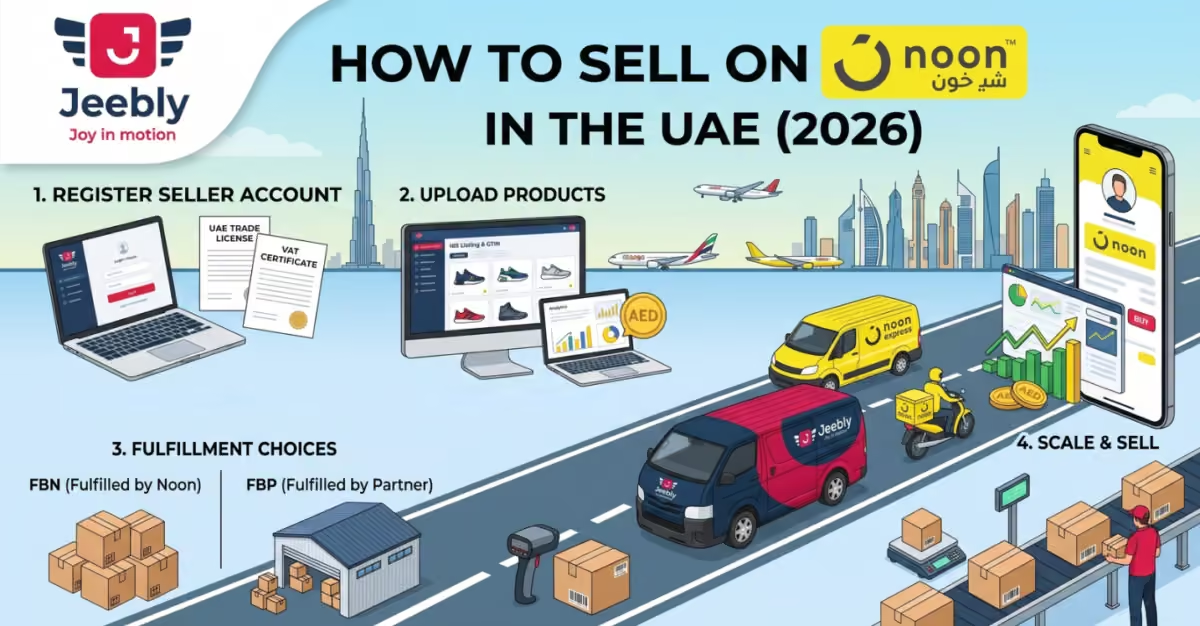
Infographic guide for selling on Noon UAE in 2026, showing seller registration steps, product cataloguing, FBN and FBP logistics options, a Jeebly delivery van, and the Dubai skyline.
How to Sell on Noon in the UAE in 2026

Expanding your e-commerce footprint across the Middle East starts with Noon—the UAE’s leading homegrown digital marketplace. Whether you are a local startup or an established retail brand, succeeding in 2026 requires understanding trade license compliance, optimizing catalog listings, and selecting the right fulfillment model between FBN and FBP. Explore our complete guide to selling on Noon UAE, covering onboarding essentials, commission structures, and how partnering with reliable last-mile delivery providers like Jeebly helps you scale faster.
Read More
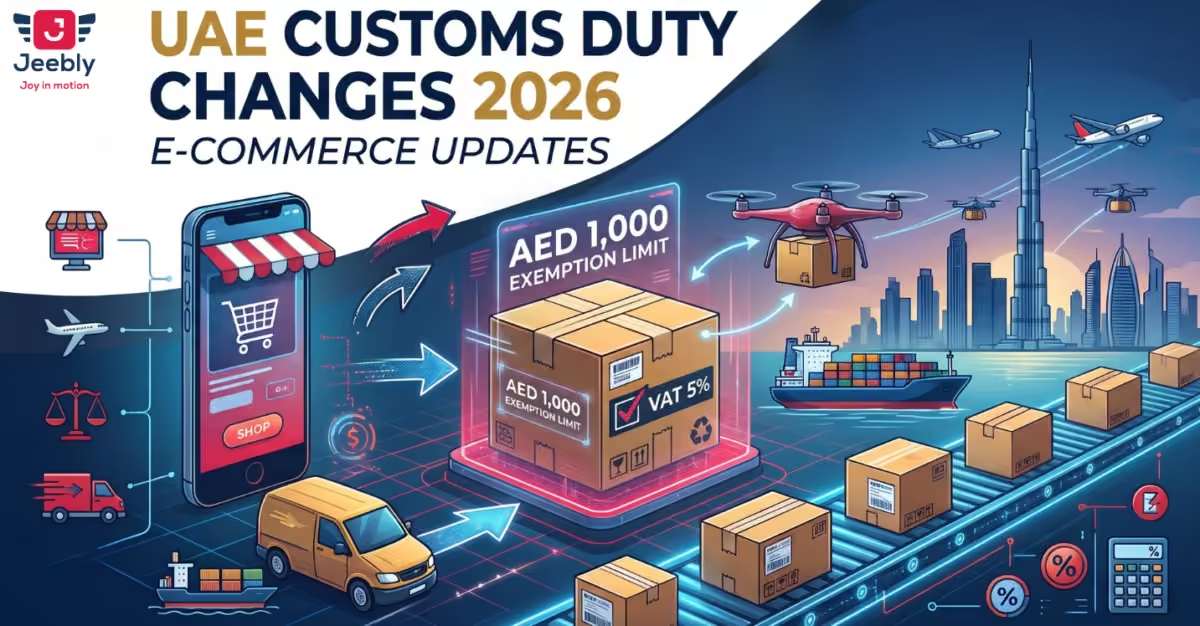
Infographic banner featuring the Jeebly logo, highlighting 2026 UAE customs duty updates for e-commerce with a Dubai skyline, delivery vans, cargo ships, conveyor belt parcels, and the AED 1,000 exemption limit.
UAE Customs Duty Changes for E-Commerce (2026)

With rapid expansions across the GCC digital commerce landscape, the UAE has implemented updated customs duty policies and clearance procedures for cross-border e-commerce shipments in 2026. From managing the AED 1,000 personal import exemption and 5% VAT rules to navigating commercial parcel compliance and streamlined last-mile delivery, discover how these regulatory shifts impact online retailers, logistics providers, and shoppers across the Emirates.
Read More
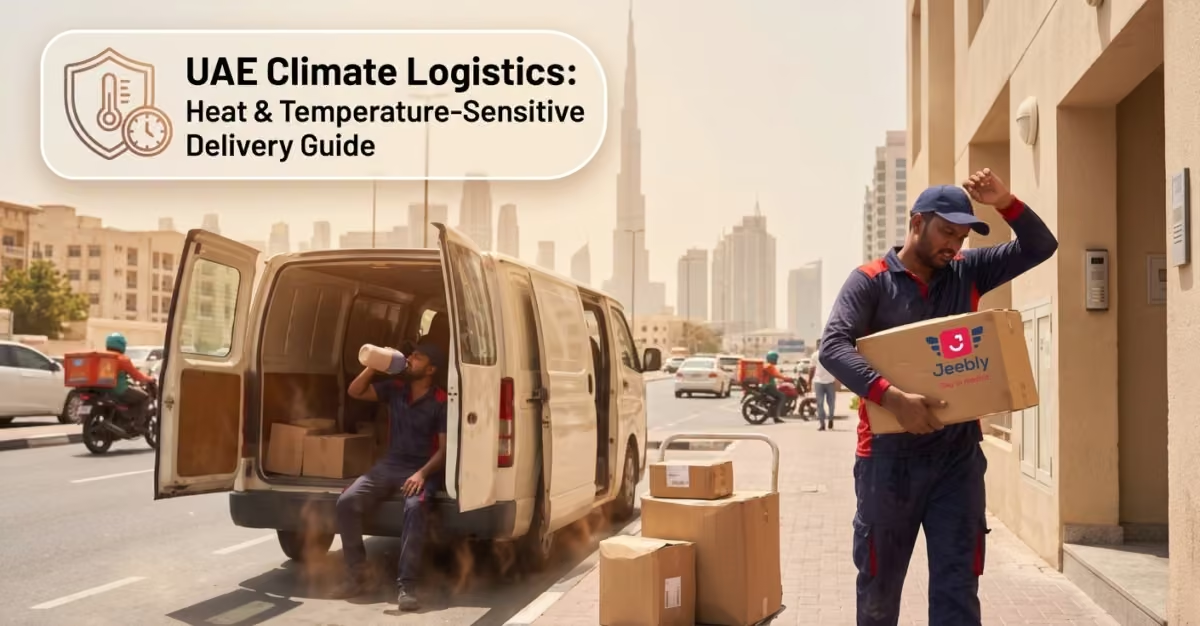
A Jeebly courier driver carrying a parcel while wiping sweat on a sunny Dubai street, with a second driver drinking water by a delivery van, illustrating UAE heat logistics and temperature-sensitive shipping challenges.
UAE Summer Delivery: Heat Effects on Couriers, Packaging and Timelines

Operating last-mile delivery in the UAE requires navigating challenging weather and heat conditions year-round. From protecting courier health to using insulated packaging and adjusting transit schedules, discover how top logistics providers keep temperature-sensitive parcels safe and on time across Dubai and the GCC.

Read More
Jeebly delivery van and driver holding a branded parcel against the Dubai skyline, featuring a digital route optimisation map interface.
What Is Route Optimisation in Last-Mile Delivery?

Last-mile delivery is the most critical—and expensive—leg of the supply chain. Discover how route optimisation leverages real-time data, traffic analytics, and smart scheduling to cut operational costs, beat urban gridlock, and ensure on-time deliveries across the UAE.
Read More
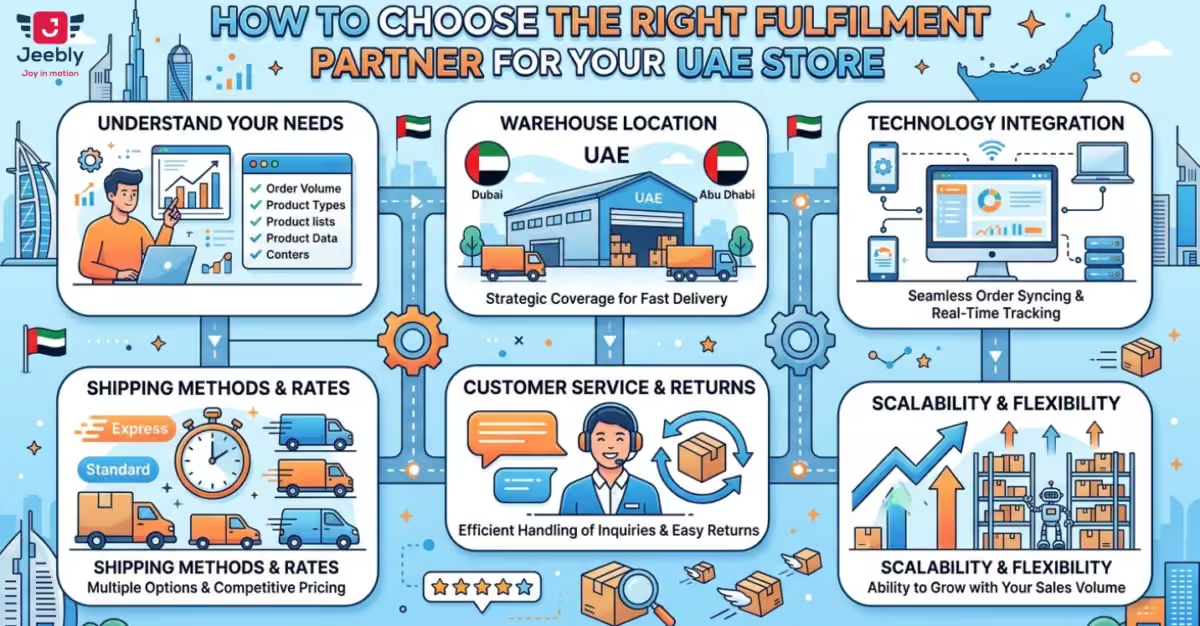
An infographic detailing six steps to choose the right fulfillment partner for a UAE store: understand needs, warehouse location (Dubai/Abu Dhabi), technology integration, shipping methods, customer service, and scalability, set against a UAE city skyline
How to Choose the Right Fulfilment Partner for Your UAE Store

Selecting the right fulfillment partner can make or break your e-commerce growth in the UAE. From strategic warehouse locations in Dubai and Abu Dhabi to seamless tech integration, learn the six critical factors every online store must evaluate to lower costs, ensure same-day delivery, and scale efficiently across the GCC.
Read More
Categories
blogs

Sustainable Delivery in the UAE: Green Logistics Explained

Sustainable Delivery in the UAE: Green Logistics Explained

Sustainable Delivery in the UAE: Green Logistics Explained

Sustainability is redefining the logistics landscape in the UAE. As both consumer demand and government initiatives encourage greener practices, logistics providers are pioneering transformational change—making “sustainable logistics UAE” not just a trend, but a critical part of modern supply chains.

What Is Sustainable Logistics?

Sustainable logistics means integrating environmentally friendly strategies across every stage of freight movement, warehousing, delivery, and packaging. The goal: minimize carbon footprint, conserve resources, and maximize operational efficiency, all while meeting growing customer expectations and regulatory targets

Key Green Logistics Practices in the UAE

1) Electric & Hybrid Fleets: Logistics companies are rapidly adopting electric vehicles (EVs), hybrid vans, and even e-bikes to cut emissions. Government incentives and expanding charging infrastructure make this transition easier and more cost effective.

2) Route Optimization: AI powered software and advanced GPS solutions enable smarter, shorter delivery routes. This means less mileage, reduced fuel usage, and improved on time delivery performance.

3) Eco-Friendly Warehouses: UAE warehouses are moving toward solar powered operations, energy saving insulation, water efficient fixtures, and robust recycling programs. These innovations drastically lower energy consumption and waste.

4) Sustainable Packaging: Businesses are using recyclable and biodegradable materials, optimizing package sizes to cut waste, and encouraging customers to return or reuse packaging.

5) Alternative Delivery Methods: The rise of drones, autonomous robots, and pedestrian couriers in urban last mile scenarios reduces reliance on gas powered trucks and minimizes congestion and pollution.

6) Paperless Operations & Blockchain: Digitizing records and using blockchain enhances supply chain traceability, enabling more accurate carbon footprint tracking and transparent eco reporting.


Why Green Logistics Matters More Than Ever

The UAE’s commitment to the Green Agenda 2030 and global climate goals pushes both multinationals and local SMEs to adopt sustainable practices. Companies investing in green logistics report:

1) Lower operational costs through fuel savings and energy efficiency

2) Enhanced reputation with environmentally conscious consumers

3) Easier compliance with new regulations and eligibility for government incentives.

Jeebly: Leading Sustainable Logistics in the UAE

Jeebly is committed to sustainable logistics UAE, deploying electric vehicles, smart route planning, and green warehousing across its network. Our drive for continuous innovation helps businesses meet eco goals while elevating delivery speed and reliability.

Routes to insightful reads

Infographic guide for selling on Noon UAE in 2026, showing seller registration steps, product cataloguing, FBN and FBP logistics options, a Jeebly delivery van, and the Dubai skyline.
How to Sell on Noon in the UAE in 2026

Expanding your e-commerce footprint across the Middle East starts with Noon—the UAE’s leading homegrown digital marketplace. Whether you are a local startup or an established retail brand, succeeding in 2026 requires understanding trade license compliance, optimizing catalog listings, and selecting the right fulfillment model between FBN and FBP. Explore our complete guide to selling on Noon UAE, covering onboarding essentials, commission structures, and how partnering with reliable last-mile delivery providers like Jeebly helps you scale faster.

Read More
Infographic banner featuring the Jeebly logo, highlighting 2026 UAE customs duty updates for e-commerce with a Dubai skyline, delivery vans, cargo ships, conveyor belt parcels, and the AED 1,000 exemption limit.
UAE Customs Duty Changes for E-Commerce (2026)

With rapid expansions across the GCC digital commerce landscape, the UAE has implemented updated customs duty policies and clearance procedures for cross-border e-commerce shipments in 2026. From managing the AED 1,000 personal import exemption and 5% VAT rules to navigating commercial parcel compliance and streamlined last-mile delivery, discover how these regulatory shifts impact online retailers, logistics providers, and shoppers across the Emirates.

Read More
A Jeebly courier driver carrying a parcel while wiping sweat on a sunny Dubai street, with a second driver drinking water by a delivery van, illustrating UAE heat logistics and temperature-sensitive shipping challenges.
UAE Summer Delivery: Heat Effects on Couriers, Packaging and Timelines

Operating last-mile delivery in the UAE requires navigating challenging weather and heat conditions year-round. From protecting courier health to using insulated packaging and adjusting transit schedules, discover how top logistics providers keep temperature-sensitive parcels safe and on time across Dubai and the GCC.

Read More
Jeebly delivery van and driver holding a branded parcel against the Dubai skyline, featuring a digital route optimisation map interface.
What Is Route Optimisation in Last-Mile Delivery?

Last-mile delivery is the most critical—and expensive—leg of the supply chain. Discover how route optimisation leverages real-time data, traffic analytics, and smart scheduling to cut operational costs, beat urban gridlock, and ensure on-time deliveries across the UAE.

Read More
An infographic detailing six steps to choose the right fulfillment partner for a UAE store: understand needs, warehouse location (Dubai/Abu Dhabi), technology integration, shipping methods, customer service, and scalability, set against a UAE city skyline
How to Choose the Right Fulfilment Partner for Your UAE Store

Selecting the right fulfillment partner can make or break your e-commerce growth in the UAE. From strategic warehouse locations in Dubai and Abu Dhabi to seamless tech integration, learn the six critical factors every online store must evaluate to lower costs, ensure same-day delivery, and scale efficiently across the GCC.

Read More

    Powered by