





Jeebly | Logistics Solutions

Categories
blogs

VAT on Shipping and Delivery Services in UAE: What Businesses Need to Know

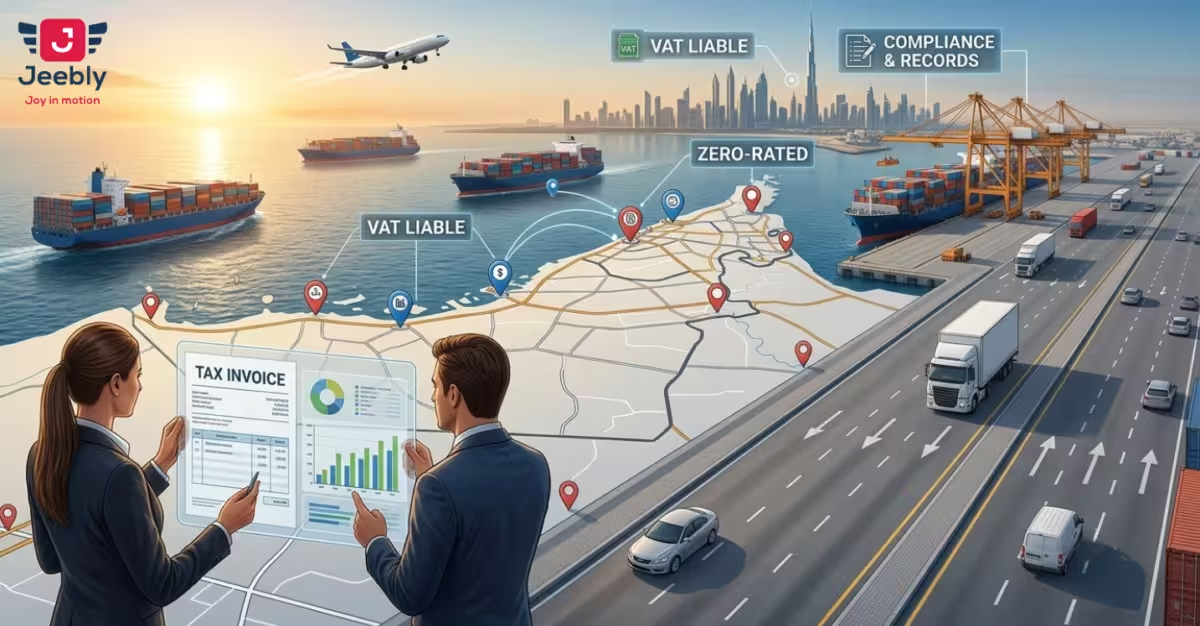
UAE VAT on imports and exports showing tax compliance, logistics, shipping and customs documentation

VAT on Shipping and Delivery Services in UAE: What Businesses Need to Know

In the UAE, most domestic courier and delivery services are subject to 5% VAT. Businesses can usually reclaim this VAT as input tax if they are VAT-registered and hold a compliant tax invoice.

This percentage is easy to overlook as it is a small percentage applied to a relatively small charge. Most businesses process it automatically without checking whether they’re applying it correctly. But if you get the VAT treatment of your shipping wrong, you’ll either be overcharging your customers at checkout, underreporting output tax to the FTA, or missing legitimate input VAT you could be reclaiming on your courier spend.

This guide covers how VAT on shipping and delivery services works, what the 2026 VAT amendments mean for your delivery operations, and how to structure your invoices and reclaim process correctly.

How UAE VAT Applies to Courier and Delivery Services

Under UAE VAT law, courier and delivery services are treated as a supply of services. The standard rule is straightforward: most taxable supplies of services are charged at 5% VAT. When a courier collects a parcel in Dubai, moves it to another emirate, or delivers to a customer, the fee is a taxable supply at the standard rate.

The applicable rate depends on the nature of the delivery, whether domestic or international, and whether the service forms part of a broader international transport arrangement.

Domestic deliveries: 5% standard rate

For most courier runs inside the UAE, VAT is charged at 5%. The same rate applies when a courier handles only a local leg linking two points within the country, even if the goods later move abroad with another supplier.

This is the rate that applies to the overwhelming majority of UAE e-commerce last-mile delivery invoices. If your courier invoice shows 5% VAT on a domestic delivery, that’s correct FTA treatment. If it doesn’t show VAT at all and your courier is VAT-registered, that’s worth investigating.

International deliveries: zero-rated under specific conditions

International door-to-door courier products can qualify for zero rating when they meet the definition of international transport of goods. Article 33 of the UAE VAT Executive Regulations allows a 0% rate when goods move between the UAE and another country, or when the domestic leg is part of a single international transport service.

However, any domestic leg can be zero-rated only when it is supplied by the same taxable person who provides the international leg. If the main carrier subcontracts the first mile to a third party and that subcontractor invoices its client separately, the subcontracted leg loses zero-rating and becomes standard-rated at 5%.

Question Answer
Domestic courier VAT 5% standard VAT.
International transport May qualify for 0% VAT, subject to UAE VAT regulations.
VAT reclaim Possible for VAT-registered businesses, provided eligibility requirements are met.
Invoice requirement A valid tax invoice displaying the supplier's Tax Registration Number (TRN).

Whether the zero-rating condition applies in practice depends on how your freight is structured. Freight Forwarding in the UAE explains how UAE freight forwarders structure multi-leg shipments and what to confirm before assuming that zero-rating applies to your invoices.

VAT on Shipping in Designated Zones and Free Zones

Courier work within free zones and designated zones is subject to specific FTA treatment. The FTA guidance on goods supplied in designated zones distinguishes between goods that remain within the zone, which are treated as outside the UAE VAT system, and goods moving between a designated zone and the UAE mainland.

The key rule for businesses using free zones as distribution hubs:

  • Supplies of goods within designated zones may receive special VAT treatment where the conditions under UAE VAT law are met. 
  • However, delivery services, mainland movements, and imports require separate assessment depending on the transaction structure.
  • Import VAT is generally calculated at 5% on the customs value plus applicable customs duties and other taxable amounts.
  • Delivery services for the mainland leg: 5% standard-rated courier service

The FTA treats the designated zone as outside the UAE VAT territory for goods purposes. The moment goods and the associated delivery service cross into the mainland, both are subject to the standard UAE VAT rate.

Incoterms and VAT Responsibility on International Shipments

When you’re shipping internationally from or to the UAE, the Incoterm you agree with your buyer or supplier directly determines who is responsible for UAE import VAT. Most businesses choose Incoterms based on shipping costs, not realising the VAT compliance obligation they’re accepting or transferring.

Incoterm Who Pays UAE Import VAT Who Handles UAE Customs Clearance
EXW (Ex Works) Buyer Buyer
FOB (Free on Board) Buyer Buyer
DAP (Delivered at Place) Buyer (at point of delivery) Buyer
DDP (Delivered Duty Paid) Seller Seller
CIF (Cost, Insurance, Freight) Buyer Buyer

Note: Actual responsibility depends on who acts as the importer of record and the customs arrangement.

DDP — the e-commerce customer experience default. Under DDP, you as the seller settle all UAE import duties and VAT before delivery. Your customer receives their order without any charges at the door.

DAP — the common operational default. Under DAP, the buyer, your UAE customer, is responsible for import duties and VAT at the point of delivery. If they weren’t expecting that charge, refusal rates spike.

The VAT liability at the point of mainland transfer is directly linked to your customs clearance process. The duty and VAT payment triggers the release order. Customs Clearance in Dubai and the UAE covers the declaration, payment, and release sequence step by step.

How to Structure Your Shipping Invoice for VAT Compliance

A courier invoice that doesn’t comply with FTA invoice requirements may affect your ability to recover input VAT and increase compliance risk. The 2026 standards have tightened, particularly with the e-invoicing mandate approaching.

What a compliant courier tax invoice must include:

  • Supplier’s legal name and address matching FTA registry exactly
  • Supplier’s Tax Registration Number (TRN)
  • Customer’s name and address
  • Unique sequential invoice number
  • Invoice issue date
  • Service description (e.g. “domestic parcel delivery, Dubai to Abu Dhabi”)
  • Quantity and rate (number of deliveries × rate per delivery)
  • VAT rate applied (5%)
  • VAT amount in AED stated separately
  • Total payable in AED

As e-invoicing becomes mandatory for B2B transactions, how well your courier integrates with your accounting or ERP system becomes a compliance question, not just an operational one.

Careem Express vs Jeebly compares the two providers on platform integration and fulfilment capabilities.

2026 UAE VAT Changes That Affect Shipping Operations

Three 2026 amendments directly affect businesses using logistics and delivery services.

1) Reverse charge mechanism: removal of self-invoicing requirement. 

From January 1, 2026, taxpayers importing “concerned goods” or “concerned services” for business purposes are no longer required to issue a tax invoice to themselves for these imports under the Reverse Charge Mechanism. Businesses now retain supplier invoices, customs documents, or evidence of imports for VAT accounting.

2) Five-year VAT credit carry-forward limit. 

From January 1, 2026, excess recoverable VAT may only be carried forward for a maximum of five years from the end of the tax period in which the excess arose. After that, unused credits expire. If your business has been carrying forward input VAT on shipping and logistics costs without claiming refunds, credits from 2021 need to be reviewed now. VAT credits from 2018 to 2020 must be claimed by December 31, 2026, or they will expire.

3) E-invoicing mandate: 2026 pilot, 2027 mandatory. 

UAE e-invoicing begins with a phased rollout. A voluntary pilot starts in July 2026, with mandatory adoption beginning from January 2027 for the first phase of businesses. Later phases will apply to additional businesses. 

E-invoices must be generated in structured XML/JSON formats and submitted via an FTA-Accredited Service Provider (ASP) using the Peppol network.

How Jeebly Handles VAT on Delivery Services

Jeebly Dash is VAT-registered and issues compliant tax invoices for all domestic delivery charges, with 5% VAT stated separately, a valid TRN, and all mandatory invoice fields included. For businesses running high delivery volumes, this means every Jeebly invoice is input-VAT reclaimable on your quarterly FTA return.

Jeebly Bizz connects your e-commerce platform (Shopify, WooCommerce, Magento) to your delivery operation. For businesses managing both domestic delivery and international inbound freight, having both handled through one platform means one consolidated record of VAT on delivery spend, rather than tracking input VAT across multiple courier accounts.

For questions about how VAT applies to your specific delivery structure, talk to the Jeebly team. We’ll walk through your shipment profile and confirm the correct VAT treatment before you file.

Frequently Asked Questions

Yes. Domestic courier and delivery services in the UAE are subject to 5% VAT under standard FTA rules. If your logistics provider is VAT-registered, their invoice will include 5% VAT on the delivery charge. If your business is also VAT-registered, you reclaim this as input tax on your quarterly VAT return.

5% for domestic deliveries. International courier services may qualify for 0% if the provider is responsible for both the domestic and international legs under a single contract. If different suppliers handle different legs with separate invoices, each domestic leg is standard-rated at 5%.

Yes, if you are VAT-registered with the FTA and the courier issues a compliant tax invoice with their valid TRN, VAT amount stated separately, and all mandatory fields included. The 5% VAT on domestic courier spend is input tax reclaimable on your VAT return.

Under DDP (Delivered Duty Paid), the seller pays UAE import VAT and customs duty before delivery. The customer receives goods without charges at the door. Under DAP (Delivered at Place), the buyer is responsible for import VAT at point of delivery. For UAE B2C shipments, DDP helps prevent delivery refusals due to unexpected import charges.

Three changes matter: the reverse charge mechanism no longer requires self-invoicing (retain supplier documents instead); excess input VAT can only be carried forward for five years (credits from 2021 start expiring in 2026); and e-invoicing becomes mandatory for B2B transactions from January 2027, with a voluntary pilot from July 2026. Courier invoices will need to be in structured digital formats from 2027.

Routes to insightful reads

Delivery SLA guide for UAE businesses showing service level agreements, delivery performance metrics, on-time delivery targets and logistics standards.
 Delivery SLA Guide for UAE Businesses: What to Expect and How to Set Standards

A clear delivery Service Level Agreement (SLA) sets the expectations for speed, reliability, and performance between businesses and their logistics partners. This guide explains what a delivery SLA should include, the key metrics to track, and how UAE businesses can set realistic standards to improve customer satisfaction and delivery performance.

Read More
Dangerous goods and restricted items that cannot be shipped by courier in the UAE, including hazardous materials, prohibited products and customs restrictions.
Dangerous Goods and Restricted Items: What You Cannot Ship by Courier in the UAE

Shipping prohibited or restricted items can lead to delays, fines, shipment rejection, or legal consequences. This guide explains which dangerous goods and restricted items cannot be shipped by courier in the UAE, the regulations businesses should know, and how to stay compliant with UAE customs and courier requirements.

Read More
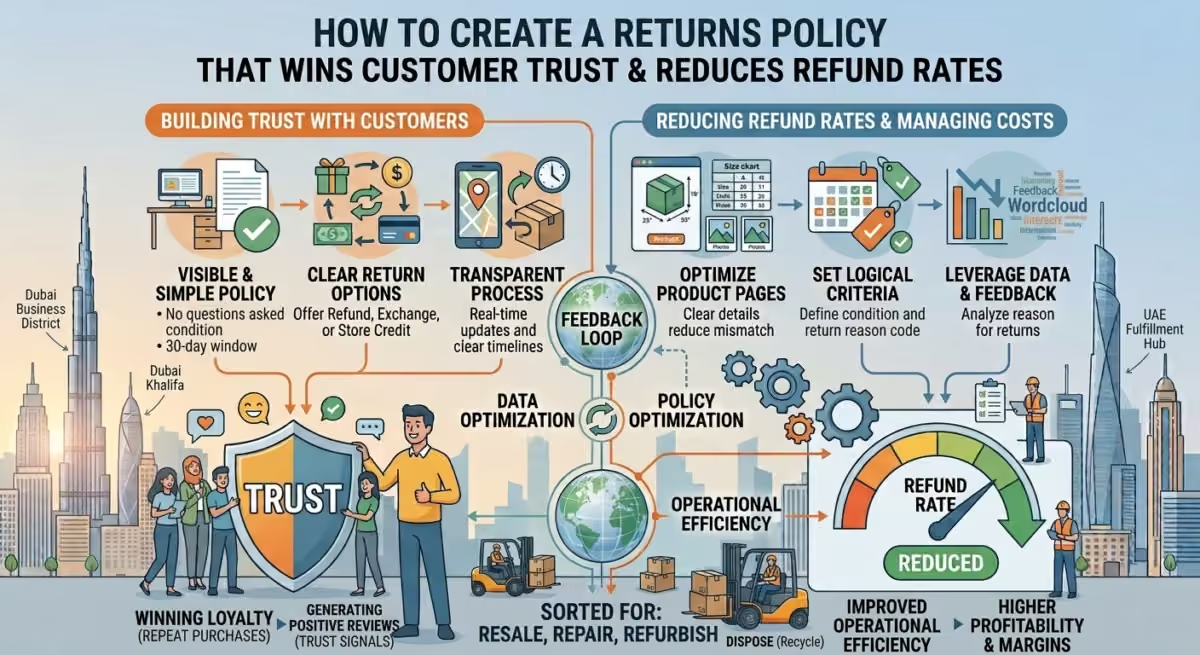
How to manage eCommerce returns in the UAE with reverse logistics, return policies, refunds and inventory restocking
How to Manage eCommerce Returns in UAE: Strategy, Policy and Logistics

Efficient returns management is essential for every UAE eCommerce business. From creating a customer-friendly return policy to streamlining reverse logistics and processing refunds quickly, this guide explains how to reduce return costs, improve customer satisfaction, and turn returns into a competitive advantage.

Read More
A medium-sized Jeebly delivery and moving truck parked outside a warehouse with its back doors wide open and a hydraulic lift gate lowered to the ground. Inside the cargo area, brown cardboard boxes are stacked neatly. The side of the truck features a dark blue advertisement wrap with the Jeebly logo, displaying a hand holding a house model under the text "Always on the Move from parcels to homes" and a call to action to "Explore it all on Jeebly NoW".
Packers and Movers in Dubai: What to Look for and How to Choose

Relocating in Dubai doesn’t have to be stressful. Whether you are moving apartments in Dubai Marina or upgrading your office space, discover the essential factors to look for in a professional moving company—from licensing and insurance to transparent pricing—and learn exactly how to choose the right team for a seamless move.

Read More
Infographic titled "Ecommerce Fulfilment in UAE: How It Works and What Businesses Should Look For." The left side shows a 5-step workflow: Online Store, Inventory, Picking & Packing, Dispatch, and Last Mile Delivery. The center features a map of the UAE with iconic cityscapes. The right side lists business requirements: Reliability & Speed, Advanced Technology, Real-Time Tracking, Scalability, and Customer Support.
eCommerce Fulfilment in UAE: How It Works and What Businesses Should Look For

Master your logistics strategy in the Middle East. Discover how e-commerce fulfillment works in the UAE—from warehousing to last-mile delivery—and learn the top 5 features your business needs from a fulfillment partner to scale successfully.

Read More
Categories
blogs

What Is Contactless Delivery and How Does It Work in the UAE?

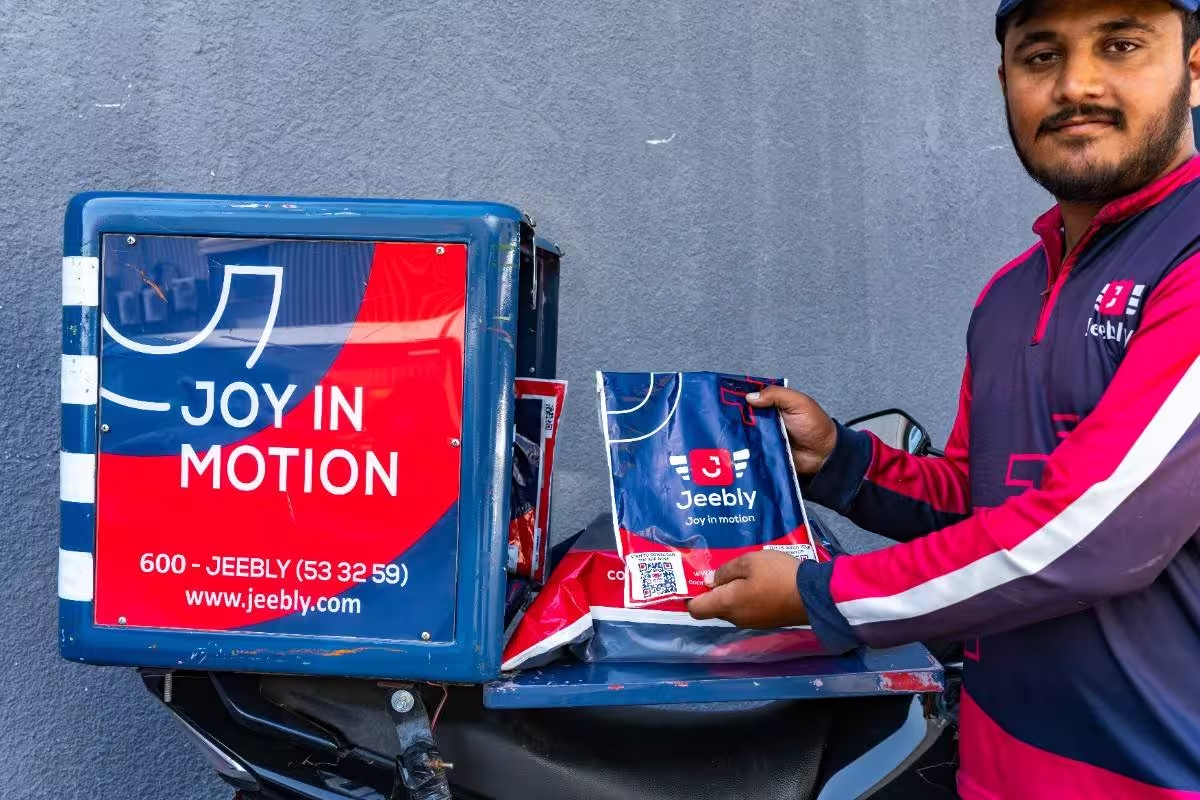
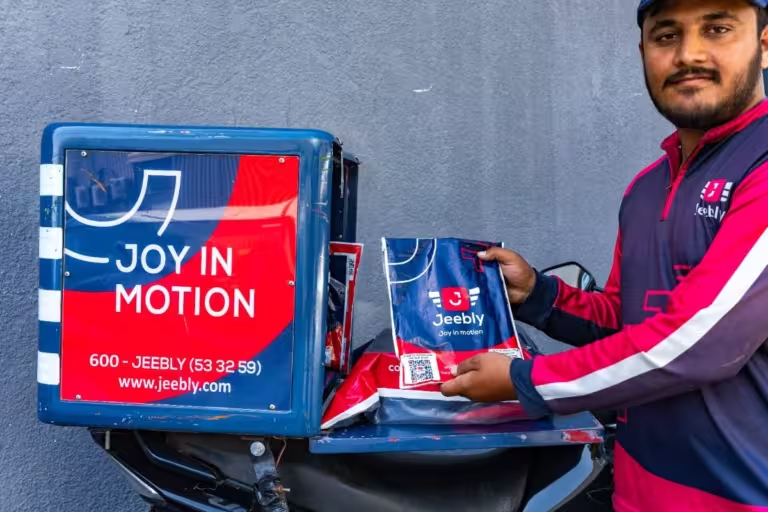
Jeebly delivery rider holding a package next to a branded motorcycle box in the UAE

What Is Contactless Delivery and How Does It Work in the UAE?

Your customers don’t want to wait at the door. They don’t want to sign anything, handle cash, or interact with a courier at all. They want their order confirmed, tracked, and dropped off without friction. Contactless delivery is how the best e-commerce businesses in the UAE are meeting that expectation.

What started as a pandemic-era response has settled into a permanent operating standard. For businesses shipping across Dubai, Abu Dhabi, and beyond, the question today is whether your contactless logistics infrastructure actually supports contactless it end-to-end.

This article explains what contactless delivery is, how it works step by step, which technologies make it reliable, and what UAE businesses need to get it right.

What Is Contactless Delivery?

Contactless delivery is a fulfilment method in which an order is left at a designated location without direct physical contact between the courier and the recipient. The customer is notified digitally, and delivery is confirmed with an electronic record, typically a timestamped photo taken at the drop-off point.

The mechanics are simple. The complexity lies in building the digital infrastructure behind them. For UAE e-commerce businesses, the stakes are unusually high. 

84% of all transactions in the UAE are now contactless, and the Dubai Cashless Strategy, rolled out in 2024, targets  90% of transactions in the city to be cashless by 2026.

Customers in this market are digitally fluent and quick to form opinions based on their delivery experience. A missed window or an awkward handoff can erode the trust that drives repeat purchases.

How Does Contactless Delivery Work: The Full Sequence

A good contactless delivery feels effortless to the customer. Behind the scenes, it’s a coordinated sequence of steps, each one enabling the next.

Step 1. Order placed and payment confirmed digitally.The customer pays online at checkout. This single step eliminates the need for any financial exchange at the door and is the foundation on which everything else is built.

Step 2. Automated dispatch and route optimisation.Once the order is ready, a courier is assigned, and their route is optimised based on the day’s load, traffic conditions, and delivery priorities. Accurate ETAs begin here.

Step 3. Real-time tracking notification.The customer receives a notification. They will know where their order is, without calling anyone or guessing at a four-hour window.

Step 4. Drop off at the agreed location.The courier places the parcel at the customer’s specified drop-off point, doorstep, building reception, or lobby without requiring the customer’s presence. No signature, no interaction.

Step 5. Electronic proof of delivery (ePOD) captured.At drop-off, the courier photographs the parcel in situ. That image is timestamped, geotagged, and logged automatically.

Step 6. Instant delivery confirmation sent.The customer receives a notification the moment the photo is uploaded. The delivery is complete, verified, and on record for both sides.

Each step in this sequence depends on the one before it. 

For a breakdown of how UAE delivery timelines actually work across service types, read How Long Does Delivery Take in the UAE? Realistic Timelines

The Technology Behind a Reliable Contactless Delivery System

Leaving a parcel on a doorstep is not contactless delivery. It’s an unverified drop. What separates the two is the digital infrastructure that makes every step traceable and accountable.

A genuinely capable contactless delivery system requires:

  • Automated notifications triggered at each stage of the journey: dispatched, en route, arriving soon, delivered. Customers who know where their order is don’t need to contact your support team.

  • Electronic proof of delivery (ePOD) with photo capture at the drop-off point. The image must be timestamped and geotagged to carry evidentiary weight. Without this, any dispute becomes a he-said-she-said situation.

  • Route optimisation software that accounts for traffic, load size, delivery priority, and geographic spread. This keeps ETAs accurate and couriers efficient, which matters especially when you’re running hundreds of daily drops across multiple Emirates.

  • Prepayment infrastructure — whether through card, digital wallet, or bank transfer. The UAE’s rapid shift toward digital payments makes this easier than ever to implement.

Together, these components create a system where every delivery is transparent, every drop-off is verifiable, and every customer interaction builds confidence rather than anxiety.

Business Benefits That Go Beyond Safety

The original case for contactless delivery was about hygiene and risk reduction. Businesses that have built it properly have discovered that the operational advantages run much deeper.

Benefit What it means for your business
Higher first-attempt delivery success Courier doesn't need the customer to be home, have cash ready, or sign anything. Fewer reasons to fail mean fewer failed deliveries.
Faster delivery cycles No waiting at the door for signatures or cash exchanges.
Fewer disputes ePOD photo evidence resolves queries before they escalate.
Lower support volume Automated tracking notifications answer questions proactively.
Paperless operations Digital records replace physical paperwork across the chain.
Scales without adding overhead Works identically for 10 parcels or 1,000 per day.

For operations running high volumes across multiple Emirates, these gains compound quickly. 

What UAE Businesses Get Wrong About Contactless Delivery

Contactless delivery fails when businesses treat it as a front-end customer experience feature rather than an end-to-end operational system. Three gaps come up consistently.

1. Incomplete payment migration.
 

Cash on delivery remains common in the UAE market. Businesses that maintain COD as a default option can’t offer a truly contactless experience for those orders. Phasing out COD, or at a minimum, defaulting new customers to digital payment, is a prerequisite for clean contactless operations.

2. No proof-of-delivery standard.
 

Without mandatory ePOD, disputes are resolved on trust rather than evidence. This creates liability for the business and uncertainty for the customer. Photo confirmation at every drop-off should be non-negotiable. 

3. Static tracking, not real-time tracking.
 

Many courier operations send a single “your order is out for delivery” notification and nothing further. Customers checking in on a high-value order expect real-time position updates. The UAE’s digitally-engaged customer base notices the difference immediately.

Failed deliveries are the most expensive line item, yet most e-commerce businesses don’t track them closely enough. For a full picture, the Top Delivery Companies in UAE (2026) guide covers first-attempt success rates across every major UAE carrier.

How Jeebly Handles Contactless Delivery

Jeebly’s approach to contactless delivery is built into the platform rather than added on top of it. Automated dispatch, real-time tracking updates, and ePOD photo capture at every drop-off are standard.

  • For e-commerce brands with daily order volumes, Jeebly Dash covers same-day and next-day delivery across the UAE, with each delivery confirmed by a photograph uploaded by the rider at drop-off. 
  • For businesses managing higher-complexity logistics, Jeebly Bizz brings automated dispatch, route optimisation, reverse logistics, and end-to-end workflow transparency into a single platform.

How to Implement Contactless Delivery for Your UAE Business

Getting contactless delivery right doesn’t require rebuilding your operation from scratch. It does require being deliberate about a few fundamentals.

  • Move to prepayment as your default. This is the single most important enabler. A COD order cannot be contactless. If you’re transitioning an existing customer base, offer digital payment as the default and COD as an opt-in.

  • Choose a logistics partner with real tracking. Position updates and precise ETAs are what customers expect in the UAE market. Confirm whether the courier you work with offers these as standard, and test the experience from the customer’s perspective before committing.

  • Make ePOD non-negotiable. Any courier partner you work with should capture and upload a photo at every drop-off. Ask how it’s stored, how long it’s retained, and how you access it when a dispute is raised.

  • Specify drop-off preferences clearly. Let customers indicate where they want their parcel left and make sure that preference is communicated to the courier. A branded tracking page that captures this information before delivery removes ambiguity at the door.

  • Automate your notification sequence. Dispatch, en route, arriving soon, delivered: each stage should trigger an automatic notification to the customer. This reduces inbound queries, increases confidence, and creates a professional delivery experience that reflects well on your brand.


Understanding your full shipping cost picture helps make the case for digital payment internally. Cost of Shipping for a Small Business in the UAE (2026) clearly breaks it down.

Conclusion

Contactless delivery is no longer a differentiator. It’s a baseline. UAE customers expect a tracked, confirmed, and friction-free delivery experience as standard, and businesses that can’t provide it will lose the repeat purchase.

The good news is that the infrastructure exists. Real-time tracking, ePOD, automated notifications, and digital payment are all readily available through the right logistics partner. The question is whether your current setup supports all of it or just some of it.

If you’re ready to build a contactless delivery operation that holds up at volume, speak to the Jeebly team. We’ll map out the right setup for your order profile, coverage needs, and growth plan

Frequently Asked Questions

The key difference between contactless delivery and standard delivery is the digital proof of delivery. A photo is taken and uploaded at drop-off, eliminating the need for any cash or signature exchange at the door.

No. The customer specifies a drop-off location in advance, and the courier places the parcel there without requiring anyone to be present. A notification confirms delivery the moment the photo is uploaded.

Coverage depends on your logistics provider. Jeebly Dash offers next-day delivery to any emirate in the UAE, with same-day and express options available in Dubai. Confirm coverage and service levels with your courier before committing to customer-facing promises.

Four components matter most: real-time tracking with precise ETAs, automated customer notifications at each stage, electronic proof of delivery with photo capture, and route optimisation software. Without all four, some part of the accountability chain breaks down.

When customers don’t need to be physically present to receive an order, first-attempt success rates improve significantly. The courier drops off, photographs, and confirms without waiting for someone to answer the door or process a payment. This results in lower re-delivery costs and faster order completion.

Routes to insightful reads

Delivery SLA guide for UAE businesses showing service level agreements, delivery performance metrics, on-time delivery targets and logistics standards.
 Delivery SLA Guide for UAE Businesses: What to Expect and How to Set Standards

A clear delivery Service Level Agreement (SLA) sets the expectations for speed, reliability, and performance between businesses and their logistics partners. This guide explains what a delivery SLA should include, the key metrics to track, and how UAE businesses can set realistic standards to improve customer satisfaction and delivery performance.

Read More
Dangerous goods and restricted items that cannot be shipped by courier in the UAE, including hazardous materials, prohibited products and customs restrictions.
Dangerous Goods and Restricted Items: What You Cannot Ship by Courier in the UAE

Shipping prohibited or restricted items can lead to delays, fines, shipment rejection, or legal consequences. This guide explains which dangerous goods and restricted items cannot be shipped by courier in the UAE, the regulations businesses should know, and how to stay compliant with UAE customs and courier requirements.

Read More
How to manage eCommerce returns in the UAE with reverse logistics, return policies, refunds and inventory restocking
How to Manage eCommerce Returns in UAE: Strategy, Policy and Logistics

Efficient returns management is essential for every UAE eCommerce business. From creating a customer-friendly return policy to streamlining reverse logistics and processing refunds quickly, this guide explains how to reduce return costs, improve customer satisfaction, and turn returns into a competitive advantage.

Read More
A medium-sized Jeebly delivery and moving truck parked outside a warehouse with its back doors wide open and a hydraulic lift gate lowered to the ground. Inside the cargo area, brown cardboard boxes are stacked neatly. The side of the truck features a dark blue advertisement wrap with the Jeebly logo, displaying a hand holding a house model under the text "Always on the Move from parcels to homes" and a call to action to "Explore it all on Jeebly NoW".
Packers and Movers in Dubai: What to Look for and How to Choose

Relocating in Dubai doesn’t have to be stressful. Whether you are moving apartments in Dubai Marina or upgrading your office space, discover the essential factors to look for in a professional moving company—from licensing and insurance to transparent pricing—and learn exactly how to choose the right team for a seamless move.

Read More
Infographic titled "Ecommerce Fulfilment in UAE: How It Works and What Businesses Should Look For." The left side shows a 5-step workflow: Online Store, Inventory, Picking & Packing, Dispatch, and Last Mile Delivery. The center features a map of the UAE with iconic cityscapes. The right side lists business requirements: Reliability & Speed, Advanced Technology, Real-Time Tracking, Scalability, and Customer Support.
eCommerce Fulfilment in UAE: How It Works and What Businesses Should Look For

Master your logistics strategy in the Middle East. Discover how e-commerce fulfillment works in the UAE—from warehousing to last-mile delivery—and learn the top 5 features your business needs from a fulfillment partner to scale successfully.

Read More

    Powered by