






Jeebly | Logistics Solutions

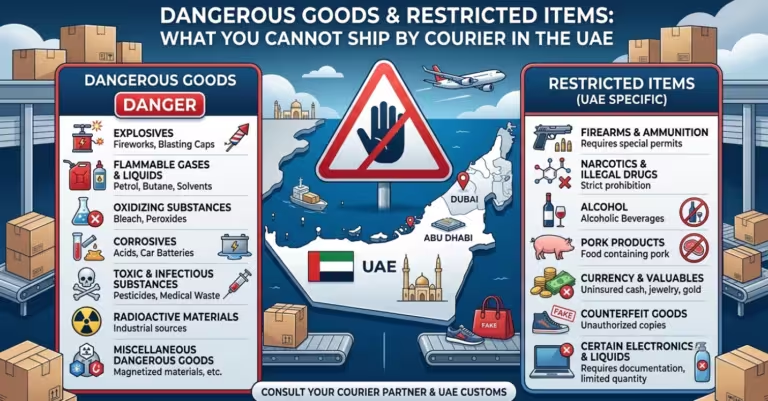
Dangerous goods and restricted items that cannot be shipped by courier in the UAE, including hazardous materials, prohibited products and customs restrictions.

Dangerous Goods and Restricted Items: What You Cannot Ship by Courier in UAE

Many UAE businesses discover their product is a dangerous good at the worst possible moment when a shipment is rejected at the courier’s processing hub, held by Dubai Customs, or returned with a non-compliance notice and a fine. 

Perfume, hand sanitiser, aerosol sprays, nail polish, and lithium battery products are not obviously hazardous goods to most sellers, but they are all regulated as dangerous goods under international courier and UAE customs rules.

This guide covers the three categories of restricted shipping (prohibited, restricted, conditionally accepted), the most common product types that catch UAE businesses off guard, and what to do if your goods fall into the grey zone.

Key Takeaways

  • Dangerous goods fall into three categories: prohibited (never accepted by any carrier), restricted (accepted with documentation, packaging, and labelling), and conditionally accepted (allowed on some modes but not others).

  • Perfume, aerosols, hand sanitiser, nail polish, and lithium battery products are classified as dangerous goods.

  • There are separate restriction lists for Dubai, Abu Dhabi, and Sharjah. Domestic UAE routes are not all governed by the same rules.

  • Flammable liquids, fireworks, and gases are among the most commonly refused items for air transport. Even everyday aerosols and cleaning chemicals can be flagged if they pose a fire or explosion risk.

  • The NAIC (National Advanced Information Centre) requires pre-arrival data submission with accurate six-digit HS codes for all dangerous goods entering the UAE.

The Three Categories: Prohibited, Restricted, and Conditionally Accepted

  • Understanding which tier your goods fall into determines what you can do next.

    1) Prohibited goods 

    These are absolutely off-limits: no carrier, no documentation, and no special permit will move them. Dubai Customs officially prohibits narcotic drugs, gambling tools, nylon fishing nets, live swine, used or reconditioned tyres, radiation-contaminated substances, items against Islamic faith or public morals, and paan or betel leaves. 

    Beyond UAE-specific prohibitions, international carriers will not accept explosives, radioactive materials, biological weapons, or illegally trafficked wildlife products under any conditions.

    2) Restricted goods 

    These can be shipped, but only with the correct classification, documentation, packaging, and labelling. Most “dangerous goods” in the e-commerce context include perfumes, aerosols, lithium batteries, flammable adhesives, and similar items. 

    The conditions that apply vary by carrier, by mode (air, road, sea), and by destination.

    3) Conditionally accepted goods 

    These are allowed on some shipping modes but prohibited on others. Lithium batteries in devices (laptops, phones) can typically ship by road or sea freight but face strict limits on air freight services.

    Many flammable liquids that cannot go by air can be moved by road through the GCC. The right mode depends on the specific goods classification.

    Whether lithium battery products can go by courier or need to be classified as freight depends on quantity, installation state, and watt-hour rating. Courier vs Freight: Key Differences? explains how to determine the right mode for your specific shipment type.

Common UAE E-Commerce Products That Are Regulated as Dangerous Goods

These are the product categories that most often catch UAE businesses off guard. None of them looks obviously hazardous, but all carry regulatory requirements.

  1. Perfumes and fragrances (Class 3 – Flammable Liquids):

Dangerous or hazardous goods, including perfumes, aftershaves, aerosols, flammable substances, and UN-classified dangerous goods, require specific handling and cannot be shipped through standard courier channels without proper documentation. 

Domestically within the UAE by road, small quantities in proper packaging are manageable. International courier service requires full dangerous goods documentation and UN-rated packaging.

  1. Aerosol products (Class 2 – Gases):

Hair sprays, deodorants, cleaning sprays, and insecticides are aerosols. They’re pressurised containers that can explode if punctured or exposed to heat. Aerosols are accepted by most couriers in limited quantities with specific pressure and fill-weight limits, but these vary by carrier and must be declared.

  1. Lithium batteries (Class 9 – Miscellaneous Dangerous Goods):

Lithium batteries in mobile phones can pose a safety risk to airport facilities and aircraft. They’re subject to strict quantity and watt-hour limits on air freight. Batteries shipped standalone (not installed in devices) face the tightest restrictions. 

Batteries installed in devices face limits on state of charge and packaging requirements. Road freight allows higher quantities than air.

  1. Hand sanitiser and alcohol-based cleaning products (Class 3 – Flammable Liquids):

Above 24% alcohol concentration, hand sanitiser is a flammable liquid. The pandemic-era surge in hand sanitiser e-commerce created a wave of incorrectly shipped flammable goods. Most couriers now require proper classification for any alcohol-based cleaning product above threshold concentrations.

  1. Nail polish and nail polish remover (Class 3 – Flammable Liquids):

Both contain acetone or similar flammable solvents. They require flammable liquid classification, UN-rated packaging, and quantity limits per shipment. Standard courier parcels cannot carry unlimited quantities. Most carriers impose 1 litre per inner packaging and 4 litres per outer package limits.

  1. Dry ice (Class 9 – Miscellaneous Dangerous Goods):

Used for temperature-controlled food and pharmaceutical shipments. Dry ice produces carbon dioxide gas as it sublimes, which can displace oxygen in an enclosed space. Carriers impose quantity limits, require ventilation-compatible packaging, and mandate advance declaration.

  1. Power banks and spare lithium batteries:

Power banks must be carried in cabin baggage, not in checked luggage. Most airlines restrict or prohibit power banks in the hold because of the fire risk from lithium batteries. 

For courier shipments, spare lithium batteries (not installed in devices) are among the most restricted items on any carrier’s list. Many carriers will not accept them as standalone items for international air freight.

For regulated goods that can go by sea rather than air, Air Freight vs Ocean Freight in UAE breaks down the cost and compliance trade-off between modes for UAE exporters.

Domestic UAE vs International: The Rules Are Different

A common mistake is applying international air freight rules to domestic UAE courier shipments, or assuming that because something ships within Dubai it can also ship internationally.

Domestic UAE courier (same-emirate and inter-emirate by road): Domestic road courier within the UAE operates under less restrictive rules for many categories of dangerous goods. The key requirements are proper packaging, quantity limits, and accurate shipment descriptions rather than the full IATA dangerous goods documentation set.

International air freight from UAE: Air transport applies IATA Dangerous Goods Regulations (DGR) in full. This means: hazard class classification, UN number, packing group, UN-rated packaging, Shipper’s Declaration for Dangerous Goods, quantity per package limits, and carrier acceptance procedures. Many goods that ship domestically by road cannot go by air at all, or can only go by air in very limited quantities.

The NAIC pre-arrival requirement: For all dangerous goods entering the UAE, the NAIC requires real-time cargo data submission well in advance of physical arrival. Submitting incorrect or incomplete data creates holds before the shipment lands, regardless of how well the packaging and documentation are prepared.

It’s important to keep in mind that the rules for what is allowed change depending on the destination. There are separate lists of restrictions for Dubai, Abu Dhabi, and Sharjah.

What Happens When You Get It Wrong

Most businesses only learn the consequences after they’ve experienced them. These are the four outcomes of incorrectly shipping dangerous goods in the UAE:

  • Shipment rejection at processing: The courier’s hub scans and identifies incorrectly classified goods. The shipment is returned to sender. You pay for the outbound attempt and the return, and your customer receives nothing on the promised date.

  • Customs hold with inspection fees: Incorrectly declared goods arriving at UAE borders trigger a customs hold. Inspection fees, storage fees (charged per day), and potential examination costs accumulate before the goods are released if they’re released at all.

  • Fines for non-compliance: UAE authorities and international carriers both have penalty structures for incorrectly documented dangerous goods. For air shipments, IATA non-compliance fines can be substantial and are documented in the carrier’s acceptance record.

  • Carrier account suspension: Repeated dangerous goods violations can result in a carrier suspending your shipping account. For businesses that rely on one courier partner for their e-commerce fulfilment, this is an operational crisis with no simple short-term resolution.

The cost of a rejected or returned shipment adds up faster than most businesses model. Shipping Costs for Small Businesses in the UAE gives a cost structure so you can model the real risk of non-compliance against the cost of getting it right upfront.

Shipping Dangerous Goods Correctly: What's Required

If your goods are classified as dangerous but not prohibited, the correct process is manageable. It requires preparation.

Step 1: Classify your goods correctly 

Check your product’s Safety Data Sheet (SDS) for the UN number, hazard class, and packing group. If there’s no SDS, contact your supplier. Every regulated product has one.

Step 2: Use UN-rated packaging

Standard cardboard boxes and bubble wrap are not sufficient for dangerous goods. UN-rated packaging specifies the packing group and the substance it’s certified to contain. Your packaging supplier can confirm certification.

Step 3: Label the outer packaging 

Each hazard class has a specific diamond-shaped label with the hazard number. The label size, placement, and colour coding are specified in IATA DGR for air freight and equivalent road freight regulations.

Step 4: Complete the Shipper’s Declaration 

For air freight, this is mandatory. For road freight between GCC countries, equivalent hazmat documentation is required. All entries must be accurate. A single error invalidates the entire declaration.

Step 5: Submit NAIC pre-arrival data

For goods entering the UAE, accurate six-digit HS codes and product descriptions must be submitted to NAIC in advance of physical arrival.

Step 6: Choose a carrier with hazmat certification

Not all couriers accept dangerous goods. Only carriers with certified hazmat personnel and approved dangerous goods acceptance procedures can legally move regulated cargo.

For freight-classified dangerous goods like bulk chemicals, industrial supplies, high-volume aerosols, or cargo exceeding domestic courier limits, Jeebly Haul covers air, sea, and road freight with in-house customs clearance across UAE and GCC routes. 

For domestic UAE shipments of goods in the conditionally accepted category, speak to the Jeebly team before booking to confirm which service and which documentation applies to your specific product and route.

Frequently Asked Questions

Any substance or article classified under the nine internationally recognised hazard classes, including flammable liquids (perfumes, hand sanitiser, nail polish), aerosols, lithium batteries, corrosives, gases, and oxidising substances. If your product has a Safety Data Sheet or a UN number on its packaging, it is regulated. The UAE applies IATA rules for air freight and ADR-equivalent rules for road freight.

Domestically within the UAE by road courier, small quantities of perfume in correctly packaged condition are generally accepted by carriers that have dangerous goods capability. Internationally by air, perfume requires full flammable liquid classification, UN-rated packaging, and a Shipper’s Declaration. Standard courier booking without a dangerous goods declaration will result in rejection at processing.

Prohibited items cannot be shipped under any conditions, including narcotics, explosives, and items banned under UAE customs law. Restricted items can be shipped but require specific documentation, packaging, and labelling. Most dangerous goods in the e-commerce context fall here. Conditionally accepted items can ship on some modes (road) but not others (air), depending on quantity and classification.

The most common outcomes are: shipment rejection and return at the courier’s processing hub, a customs hold with daily storage and inspection fees at UAE borders, regulatory fines for non-compliant documentation, or carrier account suspension for repeat violations. Incorrect air freight declarations carry the most significant penalties.

Jeebly Haul handles freight-classified dangerous goods including bulk chemicals, industrial supplies, and regulated cargo requiring specialist handling with air, sea, and road freight options and in-house customs clearance. For domestic UAE courier shipments of conditionally accepted categories, contact the Jeebly team to confirm which service applies to your specific product and documentation requirements before booking.

Routes to insightful reads

Dangerous goods and restricted items that cannot be shipped by courier in the UAE, including hazardous materials, prohibited products and customs restrictions.
Dangerous Goods and Restricted Items: What You Cannot Ship by Courier in the UAE

Shipping prohibited or restricted items can lead to delays, fines, shipment rejection, or legal consequences. This guide explains which dangerous goods and restricted items cannot be shipped by courier in the UAE, the regulations businesses should know, and how to stay compliant with UAE customs and courier requirements.

Read More
How to manage eCommerce returns in the UAE with reverse logistics, return policies, refunds and inventory restocking
How to Manage eCommerce Returns in UAE: Strategy, Policy and Logistics

Efficient returns management is essential for every UAE eCommerce business. From creating a customer-friendly return policy to streamlining reverse logistics and processing refunds quickly, this guide explains how to reduce return costs, improve customer satisfaction, and turn returns into a competitive advantage.

Read More
A medium-sized Jeebly delivery and moving truck parked outside a warehouse with its back doors wide open and a hydraulic lift gate lowered to the ground. Inside the cargo area, brown cardboard boxes are stacked neatly. The side of the truck features a dark blue advertisement wrap with the Jeebly logo, displaying a hand holding a house model under the text "Always on the Move from parcels to homes" and a call to action to "Explore it all on Jeebly NoW".
Packers and Movers in Dubai: What to Look for and How to Choose

Relocating in Dubai doesn’t have to be stressful. Whether you are moving apartments in Dubai Marina or upgrading your office space, discover the essential factors to look for in a professional moving company—from licensing and insurance to transparent pricing—and learn exactly how to choose the right team for a seamless move.

Read More
Infographic titled "Ecommerce Fulfilment in UAE: How It Works and What Businesses Should Look For." The left side shows a 5-step workflow: Online Store, Inventory, Picking & Packing, Dispatch, and Last Mile Delivery. The center features a map of the UAE with iconic cityscapes. The right side lists business requirements: Reliability & Speed, Advanced Technology, Real-Time Tracking, Scalability, and Customer Support.
eCommerce Fulfilment in UAE: How It Works and What Businesses Should Look For

Master your logistics strategy in the Middle East. Discover how e-commerce fulfillment works in the UAE—from warehousing to last-mile delivery—and learn the top 5 features your business needs from a fulfillment partner to scale successfully.

Read More
An infographic illustrating the evaluation of logistics companies in Dubai against the backdrop of the city skyline, port, and airport. It features a decision-making flow focused on key pillars like 'Global Reach & Local Network', 'Speed & Reliability', 'Tech & Tracking', 'Warehousing & Fulfillment', 'Last-Mile Delivery', and 'Cost Transparency'. A central question mark is linked to diverse transport modes and two business professionals review a 'Criteria Checklist'.
Logistics Companies in Dubai: How to Evaluate and Choose the Right Partner

Dubai’s strategic location makes it a global logistics powerhouse, but finding the perfect supply chain ally can make or break your business. From last-mile delivery tech to warehousing scale, here is your step-by-step guide to evaluating and choosing the right logistics partner in the UAE.

Read More

    Powered by