





Jeebly | Logistics Solutions

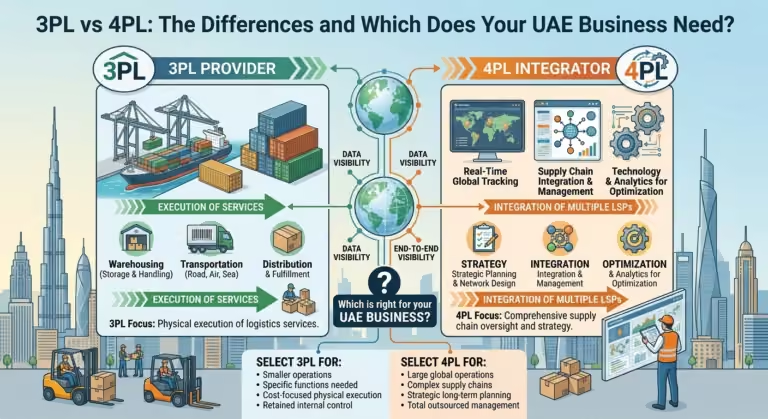
3PL vs 4PL logistics comparison showing warehousing, transportation, distribution, supply chain integration, technology, analytics, and strategic planning for UAE businesses

3PL vs 4PL: What Is the Difference and Which Does Your UAE Business Need?

The difference between a 3PL and a 4PL comes down to one question: do you need a logistics partner that does the work, or one that manages the entire system? 

A 3PL (Third-Party Logistics) provider physically handles your goods, such as warehousing, picking, packing, and shipping. A 4PL (Fourth-Party Logistics) provider sits above that layer, coordinating multiple logistics partners across your full supply chain without necessarily touching the goods themselves.

For most UAE e-commerce businesses, a 3PL is the right starting point and remains the right model well into significant scale. A 4PL becomes relevant when your supply chain spans multiple countries, carriers, and 3PLs that need to be coordinated under a single strategic layer. This guide explains both models clearly, where the line is, and how to know which one your operation actually needs.

Key Takeaways

  • A 3PL handles logistics execution such as warehousing, pick and pack, shipping, and returns, while you retain strategic control of your supply chain.

  • A 4PL manages the entire supply chain strategy, coordinating multiple 3PLs and logistics providers on your behalf, typically without owning warehouses or trucks.

  • In 2026, the best 3PLs increasingly offer capabilities that were traditionally in 4PL territory, such as multi-carrier management, real-time analytics, and cross-channel integration. This is making the distinction less clear-cut than it once was.

  • Secure COD, same-day delivery capability, and Shopify or WooCommerce integration are the UAE-specific 3PL capabilities to evaluate before the 3PL vs 4PL question becomes relevant.

What Is a 3PL (Third-Party Logistics)?

A 3PL provider handles the physical execution of your logistics. They receive your inventory, store it in their warehouse, pick and pack individual orders, dispatch them via courier, and manage returns. 

You retain strategic control: you decide which products to stock, which markets to sell in, and what delivery promises to make. The 3PL executes the operational layer underneath those decisions.

What a 3PL typically covers:

  • Receiving inbound stock and logging it against purchase orders
  • Warehousing and inventory management via a WMS (Warehouse Management System)
  • Pick and pack for individual customer orders
  • Carrier selection and dispatch
  • Last-mile delivery through courier integrations
  • Returns management and reverse logistics
  • Real-time inventory reporting and order tracking

A 3PL owns or leases physical assets and has direct, hands-on involvement in moving your product. A 3PL touches your product, touches your orders, touches your shipments. They are the ones actively driving your customer experience.

In UAE e-commerce, the 3PL also manages COD collection, remittance to the business, and the NDR (Non-Delivery Report) process when a first delivery attempt fails. These are UAE-specific operational functions that can directly affect your customer experience and cash flow.

What Is a 4PL (Fourth-Party Logistics)?

A 4PL provider manages your entire supply chain from a strategic, top-down level. Unlike a 3PL, which handles day-to-day execution, a fourth-party logistics provider oversees the entire supply chain. They typically don’t own warehouses or trucks. Instead, they focus on strategy, optimisation, and orchestration, making sure all logistics partners and systems work together seamlessly across the supply chain.

In practice, a 4PL selects and manages your 3PLs, negotiates carrier contracts, monitors performance across all providers, and builds the technology layer that connects them. You have one point of accountability, i.e. the 4PL, and they handle the coordination with everyone else.

What a 4PL typically covers:

  • Supply chain strategy and network design
  • Selection and management of multiple 3PL providers
  • Carrier negotiation and performance monitoring
  • Technology integration across all logistics systems
  • Cross-border customs strategy and compliance oversight
  • Demand forecasting and inventory positioning across multiple geographies
  • Single reporting layer across the entire supply chain

The global 4PL market reached an estimated USD 72.10 billion in 2025 and is projected to grow from USD 78.01 billion in 2026 to USD 158.61 billion by 2035. That growth reflects the needs of complex multinational businesses rather than those of typical UAE SMEs or mid-market e-commerce brands.

3PL vs 4PL: The Core Differences at a Glance

Aspects 3PL 4PL
What they do Execute logistics operations Manage the entire supply chain
Own physical assets? Yes, warehouse, equipment No, asset-light, strategic layer
Touch your product? Yes, directly handle goods No, coordinate providers who do
Level of control retained by you High, you set strategy Low, 4PL sets strategy on your behalf
Number of providers managed One relationship, your 3PL Multiple, coordinates your 3PLs and carriers
Technology role WMS, carrier integrations Overarching control tower across all systems
Best for Businesses outsourcing operations Enterprises with complex multi-provider supply chains
Typical cost structure Per-order, per-pallet, or per-storage unit Management fee + technology fee on top of 3PL costs
UAE relevance High, suitable for most UAE e-commerce businesses Lower, mainly relevant to businesses with complex supply chains

When Does a 3PL Make Sense for a Business in the UAE?

A 3PL is the right model when your primary logistics need is operational execution, and you want to retain control over which markets you serve, which products you stock, and what your customer experience looks like.

Choose a 3PL when:

  • You ship primarily within the UAE or to GCC markets from a single fulfilment hub
  • Your daily order volume ranges from 20 to several hundred, enough to justify outsourcing, but not enough to require multi-provider coordination
  • COD is a significant share of your order mix, and you need a partner who manages collection, remittance, and NDR workflows as standard
  • You’re on Shopify, WooCommerce, or Magento and need direct platform integration, not a middleware layer
  • You want a single point of accountability for warehouse and delivery performance

When Does a 4PL Make Sense?

A 4PL adds genuine value when coordinating multiple logistics providers has become an operational burden that requires dedicated management. This typically happens at enterprise scale.

Signals that a 4PL might be the right next step:

  • You manage 3+ logistics providers across different geographies and spend significant internal resources on coordinating between them
  • You operate in five or more countries with meaningfully different fulfilment requirements in each
  • Your annual logistics spend is large enough that a 4PL management fee is justified by the savings their optimisation delivers
  • You need a single technology layer across all your carriers, 3PLs, and customs brokers that none of your individual providers can supply

The 2026 Reality: The Lines Are Blurring

The sharpest observation about the 3PL vs 4PL distinction in 2026 is that the gap between the two models is narrowing significantly.

The sharp distinction between 3PL and 4PL is blurring. In 2026, the most advanced 3PLs offer services that were traditionally the domain of 4PLs. This “3PL+” model delivers the operational execution advantages of a traditional 3PL with strategic visibility that previously required a 4PL overlay. For the vast majority of UAE e-commerce businesses, this hybrid structure is optimal.

Jeebly Bizz operates in exactly this space. Inbound freight through Jeebly Haul connects to warehouse receipt and inventory management, which connects to automated dispatch through Jeebly Dash, which connects to real-time OTD and FDSS dashboards, COD management, and returns processing.

That end-to-end visibility, multi-function integration, and platform-level reporting is what businesses historically needed a 4PL to coordinate. In the UAE market, Jeebly Bizz delivers through a single 3PL relationship, without the 4PL management layer and its associated costs.

UAE-Specific Considerations in the 3PL vs 4PL Decision

Global 3PL vs 4PL guides don’t address the specifics of the UAE market. These are the variables that matter in this context.

  • COD management is a 3PL function. COD collection, remittance timing, NDR management, and RTO handling are all executed at the 3PL and last-mile layer. If COD is significant to your business, your 3PL evaluation matters far more than whether you need a 4PL.

  • Emirate-level coverage is a criterion in 3PL evaluations. “UAE-wide delivery” means different things to different providers. The 3PL you choose must have confirmed coverage across all seven emirates, with documented SLAs for each zone.

  • Free zone vs mainland fulfilment structure. The decision about where to hold inventory affects duty liability, domestic delivery speed, and re-export capability. This is a supply chain strategy question that a 4PL might address, but that most UAE businesses can resolve by working with a knowledgeable 3PL or freight forwarder.

  • The GCC expansion moment. When a UAE e-commerce brand expands into Saudi Arabia, Kuwait, or Oman, it typically adds a 3PL in each market rather than immediately appointing a 4PL to manage them all. The coordination overhead of managing two or three GCC 3PLs is manageable without a 4PL until the number of providers and the complexity of cross-border flows justifies it.

For more on how to structure cross-border operations into GCC markets, UAE Import and Export Guide: Trade Documentation, Logistics and Compliance covers the documentation and compliance framework that underpins any GCC expansion.

How Jeebly Covers the 3PL Layer for UAE Businesses

Jeebly Bizz is Jeebly’s full 3PL platform: warehousing, pick-and-pack, automated dispatch, COD management, returns processing, and real-time performance dashboards, integrated directly with Shopify, WooCommerce, Magento, ChatFood, and Grubtech.

For the inbound freight leg, Jeebly Haul covers air, sea, and road freight, with in-house customs clearance, and connects directly to the Jeebly Bizz warehouse receiving workflow.

For last-mile domestic delivery, same-day and next-day delivery across all seven UAE emirates, Jeebly Dash operates at 98% FDSS across 50,000+ daily deliveries with WhatsApp and SMS notifications at dispatch and delivery, photo ePOD at every drop-off, and weekly COD remittance as standard.

Talk to the Jeebly team about your current fulfilment setup. A direct conversation will quickly confirm whether Jeebly Bizz covers your operational requirements and what the cost per order is.

Conclusion

The difference between a 3PL and a 4PL is the difference between a partner who executes your logistics and a partner who manages your entire supply chain. For most UAE e-commerce businesses, a capable 3PL is the right model and remains so until supply chain complexity across multiple geographies justifies the additional management layer and cost that a 4PL provides. 

In 2026, the best 3PLs have already closed much of the gap. The question for most UAE businesses is not 3PL vs 4PL. It is which 3PL has the capabilities, coverage, and UAE-specific experience to support your current stage and scale with you as you grow. 

For a UAE 3PL covering inbound freight, domestic last-mile, fulfilment, COD, and returns through one connected platform, Jeebly Bizz is built for exactly that. Get in touch to discuss your requirements.

Frequently Asked Questions

A 3PL physically handles your logistics (warehousing, picking, packing, and shipping) while you retain strategic control. A 4PL manages your entire supply chain strategy, coordinating multiple 3PLs and logistics providers on your behalf, typically without owning any physical assets like warehouses or trucks. The core distinction is execution vs orchestration.

DHL operates as both, depending on the division. DHL Supply Chain is a 3PL. It physically manages warehousing and fulfilment for enterprise clients. DHL’s supply chain consulting arm provides 4PL-style services. For most businesses, DHL Supply Chain operates as a 3PL.

Amazon FBA operates as a 3PL. It physically stores your inventory in Amazon’s fulfilment centres and handles pick, pack, and delivery. Some argue Amazon’s Marketplace structure has elements of a 4PL, but for practical purposes, Amazon FBA is a 3PL relationship.

When coordinating multiple logistics providers across different geographies has become a dedicated internal resource drain, and when annual logistics spend is large enough that a 4PL’s management fee is recovered through optimisation savings.

Jeebly operates as a 3PL. It physically manages warehousing, pick-and-pack, domestic last-mile delivery, COD collection, and returns through Jeebly Bizz, with freight capabilities through Jeebly Haul. Jeebly’s platform provides multi-function integration and real-time dashboards that give UAE businesses the strategic visibility previously associated with 4PL without a separate management layer or its associated cost.

Routes to insightful reads

3PL vs 4PL logistics comparison showing warehousing, transportation, distribution, supply chain integration, technology, analytics, and strategic planning for UAE businesses
3PL vs 4PL: What Is the Difference and Which Does Your UAE Business Need?

3PL and 4PL logistics models help businesses manage different levels of supply chain operations. This guide explains the key differences between 3PL and 4PL providers, their roles, benefits, costs, and how UAE businesses can choose the right logistics model based on their size, supply chain complexity, and operational needs.

Read More
Types of packaging for courier shipments, showing outer packaging strength, void-fill options, cushioning materials, and sealing and labelling methods
Types of Packaging for Courier Shipments: Which One Best Protects Your Product?

Choosing the right packaging is essential for protecting products during courier transportation. This guide explores different types of packaging for courier shipments, including corrugated boxes, bubble wrap, air pillows, paper fillers, foam inserts, and protective seals, and explains how to choose the best option based on your product, handling needs, and shipping conditions.

Read More
Types of logistics explained through inbound, outbound, reverse and third-party logistics, showing the movement of goods between suppliers, warehouses, customers and return facilities.
Types of Logistics Explained: Inbound, Outbound, Reverse and Third-Party 

Logistics covers much more than moving goods from one place to another. This guide explains the four key types of logistics, inbound, outbound, reverse and third-party logistics (3PL), and how each supports the supply chain. Learn how goods move from suppliers to warehouses, reach customers, return for repair or disposal, and how businesses use 3PL providers to manage logistics operations.

Read More
Dark store in the UAE showing retail inventory, order picking, packaging, and Jeebly last-mile delivery for ultra-fast fulfillment
What Is a Dark Store? How UAE Retailers Are Using Them for Ultra-Fast Delivery

A dark store is a retail facility designed exclusively for online order fulfilment, with products organised for fast picking, packing, and dispatch rather than in-store customer shopping. In the UAE, dark stores are helping retailers and e-commerce businesses shorten delivery times by placing inventory closer to customers and streamlining the fulfilment process. This guide explains how dark stores work, their benefits, key challenges, and how they support ultra-fast delivery in the UAE.

Read More
DDP shipping infographic explaining seller responsibilities, customs clearance, duties, final delivery, and benefits for UAE importers
What Is DDP Shipping? What “Delivered Duty Paid” Means for UAE Importers and Exporters

DDP (Delivered Duty Paid) is an Incoterm that places most shipping, customs, duty, and import tax responsibilities on the seller. For UAE importers and exporters, understanding how DDP works can help businesses estimate landed costs, manage customs requirements, and avoid unexpected charges at delivery. This guide explains what DDP shipping means, who pays the costs, how it compares with DAP and FOB, and what UAE businesses should consider before choosing DDP.

Read More

    Powered by