






Jeebly | Logistics Solutions

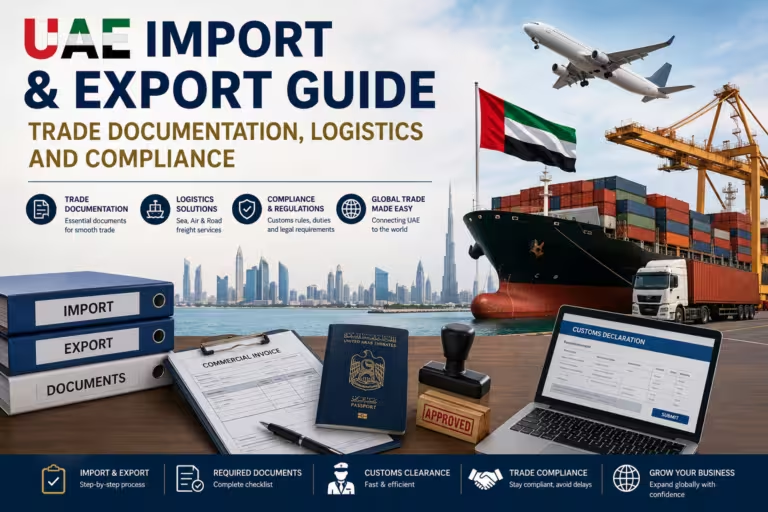
UAE import and export guide featuring trade documentation, cargo ship, air freight, customs clearance and logistics operations

UAE Import and Export Guide: Trade Documentation, Logistics and Compliance

Running import and export operations through the UAE can appear straightforward. The infrastructure is world-class, and the free zones are designed to support international trade.

What trips businesses up are the specifics: Which documents are mandatory for your cargo type? Which HS code applies? Whether free zone or mainland registration suits your trade structure? And how to keep goods moving without accumulating storage fees while a fixable compliance issue sits unresolved?

This guide covers UAE import and export from an operational standpoint. Learn how to choose a logistics partner that manages the cross-border leg without creating a separate operational burden at the domestic end.

Why the UAE Is Built for International Trade ?

UAE sits at a strategic midpoint between Asia, Europe, and Africa, making it a natural re-export centre. The UAE’s extensive network of free zones, including Jebel Ali Free Zone (JAFZA) and Dubai Multi Commodities Centre (DMCC), offers businesses streamlined customs processes, sector-specific infrastructure, and ownership structures designed for international trade.

Combine this with world-class port infrastructure, digital customs systems and automated clearance processes at major trade hubs, and you have an ecosystem built for high-volume international trade.

The UAE has also signed Comprehensive Economic Partnership Agreements (CEPAs) with India, Indonesia, Turkey, Israel, and Jordan, with further agreements in progress.

Setting Up to Trade: Registration and Licensing

Before a single shipment can move legally, a few registrations must be in place.

1) Trade license. To import goods into the UAE, companies must hold the correct trade license issued by the Department of Economic Development (DED) of the relevant emirate. Foreign businesses can establish UAE entities or use approved trade structures, depending on their activities, jurisdictions, and licensing requirements.

2) Customs registration. A customs client code is required before any declaration can be filed through the Dubai Trade Portal. VAT-registered businesses may need to link their Tax Registration Number (TRN) with their customs profile to support VAT processing on imports.

3) IOR/EOR services – trading without a UAE entity. For businesses that want to import or export through the UAE without establishing a local legal presence, Importer of Record (IOR) and Exporter of Record (EOR) services provide an alternative. 

The Importer of Record is legally responsible for an import shipment, ensuring every item complies with local regulations, accurately declaring goods to customs, and paying all applicable taxes and duties. The Exporter of Record manages export documentation, licensing, and compliance with export laws. IOR/EOR services enable international trade without the significant overhead of establishing a local legal presence.

For brands testing the UAE market entry, or businesses with occasional rather than regular import volumes, IOR/EOR is a practical option worth evaluating before committing to full entity setup.

Documents Required for UAE Import and Export

Documentation errors are the single most preventable cause of customs holds. Missing or incorrect documentation is a leading cause of clearance delays. Here is the complete document set, separated by trade type.

Import Documents (Standard)

Document Purpose
Commercial Invoice Itemised value, goods description, buyer/seller details. Must match the packing list exactly.
Packing List Lists the item count, weights, and dimensions for each package.
Bill of Lading / Airway Bill Proof of the shipment contract with the carrier and required for cargo release.
Certificate of Origin Verifies the country of origin and is required when claiming preferential duty treatment under trade agreements such as CEPA.
Import Declaration (Mirsal 2) Filed electronically through the Dubai Trade Portal before or upon cargo arrival.
Trade License Copy Confirms the business is legally authorised to import goods into the UAE.
Customs Duty Payment Proof Required before the customs release order is issued.
Category-Specific Permits (Required in Addition to Core Documents)

Food products need Dubai Municipality approval. Pharmaceuticals require permits from the Ministry of Health and Prevention (MOHAP). Cosmetics may require product registration and approvals through the relevant UAE regulatory authorities, depending on the product category and emirate.

Telecommunications equipment needs TDRA type approval. Chemicals may require approvals, permits, or safety documentation depending on classification and intended use.

Export Documents (Standard)

Document Purpose
Commercial Invoice Goods description, quantity, and declared value.
Packing List Contents and weights for each package.
Export Declaration Filed via Mirsal 2 before the shipment departs.
Certificate of Origin Required by destination customs and for preferential tariff claims.
Airway Bill / Bill of Lading Carrier-issued document for the outbound shipment.
Export Permits (if applicable) Required for controlled or regulated export categories.

Businesses should maintain trade and customs records for the legally required retention period, which is commonly five years for UAE tax records.

UAE Import and Export Costs: The Full Picture

Most businesses model 5% duty and stop there. The actual cost of a UAE import or export is broader in scope.

  1. Customs duty. The standard customs duty in the UAE is 5% of the CIF (Cost, Insurance, and Freight) value for most imported goods. Alcohol is subject to 50% duty. Tobacco products incur 100% duty. Certain categories are exempt from customs duties altogether. Essential items benefit from a 0% customs duty rate.

  2. Import VAT. 5% VAT applies to most imports, calculated on the CIF value plus applicable duty. VAT-registered businesses can recover this through their regular VAT return filing, making VAT registration commercially sensible for most trading companies importing at any meaningful volume.

  3. The duty-free threshold for courier imports. As of January 1, 2023, Dubai Customs lowered the threshold for duty-free shipments from AED 970 to AED 300. This policy applies to goods imported via courier services. For e-commerce businesses importing inventory via courier rather than freight, this threshold change affects every individual parcel below AED 300 that was previously duty-free.

  4. CEPA preferential rates. The UAE has implemented CEPAs with several trading partners, including India, Indonesia, Türkiye, Israel, and Jordan, with additional agreements under negotiation. The certificate of origin must be issued by an authorised body and comply with the rules of origin for the specific agreement.

  5. Port and terminal fees. Port handling fees, storage charges, customs agent fees, and documentation processing costs all accumulate beyond the headline duty rate. For sea freight through Jebel Ali, expect terminal handling charges, delivery order fees, and per-day storage costs if your shipment is delayed in customs.

  6. Storage and demurrage. Every day a shipment sits in a bonded facility after arrival costs money. A three-day documentation hold on a sea freight shipment can add AED 200–400 to your landed cost before the underlying issue is resolved. Accurate, pre-submitted documentation eliminates this cost entirely.

Here’s a quick tax summary in the UAE:

Cost Component Rate / Range
Standard customs duty Generally, 5% of the CIF value for most imported goods.
Import VAT 5% VAT applied on the import value, including customs duty (where applicable).
Alcohol excise/customs duty 50% (depending on applicable product classification and tax rules).
Tobacco and tobacco products 100% excise duty.
Free zone treatment Duty is generally deferred until goods enter the UAE mainland market, subject to customs rules.
CEPA preferential rates Reduced or zero duty rates may apply for qualifying goods based on origin and rules of origin.

Free Zone vs Mainland: Choosing the Right Trade Structure

The decision between importing through a free zone and operating on the UAE mainland has direct financial and operational consequences.

1) Free zone advantages

Goods can generally remain in free zones without standard import duty until they enter the UAE mainland, subject to free zone and customs regulations. Qualifying re-exports from free zones generally avoid UAE import duty because goods have not entered the mainland customs territory.

2) Mainland to free zone, and back again 

When goods leave a free zone for the UAE mainland market, an FZ Transit Out declaration must be submitted through Mirsal 2. At this point, the standard 5% customs duty becomes payable, along with applicable VAT. The duty liability exists at the point of mainland transfer, not at the point of import.

Which structure suits your business:

  • Selling primarily to UAE consumers → mainland registration, standard duty, and VAT apply
  • Re-exporting to GCC or international markets → free zone preferred, duty deferred until mainland sale
  • Testing UAE market entry without a permanent entity → IOR services through an established provider
  • Mixed model (local sale + re-export) → free zone with a mainland distribution arrangement or branch

For a detailed look at how domestic last-mile delivery connects to this decision, the List of Delivery Companies in Dubai covers the domestic distribution options once goods clear customs and enter the UAE market.

How to Structure Your UAE Logistics Operation

Getting documentation and compliance right is step one. Who handles your freight and domestic last-mile delivery determines whether goods actually reach customers on time once they clear customs.

For businesses importing inventory and distributing domestically, this is a two-part operation: cross-border freight (air, sea, or land) and UAE-wide domestic last-mile. Keeping both under a single partner removes the handoff gap, where most delivery problems occur.

  • Jeebly Haul covers the freight side, air, sea, and land, including GCC cross-border routes, with customs clearance handled in-house rather than outsourced to a third-party broker.

  • For the domestic distribution leg, Jeebly Dash covers same-day and next-day delivery across all seven UAE emirates, with direct integrations into Shopify, WooCommerce, Magento, ChatFood, and Grubtech. 

  • And Jeebly Bizz brings warehousing, fulfilment, and reverse logistics into the same platform, so businesses managing inbound freight alongside outbound B2C delivery don’t need two separate vendor relationships.


For a full comparison of UAE domestic delivery providers for the last-mile leg of your import operation, Top Delivery Companies in UAE (2026) covers seven major operators across speed, coverage, and tech integrations.

Talk to the Jeebly team about cross-border freight and domestic delivery requirements.

How Jeebly Handles Cross-Border Freight and Customs.

For businesses that want freight and customs managed by a single partner rather than coordinating between a freight forwarder and a separate customs broker, Jeebly Haul handles both.

For businesses managing regular inbound freight alongside domestic last-mile delivery, Jeebly Bizz connects the entire chain: freight-in, customs clearance, warehousing, and UAE-wide domestic delivery via Jeebly Dash, all tracked on one platform.

If you’re currently managing customs through a separate broker and finding that documentation queries take longer to resolve than they should, talk to the Jeebly team.

Conclusion

UAE import and export is a structured, well-documented process, and the compliance framework is more accessible than most businesses expect once the setup is in place. 

The critical steps are getting your trade license and customs registration sorted before your first shipment arrives, using the correct HS classification, understanding whether free zone or mainland registration suits your trade structure, and claiming CEPA preferential duty rates if your goods originate from qualifying countries. 

Act on each before they become urgent. For businesses that want freight, customs clearance, and UAE domestic delivery managed through a single connected platform, Jeebly Haul and Jeebly Bizz cover the entire chain. 

Get in touch to discuss your trade requirements.

Frequently Asked Questions

The standard rate is 5% of the CIF (Cost, Insurance, Freight) value for most goods. Exceptions include alcohol at 50%, tobacco at 100%, and some essentials at 0%. UAE Free Trade Agreements with India, Indonesia, Turkey, Israel, and Jordan may reduce or eliminate duties for qualifying goods. A certificate of origin compliant with each agreement’s rules of origin is required to claim the preferential rate.

Core documents include the commercial invoice, packing list, bill of lading or airway bill, certificate of origin, import declaration filed via Mirsal 2, trade license copy, and proof of customs duty payment. Category-specific permits apply for food, pharmaceuticals, cosmetics, electronics, and chemicals. These must be obtained before the shipment arrives.

Yes. Goods entering a UAE free zone are exempt from customs duty and VAT while they remain within the zone. Duty becomes payable when goods are transferred to the UAE mainland for local sale. Re-exports from a free zone to international destinations attract no duty.

An Importer of Record (IOR) is legally responsible for an inbound shipment, including customs declarations, duty payment, and regulatory compliance in the UAE. An Exporter of Record (EOR) holds legal responsibility for an outbound shipment, such as export documentation, licensing, and compliance with UAE export regulations. IOR/EOR services allow businesses to trade through the UAE without establishing a local legal entity.

Three changes matter most: 12-digit HS codes are now mandatory for GCC-destined trade (from February 2026) and will extend to all imports from August 2026; pre-arrival declaration for sea cargo via Mirsal 2 is now standard practice and protects against amendment fines; and the FTA’s e-invoicing mandate for B2B and B2G transactions begins with a voluntary pilot in July 2026, becoming mandatory from January 2027.

Routes to insightful reads

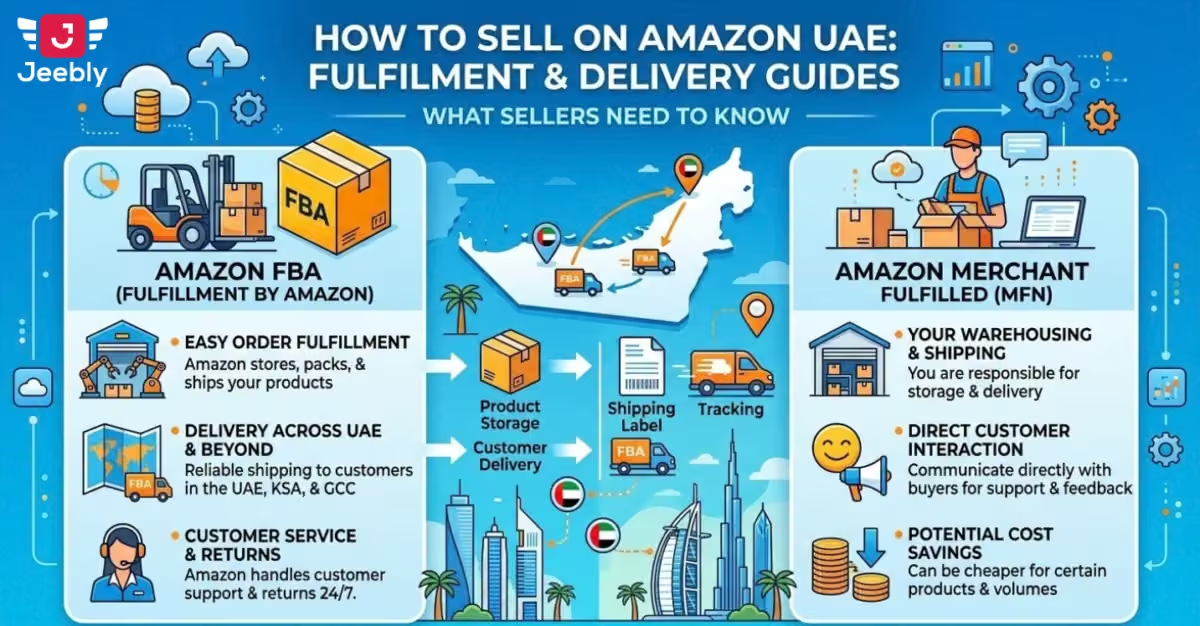
An isometric infographic detailing how to sell on Amazon UAE. The left side covers seller onboarding and listing steps like defining business activity, trade name reservation, and document preparation. The right side compares FBA (Fulfilment by Amazon) and FBM (Fulfilment by Merchant) logistics and delivery models against a Dubai skyline.
How to Sell on Amazon UAE: What Sellers Need to Know About Fulfilment and Delivery

Selling on Amazon UAE offers massive growth potential, but choosing the right logistics model can make or break your margins. Discover the step-by-step onboarding process for Amazon.ae, explore the core differences between Fulfilment by Amazon (FBA) and Fulfilment by Merchant (FBM), and learn how to optimize your delivery strategy to scale efficiently in the UAE market.

Read More
A woman in a black dress and white gloves holds a branded "Jeebly" box next to a white Land Rover Defender with a bougainvillea hedge behind them.
High-Value Item Delivery in the UAE: Insurance, Handling, and What to Ask

Delivering high-value, luxury items in the UAE requires far more than standard shipping—it demands white-glove precision, specialized security protocols, and comprehensive transit insurance. Discover how premium handling, secure transit procedures, and asking the right questions of your courier partner ensure high-ticket goods reach your clients safely, preserving both product integrity and brand trust.

Read More
A Jeebly delivery courier handing over stacked packages outside a Dubai residence to a mother and her school-aged children, with a Jeebly delivery van parked nearby and the Dubai skyline featuring the Burj Khalifa in the background.
Back-to-School Delivery Trends: What UAE Retailers Learned This Season

As the back-to-school rush hits the UAE, retailers face surging demand for fast, flexible, and reliable last-mile deliveries. From school uniforms and backpacks to tech essentials, learn how seamless multi-channel logistics, scheduled doorstep deliveries, and real-time tracking help UAE brands meet evolving parent expectations and turn seasonal spikes into long-term customer loyalty

Read More
A Jeebly delivery rider wearing a helmet and branded jacket riding a black motorcycle with a red and blue branded delivery box mounted on the back.
Urgent Delivery in the UAE: Jeebly Dash Services, Costs and Booking

When speed is everything, traditional delivery options just won’t cut it. Learn how Jeebly Dash provides ultra-fast, on-demand courier services across the UAE—giving businesses and consumers a seamless booking experience, transparent pricing, and real-time tracking to ensure urgent parcels reach their destination within minutes.

Read More
An infographic illustrating how to create an e-commerce returns policy that builds customer trust and reduces refund rates, featuring a split diagram of customer loyalty strategies alongside operational efficiency workflows set against the Dubai skyline.
How to Create a Returns Policy That Wins Customer Trust and Reduces Refund Rates

Mastering returns is a delicate balancing act for e-commerce brands—make it too strict, and you lose customer trust; make it too lenient, and your profit margins take a hit. Discover actionable strategies to build a seamless, customer-first returns policy that converts first-time buyers into loyal brand advocates while optimizing backend operations to keep refund rates and logistics costs low.

Read More

    Powered by