






Jeebly | Logistics Solutions

Categories
blogs

What Is a Delivery Note and Why Does Every UAE Shipment Need One?

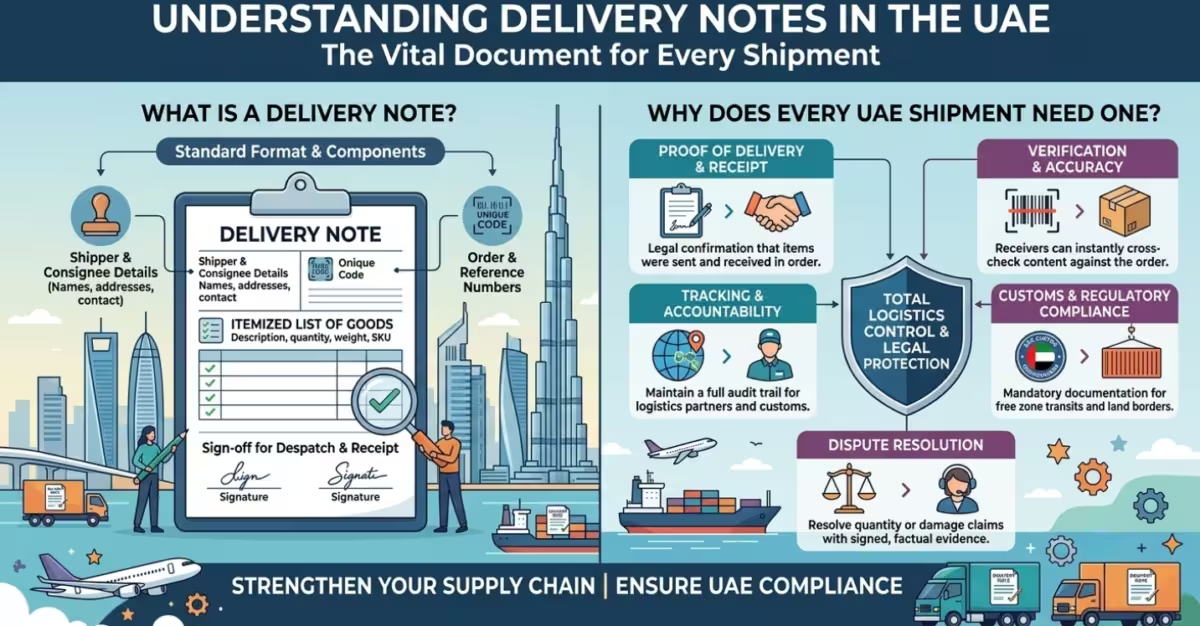
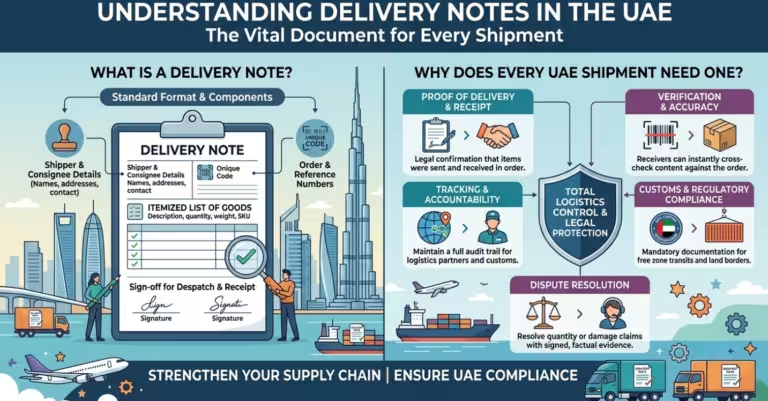
Delivery note document showing shipment details, proof of delivery, tracking, verification and UAE logistics compliance

What Is a Delivery Note and Why Does Every UAE Shipment Need One?

A delivery note is the document that travels with a shipment of goods listing what was sent, in what quantities, and confirming receipt when the goods arrive. It is not an invoice, not a contract, and not optional for any UAE business operating at scale.

When a quantity dispute arises, when a customer claims they received the wrong items, or when an auditor asks for documentation of goods received, the delivery note is the first document both parties reach for. Without one, a shipment is unverifiable at the point of handover.

This guide covers what a delivery note contains, how it works in practice, how it differs from an invoice, the shift from paper to electronic proof of delivery (ePOD) in UAE logistics, and what UAE-specific compliance changes affect delivery documentation.

Key Takeaways

  • A delivery note confirms what was physically sent and received. It travels with the shipment, not separately like an invoice.

  • It does not contain prices; an invoice is the financial document; a delivery note is the delivery record.

  • Electronic proof of delivery (ePOD) (photo, GPS timestamp, digital signature) is the digital evolution of the paper delivery note and is now standard practice in UAE last-mile operations.

  • Keep copies of all delivery notes for a minimum of five years to support dispute resolution and documentation for claims.

  • UAE businesses using a logistics company in the UAE that issues ePODs automatically should ensure the digital record is accessible and searchable.

What Is a Delivery Note? Definition and Core Purpose

A delivery note is a commercial document that accompanies a shipment of goods from sender to recipient. It lists the items included in the delivery, the quantities of each, and identifying details such as the order number, sender information, and recipient information. When the recipient confirms the goods have arrived correctly, the delivery note serves as proof of receipt.

Also referred to as a dispatch note or goods received note depending on who is completing it, the delivery note performs three functions simultaneously:

  1. It confirms dispatch. The sender has a record that these specific items left the warehouse in this condition on this date.

  2. It enables verification. The recipient can check what arrived against what was ordered before signing or confirming. Discrepancies are caught at the point of handover rather than days later.

  3. It creates an evidence trail. If a dispute arises, like a wrong item, short quantity, or damaged goods, the delivery note is the contemporaneous record that documents what both parties agreed was delivered.

For UAE businesses managing high order volumes across multiple emirates, this trail matters more than it might seem. A single consignment of 500 units with an undocumented quantity discrepancy can translate into an inventory reconciliation problem that takes days to resolve without a delivery note.

Delivery Note vs Invoice: What's the Difference?

This is the single most common point of confusion in delivery documentation. The two documents serve different purposes and must not be conflated.

Aspects Delivery Note Invoice
Purpose Confirms physical delivery of goods Requests payment for goods or services
Contains prices? No Yes
When issued At point of delivery, travels with goods After delivery, sent to accounts payable
Who completes it Sender (dispatching party) Seller
Signed by Recipient (on receipt) Seller (issued)
Legal function Proof of delivery and receipt Financial claim/tax document
VAT implications None directly Subject to UAE FTA VAT rules

So, if a shipment of 100 units is delivered and the delivery note says 100 but the invoice says 120, that discrepancy is immediately visible and auditable. Without the delivery note, only the invoice exists, and the buyer has no contemporaneous record of what actually arrived.

What a Delivery Note Should Contain

A well-structured delivery note should include the following fields. Missing any of these creates gaps in the evidentiary trail.

Field Why it matters
Sender name and address Identifies the dispatching party
Recipient name and address Confirms the correct delivery destination
Delivery date Creates a timestamp for the handover
Order number/reference Links the delivery to the original purchase order
Item description Identifies what was sent (SKU, product name)
Quantity per item The most critical field for dispute resolution
Unit of measurement Prevents ambiguity (units, kg, boxes, pallets)
Delivery method/carrier Documents how goods were transported
Signature or confirmation field Proof of receipt by the recipient
Notes or exceptions Records any damage, missing items, or conditions observed at handover

One field that surprises most businesses by its absence: price

A delivery note deliberately excludes prices. The moment you add pricing, you are creating a document that overlaps with the invoice, which creates VAT documentation confusion.

How a Delivery Note Works: The Handover Sequence

The delivery note process follows a repeatable sequence that every UAE business should standardise.

Step 1: Generation at dispatch

When an order is packed and ready to leave the warehouse, a delivery note is generated, ideally automatically from the order management system to eliminate manual data entry errors. The note is either printed and attached to the shipment, or sent digitally to the recipient ahead of arrival.

Step 2: Travel with the goods

The delivery note accompanies the shipment. The courier or driver carries it to the delivery point. It is not sent separately by email or uploaded after the fact. Its purpose is to be present at the point of handover.

Step 3: Recipient verification

On arrival, the recipient checks the delivered items against the delivery note. Any discrepancy, such as a wrong item, short quantity, or damaged goods, is noted on the delivery note before signature.

Step 4: Confirmation

In paper-based systems, the recipient signs and dates the delivery note. The driver retains one copy; the recipient keeps one. In ePOD systems (covered below), digital confirmation is captured automatically.

Step 5: Filing and retention

Both parties retain their copies. Keeping delivery notes for at least five years is advisable to support documentation for disputes or claims. For UAE businesses managing import documentation, this retention period also aligns with FTA audit requirements for VAT-related records.

Paper vs Electronic: Why ePOD Is Now Standard Practice in UAE Logistics

Electronic proof of delivery (ePOD) is the digital evolution of the paper delivery note. Instead of a printed document signed with a pen, ePOD captures:

  • A digital signature from the recipient
  • A timestamped photograph of the delivered goods at the drop-off location
  • GPS coordinates confirming where and when the delivery was completed
  • Automatic data upload to a dashboard accessible in real time by the sender
Factors Paper Delivery Note ePOD (Electronic Proof of Delivery)
Speed of confirmation Manual, delayed Instant
Accuracy Human error risk in data entry Auto-populated from order data
Storage Physical filing required Cloud-based, searchable
Dispute resolution Document retrieval, days Real-time data with timestamp and photo
Customer visibility None until confirmation Notification sent immediately at delivery
Scalability Breaks down at volume Handles 50,000+ deliveries daily

For UAE e-commerce businesses managing same-day and next-day delivery across multiple emirates, ePOD removes the operational ceiling that paper delivery notes create. At 200+ daily orders, manually managing, filing, and retrieving paper delivery notes is a full-time administrative burden. At 2,000 orders, it’s an impossible one.

The WhatsApp confirmation expectation of UAE consumers adds a dimension. A customer who receives a WhatsApp message with a delivery photo from their courier has a real-time ePOD.

Delivery Notes and UAE Compliance in 2026-2027

Two regulatory developments affect how UAE businesses should think about delivery documentation moving forward.

VAT on delivery and the e-invoicing mandate: The UAE FTA has confirmed mandatory e-invoicing for B2B and B2G transactions starting January 2027 for large businesses (annual revenue AED 50M+) and July 2027 for smaller businesses. 

E-invoices will be in structured XML/JSON format via the Peppol network. Delivery notes are distinct from invoices and are not within the scope of the e-invoicing mandate. But businesses should ensure their delivery documentation and invoicing processes are clearly separated, as the FTA’s audit trail requirements will examine both.

FTA audit documentation: UAE FTA VAT audits examine records for up to five years. For any shipment that has a VAT component, including goods, the delivery note forms part of the documentation trail confirming what was supplied and when.

A business that cannot produce delivery notes for a disputed shipment within the five-year audit window is in a weaker position on any supply-side claim.

For a detailed explanation of how VAT applies to shipping and delivery services in the UAE, VAT on Shipping and Delivery Services in UAE covers the full compliance picture.

How Jeebly Handles Delivery Documentation

Jeebly Dash captures a photo ePOD at every domestic delivery and uploads it at the point of drop-off. The delivery record is accessible to the business through the platform dashboard and visible to the customer through their delivery notification.

For businesses managing B2B consignments where the delivery note feeds into accounts payable workflows, Jeebly Bizz connects the delivery confirmation directly to order management. The completed delivery record updates the system automatically, without a manual handoff.

For freight shipments where delivery documentation needs to cover multi-item consignments, pallet quantities, and goods received against purchase orders, Jeebly Haul manages freight documentation alongside transit.

Talk to the Jeebly team if your current delivery partner doesn’t provide ePOD as standard, or if you need a delivery documentation setup that integrates with your inventory management or accounts payable workflo

Conclusion

A delivery note is a small document with significant operational weight. It confirms what was sent, what was received, and creates the contemporaneous evidence that protects both parties when something goes wrong. 

For UAE businesses running e-commerce at any meaningful volume, the paper delivery note has been superseded by ePOD. The transition from paper to digital delivery documentation is not a technology upgrade. It’s a risk management decision.

For delivery documentation that works automatically at every drop-off, Jeebly Dash captures ePOD as standard across 50,000+ daily deliveries. Get in touch to discuss your documentation requirements.

Related Articles:

Frequently Asked Questions

A delivery note is a document that travels with a shipment confirming what goods were sent and in what quantities. The recipient checks the goods against the delivery note on arrival, and signs or digitally confirms receipt. It does not include prices. That’s the invoice’s job.

A delivery note is not specifically mandated by UAE law for domestic trade, but it functions as primary evidence in any goods-related dispute. For businesses in regulated sectors, or those subject to FTA VAT audits, a delivery note forms part of the supply documentation trail covering up to five years of transactions.

A delivery note confirms what was sent and received. The recipient signs it as proof of handover. A packing list is a shipping document listing the contents of a shipment for customs and carrier purposes. Both may travel with a shipment, but serve different functions: the delivery note creates an agreed receipt record; the packing list describes the physical contents for handling and customs.

 Keeping copies of all delivery notes for at least five years is advisable to maintain control over delivered products and provide documentation for disputes or claims. This also aligns with UAE FTA audit documentation requirements for VAT-related supply records.

ePOD (electronic proof of delivery) captures a digital signature, timestamped photo, and GPS-confirmed location at the point of delivery using a mobile device. The data uploads automatically to a cloud dashboard accessible to both sender and recipient. It performs the same function as a paper delivery note but with instant confirmation, searchable records, and no risk of lost paperwork.

Routes to insightful reads

How to get an eCommerce licence in the UAE, showing five steps from selecting a business structure and trade name to submitting the application, paying fees, and obtaining the licence
How to Get an eCommerce Licence in the UAE

Planning to start an eCommerce business in the UAE? Learn how to get an eCommerce licence, choose between mainland and free zone options, prepare the required documents, submit your application, and complete the licensing process to start trading legally in the UAE.

Read More
BNPL in the UAE and its impact on ecommerce delivery and returns, showing the transaction cycle, faster fulfilment, order frequency, real-time tracking, and streamlined returns
Buy Now Pay Later in the UAE: What BNPL Means for eCommerce Delivery and Returns.

Buy Now Pay Later (BNPL) is changing how consumers shop and how eCommerce businesses manage fulfilment and returns in the UAE. This guide explores how BNPL can influence order volumes, delivery demand, fulfilment operations, return rates, refund processing, and the logistics strategies businesses need to support a growing BNPL-driven customer base.

Read More
Infographic explaining how to calculate volumetric weight for shipping, including the formula, measurement example and comparison between actual and chargeable weight.
How to Calculate Volumetric Weight for Shipping: Formula and Examples

Learn how to calculate volumetric weight for shipping with an easy-to-follow formula and practical examples. Understand how package dimensions, actual weight and carrier conversion factors determine the chargeable weight and ultimately impact your shipping costs.

Read More
3PL vs 4PL logistics comparison showing warehousing, transportation, distribution, supply chain integration, technology, analytics, and strategic planning for UAE businesses
3PL vs 4PL: What Is the Difference and Which Does Your UAE Business Need?

3PL and 4PL logistics models help businesses manage different levels of supply chain operations. This guide explains the key differences between 3PL and 4PL providers, their roles, benefits, costs, and how UAE businesses can choose the right logistics model based on their size, supply chain complexity, and operational needs.

Read More
Types of packaging for courier shipments, showing outer packaging strength, void-fill options, cushioning materials, and sealing and labelling methods
Types of Packaging for Courier Shipments: Which One Best Protects Your Product?

Choosing the right packaging is essential for protecting products during courier transportation. This guide explores different types of packaging for courier shipments, including corrugated boxes, bubble wrap, air pillows, paper fillers, foam inserts, and protective seals, and explains how to choose the best option based on your product, handling needs, and shipping conditions.

Read More
Categories
blogs

Dangerous Goods and Restricted Items: What You Cannot Ship by Courier in the UAE

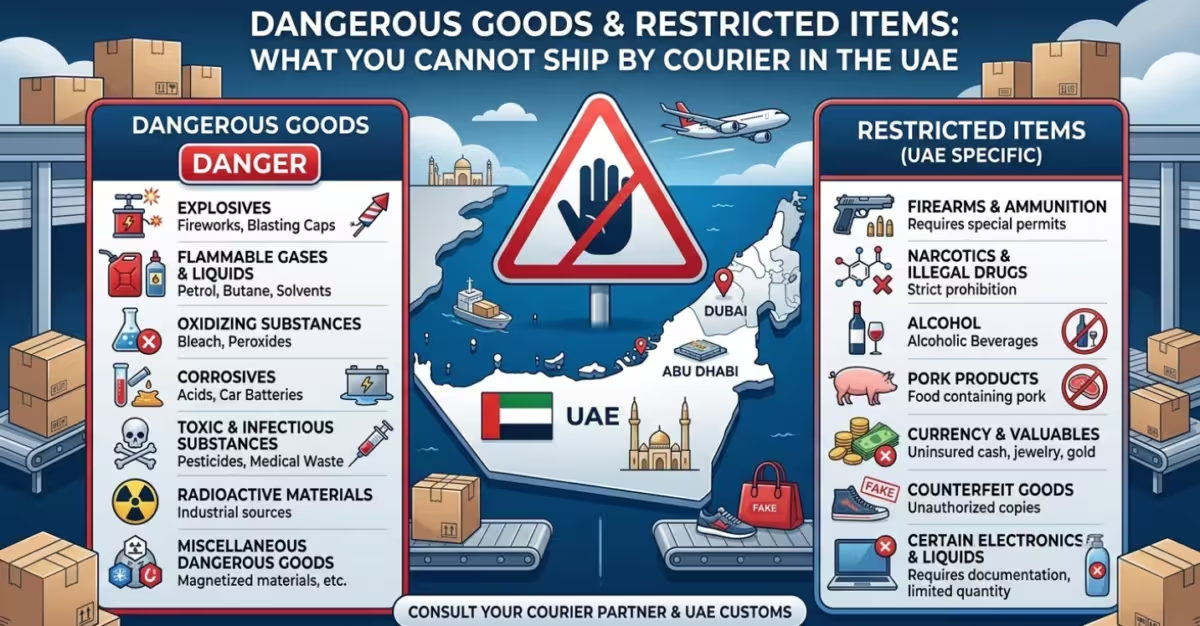
Dangerous goods and restricted items that cannot be shipped by courier in the UAE, including hazardous materials, prohibited products and customs restrictions.

Dangerous Goods and Restricted Items: What You Cannot Ship by Courier in UAE

Many UAE businesses discover their product is a dangerous good at the worst possible moment when a shipment is rejected at the courier’s processing hub, held by Dubai Customs, or returned with a non-compliance notice and a fine. 

Perfume, hand sanitiser, aerosol sprays, nail polish, and lithium battery products are not obviously hazardous goods to most sellers, but they are all regulated as dangerous goods under international courier and UAE customs rules.

This guide covers the three categories of restricted shipping (prohibited, restricted, conditionally accepted), the most common product types that catch UAE businesses off guard, and what to do if your goods fall into the grey zone.

Key Takeaways

  • Dangerous goods fall into three categories: prohibited (never accepted by any carrier), restricted (accepted with documentation, packaging, and labelling), and conditionally accepted (allowed on some modes but not others).

  • Perfume, aerosols, hand sanitiser, nail polish, and lithium battery products are classified as dangerous goods.

  • There are separate restriction lists for Dubai, Abu Dhabi, and Sharjah. Domestic UAE routes are not all governed by the same rules.

  • Flammable liquids, fireworks, and gases are among the most commonly refused items for air transport. Even everyday aerosols and cleaning chemicals can be flagged if they pose a fire or explosion risk.

  • The NAIC (National Advanced Information Centre) requires pre-arrival data submission with accurate six-digit HS codes for all dangerous goods entering the UAE.

The Three Categories: Prohibited, Restricted, and Conditionally Accepted

  • Understanding which tier your goods fall into determines what you can do next.

    1) Prohibited goods 

    These are absolutely off-limits: no carrier, no documentation, and no special permit will move them. Dubai Customs officially prohibits narcotic drugs, gambling tools, nylon fishing nets, live swine, used or reconditioned tyres, radiation-contaminated substances, items against Islamic faith or public morals, and paan or betel leaves. 

    Beyond UAE-specific prohibitions, international carriers will not accept explosives, radioactive materials, biological weapons, or illegally trafficked wildlife products under any conditions.

    2) Restricted goods 

    These can be shipped, but only with the correct classification, documentation, packaging, and labelling. Most “dangerous goods” in the e-commerce context include perfumes, aerosols, lithium batteries, flammable adhesives, and similar items. 

    The conditions that apply vary by carrier, by mode (air, road, sea), and by destination.

    3) Conditionally accepted goods 

    These are allowed on some shipping modes but prohibited on others. Lithium batteries in devices (laptops, phones) can typically ship by road or sea freight but face strict limits on air freight services.

    Many flammable liquids that cannot go by air can be moved by road through the GCC. The right mode depends on the specific goods classification.

    Whether lithium battery products can go by courier or need to be classified as freight depends on quantity, installation state, and watt-hour rating. Courier vs Freight: Key Differences? explains how to determine the right mode for your specific shipment type.

Common UAE E-Commerce Products That Are Regulated as Dangerous Goods

These are the product categories that most often catch UAE businesses off guard. None of them looks obviously hazardous, but all carry regulatory requirements.

  1. Perfumes and fragrances (Class 3 – Flammable Liquids):

Dangerous or hazardous goods, including perfumes, aftershaves, aerosols, flammable substances, and UN-classified dangerous goods, require specific handling and cannot be shipped through standard courier channels without proper documentation. 

Domestically within the UAE by road, small quantities in proper packaging are manageable. International courier service requires full dangerous goods documentation and UN-rated packaging.

  1. Aerosol products (Class 2 – Gases):

Hair sprays, deodorants, cleaning sprays, and insecticides are aerosols. They’re pressurised containers that can explode if punctured or exposed to heat. Aerosols are accepted by most couriers in limited quantities with specific pressure and fill-weight limits, but these vary by carrier and must be declared.

  1. Lithium batteries (Class 9 – Miscellaneous Dangerous Goods):

Lithium batteries in mobile phones can pose a safety risk to airport facilities and aircraft. They’re subject to strict quantity and watt-hour limits on air freight. Batteries shipped standalone (not installed in devices) face the tightest restrictions. 

Batteries installed in devices face limits on state of charge and packaging requirements. Road freight allows higher quantities than air.

  1. Hand sanitiser and alcohol-based cleaning products (Class 3 – Flammable Liquids):

Above 24% alcohol concentration, hand sanitiser is a flammable liquid. The pandemic-era surge in hand sanitiser e-commerce created a wave of incorrectly shipped flammable goods. Most couriers now require proper classification for any alcohol-based cleaning product above threshold concentrations.

  1. Nail polish and nail polish remover (Class 3 – Flammable Liquids):

Both contain acetone or similar flammable solvents. They require flammable liquid classification, UN-rated packaging, and quantity limits per shipment. Standard courier parcels cannot carry unlimited quantities. Most carriers impose 1 litre per inner packaging and 4 litres per outer package limits.

  1. Dry ice (Class 9 – Miscellaneous Dangerous Goods):

Used for temperature-controlled food and pharmaceutical shipments. Dry ice produces carbon dioxide gas as it sublimes, which can displace oxygen in an enclosed space. Carriers impose quantity limits, require ventilation-compatible packaging, and mandate advance declaration.

  1. Power banks and spare lithium batteries:

Power banks must be carried in cabin baggage, not in checked luggage. Most airlines restrict or prohibit power banks in the hold because of the fire risk from lithium batteries. 

For courier shipments, spare lithium batteries (not installed in devices) are among the most restricted items on any carrier’s list. Many carriers will not accept them as standalone items for international air freight.

For regulated goods that can go by sea rather than air, Air Freight vs Ocean Freight in UAE breaks down the cost and compliance trade-off between modes for UAE exporters.

Domestic UAE vs International: The Rules Are Different

A common mistake is applying international air freight rules to domestic UAE courier shipments, or assuming that because something ships within Dubai it can also ship internationally.

Domestic UAE courier (same-emirate and inter-emirate by road): Domestic road courier within the UAE operates under less restrictive rules for many categories of dangerous goods. The key requirements are proper packaging, quantity limits, and accurate shipment descriptions rather than the full IATA dangerous goods documentation set.

International air freight from UAE: Air transport applies IATA Dangerous Goods Regulations (DGR) in full. This means: hazard class classification, UN number, packing group, UN-rated packaging, Shipper’s Declaration for Dangerous Goods, quantity per package limits, and carrier acceptance procedures. Many goods that ship domestically by road cannot go by air at all, or can only go by air in very limited quantities.

The NAIC pre-arrival requirement: For all dangerous goods entering the UAE, the NAIC requires real-time cargo data submission well in advance of physical arrival. Submitting incorrect or incomplete data creates holds before the shipment lands, regardless of how well the packaging and documentation are prepared.

It’s important to keep in mind that the rules for what is allowed change depending on the destination. There are separate lists of restrictions for Dubai, Abu Dhabi, and Sharjah.

What Happens When You Get It Wrong

Most businesses only learn the consequences after they’ve experienced them. These are the four outcomes of incorrectly shipping dangerous goods in the UAE:

  • Shipment rejection at processing: The courier’s hub scans and identifies incorrectly classified goods. The shipment is returned to sender. You pay for the outbound attempt and the return, and your customer receives nothing on the promised date.

  • Customs hold with inspection fees: Incorrectly declared goods arriving at UAE borders trigger a customs hold. Inspection fees, storage fees (charged per day), and potential examination costs accumulate before the goods are released if they’re released at all.

  • Fines for non-compliance: UAE authorities and international carriers both have penalty structures for incorrectly documented dangerous goods. For air shipments, IATA non-compliance fines can be substantial and are documented in the carrier’s acceptance record.

  • Carrier account suspension: Repeated dangerous goods violations can result in a carrier suspending your shipping account. For businesses that rely on one courier partner for their e-commerce fulfilment, this is an operational crisis with no simple short-term resolution.

The cost of a rejected or returned shipment adds up faster than most businesses model. Shipping Costs for Small Businesses in the UAE gives a cost structure so you can model the real risk of non-compliance against the cost of getting it right upfront.

Shipping Dangerous Goods Correctly: What's Required

If your goods are classified as dangerous but not prohibited, the correct process is manageable. It requires preparation.

Step 1: Classify your goods correctly 

Check your product’s Safety Data Sheet (SDS) for the UN number, hazard class, and packing group. If there’s no SDS, contact your supplier. Every regulated product has one.

Step 2: Use UN-rated packaging

Standard cardboard boxes and bubble wrap are not sufficient for dangerous goods. UN-rated packaging specifies the packing group and the substance it’s certified to contain. Your packaging supplier can confirm certification.

Step 3: Label the outer packaging 

Each hazard class has a specific diamond-shaped label with the hazard number. The label size, placement, and colour coding are specified in IATA DGR for air freight and equivalent road freight regulations.

Step 4: Complete the Shipper’s Declaration 

For air freight, this is mandatory. For road freight between GCC countries, equivalent hazmat documentation is required. All entries must be accurate. A single error invalidates the entire declaration.

Step 5: Submit NAIC pre-arrival data

For goods entering the UAE, accurate six-digit HS codes and product descriptions must be submitted to NAIC in advance of physical arrival.

Step 6: Choose a carrier with hazmat certification

Not all couriers accept dangerous goods. Only carriers with certified hazmat personnel and approved dangerous goods acceptance procedures can legally move regulated cargo.

For freight-classified dangerous goods like bulk chemicals, industrial supplies, high-volume aerosols, or cargo exceeding domestic courier limits, Jeebly Haul covers air, sea, and road freight with in-house customs clearance across UAE and GCC routes. 

For domestic UAE shipments of goods in the conditionally accepted category, speak to the Jeebly team before booking to confirm which service and which documentation applies to your specific product and route.

Related Articles:

Frequently Asked Questions

Any substance or article classified under the nine internationally recognised hazard classes, including flammable liquids (perfumes, hand sanitiser, nail polish), aerosols, lithium batteries, corrosives, gases, and oxidising substances. If your product has a Safety Data Sheet or a UN number on its packaging, it is regulated. The UAE applies IATA rules for air freight and ADR-equivalent rules for road freight.

Domestically within the UAE by road courier, small quantities of perfume in correctly packaged condition are generally accepted by carriers that have dangerous goods capability. Internationally by air, perfume requires full flammable liquid classification, UN-rated packaging, and a Shipper’s Declaration. Standard courier booking without a dangerous goods declaration will result in rejection at processing.

Prohibited items cannot be shipped under any conditions, including narcotics, explosives, and items banned under UAE customs law. Restricted items can be shipped but require specific documentation, packaging, and labelling. Most dangerous goods in the e-commerce context fall here. Conditionally accepted items can ship on some modes (road) but not others (air), depending on quantity and classification.

The most common outcomes are: shipment rejection and return at the courier’s processing hub, a customs hold with daily storage and inspection fees at UAE borders, regulatory fines for non-compliant documentation, or carrier account suspension for repeat violations. Incorrect air freight declarations carry the most significant penalties.

Jeebly Haul handles freight-classified dangerous goods including bulk chemicals, industrial supplies, and regulated cargo requiring specialist handling with air, sea, and road freight options and in-house customs clearance. For domestic UAE courier shipments of conditionally accepted categories, contact the Jeebly team to confirm which service applies to your specific product and documentation requirements before booking.

Routes to insightful reads

How to get an eCommerce licence in the UAE, showing five steps from selecting a business structure and trade name to submitting the application, paying fees, and obtaining the licence
How to Get an eCommerce Licence in the UAE

Planning to start an eCommerce business in the UAE? Learn how to get an eCommerce licence, choose between mainland and free zone options, prepare the required documents, submit your application, and complete the licensing process to start trading legally in the UAE.

Read More
BNPL in the UAE and its impact on ecommerce delivery and returns, showing the transaction cycle, faster fulfilment, order frequency, real-time tracking, and streamlined returns
Buy Now Pay Later in the UAE: What BNPL Means for eCommerce Delivery and Returns.

Buy Now Pay Later (BNPL) is changing how consumers shop and how eCommerce businesses manage fulfilment and returns in the UAE. This guide explores how BNPL can influence order volumes, delivery demand, fulfilment operations, return rates, refund processing, and the logistics strategies businesses need to support a growing BNPL-driven customer base.

Read More
Infographic explaining how to calculate volumetric weight for shipping, including the formula, measurement example and comparison between actual and chargeable weight.
How to Calculate Volumetric Weight for Shipping: Formula and Examples

Learn how to calculate volumetric weight for shipping with an easy-to-follow formula and practical examples. Understand how package dimensions, actual weight and carrier conversion factors determine the chargeable weight and ultimately impact your shipping costs.

Read More
3PL vs 4PL logistics comparison showing warehousing, transportation, distribution, supply chain integration, technology, analytics, and strategic planning for UAE businesses
3PL vs 4PL: What Is the Difference and Which Does Your UAE Business Need?

3PL and 4PL logistics models help businesses manage different levels of supply chain operations. This guide explains the key differences between 3PL and 4PL providers, their roles, benefits, costs, and how UAE businesses can choose the right logistics model based on their size, supply chain complexity, and operational needs.

Read More
Types of packaging for courier shipments, showing outer packaging strength, void-fill options, cushioning materials, and sealing and labelling methods
Types of Packaging for Courier Shipments: Which One Best Protects Your Product?

Choosing the right packaging is essential for protecting products during courier transportation. This guide explores different types of packaging for courier shipments, including corrugated boxes, bubble wrap, air pillows, paper fillers, foam inserts, and protective seals, and explains how to choose the best option based on your product, handling needs, and shipping conditions.

Read More

    Powered by