

Jeebly | Logistics Solutions

Categories
blogs

What Is a Delivery Note and Why Does Every UAE Shipment Need One?

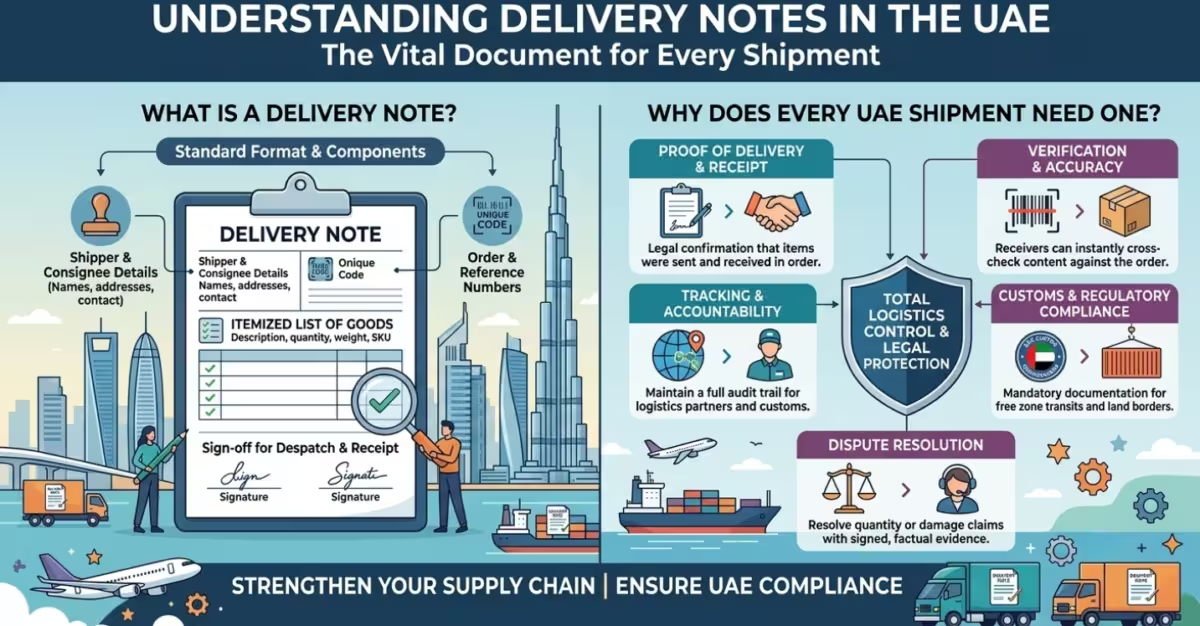
Delivery note document showing shipment details, proof of delivery, tracking, verification and UAE logistics compliance

What Is a Delivery Note and Why Does Every UAE Shipment Need One?

A delivery note is the document that travels with a shipment of goods listing what was sent, in what quantities, and confirming receipt when the goods arrive. It is not an invoice, not a contract, and not optional for any UAE business operating at scale.

When a quantity dispute arises, when a customer claims they received the wrong items, or when an auditor asks for documentation of goods received, the delivery note is the first document both parties reach for. Without one, a shipment is unverifiable at the point of handover.

This guide covers what a delivery note contains, how it works in practice, how it differs from an invoice, the shift from paper to electronic proof of delivery (ePOD) in UAE logistics, and what UAE-specific compliance changes affect delivery documentation.

Key Takeaways

  • A delivery note confirms what was physically sent and received. It travels with the shipment, not separately like an invoice.

  • It does not contain prices; an invoice is the financial document; a delivery note is the delivery record.

  • Electronic proof of delivery (ePOD) (photo, GPS timestamp, digital signature) is the digital evolution of the paper delivery note and is now standard practice in UAE last-mile operations.

  • Keep copies of all delivery notes for a minimum of five years to support dispute resolution and documentation for claims.

  • UAE businesses using a logistics company in the UAE that issues ePODs automatically should ensure the digital record is accessible and searchable.

What Is a Delivery Note? Definition and Core Purpose

A delivery note is a commercial document that accompanies a shipment of goods from sender to recipient. It lists the items included in the delivery, the quantities of each, and identifying details such as the order number, sender information, and recipient information. When the recipient confirms the goods have arrived correctly, the delivery note serves as proof of receipt.

Also referred to as a dispatch note or goods received note depending on who is completing it, the delivery note performs three functions simultaneously:

  1. It confirms dispatch. The sender has a record that these specific items left the warehouse in this condition on this date.

  2. It enables verification. The recipient can check what arrived against what was ordered before signing or confirming. Discrepancies are caught at the point of handover rather than days later.

  3. It creates an evidence trail. If a dispute arises, like a wrong item, short quantity, or damaged goods, the delivery note is the contemporaneous record that documents what both parties agreed was delivered.

For UAE businesses managing high order volumes across multiple emirates, this trail matters more than it might seem. A single consignment of 500 units with an undocumented quantity discrepancy can translate into an inventory reconciliation problem that takes days to resolve without a delivery note.

Delivery Note vs Invoice: What's the Difference?

This is the single most common point of confusion in delivery documentation. The two documents serve different purposes and must not be conflated.

Aspects Delivery Note Invoice
Purpose Confirms physical delivery of goods Requests payment for goods or services
Contains prices? No Yes
When issued At point of delivery, travels with goods After delivery, sent to accounts payable
Who completes it Sender (dispatching party) Seller
Signed by Recipient (on receipt) Seller (issued)
Legal function Proof of delivery and receipt Financial claim/tax document
VAT implications None directly Subject to UAE FTA VAT rules

So, if a shipment of 100 units is delivered and the delivery note says 100 but the invoice says 120, that discrepancy is immediately visible and auditable. Without the delivery note, only the invoice exists, and the buyer has no contemporaneous record of what actually arrived.

What a Delivery Note Should Contain

A well-structured delivery note should include the following fields. Missing any of these creates gaps in the evidentiary trail.

Field Why it matters
Sender name and address Identifies the dispatching party
Recipient name and address Confirms the correct delivery destination
Delivery date Creates a timestamp for the handover
Order number/reference Links the delivery to the original purchase order
Item description Identifies what was sent (SKU, product name)
Quantity per item The most critical field for dispute resolution
Unit of measurement Prevents ambiguity (units, kg, boxes, pallets)
Delivery method/carrier Documents how goods were transported
Signature or confirmation field Proof of receipt by the recipient
Notes or exceptions Records any damage, missing items, or conditions observed at handover

One field that surprises most businesses by its absence: price. 

A delivery note deliberately excludes prices. The moment you add pricing, you are creating a document that overlaps with the invoice, which creates VAT documentation confusion.

How a Delivery Note Works: The Handover Sequence

The delivery note process follows a repeatable sequence that every UAE business should standardise.

Step 1: Generation at dispatch

When an order is packed and ready to leave the warehouse, a delivery note is generated, ideally automatically from the order management system to eliminate manual data entry errors. The note is either printed and attached to the shipment, or sent digitally to the recipient ahead of arrival.

Step 2: Travel with the goods

The delivery note accompanies the shipment. The courier or driver carries it to the delivery point. It is not sent separately by email or uploaded after the fact. Its purpose is to be present at the point of handover.

Step 3: Recipient verification

On arrival, the recipient checks the delivered items against the delivery note. Any discrepancy, such as a wrong item, short quantity, or damaged goods, is noted on the delivery note before signature.

Step 4: Confirmation

In paper-based systems, the recipient signs and dates the delivery note. The driver retains one copy; the recipient keeps one. In ePOD systems (covered below), digital confirmation is captured automatically.

Step 5: Filing and retention

Both parties retain their copies. Keeping delivery notes for at least five years is advisable to support documentation for disputes or claims. For UAE businesses managing import documentation, this retention period also aligns with FTA audit requirements for VAT-related records.

Paper vs Electronic: Why ePOD Is Now Standard Practice in UAE Logistics

Electronic proof of delivery (ePOD) is the digital evolution of the paper delivery note. Instead of a printed document signed with a pen, ePOD captures:

  • A digital signature from the recipient
  • A timestamped photograph of the delivered goods at the drop-off location
  • GPS coordinates confirming where and when the delivery was completed
  • Automatic data upload to a dashboard accessible in real time by the sender
Factors Paper Delivery Note ePOD (Electronic Proof of Delivery)
Speed of confirmation Manual, delayed Instant
Accuracy Human error risk in data entry Auto-populated from order data
Storage Physical filing required Cloud-based, searchable
Dispute resolution Document retrieval, days Real-time data with timestamp and photo
Customer visibility None until confirmation Notification sent immediately at delivery
Scalability Breaks down at volume Handles 50,000+ deliveries daily

For UAE e-commerce businesses managing same-day and next-day delivery across multiple emirates, ePOD removes the operational ceiling that paper delivery notes create. At 200+ daily orders, manually managing, filing, and retrieving paper delivery notes is a full-time administrative burden. At 2,000 orders, it’s an impossible one.

The WhatsApp confirmation expectation of UAE consumers adds a dimension. A customer who receives a WhatsApp message with a delivery photo from their courier has a real-time ePOD.

Delivery Notes and UAE Compliance in 2026-2027

Two regulatory developments affect how UAE businesses should think about delivery documentation moving forward.

VAT on delivery and the e-invoicing mandate: The UAE FTA has confirmed mandatory e-invoicing for B2B and B2G transactions starting January 2027 for large businesses (annual revenue AED 50M+) and July 2027 for smaller businesses. 

E-invoices will be in structured XML/JSON format via the Peppol network. Delivery notes are distinct from invoices and are not within the scope of the e-invoicing mandate. But businesses should ensure their delivery documentation and invoicing processes are clearly separated, as the FTA’s audit trail requirements will examine both.

FTA audit documentation: UAE FTA VAT audits examine records for up to five years. For any shipment that has a VAT component, including goods, the delivery note forms part of the documentation trail confirming what was supplied and when.

A business that cannot produce delivery notes for a disputed shipment within the five-year audit window is in a weaker position on any supply-side claim.

For a detailed explanation of how VAT applies to shipping and delivery services in the UAE, VAT on Shipping and Delivery Services in UAE covers the full compliance picture.

How Jeebly Handles Delivery Documentation

Jeebly Dash captures a photo ePOD at every domestic delivery and uploads it at the point of drop-off. The delivery record is accessible to the business through the platform dashboard and visible to the customer through their delivery notification.

For businesses managing B2B consignments where the delivery note feeds into accounts payable workflows, Jeebly Bizz connects the delivery confirmation directly to order management. The completed delivery record updates the system automatically, without a manual handoff.

For freight shipments where delivery documentation needs to cover multi-item consignments, pallet quantities, and goods received against purchase orders, Jeebly Haul manages freight documentation alongside transit.

Talk to the Jeebly team if your current delivery partner doesn’t provide ePOD as standard, or if you need a delivery documentation setup that integrates with your inventory management or accounts payable workflo

Conclusion

A delivery note is a small document with significant operational weight. It confirms what was sent, what was received, and creates the contemporaneous evidence that protects both parties when something goes wrong. 

For UAE businesses running e-commerce at any meaningful volume, the paper delivery note has been superseded by ePOD. The transition from paper to digital delivery documentation is not a technology upgrade. It’s a risk management decision.

For delivery documentation that works automatically at every drop-off, Jeebly Dash captures ePOD as standard across 50,000+ daily deliveries. Get in touch to discuss your documentation requirements.

Related Articles:

Frequently Asked Questions

A delivery note is a document that travels with a shipment confirming what goods were sent and in what quantities. The recipient checks the goods against the delivery note on arrival, and signs or digitally confirms receipt. It does not include prices. That’s the invoice’s job.

A delivery note is not specifically mandated by UAE law for domestic trade, but it functions as primary evidence in any goods-related dispute. For businesses in regulated sectors, or those subject to FTA VAT audits, a delivery note forms part of the supply documentation trail covering up to five years of transactions.

A delivery note confirms what was sent and received. The recipient signs it as proof of handover. A packing list is a shipping document listing the contents of a shipment for customs and carrier purposes. Both may travel with a shipment, but serve different functions: the delivery note creates an agreed receipt record; the packing list describes the physical contents for handling and customs.

 Keeping copies of all delivery notes for at least five years is advisable to maintain control over delivered products and provide documentation for disputes or claims. This also aligns with UAE FTA audit documentation requirements for VAT-related supply records.

ePOD (electronic proof of delivery) captures a digital signature, timestamped photo, and GPS-confirmed location at the point of delivery using a mobile device. The data uploads automatically to a cloud dashboard accessible to both sender and recipient. It performs the same function as a paper delivery note but with instant confirmation, searchable records, and no risk of lost paperwork.

Routes to insightful reads

Infographic guide for selling on Noon UAE in 2026, showing seller registration steps, product cataloguing, FBN and FBP logistics options, a Jeebly delivery van, and the Dubai skyline.
How to Sell on Noon in the UAE in 2026

Expanding your e-commerce footprint across the Middle East starts with Noon—the UAE’s leading homegrown digital marketplace. Whether you are a local startup or an established retail brand, succeeding in 2026 requires understanding trade license compliance, optimizing catalog listings, and selecting the right fulfillment model between FBN and FBP. Explore our complete guide to selling on Noon UAE, covering onboarding essentials, commission structures, and how partnering with reliable last-mile delivery providers like Jeebly helps you scale faster.
Read More
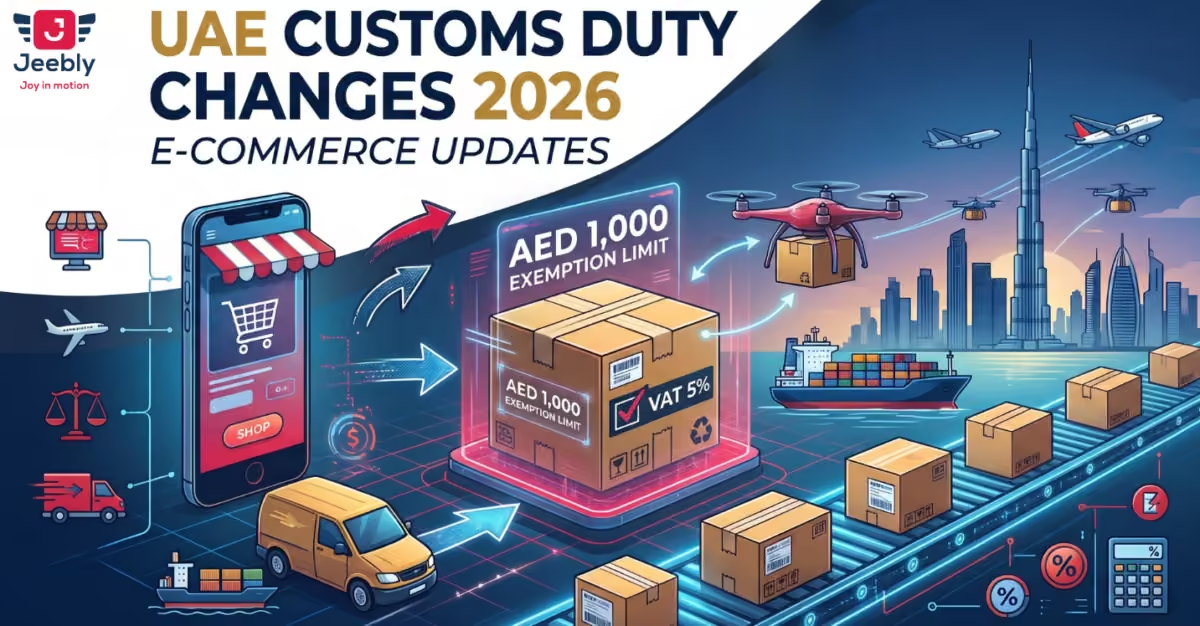
Infographic banner featuring the Jeebly logo, highlighting 2026 UAE customs duty updates for e-commerce with a Dubai skyline, delivery vans, cargo ships, conveyor belt parcels, and the AED 1,000 exemption limit.
UAE Customs Duty Changes for E-Commerce (2026)

With rapid expansions across the GCC digital commerce landscape, the UAE has implemented updated customs duty policies and clearance procedures for cross-border e-commerce shipments in 2026. From managing the AED 1,000 personal import exemption and 5% VAT rules to navigating commercial parcel compliance and streamlined last-mile delivery, discover how these regulatory shifts impact online retailers, logistics providers, and shoppers across the Emirates.

Read More
A Jeebly courier driver carrying a parcel while wiping sweat on a sunny Dubai street, with a second driver drinking water by a delivery van, illustrating UAE heat logistics and temperature-sensitive shipping challenges.
UAE Summer Delivery: Heat Effects on Couriers, Packaging and Timelines

Operating last-mile delivery in the UAE requires navigating challenging weather and heat conditions year-round. From protecting courier health to using insulated packaging and adjusting transit schedules, discover how top logistics providers keep temperature-sensitive parcels safe and on time across Dubai and the GCC.

Read More
Jeebly delivery van and driver holding a branded parcel against the Dubai skyline, featuring a digital route optimisation map interface.
What Is Route Optimisation in Last-Mile Delivery?

Last-mile delivery is the most critical—and expensive—leg of the supply chain. Discover how route optimisation leverages real-time data, traffic analytics, and smart scheduling to cut operational costs, beat urban gridlock, and ensure on-time deliveries across the UAE.
Read More
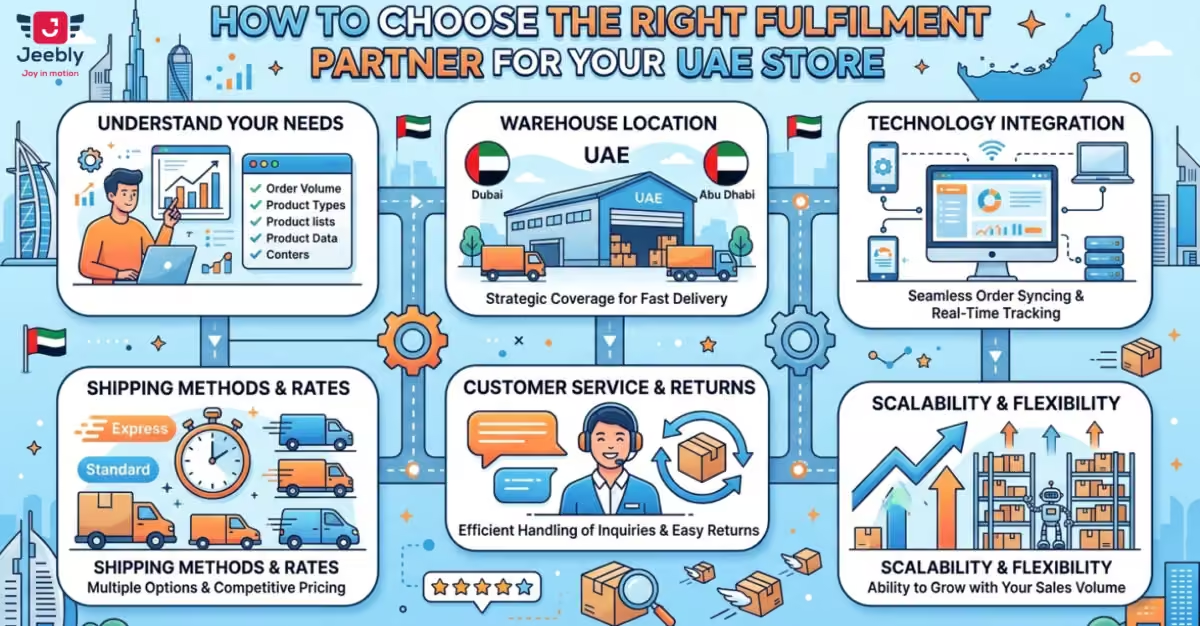
An infographic detailing six steps to choose the right fulfillment partner for a UAE store: understand needs, warehouse location (Dubai/Abu Dhabi), technology integration, shipping methods, customer service, and scalability, set against a UAE city skyline
How to Choose the Right Fulfilment Partner for Your UAE Store

Selecting the right fulfillment partner can make or break your e-commerce growth in the UAE. From strategic warehouse locations in Dubai and Abu Dhabi to seamless tech integration, learn the six critical factors every online store must evaluate to lower costs, ensure same-day delivery, and scale efficiently across the GCC.

Read More

    Powered by