
Jeebly | Logistics Solutions

Categories
blogs

UAE Summer Delivery: Heat Effects on Couriers, Packaging and Timelines

A Jeebly courier driver carrying a parcel while wiping sweat on a sunny Dubai street, with a second driver drinking water by a delivery van, illustrating UAE heat logistics and temperature-sensitive shipping challenges.

UAE Summer Delivery: Heat Effects on Couriers, Packaging and Timelines

Summer in the UAE is not simply hot weather. It is an operational variable that directly affects delivery timelines, packaging integrity, and courier capacity every year. Delivery vehicles without temperature control become mobile ovens. And the UAE’s Midday Work Ban, enforced by MoHRE for the 22nd consecutive year in 2026, legally restricts outdoor courier work between 12:30 pm and 3:00 pm daily throughout the summer period.

For UAE businesses shipping cosmetics, chocolate, candles, electronics, or any temperature-sensitive product, summer is a logistics planning challenge that determines whether orders arrive in acceptable condition and whether delivery windows can actually be met.

This guide explains how UAE summer heat affects courier operations, packaging, delivery timelines, and which product categories carry the highest risk, along with the operational steps to manage each.

Key Takeaways

  • The UAE Midday Work Ban prohibits outdoor courier work between 12:30 pm and 3:00 pm from 15 June to 15 September. This directly compresses available delivery windows during peak summer months.

  • Delivery vehicles without temperature control can reach much higher interior temperatures, increasing the risk of heat damage to sensitive products.

  • Cosmetics, chocolate, candles, supplements, electronics with battery components, and pharmaceuticals are the product categories most vulnerable to heat damage during transit.

  • Temperature fluctuations between air-conditioned storage and hot outdoor delivery vehicles cause condensation inside packages.

  • In a growing UAE cold chain market, temperature-controlled delivery is now a mainstream commercial requirement.

How the UAE Midday Work Ban Affects Delivery Operations

The UAE Occupational Heat Stress Prevention Policy, commonly called the Midday Work Ban, has been enforced every summer since 2005. In 2026, it runs from 15 June to 15 September and prohibits outdoor work under direct sunlight between 12:30 pm and 3:00 pm daily.

The policy applies to every outdoor worker in the UAE, including delivery riders. Under a clarification issued by MoHRE in July 2026, delivery riders cannot be compelled to work during the banned hours. To support compliance, MoHRE expanded a nationwide network of more than 12,000 air-conditioned rest stations for delivery workers across the UAE during summer 2026.

What does this mean for delivery timelines?

The 12:30 pm–3:00 pm window is 2.5 hours of reduced courier availability every day for 93 consecutive days. For businesses scheduling same-day deliveries, this creates a practical constraint such as: 

  • Orders placed before approximately 11:00 am can dispatch and reach the customer before the midday restriction. 
  • Orders placed between 11:00 am and 3:00 pm may be delayed as couriers finish pre-restriction runs or resume operations after the ban lifts at 3:00pm.

Scheduled and next-day deliveries are less directly affected. The total daily delivery window is compressed, but the following day’s delivery target provides enough time to accommodate the restriction.

For businesses scheduling urgent or same-day orders during summer months, the most practical step is to time the booking around the midday restriction window. How to Schedule a Same-Day Delivery in the UAE with Jeebly explains the process step by step.

How UAE Summer Heat Affects Delivery Timelines

Beyond the Midday Work Ban, heat affects courier operating efficiency through several compounding mechanisms.

1) Reduced daily delivery capacity: Riders complete fewer orders per hour during extreme heat because the physical toll of outdoor temperatures reduces overall throughput, even during permitted hours. Platforms managing this proactively route fewer orders per rider during peak heat periods.

2) Vehicle performance: Delivery vehicles, particularly motorcycles and small vans, degrade in sustained 45°C+ ambient temperatures. Tyre pressure, battery performance, and engine cooling all require more frequent attention during summer, adding time to daily operations.

3) Customer availability: UAE residents reducing outdoor activity, irregular working hours, and increased time away during school holidays affect whether customers are home to receive deliveries or have cash available for COD. As a direct result, failed first delivery attempts increase during summer months, extending the effective delivery timeline when re-attempts are required.

4) Inter-emirate variability: Northern and eastern emirates (Ras Al Khaimah, Fujairah, and parts of Sharjah) have their own heat and road condition variables that affect transit times. Delivery timelines quoted for Dubai may not apply to routes that require additional travel through exposed highway sections during peak afternoon hours.

For a clear breakdown of realistic delivery timelines by service tier across UAE emirates, this piece on How Long Does Delivery Take in UAE? Timelines by Service Type gives the benchmarks to set accurate customer expectations during summer.

Which Products Are Most at Risk from UAE Summer Heat?

Not all products face the same risk. The following categories carry a materially higher probability of heat damage during UAE summer transit.

Product category Heat risk Specific effect
Chocolate and confectionery High Melts easily and is irreversible in most cases
Candles High Deform or melt during transit in hot vehicles
Cosmetics and skincare Medium–High Formulation separation, texture change, fragrance degradation
Supplements and wellness products Medium–High Efficacy loss, capsule deformation
Electronics (lithium battery products) Medium Lithium battery performance and safety affected, risk of swelling
Pharmaceuticals High Therapeutic efficacy at risk, regulatory non-compliance if cold chain is broken
Adhesives and sealants Medium Viscosity change, premature curing
Fresh flowers High Wilt rapidly without temperature control
Food products High Spoilage, food safety risk

Damage isn’t only caused by outside temperature. Temperature fluctuations between air-conditioned storage and hot delivery vehicles cause condensation inside packages. This can affect product integrity in ways the customer may not see until they open the parcel.

How Does Summer Heat Affect Packaging Materials?

Heat degrades the packaging that protects it. UAE businesses using standard corrugated boxes, adhesive tape, or poly mailers should understand what summer temperatures do to each.

  • Corrugated boxes: Corrugated cardboard absorbs moisture from condensation. Humid summer air entering a hot vehicle and condensing on cooler packaging weakens the board’s structural integrity over time.


  • Adhesive tape: Standard packing tape loses adhesion at high temperatures. A parcel sealed in an air-conditioned packing station and then placed in a 55°C vehicle risks seal failure during transit. Heat-resistant tape is the correct choice for UAE summer parcels.


  • Poly mailers: Standard poly mailers retain integrity at UAE summer temperatures but provide zero insulation. For temperature-sensitive products that are also low-weight and non-fragile, a poly mailer with an internal insulating liner is a lower-cost alternative to a fully insulated box.


  • Bubble wrap and foam: Heat-induced expansion and contraction of bubble wrap cushioning can degrade its protective properties over a transit cycle in extreme temperatures. For fragile products, factor this into packaging design during summer months.


For a complete guide to packaging material selection and how each performs in UAE summer conditions, Types of Packaging for Courier Shipments: Which One Protects Your Product Best? covers every format with UAE-specific context.

What Can UAE Businesses Do to Protect Shipments in Summer?

These operational steps reduce the risk of summer heat damage to an acceptable level.

  1. Use insulated packaging for heat-sensitive products. Insulated shipping boxes with thermal liners keep internal temperatures well below ambient for standard courier transit times. For chocolate, candles, and cosmetics, this is an effective intervention. Gel packs extend the cooling window further for products with tight temperature tolerance. 

  2. Schedule dispatches outside the peak heat window. For same-day deliveries during summer, dispatch early in the morning, before 10:00 am where possible, to minimise the time the parcel spends in a hot vehicle during the hottest part of the day. For next-day deliveries, dispatch in the late afternoon (after 4:00 pm) keeps the parcel in transit during cooler evening hours.

  3. Choose heat-resistant tape. Confirm that your packing station stocks tape rated for high-temperature adhesion. Standard tape at 60°C ambient temperature has significantly reduced peel resistance. This is a low-cost change with a meaningful impact on parcel seal integrity during summer.

  4. Review corrugated box weight limits during summer. Reduce the maximum stacking weight applied to corrugated boxes during June–September. If your 5-ply boxes are rated to a specific load at ambient temperature, apply a conservative safety margin during summer months to account for moisture-weakened board.

  5. Communicate summer timelines proactively to customers. The Midday Work Ban is public knowledge, but many online shoppers don’t connect it to their delivery expectations. A delivery note like “Summer deliveries in the UAE may experience a 1–2 hour variation due to UAE heat protection regulations for delivery riders, 15 June–15 September” sets accurate expectations without alarming customers.

  6. Confirm courier summer protocols before peak season. Ask your courier partner specifically: how are summer delivery operations structured? Is dispatch time adjusted? Are riders capped on orders per hour? What is the plan for temperature-sensitive product categories? A courier with no structured summer protocol is harder to predict during June–September.

If you are evaluating UAE couriers on summer delivery protocols, Best Courier Services in UAE: 2026 Comparison Guide benchmarks the major operators across the criteria that determine real-world summer performance.

What About Temperature-Controlled Delivery in the UAE?

For product categories where standard packaging adaptations are insufficient, like pharmaceuticals, medical devices, certain food products, and regulated cosmetics, full cold chain delivery is the appropriate solution.

Cold chain delivery is basically a temperature-controlled supply chain process that keeps perishable or sensitive goods at a specific, stable temperature from the point of manufacture or harvest to the final user.

The UAE cold chain logistics market is estimated at USD 0.71 billion in 2025 and is expected to reach USD 1.15 billion by 2030 at a CAGR of 10.29%. That growth reflects a market moving toward routine temperature-controlled logistics in categories that previously relied on insulated packaging as a workaround.

For e-commerce businesses shipping cosmetics, supplements, or food during UAE summer, the question isn’t whether to use cold chain. It is whether your product requires active refrigeration or whether high-quality insulation for a standard transit window is sufficient.

How Jeebly Handles Summer Delivery Operations

Jeebly’s approach to summer delivery operations is built around consistent FDSS performance year-round. The 98% First Day Delivery Success rate is achieved across 50,000+ daily deliveries throughout the summer, with dispatch scheduling adjusted for rules and ease.

For same-day delivery in Dubai during summer months, the Jeebly Dash team advises on the optimal dispatch window based on the product category, delivery zone, and current day’s conditions.

For businesses importing temperature-sensitive goods like fresh produce that need inbound freight managed with cold chain continuity from origin to UAE warehouse, Jeebly Haul covers air, sea, and road freight with in-house customs clearance.

For businesses whose summer delivery concerns relate to fulfilment accuracy and returns management rather than temperature control, Jeebly Bizz manages pick, pack, and dispatch from an air-conditioned warehouse facility. The controlled environment at the fulfilment stage is the baseline that summer packaging adaptations build from.

Talk to the Jeebly team about your summer delivery requirements. A direct conversation will confirm which dispatch scheduling, packaging, and service tier covers your operation through the summer period.

Conclusion

UAE summer delivery is a specific operational context. The Midday Work Ban compresses available delivery windows. High temperatures increase the risk of heat damage to cosmetics, chocolate, candles, electronics, and pharmaceuticals. 

Temperature fluctuations between air-conditioned storage and hot delivery vehicles create condensation inside packages. Packaging materials degrade under sustained heat, affecting product protection during transit. Businesses that handle summer well treat it as a planning exercise completed early.

For next-day and same-day courier delivery across the UAE with consistent summer FDSS performance, Jeebly Dash operates throughout the summer. Get in touch to discuss your specific summer delivery requirements before the next season opens.

Frequently Asked Questions

Yes. The Midday Work Ban enforced by MoHRE from 15 June to 15 September, 12:30 pm–3:00 pm daily, applies to all outdoor workers, including delivery riders. In 2026, MoHRE clarified that riders cannot be compelled to work during the banned hours, though they may choose to do so voluntarily. Employers who require outdoor work during the restricted hours face fines of AED 5,000 per worker, up to a maximum of AED 50,000 per incident.

The highest-risk categories are chocolate and confectionery, candles, cosmetics and skincare, supplements, lithium battery electronics, and pharmaceuticals. Temperature fluctuations between air-conditioned storage and hot delivery vehicles also cause condensation inside packaging, which can damage products that appear undamaged externally.

Use insulated shipping boxes with thermal liners to maintain internal temperature below ambient for the transit duration. Add gel packs for products with tighter temperature tolerance. Schedule dispatch in early morning or late afternoon to avoid the hottest part of the day. Use heat-resistant adhesive tape. For products requiring strict temperature control, specialist cold chain delivery is the appropriate solution.

It can. The Midday Work Ban creates a 2.5-hour window of restricted courier availability each day. Beyond the legal restriction, heat reduces rider efficiency and can increase failed first-attempt deliveries as customers adjust their routines in summer. Same-day deliveries placed before 11:00 am are least affected. Next-day deliveries are minimally impacted as the total daily window remains sufficient to complete the delivery.

External ambient temperatures at UAE ground handling facilities exceed 45°C during August. The interior of a closed delivery vehicle parked in direct sunlight can reach 70–80°C. Even actively driven vehicles with windows down can sustain interior temperatures well above 50°C. For any product with a thermal sensitivity threshold below these temperatures, standard delivery without insulation creates a real risk of heat damage.

Routes to insightful reads

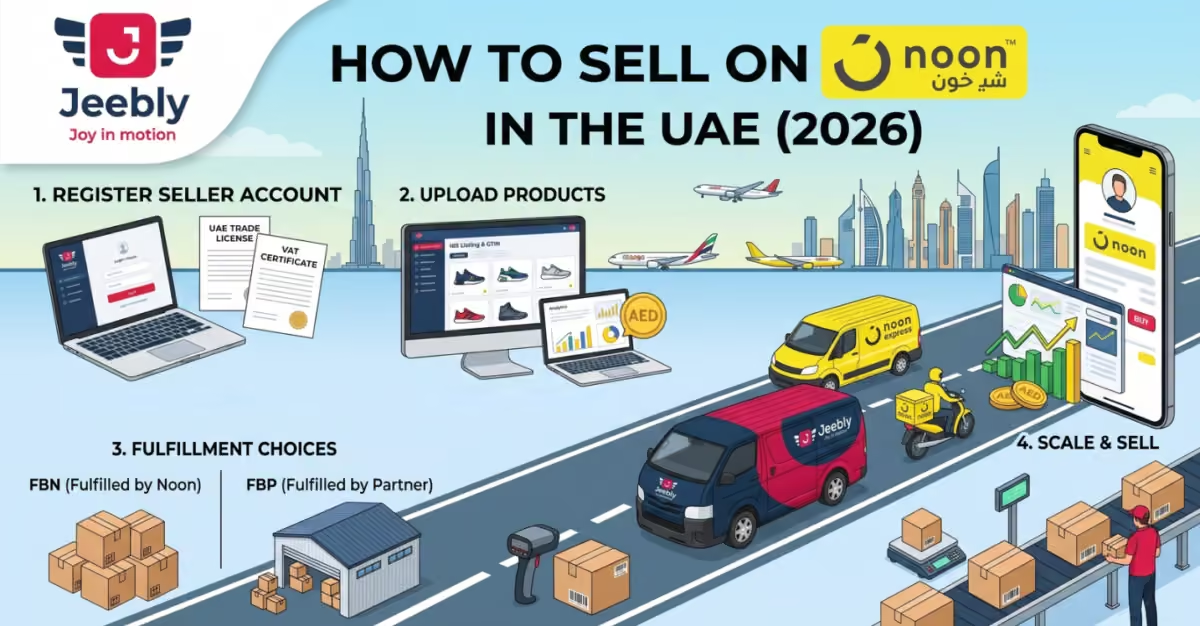
Infographic guide for selling on Noon UAE in 2026, showing seller registration steps, product cataloguing, FBN and FBP logistics options, a Jeebly delivery van, and the Dubai skyline.
How to Sell on Noon in the UAE in 2026

Expanding your e-commerce footprint across the Middle East starts with Noon—the UAE’s leading homegrown digital marketplace. Whether you are a local startup or an established retail brand, succeeding in 2026 requires understanding trade license compliance, optimizing catalog listings, and selecting the right fulfillment model between FBN and FBP. Explore our complete guide to selling on Noon UAE, covering onboarding essentials, commission structures, and how partnering with reliable last-mile delivery providers like Jeebly helps you scale faster.
Read More
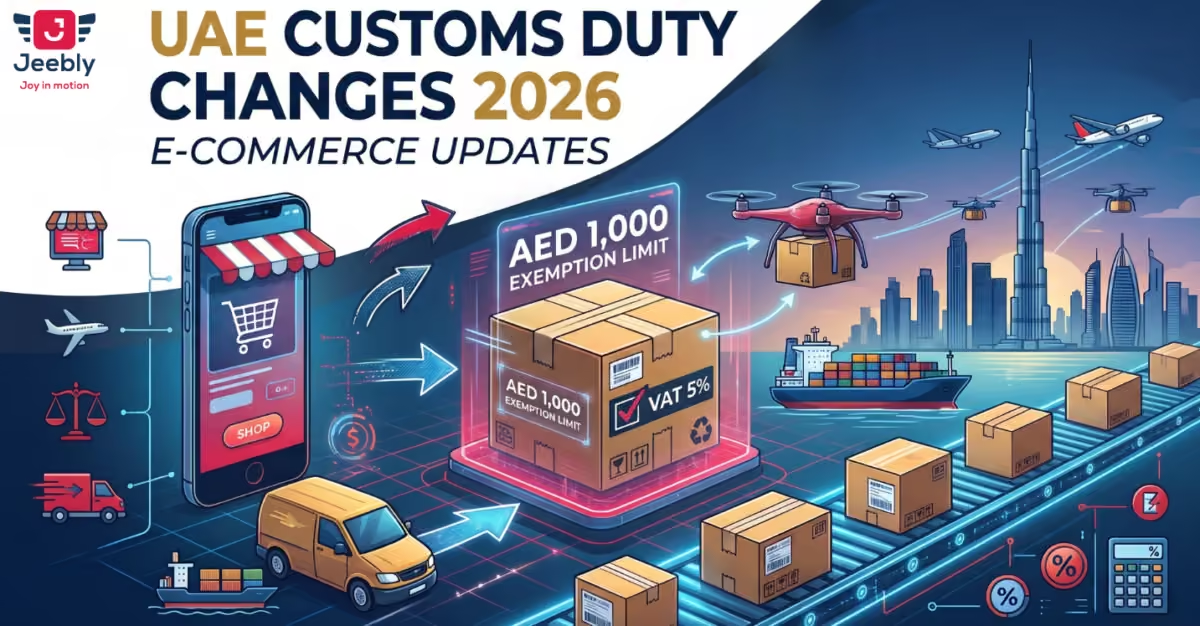
Infographic banner featuring the Jeebly logo, highlighting 2026 UAE customs duty updates for e-commerce with a Dubai skyline, delivery vans, cargo ships, conveyor belt parcels, and the AED 1,000 exemption limit.
UAE Customs Duty Changes for E-Commerce (2026)

With rapid expansions across the GCC digital commerce landscape, the UAE has implemented updated customs duty policies and clearance procedures for cross-border e-commerce shipments in 2026. From managing the AED 1,000 personal import exemption and 5% VAT rules to navigating commercial parcel compliance and streamlined last-mile delivery, discover how these regulatory shifts impact online retailers, logistics providers, and shoppers across the Emirates.

Read More
A Jeebly courier driver carrying a parcel while wiping sweat on a sunny Dubai street, with a second driver drinking water by a delivery van, illustrating UAE heat logistics and temperature-sensitive shipping challenges.
UAE Summer Delivery: Heat Effects on Couriers, Packaging and Timelines

Operating last-mile delivery in the UAE requires navigating challenging weather and heat conditions year-round. From protecting courier health to using insulated packaging and adjusting transit schedules, discover how top logistics providers keep temperature-sensitive parcels safe and on time across Dubai and the GCC.

Read More
Jeebly delivery van and driver holding a branded parcel against the Dubai skyline, featuring a digital route optimisation map interface.
What Is Route Optimisation in Last-Mile Delivery?

Last-mile delivery is the most critical—and expensive—leg of the supply chain. Discover how route optimisation leverages real-time data, traffic analytics, and smart scheduling to cut operational costs, beat urban gridlock, and ensure on-time deliveries across the UAE.
Read More
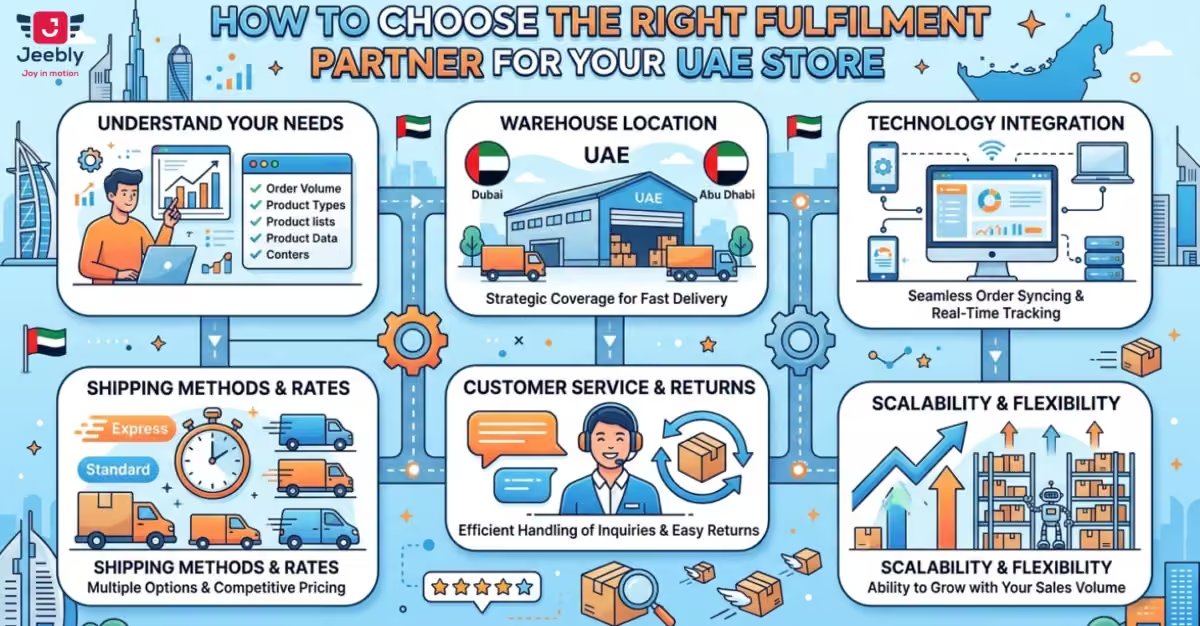
An infographic detailing six steps to choose the right fulfillment partner for a UAE store: understand needs, warehouse location (Dubai/Abu Dhabi), technology integration, shipping methods, customer service, and scalability, set against a UAE city skyline
How to Choose the Right Fulfilment Partner for Your UAE Store

Selecting the right fulfillment partner can make or break your e-commerce growth in the UAE. From strategic warehouse locations in Dubai and Abu Dhabi to seamless tech integration, learn the six critical factors every online store must evaluate to lower costs, ensure same-day delivery, and scale efficiently across the GCC.


Read More
Categories
blogs

EMX vs Jeebly: Which Courier Delivers More Value for Your Business?

EMX vs Jeebly: Which Courier Delivers More Value for Your Business?

EMX vs Jeebly: Which Courier Delivers More Value for Your Business?

Your courier partner is not a vendor you swap easily. It shapes how customers experience your brand after checkout. In a market where the UAE’s e-commerce fulfilment services market is projected to reach USD 4.64 billion by 2030, that choice carries real commercial weight.

When comparing EMX vs Jeebly, most businesses find two genuinely different propositions, not just different price points. This article maps providers across service capabilities, technology, pricing structures, and e-commerce fit, so you can match the right partner to how your business actually operates.

What EMX and Jeebly Do and Where They Differ

EMX is part of the 7X Group, formerly Emirates Post Group, a government-backed logistics entity. 

* Its core services cover UAE domestic door-to-door delivery, GCC cross-border shipping via EMX International (KSA, Kuwait, Bahrain, Oman, Qatar, Jordan, Egypt), and freight forwarding by sea, land, and air, including customs clearance. 
* EMX International promises 2–4-day transit times to GCC markets. 
* EMX also runs a dedicated card solutions division that designs, manufactures, and delivers physical cards for government agencies, banks, and large corporations.

Jeebly was purpose-built for the UAE’s e-commerce market. 

* This 360° logistics company has grown to serve 12M+ customers, completing 50,000+ deliveries daily with a 98% First-Day Delivery Success (FDSS) rate across a fleet of 4,000+ vehicles. 
* Its service lines cover everything from 60-minute express delivery in Dubai to bulk freight and white-glove service. 
Where EMX operates with a broad government mandate, Jeebly’s infrastructure is calibrated to one outcome: helping online businesses deliver faster, retain customers, and scale without logistics becoming the bottleneck.

EMX vs Jeebly: Head-to-Head Comparison

No structured public comparison of these two providers exists in the market. Here is what UAE businesses need to know before making a choice.

Capability EMX Jeebly
Ownership 7X Group (government-backed) Independent, e-commerce-native
UAE Last-Mile Yes Yes, same-day and next-day
GCC Cross-Border Yes, EMX International, 2–4 days, customs included Yes, via Jeebly Dash International
Freight Forwarding Sea, land, air, and customs clearance Yes, via Jeebly Haul
Marketplace Integrations Limited public information Yes, Shopify, WooCommerce, Magento, and more
Self-Service Portal Not publicly available Yes, Jeebly Now portal
Real-Time Tracking Yes Yes, a centralised dashboard with ETA updates
COD Support Available Yes, with prompt remittances
Fulfillment & Warehousing Available Yes, including micro-fulfilment centres for Q-commerce
Card/Speciality Logistics Yes, dedicated division Not applicable
Primary Client Profile Government, banking, corporate accounts E-commerce merchants, SMEs, startups, D2C brands

The table tells the story clearly. EMX suits institutional logistics, whereas Jeebly is built for merchants who sell online and need a partner that handles the last mile as precisely as they handle the first sale.

Where Does Technology Make the Difference

For UAE e-commerce businesses, this is where the EMX vs Jeebly comparison becomes most commercially relevant.

EMX inherits the infrastructure of a government-affiliated group. It is stable, compliant, and capable of managing complex freight and customs across multiple markets. Its technology serves a wide stakeholder base.

Jeebly’s platform is merchant-first by design:

* The centralised dashboard provides businesses with real-time visibility into all orders. Dedicated Key Account Managers and coordinators handle issue resolution directly via WhatsApp groups, email, and direct calls.
 
* During peak seasons, when order volumes for clients like Carrefour and Amazon can double, Jeebly uses data-driven forecasting to scale fleet capacity and rider deployment in advance.
 
* When a client lacks full system integration, Jeebly’s operations team manages tracking and dashboards manually on their behalf.

The platform connects natively with Shopify, WooCommerce, Magento, ChatFood, and Grubtech. For businesses not yet on a major platform, the Jeebly One App allows sign-up in under five minutes with no minimum order commitment. 

That accessibility is a deliberate choice. It means startups and established retailers access the same technology infrastructure without a volume premium. See how Jeebly’s technology platform works!

Pricing Transparency: What UAE Businesses Should Know

Neither EMX nor Jeebly publishes a comprehensive public rate card. UAE logistics pricing is negotiated by volume, delivery zone, and service level. 

* That said, Jeebly publishes its base Dash rate: AED 17.31 for next-day delivery on packages up to 5 kg, with AED 2/kg above that threshold. No long-term contract is required to start.
* EMX rates are structured primarily around corporate, government, and banking accounts. For an e-commerce brand managing COD cycles, returns, and variable volumes, the pricing architecture and account management model can be a less natural fit.

The practical step is to request custom quotes from both providers with your actual order volumes and delivery zones.
Trying to get a realistic picture of what delivery actually costs your business? Read our guide on the Cost of Shipping for a Small Business in the UAE.

How Jeebly Is Built for UAE E-Commerce Businesses

Jeebly’s product suite maps directly to the operational needs of online merchants as the core of the company’s operations.

* Jeebly Dash handles same-day delivery in Dubai and next-day delivery across the UAE, with cutoffs around 11 AM for same-day and 2–4 PM for next-day delivery. COD is fully supported.

* For cross-border needs, Jeebly Dash International covers the GCC, South Asia, and global destinations, offering end-to-end customs clearance and real-time tracking.

* Jeebly Bizz is the umbrella for business logistics. It combines last-mile, warehousing and fulfilment, reverse logistics, international shipping, and temperature-controlled delivery on a single platform.

* Jeebly Haul covers freight above 20 kg by road, air, and sea. Domestic UAE, cross-border GCC and MENA, with LTL options and customs documentation is handled end-to-end.

* Jeebly Plus provides white-glove service for B2B clients delivering high-value products to their customers. It is chauffeur-led, fully trackable, and designed for luxury and premium categories.

Trusted by Mumzworld.com, Instashop, DOD UAE, and BFL Group, Jeebly carries AED 500M+ in combined revenue and AED 1.5B+ in shipments delivered.

How to Pick the Right UAE Courier for Your Business

Make note of these five quick questions that are worth working through before committing:

1. What is your primary delivery use case? For high-volume GCC freight, government contracts, or corporate card logistics, choose EMX. For the UAE last-mile e-commerce, same-day delivery, COD, and fulfillment, Jeebly is the right fit.

2. Do you sell on marketplaces or through your own store? Jeebly’s native integrations with Shopify, WooCommerce, and Magento automatically connect your orders to dispatch. That eliminates manual order pushing and reduces errors at scale.

3. How important is COD remittance speed? If COD accounts for a significant share of your orders, the remittance cycle time directly affects working capital. Jeebly’s prompt COD remittances are consistently cited by partners as a key operational advantage.

4. Are you planning to scale in the next 12 months? EMX is calibrated for enterprise-scale commitments. Jeebly is designed to grow alongside you, from your first 50 orders to peak-season surges, without requiring large upfront volume guarantees or complex onboarding.

5. Do you need GCC cross-border coverage? Both providers offer it. EMX International handles GCC parcels with a 2–4-day transit, including customs processing. Jeebly Dash International covers the GCC and beyond, offering real-time tracking and comprehensive customs support.

Conclusion

EMX is a strong fit for corporate freight, government logistics, and GCC cross-border at an institutional scale.

For UAE online merchants, whether you’re a startup shipping 100 parcels a month or an established retailer managing peak-season surges, Jeebly is the more relevant partner.

At Jeebly, we don’t just move parcels. We move businesses forward. If you’re ready to build logistics that scale with your ambition, talk to the Jeebly team and get a solution mapped to your specific volumes, routes, and growth targets.

Frequently Asked Questions

Jeebly Dash offers same-day delivery across Dubai with an 11 AM order cut-off, and express delivery within 60–120 minutes in the city. It is purpose-built for merchants that cannot afford failed or delayed deliveries.

Jeebly Dash’s published next-day rate starts at AED 17.31 for packages up to 5 kg, with no minimum order requirement. Community data for the Dubai SME market corroborates that range, with volume discounts available at higher order counts.

Yes. Both providers support COD. Jeebly is specifically recognised by partners for prompt COD remittances, which keeps cash flow predictable. It is a meaningful advantage for merchants where COD accounts for a significant share of orders.

Yes. Jeebly’s pay-as-you-go model requires no long-term contracts or minimum volumes. The self-service Jeebly One App lets businesses onboard in under five minutes, with access to the same dashboard, tracking, and operational support used by major brand partners.

EMX is a UAE logistics company within the 7X Group (formerly Emirates Post Group), a government-backed entity. EMX handles domestic UAE delivery, GCC cross-border e-commerce parcels via EMX International, freight forwarding, and specialist card services for government and financial institutions.

Routes to insightful reads

Infographic guide for selling on Noon UAE in 2026, showing seller registration steps, product cataloguing, FBN and FBP logistics options, a Jeebly delivery van, and the Dubai skyline.
How to Sell on Noon in the UAE in 2026

Expanding your e-commerce footprint across the Middle East starts with Noon—the UAE’s leading homegrown digital marketplace. Whether you are a local startup or an established retail brand, succeeding in 2026 requires understanding trade license compliance, optimizing catalog listings, and selecting the right fulfillment model between FBN and FBP. Explore our complete guide to selling on Noon UAE, covering onboarding essentials, commission structures, and how partnering with reliable last-mile delivery providers like Jeebly helps you scale faster.

Read More
Infographic banner featuring the Jeebly logo, highlighting 2026 UAE customs duty updates for e-commerce with a Dubai skyline, delivery vans, cargo ships, conveyor belt parcels, and the AED 1,000 exemption limit.
UAE Customs Duty Changes for E-Commerce (2026)

With rapid expansions across the GCC digital commerce landscape, the UAE has implemented updated customs duty policies and clearance procedures for cross-border e-commerce shipments in 2026. From managing the AED 1,000 personal import exemption and 5% VAT rules to navigating commercial parcel compliance and streamlined last-mile delivery, discover how these regulatory shifts impact online retailers, logistics providers, and shoppers across the Emirates.

Read More
A Jeebly courier driver carrying a parcel while wiping sweat on a sunny Dubai street, with a second driver drinking water by a delivery van, illustrating UAE heat logistics and temperature-sensitive shipping challenges.
UAE Summer Delivery: Heat Effects on Couriers, Packaging and Timelines

Operating last-mile delivery in the UAE requires navigating challenging weather and heat conditions year-round. From protecting courier health to using insulated packaging and adjusting transit schedules, discover how top logistics providers keep temperature-sensitive parcels safe and on time across Dubai and the GCC.

Read More
Jeebly delivery van and driver holding a branded parcel against the Dubai skyline, featuring a digital route optimisation map interface.
What Is Route Optimisation in Last-Mile Delivery?

Last-mile delivery is the most critical—and expensive—leg of the supply chain. Discover how route optimisation leverages real-time data, traffic analytics, and smart scheduling to cut operational costs, beat urban gridlock, and ensure on-time deliveries across the UAE.

Read More
An infographic detailing six steps to choose the right fulfillment partner for a UAE store: understand needs, warehouse location (Dubai/Abu Dhabi), technology integration, shipping methods, customer service, and scalability, set against a UAE city skyline
How to Choose the Right Fulfilment Partner for Your UAE Store

Selecting the right fulfillment partner can make or break your e-commerce growth in the UAE. From strategic warehouse locations in Dubai and Abu Dhabi to seamless tech integration, learn the six critical factors every online store must evaluate to lower costs, ensure same-day delivery, and scale efficiently across the GCC.

Read More

    Powered by