


Jeebly | Logistics Solutions

Categories
blogs

The Role of Customer Support in Modern Delivery Services

The Role of Customer Support in Modern Delivery Services

The Role of Customer Support in Modern Delivery Services

In today’s fast-paced e-commerce environment, delivery speed alone is no longer enough to win customer loyalty. What truly differentiates brands is how effectively they communicate before, during, and after delivery. This is where customer support in delivery services plays a decisive role.

Modern consumers expect real-time updates, instant responses, and seamless issue resolution. According to Deloitte, customer experience is now one of the top drivers of brand differentiation worldwide. In logistics, that experience is heavily shaped by the quality of customer support.

Why Customer Support Matters in Delivery Operations

Delivery is the final touchpoint in the customer journey. A delayed shipment, failed delivery attempt, or unclear tracking update can quickly turn a positive purchase into a frustrating experience.

Strong customer support in delivery services ensures:

* Clear communication about shipment status

* Immediate handling of delivery issues

* Faster resolution of returns or exchanges

* Improved transparency through real-time tracking

In high growth markets like the UAE, where same day and next day delivery expectations are increasing, proactive support becomes even more critical. The International Trade Administration highlights the rapid expansion of e-commerce in the region, a trend that places even more pressure on logistics providers to maintain responsive service standards.

Real-Time Communication Builds Trust

Customers no longer tolerate uncertainty. They want accurate Estimated Time of Arrival (ETA) updates and instant notifications. This is why integrating support with live tracking systems is essential.

Jeebly’s article on Why Real-Time ETA Updates Reduce Customer Complaints explains how proactive communication significantly reduces delivery related frustration.

When support teams have access to centralized dashboards and real-time data, they can:

* Provide instant shipment updates

* Resolve delivery delays quickly

* Coordinate reattempts efficiently

This transparency builds trust and increases repeat purchase rates.

Handling Returns and Reverse Logistics

Handling Returns and Reverse Logistics

Customer support also plays a key role in managing post-delivery experiences. Returns, exchanges, and Cash on Delivery (COD) refusals are common in the UAE market.

Without coordinated support and logistics systems, reverse flows become chaotic. As discussed in Jeebly’s blog on Reverse Logistics for Businesses, structured processes supported by responsive teams reduce operational strain and protect margins.

Support teams that can instantly schedule pickups, confirm doorstep quality checks, and trigger refunds enhance customer satisfaction while improving operational efficiency.

Technology + Human Support = Competitive Advantage

Modern delivery services combine automation with human expertise. AI-powered tracking systems provide predictive insights, while trained support teams handle complex or sensitive cases.

Research from McKinsey & Company emphasizes that companies integrating digital tools with customer-centric support outperform competitors in retention and operational resilience.

For logistics providers, this means:

* API integration between support and delivery systems

* Real-time visibility across shipments

* Digital proof of delivery

* Faster complaint resolution cycles

Final Thoughts

Customer support in delivery services is no longer a reactive function. It is a strategic pillar that directly impacts customer loyalty, operational efficiency, and brand reputation.

In competitive markets like the UAE, businesses that integrate technology, transparency, and responsive support into their logistics operations gain a clear advantage.

Because in modern delivery, it’s not just about getting the package there, it’s about how well you support the journey.

Routes to insightful reads

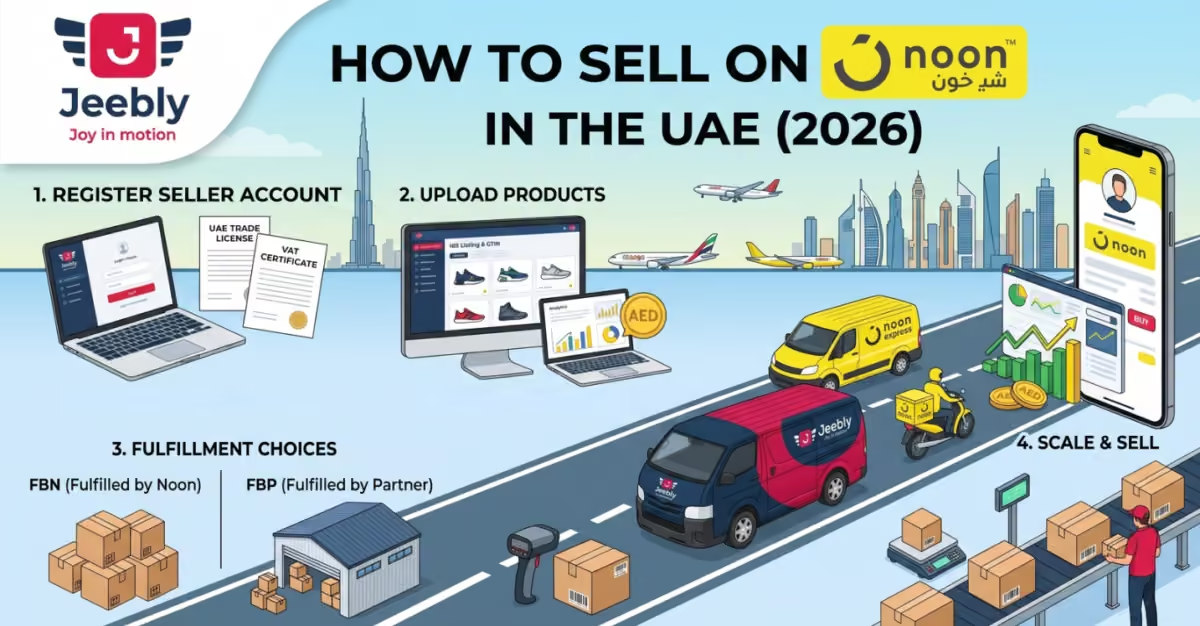
Infographic guide for selling on Noon UAE in 2026, showing seller registration steps, product cataloguing, FBN and FBP logistics options, a Jeebly delivery van, and the Dubai skyline.
How to Sell on Noon in the UAE in 2026

Expanding your e-commerce footprint across the Middle East starts with Noon—the UAE’s leading homegrown digital marketplace. Whether you are a local startup or an established retail brand, succeeding in 2026 requires understanding trade license compliance, optimizing catalog listings, and selecting the right fulfillment model between FBN and FBP. Explore our complete guide to selling on Noon UAE, covering onboarding essentials, commission structures, and how partnering with reliable last-mile delivery providers like Jeebly helps you scale faster.
Read More
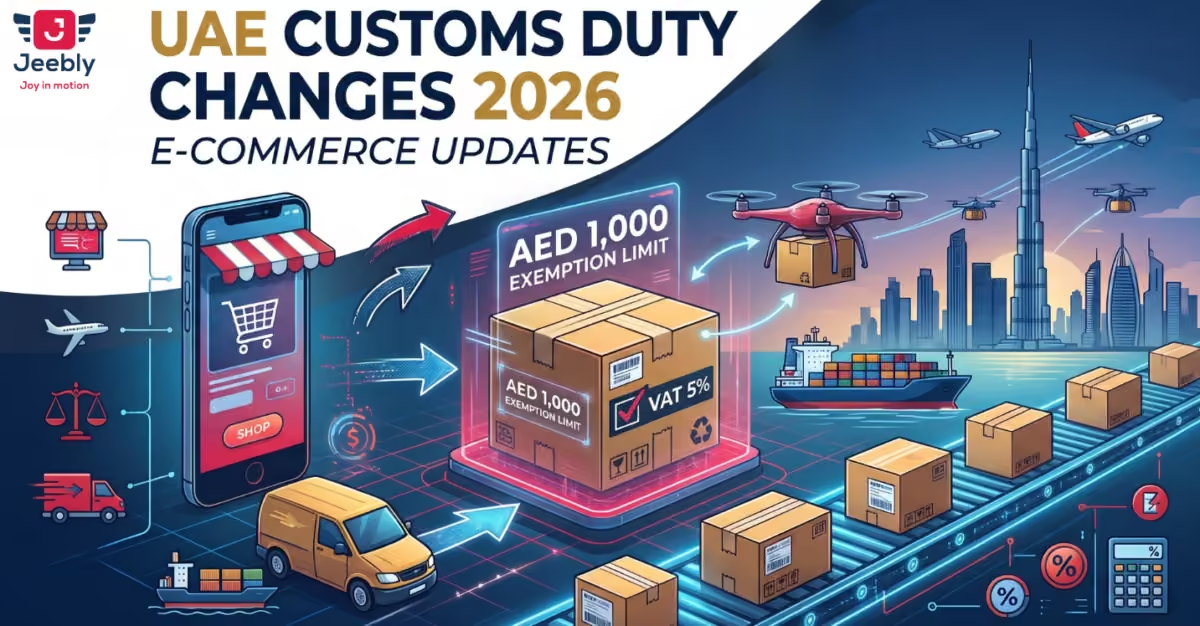
Infographic banner featuring the Jeebly logo, highlighting 2026 UAE customs duty updates for e-commerce with a Dubai skyline, delivery vans, cargo ships, conveyor belt parcels, and the AED 1,000 exemption limit.
UAE Customs Duty Changes for E-Commerce (2026)

With rapid expansions across the GCC digital commerce landscape, the UAE has implemented updated customs duty policies and clearance procedures for cross-border e-commerce shipments in 2026. From managing the AED 1,000 personal import exemption and 5% VAT rules to navigating commercial parcel compliance and streamlined last-mile delivery, discover how these regulatory shifts impact online retailers, logistics providers, and shoppers across the Emirates.

Read More
A Jeebly courier driver carrying a parcel while wiping sweat on a sunny Dubai street, with a second driver drinking water by a delivery van, illustrating UAE heat logistics and temperature-sensitive shipping challenges.
UAE Summer Delivery: Heat Effects on Couriers, Packaging and Timelines

Operating last-mile delivery in the UAE requires navigating challenging weather and heat conditions year-round. From protecting courier health to using insulated packaging and adjusting transit schedules, discover how top logistics providers keep temperature-sensitive parcels safe and on time across Dubai and the GCC.

Read More
Jeebly delivery van and driver holding a branded parcel against the Dubai skyline, featuring a digital route optimisation map interface.
What Is Route Optimisation in Last-Mile Delivery?

Last-mile delivery is the most critical—and expensive—leg of the supply chain. Discover how route optimisation leverages real-time data, traffic analytics, and smart scheduling to cut operational costs, beat urban gridlock, and ensure on-time deliveries across the UAE.
Read More
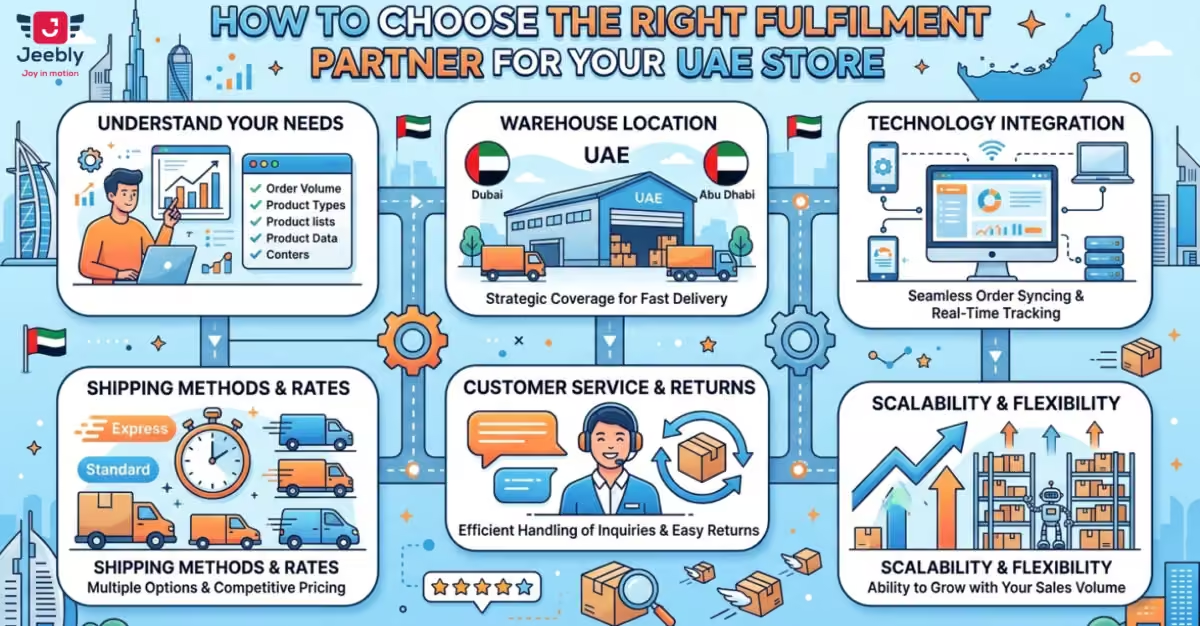
An infographic detailing six steps to choose the right fulfillment partner for a UAE store: understand needs, warehouse location (Dubai/Abu Dhabi), technology integration, shipping methods, customer service, and scalability, set against a UAE city skyline
How to Choose the Right Fulfilment Partner for Your UAE Store

Selecting the right fulfillment partner can make or break your e-commerce growth in the UAE. From strategic warehouse locations in Dubai and Abu Dhabi to seamless tech integration, learn the six critical factors every online store must evaluate to lower costs, ensure same-day delivery, and scale efficiently across the GCC.
Read More
Categories
blogs

Why real-time delivery updates reduce complaints (and how UAE sellers set them up)

Why Real-Time ETA Updates Reduce Customer Complaints

Why Real-Time ETA Updates Reduce Customer Complaints

Sending customers real-time delivery updates — including live ETA and proof of delivery — reduces complaints by up to 40% and increases repeat purchase rates. Here’s how UAE businesses set up delivery notifications that work.

Customer complaints about deliveries rarely begin with the delivery itself. They begin with uncertainty.

A customer places an order and receives a vague delivery promise: “Arriving today.” Hours pass with no update. They cannot plan their day, they do not know when the driver will arrive, and they start wondering whether the order is delayed or lost.

This is where most delivery complaints originate, not necessarily from delays, but from a lack of clear communication.

For businesses operating in the UAE, where same day delivery and cash on delivery (COD) remain common, this problem becomes even more visible. Customers often need to be physically present to receive their order and complete payment.

When delivery timing is unclear, frustration grows quickly. Real time delivery updates solve this problem by replacing uncertainty with clear communication. Instead of wondering when a package will arrive, customers receive accurate updates about the status of their delivery and estimated arrival window.

In today’s logistics environment, transparent delivery updates are no longer a “nice to have” feature. They are one of the most effective tools businesses have for reducing customer complaints and improving delivery success rates.

Why Most Delivery Complaints Are Actually Communication Problems

When businesses analyze delivery complaints, they often assume the main issue is late deliveries. In reality, the root cause is usually different.

Most complaints happen because customers do not know what is happening with their order.

Typical customer frustrations include:

* Not knowing when a package will arrive

* Receiving no updates after the order is dispatched

* Being unavailable when the delivery driver arrives

* Waiting all day for a delivery that comes much later than expected

Even a minor delay can trigger a complaint when customers are left guessing about the delivery status.

This is especially relevant in the last-mile stage of delivery, which is widely considered the most complex part of the logistics journey. If you’re unfamiliar with this stage, you can learn more about what last-mile delivery means and why it matters for businesses and customers.

When customers know approximately when their order will arrive, they are far less likely to contact support teams or express frustration about delays.

The Role of Delivery Updates in the UAE Market

Delivery expectations in the UAE are particularly high.

The rapid growth of e-commerce and digital shopping has created an environment where customers expect fast and predictable logistics. According to DataReportal’s UAE digital consumer report, the UAE has one of the highest smartphone and internet penetration rates globally, which means customers are highly accustomed to real-time digital services.

At the same time, cash on delivery (COD) remains widely used across the region. Many customers prefer paying only when the order arrives, especially for purchases made through social media stores or first-time online purchases.

This creates an additional layer of coordination. A successful delivery requires:

* The customer to be available at the delivery location

* The correct payment amount to be ready

* The delivery driver to arrive within a predictable time window

Without accurate delivery updates, this coordination breaks down. Customers may step out briefly, miss the delivery attempt, or forget about the order entirely.

When this happens, businesses face the operational consequences: failed deliveries, COD refusals, and additional delivery attempts that increase logistics costs.

Businesses facing these issues often look for strategies to reduce failed deliveries in the UAE by improving communication and delivery coordination.

How Real Time Delivery Updates Improve Customer Experience

Clear Delivery Expectations

One of the biggest benefits of delivery updates is that they set clear expectations for customers.

Instead of receiving vague delivery promises such as “today” or “out for delivery,” customers receive notifications indicating the progress of their order and the expected delivery window.

This allows them to plan their time around the delivery rather than waiting indefinitely.

When customers know approximately when their order will arrive, they are less likely to contact support teams or express frustration about delays.

Fewer Missed Deliveries

Missed deliveries are a common source of complaints in last-mile logistics.

A driver may arrive at a location only to discover that the customer is not available to receive the order. In apartment buildings or gated communities, the driver may also need confirmation from the customer before entering.

Delivery updates significantly reduce this problem. Notifications inform customers when their order is dispatched and when it is approaching the delivery area.

For COD orders, this coordination becomes even more important. Customers can ensure that they are present and have the payment ready, improving the likelihood of a successful first delivery attempt.

Missed deliveries also increase operational costs because they trigger reverse logistics processes. Businesses handling frequent returns often need structured processes similar to those explained in reverse logistics for businesses.
.

Reduced Customer Support Queries

One of the most common questions customer support teams receive is:

“Where is my order?”

These inquiries—often called WISMO (“Where Is My Order?”) queries, create significant workloads for customer support teams.

Delivery updates reduce these inquiries by proactively answering the customer’s question before they need to ask it.

When customers receive timely notifications about their order status, they feel informed and reassured.

Instead of contacting support for updates, they simply wait for the delivery.

Greater Customer Trust

Transparency builds trust.

Customers understand that delays can happen due to traffic, weather conditions, or operational challenges. What frustrates them is silence.

When businesses communicate clearly about delivery progress, customers perceive the service as professional and reliable.

Even if a delay occurs, customers are far more likely to accept it when they receive proactive updates explaining the situation.

This trust plays an important role in encouraging repeat purchases and long-term customer loyalty.

Why Delivery Updates Matter for Cash-on-Delivery Orders

Cash-on-delivery transactions introduce a unique challenge for logistics operations.

Because payment happens at the moment of delivery, both the customer and the driver must coordinate carefully.

If the customer is unavailable or forgets about the order, the delivery attempt may fail.

This leads to several operational issues:

Increased delivery costs due to reattempts

Higher COD refusal rates

Delayed revenue collection for businesses

Delivery updates help reduce these problems by keeping customers informed throughout the process.

Notifications remind customers that their order is on the way and provide a clear indication of the delivery window.

This makes it easier for them to be present and complete the payment when the driver arrives.

The Technology Behind Accurate Delivery Updates

Providing accurate delivery updates requires more than sending a generic notification.

Modern logistics systems use multiple sources of data to estimate delivery times and keep customers informed.

These systems typically combine:

GPS location data from delivery vehicles

Route optimization algorithms

Traffic data and mapping intelligence

Automated customer notification systems

According to research from McKinsey on last-mile logistics technology, predictive routing and automated notifications are among the most important innovations improving delivery reliability and customer satisfaction.

Importantly, these updates do not always require live map tracking. Many logistics providers focus instead on real-time ETA notifications and delivery status updates, which provide customers with the information they need without requiring continuous map visibility.

The Technology Behind Accurate Delivery Updates

Providing accurate delivery updates requires more than sending a generic notification.

Modern logistics systems use multiple sources of data to estimate delivery times and keep customers informed.

These systems typically combine:

* GPS location data from delivery vehicles

* Route optimization algorithms

* Traffic data and mapping intelligence

* Automated customer notification systems

According to research from McKinsey on last-mile logistics technology, predictive routing and automated notifications are among the most important innovations improving delivery reliability and customer satisfaction.

Importantly, these updates do not always require live map tracking. Many logistics providers focus instead on real-time ETA notifications and delivery status updates, which provide customers with the information they need without requiring continuous map visibility.

How Jeebly Uses Real-Time Delivery Updates

At Jeebly, delivery communication is designed to keep both businesses and customers informed throughout the delivery journey.

Instead of relying on live map tracking, Jeebly provides real-time delivery updates and ETA notifications that inform customers about the status of their order and the expected arrival window.

These updates include key milestones such as:

* Order dispatch confirmation

* Delivery progress updates

* Estimated arrival notifications

By combining optimized routing systems with automated notifications, Jeebly helps businesses create a transparent delivery experience that reduces complaints and improves delivery success rates.

For businesses managing growing order volumes, reliable delivery communication becomes an essential part of maintaining customer satisfaction.

Final Thoughts

Customer complaints about deliveries rarely come down to a single delay. More often, they result from uncertainty about what is happening with an order.

When customers are left without updates, frustration grows quickly—even if the delivery itself arrives on time.

Real-time delivery updates address this problem by providing clear communication throughout the delivery process. Customers know when their order is dispatched, when it is approaching, and when it is expected to arrive.

For businesses operating in the UAE, where delivery expectations are high and cash on delivery transactions remain common, this transparency is especially important.

By keeping customers informed and coordinating delivery timing more effectively, businesses can reduce complaints, minimize failed deliveries, and build stronger trust with their customers.

Frequently Asked Questions

Real-time delivery updates keep customers informed throughout the delivery journey, reducing uncertainty and improving transparency. When customers receive notifications about shipment status, delays, and estimated arrival times, they are less likely to contact support for updates, helping reduce complaints and improve the overall delivery experience.

Businesses can send delivery updates through SMS, email, mobile apps, WhatsApp, or customer portals. Many logistics platforms provide automated notifications for order confirmation, dispatch, out-for-delivery status, delivery completion, and any unexpected delays, helping customers stay informed at every stage.

A delivery ETA (Estimated Time of Arrival) notification informs customers when they can expect their shipment to arrive. ETA notifications are typically generated using real-time location data, traffic conditions, route information, and delivery schedules to provide more accurate delivery expectations.

Real-time tracking improves customer satisfaction by providing visibility into shipment progress and reducing uncertainty. Customers can monitor their orders, receive delivery updates, plan for receipt of their shipment, and gain confidence that their order is moving as expected, resulting in a better overall experience.

Many modern logistics and delivery platforms in the UAE offer real-time tracking and ETA notifications as part of their delivery services. Businesses should look for logistics providers that offer live shipment visibility, automated customer notifications, proof of delivery, and accurate ETA updates to improve customer communication and delivery performance.

Routes to insightful reads

Infographic guide for selling on Noon UAE in 2026, showing seller registration steps, product cataloguing, FBN and FBP logistics options, a Jeebly delivery van, and the Dubai skyline.
How to Sell on Noon in the UAE in 2026

Expanding your e-commerce footprint across the Middle East starts with Noon—the UAE’s leading homegrown digital marketplace. Whether you are a local startup or an established retail brand, succeeding in 2026 requires understanding trade license compliance, optimizing catalog listings, and selecting the right fulfillment model between FBN and FBP. Explore our complete guide to selling on Noon UAE, covering onboarding essentials, commission structures, and how partnering with reliable last-mile delivery providers like Jeebly helps you scale faster.

Read More
Infographic banner featuring the Jeebly logo, highlighting 2026 UAE customs duty updates for e-commerce with a Dubai skyline, delivery vans, cargo ships, conveyor belt parcels, and the AED 1,000 exemption limit.
UAE Customs Duty Changes for E-Commerce (2026)

With rapid expansions across the GCC digital commerce landscape, the UAE has implemented updated customs duty policies and clearance procedures for cross-border e-commerce shipments in 2026. From managing the AED 1,000 personal import exemption and 5% VAT rules to navigating commercial parcel compliance and streamlined last-mile delivery, discover how these regulatory shifts impact online retailers, logistics providers, and shoppers across the Emirates.

Read More
A Jeebly courier driver carrying a parcel while wiping sweat on a sunny Dubai street, with a second driver drinking water by a delivery van, illustrating UAE heat logistics and temperature-sensitive shipping challenges.
UAE Summer Delivery: Heat Effects on Couriers, Packaging and Timelines

Operating last-mile delivery in the UAE requires navigating challenging weather and heat conditions year-round. From protecting courier health to using insulated packaging and adjusting transit schedules, discover how top logistics providers keep temperature-sensitive parcels safe and on time across Dubai and the GCC.

Read More
Jeebly delivery van and driver holding a branded parcel against the Dubai skyline, featuring a digital route optimisation map interface.
What Is Route Optimisation in Last-Mile Delivery?

Last-mile delivery is the most critical—and expensive—leg of the supply chain. Discover how route optimisation leverages real-time data, traffic analytics, and smart scheduling to cut operational costs, beat urban gridlock, and ensure on-time deliveries across the UAE.

Read More
An infographic detailing six steps to choose the right fulfillment partner for a UAE store: understand needs, warehouse location (Dubai/Abu Dhabi), technology integration, shipping methods, customer service, and scalability, set against a UAE city skyline
How to Choose the Right Fulfilment Partner for Your UAE Store

Selecting the right fulfillment partner can make or break your e-commerce growth in the UAE. From strategic warehouse locations in Dubai and Abu Dhabi to seamless tech integration, learn the six critical factors every online store must evaluate to lower costs, ensure same-day delivery, and scale efficiently across the GCC.

Read More

    Powered by