
Jeebly | Logistics Solutions

Categories
blogs

Peak Season Logistics Checklist: Getting Ready for Q4 UAE

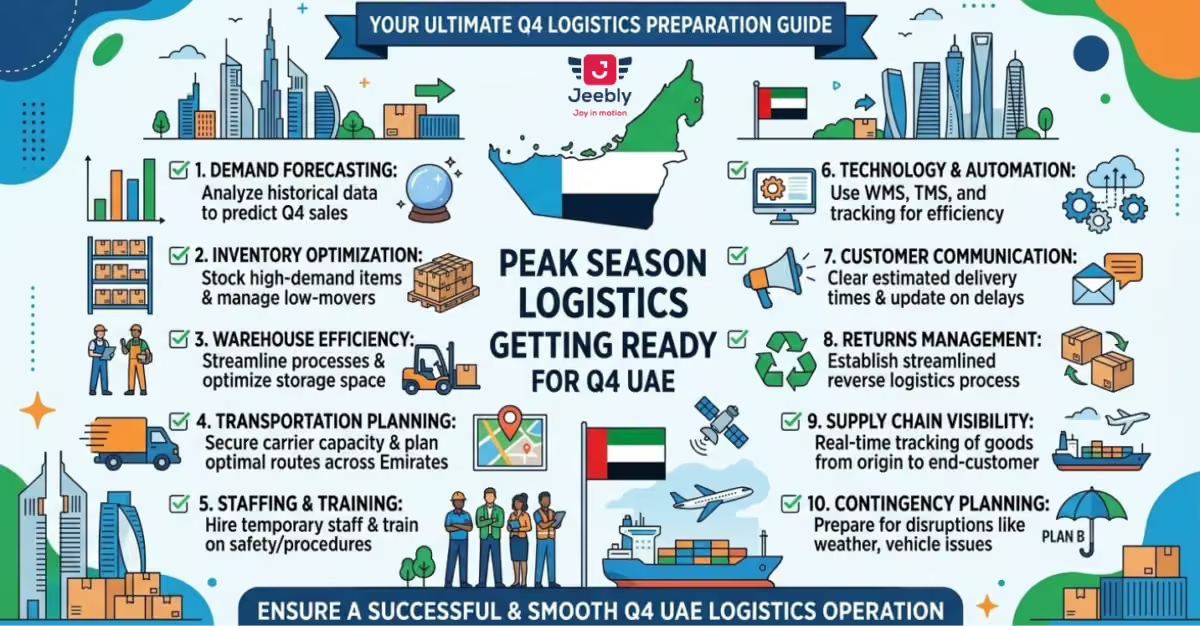
An infographic checklist outlining 10 key steps for Q4 UAE logistics preparation, featuring icons for demand forecasting, inventory, warehouse efficiency, transportation, staffing, and technology against a UAE skyline and map background.

Peak Season Logistics Checklist: Getting Ready for Q4 UAE

Q4 in the UAE is different from Q4 anywhere else. White Friday, i.e., the regional equivalent of Black Friday, falls in November, followed by UAE National Day (2 December), Christmas gifting demand, and New Year promotions. Combined, these events can compress more order volume into fewer weeks than any other period in the UAE retail calendar.

Businesses that handle this well don’t wait until October to prepare. The brands that post their best numbers do not out-discount anyone in the final week. They spend the summer fixing what can’t be fixed under load: inventory depth, fulfilment capacity, and the automated flows that do most of the work. 

This checklist gives UAE retailers and e-commerce operators a month-by-month logistics preparation timeline, from July through November, to enter the Q4 peak season operationally ready.

Key Takeaways

  • White Friday is the UAE’s primary Q4 sales event, bigger in dollar value than any other UAE retail moment, falling in late November.

  • The UAE Q4 peak calendar includes White Friday, UAE National Day (2 December), Christmas, and New Year. Four distinct demand moments require separate inventory and delivery planning.

  • Place procurement orders by July or August to arrive in time for the October inventory build.

  • Pre-confirm fulfilment capacity with your 3PL or courier service partner before October. Competing for warehouse space and courier volume during peak week is not a strategy

  • Returns management is a September design decision. Policy, exchange flow, and reverse logistics capacity should all be confirmed before the first White Friday order ships

The UAE Q4 Peak Season Calendar: What You Are Preparing For

The UAE Q4 peak season is not one event. It is four distinct demand moments in eight weeks.

Date Event What it drives
11 November Singles Day Electronics, fashion, beauty, UAE participation growing annually
Late November White Friday Highest-value UAE sales event: clothing, footwear, electronics, home
2 December UAE National Day Gifting, patriotic merchandise, food and hospitality
25 December Christmas Expat and tourist gifting: luxury, experiences, consumer electronics
31 December New Year Gifting, fashion, last-minute orders

These are not separate campaigns. They are one continuous operational period. Your fulfilment infrastructure, courier agreements, and returns process need to cover the full eight-week window.

July: Procurement and Inbound Freight Decisions

This is the least visible preparation month and has the most downstream consequences.

  1. Inventory forecasting: Start with last year’s Q4 data like top-selling SKUs by volume, top-margin contributors, and any SKUs that underperformed. Apply your YTD growth rate and add a safety buffer. A good forecast specifies which SKUs are likely to sell, in what quantities, across which weeks.

  2. Procurement orders placed: If you are sourcing products from overseas, you must place production orders by July or August to arrive in time for the October inventory build. Waiting until September forces air freight, which is very expensive and directly compresses the margins you are trying to protect during a promotion-heavy period.

  3. Inbound freight confirmed: Book sea freight capacity for your main inbound shipment in July. Freight capacity may tighten in August and September as every retailer begins the same pre-peak inventory move. Booking in July secures both the vessel space and the rate.

For structuring the inbound freight leg, including mode selection, Jebel Ali customs clearance, and UAE warehouse receipt timelines, Freight Forwarding in UAE covers the full process.

August: Inventory and Warehouse Preparation

1) Warehouse capacity confirmed: If you use a 3PL (third-party logistics) for warehousing and fulfilment, confirm your Q4 space allocation in August. Peak season is when warehouse space is most constrained and most expensive. Retailers who confirm their Q4 capacity in August can get the space they need at agreed rates.

2) Inbound stock received and slotted: Your first inbound shipment, ordered in July, should arrive in August. Receipt, quality inspection, and putaway need to happen efficiently to clear the receiving dock for subsequent shipments. Slot high-velocity SKUs closest to packing stations to reduce pick time during the high-volume weeks ahead.

3) Inventory accuracy check: Run a full cycle count in August, before the season begins. Peak season exposes every inventory discrepancy. Fixing these in August takes hours. Fixing them in November, during peak dispatch, takes significantly more.

September: Courier Agreements and Technology Checks

1) Q4 courier capacity pre-confirmed. Courier capacity during White Friday week is finite. Every e-commerce brand in the UAE is competing for the same last-mile delivery slots simultaneously. Retailers with pre-arranged priority volume agreements with their courier partner don’t compete for capacity during the surge. Those without are at the back of the queue when it matters most.

For same-day delivery across Dubai and next-day delivery across all seven UAE emirates, confirm your Q4 volume requirements with the Jeebly team before October. Jeebly Dash maintains 98% FDSS across 50,000+ daily deliveries.

2) COD remittance confirmed. Secure COD remains a significant share of UAE e-commerce transactions. During Q4, high order volumes create a corresponding COD float. Confirm your courier’s remittance cycle in writing before peak season.

3) Platform and integration testing. Run a full end-to-end test of your store-to-fulfilment integration in September. If your Shopify or WooCommerce integration with your 3PL passes orders through a connection that has not been load-tested, discovering the failure during White Friday is the worst possible moment. Test at simulated peak volume before October.

4) Delivery promise audit. Check every delivery-related message a customer sees during the purchase journey: product page delivery estimate, checkout delivery date, order confirmation, and tracking notification. Peak season delivery windows are tighter, and customer expectations are higher.

5) Returns infrastructure in place: Treat returns as a September design decision like policy page, exchange flow, and reverse-logistics capacity. The returns flow for Q4 orders needs to be ready before the first peak order ships, because post-White Friday return volumes arrive within days of the event.

October: Promotional and Operational Readiness

  1. Peak season pricing and promotion confirmed. Confirm promotional mechanics for White Friday in October, not the week before launch. This gives your delivery and fulfilment operation visibility into which SKUs are likely to spike so inventory can be pre-positioned and packing materials can be ordered in sufficient quantity.

  2. Free delivery threshold modelled. Confirm the per-parcel cost at each delivery tier and model the order value at which free delivery is commercially viable for your Q4 promotions. For the full UAE domestic shipping cost structure, Cost of Shipping for a Small Business in UAE (2026) provides the rate card to model against.

  3. Packaging materials stocked. Order all packing materials before the end of October. Packaging suppliers face the same peak demand as couriers. Running out of 5-ply corrugated during White Friday dispatch is an avoidable operational failure that delays shipments and creates customer experience problems.

  4. Shipping cut-off dates published. Publish your cut-off dates for each delivery tier on your website before peak week. Customers checking whether an order will arrive before National Day or Christmas need to see this information without contacting support. Publish it on your product pages, checkout flow, and a dedicated delivery information page.

November: Peak Week Execution

1) White Friday operations running. By November, all preparation decisions are made. The November plan is execution, monitoring and rapid response, not new decisions.

2) Monitor daily order volume against courier SLA. Track your FDSS rate daily during peak week. If first-attempt delivery rates drop, escalate to your courier partner immediately. A 2% drop in FDSS at 1,000 daily orders is 20 additional RTOs per day, each with a double shipping cost.

3) NDR management active. Failed delivery attempts during peak week should trigger immediate WhatsApp or SMS outreach to the customer to reschedule. Every recovered NDR during peak week saves delivery cost and improves the customer experience that would otherwise become an RTO. 

For more on reducing COD-related RTOs specifically, COD Fraud in UAE eCommerce covers the pre-dispatch and NDR interventions that protect peak-season margins.

4) Returns flow operational. From the day White Friday orders ship, returns begin arriving within 3–5 days for clothing and electronics. Your reverse logistics workflow needs to be running from day one of peak dispatch. For businesses managing returns through Jeebly Bizz, the returns flow connects to the same platform as forward delivery.

The Q4 Logistics Checklist: Summary by Month

Month Action Owner
July Inventory forecast completed Operations
Overseas procurement orders placed Buying / Operations
Inbound sea freight booked Logistics / 3PL
August Warehouse Q4 capacity confirmed with 3PL Operations
Inbound stock received, inspected, slotted Warehouse
Cycle count completed, inventory accuracy confirmed Warehouse
September Q4 courier volume pre-confirmed Operations
COD remittance cycle confirmed in writing Finance
Platform-to-fulfilment integration load-tested Technology
Delivery promise language audited across customer journey Marketing / Operations
Returns policy and exchange flow confirmed Operations / Customer service
October Promotional mechanics confirmed: discount tiers, bundles, thresholds Marketing / Finance
Free delivery threshold modelled against cost Finance / Operations
Packaging materials stocked Warehouse
Shipping cut-off dates published on-site Marketing
November Daily FDSS monitoring active Operations
NDR management active: same-day WhatsApp outreach on failed attempts Customer service
Returns flow operational from day one of peak dispatch Operations

How Jeebly Supports Q4 Peak Season Operations

For UAE retailers managing Q4 through Jeebly, the platform connects every stage of the checklist above.

  • Inbound freight: Jeebly Haul handles the inbound freight leg, air and sea freight from Asia and Europe, with in-house customs clearance. Retailers who pre-book Haul capacity for their Q4 inventory shipment in July avoid the September scramble for freight capacity.


  • Warehousing and fulfilment: Jeebly Bizz covers warehousing, pick and pack, automated dispatch, returns management, and real-time inventory tracking integrated directly with Shopify, WooCommerce, Magento, ChatFood, and Grubtech.


  • Last-mile delivery: Jeebly Dash covers same-day delivery in Dubai and next-day delivery across all seven UAE emirates, with 98% FDSS across 50,000+ daily deliveries. Photo ePOD at every drop-off. WhatsApp and SMS notifications at dispatch and delivery. COD collection with weekly remittance.


Talk to the Jeebly team before October to confirm your Q4 volume requirements. A direct conversation about your expected daily order count, product mix, and emirate coverage will confirm the right capacity allocation and fulfilment setup before the peak window opens.

For an FBA vs FBM UAE decision, do not compare fees alone. Consider inventory turnover, storage, packing, delivery, returns, service levels, and the internal resources required to operate each model.

Conclusion

Q4 peak season logistics in the UAE is a five-month preparation project. Inventory procurement decisions made in July determine whether stock is available for White Friday. Courier capacity confirmed in September determines whether orders actually reach customers during peak week. 

Returns infrastructure determines whether the post-peak customer experience is manageable or chaotic. The businesses that win Q4 in the UAE treat it as an operational programme, starting in July, with a specific owner and deadline for every workstream. 

For a logistics partner covering inbound freight, fulfilment, same-day domestic delivery, COD management, and returns through one connected platform, Jeebly Haul, Jeebly Bizz, and Jeebly Dash cover the full Q4 chain. Get in touch to plan your peak season logistics before the window closes.

Frequently Asked Questions

White Friday, the UAE and GCC equivalent of Black Friday, falls in late November, typically the last Friday of the month or aligned with the global Black Friday date. It is the UAE’s highest-value annual sales event, driving the largest single-week order volumes across electronics, fashion, and home categories.

July is the correct starting point for Q4 logistics preparation. Place overseas procurement orders by July or August to arrive in time for the October inventory build. Confirm courier capacity and warehouse space in September. Waiting until October to begin Q4 logistics planning leaves insufficient time to secure the resources needed during the busiest weeks.

Both fall on the same date and are driven by the same global promotional cycle, but White Friday uses the regional Arabic name and is promoted by UAE-based platforms including Noon and Amazon.ae under local branding. For retailers, the operational implications are identical: a concentrated order-volume spike requiring pre-confirmed fulfilment and courier capacity.

COD remains a significant share of UAE e-commerce transactions. During Q4, high order volumes create a proportionally larger COD float held by the courier between collection and remittance. Confirm your courier’s remittance cycle in writing before peak season. Jeebly Dash remits weekly. Also implement OTP confirmation and NDR management workflows before peak week to reduce fraudulent COD orders and recover failed deliveries before they become RTOs.

Returns for clothing and electronics may begin arriving within 3–5 days of White Friday delivery. A structured returns process, like a clear policy visible at checkout, and courier collection from the customer needs to be operational before the first peak order ships. Without this, post-White Friday return volume creates a backlog that extends into December and affects your National Day inventory accuracy.

Routes to insightful reads

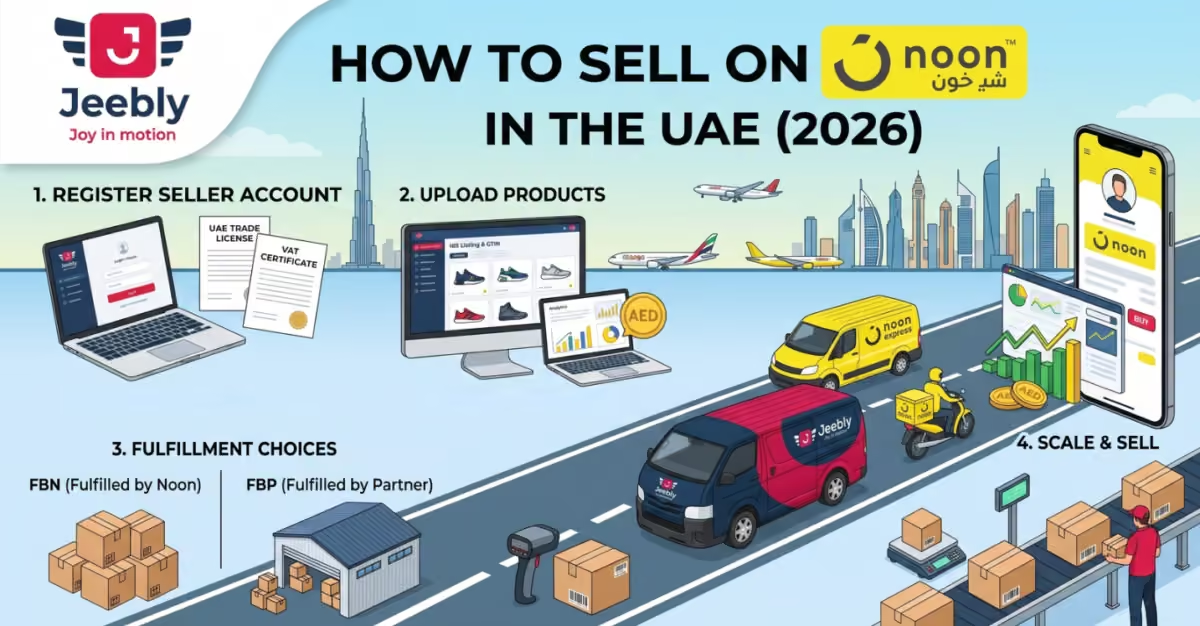
Infographic guide for selling on Noon UAE in 2026, showing seller registration steps, product cataloguing, FBN and FBP logistics options, a Jeebly delivery van, and the Dubai skyline.
How to Sell on Noon in the UAE in 2026

Expanding your e-commerce footprint across the Middle East starts with Noon—the UAE’s leading homegrown digital marketplace. Whether you are a local startup or an established retail brand, succeeding in 2026 requires understanding trade license compliance, optimizing catalog listings, and selecting the right fulfillment model between FBN and FBP. Explore our complete guide to selling on Noon UAE, covering onboarding essentials, commission structures, and how partnering with reliable last-mile delivery providers like Jeebly helps you scale faster.
Read More
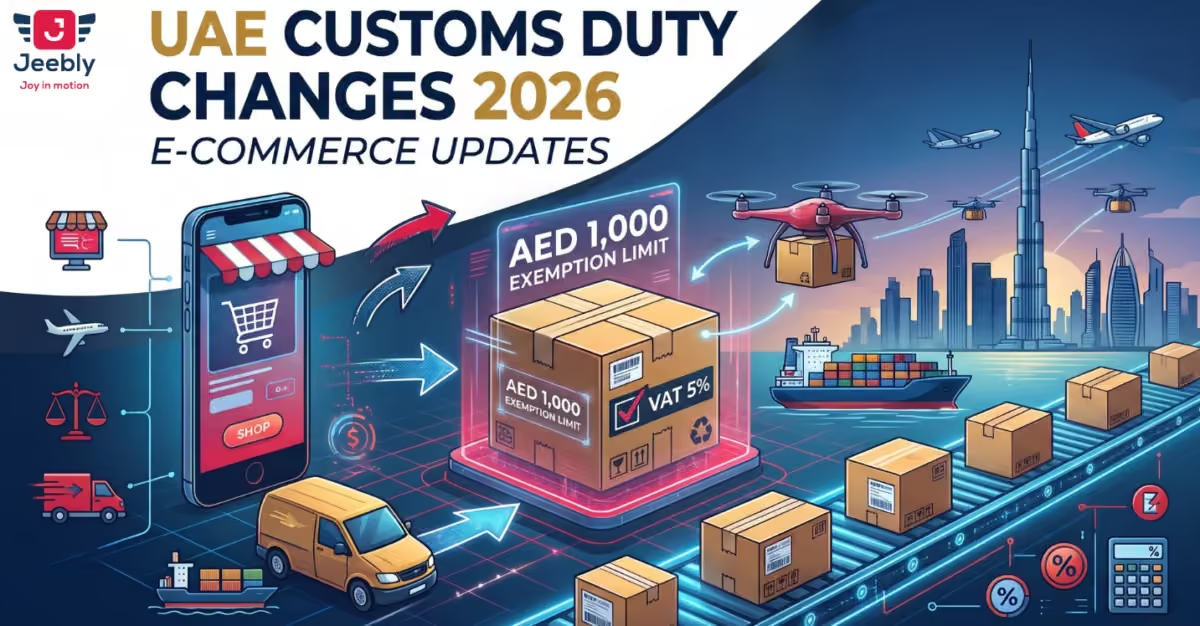
Infographic banner featuring the Jeebly logo, highlighting 2026 UAE customs duty updates for e-commerce with a Dubai skyline, delivery vans, cargo ships, conveyor belt parcels, and the AED 1,000 exemption limit.
UAE Customs Duty Changes for E-Commerce (2026)

With rapid expansions across the GCC digital commerce landscape, the UAE has implemented updated customs duty policies and clearance procedures for cross-border e-commerce shipments in 2026. From managing the AED 1,000 personal import exemption and 5% VAT rules to navigating commercial parcel compliance and streamlined last-mile delivery, discover how these regulatory shifts impact online retailers, logistics providers, and shoppers across the Emirates.

Read More
A Jeebly courier driver carrying a parcel while wiping sweat on a sunny Dubai street, with a second driver drinking water by a delivery van, illustrating UAE heat logistics and temperature-sensitive shipping challenges.
UAE Summer Delivery: Heat Effects on Couriers, Packaging and Timelines

Operating last-mile delivery in the UAE requires navigating challenging weather and heat conditions year-round. From protecting courier health to using insulated packaging and adjusting transit schedules, discover how top logistics providers keep temperature-sensitive parcels safe and on time across Dubai and the GCC.

Read More
Jeebly delivery van and driver holding a branded parcel against the Dubai skyline, featuring a digital route optimisation map interface.
What Is Route Optimisation in Last-Mile Delivery?

Last-mile delivery is the most critical—and expensive—leg of the supply chain. Discover how route optimisation leverages real-time data, traffic analytics, and smart scheduling to cut operational costs, beat urban gridlock, and ensure on-time deliveries across the UAE.
Read More
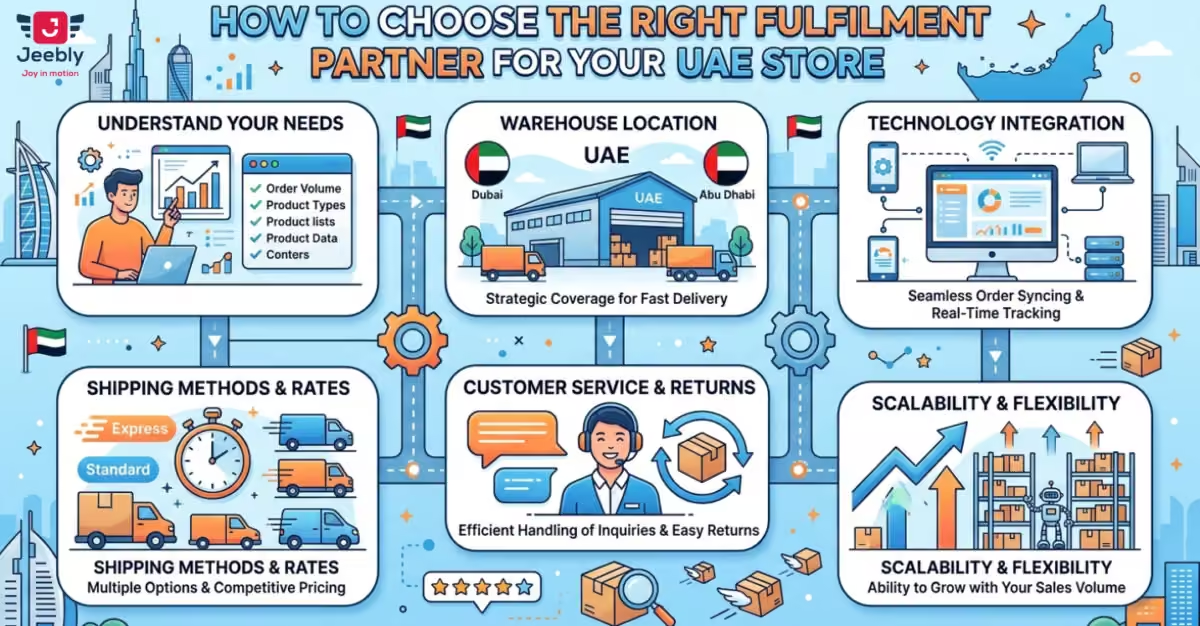
An infographic detailing six steps to choose the right fulfillment partner for a UAE store: understand needs, warehouse location (Dubai/Abu Dhabi), technology integration, shipping methods, customer service, and scalability, set against a UAE city skyline
How to Choose the Right Fulfilment Partner for Your UAE Store

Selecting the right fulfillment partner can make or break your e-commerce growth in the UAE. From strategic warehouse locations in Dubai and Abu Dhabi to seamless tech integration, learn the six critical factors every online store must evaluate to lower costs, ensure same-day delivery, and scale efficiently across the GCC.


Read More
Categories
blogs

How Jeebly Helps SMEs Scale During Peak Shopping Seasons

How Jeebly Helps SMEs Scale During Peak Shopping Seasons

How Jeebly Helps SMEs Scale During Peak Shopping Seasons

Peak shopping seasons can be both exciting and overwhelming for small and medium sized businesses (SMEs). Whether it’s festive sales, online shopping events, or promotional campaigns, order volumes can surge overnight. Without the right logistics support, this growth can quickly turn into delayed deliveries, unhappy customers, and lost revenue. That’s why choosing the right logistics solutions for SMEs during peak season becomes critical for sustainable growth.

At Jeebly, we help SMEs prepare for and scale smoothly during high demand periods with smart logistics planning, reliable delivery networks, and real time visibility.

Managing Sudden Order Surges with Ease

One of the biggest challenges SMEs face during peak seasons is managing sudden spikes in orders. Manual processes and limited delivery capacity can lead to missed pickups, delayed dispatches, and operational stress. Jeebly offers scalable delivery infrastructure that adjusts to your order volume, ensuring your business stays efficient even during high demand.

With flexible pickup scheduling, on demand delivery options, and same day or scheduled services, SMEs can keep operations running smoothly without overloading their teams.

Faster Fulfilment and Reliable Deliveries

During peak shopping periods, customers expect faster deliveries and accurate timelines. Delays can lead to negative reviews and lost repeat business. Jeebly’s optimized routing technology and reliable delivery network ensure that packages reach customers on time, even during busy periods.

Real time tracking and ETA updates also help businesses in Dubai keep customers informed throughout the delivery journey. This transparency reduces customer complaints and builds trust, which is essential during high volume sales seasons.

Smart Technology for Better Planning

Peak seasons require more than just extra delivery capacity. Businesses need visibility into orders, shipments, and delivery performance. Jeebly’s platform provides SMEs with real time dashboards, tracking tools, and analytics that make it easier to plan and manage operations.

With clear insights into delivery timelines, order status, and performance metrics, businesses can make quick decisions and maintain service quality. This technology driven approach is a key reason why many companies rely on logistics solutions for SMEs during peak season to stay competitive.

Cost Control During High Demand

Scaling during peak seasons can increase operational costs if not managed properly. Hiring temporary staff, arranging extra vehicles, or handling failed deliveries can quickly add up. Jeebly helps SMEs control costs through optimized routing, consolidated deliveries, and transparent pricing models.

By reducing failed delivery attempts and improving route efficiency, businesses can maintain profitability while meeting customer expectations.

Seamless Customer Experience

Customer experience plays a major role in repeat purchases and brand loyalty. During peak seasons, even small delays can affect customer satisfaction. Jeebly ensures smooth deliveries, accurate ETAs, and responsive support so that SMEs can deliver a consistent and reliable experience.

From first mile pickup to last mile delivery, our services are designed to support growing businesses and help them maintain service quality during their busiest periods.

Scale with Confidence

Peak shopping seasons are an opportunity for SMEs in UAE to grow their customer base and boost revenue. With the right logistics partner, scaling operations becomes far more manageable. Jeebly provides dependable, flexible, and tech enabled logistics solutions that help SMEs meet demand without compromising on service.

If your business is preparing for the next big sales season, investing in the right logistics solutions for SMEs during peak season can make all the difference. With Jeebly by your side, you can scale confidently, deliver faster, and keep customers coming back long after the peak season ends.

Routes to insightful reads

Infographic guide for selling on Noon UAE in 2026, showing seller registration steps, product cataloguing, FBN and FBP logistics options, a Jeebly delivery van, and the Dubai skyline.
How to Sell on Noon in the UAE in 2026

Expanding your e-commerce footprint across the Middle East starts with Noon—the UAE’s leading homegrown digital marketplace. Whether you are a local startup or an established retail brand, succeeding in 2026 requires understanding trade license compliance, optimizing catalog listings, and selecting the right fulfillment model between FBN and FBP. Explore our complete guide to selling on Noon UAE, covering onboarding essentials, commission structures, and how partnering with reliable last-mile delivery providers like Jeebly helps you scale faster.

Read More
Infographic banner featuring the Jeebly logo, highlighting 2026 UAE customs duty updates for e-commerce with a Dubai skyline, delivery vans, cargo ships, conveyor belt parcels, and the AED 1,000 exemption limit.
UAE Customs Duty Changes for E-Commerce (2026)

With rapid expansions across the GCC digital commerce landscape, the UAE has implemented updated customs duty policies and clearance procedures for cross-border e-commerce shipments in 2026. From managing the AED 1,000 personal import exemption and 5% VAT rules to navigating commercial parcel compliance and streamlined last-mile delivery, discover how these regulatory shifts impact online retailers, logistics providers, and shoppers across the Emirates.

Read More
A Jeebly courier driver carrying a parcel while wiping sweat on a sunny Dubai street, with a second driver drinking water by a delivery van, illustrating UAE heat logistics and temperature-sensitive shipping challenges.
UAE Summer Delivery: Heat Effects on Couriers, Packaging and Timelines

Operating last-mile delivery in the UAE requires navigating challenging weather and heat conditions year-round. From protecting courier health to using insulated packaging and adjusting transit schedules, discover how top logistics providers keep temperature-sensitive parcels safe and on time across Dubai and the GCC.

Read More
Jeebly delivery van and driver holding a branded parcel against the Dubai skyline, featuring a digital route optimisation map interface.
What Is Route Optimisation in Last-Mile Delivery?

Last-mile delivery is the most critical—and expensive—leg of the supply chain. Discover how route optimisation leverages real-time data, traffic analytics, and smart scheduling to cut operational costs, beat urban gridlock, and ensure on-time deliveries across the UAE.

Read More
An infographic detailing six steps to choose the right fulfillment partner for a UAE store: understand needs, warehouse location (Dubai/Abu Dhabi), technology integration, shipping methods, customer service, and scalability, set against a UAE city skyline
How to Choose the Right Fulfilment Partner for Your UAE Store

Selecting the right fulfillment partner can make or break your e-commerce growth in the UAE. From strategic warehouse locations in Dubai and Abu Dhabi to seamless tech integration, learn the six critical factors every online store must evaluate to lower costs, ensure same-day delivery, and scale efficiently across the GCC.

Read More

    Powered by