Jeebly | Logistics Solutions

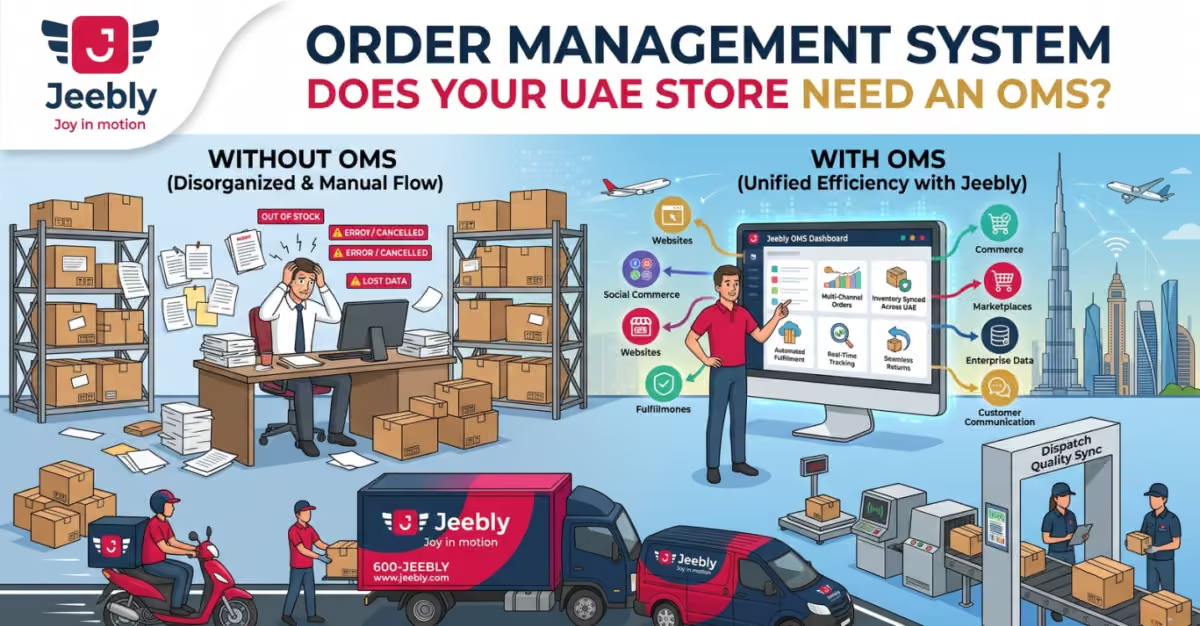
Split-screen infographic featuring the Jeebly logo, comparing chaotic manual order processing without an OMS against a streamlined, unified OMS workflow with Jeebly trucks, vans, and the Dubai skyline.

What Is an Order Management System (OMS) and Does Your UAE Store Need One?

An order management system (OMS) is software that tracks each customer order from checkout to delivery and returns, and keeps your sales channels, stock, warehouse and courier working from the same data. Most UAE stores don’t need a standalone OMS on day one because platforms like Shopify include order management. You need one when you sell across several channels, fulfil from multiple locations, or ship internationally and keep re-keying data.

UAE e-commerce is projected to reach USD 12.30 billion in 2026, and cross-border orders add customs, duties, and extra carriers to every order. This guide covers what an OMS does, what international shipping from the UAE adds, how an OMS connects to couriers and how to decide whether you need one.

Key Takeaways

  • An OMS manages the order lifecycle: capture, stock check, routing, dispatch, tracking and returns. It is not a warehouse system (WMS), a whole-business system (ERP) or a customer database (CRM).

  • Built-in order management is enough for a single-channel store that fulfils from one or two locations. Consider an OMS when channels, locations or international complexity grow.

  • International orders need extra data per product: HS code (customs tariff code), country of origin, declared value and Incoterm. 12-digit HS codes have been mandatory for trade destined for the GCC since 1 February 2026.

  • An OMS connects to a courier via API (application programming interface) to book shipments, generate labels, and track events. Ask whether international bookings, customs fields, proof of delivery and failed-delivery data are supported.

  • Count six signals (channels, locations, re-keying, overselling, international orders, returns) to decide. Two or three means add an app, and four or more means evaluate a dedicated OMS.

What Is an Order Management System (OMS)?

An OMS is software that manages the order lifecycle: order entry, inventory, fulfilment, and after-sales service. IBM frames order management as tracking an order from inception to fulfilment and managing the people, processes and data attached to it. In practice, the OMS holds one record per order that every team and system reads from.

System What it owns Example task
OMS The order across channels Decide which location ships an order and track its status
WMS (warehouse management system) Physical warehouse work Pick, pack and move stock
ERP (enterprise resource planning) Whole-business processes Finance, procurement, HR

An OMS usually sits above the warehouse system and coordinates it, rather than replacing it.

How Does an OMS Work? The Six Steps of the Order Lifecycle

Step What happens Without an OMS
1. Order capture Orders from every channel land in one queue Staff check each channel separately
2. Inventory check Stock is confirmed across locations Overselling when counts lag
3. Order routing The order is assigned to a location and carrier Manual decisions per order
4. Pick, pack and dispatch The warehouse receives instructions Orders copied between systems
5. Shipping and tracking The courier is booked, and the customer is updated Tracking numbers pasted by hand
6. After-sales Returns and exchanges are logged on the original order Returns tracked outside the order

Orders now arrive from marketplaces and chat apps, as well as websites, so a single queue matters. How to Sell on Amazon UAE and Social Commerce UAE show the channel mix UAE sellers manage.

What Makes International Shipping from the UAE Harder to Manage?

  • Customs data: every parcel needs a correct HS code, value, origin and description. Errors cause holds.


  • HS code format: Dubai Customs is replacing 8-digit codes with 12-digit codes in phases. Since 1 February 2026, they are mandatory for GCC-destined trade, and from August 2026 they extend to rest-of-world imports. Using flows outside the listed ones can attract penalties, so confirm the format with your broker.


  • Duties and taxes: DDP (Delivered Duty Paid) puts duty on the seller, while DAP (Delivered at Place) leaves it with the buyer.


  • Restricted goods: rules differ by destination. Read Dangerous Goods and Restricted Items.

  • Multiple handoffs: UAE pickup, transit and destination delivery may involve different carriers.


  • Cross-border returns: a return re-enters customs in the other direction.


For the destination rules, see Cross-Border Shipping Within the GCC, Customs Clearance in Dubai and UAE and 7 Essentials for a Smooth International Shipping Checklist.

What Data Should an OMS Hold for an International Order?

An OMS should carry these fields on every international order so the courier or broker never has to ask:

Field Why it matters
HS code (12-digit for GCC-destined trade) Duty calculation and clearance
Country of origin Duty treatment and certificates
Declared value and currency Duty and VAT basis
Plain-language product description Vague descriptions cause holds
Weight and dimensions Rate and volumetric weight
Consignee address and phone Delivery and customs contact
Incoterm (DDP or DAP) Who pays duty at destination
Restricted-item flag Stops prohibited goods before booking
Payment method (prepaid or COD) Collection and remittance
Return address Cross-border returns

An OMS holds and passes this data. Whether it also prints commercial invoices depends on the OMS or the shipping module you add, so check before you buy.

How Does an OMS Connect to a Courier Like Jeebly Dash International?

The OMS books each shipment through the courier’s API, receives a label, and gets tracking events that update the customer and the sales channel. In sequence: the order is confirmed in the OMS, the OMS picks the service and books it, the label returns, tracking events flow back, and returns open as new orders.

What Jeebly publishes:

  • API: ClickPost’s integration library lists Jeebly order creation, cancellation, label generation, tracking by polling and by webhook, and return webhooks. It does not list proof of delivery, failed-delivery data or pickup requests for that integration.
  • Dash International: cross-border e-commerce with COD, real-time tracking, flexible pickup points, customs clearance support and a courier partner network.
  • Platform connections: Jeebly Bizz connects Shopify, Magento, WooCommerce and custom APIs, so orders flow without manual entry.


Ask any courier these six questions before connecting:

  1. Does the API support international bookings and customs fields?
  2. Which tracking events come back, including customs holds?
  3. Are proof of delivery and failed-delivery data available by API?
  4. How does COD work, and how is it remitted on international orders?
  5. How are returns booked and tracked across borders?
  6. Which destinations and shipment types are covered?

Re-keying orders into a courier portal is where errors creep in. A logistics partner for ecommerce with an order integration removes that step. Talk to the Jeebly team about connecting your store.

Does Your UAE Store Need an OMS? A Six-Signal Check

Probably not if you sell on one channel and fulfil from one location. Probably yes once several of these signals appear. No magic order count triggers the decision. The warning signs show up in the workflow first.

Signal What it looks like
1. Several channels Website, marketplace and chat orders managed in different places
2. Several fulfilment points Your own stock plus a 3PL, or multiple locations
3. Manual re-keying Orders or tracking numbers copied between systems daily
4. Overselling Stock counts lag between channels
5. International orders Customs data and carrier choice handled by hand
6. Returns outside the order record Returns tracked in a spreadsheet

Not sure how many signals you meet? Talk to the Jeebly team with your channels, locations and destinations.

Conclusion

An OMS is the one record that carries an order from checkout to delivery and back. For a UAE store, the question is not “do I need one” but “how many of the six signals do I have”. International orders add the most: product-level customs data, the right Incoterm, and a courier connection that returns tracking and returns data.

For the carrier side, read What Is Multi-Carrier Shipping and Do UAE Sellers Need It?. To connect your order data to cross-border delivery, Jeebly Dash International and Jeebly Bizz cover the courier and platform sides. Contact us to review your setup.

Frequently Asked Questions

Usually the seller: you pay the forward attempt and the return, and you lose the sale. There are no set charges as courier terms differ. Get failed-attempt, return-leg and COD fees in writing.

The steps are receiving, storing, order processing, picking, packing, shipping and returns. An OMS manages order processing and coordinates the others, while a WMS handles receiving, storage, picking, and packing in the warehouse.

 It means fulfilling orders from multiple locations, with the OMS choosing which one ships each order based on stock, proximity and cost. For UAE examples of smaller, closer locations, see Micro-Fulfilment Centres and What Is a Dark Store?

It depends on the type: built into your store platform, a subscription app, or an enterprise licence with implementation. Compare the 12-month total, including integration, per-order fees and support, and ask for an itemised quote.

Not for occasional documents. Book them with the courier directly. Jeebly Dash International lists document and parcel shipping from the UAE with customs support and tracking. An OMS earns its place when document and parcel orders arrive at volume through your sales channels.

No. Customs authorities handle clearance through a broker or your courier. The OMS supplies the data. Jeebly lists customs clearance support under Dash International, so confirm its scope for your destination.

No. A CRM (customer relationship management) system stores customer contacts and sales activity, while an OMS manages orders. The two connect so support teams can see an order’s status next to the customer’s history.

Sometimes. Some couriers accept a re-attempt request before the parcel leaves the local hub if the customer responds. Once it is in reverse transit, many treat it as committed, and the practical route is to reship as a new order after it returns. Ask your courier about its re-attempt cut-off.

Yes, but rarely. Causes include incorrect addresses, unreachable customers, and refusals due to a change of mind. When a prepaid parcel comes back, refund it per your policy, inform the customer, and correct the address data.

Judge COD and prepaid separately. There is no set benchmark. Your target depends on your COD share: blended RTO = COD share × COD RTO + prepaid share × prepaid RTO. Watch the monthly trend.

Under Fulfilled by Noon (FBN), where Noon stores and delivers your stock, the outbound fee applies once an order is first marked Delivered or NDR, so a failed delivery still costs a fee. Under DirectShip, you hand-pack orders for Noon, and undeliverable orders return to you after three attempts. For sellers shipping Amazon.ae orders themselves, a refused COD order generally becomes a failed delivery entering an RTO workflow.

Routes to insightful reads

Split-screen infographic featuring the Jeebly logo, comparing chaotic manual order processing without an OMS against a streamlined, unified OMS workflow with Jeebly trucks, vans, and the Dubai skyline.
Order Management System: Does Your UAE Store Need an OMS?

Managing orders across your website, social channels, and marketplaces like Noon and Amazon can quickly overwhelm manual spreadsheets and disconnected systems. Stockouts, delayed dispatches, and rising return rates often signal that your business has outgrown basic order tracking. Discover the key signs your UAE e-commerce store needs an Order Management System (OMS) and how integrating automated order workflows with Jeebly streamlines inventory sync, multi-channel fulfillment, and last-mile delivery.
Read More
An animated vector-style graphic illustrating "What is RTO (Return to Origin) in E-Commerce and How UAE Sellers Can Reduce It", featuring Dubai's skyline, Jeebly delivery vans, and the loop of a package being returned to an origin hub alongside tips for successful doorstep delivery.
What Is RTO (Return to Origin) in E-Commerce and How UAE Sellers Can Reduce It

Return to Origin (RTO) is one of the most expensive headaches for UAE e-commerce sellers—often driven by non-standardized addresses, hard-to-reach customers, and Cash on Delivery (COD) refusals. But you don’t have to let failed deliveries eat into your profit margins. Discover what causes high RTO rates in the UAE and learn practical, actionable strategies—from address validation and automated customer communication to partnering with reliable delivery services like Jeebly—to protect your bottom line and ensure more orders find their home on the very first try.
Read More
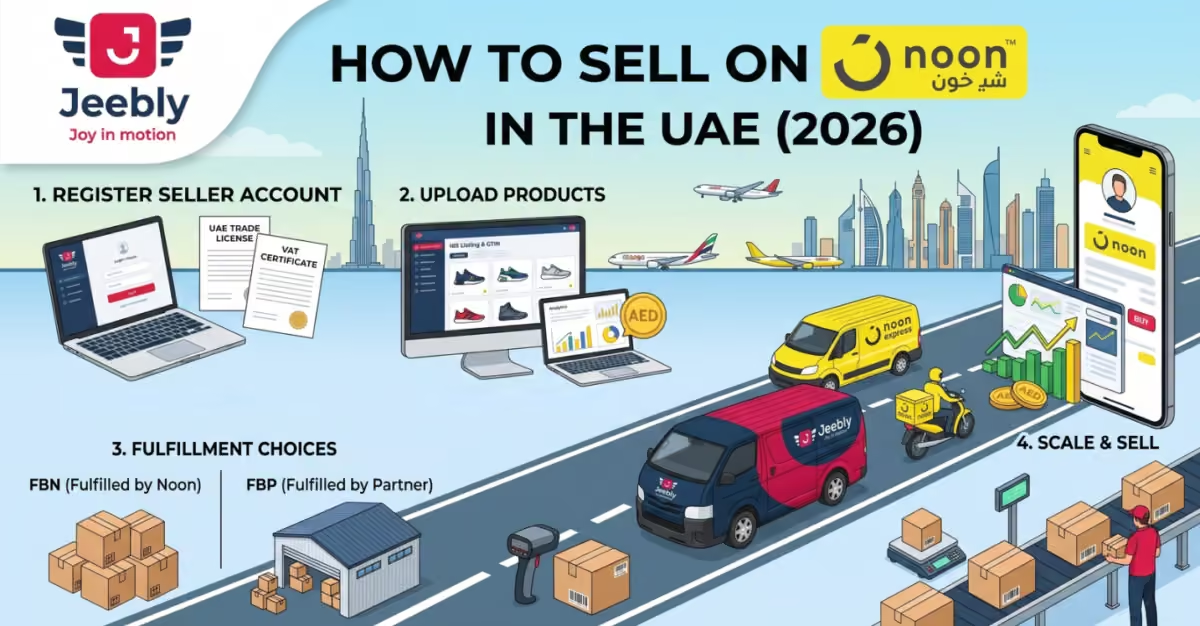
Infographic guide for selling on Noon UAE in 2026, showing seller registration steps, product cataloguing, FBN and FBP logistics options, a Jeebly delivery van, and the Dubai skyline.
How to Sell on Noon in the UAE in 2026

Expanding your e-commerce footprint across the Middle East starts with Noon—the UAE’s leading homegrown digital marketplace. Whether you are a local startup or an established retail brand, succeeding in 2026 requires understanding trade license compliance, optimizing catalog listings, and selecting the right fulfillment model between FBN and FBP. Explore our complete guide to selling on Noon UAE, covering onboarding essentials, commission structures, and how partnering with reliable last-mile delivery providers like Jeebly helps you scale faster.
Read More
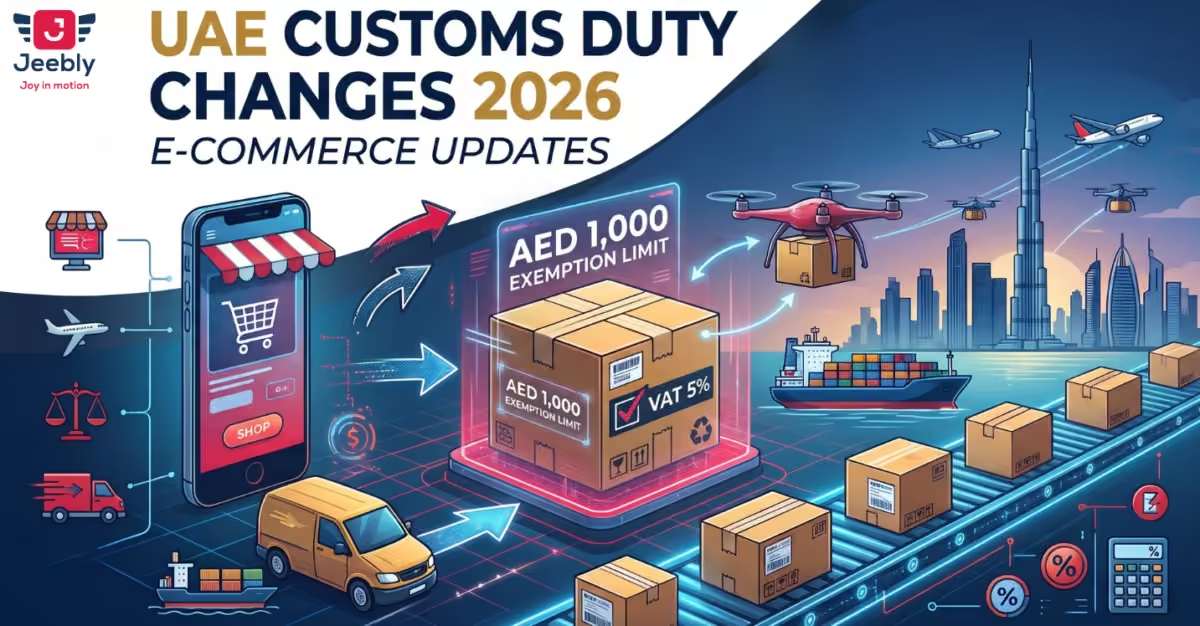
Infographic banner featuring the Jeebly logo, highlighting 2026 UAE customs duty updates for e-commerce with a Dubai skyline, delivery vans, cargo ships, conveyor belt parcels, and the AED 1,000 exemption limit.
UAE Customs Duty Changes for E-Commerce (2026)

With rapid expansions across the GCC digital commerce landscape, the UAE has implemented updated customs duty policies and clearance procedures for cross-border e-commerce shipments in 2026. From managing the AED 1,000 personal import exemption and 5% VAT rules to navigating commercial parcel compliance and streamlined last-mile delivery, discover how these regulatory shifts impact online retailers, logistics providers, and shoppers across the Emirates.

Read More
A Jeebly courier driver carrying a parcel while wiping sweat on a sunny Dubai street, with a second driver drinking water by a delivery van, illustrating UAE heat logistics and temperature-sensitive shipping challenges.
UAE Summer Delivery: Heat Effects on Couriers, Packaging and Timelines

Operating last-mile delivery in the UAE requires navigating challenging weather and heat conditions year-round. From protecting courier health to using insulated packaging and adjusting transit schedules, discover how top logistics providers keep temperature-sensitive parcels safe and on time across Dubai and the GCC.

Read More

    Powered by