






In today’s competitive e-commerce landscape, competing on price alone is a race to the bottom. Customers are increasingly valuing speed, transparent tracking, and reliable service over minor cost savings. Discover why elevating your delivery experience is the ultimate brand differentiator for UAE sellers and how it drives long-term customer loyalty.
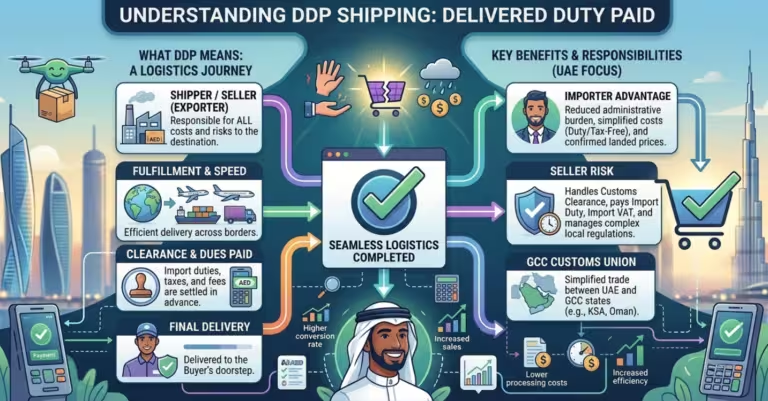
What Is DDP Shipping? What "Delivered Duty Paid" Means for UAE Importers and Exporters
When a UAE business orders goods from a Chinese supplier and receives a single all-in price covering freight, UAE customs clearance, 5% import duty, 5% VAT, and doorstep delivery, that’s DDP (Delivered Duty Paid) shipping. The buyer pays once and receives everything cleared. There are no customs queues, surprise duty invoices, or handoff between carrier and customs broker.
For UAE importers buying from Asia and UAE exporters selling to GCC markets, DDP is both an opportunity and a risk depending on who structures it, how the documentation works, and whether the VAT element is actually recoverable.
This guide explains how DDP shipping works for UAE businesses specifically, what it costs, where it can create problems, and when to use DAP (Delivered at Place) instead.
Key Takeaways
- DDP (Delivered Duty Paid) means the seller pays all costs (freight, customs clearance, import duties, and VAT) until goods reach the buyer’s named address.
- UAE importers buying DDP from overseas suppliers often cannot reclaim the 5% UAE import VAT, because it’s paid under the agent’s TRN rather than their own.
- For UAE exporters selling to GCC markets under DDP, the seller takes on customs clearance and duty payment in the destination country, which requires either local entity registration or an IOR (Importer of Record).
- DDP suits first-time or low-volume importers. Growing businesses can save significant margin by switching from DDP to FOB with their own freight forwarding system once volumes justify it.
What Is DDP Shipping?
DDP (Delivered Duty Paid) is an Incoterm, one of 11 standardised international trade terms published by the International Chamber of Commerce, that defines who pays for what in a cross-border shipment.
Under DDP, the seller is responsible for all costs and risks from origin to the buyer’s named delivery address, including export formalities, freight, insurance, import customs clearance, import duties, and VAT or equivalent taxes in the destination country.
The buyer’s only obligation is to accept delivery. There are no further charges at the door. In practice, UAE businesses encounter DDP in two directions:
- As importers: A UAE company buying goods from China or Europe may receive a DDP quote from a supplier or freight agent, one price covering everything from the factory to the Dubai warehouse address. No separate customs agent required and no duty invoice arriving two weeks later.
- As exporters: A UAE brand selling to customers in Saudi Arabia, Kuwait, or the UK may offer DDP terms to its buyers, absorbing all the destination-country duty and VAT to deliver a frictionless customer experience.
Both directions carry fundamentally different implications.
How DDP Shipping Works: The Full Sequence
For a UAE importer receiving DDP goods from China:
- Order placed and DDP price agreed. The supplier or freight agent provides an all-in DDP quote covering the goods, export formalities, freight (air or sea), UAE customs clearance, 5% import duty, and 5% VAT to a named UAE address.
- Supplier arranges export. The seller prepares commercial invoice, packing list, and export declaration in China. Goods are collected from the factory.
- International transit. Goods move by air freight services (3–7 days from China) or sea freight (18–25 days via Jebel Ali) to the UAE.
- UAE customs clearance. The DDP agent files the import declaration with Dubai Customs (via Mirsal 2), pays the 5% customs duty and 5% VAT, and obtains the release order.
- Last-mile delivery. Goods are delivered to the UAE importer’s warehouse, free zone, or office.
For a UAE exporter shipping DDP to a GCC buyer:
The same sequence applies in reverse. The UAE seller arranges freight to Saudi Arabia, Kuwait, or Oman; handles destination-country customs clearance; pays applicable import duties; and delivers to the buyer’s address. The destination country’s customs authority is the operative regulatory body.
DDP vs DAP vs FOB: The UAE-Specific Comparison
For UAE businesses, three Incoterms majorly determine how cross-border costs are split between seller and buyer: DDP (Delivered Duty Paid), DAP (Delivered at Place), and FOB (Free on Board).
Each one places a different set of obligations on each party, and choosing the wrong one either erodes your margin as a seller or creates unexpected charges for your buyer.
| Aspects | DDP | DAP | FOB |
|---|---|---|---|
| Who pays import duty | Seller | Buyer | Buyer |
| Who pays import VAT | Seller | Buyer | Buyer |
| Who arranges customs clearance | Seller | Buyer | Buyer |
| Buyer's experience | Frictionless, one price | Surprise charges at delivery | Full control + cost visibility |
| Seller's cost | Highest | Moderate | Lowest |
| VAT reclaimability (UAE importer) | Often not | Yes, under your own TRN | Yes, under your own TRN |
| Best for | First-time importers, B2C buyers | B2B buyers handling own clearance | Scaling importers with own forwarder |
DAP leaves import duty and VAT to the buyer. It’s simpler for the seller, but creates the risk that the buyer faces an unexpected charge at delivery or customs hold.
When is each appropriate:
- If your goal is lower cart abandonment and fewer failed deliveries, DDP usually performs better because it removes uncertainty from the buying experience.
- DAP still has a place when you’re testing markets or protecting margin early, but scaling DAP without clear transparency almost always shows up later in higher refusal rates.
- FOB is appropriate if importing at meaningful volume. Under FOB, goods are handed to the buyer’s freight forwarder at the origin port. The buyer arranges their own freight, manages their own customs clearance, and pays duty and VAT directly to UAE Customs under their own TRN.
A quick guide on VAT on Shipping and Delivery in UAE covers more on how UAE import VAT works, what a compliant tax invoice must contain, and the changes that affect how shipping VAT is documented and recovered.
When does it make sense to move from DDP to FOB?
For UAE importers, the economics of DDP shift as volume grows. At low volume, DDP’s convenience premium is worth paying. There’s no customs agent to manage, no freight forwarder relationship to maintain, and no separate duty payment to coordinate.
Above that threshold, engaging your own freight forwarder and customs broker can recover some percentage of the DDP premium, while also making your UAE import VAT reclaimable under your own TRN.
The UAE-Specific DDP Problems
These are the issues that specifically affect UAE businesses using DDP that global Incoterms guides don’t address.
Problem 1: The VAT reclaim gap for UAE importers.
Because the DDP agent pays UAE import VAT in their own name, UAE-registered businesses often don’t receive a valid import VAT document under their company’s TRN. A VAT-registered UAE business may be unable to reclaim that 5%.
The fix: If you’re VAT-registered in the UAE and importing regularly, confirm with any DDP provider whether the import declaration will be filed under your TRN. If the answer is no or unclear, the convenience of DDP is costing you recoverable VAT.
Problem 2: Under-declared customs values.
Some DDP agents lower the declared customs value to cut duty and offer a tempting DDP price. If UAE Customs reassesses the declared value, the importer faces penalties, and it’s your goods, your liability.
The fix: Always request a copy of the import declaration and verify that the declared value matches your commercial invoice.
Problem 3: UAE exporters need IOR arrangements for GCC DDP.
For a UAE brand offering DDP to Saudi, Kuwaiti, or Omani buyers, the seller must either be registered as an importer in the destination country or appoint an Importer of Record (IOR) service provider to handle customs clearance on their behalf.
Without this, the seller can’t legally act as the DDP importer at the destination. This requirement is frequently overlooked by SMEs new to GCC cross-border DDP.
Problem 4: De minimis changes affecting DDP economics.
The August 2025 suspension of the US de minimis exemption (affecting goods from all origins) means shipments that previously cleared US customs duty-free now face full tariff rates. For UAE exporters selling to US customers under DDP, this materially changes the seller’s landed cost calculation.
DDP is more expensive post-August 2025, but also more important for customer experience. Buyers who previously received duty-free parcels now face import charges under DAP terms, which creates refusals and returns.
What DDP Shipping Costs: The Full Landed Cost Breakdown
Most DDP quotes present a single number. Here’s what’s inside it and what you should verify before accepting.
| Cost Component | Who Pays (DDP) | Notes |
|---|---|---|
| Goods value | Seller | Invoice value |
| Export documentation and freight forwarding (origin) | Seller | Varies by origin port and agent |
| International freight (air or sea) | Seller | Major variable, get a market rate comparison |
| Origin port handling | Seller | Check whether included in freight quote |
| Destination port handling and terminal fees | Seller | Often quoted separately |
| UAE customs clearance fees | Seller | Per declaration, typically AED 50–200 |
| UAE import duty | Seller | 5% of CIF value for most goods |
| UAE VAT at import | Seller | 5% of CIF value plus duty |
| Last-mile delivery | Seller | To named UAE address |
Along with the expenses, it’s important to determine whether your goods are classified as dangerous or restricted, which affects carrier acceptance and adds handling surcharges to your DDP cost.
Here’s a quick read on Dangerous Goods and Restricted Items in the UAE that covers which product categories carry essential requirements and what the compliance steps are before shipping.
How a Delivery Note Works: The Handover Sequence
The delivery note process follows a repeatable sequence that every UAE business should standardise.
Step 1: Generation at dispatch
When an order is packed and ready to leave the warehouse, a delivery note is generated, ideally automatically from the order management system to eliminate manual data entry errors. The note is either printed and attached to the shipment, or sent digitally to the recipient ahead of arrival.
Step 2: Travel with the goods
The delivery note accompanies the shipment. The courier or driver carries it to the delivery point. It is not sent separately by email or uploaded after the fact. Its purpose is to be present at the point of handover.
Step 3: Recipient verification
On arrival, the recipient checks the delivered items against the delivery note. Any discrepancy, such as a wrong item, short quantity, or damaged goods, is noted on the delivery note before signature.
Step 4: Confirmation
In paper-based systems, the recipient signs and dates the delivery note. The driver retains one copy; the recipient keeps one. In ePOD systems (covered below), digital confirmation is captured automatically.
Step 5: Filing and retention
Both parties retain their copies. Keeping delivery notes for at least five years is advisable to support documentation for disputes or claims. For UAE businesses managing import documentation, this retention period also aligns with FTA audit requirements for VAT-related records.
How Jeebly Can Support DDP Operations
For UAE businesses managing cross-border freight alongside domestic last-mile delivery, having both legs under one platform removes the coordination overhead that typically creates DDP delays.
Jeebly Haul covers the freight leg (air, sea, road) across UAE and GCC routes with in-house customs clearance rather than outsourced brokerage. For UAE businesses importing goods under DDP or structured as FOB with Jeebly managing the UAE customs leg, this means one point of contact from port to warehouse.
For UAE exporters shipping to GCC customers who want a clean, tracked last-mile experience at the destination end, Jeebly Bizz connects order management with domestic delivery. Shopify and WooCommerce orders dispatch automatically, with real-time tracking and photo ePOD at every delivery.
For businesses shipping domestic parcels alongside cross-border operations, same-day delivery across the UAE through Jeebly Dash completes the fulfilment loop. Domestic last-mile is at 98% FDSS, connected to the same platform managing inbound freight.
Talk to the Jeebly team to discuss your specific import or export profile, and we’ll confirm how Jeebly Haul covers the freight and customs clearance leg for your operation.
Conclusion
DDP shipping gives buyers a frictionless experience: one price, no customs surprises, no charges at the door. For UAE importers, the critical check is whether the 5% UAE import VAT is paid under your TRN (making it reclaimable) or the agent’s TRN (making it a sunk cost).
For UAE exporters, DDP to GCC markets requires either IOR arrangements or a logistics partner with GCC-wide customs capability. The economics of DDP shift as volume grows. The convenience premium that makes sense at low volume often doesn’t at scale, where FOB with your own freight forwarder recovers meaningful margin.
For UAE businesses managing cross-border freight and domestic last-mile through one connected platform, Jeebly Haul and Jeebly Bizz cover both legs. Get in touch to discuss your import or export structure.
Related Articles:
Frequently Asked Questions

DDP (Delivered Duty Paid) is an Incoterm where the seller pays all costs such as freight, customs clearance, import duties, and VAT until goods reach the buyer’s named delivery address. The buyer pays nothing extra on arrival. It places maximum responsibility on the seller and minimum on the buyer.
Only if the import declaration is filed under your company’s UAE Tax Registration Number (TRN). Many DDP freight agents file import declarations under their own TRN, meaning the 5% UAE import VAT is paid in their name, and you cannot reclaim it on your FTA VAT return. Always confirm with your DDP provider which TRN the customs declaration will be filed under before accepting the arrangement.
Under DDP, the UAE seller pays destination-country import duties and VAT, and handles customs clearance. The buyer receives goods with no additional charges. Under DAP, the buyer is responsible for import duties and customs clearance at the destination.
A UAE importer should switch from DDP (Delivered Duty Paid) to FOB (Free on Board) if shipping volumes scale up, internal logistics are established, and there is a need to lower high markup costs embedded in seller-managed freight. This transition makes sense when the business gains the capability to manage local UAE customs clearance and ocean freight directly.
Yes. DDP applies to any mode of transport: air, sea, or road. For China-to-UAE imports, sea freight DDP via Jebel Ali is the most cost-effective option for non-time-sensitive goods (18–25 days). Air freight DDP is appropriate for high-value or time-sensitive shipments (3–7 days from China). The DDP price includes the freight cost for whichever mode is used.
Routes to insightful reads

Why Delivery Experience Is a Bigger Brand Differentiator Than Price
Author:
October 15, 2026
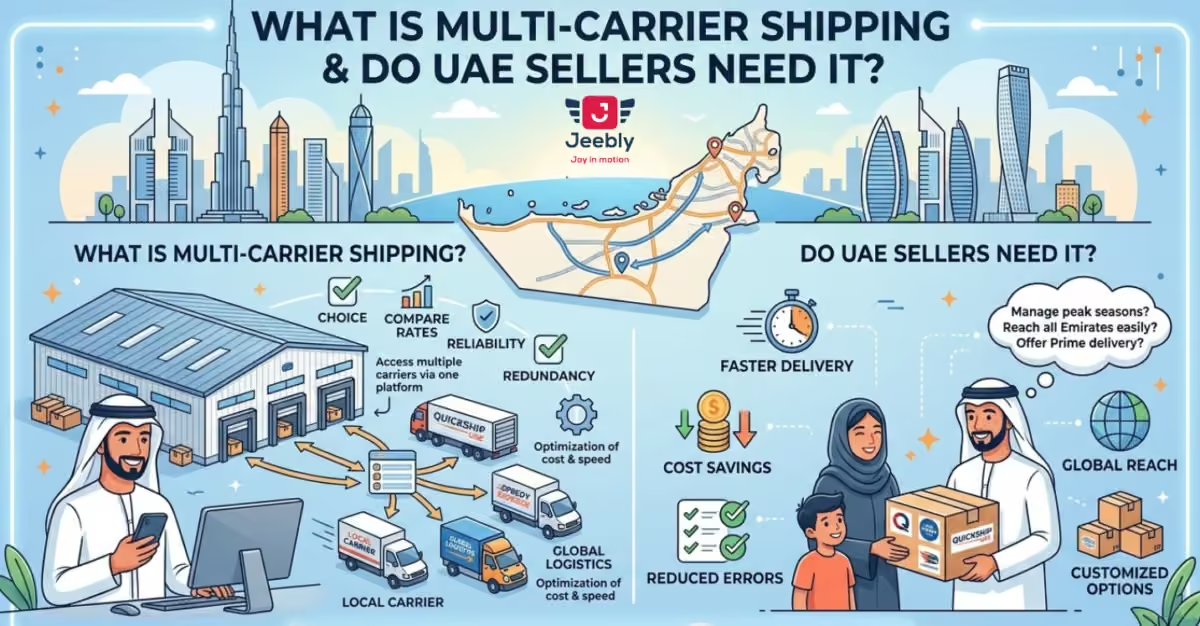
What Is Multi-Carrier Shipping and Do UAE Sellers Need It?
Author:
October 12, 2026
Relying on a single shipping provider can lead to bottlenecks, higher costs, and limited reach. Discover what multi-carrier shipping is and why e-commerce sellers in the UAE need a unified shipping strategy to compare rates, optimize delivery times across all Emirates, and scale their business smoothly.
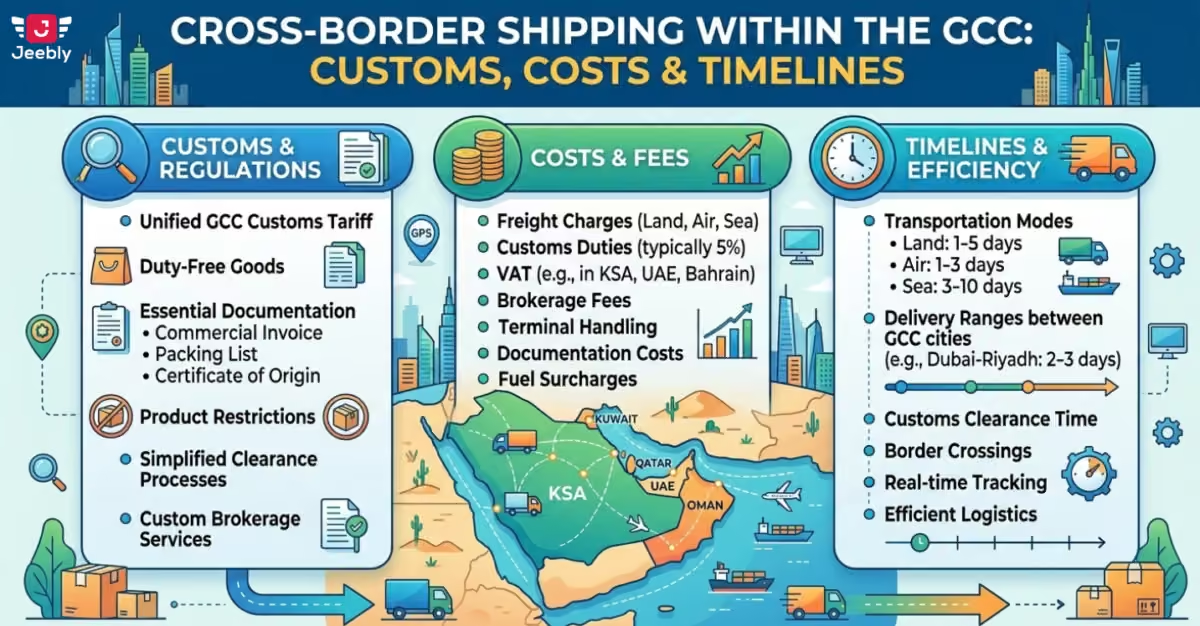
Cross-Border Shipping Within the GCC: Customs, Costs and Timelines
Author:
October 8, 2026
Gearing up for Q4 in the UAE? Navigating peak season demand requires early planning across warehouse operations, carrier capacity, inventory, and customer experience. Explore our 10-step logistics checklist to streamline your supply chain, avoid bottleneck delays, and ensure smooth delivery during the busiest shopping quarter of the year.
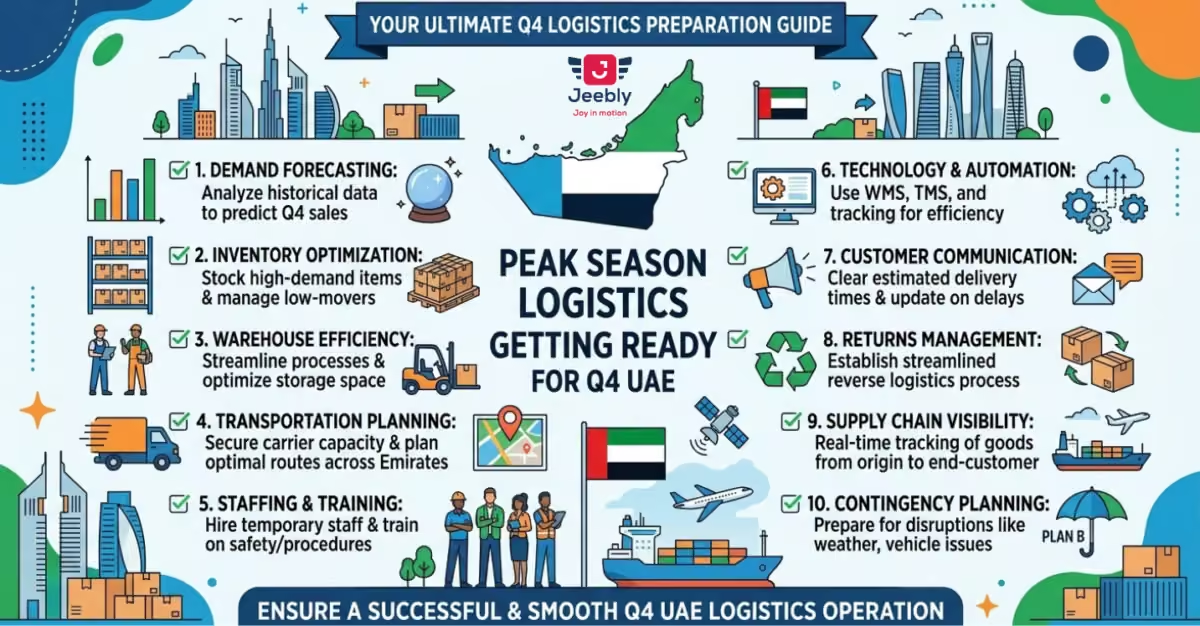
Peak Season Logistics Checklist: Getting Ready for Q4 UAE
Author:
October 5, 2026
Gearing up for Q4 in the UAE? Navigating peak season demand requires early planning across warehouse operations, carrier capacity, inventory, and customer experience. Explore our 10-step logistics checklist to streamline your supply chain, avoid bottleneck delays, and ensure smooth delivery during the busiest shopping quarter of the year.
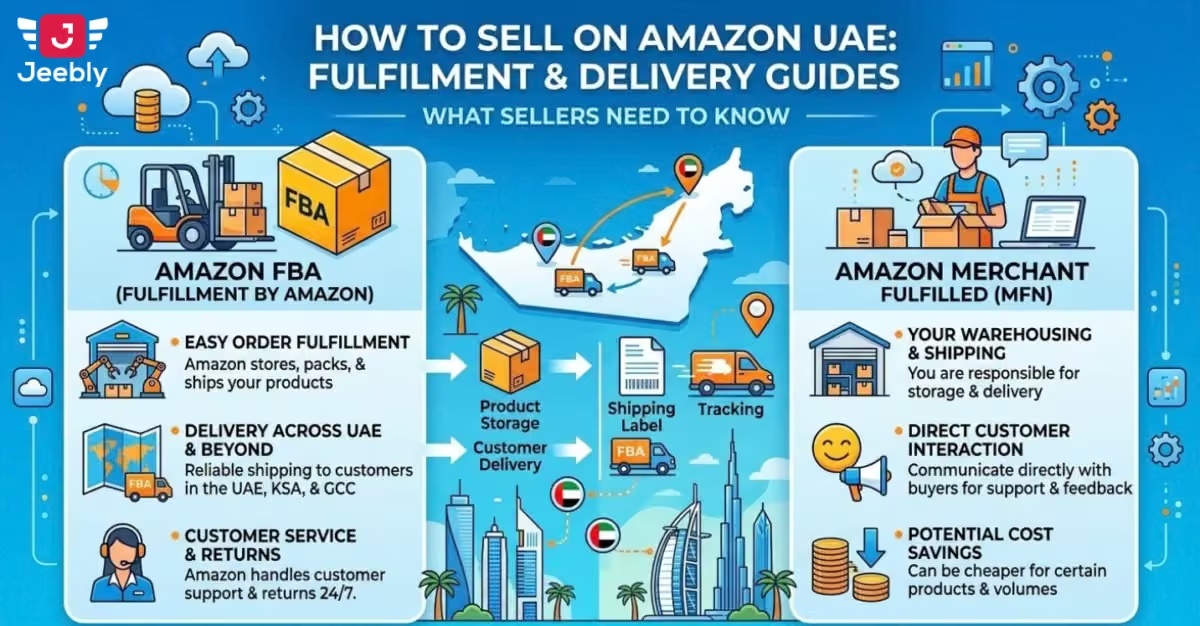
How to Sell on Amazon UAE: What Sellers Need to Know About Fulfilment and Delivery
Author:
September 28, 2026
Selling on Amazon UAE offers massive growth potential, but choosing the right logistics model can make or break your margins. Discover the step-by-step onboarding process for Amazon.ae, explore the core differences between Fulfilment by Amazon (FBA) and Fulfilment by Merchant (FBM), and learn how to optimize your delivery strategy to scale efficiently in the UAE market.
