






Jeebly | Logistics Solutions

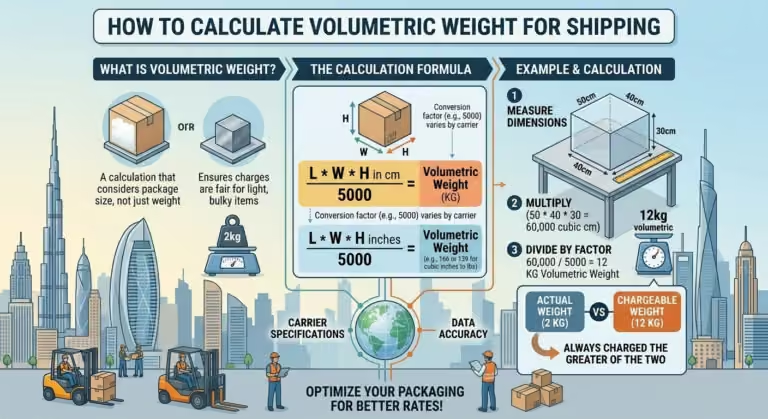
Infographic explaining how to calculate volumetric weight for shipping, including the formula, measurement example and comparison between actual and chargeable weight.

If your shipping charge looks higher than expected even though the parcel feels light, its size may be the reason. Carriers often consider volumetric weight, which reflects how much space a packed parcel occupies during transport. 

To calculate it, multiply the parcel’s length, width, and height, then divide the total by the applicable dimensional divisor. Compare the result with the parcel’s actual weight to estimate the chargeable weight.

Key Takeaways

  • Volumetric weight reflects the transport space occupied by a packed parcel.


  • Calculate it by multiplying length Ă— width Ă— height and dividing the result by the applicable dimensional divisor.


  • A divisor of 5,000 is commonly used for courier and express shipments, while the general IATA air-freight rule uses 6,000.


  • The higher applicable figure between actual and volumetric weight is generally used as the chargeable weight.


  • Measure the final packed parcel because external dimensions and provider-specific rounding rules can affect the calculation.


  • Large, heavy, or specialised shipments may require a customised freight quote instead of standard parcel pricing.

What Is the Difference Between Actual, Volumetric, and Chargeable Weight?

Volumetric weight, also called dimensional weight, estimates a parcel’s weight based on the space it occupies during transport. Actual weight measures the fully packed parcel on a scale, while chargeable weight is the figure generally used to calculate the shipping rate.

Weight type What it means How it is determined
Actual weight The physical weight of the fully packed parcel Measured on a scale
Volumetric weight The calculated weight based on the parcel’s external dimensions Calculated from length, width, and height
Chargeable weight The weight generally used to calculate the shipping rate Usually the higher applicable figure between actual and volumetric weight

Some shipping references use dead weight to mean the parcel’s actual weight measured on a scale. Volumetric weight, by contrast, is calculated from the space the parcel occupies.

The final billed weight can still depend on the provider’s measurement, rounding, minimum-weight, or service-specific pricing rules.

How Should You Measure a Parcel for Volumetric Weight?

Use the dimensions of the final packed parcel, not the product by itself. The outer packaging determines how much space the shipment occupies during transport.

Measure the parcel at its longest external points:

  • Length: the longest side
  • Width: the shorter side across the base
  • Height: the distance from the base to the highest point

Include any bulges, handles, uneven edges, or protruding packaging that increase the parcel’s overall size.

Record all three dimensions in centimetres when using a centimetre-based divisor such as 5,000 or 6,000. It is also important to check the provider’s rounding rules, since some carriers round dimensions before calculating volumetric weight.

Finally, weigh the fully packed parcel, including the box, protective material, inserts, and any other packaging. You will need this actual weight later when determining the chargeable weight.

What Is the Volumetric Weight Formula?

The basic volumetric weight formula is:

Volumetric weight (kg) = Length Ă— Width Ă— Height in cm Ă· dimensional divisor

The dimensional divisor converts the parcel’s cubic volume into a weight value. The figure used can vary by carrier, transport mode, service type, route, or commercial agreement.

Shipment context Common divisor What to keep in mind
Courier or express parcel 5,000 Commonly used, but not universal
General air freight 6,000 General IATA volumetric rule
Specialised or contract-based service Varies Confirm the applicable divisor with the logistics provider

Businesses comparing courier and express delivery rates in the UAE can also review Jeebly Dash for eligible same-day and scheduled parcel deliveries.

For Jeebly shipments, the applicable divisor should be confirmed for the specific service or quotation unless a standard figure is formally approved for publication.

A volumetric weight calculator uses the same formula automatically once you enter the parcel dimensions and applicable divisor.

How to Calculate Volumetric Weight in Kg Step by Step

Once you have the parcel dimensions and the correct divisor, the calculation is straightforward.

Step 1: Measure the Packed Parcel

Record the parcel’s length, width, and height in centimetres. Use the final external dimensions after the shipment has been fully packed.

Step 2: Calculate the Cubic Volume

Multiply the three dimensions:

Length Ă— Width Ă— Height

This gives you the parcel volume in cubic centimetres.

Step 3: Divide by the Applicable Divisor

Divide the cubic volume by the dimensional divisor used for the shipment.

For example, if the applicable divisor is 5,000:

Volumetric weight = Cubic volume Ă· 5,000

Step 4: Compare It With the Actual Weight

Compare the calculated volumetric weight with the parcel’s actual scale weight. The higher applicable figure is generally used to determine the chargeable weight.

Worked Example: When Volumetric Weight Is Higher

Suppose a packed parcel measures 50 Ă— 40 Ă— 30 cm and weighs 6 kg on a scale. If the applicable dimensional divisor is 5,000, the volumetric weight is calculated as follows:

50 Ă— 40 Ă— 30 = 60,000 cmÂł

60,000 Ă· 5,000 = 12 kg

The parcel therefore has:

  • Actual weight: 6 kg
  • Volumetric weight: 12 kg
  • Indicative chargeable weight: 12 kg

Since 12 kg is higher than the 6 kg actual weight, 12 kg would generally be the chargeable weight in this example.

Worked Example: When Actual Weight Is Higher

Now consider a smaller, denser parcel measuring 25 Ă— 20 Ă— 15 cm with an actual weight of 4 kg. Using a dimensional divisor of 5,000, the volumetric weight is:

25 Ă— 20 Ă— 15 = 7,500 cmÂł

7,500 Ă· 5,000 = 1.5 kg

The parcel therefore has:

  • Actual weight: 4 kg
  • Volumetric weight: 1.5 kg
  • Indicative chargeable weight: 4 kg

Since the 4 kg actual weight is higher than the 1.5 kg volumetric weight, 4 kg would generally be the chargeable weight.

Volumetric Weight Reference Table for Common Parcel Sizes

The table below shows how the same parcel dimensions produce different volumetric weights when different divisors are used.

Package dimensions Volume Weight at 5,000 Weight at 6,000
20 Ă— 15 Ă— 10 cm 3,000 cmÂł 0.6 kg 0.5 kg
30 Ă— 20 Ă— 15 cm 9,000 cmÂł 1.8 kg 1.5 kg
40 Ă— 30 Ă— 20 cm 24,000 cmÂł 4.8 kg 4 kg
50 Ă— 40 Ă— 30 cm 60,000 cmÂł 12 kg 10 kg
60 Ă— 50 Ă— 40 cm 120,000 cmÂł 24 kg 20 kg

Note: These are calculated volumetric weights. Final billing may reflect the logistics provider’s measurement and rounding rules.

Why Can Shipping Cost More Than the Parcel’s Actual Weight?

Shipping capacity is limited by both weight and physical space. A lightweight item packed in a large carton can therefore consume more transport capacity than its scale weight suggests. 

This can affect bulky-but-light apparel, footwear, home goods, gift sets, and electronics that require substantial protective packaging. For UAE e-commerce sellers and shipping teams, comparing final package dimensions with product weight can help explain why a shipping quote is higher than expected.

How Can UAE Sellers Reduce Volumetric Shipping Costs?

Reducing unnecessary package volume can help lower volumetric weight, but the parcel still needs enough protection to reach the customer safely. The goal is to use space more efficiently.

Practical ways to reduce excess volume include:

  • Choose right-sized packaging: Use a box or mailer that fits the product closely without leaving large empty areas.
  • Limit unnecessary void space: Avoid oversized cartons that require excessive filler around a small item.
  • Review outer packaging: A compact retail box may not need a much larger shipping carton unless extra protection is necessary.
  • Standardise common package sizes: Build box or mailer options around the product combinations you ship most frequently.
  • Pack multi-item orders efficiently: Combining suitable items in one well-fitted parcel may reduce the total space used across several packages.
  • Measure packages after sealing them: Final dimensions can differ from the original box measurements once cushioning and products are added.

Packaging changes should not increase product damage or returns. Sellers can also review how protective packaging and the unboxing experience work together when deciding where package size can be reduced.

Businesses managing recurring e-commerce orders can also explore Jeebly’s warehousing, fulfilment, and e-commerce shipping support through Jeebly Bizz, where packaging and fulfilment processes can be managed as part of a wider logistics operation.

Sellers preparing inventory for online marketplaces can also review Jeebly’s guide on how to sell on Amazon UAE, including fulfilment and shipment-planning considerations.

When Does a Shipment Need a Freight Quote Instead?

Volumetric weight is relevant across many parcel and freight calculations, but the same formula and pricing method do not apply universally to every shipment. Large, heavy, palletised, temperature-controlled, or specialised cargo may require an individual freight quotation that considers several pricing factors.

A customised freight quote may consider factors such as:

  • Total shipment weight and volume
  • Number of parcels or pallets
  • Origin, destination, and transport mode
  • Cross-border or customs requirements
  • Temperature control, security, or specialised handling

Jeebly currently directs shipments exceeding 20 kg or 100 Ă— 50 Ă— 50 cm toward Jeebly Haul for freight-based handling and quotation. Jeebly Haul is designed for larger or more complex cargo that requires a tailored logistics quote rather than standard parcel pricing.

Calculate Before You Ship

Calculating volumetric weight before dispatch can help you estimate the likely chargeable weight, review package size, and understand why a shipping quote may differ from the parcel’s scale weight.

For your next packaging review, see how protective packaging and the unboxing experience can work together without adding unnecessary parcel volume. 

Ready to price your shipments? Request a shipping rate quote from Jeebly based on your parcel or freight volumes and shipment requirements.

Frequently Asked Questions

Yes. Volumetric weight and dimensional weight generally refer to the same calculation based on the space a shipment occupies. This is different from actual weight, which is measured on a scale.

Measure the longest external length, width, and height as though the parcel were enclosed in a rectangular box. Confirm any additional rules for tubes, cylinders, or unusual package shapes with the logistics provider.

It can. A small, dense parcel may have a higher actual weight, while a lightweight parcel with relatively larger dimensions may produce a higher volumetric weight.

Yes. Carriers may use different dimensional divisors or rounding rules, so the same parcel can produce different volumetric or billable-weight results across services.

Routes to insightful reads

Infographic explaining how to calculate volumetric weight for shipping, including the formula, measurement example and comparison between actual and chargeable weight.
How to Calculate Volumetric Weight for Shipping: Formula and Examples

Learn how to calculate volumetric weight for shipping with an easy-to-follow formula and practical examples. Understand how package dimensions, actual weight and carrier conversion factors determine the chargeable weight and ultimately impact your shipping costs.

Read More
3PL vs 4PL logistics comparison showing warehousing, transportation, distribution, supply chain integration, technology, analytics, and strategic planning for UAE businesses
3PL vs 4PL: What Is the Difference and Which Does Your UAE Business Need?

3PL and 4PL logistics models help businesses manage different levels of supply chain operations. This guide explains the key differences between 3PL and 4PL providers, their roles, benefits, costs, and how UAE businesses can choose the right logistics model based on their size, supply chain complexity, and operational needs.

Read More
Types of packaging for courier shipments, showing outer packaging strength, void-fill options, cushioning materials, and sealing and labelling methods
Types of Packaging for Courier Shipments: Which One Best Protects Your Product?

Choosing the right packaging is essential for protecting products during courier transportation. This guide explores different types of packaging for courier shipments, including corrugated boxes, bubble wrap, air pillows, paper fillers, foam inserts, and protective seals, and explains how to choose the best option based on your product, handling needs, and shipping conditions.

Read More
Types of logistics explained through inbound, outbound, reverse and third-party logistics, showing the movement of goods between suppliers, warehouses, customers and return facilities.
Types of Logistics Explained: Inbound, Outbound, Reverse and Third-Party 

Logistics covers much more than moving goods from one place to another. This guide explains the four key types of logistics, inbound, outbound, reverse and third-party logistics (3PL), and how each supports the supply chain. Learn how goods move from suppliers to warehouses, reach customers, return for repair or disposal, and how businesses use 3PL providers to manage logistics operations.

Read More
Dark store in the UAE showing retail inventory, order picking, packaging, and Jeebly last-mile delivery for ultra-fast fulfillment
What Is a Dark Store? How UAE Retailers Are Using Them for Ultra-Fast Delivery

A dark store is a retail facility designed exclusively for online order fulfilment, with products organised for fast picking, packing, and dispatch rather than in-store customer shopping. In the UAE, dark stores are helping retailers and e-commerce businesses shorten delivery times by placing inventory closer to customers and streamlining the fulfilment process. This guide explains how dark stores work, their benefits, key challenges, and how they support ultra-fast delivery in the UAE.

Read More

    Powered by