Jeebly | Logistics Solutions

Categories
blogs

How to Choose the Right Fulfilment Partner for Your UAE Store

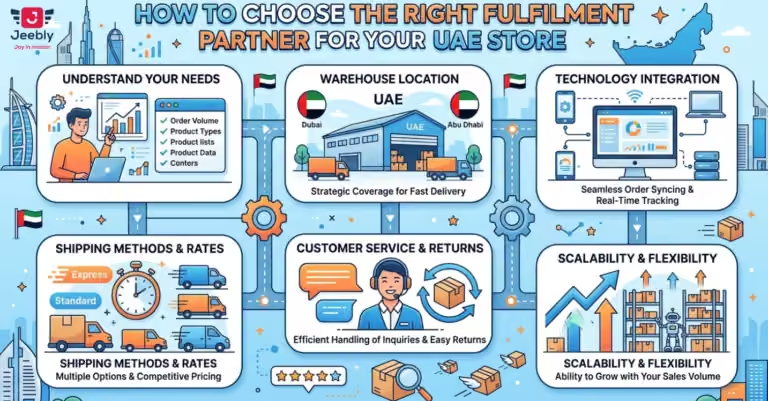
An infographic detailing six steps to choose the right fulfillment partner for a UAE store: understand needs, warehouse location (Dubai/Abu Dhabi), technology integration, shipping methods, customer service, and scalability, set against a UAE city skyline

How to Choose the Right Fulfilment Partner for Your UAE Store

Choosing a fulfilment partner is one of the highest-impact operational decisions a UAE e-commerce business makes and one of the most commonly rushed. Most brands evaluate on price and name recognition, sign a contract, and discover six months later that the partner cannot handle their COD volume efficiently, doesn’t cover Fujairah on next-day, or lacks a Shopify integration that works under load.

The right fulfilment partner matches your operational capabilities to your specific store profile. This guide is a structured evaluation checklist covering eight criteria, the right questions to ask before signing, and a break-even model to confirm the economics.

Key Takeaways

  • This is a buyer’s checklist for UAE store operators who have decided to outsource fulfilment and need a structured framework to evaluate and compare partners.


  • The break-even point for outsourcing fulfilment to a 3PL is typically between 1,000 and 3,000 orders per month. Below that, self-fulfilment is often more cost-effective; above it, the 3PL variable cost model almost always wins.


  • UAE-specific evaluation criteria that global guides miss: COD remittance cycle, emirate-level FDSS confirmation, free zone vs mainland warehouse location, and native Shopify or WooCommerce integration rather than middleware.


  • Your fulfilment partner’s last-mile network and FDSS rate drive conversion, not back-office metrics.


  • Always request an itemised per-order cost model including receiving, storage, pick and pack, shipping, COD fee, and returns handling before comparing any two partners on price.

When Should a UAE Business Switch to a Fulfilment Partner?

The breakeven point for outsourcing fulfilment services to a 3PL falls between 1,000 and 3,000 orders per month depending on product characteristics and geographic distribution requirements. Below that, self-fulfilment is often more cost-effective; above it, the 3PL’s variable cost model and the operational release almost always win. 

For a deeper dive into how UAE e-commerce fulfilment works operationally, eCommerce Fulfilment in UAE covers everything that precedes the partner selection decision. If you consistently exceed that threshold, or peak periods break your operation, now is the time to act. 

Use the eight criteria below to evaluate once you have made that call.

The Eight Criteria That Determine the Right Fulfilment Partner

1. UAE-wide coverage confirmed by emirate

“UAE-wide delivery” means different things to different providers. The question is whether the partner has confirmed a next-day delivery SLA for each of the seven emirates.

Northern and eastern emirates (Ras Al Khaimah, Fujairah, Umm Al Quwain) carry different delivery dynamics from Dubai and Abu Dhabi. Confirm the FDSS rate and next-day commitment for these zones before signing. A partner with 98% FDSS in Dubai and 82% in Ras Al Khaimah is not a UAE-wide delivery partner for a store with customers across the country.

Ask specifically: what is your published FDSS rate for Dubai, Abu Dhabi, and Ras Al Khaimah separately? The answer tells you more than any claimed overall figure.

2. COD remittance cycle

Secure COD remains a significant share of UAE e-commerce transactions. The remittance cycle, i.e. how quickly your fulfilment partner transfers collected COD funds back to your account, directly affects your working capital. A partner remitting fortnightly versus weekly holds an additional week of your peak-season revenue at any given time.

Confirm: weekly, fortnightly, or monthly remittance? Is this contractually guaranteed or operationally standard? Does the COD fee apply at the 3PL level, the courier level, or both? Get the answer in writing before signing.

3. Platform integration depth

Ask whether the 3PL has a certified app in the Shopify App Store, or whether the connection runs through a third-party middleware layer. If middleware, clarify who owns the connection when it breaks and what the error-handling process looks like.

A native Shopify or WooCommerce integration means orders sync automatically at the point of purchase, inventory counts update in real time as items are picked and returned, and tracking information flows back into your store. A middleware-dependent connection introduces a failure point that becomes critical during White Friday or Ramadan surges.

Test the integration in a live environment with representative order volumes before committing operationally.

4. Pick accuracy rate

Pick accuracy is the metric that most directly drives your incorrect-order return rate. A 99.5% pick accuracy at 500 daily orders means 2–3 incorrect orders per day. A 98% rate means 10. At scale, each incorrect order generates a return, a replacement, and a customer service interaction.

Professional UAE 3PLs should be able to quote their pick accuracy rate against an audited monthly order volume. Any provider that cannot provide this figure doesn’t track it, which says something about their operational standards.

5. Returns management

Most 3PL providers offer returns management. What matters is the process structure. 

Ask specifically: Is return collection managed in-house or outsourced to a separate provider? What is the SLA from customer door back to graded inventory? Is the returns tracking system integrated with the forward delivery system or maintained separately?

A fulfilment partner that handles returns through a separate vendor or a manual process creates a gap between your forward delivery and reverse logistics data. This makes it harder to identify which products are driving your return rate and why.

6. Warehouse location

Your partner’s warehouse location affects both delivery speed and duty liability. A warehouse inside JAFZA (Jebel Ali Free Zone) means goods remain duty-free until they move to the UAE mainland for sale. A Dubai mainland facility means you pay duty on inbound stock, but domestic delivery from the warehouse to your customer may be faster for last-mile delivery.

For brands importing from Asia and primarily selling to UAE domestic customers, the warehouse location decision affects your landed cost calculation as much as the 3PL’s pick-and-pack rate. 

Ask your shortlisted partners where their warehouse is, how they would treat duty on your inbound stock at that location, and the typical transit time from their facility to key delivery zones.

7. Total per-order cost

Request an itemised per-order cost breakdown from every fulfilment partner you evaluate. The line items to request:


Cost component What to confirm
Receiving (per pallet or per unit) Included or charged separately
Storage (per pallet per month or per CBM) Minimum monthly charge, if any
Pick fee (per item picked) Rate and whether minimum applies
Pack fee (per order) Packaging materials included or charged
Shipping (domestic, per kg or per parcel) Published rate by zone
COD fee Percentage or fixed, at 3PL or courier level
Returns handling (per return) Includes grading and restocking or not
Technology fee Monthly or per-order platform charge

Before confirming any fulfilment partner, you need a clear, compliant return policy. Your 3PL’s reverse logistics capability is only as effective as the policy it executes. How to Create a Returns Policy That Wins Customer Trust covers what a UAE-compliant return policy must include.

8. Peak-season capacity

Ask specifically: how does your operation scale during White Friday and Ramadan? Do you hire temporary staff or maintain owned capacity? What is your SLA commitment during peak periods versus standard periods?

The brands that experience the worst fulfilment breakdowns during White Friday are almost always ones that did not confirm capacity commitments in writing before the season.

What Questions Should You Ask a Fulfilment Partner Before Signing?

Question Why it matters
What is your published FDSS rate by emirate? Confirms whether coverage claims match performance reality
What is your COD remittance cycle, contractually? Determines cash flow impact at your current COD volume
Is your Shopify/WooCommerce integration native or middleware? Determines reliability under peak load
What is your pick accuracy rate against audited monthly volume? Determines your expected incorrect-order return rate
What is the SLA for returns, door to graded inventory? Determines post-White Friday returns processing speed
Where is your warehouse and what is the duty treatment of inbound stock? Determines landed cost and domestic delivery speed
What is your per-order cost breakdown across all components? Enables total cost comparison, not headline rate comparison
How do you handle peak season capacity? Determines White Friday and Ramadan performance reliability

For more on how 3PLs structure their services in the UAE, what to look for, and how to evaluate before signing, see What Is a 3PL? Third-Party Logistics for UAE Businesses covers the full category in detail.

The Breakeven Model: When Does a 3PL Save Money?

Run this calculation before deciding. The total cost of self-fulfilment includes:

  • Warehouse rent (AED per sq ft × sq footage used by fulfilment)
  • Staff cost (hours spent on fulfilment × hourly cost)
  • Packaging materials (per order)
  • Carrier rate (per order)
  • Time cost of carrier management, invoice reconciliation, dispute handling.


The total cost of 3PL fulfilment includes:

  • Receiving + storage + pick and pack + shipping + COD fee + returns + technology fee (itemised, as above)

When the total 3PL cost per order is lower than the total self-fulfilment cost per order, including all components, the switch pays off.

For a clear explanation of how 3PL and 4PL models differ structurally and which one applies at your current business stage, 3PL vs 4PL: What Is the Difference covers the full comparison.

How Jeebly Bizz Covers UAE Fulfilment Requirements

Jeebly Bizz is Jeebly’s end-to-end fulfilment platform with warehousing, pick and pack, automated dispatch, COD management, returns processing, and real-time inventory tracking, integrated directly with Shopify, WooCommerce, Magento, ChatFood, and Grubtech.

Against the eight criteria above:

Coverage: Jeebly Dash delivers same-day and next-day across all seven UAE emirates, with 98% FDSS across 50,000+ daily deliveries.

COD remittance: Weekly, as standard. Confirmed in writing at onboarding.

Integration: Native Shopify, WooCommerce, and Magento integrations with no middleware. Orders sync automatically from purchase to dispatch without manual intervention.

Returns: Reverse logistics is managed within the same platform as forward delivery with one tracking system, one account, and real-time inventory updates.

Inbound freight: Jeebly Haul covers the inbound freight leg (air, sea, and road) with in-house customs clearance, connecting directly into the Jeebly Bizz warehouse receiving workflow.

Talk to the Jeebly team about your current order volume, COD rate, and platform stack. A direct conversation will confirm whether Jeebly Bizz covers your fulfilment requirements and what the total per-order cost looks like against your current setup.

Conclusion

Choosing the right fulfilment partner for a UAE store is a structured decision, not a shortlist exercise. The eight criteria above determine whether a fulfilment partner delivers the customer experience your store promises. 

The brands that get this right evaluate systematically before signing. Those that get it wrong discover the gaps under peak-season load, when fixing them is expensive, and the customer impact is immediate. 

For a UAE fulfilment platform covering warehousing, pick and pack, COD management, and domestic last-mile through one connected system, Jeebly Bizz is built for exactly that. Get in touch to discuss your requirements.

Frequently Asked Questions

A fulfilment partner, also called a 3PL, is a third-party logistics provider that handles warehousing, order picking and packing, shipping, and returns on behalf of an e-commerce business. The business retains ownership of inventory and the customer relationship; the fulfilment partner manages the operational layer between order placement and parcel delivery.

Evaluate eight criteria specifically: UAE-wide FDSS rate confirmed by emirate, COD remittance cycle in writing, native Shopify or WooCommerce integration, pick accuracy rate against audited volume, returns management process structure, warehouse location and duty treatment, itemised total per-order cost, and peak-season capacity documentation. Compare partners on total cost across all components.

The breakeven point falls between 1,000 and 3,000 orders per month. Below that threshold, the 3PL’s minimum fees often make self-fulfilment more cost-effective. Above it, the variable cost model and the operational release from in-house fulfilment almost always deliver better unit economics. Earlier signals include: fulfilment consuming growth time, increasing pick errors, peak periods breaking the operation, or expansion to new emirates or GCC markets.

Confirm the remittance cycle in writing: weekly, fortnightly, or monthly. Understand whether the COD fee is charged at the 3PL level, the courier level, or both. Confirm whether COD collection status is visible in real time on the platform dashboard or only on the remittance statement. At high COD volumes, a fortnightly remittance cycle versus a weekly one can hold a material amount of your working capital at any point in time.

Yes, significantly. A free zone warehouse (JAFZA, Dubai South) keeps goods duty-free until they move to the UAE mainland for sale, which reduces your landed cost if you import in bulk and sell domestically. A mainland Dubai facility means you pay duty on inbound stock, but domestic last-mile delivery to customers may be faster from that location. Ask any fulfilment partner where their warehouse sits, how they’d treat your inbound stock for duty, and what the typical transit time is to key UAE delivery zones from their facility.

Routes to insightful reads

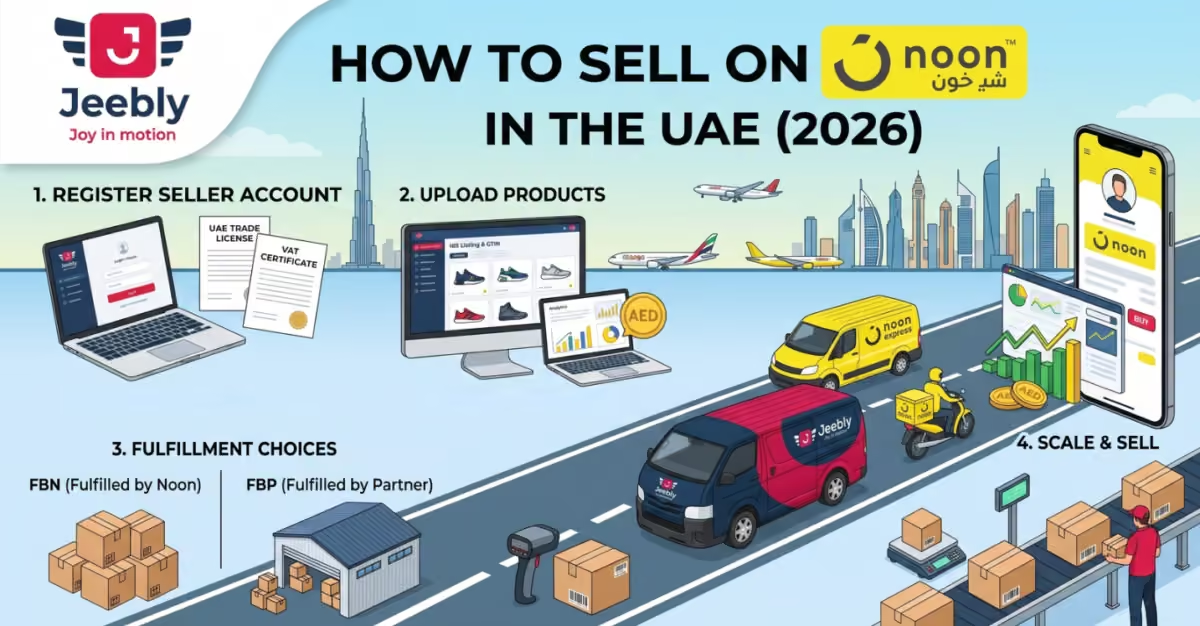
Infographic guide for selling on Noon UAE in 2026, showing seller registration steps, product cataloguing, FBN and FBP logistics options, a Jeebly delivery van, and the Dubai skyline.
How to Sell on Noon in the UAE in 2026

Expanding your e-commerce footprint across the Middle East starts with Noon—the UAE’s leading homegrown digital marketplace. Whether you are a local startup or an established retail brand, succeeding in 2026 requires understanding trade license compliance, optimizing catalog listings, and selecting the right fulfillment model between FBN and FBP. Explore our complete guide to selling on Noon UAE, covering onboarding essentials, commission structures, and how partnering with reliable last-mile delivery providers like Jeebly helps you scale faster.

Read More
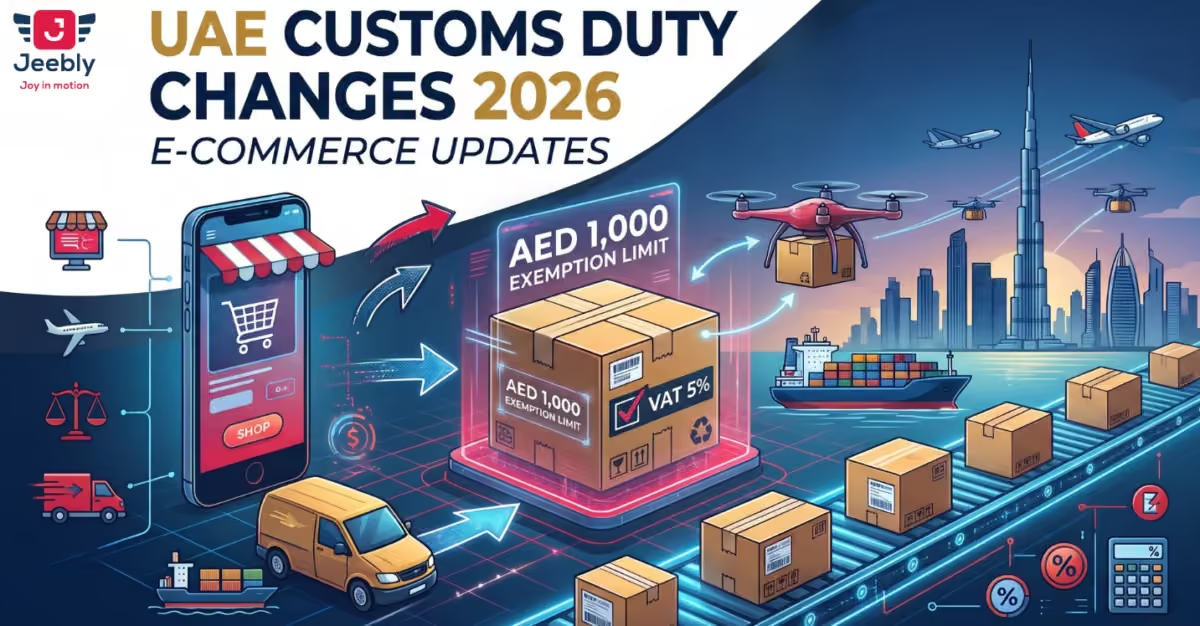
Infographic banner featuring the Jeebly logo, highlighting 2026 UAE customs duty updates for e-commerce with a Dubai skyline, delivery vans, cargo ships, conveyor belt parcels, and the AED 1,000 exemption limit.
UAE Customs Duty Changes for E-Commerce (2026)

With rapid expansions across the GCC digital commerce landscape, the UAE has implemented updated customs duty policies and clearance procedures for cross-border e-commerce shipments in 2026. From managing the AED 1,000 personal import exemption and 5% VAT rules to navigating commercial parcel compliance and streamlined last-mile delivery, discover how these regulatory shifts impact online retailers, logistics providers, and shoppers across the Emirates.

Read More
A Jeebly courier driver carrying a parcel while wiping sweat on a sunny Dubai street, with a second driver drinking water by a delivery van, illustrating UAE heat logistics and temperature-sensitive shipping challenges.
UAE Summer Delivery: Heat Effects on Couriers, Packaging and Timelines

Operating last-mile delivery in the UAE requires navigating challenging weather and heat conditions year-round. From protecting courier health to using insulated packaging and adjusting transit schedules, discover how top logistics providers keep temperature-sensitive parcels safe and on time across Dubai and the GCC.

Read More
Jeebly delivery van and driver holding a branded parcel against the Dubai skyline, featuring a digital route optimisation map interface.
What Is Route Optimisation in Last-Mile Delivery?

Last-mile delivery is the most critical—and expensive—leg of the supply chain. Discover how route optimisation leverages real-time data, traffic analytics, and smart scheduling to cut operational costs, beat urban gridlock, and ensure on-time deliveries across the UAE.

Read More
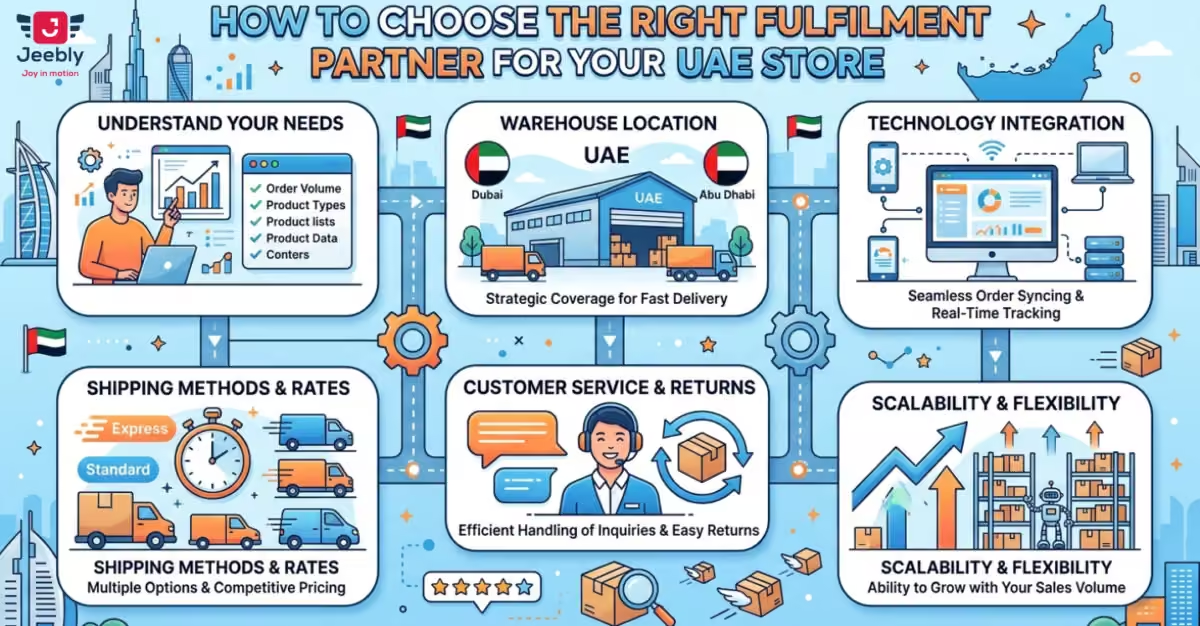
An infographic detailing six steps to choose the right fulfillment partner for a UAE store: understand needs, warehouse location (Dubai/Abu Dhabi), technology integration, shipping methods, customer service, and scalability, set against a UAE city skyline
How to Choose the Right Fulfilment Partner for Your UAE Store

Selecting the right fulfillment partner can make or break your e-commerce growth in the UAE. From strategic warehouse locations in Dubai and Abu Dhabi to seamless tech integration, learn the six critical factors every online store must evaluate to lower costs, ensure same-day delivery, and scale efficiently across the GCC.

Read More

    Powered by