





Jeebly | Logistics Solutions

Categories
blogs

DHL vs Jeebly: Which Is Better for UAE Businesses and eCommerce Delivery?

A comparison banner for UAE eCommerce delivery showing two hands holding smartphones side-by-side against a blurred Dubai skyline. The left screen displays the DHL Express logo with an "International Express" badge below it, while the right screen displays the Jeebly logo with a "Local Hyper-local" map route badge. A bold "VS" graphic splits the center.

DHL vs Jeebly: Which Is Better for UAE Businesses and eCommerce Delivery?

DHL vs Jeebly is a question with a cleaner answer than most courier comparisons because these two providers are not built for the same business profile. 

DHL is the global standard for international express and enterprise logistics. Jeebly is built specifically for UAE domestic e-commerce delivery, COD operations, and end-to-end logistics management for businesses at any scale. Choosing between them depends entirely on where your customers are, how many orders you ship, and whether your priority is international reach or domestic delivery performance.

This guide compares the two directly: what each provider does, where each wins, how costs compare, and which business profile suits each platform.

DHL in the UAE: Four Divisions, Four Different Products

Most businesses treat “DHL” as if it’s a single service. In practice, DHL operates four distinct divisions in the UAE. Each serves a different use case. Knowing which one is relevant to your business changes the comparison entirely.

1) DHL Express: time-definite international courier. The service most people think of when they say “DHL.” Best known for fast, time-definite international shipping. Often chosen when speed and global reach matter more than local last-mile optimisation. Operates across 220+ countries. Strong on documentation, customs clearance, and B2B international shipments. Premium pricing.

2) DHL Global Forwarding: freight. Air, sea, and road freight for commercial cargo, with customs brokerage. Currently expanding UAE presence with fleet investment and a joint venture with Etihad Rail to enhance connectivity across the region. Enterprise-focused. Not relevant for parcel delivery.

3) DHL Supply Chain: contract logistics and e-commerce fulfilment for large businesses. Sets up Distribution Centres to handle omnichannel needs, demand fluctuations, B2B and B2C fulfilment, with last-mile delivery through accredited partners rather than a proprietary fleet. Minimum volumes required. Not accessible for early-stage or SME e-commerce brands.

4) DHL eCommerce: domestic and regional parcel delivery. The division is actively investing in last-mile capabilities in the Middle East. UAE-specific SME e-commerce capabilities are developing but not yet at the same level of integration depth as Jeebly’s native platform.

For a UAE e-commerce brand shipping domestic orders, DHL Express and DHL eCommerce are the two relevant divisions. The comparison with Jeebly sits squarely in those lanes.

DHL vs Jeebly: A Direct Comparison

Dimension DHL Express UAE Jeebly
Primary strength International express shipping UAE domestic e-commerce delivery
Global coverage 220+ countries UAE + GCC cross-border
Same-day domestic (UAE) Not standard Yes, Jeebly Dash
Next-day domestic (UAE) Available Yes, Jeebly Dash, AED 17.31/parcel
Published base rate Not publicly listed AED 17.31 per parcel up to 5 kg
COD support Limited / not standard for SMEs Yes, weekly remittance standard
Shopify / WooCommerce integration Available via API Native direct integrations
First-attempt delivery success (UAE) Not published 98% across 50,000+ daily deliveries
Warehousing and fulfilment Enterprise accounts (DHL Supply Chain) Jeebly Bizz; all business sizes
Freight DHL Global Forwarding Jeebly Haul; road, air, ocean
Reverse logistics Available Jeebly Bizz; native
Minimum volume Enterprise thresholds for fulfilment No minimum for Jeebly Dash
Pricing model Zone and weight-based, quote-driven Published rate card + volume terms
Best for Cross-border express and enterprise logistics UAE domestic e-commerce at any scale

When DHL Is the Right Choice

DHL earns its place clearly in three specific scenarios.

  • High-value international express. If you’re shipping documents, high-value goods, or time-sensitive B2B cargo internationally, DHL Express is the market standard. Transit times take 1–3 business days internationally, with comprehensive customs clearance and tracking.


  • Enterprise contract logistics. For large UAE businesses requiring managed warehousing, omnichannel fulfilment, and supply chain outsourcing at scale, DHL Supply Chain offers the infrastructure. Enterprise-level Distribution Centres, inventory optimisation, near-real-time visibility, and B2B/B2C flexibility are designed for businesses with complex, high-volume operations.


  • International freight. DHL Global Forwarding competes directly with other major forwarders for air and sea freight out of the UAE. The Etihad Rail joint venture currently under development adds UAE-to-Saudi land-corridor connectivity to an already substantial freight network.

When DHL is not the right choice: 

If you’re a UAE D2C brand shipping domestic orders with COD, need same-day delivery within Dubai, require a Shopify integration that updates customers in real time, or want to start without enterprise volume commitments, DHL is not built for that use case.

When Jeebly Is the Right Choice

Jeebly is built for the operational reality of UAE domestic e-commerce, which means the specifics that matter to a business shipping to UAE customers daily: no standardised postcodes, high COD volumes, customers who expect same-day or next-day delivery with live tracking, and the need to manage returns without a separate vendor relationship.

  • UAE domestic e-commerce, any scale. Jeebly Dash covers same-day and next-day delivery across all seven UAE emirates. No minimum order volume and the same rate structure applies whether you ship 20 orders a day or 2,000.


  • COD-heavy operations. COD collection, weekly remittance, and photo ePOD at every drop are standard across Jeebly Dash. For a business where 30–40% of orders are COD, the timing of remittances directly affects working capital.


  • Integrated fulfilment without enterprise minimums. Jeebly Bizz covers warehousing, pick-and-pack, automated dispatch, returns management, and B2B supply chain. Native integrations with Shopify, WooCommerce, Magento, ChatFood, and Grubtech mean orders sync automatically without middleware.


  • Freight alongside last-mile. Jeebly Haul handles road, air, and ocean freight for shipments over 20 kg, with in-house customs clearance. For businesses that import inventory and distribute domestically, both legs are managed through a single platform.


For more on the freight side, Freight Forwarding in UAE: How It Works, Costs and How to Choose a Provider covers the mode comparison in detail.

Cost Comparison: What You Actually Pay

DHL does not publish domestic UAE e-commerce rates publicly. Pricing is quote-driven, adjusted by weight zone, shipment frequency, and account tier. For SME e-commerce brands without volume leverage, the rate offered at onboarding is typically higher than that of alternatives built natively for the domestic market.

For domestic UAE delivery, Jeebly’s published cost structure:

Service Rate
Jeebly Dash: next-day domestic AED 17.31 per parcel up to 5 kg
Same-day Dubai Custom quote based on urgency tier
COD fee Included, remittance weekly
International (Jeebly Dash International) Quote-based by destination
Freight: Jeebly Haul Custom quote by cargo type and route

DHL's UAE Investment: What It Means for the Comparison

DHL Group announced an EUR 500 million investment in the Middle East between 2024 and 2030, including specific e-commerce last-mile investments through the AJEX acquisition in Saudi Arabia and warehousing expansion in the UAE.

For businesses making a 2–3 year logistics partnership decision, this is relevant context. DHL is actively building UAE and GCC e-commerce capability. The gap in domestic SME last-mile integration, COD infrastructure, and Shopify-native connectivity that exists today is likely to narrow over the investment period.

For businesses deciding now, Jeebly has those capabilities built and operational today, with verified FDSS data, published pricing, and native platform integrations. DHL’s investment trajectory is worth monitoring, but in practice, investment plans and operational capabilities differ. The decision should be based on what each provider can actually deliver today at your order volume.

For a broader comparison of Jeebly against other UAE last-mile operators, Best Courier Services in UAE: 2026 Comparison Guide covers seven major providers across FDSS, COD, pricing, and integration capability.

Conclusion

DHL vs Jeebly is not a close call once you understand where each provider is built to operate. DHL Express is the global standard for international express delivery. It is the right choice when your shipment crosses a border, and speed matters more than cost. 

Jeebly is built for UAE domestic e-commerce: same-day and next-day delivery via Jeebly Dash, COD with weekly remittance, warehousing and fulfilment via Jeebly Bizz, and freight via Jeebly Haul. All are connected via a single platform with native integrations for Shopify, WooCommerce, and Magento. 

Talk to the Jeebly team. We’ll map out the right setup for your order volume and coverage requirements.

Frequently Asked Questions

 DHL is primarily built for international express shipping. Its UAE domestic e-commerce offering (via DHL eCommerce) is developing but lacks the COD infrastructure, SME-accessible pricing, and Shopify-native integrations that UAE-native providers like Jeebly offer as standard. For domestic UAE last-mile, Jeebly Dash is purpose-built for that use case.

For domestic UAE parcels, Jeebly Dash publishes a base rate of AED 17.31 per parcel up to 5 kg. DHL does not publish domestic UAE e-commerce rates; pricing is quote-driven and typically tiered for enterprise accounts.

DHL’s COD capability in the UAE is limited and not a standard feature for SME e-commerce accounts. Jeebly supports COD as standard across Jeebly Dash, with weekly remittance and photo ePOD at every delivery.

Jeebly Dash International covers selected international routes. For broad international express shipping across 220+ countries with time-definite SLAs, DHL Express remains the established choice. For freight (air, sea, or road), Jeebly Haul covers UAE, GCC, and international routes.

Jeebly is accessible from day one with no minimum volume commitment, published pricing, and native Shopify integration. DHL’s enterprise fulfilment products (DHL Supply Chain) require volume thresholds that most startups won’t meet. For domestic UAE delivery from the first order, Jeebly Dash is the more practical starting point.

Routes to insightful reads

A comparison banner for UAE eCommerce delivery showing two hands holding smartphones side-by-side against a blurred Dubai skyline. The left screen displays the DHL Express logo with an "International Express" badge below it, while the right screen displays the Jeebly logo with a "Local Hyper-local" map route badge. A bold "VS" graphic splits the center.
DHL vs Jeebly: Which Is Better for UAE Businesses and eCommerce Delivery?

Looking for the right logistics partner in the UAE? We break down DHL vs. Jeebly to help you choose between global express shipping and local, tech-driven e-commerce fulfillment. Discover which courier wins on domestic delivery speeds, Cash on Delivery (COD) handling, and cross-border customs.

Read More
Logisty vs Jeebly comparison for UAE eCommerce delivery, last-mile logistics and courier services
Logisty vs Jeebly: UAE eCommerce Delivery Comparison

Logisty and Jeebly serve different logistics needs, but which is the better choice for your business? This comparison explores their services, delivery capabilities, technology, coverage, eCommerce integrations, cash on delivery (COD), and fulfilment solutions to help UAE businesses choose the right logistics partner for growth.

Read More
UAE VAT on imports and exports showing tax compliance, logistics, shipping and customs documentation
VAT on Shipping and Delivery Services in UAE: What Businesses Need to Know

VAT can significantly impact the cost of shipping and delivery services in the UAE, making it essential for businesses to understand how it applies to domestic and international shipments. This guide explains VAT rules, zero-rated and standard-rated services, invoicing requirements, and practical compliance tips to help businesses manage logistics costs and stay compliant with UAE tax regulations.

Read More
COD fraud prevention in the UAE with secure payment verification, order authentication and logistics risk management
COD Fraud in UAE eCommerce: How to Detect, Prevent and Reduce Losses

Cash on Delivery (COD) fraud is a growing challenge for e-commerce businesses across the UAE, leading to fake orders, delivery failures and unnecessary operational costs. Learn how to identify common fraud tactics, implement effective prevention strategies and protect your business while maintaining a seamless customer experience.

Read More
UAE import and export guide featuring trade documentation, cargo ship, air freight, customs clearance and logistics operations
UAE Import and Export Guide: Trade Documentation, Logistics and Compliance

Customs clearance is a critical step in moving goods into and out of the UAE. Whether you’re importing, exporting, or shipping across borders, understanding the customs process, required documentation, and compliance requirements can help you avoid delays, reduce costs, and keep your supply chain running efficiently.

Read More
Categories
blogs

Logisty vs Jeebly: UAE eCommerce Delivery Comparison

Logisty vs Jeebly comparison for UAE eCommerce delivery, last-mile logistics and courier services

Logisty vs Jeebly: UAE eCommerce Delivery Comparison

If you’re comparing Logisty vs Jeebly as a UAE business trying to decide on a logistics partner, the first thing to know is that these two platforms were not built for the same problem. 

Logisty is a digital freight-matching platform built for commercial truck hire. Jeebly is an end-to-end logistics platform built for e-commerce and business delivery. Understanding that difference upfront saves you from evaluating the wrong things.

This guide covers what each platform actually does, which business profiles suit each one, how they compare across the criteria that matter and where each falls short. If you’re a UAE business with active delivery operations or planning to scale them, this is the comparison you need before you commit.

What Logisty Is and Is Not

Logisty is a digital logistics platform launched in December 2024 through a collaboration between Dubai’s Roads and Transport Authority (RTA) and TruKKer, the GCC’s largest digital freight company. It connects businesses with commercial transport service providers for on-demand truck booking and real-time freight tracking.

The platform offers commercial transport services, fleet management solutions, and on-demand booking with real-time tracking. Its headline technology feature is an AI-powered CBM Calculator that estimates shipment volumes from uploaded photos or videos.

What Logisty is not:

It is not a last-mile courier, an e-commerce fulfilment platform, a COD handler, or a consumer-facing delivery service. It is built specifically to serve Dubai’s 10,000+ commercial transport companies and the businesses that need to move bulk freight digitally rather than through traditional phone-based truck booking.

What Jeebly Is and How It's Structured

Jeebly is a UAE-native logistics platform covering the full delivery chain: same-day and next-day parcel delivery, cross-border freight, warehousing, fulfilment, and reverse logistics. While Logisty is built for a single use case (truck hire for commercial freight), Jeebly is built to serve multiple delivery needs on a single operational platform.

The service structure is designed around business type rather than shipment type:

Jeebly Dash covers express, same-day, and next-day domestic delivery. Base rate AED 17.31 per parcel up to 5 kg. Direct integrations with Shopify, WooCommerce, Magento, ChatFood, and Grubtech. COD collection and weekly remittance as standard. Operates across all seven UAE emirates.

Jeebly Haul handles road freight above 20 kg, air freight, and ocean freight across the UAE and GCC. Over 2,000 active fleet vehicles, 70+ transporter partners, and 20+ vehicle categories. Custom-quoted. Built for businesses with regular inbound inventory movement or cross-border freight requirements.

Jeebly Bizz is the business logistics layer. Warehousing, fulfilment, automated dispatch, route optimisation, reverse logistics, and B2B supply chain management are integrated on a single platform. Built for operations running hundreds of daily orders where manual coordination creates a ceiling on growth.

Operational scale: 50,000+ daily deliveries, 12M+ customers served, 98% First Day Delivery Success (FDSS) rate, and AED 1.5B+ in shipments.

Logisty vs Jeebly: Direct Comparison

Criteria Logisty Jeebly
Launched December 2024 Established UAE operator
Built by RTA + TruKKer Jeebly (UAE-native)
Primary use case Commercial freight/truck hire E-commerce delivery + logistics
Last-mile parcel delivery No Yes, Jeebly Dash
Freight and bulk cargo Yes, digital truck booking Yes, Jeebly Haul
E-commerce platform integration Not confirmed Shopify, WooCommerce, Magento, ChatFood, Grubtech
Cash on delivery (COD) Not confirmed Yes, weekly remittance
COD fraud protection / ePOD Not confirmed Photo ePOD at every drop
Returns/reverse logistics Not confirmed Yes, Jeebly Bizz
Warehousing and fulfilment Not confirmed Yes, Jeebly Bizz
Fleet scale TruKKer 55,000+ trucks (GCC-wide) 2,000+ Jeebly fleet + 70 transporter partners
AI features AI CBM Calculator (volume estimation) AI-assisted dispatch and route optimisation
Coverage Dubai-focused (UAE road freight) UAE-wide (all 7 emirates) + GCC cross-border
Consumer-facing tracking Basic tracking Branded tracking pages, real-time GPS
Target customer Bulk commercial freight businesses E-commerce brands, D2C, SMEs, enterprises
Best for Freight movement eCommerce operations

For a broader view of how Jeebly’s delivery rates, FDSS, and platform integrations compare across the full UAE courier market, Best Courier Services in UAE: 2026 Comparison Guide covers seven major operators on the criteria that matter for e-commerce businesses.

When Logisty Is the Right Choice

Logisty is the better fit for a specific, well-defined business profile: companies whose primary logistics need is moving large commercial freight within Dubai and the UAE, with no requirement for parcel-level delivery, consumer communication, or e-commerce platform integration.

Logisty suits you if:

  • You’re moving raw materials, construction goods, industrial equipment, or bulk stock between facilities and warehouses. 
  • Your logistics operation is B2B rather than B2C. 
  • You’re not delivering to end consumers, so tracking pages, COD, and delivery notifications are irrelevant to your use case. 
  • Your shipments are large and irregular, best described as “book a truck” rather than “dispatch 200 orders.”


The platform’s core proposition is connecting businesses with commercial transport service providers through a digital interface. For businesses that have historically relied on phone calls to coordinate trucking, that digitisation has genuine operational value.

Logisty is not the right choice if you’re running e-commerce orders, need COD collection, want Shopify integration, require returns management, or serve end consumers who expect real-time tracking and delivery confirmation.

One gap in Logisty’s freight-booking model is that the platform handles truck booking, but customs clearance for inbound freight into the UAE is a separate process requiring its own documentation, declarations, and duty payment. 

Customs Clearance in Dubai and the UAE covers the process, with useful context to help you decide whether a freight-booking-only platform meets your full inbound logistics needs.

When Jeebly Is the Right Choice

Jeebly suits any business where delivery is a customer-facing operation, and the quality of the drop-off directly affects your brand, repeat purchase rate, and RTO costs.

Jeebly suits you if:

  • You’re an e-commerce brand shipping B2C orders, and your customers expect same-day or next-day delivery with live tracking. 
  • You operate COD and need reliable collection, clean remittance, and ePOD at every drop. 
  • You’re importing inventory and need freight handling alongside domestic last-mile delivery through a single connected platform. 
  • You’re managing returns and need reverse logistics built into the same workflow as forward delivery. 
  • You’re scaling and need a platform that integrates directly with your store without manual order uploads.


Jeebly is not the first choice if your only logistics need is moving heavy commercial freight between facilities and there is no parcel-level delivery requirement. For pure bulk truck hire within Dubai, Logisty’s freight-matching model is purpose-built for that specific use case.

The eCommerce Stack: Where the Comparison Ends

This is where Logisty and Jeebly stop being comparable alternatives and become entirely different tools.

Logisty has no published information on e-commerce platform integrations, COD support, parcel tracking, NDR management, returns processing, or consumer notification systems. These are not features it’s currently building toward. They’re outside the platform’s stated purpose of commercial freight matching.

Jeebly’s e-commerce infrastructure covers:

  1. Platform integrations: Direct API and plugin integrations with Shopify, WooCommerce, Magento, ChatFood, and Grubtech. Orders sync automatically. No manual CSV uploads and no middleware required.


  2. Secure COD delivery: Collection at the door, ePOD photo confirmation at every drop, weekly remittance cycle. For businesses managing 30–50% of orders as COD, the remittance timing directly affects working capital. Weekly remittance compresses the float relative to providers running fortnightly or monthly cycles.


  3. NDR and RTO management: Failed delivery attempts are automatically flagged, triggering customer notifications via SMS or WhatsApp to reschedule. NDR-to-RTO conversion is one of the most controllable cost lines in e-commerce delivery.


  4. Returns and reverse logistics: Jeebly Bizz handles reverse logistics within the same platform as forward delivery. No separate vendor relationship and no separate tracking system. Customers get a clean return experience; businesses get a unified delivery record.

If your operation requires these eCommerce-specific capabilities, a dedicated last-mile logistics platform such as Jeebly is likely a better fit. 

If your need is exclusively for bulk commercial truck hire, Jeebly Haul competes in that lane, but Logisty’s TruKKer network gives it greater truck density for pure freight matching.

How to Choose: A Decision Framework

Choose Logisty if:

  • Your primary logistics need is commercial freight and bulk truck hire within Dubai
  • You move large shipments between facilities or suppliers with no consumer-facing delivery requirement
  • You want a digitised truck-booking experience backed by regulatory oversight from the RTA


Choose Jeebly Dash if:

  • You’re shipping e-commerce orders B2C and need same-day or next-day delivery with live tracking
  • Your customers pay COD, and you need clean collection, ePOD, and weekly remittance
  • Your store runs on Shopify, WooCommerce, or Magento and you want direct integration


Choose Jeebly Bizz if:

  • You’re running 50+ orders per day and need automated dispatch, route optimisation, and returns management in one platform
  • You’re managing fulfilment alongside delivery and need warehousing connected to the same system


Choose Jeebly Haul if:

  • You need freight above 20 kg, road freight across the GCC, air freight, or ocean freight, alongside an e-commerce delivery operation through one partner


For businesses comparing Jeebly against other UAE last-mile operators rather than Logisty, Aramex vs Jeebly and Careem Express vs Jeebly cover those specific comparisons in detail.

Conclusion

Logisty and Jeebly solve different problems for different businesses. Logisty is a digital platform connecting businesses with commercial transport providers for freight booking and tracking. It is designed for bulk truck hire in Dubai, backed by the RTA’s regulatory framework and TruKKer’s GCC-wide fleet. 

Jeebly is a full logistics platform with last-mile parcel delivery, freight, fulfilment, COD, returns, and e-commerce integrations. It is built for UAE businesses where delivery is a customer-facing operation rather than just a cargo-movement task. 

For e-commerce and D2C brands, Jeebly is the clearer fit. For pure commercial freight within Dubai, Logisty’s model is worth evaluating. 

For businesses that need both, Jeebly Haul and Jeebly Dash cover both lanes through one platform. Speak with Jeebly’s logistics team to map the right delivery setup for your order volume, customer expectations, and fulfilment needs.

Frequently Asked Questions

 Logisty is a digital logistics platform launched in December 2024 through a collaboration between Dubai’s Roads and Transport Authority (RTA) and TruKKer, the GCC’s largest digital freight company. It connects businesses with commercial truck operators for on-demand freight booking and real-time tracking. It is built specifically for commercial bulk freight, not for e-commerce parcel delivery.

No. Logisty is a commercial freight platform. It is not designed for parcel-level delivery, COD collection, consumer notifications, or e-commerce platform integration. If your operation requires any of these, Logisty is not the right tool.

No. Logisty is positioned as a digital commercial transport platform focused on freight booking, transport services, fleet management, and tracking. Businesses needing parcel delivery, COD, and eCommerce fulfilment require a last-mile logistics solution.

 For Shopify-based businesses, Jeebly is designed around eCommerce delivery workflows, including order integrations, last-mile delivery, COD, and returns management.

Jeebly covers the full e-commerce delivery stack: same-day and next-day parcel delivery, COD with weekly remittance, photo ePOD at every drop, direct integrations with Shopify and WooCommerce, reverse logistics, and warehousing all through one platform. Logisty offers truck hire for commercial freight. They are not comparable for e-commerce operations.

Yes. Jeebly Haul covers road, air, and ocean freight for shipments over 20 kg, with a fleet of 2,000+ vehicles and 70+ transporter partners across the UAE and the GCC. This freight capability is connected to the same platform as Jeebly Dash (last-mile) and Jeebly Bizz (fulfilment and returns).

Businesses whose primary logistics need is moving large commercial cargo within Dubai by road (construction materials, industrial goods, bulk stock transfers between facilities) without a requirement for consumer-facing delivery, tracking, or COD. Logisty is built around Dubai’s 10,000+ commercial transport companies and the digital transformation of that sector.

Routes to insightful reads

A comparison banner for UAE eCommerce delivery showing two hands holding smartphones side-by-side against a blurred Dubai skyline. The left screen displays the DHL Express logo with an "International Express" badge below it, while the right screen displays the Jeebly logo with a "Local Hyper-local" map route badge. A bold "VS" graphic splits the center.
DHL vs Jeebly: Which Is Better for UAE Businesses and eCommerce Delivery?

Looking for the right logistics partner in the UAE? We break down DHL vs. Jeebly to help you choose between global express shipping and local, tech-driven e-commerce fulfillment. Discover which courier wins on domestic delivery speeds, Cash on Delivery (COD) handling, and cross-border customs.

Read More
Logisty vs Jeebly comparison for UAE eCommerce delivery, last-mile logistics and courier services
Logisty vs Jeebly: UAE eCommerce Delivery Comparison

Logisty and Jeebly serve different logistics needs, but which is the better choice for your business? This comparison explores their services, delivery capabilities, technology, coverage, eCommerce integrations, cash on delivery (COD), and fulfilment solutions to help UAE businesses choose the right logistics partner for growth.

Read More
UAE VAT on imports and exports showing tax compliance, logistics, shipping and customs documentation
VAT on Shipping and Delivery Services in UAE: What Businesses Need to Know

VAT can significantly impact the cost of shipping and delivery services in the UAE, making it essential for businesses to understand how it applies to domestic and international shipments. This guide explains VAT rules, zero-rated and standard-rated services, invoicing requirements, and practical compliance tips to help businesses manage logistics costs and stay compliant with UAE tax regulations.

Read More
COD fraud prevention in the UAE with secure payment verification, order authentication and logistics risk management
COD Fraud in UAE eCommerce: How to Detect, Prevent and Reduce Losses

Cash on Delivery (COD) fraud is a growing challenge for e-commerce businesses across the UAE, leading to fake orders, delivery failures and unnecessary operational costs. Learn how to identify common fraud tactics, implement effective prevention strategies and protect your business while maintaining a seamless customer experience.

Read More
UAE import and export guide featuring trade documentation, cargo ship, air freight, customs clearance and logistics operations
UAE Import and Export Guide: Trade Documentation, Logistics and Compliance

Customs clearance is a critical step in moving goods into and out of the UAE. Whether you’re importing, exporting, or shipping across borders, understanding the customs process, required documentation, and compliance requirements can help you avoid delays, reduce costs, and keep your supply chain running efficiently.

Read More
Categories
blogs

VAT on Shipping and Delivery Services in UAE: What Businesses Need to Know

UAE VAT on imports and exports showing tax compliance, logistics, shipping and customs documentation

VAT on Shipping and Delivery Services in UAE: What Businesses Need to Know

In the UAE, most domestic courier and delivery services are subject to 5% VAT. Businesses can usually reclaim this VAT as input tax if they are VAT-registered and hold a compliant tax invoice.

This percentage is easy to overlook as it is a small percentage applied to a relatively small charge. Most businesses process it automatically without checking whether they’re applying it correctly. But if you get the VAT treatment of your shipping wrong, you’ll either be overcharging your customers at checkout, underreporting output tax to the FTA, or missing legitimate input VAT you could be reclaiming on your courier spend.

This guide covers how VAT on shipping and delivery services works, what the 2026 VAT amendments mean for your delivery operations, and how to structure your invoices and reclaim process correctly.

How UAE VAT Applies to Courier and Delivery Services

Under UAE VAT law, courier and delivery services are treated as a supply of services. The standard rule is straightforward: most taxable supplies of services are charged at 5% VAT. When a courier collects a parcel in Dubai, moves it to another emirate, or delivers to a customer, the fee is a taxable supply at the standard rate.

The applicable rate depends on the nature of the delivery, whether domestic or international, and whether the service forms part of a broader international transport arrangement.

Domestic deliveries: 5% standard rate

For most courier runs inside the UAE, VAT is charged at 5%. The same rate applies when a courier handles only a local leg linking two points within the country, even if the goods later move abroad with another supplier.

This is the rate that applies to the overwhelming majority of UAE e-commerce last-mile delivery invoices. If your courier invoice shows 5% VAT on a domestic delivery, that’s correct FTA treatment. If it doesn’t show VAT at all and your courier is VAT-registered, that’s worth investigating.

International deliveries: zero-rated under specific conditions

International door-to-door courier products can qualify for zero rating when they meet the definition of international transport of goods. Article 33 of the UAE VAT Executive Regulations allows a 0% rate when goods move between the UAE and another country, or when the domestic leg is part of a single international transport service.

However, any domestic leg can be zero-rated only when it is supplied by the same taxable person who provides the international leg. If the main carrier subcontracts the first mile to a third party and that subcontractor invoices its client separately, the subcontracted leg loses zero-rating and becomes standard-rated at 5%.

Question Answer
Domestic courier VAT 5% standard VAT.
International transport May qualify for 0% VAT, subject to UAE VAT regulations.
VAT reclaim Possible for VAT-registered businesses, provided eligibility requirements are met.
Invoice requirement A valid tax invoice displaying the supplier's Tax Registration Number (TRN).

Whether the zero-rating condition applies in practice depends on how your freight is structured. Freight Forwarding in the UAE explains how UAE freight forwarders structure multi-leg shipments and what to confirm before assuming that zero-rating applies to your invoices.

VAT on Shipping in Designated Zones and Free Zones

Courier work within free zones and designated zones is subject to specific FTA treatment. The FTA guidance on goods supplied in designated zones distinguishes between goods that remain within the zone, which are treated as outside the UAE VAT system, and goods moving between a designated zone and the UAE mainland.

The key rule for businesses using free zones as distribution hubs:

  • Supplies of goods within designated zones may receive special VAT treatment where the conditions under UAE VAT law are met. 
  • However, delivery services, mainland movements, and imports require separate assessment depending on the transaction structure.
  • Import VAT is generally calculated at 5% on the customs value plus applicable customs duties and other taxable amounts.
  • Delivery services for the mainland leg: 5% standard-rated courier service

The FTA treats the designated zone as outside the UAE VAT territory for goods purposes. The moment goods and the associated delivery service cross into the mainland, both are subject to the standard UAE VAT rate.

Incoterms and VAT Responsibility on International Shipments

When you’re shipping internationally from or to the UAE, the Incoterm you agree with your buyer or supplier directly determines who is responsible for UAE import VAT. Most businesses choose Incoterms based on shipping costs, not realising the VAT compliance obligation they’re accepting or transferring.

Incoterm Who Pays UAE Import VAT Who Handles UAE Customs Clearance
EXW (Ex Works) Buyer Buyer
FOB (Free on Board) Buyer Buyer
DAP (Delivered at Place) Buyer (at point of delivery) Buyer
DDP (Delivered Duty Paid) Seller Seller
CIF (Cost, Insurance, Freight) Buyer Buyer

Note: Actual responsibility depends on who acts as the importer of record and the customs arrangement.

DDP — the e-commerce customer experience default. Under DDP, you as the seller settle all UAE import duties and VAT before delivery. Your customer receives their order without any charges at the door.

DAP — the common operational default. Under DAP, the buyer, your UAE customer, is responsible for import duties and VAT at the point of delivery. If they weren’t expecting that charge, refusal rates spike.

The VAT liability at the point of mainland transfer is directly linked to your customs clearance process. The duty and VAT payment triggers the release order. Customs Clearance in Dubai and the UAE covers the declaration, payment, and release sequence step by step.

How to Structure Your Shipping Invoice for VAT Compliance

A courier invoice that doesn’t comply with FTA invoice requirements may affect your ability to recover input VAT and increase compliance risk. The 2026 standards have tightened, particularly with the e-invoicing mandate approaching.

What a compliant courier tax invoice must include:

  • Supplier’s legal name and address matching FTA registry exactly
  • Supplier’s Tax Registration Number (TRN)
  • Customer’s name and address
  • Unique sequential invoice number
  • Invoice issue date
  • Service description (e.g. “domestic parcel delivery, Dubai to Abu Dhabi”)
  • Quantity and rate (number of deliveries × rate per delivery)
  • VAT rate applied (5%)
  • VAT amount in AED stated separately
  • Total payable in AED

As e-invoicing becomes mandatory for B2B transactions, how well your courier integrates with your accounting or ERP system becomes a compliance question, not just an operational one.

Careem Express vs Jeebly compares the two providers on platform integration and fulfilment capabilities.

2026 UAE VAT Changes That Affect Shipping Operations

Three 2026 amendments directly affect businesses using logistics and delivery services.

1) Reverse charge mechanism: removal of self-invoicing requirement. 

From January 1, 2026, taxpayers importing “concerned goods” or “concerned services” for business purposes are no longer required to issue a tax invoice to themselves for these imports under the Reverse Charge Mechanism. Businesses now retain supplier invoices, customs documents, or evidence of imports for VAT accounting.

2) Five-year VAT credit carry-forward limit. 

From January 1, 2026, excess recoverable VAT may only be carried forward for a maximum of five years from the end of the tax period in which the excess arose. After that, unused credits expire. If your business has been carrying forward input VAT on shipping and logistics costs without claiming refunds, credits from 2021 need to be reviewed now. VAT credits from 2018 to 2020 must be claimed by December 31, 2026, or they will expire.

3) E-invoicing mandate: 2026 pilot, 2027 mandatory. 

UAE e-invoicing begins with a phased rollout. A voluntary pilot starts in July 2026, with mandatory adoption beginning from January 2027 for the first phase of businesses. Later phases will apply to additional businesses. 

E-invoices must be generated in structured XML/JSON formats and submitted via an FTA-Accredited Service Provider (ASP) using the Peppol network.

How Jeebly Handles VAT on Delivery Services

Jeebly Dash is VAT-registered and issues compliant tax invoices for all domestic delivery charges, with 5% VAT stated separately, a valid TRN, and all mandatory invoice fields included. For businesses running high delivery volumes, this means every Jeebly invoice is input-VAT reclaimable on your quarterly FTA return.

Jeebly Bizz connects your e-commerce platform (Shopify, WooCommerce, Magento) to your delivery operation. For businesses managing both domestic delivery and international inbound freight, having both handled through one platform means one consolidated record of VAT on delivery spend, rather than tracking input VAT across multiple courier accounts.

For questions about how VAT applies to your specific delivery structure, talk to the Jeebly team. We’ll walk through your shipment profile and confirm the correct VAT treatment before you file.

Frequently Asked Questions

Yes. Domestic courier and delivery services in the UAE are subject to 5% VAT under standard FTA rules. If your logistics provider is VAT-registered, their invoice will include 5% VAT on the delivery charge. If your business is also VAT-registered, you reclaim this as input tax on your quarterly VAT return.

5% for domestic deliveries. International courier services may qualify for 0% if the provider is responsible for both the domestic and international legs under a single contract. If different suppliers handle different legs with separate invoices, each domestic leg is standard-rated at 5%.

Yes, if you are VAT-registered with the FTA and the courier issues a compliant tax invoice with their valid TRN, VAT amount stated separately, and all mandatory fields included. The 5% VAT on domestic courier spend is input tax reclaimable on your VAT return.

Under DDP (Delivered Duty Paid), the seller pays UAE import VAT and customs duty before delivery. The customer receives goods without charges at the door. Under DAP (Delivered at Place), the buyer is responsible for import VAT at point of delivery. For UAE B2C shipments, DDP helps prevent delivery refusals due to unexpected import charges.

Three changes matter: the reverse charge mechanism no longer requires self-invoicing (retain supplier documents instead); excess input VAT can only be carried forward for five years (credits from 2021 start expiring in 2026); and e-invoicing becomes mandatory for B2B transactions from January 2027, with a voluntary pilot from July 2026. Courier invoices will need to be in structured digital formats from 2027.

Routes to insightful reads

A comparison banner for UAE eCommerce delivery showing two hands holding smartphones side-by-side against a blurred Dubai skyline. The left screen displays the DHL Express logo with an "International Express" badge below it, while the right screen displays the Jeebly logo with a "Local Hyper-local" map route badge. A bold "VS" graphic splits the center.
DHL vs Jeebly: Which Is Better for UAE Businesses and eCommerce Delivery?

Looking for the right logistics partner in the UAE? We break down DHL vs. Jeebly to help you choose between global express shipping and local, tech-driven e-commerce fulfillment. Discover which courier wins on domestic delivery speeds, Cash on Delivery (COD) handling, and cross-border customs.

Read More
Logisty vs Jeebly comparison for UAE eCommerce delivery, last-mile logistics and courier services
Logisty vs Jeebly: UAE eCommerce Delivery Comparison

Logisty and Jeebly serve different logistics needs, but which is the better choice for your business? This comparison explores their services, delivery capabilities, technology, coverage, eCommerce integrations, cash on delivery (COD), and fulfilment solutions to help UAE businesses choose the right logistics partner for growth.

Read More
UAE VAT on imports and exports showing tax compliance, logistics, shipping and customs documentation
VAT on Shipping and Delivery Services in UAE: What Businesses Need to Know

VAT can significantly impact the cost of shipping and delivery services in the UAE, making it essential for businesses to understand how it applies to domestic and international shipments. This guide explains VAT rules, zero-rated and standard-rated services, invoicing requirements, and practical compliance tips to help businesses manage logistics costs and stay compliant with UAE tax regulations.

Read More
COD fraud prevention in the UAE with secure payment verification, order authentication and logistics risk management
COD Fraud in UAE eCommerce: How to Detect, Prevent and Reduce Losses

Cash on Delivery (COD) fraud is a growing challenge for e-commerce businesses across the UAE, leading to fake orders, delivery failures and unnecessary operational costs. Learn how to identify common fraud tactics, implement effective prevention strategies and protect your business while maintaining a seamless customer experience.

Read More
UAE import and export guide featuring trade documentation, cargo ship, air freight, customs clearance and logistics operations
UAE Import and Export Guide: Trade Documentation, Logistics and Compliance

Customs clearance is a critical step in moving goods into and out of the UAE. Whether you’re importing, exporting, or shipping across borders, understanding the customs process, required documentation, and compliance requirements can help you avoid delays, reduce costs, and keep your supply chain running efficiently.

Read More
Categories
blogs

COD Fraud in UAE eCommerce: How to Detect, Prevent and Reduce Losses

COD fraud prevention in the UAE with secure payment verification, order authentication and logistics risk management

COD Fraud in UAE eCommerce: How to Detect, Prevent and Reduce Losses

Cash on delivery is not going away in the UAE. It still accounts for nearly 35% of transactions across the Middle East and Africa.

The problem is that COD also creates a specific category of fraud risk that digital payment orders don’t carry: low-intent buyers who never planned to accept the parcel, external scammers exploiting the system’s offline nature, and a cascade of operational costs that appear as return-to-origin (RTO) losses on your courier statement.

This guide covers types of COD fraud that UAE businesses face. Know how to detect each, and the operational and technology measures that reduce losses without removing COD from your checkout.

Two Types of COD Fraud: External Scams vs Merchant Losses

1) External COD scams 

This targets your customers. Fraudsters may obtain customer details through leaked databases, phishing, public information, or other illegal sources. They dispatch parcels through legitimate logistics companies and specify a cash amount to be collected on delivery. 

When the courier arrives, the recipient assumes a family member or colleague placed the order and pays without verifying. By the time they open the parcel and discover the contents are worthless, it is difficult to reverse the transaction. This type of fraud damages your customers and, if your brand is being impersonated, directly damages your reputation.

2) Fake-order fraud & high-RTO abuse 

This targets your operations. Fraudulent COD orders placed using fake phone numbers and addresses result in guaranteed RTOs. The courier attempts delivery to a non-existent recipient and returns. 

Beyond outright fake orders, serial refusers, and customers who genuinely placed an order but later choose to refuse delivery, all incur similar operational costs. The distinction matters because the solutions differ.

Understanding which type is driving your losses determines which interventions to prioritise.

How External COD Scams Work

The mechanics follow a consistent pattern. 

Scammers obtain real addresses and phone numbers, dispatch parcels through legitimate logistics companies, and have the courier collect cash on their behalf. The delivery agent follows standard instructions with no knowledge of the contents. Once payment is made, the courier processes the funds through its standard settlement cycle and transfers the amount to the sender.

Unlike prepaid transactions, COD removes many digital payment protections such as automated payment authentication and chargeback processes, shifting more fraud risk into delivery operations.

Common external COD scam types currently active across the region:

  • The unsolicited parcel scam: A fraudster sends a package to a real address using leaked personal data. The recipient assumes a family member ordered it and pays. The parcel contains low-value or worthless items.

  • Brand impersonation: Scammers build convincing replicas of real UAE e-commerce stores, collect orders at scale, and dispatch cheap substitutes via third-party couriers. Your brand takes the fallout from customer service.

  • Fake courier impersonation: Some fraudsters pose as delivery companies, sending packages and demanding cash payments. Packages may include a QR code that, when scanned, links to a phishing site that collects additional personal data.

  • The advanced call variation: In some variations, fraudsters send advance messages or make phone calls claiming a shipment is on its way, creating a sense of legitimacy before the parcel arrives.

One protection against brand impersonation is ensuring your customers can independently verify delivery through a branded tracking page from your actual logistics partner. 

Aramex vs Jeebly: Which Is Better for UAE Last-Mile Delivery? compares how the two providers handle tracking visibility, ePOD, and customer communication. These capabilities help customers distinguish your legitimate delivery from a scam.

How Fake-Order Fraud Costs Your Business

Every failed COD delivery incurs double shipping costs: you paid for the forward attempt, and you pay for the return. The cash flow impact is separate and often underestimated. For brands with 25–30% COD RTO rates, the cash trapped in transit at any point can equal 3–5 weeks of revenue, creating a liquidity problem that grows with scale. 

When combined with Jeebly’s structured COD remittance cycle, this gap can be materially compressed compared to providers that remit fortnightly or monthly. But the RTO rate itself needs to be addressed at the source.

The total cost per RTO order is higher than most business models. A refused COD delivery carries forward shipping cost, return shipping cost, repackaging and restocking time, the COD amount that was never collected, and the customer acquisition cost spent to generate an order that never converted.

Detecting Fake Orders Before Dispatch

The most cost-effective COD fraud intervention happens before the parcel leaves your warehouse. A risk-scoring approach works better than applying the same verification to every order. 

Assess each COD order based on new-customer status, order value, address deliverability, phone-number validity, and historical RTO patterns for the same contact details. Low-risk orders proceed without friction. High-risk orders get additional verification steps.

Signals that flag a COD order as high-risk:

  • Phone number doesn’t match the delivery emirate’s prefix pattern
  • Address is incomplete, contains only a building name with no flat or office number, or matches a known high-RTO zone
  • Multiple orders from the same device or IP with different contact details
  • First-time customer placing a high-value COD order with no order history
  • Order placed outside normal hours with an unusual address format


OTP verification is one of the most effective pre-dispatch controls for reducing fake COD orders. OTP confirmation filters out fake or uncertain orders, ensuring only genuinely interested customers proceed with COD purchases.

Address validation at checkout catches genuine customers who entered incomplete or incorrect addresses. AI-powered address validation can reduce preventable delivery failures by identifying incomplete addresses, invalid locations, and delivery-risk patterns before dispatch.

The RTO lock is the most operationally precise tool for repeat offenders. RTO lock blocks customers with a history of COD refusals from accessing the COD payment option; they can still purchase with prepaid methods.

These pre-dispatch interventions are only as effective as the fulfilment partner executing them. 

Whether your operation suits a carrier or a courier model affects which fraud prevention tools are actually available to you. Carrier vs Courier: What’s the Difference and Which Do You Need in the UAE? clarifies the distinction.

Reducing Losses After Dispatch: NDR Management

An NDR (Non-Delivery Report) is a recoverable event. An RTO is the loss. The intervention window between the two is the time when significant losses can be prevented.

When a first delivery attempt fails, most businesses leave the outcome to the courier. Automated NDR management, such as WhatsApp or SMS outreach to the customer immediately after a failed attempt to confirm a new delivery window, reduces NDR-to-RTO conversion. 

The message content matters: 

  • Include the exact COD amount 
  • The rescheduled delivery window 
  • A simple one-tap confirmation. 

Customers who confirm reschedule convert at significantly higher rates than those who receive a generic “we’ll try again” notification.

What to Look for in a Logistics Partner for COD Operations

Your courier partner is operationally central to the risk of COD fraud. The specific capabilities to confirm before committing:

  • Digital proof of delivery (ePOD) is standard. Every drop-off should be confirmed with a timestamped photo and, for high-value orders, OTP or signature capture. This creates an evidentiary record for every delivery and eliminates “I never received it” disputes without a trail to resolve them.

  • NDR workflow transparency. Ask specifically: when a delivery attempt fails, what happens next? How quickly is the NDR flagged? Is the customer contacted automatically, or does re-attempt coordination require your team’s involvement? A courier with automated NDR management recovers more failed deliveries without adding to your ops overhead.

  • Weekly COD remittance. The remittance cycle directly affects your working capital. Jeebly supports structured COD settlement workflows, with settlement schedules depending on client arrangements. Confirm the cycle with any provider before signing.

  • 98% First Day Delivery Success (FDSS). Jeebly’s published FDSS across 50,000+ daily deliveries. A high first-attempt success rate is the most direct structural reduction in your RTO exposure. It limits the number of situations where an NDR even needs to be managed.

For a broader comparison of UAE courier providers on these criteria, Best Courier Service in UAE: 2026 Comparison Guide covers FDSS, remittance cycles, and NDR handling across the major operators.

How Jeebly Handles COD Operations

Jeebly Dash builds fraud-resistant COD delivery into the standard service rather than offering it as an optional add-on. Photo ePOD is captured at every drop-off and is timestamped and geotagged. The delivery record is immediately accessible to the business through the platform, which means disputes are resolved on the basis of evidence rather than through verbal disputes.

For businesses managing high COD volumes, Jeebly Bizz integrates order management, dispatch, and delivery tracking into a single platform. COD remittance runs weekly, reducing the cash-in-transit gap that high-RTO operations typically carry.

For businesses currently experiencing elevated RTO on COD orders or concerned about brand impersonation affecting their customers, talk to the Jeebly team. A direct conversation will identify quickly where the losses are coming from and which operational changes address them.

Frequently Asked Questions

COD fraud covers two distinct problems: external scammers who exploit cash-on-delivery to send fake parcels and collect cash from unsuspecting customers, and fake-order fraud, where low-intent buyers or bots place orders with no intention of accepting delivery, creating return-to-origin losses for the merchant. Both are active in the UAE market and require different operational responses.

 COD transactions bypass digital payment safeguards like chargeback mechanisms, authentication protocols, and automated fraud detection systems. Once cash is handed over at the door, the transaction is effectively irreversible.

OTP verification at checkout is the highest-ROI single intervention. It eliminates fake orders placed with wrong or non-existent phone numbers. Address validation at checkout is the complementary layer that handles address-error RTOs.

RTO lock restricts customers with a pattern of COD refusals from accessing COD at checkout. They can still purchase using prepaid options. Many businesses introduce COD restrictions when customer behaviour shows repeated refusal patterns.

Publish your official courier partners on your website and customer communications. Instruct customers never to pay cash for a parcel they didn’t order. Build branded tracking pages so customers can verify delivery status independently, without relying on messages from unknown numbers. And ensure your logistics partner captures ePOD at every delivery.

COD losses usually include failed delivery costs, return shipping, handling costs, lost customer acquisition spend, and delayed cash flow.

Removing COD can reduce failed deliveries but may also reduce conversions from customers who prefer paying after receiving their order. Many businesses improve profitability by managing COD risk instead of eliminating it.

Routes to insightful reads

A comparison banner for UAE eCommerce delivery showing two hands holding smartphones side-by-side against a blurred Dubai skyline. The left screen displays the DHL Express logo with an "International Express" badge below it, while the right screen displays the Jeebly logo with a "Local Hyper-local" map route badge. A bold "VS" graphic splits the center.
DHL vs Jeebly: Which Is Better for UAE Businesses and eCommerce Delivery?

Looking for the right logistics partner in the UAE? We break down DHL vs. Jeebly to help you choose between global express shipping and local, tech-driven e-commerce fulfillment. Discover which courier wins on domestic delivery speeds, Cash on Delivery (COD) handling, and cross-border customs.

Read More
Logisty vs Jeebly comparison for UAE eCommerce delivery, last-mile logistics and courier services
Logisty vs Jeebly: UAE eCommerce Delivery Comparison

Logisty and Jeebly serve different logistics needs, but which is the better choice for your business? This comparison explores their services, delivery capabilities, technology, coverage, eCommerce integrations, cash on delivery (COD), and fulfilment solutions to help UAE businesses choose the right logistics partner for growth.

Read More
UAE VAT on imports and exports showing tax compliance, logistics, shipping and customs documentation
VAT on Shipping and Delivery Services in UAE: What Businesses Need to Know

VAT can significantly impact the cost of shipping and delivery services in the UAE, making it essential for businesses to understand how it applies to domestic and international shipments. This guide explains VAT rules, zero-rated and standard-rated services, invoicing requirements, and practical compliance tips to help businesses manage logistics costs and stay compliant with UAE tax regulations.

Read More
COD fraud prevention in the UAE with secure payment verification, order authentication and logistics risk management
COD Fraud in UAE eCommerce: How to Detect, Prevent and Reduce Losses

Cash on Delivery (COD) fraud is a growing challenge for e-commerce businesses across the UAE, leading to fake orders, delivery failures and unnecessary operational costs. Learn how to identify common fraud tactics, implement effective prevention strategies and protect your business while maintaining a seamless customer experience.

Read More
UAE import and export guide featuring trade documentation, cargo ship, air freight, customs clearance and logistics operations
UAE Import and Export Guide: Trade Documentation, Logistics and Compliance

Customs clearance is a critical step in moving goods into and out of the UAE. Whether you’re importing, exporting, or shipping across borders, understanding the customs process, required documentation, and compliance requirements can help you avoid delays, reduce costs, and keep your supply chain running efficiently.

Read More
Categories
blogs

UAE Import and Export Guide: Trade Documentation, Logistics and Compliance

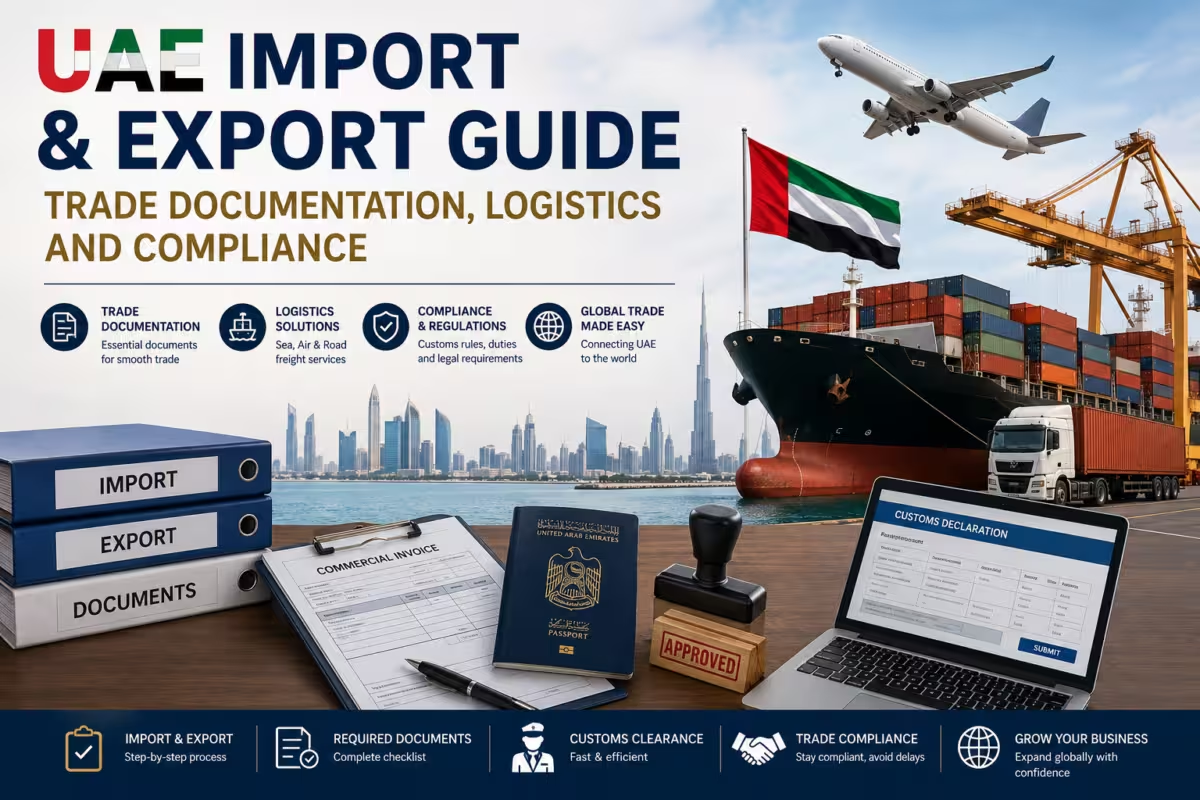
UAE import and export guide featuring trade documentation, cargo ship, air freight, customs clearance and logistics operations

UAE Import and Export Guide: Trade Documentation, Logistics and Compliance

Running import and export operations through the UAE can appear straightforward. The infrastructure is world-class, and the free zones are designed to support international trade.

What trips businesses up are the specifics: Which documents are mandatory for your cargo type? Which HS code applies? Whether free zone or mainland registration suits your trade structure? And how to keep goods moving without accumulating storage fees while a fixable compliance issue sits unresolved?

This guide covers UAE import and export from an operational standpoint. Learn how to choose a logistics partner that manages the cross-border leg without creating a separate operational burden at the domestic end.

Why the UAE Is Built for International Trade ?

UAE sits at a strategic midpoint between Asia, Europe, and Africa, making it a natural re-export centre. The UAE’s extensive network of free zones, including Jebel Ali Free Zone (JAFZA) and Dubai Multi Commodities Centre (DMCC), offers businesses streamlined customs processes, sector-specific infrastructure, and ownership structures designed for international trade.

Combine this with world-class port infrastructure, digital customs systems and automated clearance processes at major trade hubs, and you have an ecosystem built for high-volume international trade.

The UAE has also signed Comprehensive Economic Partnership Agreements (CEPAs) with India, Indonesia, Turkey, Israel, and Jordan, with further agreements in progress.

Setting Up to Trade: Registration and Licensing

Before a single shipment can move legally, a few registrations must be in place.

1) Trade license. To import goods into the UAE, companies must hold the correct trade license issued by the Department of Economic Development (DED) of the relevant emirate. Foreign businesses can establish UAE entities or use approved trade structures, depending on their activities, jurisdictions, and licensing requirements.

2) Customs registration. A customs client code is required before any declaration can be filed through the Dubai Trade Portal. VAT-registered businesses may need to link their Tax Registration Number (TRN) with their customs profile to support VAT processing on imports.

3) IOR/EOR services – trading without a UAE entity. For businesses that want to import or export through the UAE without establishing a local legal presence, Importer of Record (IOR) and Exporter of Record (EOR) services provide an alternative. 

The Importer of Record is legally responsible for an import shipment, ensuring every item complies with local regulations, accurately declaring goods to customs, and paying all applicable taxes and duties. The Exporter of Record manages export documentation, licensing, and compliance with export laws. IOR/EOR services enable international trade without the significant overhead of establishing a local legal presence.

For brands testing the UAE market entry, or businesses with occasional rather than regular import volumes, IOR/EOR is a practical option worth evaluating before committing to full entity setup.

Documents Required for UAE Import and Export

Documentation errors are the single most preventable cause of customs holds. Missing or incorrect documentation is a leading cause of clearance delays. Here is the complete document set, separated by trade type.

Import Documents (Standard)

Document Purpose
Commercial Invoice Itemised value, goods description, buyer/seller details. Must match the packing list exactly.
Packing List Lists the item count, weights, and dimensions for each package.
Bill of Lading / Airway Bill Proof of the shipment contract with the carrier and required for cargo release.
Certificate of Origin Verifies the country of origin and is required when claiming preferential duty treatment under trade agreements such as CEPA.
Import Declaration (Mirsal 2) Filed electronically through the Dubai Trade Portal before or upon cargo arrival.
Trade License Copy Confirms the business is legally authorised to import goods into the UAE.
Customs Duty Payment Proof Required before the customs release order is issued.
Category-Specific Permits (Required in Addition to Core Documents)

Food products need Dubai Municipality approval. Pharmaceuticals require permits from the Ministry of Health and Prevention (MOHAP). Cosmetics may require product registration and approvals through the relevant UAE regulatory authorities, depending on the product category and emirate.

Telecommunications equipment needs TDRA type approval. Chemicals may require approvals, permits, or safety documentation depending on classification and intended use.

Export Documents (Standard)

Document Purpose
Commercial Invoice Goods description, quantity, and declared value.
Packing List Contents and weights for each package.
Export Declaration Filed via Mirsal 2 before the shipment departs.
Certificate of Origin Required by destination customs and for preferential tariff claims.
Airway Bill / Bill of Lading Carrier-issued document for the outbound shipment.
Export Permits (if applicable) Required for controlled or regulated export categories.

Businesses should maintain trade and customs records for the legally required retention period, which is commonly five years for UAE tax records.

UAE Import and Export Costs: The Full Picture

Most businesses model 5% duty and stop there. The actual cost of a UAE import or export is broader in scope.

  1. Customs duty. The standard customs duty in the UAE is 5% of the CIF (Cost, Insurance, and Freight) value for most imported goods. Alcohol is subject to 50% duty. Tobacco products incur 100% duty. Certain categories are exempt from customs duties altogether. Essential items benefit from a 0% customs duty rate.

  2. Import VAT. 5% VAT applies to most imports, calculated on the CIF value plus applicable duty. VAT-registered businesses can recover this through their regular VAT return filing, making VAT registration commercially sensible for most trading companies importing at any meaningful volume.

  3. The duty-free threshold for courier imports. As of January 1, 2023, Dubai Customs lowered the threshold for duty-free shipments from AED 970 to AED 300. This policy applies to goods imported via courier services. For e-commerce businesses importing inventory via courier rather than freight, this threshold change affects every individual parcel below AED 300 that was previously duty-free.

  4. CEPA preferential rates. The UAE has implemented CEPAs with several trading partners, including India, Indonesia, Türkiye, Israel, and Jordan, with additional agreements under negotiation. The certificate of origin must be issued by an authorised body and comply with the rules of origin for the specific agreement.

  5. Port and terminal fees. Port handling fees, storage charges, customs agent fees, and documentation processing costs all accumulate beyond the headline duty rate. For sea freight through Jebel Ali, expect terminal handling charges, delivery order fees, and per-day storage costs if your shipment is delayed in customs.

  6. Storage and demurrage. Every day a shipment sits in a bonded facility after arrival costs money. A three-day documentation hold on a sea freight shipment can add AED 200–400 to your landed cost before the underlying issue is resolved. Accurate, pre-submitted documentation eliminates this cost entirely.

Here’s a quick tax summary in the UAE:

Cost Component Rate / Range
Standard customs duty Generally, 5% of the CIF value for most imported goods.
Import VAT 5% VAT applied on the import value, including customs duty (where applicable).
Alcohol excise/customs duty 50% (depending on applicable product classification and tax rules).
Tobacco and tobacco products 100% excise duty.
Free zone treatment Duty is generally deferred until goods enter the UAE mainland market, subject to customs rules.
CEPA preferential rates Reduced or zero duty rates may apply for qualifying goods based on origin and rules of origin.

Free Zone vs Mainland: Choosing the Right Trade Structure

The decision between importing through a free zone and operating on the UAE mainland has direct financial and operational consequences.

1) Free zone advantages

Goods can generally remain in free zones without standard import duty until they enter the UAE mainland, subject to free zone and customs regulations. Qualifying re-exports from free zones generally avoid UAE import duty because goods have not entered the mainland customs territory.

2) Mainland to free zone, and back again 

When goods leave a free zone for the UAE mainland market, an FZ Transit Out declaration must be submitted through Mirsal 2. At this point, the standard 5% customs duty becomes payable, along with applicable VAT. The duty liability exists at the point of mainland transfer, not at the point of import.

Which structure suits your business:

  • Selling primarily to UAE consumers → mainland registration, standard duty, and VAT apply
  • Re-exporting to GCC or international markets → free zone preferred, duty deferred until mainland sale
  • Testing UAE market entry without a permanent entity → IOR services through an established provider
  • Mixed model (local sale + re-export) → free zone with a mainland distribution arrangement or branch

For a detailed look at how domestic last-mile delivery connects to this decision, the List of Delivery Companies in Dubai covers the domestic distribution options once goods clear customs and enter the UAE market.

How to Structure Your UAE Logistics Operation

Getting documentation and compliance right is step one. Who handles your freight and domestic last-mile delivery determines whether goods actually reach customers on time once they clear customs.

For businesses importing inventory and distributing domestically, this is a two-part operation: cross-border freight (air, sea, or land) and UAE-wide domestic last-mile. Keeping both under a single partner removes the handoff gap, where most delivery problems occur.

  • Jeebly Haul covers the freight side, air, sea, and land, including GCC cross-border routes, with customs clearance handled in-house rather than outsourced to a third-party broker.

  • For the domestic distribution leg, Jeebly Dash covers same-day and next-day delivery across all seven UAE emirates, with direct integrations into Shopify, WooCommerce, Magento, ChatFood, and Grubtech. 

  • And Jeebly Bizz brings warehousing, fulfilment, and reverse logistics into the same platform, so businesses managing inbound freight alongside outbound B2C delivery don’t need two separate vendor relationships.


For a full comparison of UAE domestic delivery providers for the last-mile leg of your import operation, Top Delivery Companies in UAE (2026) covers seven major operators across speed, coverage, and tech integrations.

Talk to the Jeebly team about cross-border freight and domestic delivery requirements.

How Jeebly Handles Cross-Border Freight and Customs.

For businesses that want freight and customs managed by a single partner rather than coordinating between a freight forwarder and a separate customs broker, Jeebly Haul handles both.

For businesses managing regular inbound freight alongside domestic last-mile delivery, Jeebly Bizz connects the entire chain: freight-in, customs clearance, warehousing, and UAE-wide domestic delivery via Jeebly Dash, all tracked on one platform.

If you’re currently managing customs through a separate broker and finding that documentation queries take longer to resolve than they should, talk to the Jeebly team.

Conclusion

UAE import and export is a structured, well-documented process, and the compliance framework is more accessible than most businesses expect once the setup is in place. 

The critical steps are getting your trade license and customs registration sorted before your first shipment arrives, using the correct HS classification, understanding whether free zone or mainland registration suits your trade structure, and claiming CEPA preferential duty rates if your goods originate from qualifying countries. 

Act on each before they become urgent. For businesses that want freight, customs clearance, and UAE domestic delivery managed through a single connected platform, Jeebly Haul and Jeebly Bizz cover the entire chain. 

Get in touch to discuss your trade requirements.

Frequently Asked Questions

The standard rate is 5% of the CIF (Cost, Insurance, Freight) value for most goods. Exceptions include alcohol at 50%, tobacco at 100%, and some essentials at 0%. UAE Free Trade Agreements with India, Indonesia, Turkey, Israel, and Jordan may reduce or eliminate duties for qualifying goods. A certificate of origin compliant with each agreement’s rules of origin is required to claim the preferential rate.

Core documents include the commercial invoice, packing list, bill of lading or airway bill, certificate of origin, import declaration filed via Mirsal 2, trade license copy, and proof of customs duty payment. Category-specific permits apply for food, pharmaceuticals, cosmetics, electronics, and chemicals. These must be obtained before the shipment arrives.

Yes. Goods entering a UAE free zone are exempt from customs duty and VAT while they remain within the zone. Duty becomes payable when goods are transferred to the UAE mainland for local sale. Re-exports from a free zone to international destinations attract no duty.

An Importer of Record (IOR) is legally responsible for an inbound shipment, including customs declarations, duty payment, and regulatory compliance in the UAE. An Exporter of Record (EOR) holds legal responsibility for an outbound shipment, such as export documentation, licensing, and compliance with UAE export regulations. IOR/EOR services allow businesses to trade through the UAE without establishing a local legal entity.

Three changes matter most: 12-digit HS codes are now mandatory for GCC-destined trade (from February 2026) and will extend to all imports from August 2026; pre-arrival declaration for sea cargo via Mirsal 2 is now standard practice and protects against amendment fines; and the FTA’s e-invoicing mandate for B2B and B2G transactions begins with a voluntary pilot in July 2026, becoming mandatory from January 2027.

Routes to insightful reads

A comparison banner for UAE eCommerce delivery showing two hands holding smartphones side-by-side against a blurred Dubai skyline. The left screen displays the DHL Express logo with an "International Express" badge below it, while the right screen displays the Jeebly logo with a "Local Hyper-local" map route badge. A bold "VS" graphic splits the center.
DHL vs Jeebly: Which Is Better for UAE Businesses and eCommerce Delivery?

Looking for the right logistics partner in the UAE? We break down DHL vs. Jeebly to help you choose between global express shipping and local, tech-driven e-commerce fulfillment. Discover which courier wins on domestic delivery speeds, Cash on Delivery (COD) handling, and cross-border customs.

Read More
Logisty vs Jeebly comparison for UAE eCommerce delivery, last-mile logistics and courier services
Logisty vs Jeebly: UAE eCommerce Delivery Comparison

Logisty and Jeebly serve different logistics needs, but which is the better choice for your business? This comparison explores their services, delivery capabilities, technology, coverage, eCommerce integrations, cash on delivery (COD), and fulfilment solutions to help UAE businesses choose the right logistics partner for growth.

Read More
UAE VAT on imports and exports showing tax compliance, logistics, shipping and customs documentation
VAT on Shipping and Delivery Services in UAE: What Businesses Need to Know

VAT can significantly impact the cost of shipping and delivery services in the UAE, making it essential for businesses to understand how it applies to domestic and international shipments. This guide explains VAT rules, zero-rated and standard-rated services, invoicing requirements, and practical compliance tips to help businesses manage logistics costs and stay compliant with UAE tax regulations.

Read More
COD fraud prevention in the UAE with secure payment verification, order authentication and logistics risk management
COD Fraud in UAE eCommerce: How to Detect, Prevent and Reduce Losses

Cash on Delivery (COD) fraud is a growing challenge for e-commerce businesses across the UAE, leading to fake orders, delivery failures and unnecessary operational costs. Learn how to identify common fraud tactics, implement effective prevention strategies and protect your business while maintaining a seamless customer experience.

Read More
UAE import and export guide featuring trade documentation, cargo ship, air freight, customs clearance and logistics operations
UAE Import and Export Guide: Trade Documentation, Logistics and Compliance

Customs clearance is a critical step in moving goods into and out of the UAE. Whether you’re importing, exporting, or shipping across borders, understanding the customs process, required documentation, and compliance requirements can help you avoid delays, reduce costs, and keep your supply chain running efficiently.

Read More

    Powered by