



Jeebly | Logistics Solutions

Categories
blogs

Delivery SLAs in UAE: What businesses must demand from their logistics partner

Understanding Delivery SLAs: What UAE Businesses Should Know​

Understanding Delivery SLAs: What UAE Businesses Should Know

A delivery SLA (Service Level Agreement) defines the maximum time allowed for a shipment to be delivered. In UAE eCommerce, standard SLAs are 24–48 hours for same-emirate and 72 hours for inter-emirate deliveries.

Core SLA components every UAE business should expect

A logistics SLA typically covers: promised delivery windows (same day, next day, timed slots), on time delivery metrics, first time delivery success, lost/damaged goods handling, customer support response times, and dispute or refund processes. These elements remove ambiguity and ensure accountability.

The KPIs that matter

The most common SLA KPIs are:

On-Time Delivery (OTD): percent of deliveries made within the promised window. This is the single most important trust metric for customers.

First-Delivery Success Rate (FDSR): how often parcels are delivered on the first attempt (reduces cost and returns).

Order Accuracy & Damage Rate: percent of orders delivered correctly and undamaged.

Customer Response / Resolution Time: how quickly the carrier responds to exceptions.

Tracking these KPIs in your SLA helps you measure carrier performance and protect margins.

Why local context matters in the UAE

UAE logistics operate under specific rules (postal and transport frameworks) and seasonal patterns (e.g., Ramadan/Eid surges). Make sure SLAs reference local requirements and include contingency plans for regulatory checks or peak-season capacity. (See Emirates Post / postal framework for local rules.)

Practical SLA clauses to negotiate

* Defined delivery windows (not “same day” vaguely — specify cut offs and guaranteed slots).

* Remediation & penalties (credits or refunds when KPIs miss targets).

* Escalation matrix & SLAs for support (response times for customer queries).

* COD handling & reconciliation terms (critical in UAE markets).

* Peak season capacity guarantees (Eid/Ramadan surge support).

For operational playbooks on cut offs and surge planning, see Jeebly’s Ramadan and peak season guidance. (e.g., How Jeebly Helps SMEs Scale During Peak Shopping Seasons).

How to monitor and enforce SLAs

Automate performance dashboards, ingest carrier telemetry (ETAs, proof of delivery), and run weekly KPI reviews. Use API integrations so order status and PODs flow into your CRM/ERP, this removes reconciliation lag and enables faster refunds and dispute handling.

Final checklist for choosing an SLA partner

* Are OTD and FDSR explicitly defined?

* Are penalties and remediation clear?

* Is there an API for real time data and digital proof of delivery?

* Does the SLA include peak season capacity and COD terms?

* Can the carrier demonstrate UAE compliance and local experience?

A well-written SLA converts promises into predictable business outcomes. For UAE businesses that depend on customer trust, tight delivery SLAs UAE are a commercial necessity and a strong SLA with the right partner (and API integrations) is one of the fastest ways to improve delivery performance and reduce customer complaints.

Frequently Asked Questions

A delivery SLA (Service Level Agreement) is a formal commitment that defines the expected delivery performance between a business and its logistics provider. It typically outlines delivery timelines, service standards, tracking requirements, reporting obligations, and performance metrics used to measure delivery success.

Delivery SLAs for UAE eCommerce businesses vary by service type. Same-day deliveries are often completed within a few hours, while next-day delivery is a common standard for orders placed before a specified cutoff time. Many businesses also track metrics such as on-time delivery rates, successful first-attempt deliveries, and customer satisfaction levels.

When a courier misses an SLA, the outcome depends on the agreement between the business and the logistics provider. Common responses include performance reviews, service credits, corrective action plans, reporting requirements, or other remedies defined within the contract. Consistent SLA failures may indicate operational issues that require improvement.

A delivery SLA should clearly define delivery timeframes, service coverage areas, pickup and delivery windows, tracking requirements, reporting standards, escalation procedures, performance targets, and responsibilities for both parties. It should also specify how performance will be measured and what happens if service levels are not met.

The right SLA depends on your business model and customer expectations. Most businesses should seek clear commitments around on-time delivery performance, shipment visibility, delivery attempt success rates, customer support responsiveness, proof of delivery, and issue resolution timelines. The SLA should align with your operational requirements and customer experience goals.

Routes to insightful reads

Infographic guide for selling on Noon UAE in 2026, showing seller registration steps, product cataloguing, FBN and FBP logistics options, a Jeebly delivery van, and the Dubai skyline.
How to Sell on Noon in the UAE in 2026

Expanding your e-commerce footprint across the Middle East starts with Noon—the UAE’s leading homegrown digital marketplace. Whether you are a local startup or an established retail brand, succeeding in 2026 requires understanding trade license compliance, optimizing catalog listings, and selecting the right fulfillment model between FBN and FBP. Explore our complete guide to selling on Noon UAE, covering onboarding essentials, commission structures, and how partnering with reliable last-mile delivery providers like Jeebly helps you scale faster.
Read More
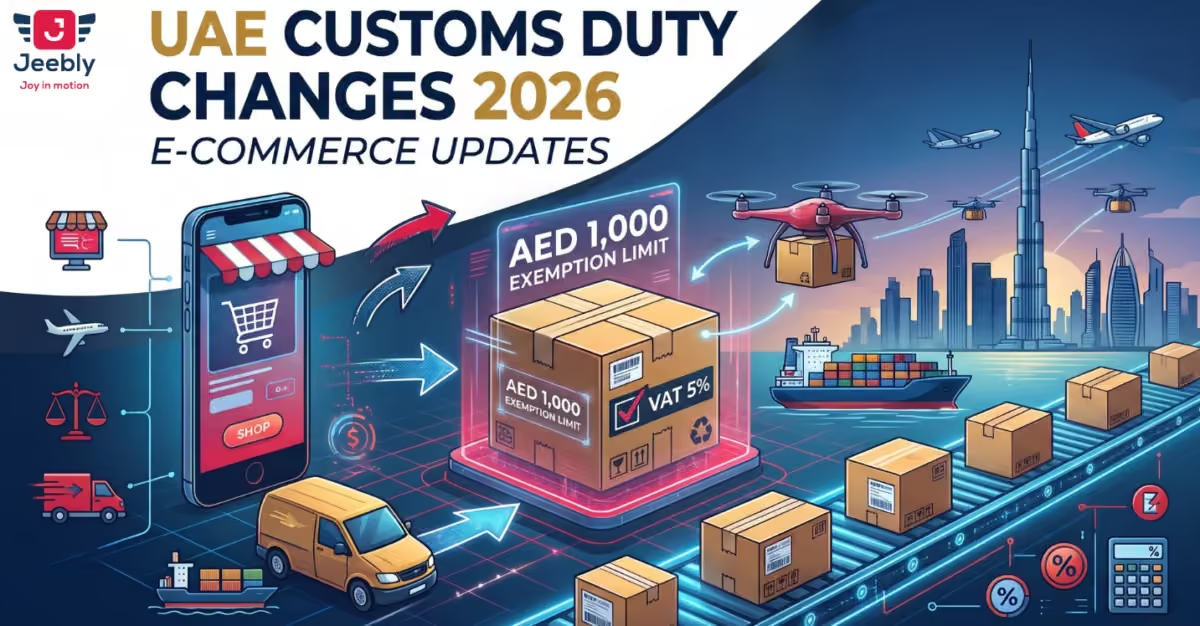
Infographic banner featuring the Jeebly logo, highlighting 2026 UAE customs duty updates for e-commerce with a Dubai skyline, delivery vans, cargo ships, conveyor belt parcels, and the AED 1,000 exemption limit.
UAE Customs Duty Changes for E-Commerce (2026)

With rapid expansions across the GCC digital commerce landscape, the UAE has implemented updated customs duty policies and clearance procedures for cross-border e-commerce shipments in 2026. From managing the AED 1,000 personal import exemption and 5% VAT rules to navigating commercial parcel compliance and streamlined last-mile delivery, discover how these regulatory shifts impact online retailers, logistics providers, and shoppers across the Emirates.

Read More
A Jeebly courier driver carrying a parcel while wiping sweat on a sunny Dubai street, with a second driver drinking water by a delivery van, illustrating UAE heat logistics and temperature-sensitive shipping challenges.
UAE Summer Delivery: Heat Effects on Couriers, Packaging and Timelines

Operating last-mile delivery in the UAE requires navigating challenging weather and heat conditions year-round. From protecting courier health to using insulated packaging and adjusting transit schedules, discover how top logistics providers keep temperature-sensitive parcels safe and on time across Dubai and the GCC.

Read More
Jeebly delivery van and driver holding a branded parcel against the Dubai skyline, featuring a digital route optimisation map interface.
What Is Route Optimisation in Last-Mile Delivery?

Last-mile delivery is the most critical—and expensive—leg of the supply chain. Discover how route optimisation leverages real-time data, traffic analytics, and smart scheduling to cut operational costs, beat urban gridlock, and ensure on-time deliveries across the UAE.
Read More
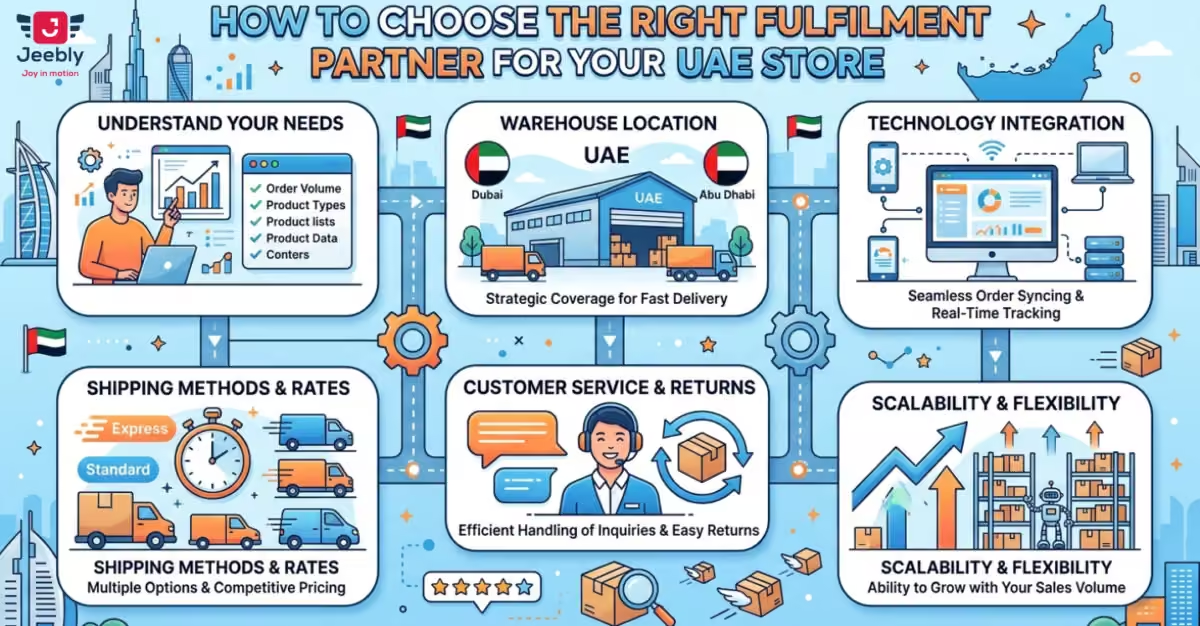
An infographic detailing six steps to choose the right fulfillment partner for a UAE store: understand needs, warehouse location (Dubai/Abu Dhabi), technology integration, shipping methods, customer service, and scalability, set against a UAE city skyline
How to Choose the Right Fulfilment Partner for Your UAE Store

Selecting the right fulfillment partner can make or break your e-commerce growth in the UAE. From strategic warehouse locations in Dubai and Abu Dhabi to seamless tech integration, learn the six critical factors every online store must evaluate to lower costs, ensure same-day delivery, and scale efficiently across the GCC.

Read More

    Powered by