
Jeebly | Logistics Solutions

Illustrated banner for Jeebly showing a delivery courier in Dubai handing a parcel to a customer signing an electronic proof of delivery (ePOD) tablet, surrounded by Jeebly delivery vans, a smartphone displaying digital signature confirmation, and the Dubai skyline in the background.

What Is Proof of Delivery (POD) and Why It Matters for UAE Shipments

Proof of delivery (POD) is a record that a shipment reached the intended recipient: a signature, photo or digital confirmation with date, time and location. In the UAE, it matters most when a customer says “I never received it”, which can happen with COD orders, card chargebacks marked “merchandise not received” and business invoices that can’t be raised until delivery is confirmed.

This guide explains what POD is and what it looks like, why it matters in the UAE, whether photo POD is valid under UAE law, how small businesses can set it up, how to get it from a courier, and how Jeebly handles it.

Key Takeaways

  • POD confirms receipt (who, when, where, condition). A tracking status and a delivery note do not.


  • UAE law doesn’t allow rejecting electronic evidence merely because it is electronic. Weight depends on reliability, so

    timestamps, GPS, and order IDs matter.

  • POD protects you in three disputes: COD claims, “not received” chargebacks, and B2B invoice holds.


  • The simplest start is courier-captured photo POD stored per order. Add a signature or ID check for high-value orders.


  • Jeebly’s driver photo POD is timestamped, GPS-tagged, stored per order and viewable in the dashboard and Jeebly One app.

What Is Proof of Delivery (POD)?

Proof of delivery is a document or digital record confirming that goods were handed to the right person at the right place, with the time and, often, the condition of the parcel. It takes several forms: a paper or electronic signature, a photo, a GPS-tagged digital record and, where a courier offers it, a delivery code.

Document What it shows Confirms receipt?
Tracking status Where the parcel is and its latest event No
Delivery note The goods listed in the shipment Only if signed
Proof of delivery Who received it, when, where and in what condition Yes
Bill of lading or air waybill The contract of carriage and routing No

A POD is a receipt of completion, not a contract of carriage. A “delivered” status doesn’t say who accepted the parcel.

What Does a Proof of Delivery Look Like?

A digital POD is a record, and it should carry:

Field Why it matters
Order or tracking number Links the proof to the sale
Recipient name (and signature if taken) Shows who accepted
Delivery address and GPS location Shows where
Date and time Shows when
Photo Shows the parcel at handover
Items and quantity Matches the order
Condition notes Supports damage claims
Courier or driver ID Supports accountability

Why Does Proof of Delivery Matter for UAE Shipments?

Situation Without POD POD evidence that helps
COD "I didn't receive it" or "I paid" disputes Unresolved claim, cash gaps Photo at handover. Jeebly says its driver photo proves delivery and cash collection
"Merchandise not received" chargeback The merchant carries the burden of proof Delivery confirmation showing address, time and recipient
Non-delivery refund requests Refund granted by default POD showing delivery
B2B invoicing Invoice held. Many businesses run "no POD, no invoice" Signed delivery receipt
Courier accountability No basis for a claim Per-order record

COD is large in the UAE: 31.6% of orders in a 2024 sample of about 30,000 (Shorages). Delivery evidence works against “not received” claims, not fraud claims, so match the proof to the dispute reason.

COD Fraud in UAE eCommerce covers the fraud side, and the Delivery SLA Guide for UAE Businesses shows how to include POD in a courier agreement.

Is a Photo or E-Signature Valid Proof of Delivery in the UAE?

As evidence, yes, in principle, but its weight depends on its reliability. Under Federal Decree-Law No. 46 of 2021 (in force since 2 January 2022), courts can admit electronic documents, signatures, or transactions as evidence, and you can’t exclude them merely because they’re electronic. Courts weigh the evidence, and an audit trail (identity, timestamps, device, integrity) is easier to defend.

A digital POD is strongest when it has:

  • a timestamp and GPS location
  • the order or tracking ID attached
  • a photo of the parcel or recipient at the address
  • storage per order, unaltered and retrievable later

This is not legal advice. For high-value disputes, consult a UAE lawyer.

How Can Small UAE Businesses Implement Proof of Delivery?

Method How it works Best for Limit
Courier-captured photo POD Rider photographs the parcel at handover; record stored per order Most B2C parcels, COD Shows location, not always who received
Photo plus e-signature Recipient signs on the rider's phone Higher-value and B2B Slower at the door
WhatsApp confirmation You send the customer the delivery photo Social sellers Manual; evidence sits in chat
Delivery code or PIN (if offered) Customer gives a code to receive High-value, fraud-prone orders Availability varies by courier
Signed paper delivery note, photographed Recipient signs a printed note Businesses not yet digital Easy to lose; manual filing

Check whether your courier already includes POD before adding software. Match the method to the order: photo for low-value orders, photo plus signature or ID for high-value ones, and photo plus a cash record for COD. 

For high-value item delivery, agree on the standard in advance. Social sellers can forward the courier photo in the customer chat.

How Do You Get a Proof of Delivery From a Courier?

  1. Keep the tracking or order number.
  2. Open the courier’s tracking page, dashboard or app and look for the POD: photo, signature or GPS.
  3. If it’s missing, ask support with the tracking number, recipient name and delivery date.
  4. Save a copy straight away. Retention windows vary by carrier.
  5. Attach it to the order record.

FedEx lists UAE-destination residential shipments as released without a signature, with photo proof of delivery in the tracking. Jeebly stores its driver photo POD per order, accessible in the Jeebly dashboard and app.

How Do You Set Up a POD Process Customers Trust?

  1. Define what counts as delivered: photo, signature, code or a mix by order value.
  2. Brief everyone at the last mile, whether your riders or a courier’s.
  3. Tell customers up front: “You’ll get photo confirmation when your order arrives.”
  4. Store records per order where your team can retrieve them in minutes.
  5. Review disputes monthly and tighten the standard.

When a customer says “I didn’t receive it”:

  • Pull the photo, time and GPS for that order.
  • Check the address and pin against the order.
  • Reply with evidence, not an argument.
  • If it looks like the wrong address or person, open a courier claim and refund or reship under your policy.

Chasing couriers for delivery proof while a customer waits wastes days. An e-commerce delivery service that stores POD per order removes the chase. Talk to the Jeebly team about your delivery volume and COD share.

How Does Jeebly Handle Proof of Delivery?

Jeebly’s published POD is a photograph the rider takes at handover. It is timestamped and GPS-tagged, stored per order, and accessible to the business through the Jeebly dashboard and the Jeebly One app. Jeebly remits COD weekly and doesn’t offer card-on-delivery. For returns, Jeebly’s reverse logistics line captures digital proof of pickup.

Jeebly Bizz is built for ecommerce logistics, with delivery, COD, and returns on one platform.

What Jeebly doesn’t publish, so ask us as you would any courier:

For shipments abroad, see Jeebly’s international courier service. Talk to the Jeebly team to confirm which POD fits your orders.

Conclusion

POD is the record that turns “it was delivered” into evidence. In the UAE, it settles COD disputes, answers “not received” chargebacks and unlocks B2B invoices. It is strongest when timestamped, GPS-tagged and stored per order, and it needs no heavy software: a courier-captured photo is a sound start.

To capture and store POD per order, Jeebly Dash and Jeebly Bizz cover delivery, COD, and returns. Get in touch to review your set-up.

Frequently Asked Questions

For high-value goods, B2B consignments where the contract requires it, and repeated disputes. For low-value residential orders, a timestamped photo with GPS is usually enough. Set the rule by order value and apply it consistently.

The courier typically captures and provides it. You need access to it, so write dashboard or app access and the retention period into your courier agreement.

POD supports your sales invoices, so keep it as long as the invoice record it backs up. VAT records must be kept for at least five years from the end of the tax period, and corporate tax records for seven. Confirm with your tax adviser.

Use the POD’s GPS and photo to establish where the parcel went, then open a claim with the courier and refund or reship under your policy. Keep the claim reference on the order record.

Yes. Proof of pickup shows the courier collected the parcel from the customer, which protects you against “I already returned it” claims. Jeebly’s reverse logistics line captures digital proof of pickup. How to Manage eCommerce Returns in UAE covers the full process.

Yes. COD and chat orders carry the same “I didn’t receive it” risk. Use a courier that captures photo POD and forward it to the customer via WhatsApp or Instagram.

Routes to insightful reads

Illustrated banner for Jeebly showing a delivery courier in Dubai handing a parcel to a customer signing an electronic proof of delivery (ePOD) tablet, surrounded by Jeebly delivery vans, a smartphone displaying digital signature confirmation, and the Dubai skyline in the background.
What Is Proof of Delivery (POD) and Why It Matters for UAE Shipments

In the UAE’s fast-moving logistics landscape, Proof of Delivery (POD) has evolved far beyond a paper receipt. From real-time GPS timestamps to instant digital signatures, discover how modern ePOD protects businesses, eliminates delivery disputes, and guarantees transparency across every mile.

Read More
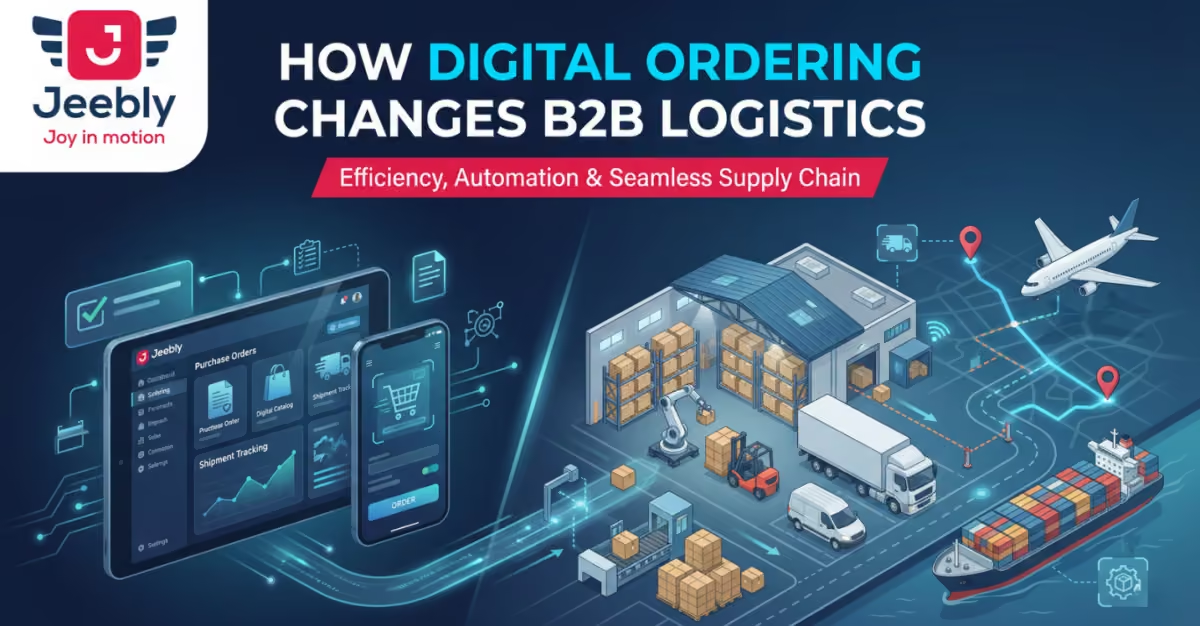
A modern navy and cyan digital blog banner titled 'HOW DIGITAL ORDERING CHANGES B2B LOGISTICS' with the Jeebly logo in the top-left corner. The illustration features a tablet and smartphone on the left showing digital B2B purchase orders, shipment tracking, and procurement interfaces, connected via glowing digital data streams to a bustling smart logistics ecosystem on the right with an automated warehouse, forklifts, delivery trucks, a cargo airplane, and a container ship.
B2B E-Commerce in the UAE: How Digital Ordering Is Changing Business Logistics

Managing orders across your website, social channels, and marketplaces like Noon and Amazon can quickly overwhelm manual spreadsheets and disconnected systems. Stockouts, delayed dispatches, and rising return rates often signal that your business has outgrown basic order tracking. Discover the key signs your UAE e-commerce store needs an Order Management System (OMS) and how integrating automated order workflows with Jeebly streamlines inventory sync, multi-channel fulfillment, and last-mile delivery.
Read More
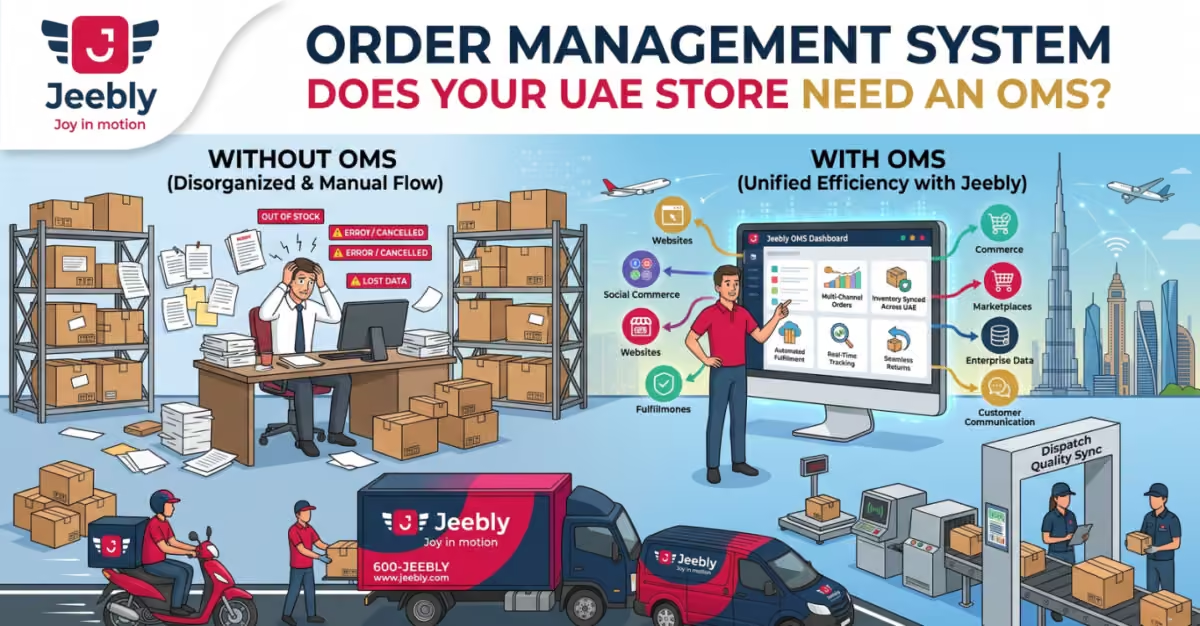
Split-screen infographic featuring the Jeebly logo, comparing chaotic manual order processing without an OMS against a streamlined, unified OMS workflow with Jeebly trucks, vans, and the Dubai skyline.
Order Management System: Does Your UAE Store Need an OMS?

Managing orders across your website, social channels, and marketplaces like Noon and Amazon can quickly overwhelm manual spreadsheets and disconnected systems. Stockouts, delayed dispatches, and rising return rates often signal that your business has outgrown basic order tracking. Discover the key signs your UAE e-commerce store needs an Order Management System (OMS) and how integrating automated order workflows with Jeebly streamlines inventory sync, multi-channel fulfillment, and last-mile delivery.
Read More
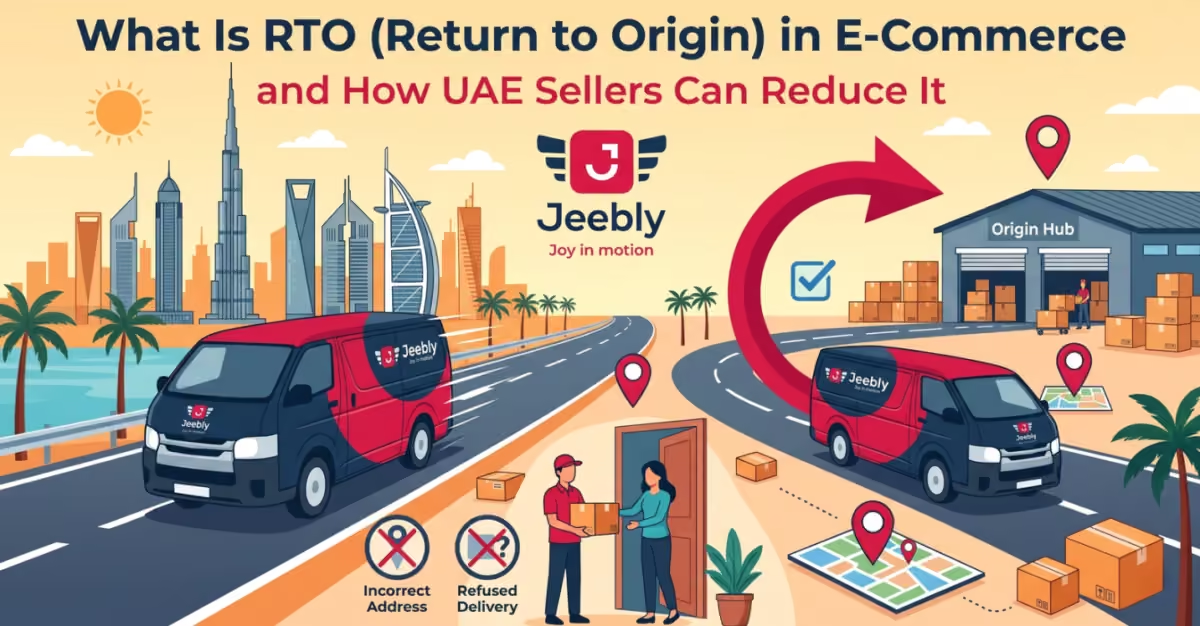
An animated vector-style graphic illustrating "What is RTO (Return to Origin) in E-Commerce and How UAE Sellers Can Reduce It", featuring Dubai's skyline, Jeebly delivery vans, and the loop of a package being returned to an origin hub alongside tips for successful doorstep delivery.
What Is RTO (Return to Origin) in E-Commerce and How UAE Sellers Can Reduce It

Return to Origin (RTO) is one of the most expensive headaches for UAE e-commerce sellers—often driven by non-standardized addresses, hard-to-reach customers, and Cash on Delivery (COD) refusals. But you don’t have to let failed deliveries eat into your profit margins. Discover what causes high RTO rates in the UAE and learn practical, actionable strategies—from address validation and automated customer communication to partnering with reliable delivery services like Jeebly—to protect your bottom line and ensure more orders find their home on the very first try.
Read More
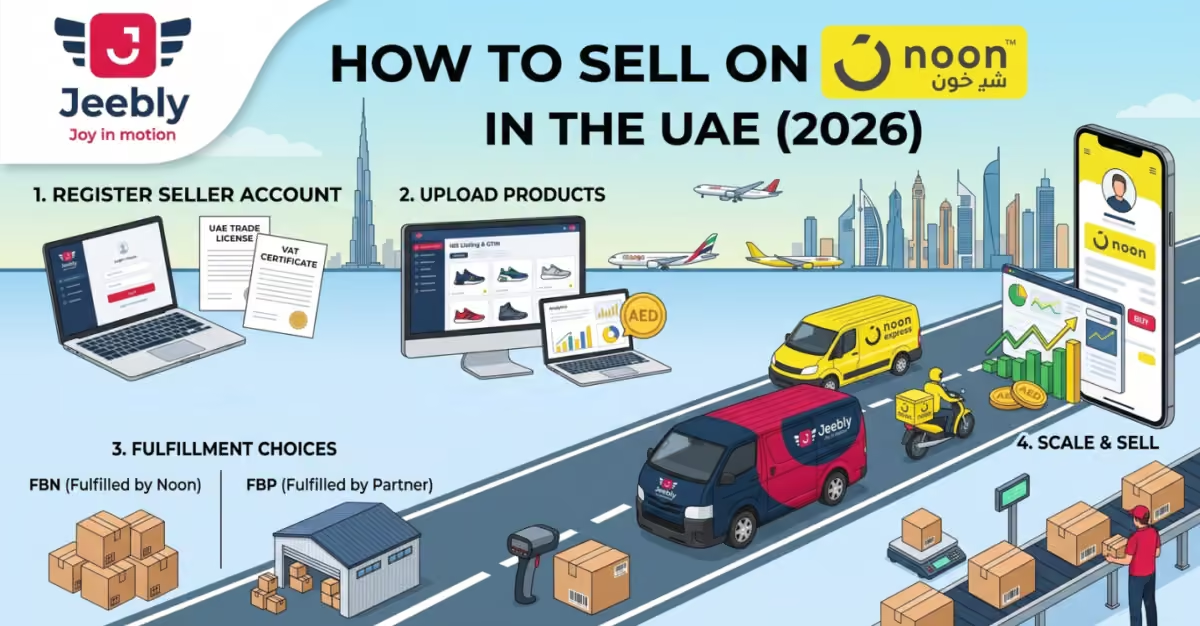
Infographic guide for selling on Noon UAE in 2026, showing seller registration steps, product cataloguing, FBN and FBP logistics options, a Jeebly delivery van, and the Dubai skyline.
How to Sell on Noon UAE: Fulfilment, Delivery and Seller Logistics Explained

Expanding your e-commerce footprint across the Middle East starts with Noon—the UAE’s leading homegrown digital marketplace. Whether you are a local startup or an established retail brand, succeeding in 2026 requires understanding trade license compliance, optimizing catalog listings, and selecting the right fulfillment model between FBN and FBP. Explore our complete guide to selling on Noon UAE, covering onboarding essentials, commission structures, and how partnering with reliable last-mile delivery providers like Jeebly helps you scale faster.

Read More

    Powered by