Jeebly | Logistics Solutions

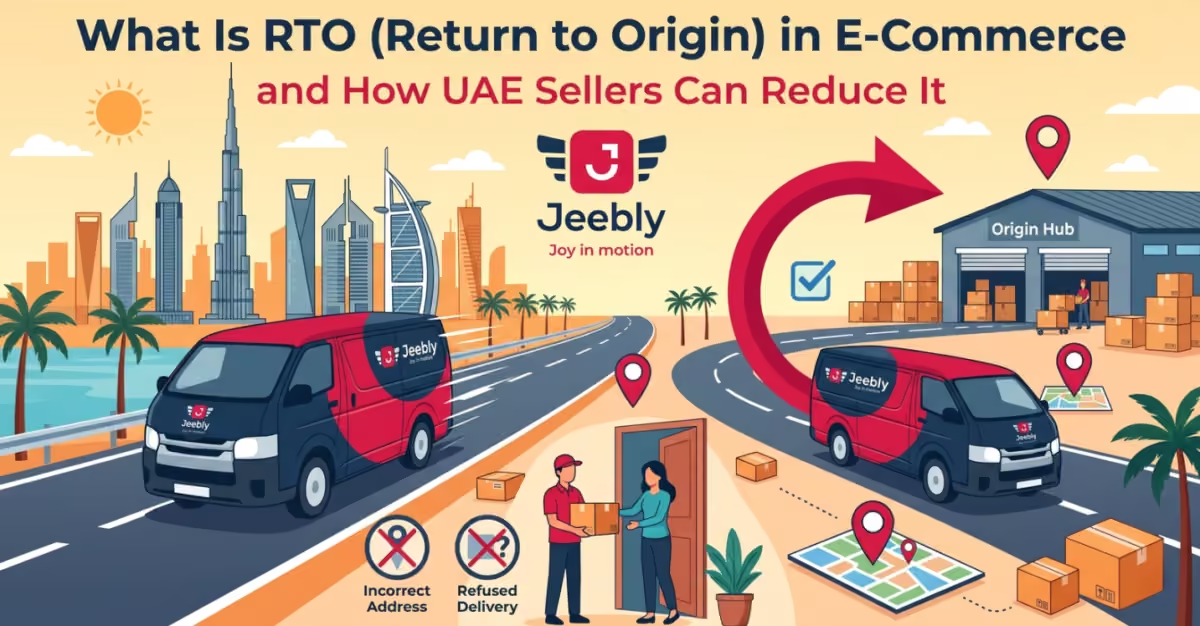
An animated vector-style graphic illustrating "What is RTO (Return to Origin) in E-Commerce and How UAE Sellers Can Reduce It", featuring Dubai's skyline, Jeebly delivery vans, and the loop of a package being returned to an origin hub alongside tips for successful doorstep delivery.

What Is RTO (Return to Origin) in E-Commerce and How UAE Sellers Can Reduce It

RTO (Return to Origin) in e-commerce means a parcel the courier couldn’t deliver that returns to the seller. The customer never receives the order, the sale is lost, and the seller pays delivery both ways.

COD orders typically have an RTO rate 2X to 4X higher than prepaid orders. For a prepaid order, RTO might hover around 5-10%, driven primarily by genuine quality issues or sizing problems. For COD, this figure frequently jumps to 15-35% and, in some challenging markets, can even exceed 40%

This guide explains how RTO works, how it differs from failed-attempt reports and customer returns and eight ways UAE sellers can reduce it.

Key Takeaways

  • RTO is a parcel sent back to the seller after failed delivery attempts or refusal. Customer returns are different. They happen after delivery.


  • COD orders typically have RTO rates of 15% to 35%, while prepaid orders have much lower RTO rates, generally around 5% to 10%.

  • Each RTO costs delivery both ways plus handling and wasted ad spend. For Jeebly, at AED 17.31 each way, that is about AED 39.62 before the lost sale.


  • The levers that work are confirming COD orders before dispatch, validating addresses, shipping fast, running a failed-delivery workflow, and tracking RTO by payment method, emirate and courier.

What Does RTO Mean in E-Commerce?

RTO stands for Return to Origin. A courier attempts delivery, can’t complete it, and sends the parcel back to the seller’s address. The usual triggers are:

  • the customer refuses the parcel (common with COD)
  • the customer is unavailable or unreachable
  • the address or phone number is wrong or incomplete
  • the courier can’t access the location
  • the permitted delivery attempts run out

How Does RTO Work? What "RTO Initiated", "RTO in Transit" and "RTO Delivered" Mean

RTO initiated means the courier has decided not to deliver and has started the return. RTO in transit means the parcel is travelling back to you. RTO delivered means it has reached the seller.

Stage What happens Typical tracking status
1. Out for delivery The rider attempts delivery Out for delivery
2. Attempt fails Customer unavailable, refuses, or address problem Delivery attempt failed (NDR)
3. Re-attempt Courier contacts the customer and tries again, often up to three attempts Re-attempt scheduled
4. RTO triggered Attempts are exhausted, or the customer refuses outright RTO initiated
5. Reverse transit The parcel travels back to the seller RTO in transit
6. Back with seller Seller receives, inspects and restocks RTO delivered

Attempt limits vary by provider. Jeebly makes three delivery attempts before marking an order as RTO. Status wording differs by courier.

What Is the Difference Between RTO, NDR, a Return and a Cancellation?

Term When it happens Did the customer get the parcel? Who triggers it
NDR (non-delivery report) A single failed delivery attempt No Courier logs the attempt
RTO After repeated failures or a refusal No Courier, once attempts end
Customer return After delivery Yes Customer
Cancellation Before dispatch No Customer or seller

Track them separately. A refused COD parcel is an RTO, not a return, and mixing the two hides whether the problem is the product, the address or the payment method. How to Manage eCommerce Returns in UAE covers customer returns.

Why Do UAE Orders Go RTO?

  1. COD refusals and impulse orders. Shortages, changing lists, impulse purchases, and reluctance to pay at the door are key causes. Orders from social channels are especially exposed.
  2. Wrong or incomplete addresses and phone numbers. The UAE has no standard postcode system, so building, unit and area details matter.
  3. Customer unavailable. No one is home or reachable during the delivery window.
  4. Fake or test orders. See COD Fraud in UAE eCommerce.
  5. Slow dispatch. The longer an impulse buyer waits, the more likely they reconsider.
  6. Weak failed-delivery follow-up. If nobody contacts the customer after the first miss, attempts are wasted.

How Much Does an RTO Cost a UAE Seller?

Cost per RTO = forward delivery + return delivery + packaging written off + inspection and restocking (+ ad spend already spent on that order).

Cost line Illustrative Example (AED) Note
Forward delivery 17.31 Jeebly Dash published base rate, up to 5 kg
Return leg 17.31 Assumed equal, confirm your courier's reverse rate
Packaging written off 2.00 Assumption
Inspection and restocking 3.00 Assumption
Cost per RTO (before lost sale) 39.62
Ad cost per order 25.00 Assumption: use your own acquisition cost
Cost per RTO including ad spend 64.62

The sale never completes, so the real cost is higher. If RTO is a margin leak in your business, talk to the Jeebly team with your COD share, monthly orders and current RTO rate to map where parcels are failing.

How Can UAE Sellers Reduce RTO? Eight Tactics

Initiatives like combining address verification, same-day shipping, a pay-online option, and three attempts on separate days can reduce RTO.

  1. Confirm COD orders before dispatch. Message or call the customer with the exact amount and require an explicit yes. COD Fraud in UAE eCommerce covers OTP and fake-order screening.


  2. Validate the address at checkout. Require building, unit, area, emirate and a reachable mobile number.


  3. Ship fast. Jeebly publishes an 11 a.m. same-day cut-off in Dubai and a 2 p.m. next-day cut-off across all seven emirates. With same-day delivery in Dubai, COD orders placed before the cut-off reach the customer before they can change their mind.


  4. Offer a pay-online option when the customer isn’t home. It rescues a missed attempt without a reversal.


  5. Run a failed-delivery workflow. Contact the customer the same day, reschedule, and space attempts across days. How Small Businesses Can Reduce Failed Deliveries in the UAE and Why Real-Time Delivery Updates Reduce Complaints covers the follow-up and notifications.


  6. Manage couriers on delivery data. Ask for first-attempt success, attempt policy and RTO rate by emirate. Best Courier Services in UAE benchmarks providers, and the Delivery SLA Guide for UAE Businesses shows how to write failed-delivery terms.


  7. Nudge prepaid. A prepaid discount or free-delivery threshold is a good initiative.


  8. Measure weekly. Track RTO by payment method, reason, emirate, SKU and courier.

COD refusals eating margin? An e-commerce delivery service with weekly COD remittance and a published three-attempt policy shortens the cash cycle and reduces guesswork. Talk to the Jeebly team about your COD volume.

How Do You Calculate and Track Your RTO Rate?

RTO rate = RTO parcels ÷ parcels dispatched × 100. Calculate it per payment method, because a blended number hides the COD problem.

Metric Definition Why it matters
RTO rate by payment method RTO ÷ dispatched, COD and prepaid separately Shows where the problem lives
COD confirmation rate Confirmed COD orders ÷ COD orders placed Leading indicator of future RTO
First-attempt success Delivered on attempt one ÷ dispatched Isolates address and courier issues
RTO by emirate and courier RTO ÷ dispatched per zone and carrier Shows coverage and courier gaps
Cost per RTO Full loaded cost of one failed parcel Turns the rate into AED

What Happens After "RTO Delivered"? What Sellers Should Do

Once the parcel reaches you, five steps protect your margin and stock:

  1. Log the reason (refused, unreachable, address, attempts exhausted).
  2. Inspect and restock quickly. Stock stuck in a returns pile can’t be resold. Understanding Reverse Logistics covers the workflow.
  3. Reconcile the courier invoice, including failed-attempt and return-leg charges.
  4. Refund prepaid orders per your policy.
  5. Flag the customer or address if the pattern repeats.

RTO parcels piling up unprocessed? Jeebly’s ecommerce logistics platform includes a dedicated reverse logistics line with digital proof of pickup, so returns re-enter stock faster.

How Does Jeebly Handle Failed Deliveries and RTO?

RTO is a parcel that never reaches the customer and comes back to you. In the UAE, it is largely a COD problem. Confirm orders before dispatch, validate addresses, ship fast, and follow up on failed attempts. Track the rate by payment method and cost every RTO in AED, so the loss is visible.

For the failed-delivery process behind these numbers, read How Small Businesses Can Reduce Failed Deliveries in the UAE. If you want a UAE delivery partner with weekly COD remittance and returns on the same platform, Jeebly Dash and Jeebly Bizz cover both. Get in touch to review your RTO.

Conclusion

RTO is a parcel that never reaches the customer and comes back to you. In the UAE, it is largely a COD problem. Confirm orders before dispatch, validate addresses, ship fast, and follow up on failed attempts. Track the rate by payment method and cost every RTO in AED, so the loss is visible.

For the failed-delivery process behind these numbers, read How Small Businesses Can Reduce Failed Deliveries in the UAE. If you want a UAE delivery partner with weekly COD remittance and returns on the same platform, Jeebly Dash and Jeebly Bizz cover both. Get in touch to review your RTO.

Frequently Asked Questions

Usually the seller: you pay the forward attempt and the return, and you lose the sale. There are no set charges as courier terms differ. Get failed-attempt, return-leg and COD fees in writing.

Sometimes. Some couriers accept a re-attempt request before the parcel leaves the local hub if the customer responds. Once it is in reverse transit, many treat it as committed, and the practical route is to reship as a new order after it returns. Ask your courier about its re-attempt cut-off.

Yes, but rarely. Causes include incorrect addresses, unreachable customers, and refusals due to a change of mind. When a prepaid parcel comes back, refund it per your policy, inform the customer, and correct the address data.

Judge COD and prepaid separately. There is no set benchmark. Your target depends on your COD share: blended RTO = COD share × COD RTO + prepaid share × prepaid RTO. Watch the monthly trend.

Under Fulfilled by Noon (FBN), where Noon stores and delivers your stock, the outbound fee applies once an order is first marked Delivered or NDR, so a failed delivery still costs a fee. Under DirectShip, you hand-pack orders for Noon, and undeliverable orders return to you after three attempts. For sellers shipping Amazon.ae orders themselves, a refused COD order generally becomes a failed delivery entering an RTO workflow.

Yes. Flag their phone number and address in your order system, and switch them to prepaid-only after repeated refusals. State the rule in your COD terms so it applies consistently, and keep the refusal record in case of disputes.

Routes to insightful reads

An animated vector-style graphic illustrating "What is RTO (Return to Origin) in E-Commerce and How UAE Sellers Can Reduce It", featuring Dubai's skyline, Jeebly delivery vans, and the loop of a package being returned to an origin hub alongside tips for successful doorstep delivery.
What Is RTO (Return to Origin) in E-Commerce and How UAE Sellers Can Reduce It

Return to Origin (RTO) is one of the most expensive headaches for UAE e-commerce sellers—often driven by non-standardized addresses, hard-to-reach customers, and Cash on Delivery (COD) refusals. But you don’t have to let failed deliveries eat into your profit margins. Discover what causes high RTO rates in the UAE and learn practical, actionable strategies—from address validation and automated customer communication to partnering with reliable delivery services like Jeebly—to protect your bottom line and ensure more orders find their home on the very first try.
Read More
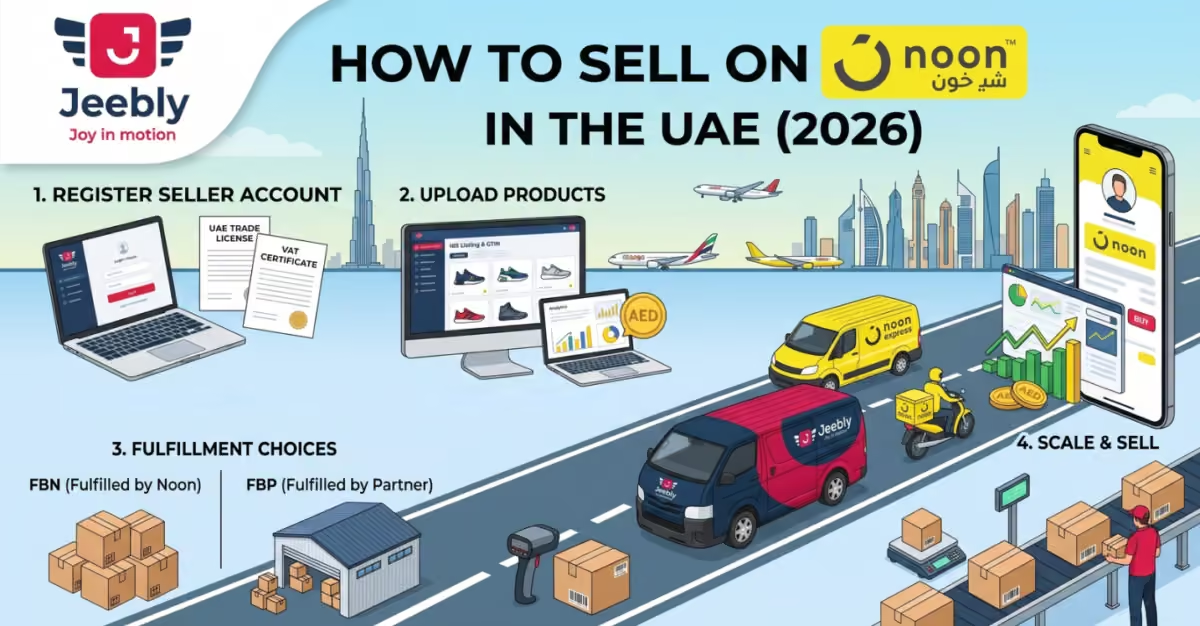
Infographic guide for selling on Noon UAE in 2026, showing seller registration steps, product cataloguing, FBN and FBP logistics options, a Jeebly delivery van, and the Dubai skyline.
How to Sell on Noon in the UAE in 2026

Expanding your e-commerce footprint across the Middle East starts with Noon—the UAE’s leading homegrown digital marketplace. Whether you are a local startup or an established retail brand, succeeding in 2026 requires understanding trade license compliance, optimizing catalog listings, and selecting the right fulfillment model between FBN and FBP. Explore our complete guide to selling on Noon UAE, covering onboarding essentials, commission structures, and how partnering with reliable last-mile delivery providers like Jeebly helps you scale faster.
Read More
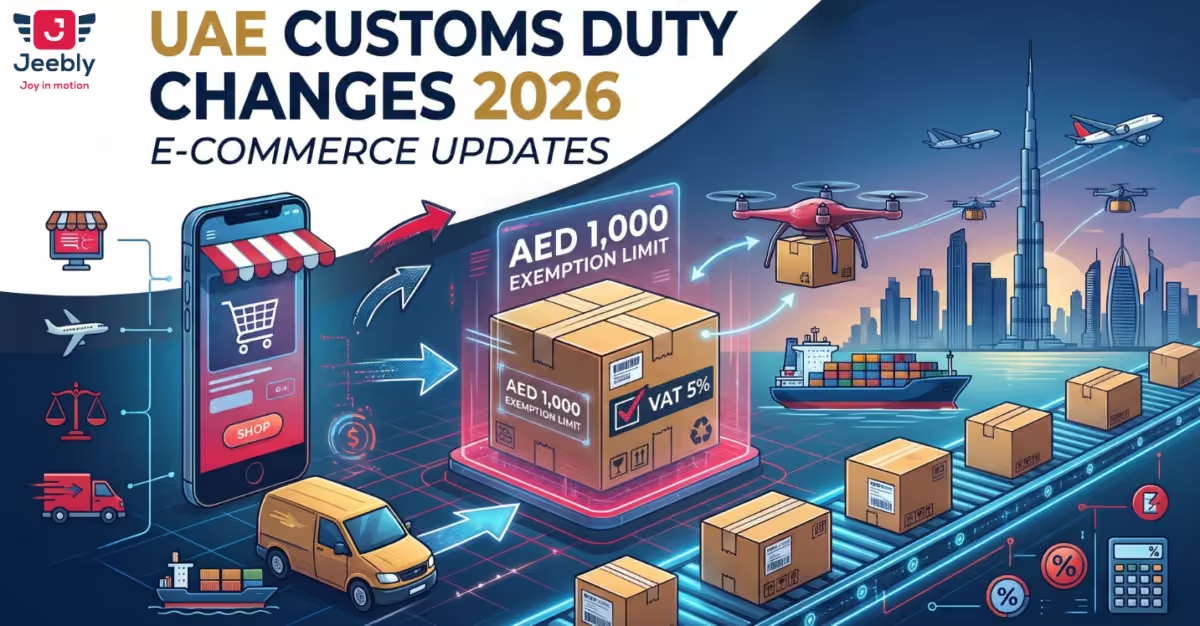
Infographic banner featuring the Jeebly logo, highlighting 2026 UAE customs duty updates for e-commerce with a Dubai skyline, delivery vans, cargo ships, conveyor belt parcels, and the AED 1,000 exemption limit.
UAE Customs Duty Changes for E-Commerce (2026)

With rapid expansions across the GCC digital commerce landscape, the UAE has implemented updated customs duty policies and clearance procedures for cross-border e-commerce shipments in 2026. From managing the AED 1,000 personal import exemption and 5% VAT rules to navigating commercial parcel compliance and streamlined last-mile delivery, discover how these regulatory shifts impact online retailers, logistics providers, and shoppers across the Emirates.

Read More
A Jeebly courier driver carrying a parcel while wiping sweat on a sunny Dubai street, with a second driver drinking water by a delivery van, illustrating UAE heat logistics and temperature-sensitive shipping challenges.
UAE Summer Delivery: Heat Effects on Couriers, Packaging and Timelines

Operating last-mile delivery in the UAE requires navigating challenging weather and heat conditions year-round. From protecting courier health to using insulated packaging and adjusting transit schedules, discover how top logistics providers keep temperature-sensitive parcels safe and on time across Dubai and the GCC.

Read More
Jeebly delivery van and driver holding a branded parcel against the Dubai skyline, featuring a digital route optimisation map interface.
What Is Route Optimisation in Last-Mile Delivery?

Last-mile delivery is the most critical—and expensive—leg of the supply chain. Discover how route optimisation leverages real-time data, traffic analytics, and smart scheduling to cut operational costs, beat urban gridlock, and ensure on-time deliveries across the UAE.

Read More

    Powered by