




Last-mile delivery is the most critical—and expensive—leg of the supply chain. Discover how route optimisation leverages real-time data, traffic analytics, and smart scheduling to cut operational costs, beat urban gridlock, and ensure on-time deliveries across the UAE.

What Is Route Optimisation in Last-Mile Delivery?
Route optimisation is the process of determining the most efficient sequence and path for a delivery driver to complete a set of stops. It helps minimise time, distance, and cost while meeting delivery windows, driver limits, and vehicle constraints.
It may sound simple. But in practice, a fleet of 20 riders completing 30 stops may produce hundreds of billions of possible route combinations. Without automated optimisation, the best a human dispatcher can do is a reasonable approximation. With it, the system finds a solution no human planner could reach.
For UAE businesses managing last-mile delivery across Dubai’s unaddressed streets and inter-emirate routes, route optimisation is the operational infrastructure that determines whether they keep delivery promises.
Key Takeaways
- Route optimisation calculates the most efficient stop sequence for each driver across the full day’s delivery load, accounting for traffic, time windows, vehicle capacity, and driver constraints simultaneously.
- Last-mile delivery costs have risen from 41% to 53% of total shipping costs between 2018 and 2023. Route optimisation is one of the few controllable levers that can directly compress this figure.
- In the UAE, route optimisation must account for variables like no standardised postcodes, Midday Work Ban time windows from 12:30 pm–3:00 pm (June–September), building access restrictions, and COD collection as a stop-level time variable.
- By technology type, the route optimisation & tracking segment dominated the market, holding 32.4% of the market share in 2025.
What Is Route Optimisation? The Direct Answer
Route optimisation is the automated calculation of the fastest, cheapest, or most efficient delivery route across multiple stops, given a defined set of constraints. Those constraints include traffic conditions, delivery time windows, vehicle capacity, driver working hours, stop-level service times, and geographic restrictions.
It is distinct from simple route planning (which maps a fixed sequence of stops) and GPS navigation (which finds the fastest path between two points). Route optimisation solves the entire multi-stop sequence simultaneously, asking which stops go to which driver, in what order, and via which roads across the full fleet.
The underlying problem is mathematically complex. A dispatcher assigning multiple stops to a single driver can face many possible route combinations. No human planner can evaluate them all. A route optimisation system does, typically within seconds.
How Does Route Optimisation Work?
Route optimisation systems solve what logistics mathematicians call the Vehicle Routing Problem (VRP). VRP is a class of problems that involves assigning and sequencing deliveries across a fleet to minimise total cost or time subject to constraints.
The inputs a route optimisation system uses:
- All delivery addresses for the day
- Delivery time windows (e.g. customer available 9 am–12 pm)
- Vehicle capacity (weight or parcel count limits per vehicle)
- Driver start and end locations
- Driver working hours and break requirements
- Traffic data (real-time and historical)
- Stop service time (estimated time spent at each delivery address)
- Any restricted zones or road access limitations
The output:
A sequence of stops per driver, across the full fleet, that minimises total driving time or distance while honouring every constraint. The system then generates a route for each driver and, in more advanced implementations, recalculates dynamically when a new order arrives, when a driver is delayed, or when a delivery address is found to be inaccessible.
What Are the Key Benefits of Route Optimisation for UAE Businesses?
1. Lower fuel and vehicle operating costs
Route optimisation eliminates unnecessary distance by removing inefficient stop sequences that human planners naturally create. Backtracking, geographic clustering errors, and poor inter-stop sequencing add distance that translates directly into fuel costs. Research shows route optimisation can cut fuel costs by 20%.
2. Higher first-attempt delivery success rate
A driver following an optimised route that accounts for delivery time windows reaches each customer within the window they confirmed, reducing the chance the customer is unavailable. In the UAE, where secure COD deliveries require the customer to be present and have cash available, a driver arriving outside the agreed window can cause a failed first attempt. Route optimisation that incorporates customer availability windows directly reduces NDR (Non-Delivery Report) rates.
3. More deliveries per driver per day
By eliminating wasted distance and idle time, optimised routes allow each driver to complete more stops in the same working day. This productivity multiplier makes route optimisation commercially significant at scale, not just cost reduction, but capacity increase without adding vehicles or headcount.
4. Accurate ETA communication
When a route is optimised and the sequence is fixed, ETA for each stop is calculable from the moment the driver departs. Customers receive a specific arrival window rather than a vague daily band. This reduces inbound queries and increases confidence in the delivery. “Why Real-Time Delivery Updates Reduce Complaints” explains how UAE businesses set up real-time ETA notifications and how they affect customer trust and operational workload.
5. Reduced carbon footprint
Less distance driven means lower emissions per parcel. For UAE businesses operating under or preparing for sustainability commitments, route optimisation is one of the highest-ROI green logistics interventions available. It reduces emissions directly through lower costs, without requiring investment in new fleet technology.
What Makes Route Optimisation Different in the UAE?
Global route optimisation software is built on assumptions that don’t hold in the UAE. These variables make UAE last-mile routing structurally different from any other market.
1) No standardised postcodes: The UAE has no conventional postcode system. Addresses are described by emirate, area, street, building name, and unit number in varying formats. Dubai address format and quality vary significantly, and many cannot be geocoded precisely from the address string alone. Effective route optimisation in the UAE requires address validation and geocoding at the point of order entry. Incorrect geocoding creates misrouted deliveries that no subsequent optimisation can recover.
2) The Midday Work Ban: From 15 June to 15 September each year, the UAE prohibits outdoor courier work between 12:30 pm and 3:00 pm. A route optimisation system that does not account for this 2.5-hour daily constraint will generate routes that schedule deliveries during a period when riders cannot legally or practically operate. All UAE route optimisation must incorporate the Midday Work Ban as a hard time window constraint during the summer period.
3) Building access restrictions: Residential towers, gated communities, and managed office buildings across Dubai and Abu Dhabi have specific access requirements like elevator bookings and security registration. A stop at an address in DIFC may take systematically longer than a stop at a standalone villa. Route optimisation systems calibrated to UAE building access patterns produce more accurate ETAs and avoid clustering access-heavy stops at the same time window.
4) Inter-emirate routing complexity: A route from Dubai to Ras Al Khaimah crosses two toll roads, runs along coastal highway with seasonal congestion patterns, and may be affected by inter-emirate bridge infrastructure. Route optimisation systems with detailed UAE road network data produce materially better inter-emirate routes than those using generic regional mapping.
5) COD collection as a stop-level time variable: In markets without COD, service time at a stop is the time to hand over a parcel and obtain a signature or photo confirmation, typically 1–3 minutes. In the UAE, a COD stop adds the time for the rider to collect cash, verify the amount, and issue change if required. Optimisation systems that use a single service time estimate for all stops will generate inaccurate ETAs on COD-heavy routes. COD stops require a separate service time input.
COD stop service time is a routing variable, but failed COD deliveries are an even more expensive outcome. COD Fraud in UAE eCommerce covers how fake COD orders inflate RTO rates and what pre-dispatch interventions reduce fraudulent COD volume before it enters the routing plan.
Static vs Dynamic Route Optimisation: What Is the Difference?
| Aspects | Static route optimisation | Dynamic route optimisation |
|---|---|---|
| When routes are calculated | Before the day begins, based on pre-planned orders | Continuously, as orders arrive and conditions change |
| Can accommodate new orders? | Only with a full recalculation | Yes, inserts new orders into the live route sequence |
| Response to traffic or delays? | No, follows the planned route regardless | Yes, recalculates to avoid congestion or reassign stops |
| Best for | Scheduled, pre-booked delivery operations | On-demand, same-day, and high-variability operations |
| UAE relevance | Next-day B2C delivery batches | Same-day and express delivery with live order intake |
Static optimisation is the right model for businesses with a clear dispatch window. All orders are known before drivers depart, routes are calculated once, and drivers follow the plan. Dynamic optimisation is required when orders arrive throughout the day and must be inserted into active routes.
In practice, many UAE last-mile operations use a hybrid: static optimisation for the morning dispatch batch, with dynamic insertion capability for afternoon same-day orders.
How AI Has Changed Route Optimisation
Traditional route optimisation used mathematical algorithms to find good solutions within computational time limits. Modern AI-enhanced route optimisation adds several capabilities that purely algorithmic approaches lack.
- Predictive traffic modelling. Rather than reacting to real-time traffic, AI models trained on historical traffic data predict congestion 15–60 minutes in advance, allowing routes to be adjusted before a driver enters a bottleneck rather than after.
- Demand forecasting. AI systems that integrate order volume forecasts can pre-position vehicles geographically before orders arrive, reducing the distance from rider to first stop and improving overall throughput during demand spikes.
- Continuous learning from outcomes. Each completed delivery generates data like actual service time at each stop, actual transit time on each road segment, and actual driver behaviour. AI systems that incorporate outcome data continuously improve their predictions, producing more accurate ETAs and better route quality over time.
- Failed delivery prediction. AI models trained on historical delivery data can identify, before dispatch, which orders are at elevated risk of failed first-attempt delivery based on address type, time window, COD vs prepaid, and customer history. This allows dispatchers to schedule additional confirmation steps for high-risk stops before the driver departs.
For a broader look at how AI is reshaping logistics operations in the UAE, How AI Is Changing Logistics in UAE: Smarter Routes, Fewer Failures, Happier Customers covers the full AI logistics landscape.
What Metrics Does Route Optimisation Improve?
These are the specific delivery performance metrics that route optimisation directly affects, each measurable and commercially significant.
| Metric | How route optimisation affects it |
|---|---|
| First Day Delivery Success (FDSS) | Higher by arriving within confirmed customer windows |
| Deliveries per driver per day | Higher by eliminating wasted distance between stops |
| Fuel cost per delivery | Lower by minimising total distance driven |
| Customer ETA accuracy | Higher by producing time-specific arrival predictions |
| NDR / RTO rate | Lower by reducing time-window misses and access failures |
| Carbon emissions per parcel | Lower as a direct consequence of reduced distance |
| Dispatcher workload | Lower by automating route assignment and sequencing |
| Real-time visibility | Higher when optimisation integrates with GPS tracking |
How Jeebly Uses Route Optimisation
Jeebly’s dispatch platform is built around AI-assisted route optimisation as the core mechanism that determines which driver handles which orders, in what sequence, and via which route. Every day’s dispatch across 50,000+ daily deliveries runs through this system before a single rider departs.
The result is Jeebly’s 98% First Day Delivery Success rate across 50,000+ daily deliveries. That performance comes from routes calculated correctly before the day begins and adjusted in real time as conditions change.
For businesses using Jeebly Bizz, the platform includes route optimisation. Orders from your Shopify or WooCommerce store route automatically to dispatch, are assigned to the right driver, and generate accurate ETAs for customer notifications before the driver departs. For same-day and next-day delivery across the UAE, Jeebly Dash applies the same optimisation to express orders, dynamically inserting new orders into active routes throughout the day.
For businesses whose current last-mile operation relies on manual route assignment or basic GPS navigation, talk to the Jeebly team about how automated route optimisation would change your FDSS rate, cost per delivery, and customer ETA accuracy. The improvement is measurable in the first week of operation.
Conclusion
Route optimisation calculates the most efficient delivery sequence across multiple stops for a full fleet, accounting for traffic, time windows, vehicle capacity, and operational constraints simultaneously, in seconds.
In the UAE, that calculation must also account for address format variability, the Midday Work Ban, COD service time, and building access complexity that global software defaults miss. The commercial impact is direct: less fuel, more deliveries per driver, higher first-attempt success rates, and accurate ETAs. Route optimisation is one of the few controllable interventions that can compress that figure without new infrastructure or headcount.
For next-day and same-day delivery across the UAE with AI-assisted route optimisation built in as standard, get in touch to discuss how route optimisation would improve your delivery operation.
Frequently Asked Questions

Route optimisation is the automated process of finding the most efficient sequence of delivery stops for a driver or fleet. It helps minimise total distance, time, or cost while respecting constraints like delivery windows, vehicle capacity, and driver working hours. It solves a combinatorial problem in seconds that human planners cannot resolve manually.
Yes. Modern route optimisation systems use AI and machine learning to predict traffic, model stop-level service times based on historical data, forecast demand to pre-position vehicles, and learn from completed delivery outcomes to improve future route quality. AI-enhanced optimisation consistently outperforms purely algorithmic approaches on real-world delivery networks.
Route optimisation can reduce fuel costs by up to 20%, according to US Department of Energy research (Upper Inc, 2026). Beyond fuel, productivity gains from higher deliveries per driver per day reduce effective cost per parcel. At fleet scale — 50+ vehicles operating daily — these gains are material and measurable within weeks of implementation.
Route planning maps a fixed sequence of stops. It answers, “How do I get from A to B to C?” Route optimisation asks, “Which stops should go to which driver, in which order, via which roads, to minimise total cost or time across the full fleet?” Optimisation incorporates all stops, all drivers, and all constraints simultaneously, producing solutions that manual planning cannot match at scale.
Effective UAE route optimisation requires address validation and geocoding at the point of order entry, converting UAE-format addresses (emirate, area, building name, unit) into geographic coordinates before dispatch. Systems that rely on postcode-based geocoding fail on UAE addresses. Well-implemented UAE route optimisation also adds building-access time buffers for high-rise and gated-community stops and, during summer, enforces the Midday Work Ban as a hard time-window constraint.
Routes to insightful reads
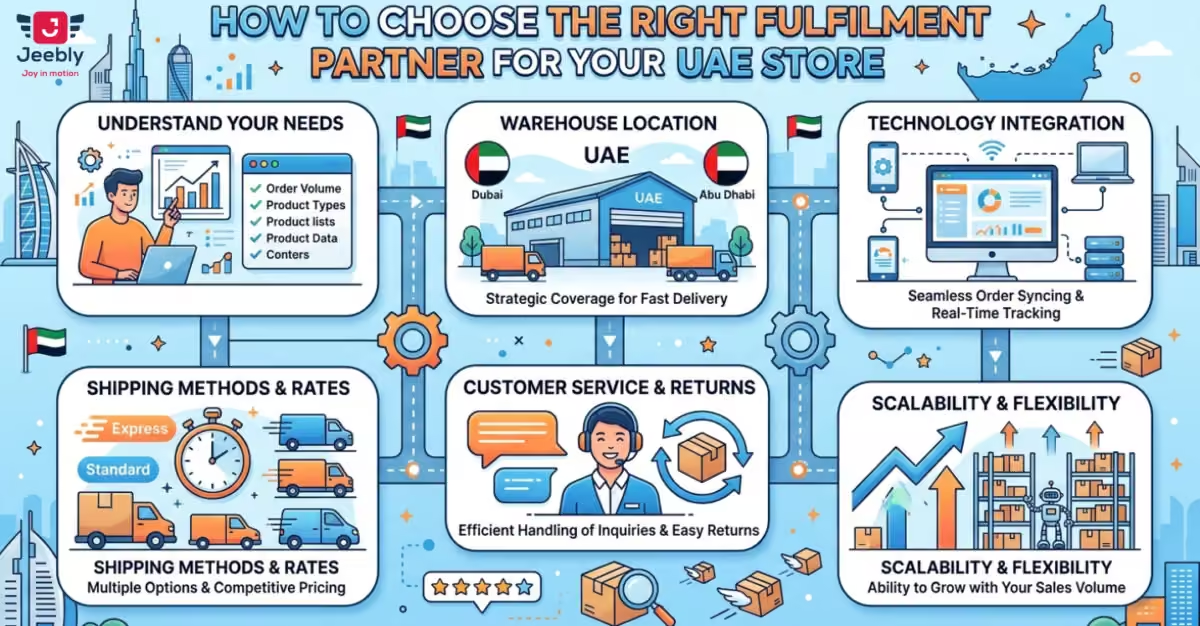
How to Choose the Right Fulfilment Partner for Your UAE Store
Author:
October 19, 2026
Selecting the right fulfillment partner can make or break your e-commerce growth in the UAE. From strategic warehouse locations in Dubai and Abu Dhabi to seamless tech integration, learn the six critical factors every online store must evaluate to lower costs, ensure same-day delivery, and scale efficiently across the GCC.

Why Delivery Experience Is a Bigger Brand Differentiator Than Price
Author:
October 15, 2026
In today’s competitive e-commerce landscape, competing on price alone is a race to the bottom. Customers are increasingly valuing speed, transparent tracking, and reliable service over minor cost savings. Discover why elevating your delivery experience is the ultimate brand differentiator for UAE sellers and how it drives long-term customer loyalty.

What Is Multi-Carrier Shipping and Do UAE Sellers Need It?
Author:
October 12, 2026
Relying on a single shipping provider can lead to bottlenecks, higher costs, and limited reach. Discover what multi-carrier shipping is and why e-commerce sellers in the UAE need a unified shipping strategy to compare rates, optimize delivery times across all Emirates, and scale their business smoothly.
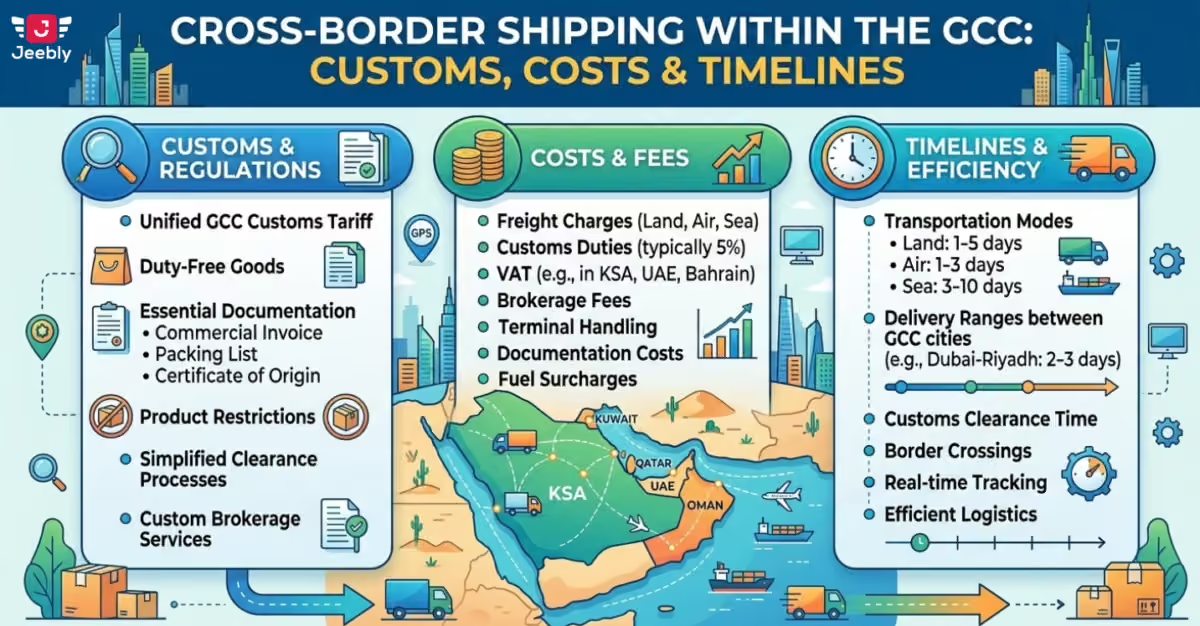
Cross-Border Shipping Within the GCC: Customs, Costs and Timelines
Author:
October 8, 2026
Gearing up for Q4 in the UAE? Navigating peak season demand requires early planning across warehouse operations, carrier capacity, inventory, and customer experience. Explore our 10-step logistics checklist to streamline your supply chain, avoid bottleneck delays, and ensure smooth delivery during the busiest shopping quarter of the year.
