





Jeebly | Logistics Solutions

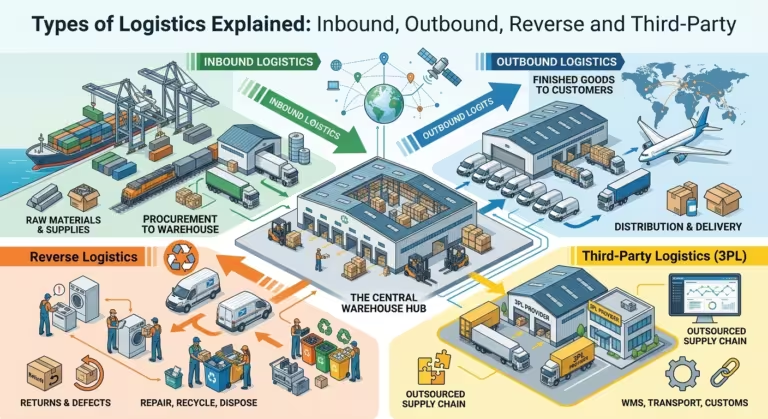
Types of logistics explained through inbound, outbound, reverse and third-party logistics, showing the movement of goods between suppliers, warehouses, customers and return facilities.

Types of Logistics Explained: Inbound, Outbound, Reverse and Third-Party

Every product that reaches a customer’s door has moved through multiple types of logistics, sometimes without the business that shipped it fully understanding which type was doing what. For UAE e-commerce businesses managing suppliers in Asia, warehouses in Dubai, and customers across the seven emirates, the wrong logistics setup at any stage can quickly compound costs.

This guide explains the core types of logistics, what each one covers, how they interact, and how to decide which combination your business actually needs at its current stage.

Key Takeaways

  • Logistics has six core types: inbound (goods coming in), outbound (orders going out), reverse (returns coming back), 3PL (outsourced logistics), 4PL (full supply chain management), and e-commerce logistics (last-mile and fulfilment for online orders).

  • Inbound, outbound, and reverse are not separate but one connected flow. A delay in inbound creates an outbound backlog, and a high reverse volume signals an outbound accuracy problem.

  • Approximately 19.3% of online sales were returned in 2025. Reverse logistics is a core e-commerce operation, not an occasional customer service task.

  • 3PL is the right model for most UAE e-commerce businesses at the growth stage, with access to infrastructure, technology, and expertise without the capital commitment of building it yourself.

  • The practical decision isn’t which single type to choose. It’s which combination suits your current order volume, product type, and delivery promise.

The Six Types of Logistics at a Glance

Type What it covers Who uses it
Inbound logistics Receiving goods from suppliers into your operation All businesses with physical inventory
Outbound logistics Shipping finished products to customers All businesses selling directly to buyers
Reverse logistics Managing returns, exchanges, repairs, recycling Any business with a return policy
Third-party logistics (3PL) Outsourcing warehousing, transport, fulfilment Growing businesses scaling beyond self-fulfilment
Fourth-party logistics (4PL) One provider managing your entire supply chain Complex, multi-market enterprise operations
E-commerce logistics Order fulfilment and last-mile for online retail Online sellers of any scale

Most businesses use more than one type simultaneously. A UAE e-commerce brand that imports stock from China, fulfils domestic orders, and manages returns is running inbound, outbound, and reverse logistics in parallel.

Inbound Logistics

Inbound logistics covers the movement of goods from supplier to your operation. It includes procurement, freight from origin, receiving, quality inspection, and storage. 

When inbound works well, your shelves are stocked accurately, and your fulfilment operation has what it needs when it needs it. When it breaks down, everything downstream suffers.

What inbound logistics involves:

  • Sourcing and purchase order management
  • International and domestic freight to your warehouse or fulfilment centre
  • Customs clearance for imported goods
  • Receiving, inspection, and quality checking at the warehouse
  • Putaway and storage location assignment

For UAE businesses importing from China, India, or Europe, inbound logistics starts at the supplier’s factory and ends at the warehouse shelf. The mode you use (air freight, ocean freight, or road freight from GCC origins) determines your cost, lead time, and flexibility.

For a full breakdown of how international freight works across air, sea, and road modes, Freight Forwarding in UAE: How to Choose the Right Provider covers the inbound leg in detail.

Outbound Logistics

Outbound logistics covers everything from the moment an order is placed to the moment it reaches the customer. Order processing, picking and packing, carrier selection, dispatch, tracking, and last-mile delivery are all outbound functions.

This is where your customer experience is formed. A customer doesn’t see your warehouse or your supplier relationships. They see whether the order arrived on time, in good condition, with tracking that worked throughout.

What outbound logistics involves:

  • Order management and processing from your store or platform
  • Pick and pack at the fulfilment centre
  • Carrier selection and label generation
  • Dispatch and handoff to the last-mile courier
  • Customer tracking notifications
  • First-attempt delivery and exception management (NDR/RTO handling)

The key metric in outbound logistics for UAE e-commerce is First Day Delivery Success (FDSS). It’s the percentage of orders delivered on the first attempt.

For businesses deciding between outbound logistics providers on FDSS, COD remittance, and platform integration, Best Courier Services in UAE: 2026 Comparison Guide benchmarks the major UAE operators across all three criteria.

Reverse Logistics

Reverse logistics covers the flow of goods from customers back to the business. Returns, exchanges, repairs, refurbishments, and end-of-life recycling all sit within reverse logistics.

According to NRF research in 2025, approximately 19.3% of online sales were returned, whereas 9% of all returns are fraudulent. These percentages make reverse logistics a core operational function, not an occasional customer service task handled manually.

What reverse logistics involves:

  • Customer return initiation and RMA (Return Merchandise Authorisation) issuance
  • Return collection from the customer’s address
  • Receipt, inspection, and grading at the warehouse
  • Inventory decision: resell as new, repackage, refurbish, or dispose
  • Refund or exchange processing
  • Data capture on return reasons to reduce future returns


The operational impact of poor reverse logistics is direct. Slow refunds reduce repeat purchase rates, messy grading creates inventory discrepancies, and missing return data means you can’t identify which products are driving return volumes.

For UAE businesses building a structured reverse logistics process, How to Manage eCommerce Returns in UAE: Strategy, Policy and Logistics covers the full operational and compliance picture.

Third-Party Logistics (3PL)

A 3PL (Third-Party Logistics) provider handles some or all of a business’s logistics operations, such as warehousing, transportation, and fulfilment, or a combination. The business retains ownership of inventory and customer relationships; the 3PL provides the physical and operational infrastructure.

What a 3PL typically covers:

  • Receiving and storing inventory in their warehouse facilities
  • Pick, pack, and label preparation for each order
  • Domestic and international shipping via carrier integrations
  • Returns management and reverse logistics processing
  • Real-time inventory tracking and reporting

The case for 3PL is strongest at the growth stage. When a business is shipping 50–500+ orders per day, building its own warehouse and hiring a logistics team is rarely cost-effective. A 3PL provides the same infrastructure at a per-order cost model, without fixed overhead.

The 1PL → 2PL → 3PL → 4PL progression reflects business maturity:

  • 1PL: You handle all your own logistics. Works at very low volume.
  • 2PL: You own the transport relationship (your own van, your own carrier account). Works at moderate volume.
  • 3PL: You outsource warehousing and fulfilment to a specialist. Works at growth stage.
  • 4PL: You appoint one provider to manage your entire supply chain, coordinating multiple 3PLs across geographies. Relevant for enterprise operations with complex multi-market logistics.

E-Commerce Logistics: Where Speed and Accuracy Are Non-Negotiable

E-commerce logistics is specifically optimised for online retail order fulfilment. It connects your store or marketplace to a fulfilment operation and last-mile delivery network, and treats every individual order as a customer experience.

The key distinction from traditional freight logistics is that e-commerce logistics operates at the parcel level, not the pallet level. Every order has a tracking number, a customer notification, and a delivery window. The performance metrics are per-order (FDSS, NDR rate, order accuracy).

What e-commerce logistics covers:

  • Direct integration with Shopify, WooCommerce, Magento, and other platforms
  • Automated order routing from store to fulfilment without manual intervention
  • Same-day and next-day delivery with scheduled options
  • COD collection and remittance
  • Photo ePOD at every delivery
  • Branded tracking pages and customer notifications
  • Returns management integrated with forward delivery

For UAE e-commerce businesses, the technology integration is as important as the physical infrastructure. A logistics partner for ecommerce that requires manual CSV uploads or doesn’t integrate natively with your platform creates an operational ceiling.

Which Types of Logistics Does Your UAE Business Need?

The answer depends on three variables: your current daily order volume, your product type, and the delivery promise you’ve made to your customers.

Business stage Daily orders Recommended logistics structure
Early-stage Under 20 Self-fulfilment (1PL) + courier account. Manage inbound and outbound manually.
Growing 20–100 3PL for outbound fulfilment. Use a freight forwarder for inbound. Basic returns process.
Scaling 100–500 Full 3PL covering inbound, outbound, and reverse. E-commerce logistics integration.
Established 500+ Dedicated 3PL infrastructure. Consider 4PL for multi-market coordination. Advanced reverse logistics.

Three questions to answer before choosing:

  1. What’s your return rate? If it’s high, you need a structured reverse-logistics process rather than a manual returns inbox.


  2. How complex is your inbound? If you’re importing from multiple suppliers across different countries, a freight forwarder managing your inbound shipments is cheaper than the time required to coordinate it yourself.


  3. What delivery window are you promising customers? If you’re committing to same-day or next-day delivery, your outbound logistics partner must have the FDSS data and last-mile coverage to consistently back that up.

How Jeebly Covers Each Logistics Type

Jeebly’s product suite maps directly onto the logistics types that matter most for UAE e-commerce businesses.

Inbound logistics: Jeebly Haul covers air, sea, and road freight across UAE and GCC routes, with in-house customs clearance for the inbound leg from origin to the UAE warehouse, without coordinating separate freight and clearance vendors.

Outbound and e-commerce logistics: Jeebly Dash handles same-day and next-day domestic delivery across all seven UAE emirates, with 98% FDSS across 50,000+ daily deliveries. Published base rate: AED 17.31 per parcel up to 5 kg. Photo ePOD at every drop-off, WhatsApp and SMS notifications at dispatch and delivery.

3PL and reverse logistics: Jeebly Bizz is the full e-commerce logistics platform integrated directly with Shopify, WooCommerce, Magento, and more. One platform for inbound stock management, outbound order fulfilment, and returns processing.

For UAE businesses currently managing multiple logistics vendors for different types, consolidating through a single platform removes coordination overhead and accountability gaps across systems.

Talk to the Jeebly team about your current order volume, product type, and which logistics types are creating friction in your operation. A direct conversation can confirm which Jeebly services best fit your structure and what the cost per order is.

Conclusion

The six types of logistics (inbound, outbound, reverse, 3PL, 4PL, and e-commerce) cover every stage of the supply chain, from supplier to customer and back again. For UAE e-commerce businesses, the practical question is which combination covers your current stage and the delivery promise you’ve made. 

Inbound, outbound, and reverse are always operating simultaneously. Businesses that treat them as a single, connected flow can build supply chains that actually scale. For a UAE logistics company covering freight, last-mile delivery, fulfilment, and returns through one connected platform, Jeebly Bizz, Jeebly Dash, and Jeebly Haul each cover one of the three core types. 

Get in touch to discuss your logistics setup.

Related Articles:

Frequently Asked Questions

The six core types are inbound logistics (goods from suppliers into your operation), outbound logistics (orders from your operation to customers), reverse logistics (returns and exchanges back from customers), third-party logistics (3PL — outsourced warehousing and fulfilment), fourth-party logistics (4PL — full supply chain management), and e-commerce logistics (last-mile and order fulfilment for online retail). Most businesses run multiple types simultaneously.

Inbound logistics covers everything that brings goods into your business, like procurement, freight from suppliers, customs clearance, receiving, and storage. Outbound logistics covers everything that moves goods from your business to customers, including order processing, pick and pack, dispatch, tracking, and last-mile delivery.

Reverse logistics manages goods flowing back from customers, such as returns, exchanges, repairs, and disposal. Returns are a core operational function. For UAE e-commerce businesses, reverse logistics also includes handling COD refusals. Parcels refused at the door re-enter the returns pipeline and must be processed identically to customer-initiated returns.

When fulfilment is consuming more management time than growth activities, or when order errors and failed deliveries are increasing as volume grows. A 3PL provides warehouse infrastructure, pick-and-pack capability, and carrier integrations on a per-order cost model, without committing to fixed warehouse rent or a logistics team.

E-commerce logistics is optimised for individual online orders rather than bulk freight movements. Every order has a tracking number, a customer notification, and a delivery window. Performance is measured per order rather than per consignment. The technology integration is what distinguishes e-commerce logistics from standard freight or warehouse operations.

Routes to insightful reads

Types of logistics explained through inbound, outbound, reverse and third-party logistics, showing the movement of goods between suppliers, warehouses, customers and return facilities.
Types of Logistics Explained: Inbound, Outbound, Reverse and Third-Party 

Logistics covers much more than moving goods from one place to another. This guide explains the four key types of logistics, inbound, outbound, reverse and third-party logistics (3PL), and how each supports the supply chain. Learn how goods move from suppliers to warehouses, reach customers, return for repair or disposal, and how businesses use 3PL providers to manage logistics operations.

Read More
Dark store in the UAE showing retail inventory, order picking, packaging, and Jeebly last-mile delivery for ultra-fast fulfillment
What Is a Dark Store? How UAE Retailers Are Using Them for Ultra-Fast Delivery

A dark store is a retail facility designed exclusively for online order fulfilment, with products organised for fast picking, packing, and dispatch rather than in-store customer shopping. In the UAE, dark stores are helping retailers and e-commerce businesses shorten delivery times by placing inventory closer to customers and streamlining the fulfilment process. This guide explains how dark stores work, their benefits, key challenges, and how they support ultra-fast delivery in the UAE.

Read More
DDP shipping infographic explaining seller responsibilities, customs clearance, duties, final delivery, and benefits for UAE importers
What Is DDP Shipping? What “Delivered Duty Paid” Means for UAE Importers and Exporters

DDP (Delivered Duty Paid) is an Incoterm that places most shipping, customs, duty, and import tax responsibilities on the seller. For UAE importers and exporters, understanding how DDP works can help businesses estimate landed costs, manage customs requirements, and avoid unexpected charges at delivery. This guide explains what DDP shipping means, who pays the costs, how it compares with DAP and FOB, and what UAE businesses should consider before choosing DDP.

Read More
Delivery note document showing shipment details, proof of delivery, tracking, verification and UAE logistics compliance
What Is a Delivery Note and Why Does Every UAE Shipment Need One?

A delivery note is a key document in the UAE logistics process, providing a clear record of what was shipped, who sent it, and who received it. From proof of delivery and shipment tracking to order verification, customs compliance, and dispute resolution, a properly prepared delivery note helps businesses maintain accurate records and protect every shipment. This guide explains what a delivery note is, what it should include, and why it is essential for businesses operating across the UAE.

Read More
Illustration showing strategies to reduce cart abandonment through transparent shipping costs, fast delivery, local fulfilment, and clear returns policies for UAE eCommerce businesses.
How to Reduce Cart Abandonment Caused by Delivery Costs and Uncertainty

Delivery costs and uncertainty are among the biggest reasons shoppers abandon their carts before completing a purchase. This guide explores practical strategies to reduce cart abandonment, including transparent shipping fees, accurate delivery estimates, flexible shipping options, local fulfilment, and hassle-free returns, helping UAE eCommerce businesses improve conversions and build customer trust.

Read More

    Powered by