
Jeebly | Logistics Solutions

Delivery SLA guide for UAE businesses showing service level agreements, delivery performance metrics, on-time delivery targets and logistics standards.

Delivery SLA Guide for UAE Businesses: What to Expect and How to Set Standards

When your logistics partner for e-commerce misses a delivery window, the customer doesn’t blame the courier. They blame you.

A delivery SLA (Service Level Agreement) is the contractual structure that prevents that from happening, defines what good performance looks like, and specifies exactly what follows when it doesn’t. Without a delivery SLA, you’re managing logistics only on trust rather than on evidence.

This guide covers the specific metrics a delivery SLA must include for the UAE e-commerce sector, how to structure enforceable penalty clauses, and the UAE-specific risks every SLA should address.

Key Takeaways

  • A delivery SLA is a formal agreement that defines performance standards, metrics, and consequences for breaches between a business and its logistics partner.

  • SLA, SLI, and SLO are three distinct layers. When you blur them, SLAs quietly lose their enforcement power.

  • The five metrics every UAE delivery SLA must contain: OTD rate, FDSS rate, order accuracy, damage rate, and breach response time.

  • UAE-specific SLA requirements include COD failure handling, WhatsApp notification compliance, and seasonal capacity guarantees for Ramadan and White Friday.

  • A well-structured SLA specifies a 30-day corrective period when a carrier repeatedly fails to meet on-time delivery targets before cancellation rights are triggered. 

What Is a Delivery SLA and What It Does

A delivery SLA is a formal contract between a business and its logistics partner that defines what constitutes successful delivery, how performance is measured, and what happens when agreed standards aren’t met.

Three distinct layers make up a functional delivery SLA, and enforcement breaks down when the lines between them blur:

  1. An SLA (service level agreement) is a formal commitment between parties that defines expected performance. 
  2. An SLI (service level indicator) is the specific metric used to measure whether that commitment is being met. 
  3. An SLO (service level objective) is a numeric target for that metric.

Without all three, you have a promise, not a contract. “We’ll deliver as quickly as possible” is an SLA without an SLI or SLO. It’s unenforceable, unmeasurable, and useless when you need to dispute a performance failure.

The UAE-Specific Returns Challenge: COD Refusals

The KPIs inside your SLA are what separate a meaningful agreement from a formality. Vague language about “timely delivery” leads to disputes while numeric targets create accountability.

  1. On-Time Delivery rate (OTD): The percentage of orders delivered within the agreed window. This is the primary SLA metric for most e-commerce operations.

  2. First Day Delivery Success (FDSS): The percentage of orders delivered on the first attempt without a reattempt or return-to-origin. Failed first attempts can be expensive, with the failed-attempt cost plus the reattempt or RTO cost.

  3. Order accuracy rate: The percentage of orders fulfilled without error. Even a 1% error rate may translate to thousands of incorrectly shipped parcels, driving return costs, customer complaints, and wasted inventory space.

  4. Damage rate: The percentage of large and heavy parcel deliveries with damage attributable to handling or transit. Damage is a direct cost to the business: product write-off, replacement shipping, and the customer relationship.

  5. Breach response time: How quickly the logistics partner must acknowledge and escalate an SLA breach. This is the metric most SLAs omit, and it’s what determines whether a missed delivery is recoverable or a lost customer.

Before you negotiate an SLA with any UAE courier, benchmark their published performance against these targets. Best Courier Services in UAE: 2026 Comparison Guide covers rates, COD remittance cycles, and NDR management across the major operators.

UAE-Specific SLA Requirements Every Agreement Must Address

These are the clauses that matter most for businesses operating in the UAE market.

1) COD failure handling

When a customer refuses a COD parcel, the delivery fails, and the return-to-origin process begins. 

Your SLA should specify who bears the cost of the RTO, the timeline for the parcel to re-enter your inventory, and whether repeat COD refusals from the same address are automatically flagged to you.

2) WhatsApp notification compliance 

WhatsApp is the dominant customer communication channel in the UAE. An email-only delivery confirmation is insufficient for most UAE consumers. 

Your SLA should require, at minimum, one WhatsApp notification when the order is out for delivery and a delivery confirmation message with a photo ePOD link within 30 minutes of drop-off. 

What Is Contactless Delivery and How Does It Work in the UAE? explains how the notification and proof-of-delivery workflow connects end-to-end.

3) Seasonal capacity guarantees 

Ramadan, White Friday, and Eid create order volume spikes. SLAs should be dynamic. An agreement that was effective a year ago may no longer work today due to e-commerce growth. 

Write a specific capacity clause: “Provider commits to maintaining OTD and FDSS targets during periods where daily order volume increases by up to X% above the baseline 30-day average.”

4) Emirate-level coverage confirmation

“UAE-wide delivery” means different things to different providers. Northern Emirates (Ras Al Khaimah, Fujairah, Umm Al Quwain) carry different SLAs than Dubai and Abu Dhabi. Negotiate separate OTD targets by zone, or require the provider to flag explicitly where full SLA coverage doesn’t apply. 

Jeebly Dash, for example, publishes same-day delivery and 98% FDSS for Dubai operations. Next-day delivery to northern and eastern emirates operates under a separate OTD commitment. That’s the standard to apply when evaluating any UAE logistics provider.

5) Free zone and compound access

Many delivery failures in the UAE occur at the building access point due to free zone entry requirements, gated community permits, and building management restrictions. 

Your SLA should specify who is responsible when delivery fails because the courier couldn’t access the delivery location and outline the reattempt process.

How to Structure Breach Penalties and Performance Incentives

Penalty clauses in UAE commercial contracts are governed by Federal Law No. 18 of 1993 (Commercial Transactions Law). UAE courts can reduce penalties deemed disproportionate to the documented actual loss, meaning penalty amounts must be tied to verifiable costs rather than abstract figures.

Three penalty structures that work:

  • Per-incident fees: A fixed amount per order delivered outside the agreed window. This structure is simple, auditable, and proportionate.

  • Percentage credits: A percentage of the shipment value credited back when the delivery fails. More appropriate for high-value freight or B2B shipments, where individual parcel values vary significantly.

  • Cumulative threshold triggers: When OTD or FDSS falls below the agreed-upon minimum for a billing period, additional penalties or contract review rights are triggered. 

For example: if a carrier repeatedly fails to meet 95% OTD, the SLA may specify a 30-day corrective period during which performance must recover. If it doesn’t, cancellation rights are triggered.

What makes a penalty clause enforceable in the UAE:

  • The penalty amount is tied to a documented, verifiable cost (re-delivery fee, customer refund, support cost)
  • The breach is defined numerically, not descriptively
  • The measurement methodology is agreed in advance: which system provides the OTD data, how disputes are resolved
  • The escalation path is named: which contact at the logistics partner receives the breach notification, and within what timeframe

A Performance Incentive Clause Worth Adding

The penalty structure above protects you when performance falls short. A performance incentive clause creates a reason for your logistics partner to consistently exceed the target.

When OTD or FDSS consistently exceeds the agreed minimum over a defined period (typically a quarter), the carrier qualifies for a structured bonus or a fixed amount or percentage credit applied to the following period’s invoices. This converts the SLA from a penalty-only instrument into a partnership structure. Carriers operating under both mechanisms will have a commercial reason to over-perform.

To set penalty amounts that are proportionate to documented loss, you need your baseline per-delivery cost breakdown. Cost of Shipping for a Small Business in the UAE (2026) provides the cost structure to build defensible penalty figures against.

How to Monitor SLA Performance in Real Time

SLAs only function as control systems when teams can see risk early and act on it while there is still time to change the outcome. SLAs designed as operational systems rather than contractual artefacts align SLIs and SLOs with delivery realities. 

This embeds verification directly into workflows, and treats exceptions as early-warning signals rather than postmortems.

In practice, this means:

  • API integration between your OMS and the logistics platform: When order status, tracking events, and delivery confirmation flow automatically into your system, SLA monitoring is continuous rather than manual. You see a developing breach before it completes.

  • Exception dashboards, not monthly reports: SLA performance reviewed at month-end means you discover breaches weeks after they happened. An exception dashboard shows you in real time which orders are at risk of missing the window while there’s still time to intervene.

  • Automated breach notifications: When an order exceeds its delivery window without a confirmed delivery event, the system should automatically alert both your team and the logistics partner. The breach response clock starts at this notification.

Jeebly’s platform provides Jeebly Bizz customers with real-time OTD and FDSS tracking through the same dashboard that manages dispatch and returns. See how Jeebly’s technology infrastructure supports this before evaluating any other provider on SLA monitoring capability.

How Jeebly Structures Delivery SLAs

Jeebly’s core performance metric is 98% FDSS across 50,000+ daily deliveries. Providers who can’t share FDSS data probably have performance they can’t defend.

Jeebly Dash SLA structure for domestic delivery: same-day within Dubai with defined cut-off times; next-day across all seven UAE emirates; WhatsApp and SMS notifications at dispatch and delivery; photo ePOD at every drop-off. Published base rate AED 17.31 per parcel up to 5 kg.

Jeebly Bizz for businesses managing high-volume e-commerce: real-time dashboards; automated workflows that trigger customer notifications and reattempt scheduling without manual intervention; secure COD collection with weekly remittance; and returns managed through the same platform as forward delivery.

Jeebly Haul for freight: transit time commitments on road, air, and ocean freight routes, with exception escalation built into the platform rather than requiring a phone call.

For businesses currently operating without a formal SLA or with a vague agreement that doesn’t specify metrics, talk to the Jeebly team. 

Bring your current OTD and FDSS data, your daily order volume, and which emirates you cover. We’ll tell you what a Jeebly SLA looks like against your current performance and what the gap is.

Similar articles

Frequently Asked Questions

A delivery SLA is a formal agreement between a business and its logistics partner that defines what successful delivery looks like and what happens when those standards aren’t met. It replaces vague commitments with measurable obligations.

An SLA is the commitment, like “we’ll deliver next-day orders by 9 pm.” An SLI is the metric used to measure it, similar to the OTD rate. An SLO is a numeric target, such as 95%. All three are needed for an SLA to be enforceable. Most delivery disputes arise because only the SLA is defined, without agreed-upon metrics or targets.

Top-tier logistics providers and major e-commerce fulfilment operations target a benchmark of at least 95% to remain competitive in dense urban corridors like Dubai and Abu Dhabi. Jeebly publishes 98% FDSS across 50,000+ daily deliveries. For same-day delivery within Dubai, this target should be a realistic SLO. Negotiate separate targets by emirate. The Northern Emirates may carry a higher risk than Dubai and Abu Dhabi.

Yes, under Federal Law No. 18 of 1993 (Commercial Transactions Law), penalty clauses in commercial contracts are enforceable. UAE courts may reduce penalties deemed disproportionate to the actual documented loss, so that the penalty amounts to verifiable costs (e.g., redelivery fees, customer refunds, support costs).

COD failure handling (who bears RTO cost, what the re-entry timeline is), WhatsApp notification compliance (the dominant customer channel in the UAE), seasonal capacity guarantees, emirate-level coverage confirmation with separate OTD targets where full coverage doesn’t apply, and building/free zone access failure responsibility.

Routes to insightful reads

Illustrated banner for Jeebly showing a red and navy blue Jeebly delivery van parked outside a modern Dubai villa, with uniformed couriers unloading an armchair, assembling furniture on the porch, and verifying delivery with a digital tablet against the Dubai skyline.
Furniture and Bulky Item Delivery in Dubai: What Retailers Should Look For

Delivering bulky, fragile, or high-value furniture across Dubai requires more than just standard transport. Learn the essential qualities to look for in a furniture delivery partner—including white-glove care, expert installation, and transparent tracking—to ensure every piece arrives safely and on time.
Read More
Illustrated banner for Jeebly showing a delivery courier in Dubai handing a parcel to a customer signing an electronic proof of delivery (ePOD) tablet, surrounded by Jeebly delivery vans, a smartphone displaying digital signature confirmation, and the Dubai skyline in the background.
What Is Proof of Delivery (POD) and Why It Matters for UAE Shipments

In the UAE’s fast-moving logistics landscape, Proof of Delivery (POD) has evolved far beyond a paper receipt. From real-time GPS timestamps to instant digital signatures, discover how modern ePOD protects businesses, eliminates delivery disputes, and guarantees transparency across every mile.
Read More
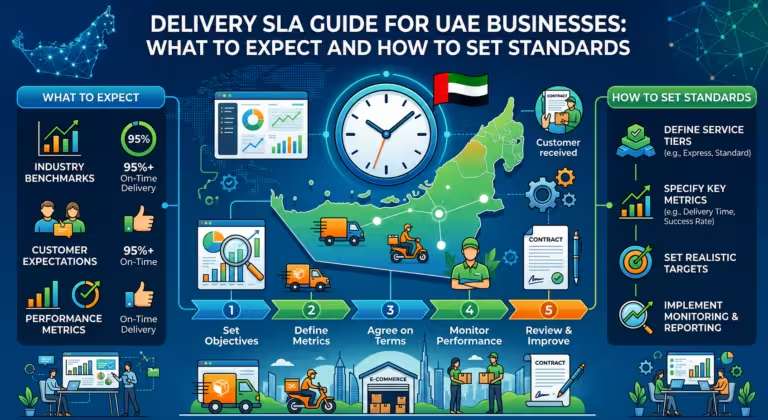
A modern navy and cyan digital blog banner titled 'HOW DIGITAL ORDERING CHANGES B2B LOGISTICS' with the Jeebly logo in the top-left corner. The illustration features a tablet and smartphone on the left showing digital B2B purchase orders, shipment tracking, and procurement interfaces, connected via glowing digital data streams to a bustling smart logistics ecosystem on the right with an automated warehouse, forklifts, delivery trucks, a cargo airplane, and a container ship.
B2B E-Commerce in the UAE: How Digital Ordering Is Changing Business Logistics

Managing orders across your website, social channels, and marketplaces like Noon and Amazon can quickly overwhelm manual spreadsheets and disconnected systems. Stockouts, delayed dispatches, and rising return rates often signal that your business has outgrown basic order tracking. Discover the key signs your UAE e-commerce store needs an Order Management System (OMS) and how integrating automated order workflows with Jeebly streamlines inventory sync, multi-channel fulfillment, and last-mile delivery.
Read More
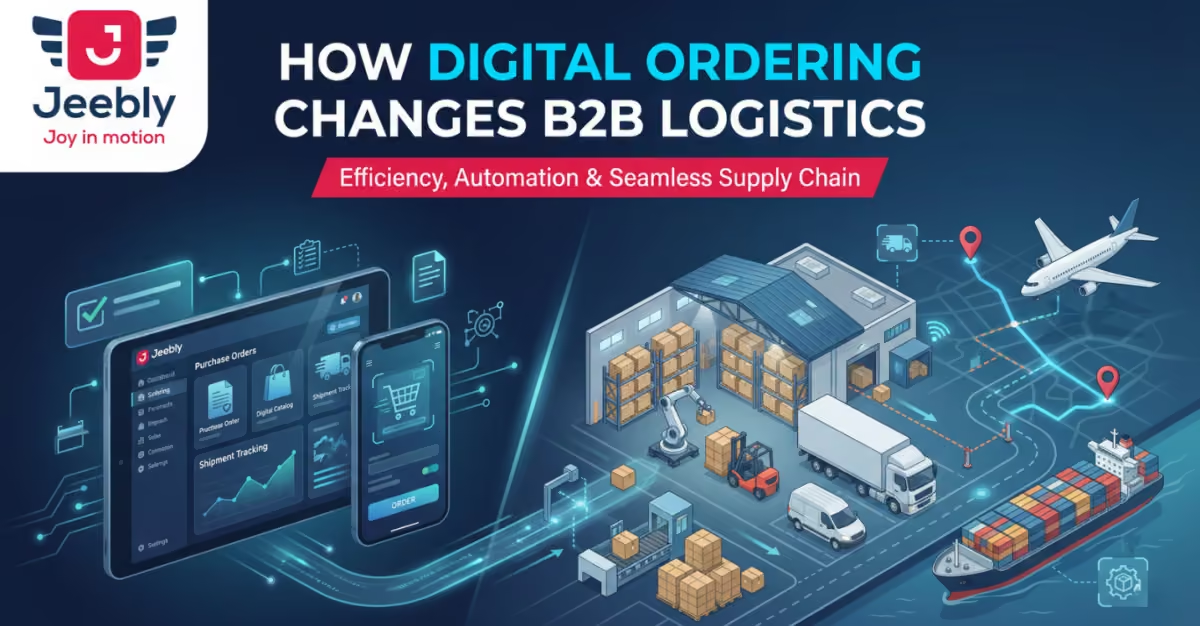
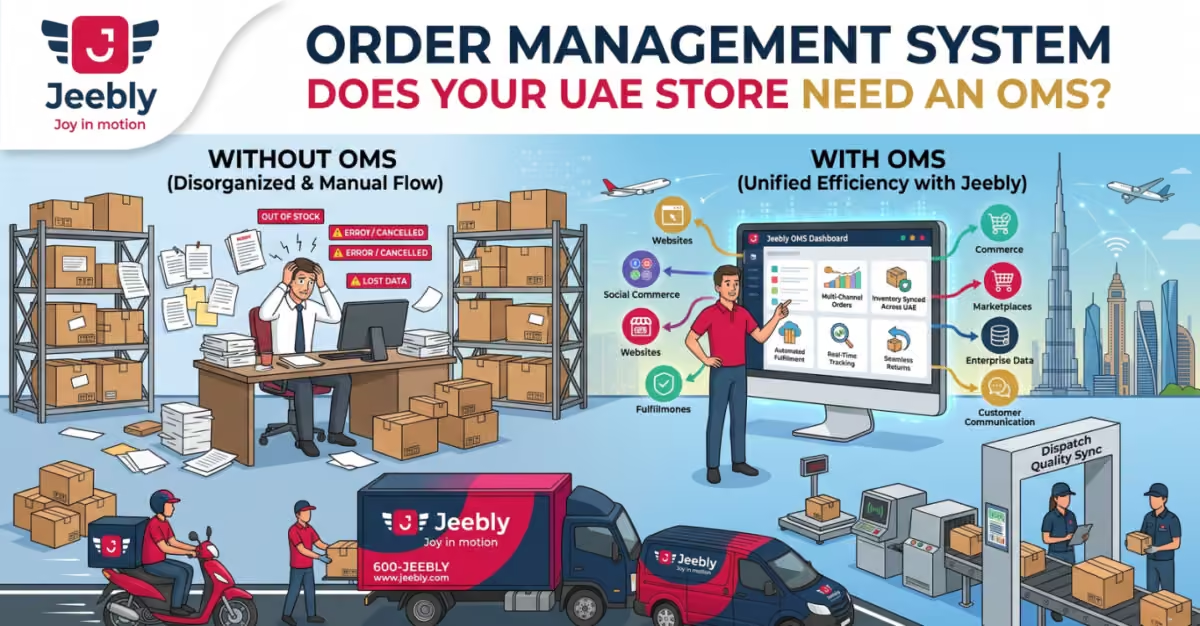
Split-screen infographic featuring the Jeebly logo, comparing chaotic manual order processing without an OMS against a streamlined, unified OMS workflow with Jeebly trucks, vans, and the Dubai skyline.
Order Management System: Does Your UAE Store Need an OMS?

Managing orders across your website, social channels, and marketplaces like Noon and Amazon can quickly overwhelm manual spreadsheets and disconnected systems. Stockouts, delayed dispatches, and rising return rates often signal that your business has outgrown basic order tracking. Discover the key signs your UAE e-commerce store needs an Order Management System (OMS) and how integrating automated order workflows with Jeebly streamlines inventory sync, multi-channel fulfillment, and last-mile delivery.
Read More
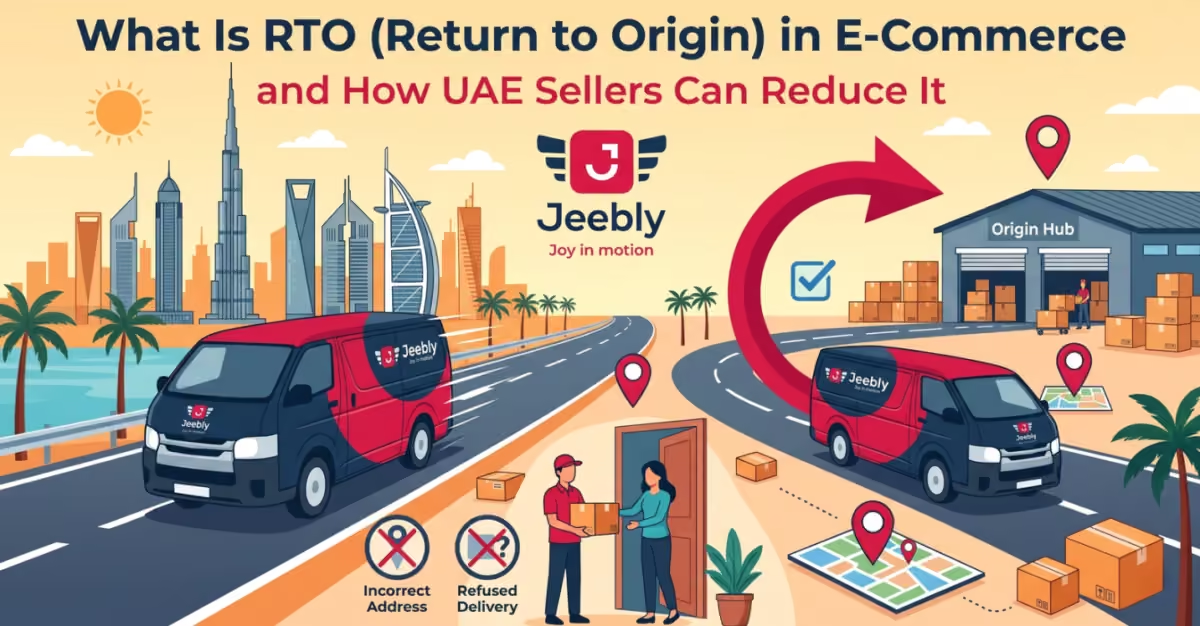
An animated vector-style graphic illustrating "What is RTO (Return to Origin) in E-Commerce and How UAE Sellers Can Reduce It", featuring Dubai's skyline, Jeebly delivery vans, and the loop of a package being returned to an origin hub alongside tips for successful doorstep delivery.
What Is RTO (Return to Origin) in E-Commerce and How UAE Sellers Can Reduce It

Return to Origin (RTO) is one of the most expensive headaches for UAE e-commerce sellers—often driven by non-standardized addresses, hard-to-reach customers, and Cash on Delivery (COD) refusals. But you don’t have to let failed deliveries eat into your profit margins. Discover what causes high RTO rates in the UAE and learn practical, actionable strategies—from address validation and automated customer communication to partnering with reliable delivery services like Jeebly—to protect your bottom line and ensure more orders find their home on the very first try.

Read More

    Powered by