





Jeebly | Logistics Solutions

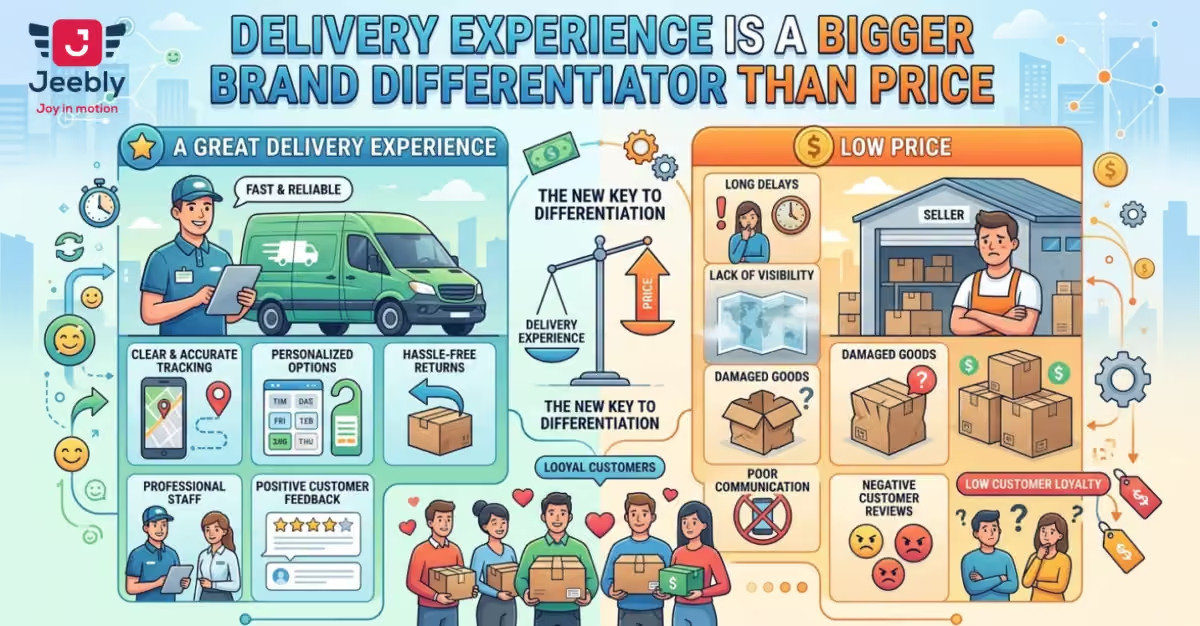
An infographic comparing how a positive delivery experience (left) vs. low price (right) impacts brand loyalty, featuring icons for tracking, staff, and costs in AED.

Why Delivery Experience Is a Bigger Brand Differentiator Than Price

Delivery is not the last stage of the purchase. It is a pre-purchase decision driver that determines whether a customer shops with you at all, and whether they come back. According to DHL’s 2026 E-Commerce Trends Report, 67% of online shoppers abandoned their purchase due to delivery offerings.

For UAE e-commerce businesses competing in a market where price differences across categories have narrowed dramatically, the delivery experience has become the primary factor determining brand preference, repeat purchase rate, and customer lifetime value. 

This article explains exactly why, which specific components of the delivery experience move the needle, and what UAE businesses can do operationally to make delivery a brand asset rather than a commodity.

Key Takeaways

  • 71% of shoppers think about delivery before checkout. 41% consider the delivery promise before browsing. Delivery is a pre-purchase brand signal rather than a post-purchase service.

  • Brands now own delivery accountability before costs in customers’ eyes.

  • 97.2% of shoppers who rated their return experience as excellent made a repeat purchase within 60 days. The post-delivery experience is a retention mechanism.

  • Speed and price are no longer differentiators. Shoppers expect low-cost or free delivery as standard. Reliability and flexibility are what set brands apart.

Price Is No Longer the Differentiator It Used to Be

Price competition in UAE e-commerce has a ceiling. Across most product categories, the price gap between competing brands has compressed. They cannot sustain margin differentiation indefinitely when competitors can match any price within days.

Fast shipping used to feel like a differentiator. Now it is an expectation. Same-day and next-day delivery in the UAE has moved from a premium offering to a baseline expectation in dense urban areas. When everyone offers free shipping above a certain order value, and everyone promises next-day delivery, neither is a differentiator anymore.

What has emerged to fill that space is delivery experience, which includes the quality, consistency, and transparency of what happens after a customer clicks “buy.” This is the dimension that customers notice, that they remember, and that determines whether they return.

Regarding the commercial relationship among delivery speed, reliability, and customer loyalty in the UAE market, The Importance of Delivery Partner Reliability for Social Commerce addresses the brand accountability dimension from a social commerce perspective.

What Is Delivery Experience and What It Covers

Delivery experience is the entire post-checkout journey, from the order confirmation message through dispatch notification, live tracking, the physical delivery interaction, and the ease of the returns process if needed.

The five components that together constitute a delivery experience:

Communication transparency

Does the customer know where their order is at every stage? A specific delivery date at checkout, a WhatsApp notification when the order is dispatched, a live tracking link, and a delivery confirmation with photo proof together create a communication experience that removes anxiety and builds confidence.

Reliability

A delivery that arrives as promised is the baseline on which every other element of the delivery experience builds. Without reliability, no amount of branded packaging or personalised messaging recovers the brand relationship.

Flexibility

Scheduled delivery windows, rescheduling options, and the ability to change delivery instructions after dispatch are increasingly table-stakes expectations. Flexibility shows customers that the brand understands their lives.

The physical handover

The driver interaction, the condition of the packaging, and the proof-of-delivery process all contribute to the experience at the door. For COD deliveries in the UAE, the driver is the last brand touchpoint before the customer forms a post-purchase opinion.

Returns ease

97.2% of shoppers who rated their return experience as “excellent” made a repeat purchase within 60 days. The returns experience is a retention mechanism that operates precisely when a customer’s trust in the brand is most fragile.

For how real-time communication specifically reduces customer complaints and support volume, Why Real-Time Delivery Updates Reduce Complaints covers the operational setup behind branded tracking and WhatsApp notifications.

How Delivery Experience Drives Repeat Purchases

The commercial case for investing in delivery experience is not abstract. The data on how delivery quality affects repeat purchase rate is now precise enough to model.

93.8% of customers say a single poor return experience permanently damages their perception of a brand, with 46.2% sharing negative experiences publicly.

The loyalty flywheel works both ways: reliable, flexible delivery creates repeat purchasing behaviour, and repeat purchasing builds the lifetime value that makes customer acquisition costs sustainable. The brands with the highest repeat purchase rates are the ones whose delivery experience consistently meets the promise made at checkout.

For the direct data on how delivery speed specifically affects repeat purchase rates and brand loyalty metrics in the UAE context, How Delivery Speed Impacts Customer Loyalty in E-commerce covers the relationship in detail.

What Delivery Experience Looks Like in the UAE Specifically

Globally sourced data on delivery experience is directionally applicable to the UAE, but the market has specific characteristics that shape what “good delivery experience” means here.

  • WhatsApp as the primary notification channel: Email delivery notifications in the UAE have significantly lower open rates than WhatsApp messages. A brand that sends a shipping confirmation by email and a delivery notification via WhatsApp with a photo confirmation provides a materially better delivery experience than one that relies on email alone.

  • COD and the door interaction: For COD deliveries, the quality of the door interaction directly shapes the brand impression. A rider who arrives within the promised window, clearly confirms the correct amount, and leaves the customer with a digital receipt creates a positive brand interaction.

  • No standardised postcodes: The UAE’s lack of standardised postcodes means delivery address accuracy is more variable than in postcode-based markets. A brand whose checkout actively validates UAE addresses and confirms the delivery point before dispatch has a structurally lower first-attempt failure rate than one that does not.

For how addressing and routing specifics affect UAE delivery outcomes, How to Write a Dubai Address (2026) covers what to confirm at checkout.

The Five Operational Levers That Improve Delivery Experience

These are the specific, implementable changes UAE businesses can make, ordered by impact.

1. Choose a courier with verified FDSS data

Ask for audited FDSS data by emirate before committing to any courier. A 98% FDSS rate across 50,000+ daily deliveries is the benchmark Jeebly states. Any provider who cannot share this data does not track it.

2. Show a specific delivery date at checkout

“Arrives by Tuesday” converts better than “3–5 business days.” The specific date creates certainty. This applies to product pages as well as checkout. For the mechanics of reducing cart abandonment through delivery promise clarity, How to Reduce Cart Abandonment Caused by Delivery Costs and Uncertainty covers the full approach.

3. Add WhatsApp notification at dispatch and delivery confirmation with photo

The dispatch notification sets the expectation, and the delivery confirmation with photo closes the loop. For customers who were not home at the time of delivery, the photo confirmation removes uncertainty about whether the parcel was left safely.

4. Make your return policy visible before purchase

A clear, prominently displayed return policy visible on the product page reduces purchase anxiety and directly improves conversion for considered purchases. For what a UAE-compliant return policy must include, How to Create a Returns Policy That Wins Customer Trust covers both the legal minimum and the policy design that converts.

5. Track and act on your NDR data

Every failed first delivery attempt is a brand experience failure. Tracking the reason for each NDR and actively reducing each category is how brands can systematically improve delivery experience at scale. Specifically for reducing failed deliveries, How Small Businesses Can Reduce Failed Deliveries in the UAE covers the interventions that work.

For businesses under the multi-carrier threshold, the higher-ROI question is whether the single carrier’s fulfilment platform covers all operational requirements. eCommerce Fulfilment in UAE covers what to look for in a UAE fulfilment partner before the carrier question even becomes relevant.

How Jeebly Delivers the Experience Behind the Brand Promise

For UAE businesses that have built a brand promise around fast, reliable delivery, Jeebly provides the operational infrastructure that makes the promise keepable.

Jeebly Dash offers same-day and next-day delivery across all seven UAE emirates, with a 98% FDSS rate across 50,000+ daily deliveries. Photo ePOD at every drop-off; WhatsApp and SMS notifications at dispatch, delivery, and COD collection; with weekly remittance.

Jeebly Bizz connects the full post-purchase experience: automated dispatch from your Shopify or WooCommerce store, real-time tracking accessible to your customer, reverse logistics for returns managed within the same platform as forward delivery.

For businesses whose delivery experience involves specialist, high-value, or premium goods, Jeebly Plus offers white-glove delivery with scheduled appointments, careful handling, and a personalised handover.

Talk to the Jeebly team about your current FDSS rate and where gaps in delivery experience are costing you repeat customers. A direct conversation will identify the specific operational changes that move brand perception.

Conclusion

Price competition in UAE e-commerce has compressed to the point where it is no longer a sustainable differentiator for most brands. Delivery speed and free shipping have become baseline expectations. What remains a genuine brand differentiator is the quality, consistency, and transparency of the delivery experience. 

For UAE e-commerce businesses ready to invest in delivery as a brand asset rather than a cost centre, the right logistics partner is the most impactful single decision. For next-day and same-day delivery across the UAE with 98% FDSS as standard, Jeebly handles the last-mile leg. Get in touch to discuss how your delivery operation can become a brand differentiator.

Frequently Asked Questions

Delivery experience is important because it is now the primary variable that determines repeat purchase behaviour and brand loyalty more than price or product quality in many categories. A single poor experience can cause customers to switch brands.

97.2% of shoppers who rated their return experience as excellent made a repeat purchase within 60 days. Reliable, flexible delivery creates a loyalty flywheel. The most profitable customers have the highest delivery expectations and reward brands that consistently meet them with repeat purchasing behaviour that is explicitly price-inelastic.

Speed and price are no longer differentiators. What differentiates brands is reliability (the promise consistently kept), flexibility (scheduled windows, rescheduling options), communication transparency (specific dates, WhatsApp notifications, photo ePOD), and ease of returns. These are the variables where brands can build a genuine advantage over competitors whose delivery promise is identical on paper but inconsistent in execution.

Treating delivery as an operational cost centre rather than a brand investment. The most common manifestation: choosing a courier based on the lowest per-parcel rate without evaluating FDSS rate by emirate. A courier with a 92% FDSS rate versus 98% means 6% more customers per day have a brand-damaging experience. The per-parcel savings are never worth the retention cost at scale.

One poor return experience can permanently damage brand perception. Conversely, customers who rate their return experience as excellent are almost universally retained as repeat buyers. Returns ease is one of the highest-ROI brand investments available to UAE e-commerce businesses.

Routes to insightful reads

An infographic comparing how a positive delivery experience (left) vs. low price (right) impacts brand loyalty, featuring icons for tracking, staff, and costs in AED.
Why Delivery Experience Is a Bigger Brand Differentiator Than Price

In today’s competitive e-commerce landscape, competing on price alone is a race to the bottom. Customers are increasingly valuing speed, transparent tracking, and reliable service over minor cost savings. Discover why elevating your delivery experience is the ultimate brand differentiator for UAE sellers and how it drives long-term customer loyalty.
Read More
An infographic illustrating multi-carrier shipping for UAE e-commerce sellers, divided into two main sections explaining what it is and why it's needed, set against a backdrop of a UAE map and modern city skyline.
What Is Multi-Carrier Shipping and Do UAE Sellers Need It?

Relying on a single shipping provider can lead to bottlenecks, higher costs, and limited reach. Discover what multi-carrier shipping is and why e-commerce sellers in the UAE need a unified shipping strategy to compare rates, optimize delivery times across all Emirates, and scale their business smoothly.
Read More
An infographic detailing the process of cross-border shipping within the Gulf Cooperation Council (GCC). The graphic is split into three main sections: "Customs & Regulations," "Costs & Fees," and "Timelines & Efficiency," all surrounding a map of the GCC region (Saudi Arabia, UAE, Oman, Qatar, Kuwait) with shipping routes.
Cross-Border Shipping Within the GCC: Customs, Costs and Timelines

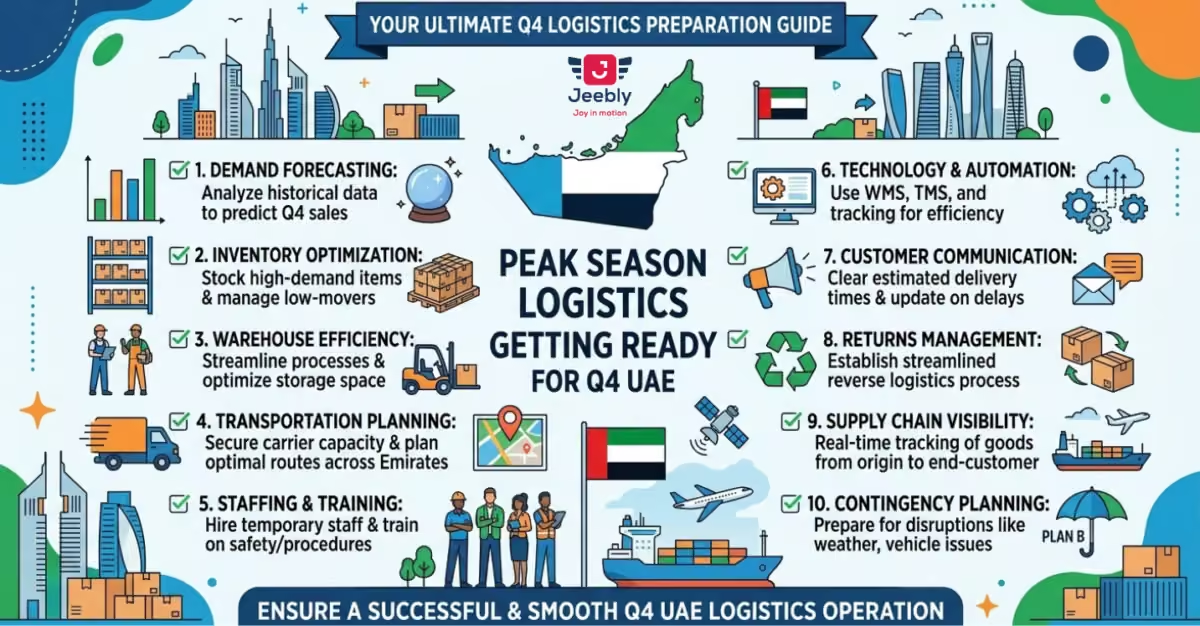
Gearing up for Q4 in the UAE? Navigating peak season demand requires early planning across warehouse operations, carrier capacity, inventory, and customer experience. Explore our 10-step logistics checklist to streamline your supply chain, avoid bottleneck delays, and ensure smooth delivery during the busiest shopping quarter of the year.
Read More
An infographic checklist outlining 10 key steps for Q4 UAE logistics preparation, featuring icons for demand forecasting, inventory, warehouse efficiency, transportation, staffing, and technology against a UAE skyline and map background.
Peak Season Logistics Checklist: Getting Ready for Q4 UAE

Gearing up for Q4 in the UAE? Navigating peak season demand requires early planning across warehouse operations, carrier capacity, inventory, and customer experience. Explore our 10-step logistics checklist to streamline your supply chain, avoid bottleneck delays, and ensure smooth delivery during the busiest shopping quarter of the year.
Read More
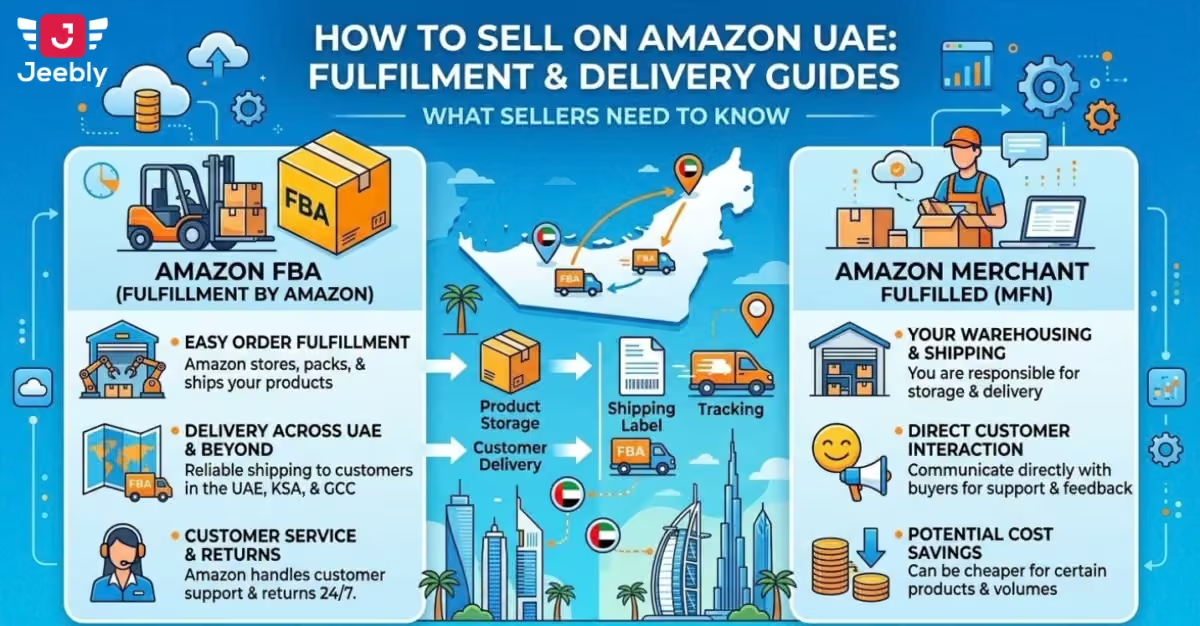
An isometric infographic detailing how to sell on Amazon UAE. The left side covers seller onboarding and listing steps like defining business activity, trade name reservation, and document preparation. The right side compares FBA (Fulfilment by Amazon) and FBM (Fulfilment by Merchant) logistics and delivery models against a Dubai skyline.
How to Sell on Amazon UAE: What Sellers Need to Know About Fulfilment and Delivery

Selling on Amazon UAE offers massive growth potential, but choosing the right logistics model can make or break your margins. Discover the step-by-step onboarding process for Amazon.ae, explore the core differences between Fulfilment by Amazon (FBA) and Fulfilment by Merchant (FBM), and learn how to optimize your delivery strategy to scale efficiently in the UAE market.

Read More

    Powered by