
Jeebly | Logistics Solutions

How a Social Seller Grew Sales with Jeebly One

How a Dubai Social Seller Grew from 22 to 85 Orders Per Week Using Jeebly One

90-Day Results at a Glance

22→85
orders/week
(Month 1→3)
34%→6%
failed delivery
rate drop
+31%
revenue lift
in 90 days
+28%
repeat customer
rate increase

A Dubai-based social seller using Jeebly One scaled from 22 to 85 orders per week in 90 days, reduced their failed delivery rate from 34% to 6%, and achieved a 31% revenue lift — without hiring additional staff or investing in logistics infrastructure.

Social Commerce Logistics in the UAE: Why Delivery Is the Make-or-Break Factor for Sellers

Social commerce is booming in the UAE. From Instagram boutiques and TikTok stores to WhatsApp-based businesses, social sellers are reaching thousands of customers daily and rewriting the rules of retail. Yet behind the curated posts and rapid-fire DMs lies a critical operational challenge that most social selling guides never address: logistics.

Deliveries that are late, untracked, or mishandled don’t just create complaints — they destroy the personal trust that social selling is built on. A customer who bought from you because they liked your content will publicly hold you accountable for a failed delivery in a way they never would with a major retailer.

This is the story of how one UAE social seller transformed her business by solving that problem — with Jeebly One.

Seller Profile: A Dubai Instagram Lifestyle Seller Managing 20+ Weekly Orders Without a Logistics System

Our featured seller — based in Dubai — runs a lifestyle and accessories brand through Instagram, with orders received via DMs and WhatsApp. When she started using Jeebly One, she was processing approximately 22 orders per week, all managed manually.

Business profile at the start of the case study:

•    Platform: Instagram DMs and WhatsApp Business
•    Category: Lifestyle accessories and skincare
•    Location: Dubai, with occasional UAE-wide orders
•    Order volume: ~22 orders/week
•    Payment method: ~70% COD, 30% bank transfer
•    Previous logistics: ad-hoc courier bookings via phone

The 4 Logistics Challenges Blocking This Social Seller's Growth in Dubai

Both the seller and his customers could track orders through real time updates. This transparency reduced customer anxiety and minimized “Where is my order?” queries, freeing up time for the seller to focus on sales. Each shipment would receive a unique air waybill number, allowing the seller and the customer to monitor progress by checking the regular updates on the Jeebly NoW app or website.

Challenge 1: A 34% Failed Delivery Rate That Was Destroying Customer Trust

Before Jeebly One, approximately 34% of her weekly orders ended in a failed delivery attempt — meaning nearly 1 in 3 orders was not delivered on the first try. Each failure triggered a customer complaint DM, a manual re-booking with the courier, and a two-day delay before the customer received their order.

At 22 orders/week, that meant 7–8 failed deliveries every week — each one requiring 20–30 minutes of her time to resolve. Over a month, that is 30+ hours of logistics firefighting instead of selling.

Challenge 2: COD Remittance Taking 14–21 Days — Causing Cash Flow Gaps

Returns are part of ecommerce, but managing them can be stressful. Jeebly’s reverse logistics gave the seller a seamless way to process returns, improving customer trust and repeat purchases. Thus making the business more trustworthy to the customers.

Challenge 3: No Tracking — Leading to 12–15 Customer Complaint DMs Per Week

Customers had no visibility into their orders after placing them. The result: 12–15 inbound DMs per week asking for delivery updates — each requiring a manual response, a call to the courier, and a relay of information back to the customer. This was consuming 2–3 hours of selling time every day.

Challenge 4: Logistics Costs Eating 18–22% of Revenue With No Scalable Model

With ad-hoc courier bookings, pricing was inconsistent. Some weeks a delivery that should have cost AED 15 was billed at AED 25 with unexplained surcharges. There was no monthly summary, no volume discount, and no way to forecast logistics costs when planning her buying decisions.

How Jeebly One Solved Each Challenge: A Feature-by-Feature Breakdown

1. Seamless Onboarding in Under 10 Minutes — No Contracts, No Minimum Orders

The first difference was the barrier to entry — or lack of one. Signing up for Jeebly One required a UAE mobile number and Emirates ID. No contract negotiation, no volume commitment, no account manager meetings. She was booking her first delivery within 10 minutes of downloading the app.
Critically: there is no minimum order volume. A week with 5 orders and a week with 105 orders cost exactly what they cost — no shortfall penalties.

2. Same-Day and Express Delivery Options That Matched What Her Customers Expected

Jeebly One gave her three delivery tiers she could offer customers directly:
•    Express delivery (60–90 minutes): for high-urgency orders — gifts, last-minute requests — within Dubai
•    Same-day delivery across all of Dubai: book by 11 AM, delivered the same day
•    Next-day delivery across the UAE: book by 4:00 PM, UAE-wide coverage the following day

Offering express and same-day as options — communicated on her Instagram stories — immediately differentiated her from other social sellers still using standard 2–3 day couriers.

3. Real Time Tracking Link Shared via WhatsApp , Customer Queries Dropped by 80%

Every Jeebly One delivery provides real time tracking updates. She shared this information with customers via WhatsApp immediately after booking — a step that took 10 seconds and eliminated the need for almost every ‘where is my order?’ message.

Within the first two weeks, inbound delivery query DMs dropped from 12–15 per week to 2–3. That reclaimed approximately 10 hours per week that she could redirect to content creation, customer acquisition, and stock management.

4. COD Remittance Cut From 21 Days to 7 Days , Fixing the Cash Flow Gap

Jeebly One’s weekly remittance cycle meant collected COD reached her bank account within 7 calendar days. For a seller with AED 12,000–15,000 in weekly COD orders, the shift from 21-day to 7-day remittance freed up the equivalent of two weeks of working capital — permanently.

Every transfer arrived with a full reconciliation report, eliminating the manual cross-checking she had previously done every week to ensure the courier amounts matched her order records.

💰  Cash Flow Impact:  Shifting from a 21-day to a 7-day COD remittance cycle on AED 14,000/week in COD orders means AED 28,000 of previously tied-up working capital is now accessible. This directly funded two additional stock orders in the first quarter.

5. Pay-Per-Shipment Pricing — Logistics Cost Dropped From 22% to 11% of Revenue

Jeebly One’s per-shipment pricing removed the inconsistency and surprise surcharges completely. With a fixed, transparent rate per delivery type and zone, she could calculate logistics costs per order at the point of pricing — and build them into her product margins accurately for the first time.

As order volume grew, the per-unit logistics cost declined further — a natural benefit of a pay-as-you-go model at scale.

6. Reverse Logistics — Returns Processed in 48 Hours Instead of 7–10 Days

Returns are unavoidable in fashion and lifestyle e-commerce. Before Jeebly One, a return meant a customer shipping an item back independently, an awkward refund conversation, and no visibility on whether the item was actually coming back.

With Jeebly’s reverse logistics, she booked a return pickup from the customer’s address, tracked it in the same dashboard as outbound orders, and processed the refund upon confirmed receipt — typically within 48 hours. Customer satisfaction scores on returns improved, and repeat purchases from customers who returned an item increased noticeably.

The Results: Full Before vs. After Metrics After 90 Days on Jeebly One

Returns are unavoidable in fashion and lifestyle e-commerce. Before Jeebly One, a return meant a customer shipping an item back independently, an awkward refund conversation, and no visibility on whether the item was actually coming back.

With Jeebly’s reverse logistics, she booked a return pickup from the customer’s address, tracked it in the same dashboard as outbound orders, and processed the refund upon confirmed receipt — typically within 48 hours. Customer satisfaction scores on returns improved, and repeat purchases from customers who returned an item increased noticeably.

Metric Before Jeebly One After 90 Days
Weekly orders 22 orders/week 85 orders/week
Failed delivery rate 34% 6%
COD remittance wait 14–21 days 7 days
Customer complaints/wk 12–15 DMs 2–3 DMs
Repeat customer rate 18% 46%
Revenue (Month 3 vs 1) Baseline +31% uplift
Avg order value (AoV) AED 112 AED 167
Hrs/week on logistics 12–14 hours 2–3 hours

After 90 days on Jeebly One: orders/week grew from 22 to 85 (+286%), failed delivery rate dropped from 34% to 6% (-82%), revenue lifted 31%, repeat customer rate grew from 18% to 46%, and time spent on logistics fell from 14 hours/week to under 3 hours.

Month-by-Month Growth Timeline: How the Results Unfolded Over 90 Days

Month 1: Stabilisation — Fixing the Failed Delivery Rate and Reclaiming Time

The first month was about fixing the operational foundation. Failed delivery rate dropped from 34% to 16% as live tracking eliminated most missed-delivery scenarios. Customer complaint DMs fell from 15/week to 6/week. The seller reported that the time she reclaimed from logistics management was immediately redirected into content creation, posting more consistently for the first time in months.

Month 2: Momentum — Same-Day Delivery as a Marketing Advantage

By Month 2, the seller had begun promoting same-day and express delivery directly on her Instagram stories and product highlights. The positioning worked: average order value climbed from AED 112 to AED 148 as customers chose higher-value products knowing delivery would be fast and trackable. Order volume reached 54/week.

Month 3: Scale — 85 Orders Per Week and a 31% Revenue Lift

Month 3 saw the full compounding effect: higher AoV, more repeat customers driven by reliable delivery, and significantly lower logistics cost as a percentage of revenue. At 85 orders/week — up from 22 at the start — the operation required less daily management time than the original 22 orders/week had, because the system was running smoothly.

Frequently Asked Questions

Sign-up takes under 10 minutes. You need an active mobile number and email id. There are no contracts, no minimum order commitments, and no onboarding fees. Your first delivery can be booked immediately after registration.

The seller reduced her failed delivery rate from 34% to 6% in 90 days — an 82% reduction. The primary drivers were live customer tracking links shared via WhatsApp (eliminating missed-home failures) and same-day delivery reducing the window in which customers changed their minds.

Jeebly One remits collected COD to the seller’s bank account within 7 calendar days, compared to the 14–21 day cycles common with alternative UAE couriers. Every remittance includes a full reconciliation report. For a seller doing AED 14,000/week in COD, this frees up approximately AED 28,000 in working capital that was previously tied up.

Yes. Jeebly One handles the entire same-day delivery operation — the seller books via the app, Jeebly assigns a rider, and the customer receives real time tracking link. No logistics team, no rider management, no vehicle required.

Lifestyle accessories and skincare — a category requiring careful handling, timely delivery to maintain freshness perception, and reliable COD collection. Jeebly One’s standard service covers these categories without specialist handling requirements.

Yes. Jeebly One is purpose-built for this use case. You enter order details manually in the app (or via bulk upload on high-volume days), share the tracking link with your customer on WhatsApp, and Jeebly handles everything from pickup to delivery to COD collection.

Jeebly’s reverse logistics service lets social sellers book a return pickup from the customer’s address directly in the app. The return is tracked in the same dashboard as outbound orders and is typically completed within 48 hours — faster than most social sellers’ previous return processes.

Final Thoughts: Logistics Is the Hidden Growth Lever Every Social Seller Is Overlooking

Most social selling advice focuses on content strategy, product sourcing, pricing, and customer engagement. Logistics is almost never the headline topic — but for the social sellers who have cracked it, it is the single biggest unlock.

This case study shows what is possible when the operational foundation is right: a seller who scaled from 22 to 85 orders per week, cut her failed delivery rate by 82%, lifted revenue by 31%, and reduced her time on logistics from 14 hours/week to under 3 — all within 90 days, and without hiring a single additional person.

Jeebly One made that possible. And because it requires no setup fee, no minimum orders, and no logistics experience to operate, it is available to every social seller in the UAE from the first order.

Routes to insightful reads

Illustrated banner for Jeebly showing a red and navy blue Jeebly delivery van parked outside a modern Dubai villa, with uniformed couriers unloading an armchair, assembling furniture on the porch, and verifying delivery with a digital tablet against the Dubai skyline.
Furniture and Bulky Item Delivery in Dubai: What Retailers Should Look For

Delivering bulky, fragile, or high-value furniture across Dubai requires more than just standard transport. Learn the essential qualities to look for in a furniture delivery partner—including white-glove care, expert installation, and transparent tracking—to ensure every piece arrives safely and on time.

Read More
Illustrated banner for Jeebly showing a delivery courier in Dubai handing a parcel to a customer signing an electronic proof of delivery (ePOD) tablet, surrounded by Jeebly delivery vans, a smartphone displaying digital signature confirmation, and the Dubai skyline in the background.
What Is Proof of Delivery (POD) and Why It Matters for UAE Shipments

In the UAE’s fast-moving logistics landscape, Proof of Delivery (POD) has evolved far beyond a paper receipt. From real-time GPS timestamps to instant digital signatures, discover how modern ePOD protects businesses, eliminates delivery disputes, and guarantees transparency across every mile.
Read More
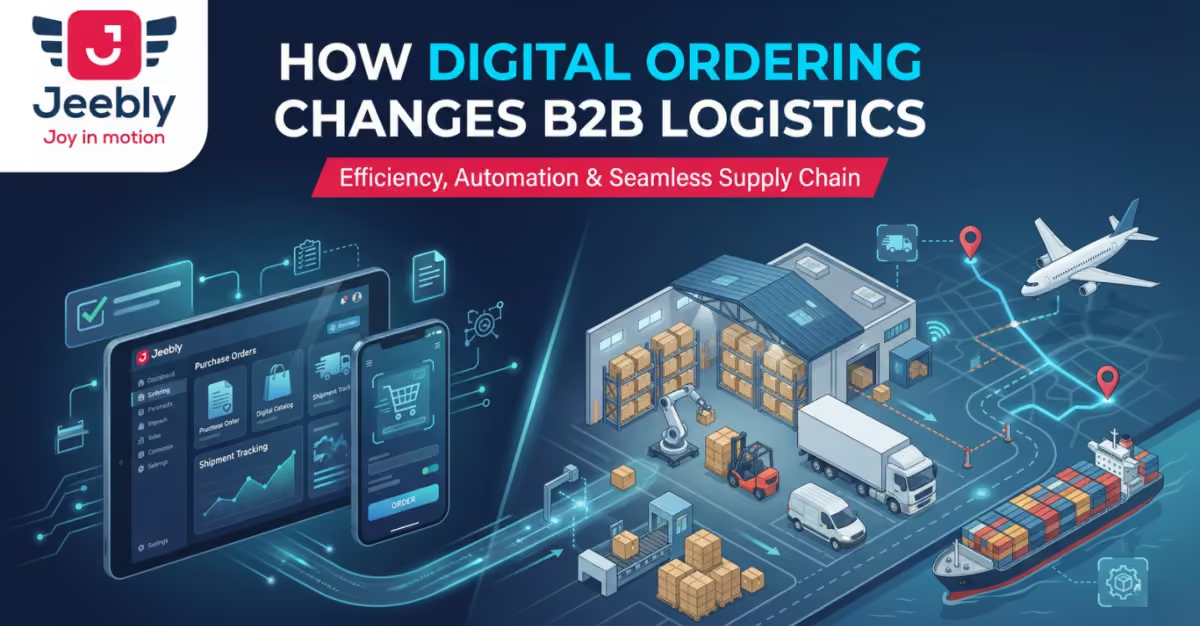
A modern navy and cyan digital blog banner titled 'HOW DIGITAL ORDERING CHANGES B2B LOGISTICS' with the Jeebly logo in the top-left corner. The illustration features a tablet and smartphone on the left showing digital B2B purchase orders, shipment tracking, and procurement interfaces, connected via glowing digital data streams to a bustling smart logistics ecosystem on the right with an automated warehouse, forklifts, delivery trucks, a cargo airplane, and a container ship.
B2B E-Commerce in the UAE: How Digital Ordering Is Changing Business Logistics

Managing orders across your website, social channels, and marketplaces like Noon and Amazon can quickly overwhelm manual spreadsheets and disconnected systems. Stockouts, delayed dispatches, and rising return rates often signal that your business has outgrown basic order tracking. Discover the key signs your UAE e-commerce store needs an Order Management System (OMS) and how integrating automated order workflows with Jeebly streamlines inventory sync, multi-channel fulfillment, and last-mile delivery.
Read More
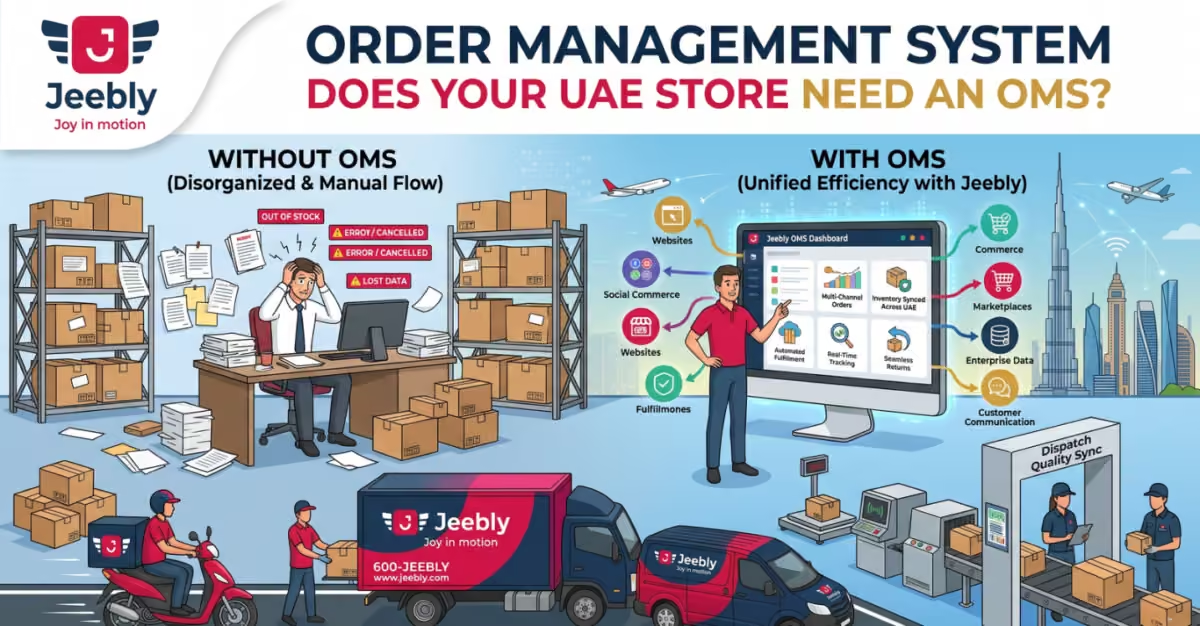
Split-screen infographic featuring the Jeebly logo, comparing chaotic manual order processing without an OMS against a streamlined, unified OMS workflow with Jeebly trucks, vans, and the Dubai skyline.
Order Management System: Does Your UAE Store Need an OMS?

Managing orders across your website, social channels, and marketplaces like Noon and Amazon can quickly overwhelm manual spreadsheets and disconnected systems. Stockouts, delayed dispatches, and rising return rates often signal that your business has outgrown basic order tracking. Discover the key signs your UAE e-commerce store needs an Order Management System (OMS) and how integrating automated order workflows with Jeebly streamlines inventory sync, multi-channel fulfillment, and last-mile delivery.
Read More
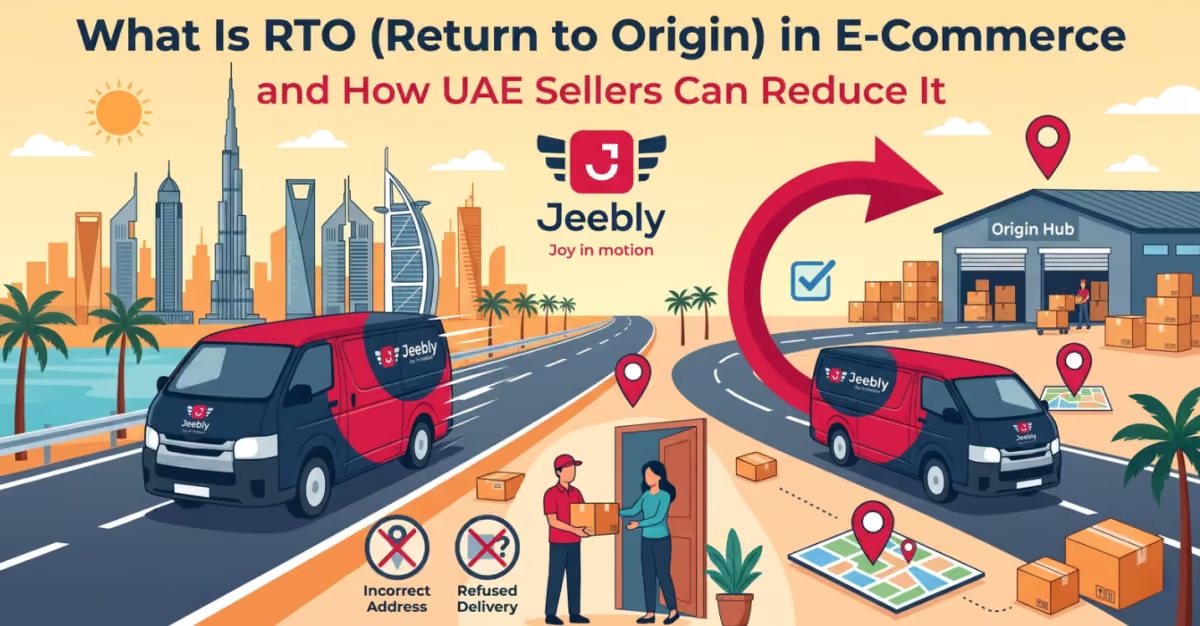
An animated vector-style graphic illustrating "What is RTO (Return to Origin) in E-Commerce and How UAE Sellers Can Reduce It", featuring Dubai's skyline, Jeebly delivery vans, and the loop of a package being returned to an origin hub alongside tips for successful doorstep delivery.
What Is RTO (Return to Origin) in E-Commerce and How UAE Sellers Can Reduce It

Return to Origin (RTO) is one of the most expensive headaches for UAE e-commerce sellers—often driven by non-standardized addresses, hard-to-reach customers, and Cash on Delivery (COD) refusals. But you don’t have to let failed deliveries eat into your profit margins. Discover what causes high RTO rates in the UAE and learn practical, actionable strategies—from address validation and automated customer communication to partnering with reliable delivery services like Jeebly—to protect your bottom line and ensure more orders find their home on the very first try.

Read More

    Powered by