
Jeebly | Logistics Solutions

Cost of Shipping for a Small Business: What You'll Actually Pay in 2026

Cost of Shipping for a Small Business in UAE: What You'll Actually Pay in 2026

Shipping costs for small businesses in UAE range from AED 15–30 for same-day within Dubai to AED 25–50 for inter-emirate delivery. COD adds AED 5–10 per shipment. Here’s a full breakdown by service type.

Shipping costs are among the few business expenses where the gap between what you expect to pay and what you actually pay can quietly erode margins. The UAE’s logistics industry employs over 378,000 professionals and contributes 14% to Dubai’s GDP. 

That figure can shift considerably depending on the service tier, carrier, and destination. 

The goal of this guide is simple: to give you a clear, realistic picture of what UAE small-business shipping costs look like in 2026. From domestic deliveries to GCC and international routes, know the expenses so you can budget accurately and negotiate from a position of knowledge.

What Actually Determines Your Shipping Cost in UAE

The core variables on which UAE carriers price shipments include: 

* Actual weight versus volumetric weight (whichever is higher) 
* Delivery speed and service tier 
* Origin and destination (emirate-to-emirate or country-to-country) 
* COD transactions and handling fees wherever applicable 
* Fuel surcharges, which adjust periodically.

Volumetric weight is the one most small businesses underestimate. Carriers calculate it using the formula: 
(Length × Width × Height) ÷ 5,000 (in cm)

For lightweight but bulky products like apparel, homeware, and gifts, the volumetric figure almost always exceeds actual weight, and that gap directly inflates your charge.

If you are new to packing shipments for a courier, these tips on how to pack a courier parcel in the UAE cover the practical side, including box sizing and weight considerations.

What Does Shipping Actually Cost? A UAE Small Business Rate Reference

Shipping costs are not fixed across all routes, carriers, or service types. Even within the UAE, the final cost depends on the delivery speed, package weight, delivery distance, serviceability, and any custom commercial terms agreed with the logistics provider.

For this reason, the safest way to plan your shipping budget is to separate confirmed domestic benchmarks from variable cross-border and international pricing.

Service Type Starting Rate What It Means
Next-Day Delivery AED 17.36 Suitable for standard domestic deliveries where speed is important, but not urgent.
Same-Day Delivery AED 28.56 Suitable for faster UAE deliveries where the order needs to reach the customer on the same day.
Domestic Express Delivery Distance-based Pricing depends on the pickup and drop-off distance between the sender and receiver.

Note: These figures are domestic delivery benchmarks. Final pricing may still vary depending on shipment weight, dimensions, pickup location, delivery location, delivery volume, and agreed commercial terms.

International shipping works differently from domestic delivery. Rates can change monthly or even weekly because they depend on external variables beyond a single logistics provider’s control.

The Practical Way to Budget Shipping Costs

For UAE small businesses, the better budgeting approach is:

1. Use confirmed domestic rates as your baseline.
2. Calculate the chargeable weight for your most common products.
3. Separate next-day, same-day, and express orders in your cost model.
4. Request live quotes for GCC and international shipments.
5. Review international pricing regularly, especially during peak shipping periods.

This keeps your logistics budget realistic without relying on outdated or misleading route-wise rate tables.

Shipping cross-border or internationally? Jeebly Bizz and Jeebly Dash International position customs support and customs clearance as part of their cross-border logistics offering. This is especially relevant for businesses expanding into GCC and international markets.

What UAE Small Businesses Get Wrong About Shipping Costs

Most businesses focus exclusively on the per-shipment rate. The real cost is the sum of the rate, RTO, handling overhead, and technology friction and those last three are often larger than the first.

* Carrier switching costs are real. Changing carriers frequently to chase lower rates prevents you from reaching the volume thresholds at which meaningful discounts are unlocked.
* Manual operations carry hidden costs. If order management, carrier booking, and customer communication run as separate manual processes, the staff hours involved are a real logistics expense.
* High RTO rates are a silent drain. Each failed attempt and RTO shipment carries a cost. Investing in pre-delivery SMS confirmation and tracking updates reduces this significantly and often yields more than any rate negotiation.

This is one area where technology now does the heavy lifting. AI-powered logistics systems can flag high-risk deliveries before dispatch and adjust routing in real time. If you want to understand how that works in practice, How AI is changing logistics in the UAE is a useful read.

How to Reduce Shipping Costs Without Cutting Delivery Quality

Reducing UAE small-business logistics costs is less about finding the cheapest carrier and more about building an operation in which every shipment moves efficiently. Four approaches consistently deliver results:

1. Consolidate volume. Working with too many carriers simultaneously prevents you from reaching the discount thresholds offered by any single provider. Committing to one primary domestic carrier and one regional or international carrier gives you the leverage to negotiate committed-volume pricing.
2. Right-size packaging. Running a one-time packaging audit against your most common SKUs reduces volumetric weight charges on every subsequent shipment. This is a fixed effort with a recurring return.
3. Plan around the UAE delivery seasonality. Rates and capacity tighten during peak windows. Ramadan can be one of the busiest e-commerce periods in the GCC, so businesses should plan inventory, fulfilment capacity, and delivery expectations early.
4. Measure total cost per order, not rate per shipment. Build a monthly cost model that includes the base rate, COD fee, (RTO rate × return cost), and administrative time. Compare carriers on that basis. A carrier 10% cheaper per shipment, but with a 30% higher RTO rate and no technology integration, will almost always cost more in total.

For domestic UAE delivery specifically, Jeebly positions Jeebly Dash as a seven-emirate last-mile network, and its published pricing includes next-day delivery from AED 17.31 for shipments up to 5 kg.

Conclusion

Shipping cost is not a fixed input. It depends on how you package, how much you consolidate, which carrier you commit to, and how effectively you reduce failed deliveries. If your current delivery spend feels opaque or your carrier performance does not match what you are paying for, that is worth a direct conversation with your logistics team. 
Get in touch with the Jeebly team to review your current setup. Determine the right service tier for your shipment profile and get a rate structure that aligns with where your business is headed.

Frequently Asked Questions

The cost of shipping a parcel in the UAE depends on factors such as package size, weight, delivery speed, destination, and any additional services required. Local parcel deliveries are generally more affordable than inter-emirate or international shipments, while express services may carry higher charges.

Courier charges in Dubai vary based on shipment dimensions, delivery location, service level, and delivery timeframe. Standard deliveries are typically more economical, while same-day, express, and specialized delivery services may cost more due to faster turnaround times and operational requirements.

Cash-on-delivery (COD) services may include an additional fee on top of the standard delivery charge. The exact cost depends on the logistics provider, shipment type, collection amount, and any payment processing requirements associated with handling and remitting collected funds.

Yes. Same-day delivery is generally more expensive than next-day delivery because it requires faster processing, dedicated delivery resources, route prioritization, and tighter delivery windows. Businesses often choose same-day delivery for urgent shipments where speed is a priority.

Small businesses can reduce shipping costs by consolidating shipments, choosing the most appropriate delivery service level, optimizing packaging, reducing failed deliveries, and partnering with logistics providers that offer volume-based pricing. Using technology to improve order accuracy and route efficiency can also help lower overall delivery expenses.

Routes to insightful reads

An infographic comparing how a positive delivery experience (left) vs. low price (right) impacts brand loyalty, featuring icons for tracking, staff, and costs in AED.
Why Delivery Experience Is a Bigger Brand Differentiator Than Price

In today’s competitive e-commerce landscape, competing on price alone is a race to the bottom. Customers are increasingly valuing speed, transparent tracking, and reliable service over minor cost savings. Discover why elevating your delivery experience is the ultimate brand differentiator for UAE sellers and how it drives long-term customer loyalty.

Read More
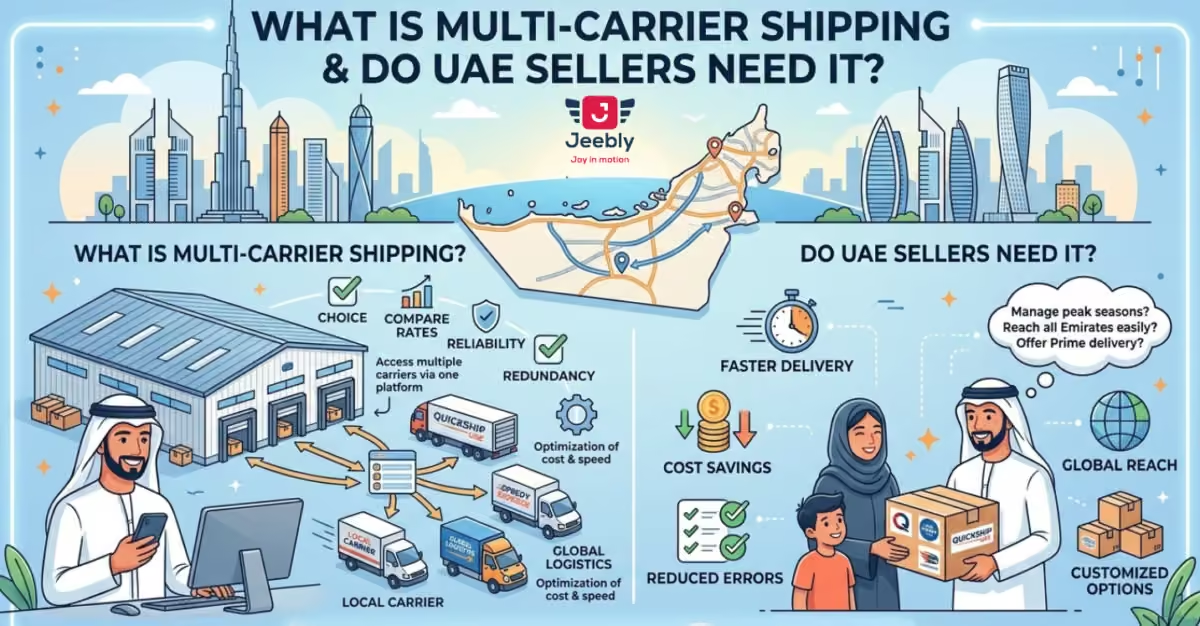
An infographic illustrating multi-carrier shipping for UAE e-commerce sellers, divided into two main sections explaining what it is and why it's needed, set against a backdrop of a UAE map and modern city skyline.
What Is Multi-Carrier Shipping and Do UAE Sellers Need It?

Relying on a single shipping provider can lead to bottlenecks, higher costs, and limited reach. Discover what multi-carrier shipping is and why e-commerce sellers in the UAE need a unified shipping strategy to compare rates, optimize delivery times across all Emirates, and scale their business smoothly.
Read More
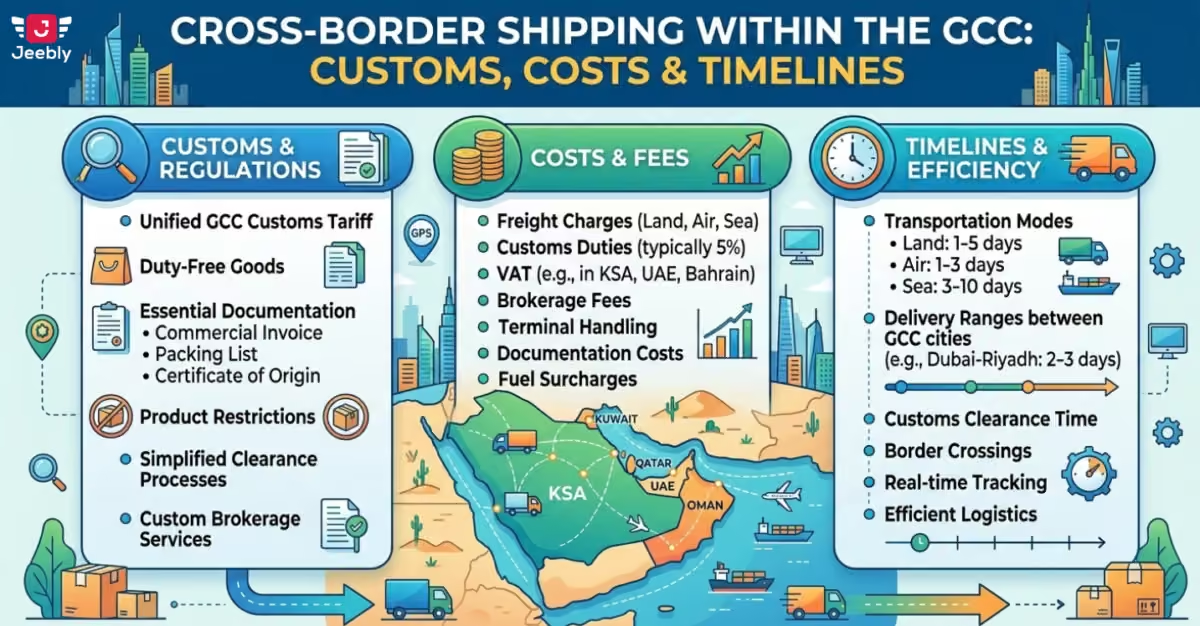
An infographic detailing the process of cross-border shipping within the Gulf Cooperation Council (GCC). The graphic is split into three main sections: "Customs & Regulations," "Costs & Fees," and "Timelines & Efficiency," all surrounding a map of the GCC region (Saudi Arabia, UAE, Oman, Qatar, Kuwait) with shipping routes.
Cross-Border Shipping Within the GCC: Customs, Costs and Timelines

Gearing up for Q4 in the UAE? Navigating peak season demand requires early planning across warehouse operations, carrier capacity, inventory, and customer experience. Explore our 10-step logistics checklist to streamline your supply chain, avoid bottleneck delays, and ensure smooth delivery during the busiest shopping quarter of the year.
Read More
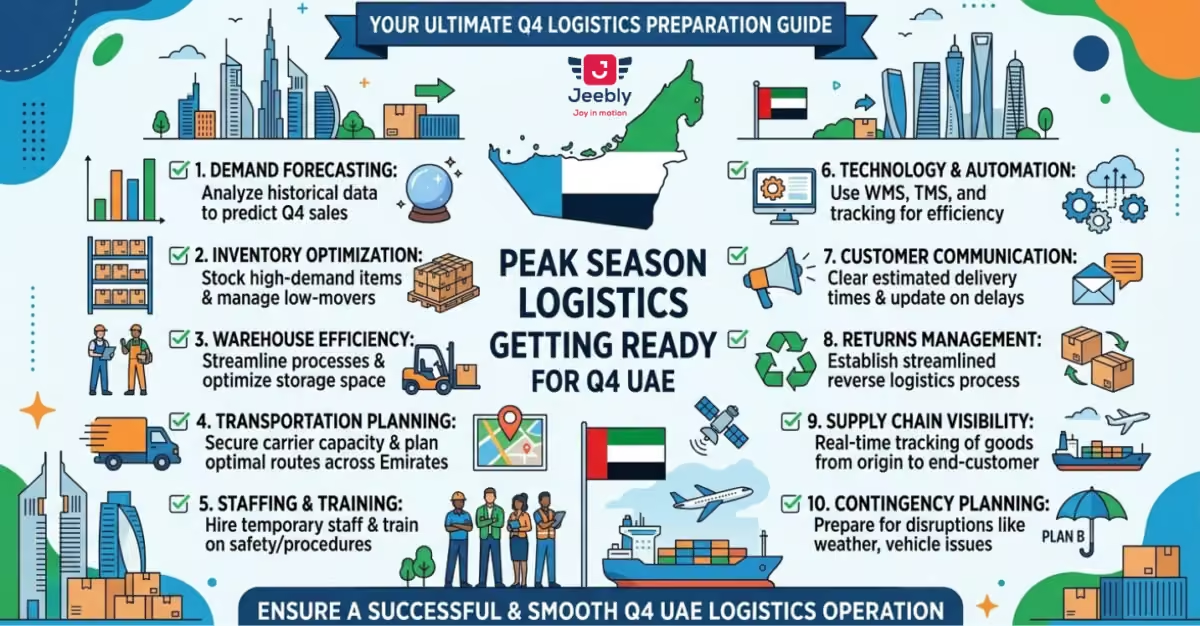
An infographic checklist outlining 10 key steps for Q4 UAE logistics preparation, featuring icons for demand forecasting, inventory, warehouse efficiency, transportation, staffing, and technology against a UAE skyline and map background.
Peak Season Logistics Checklist: Getting Ready for Q4 UAE

Gearing up for Q4 in the UAE? Navigating peak season demand requires early planning across warehouse operations, carrier capacity, inventory, and customer experience. Explore our 10-step logistics checklist to streamline your supply chain, avoid bottleneck delays, and ensure smooth delivery during the busiest shopping quarter of the year.
Read More
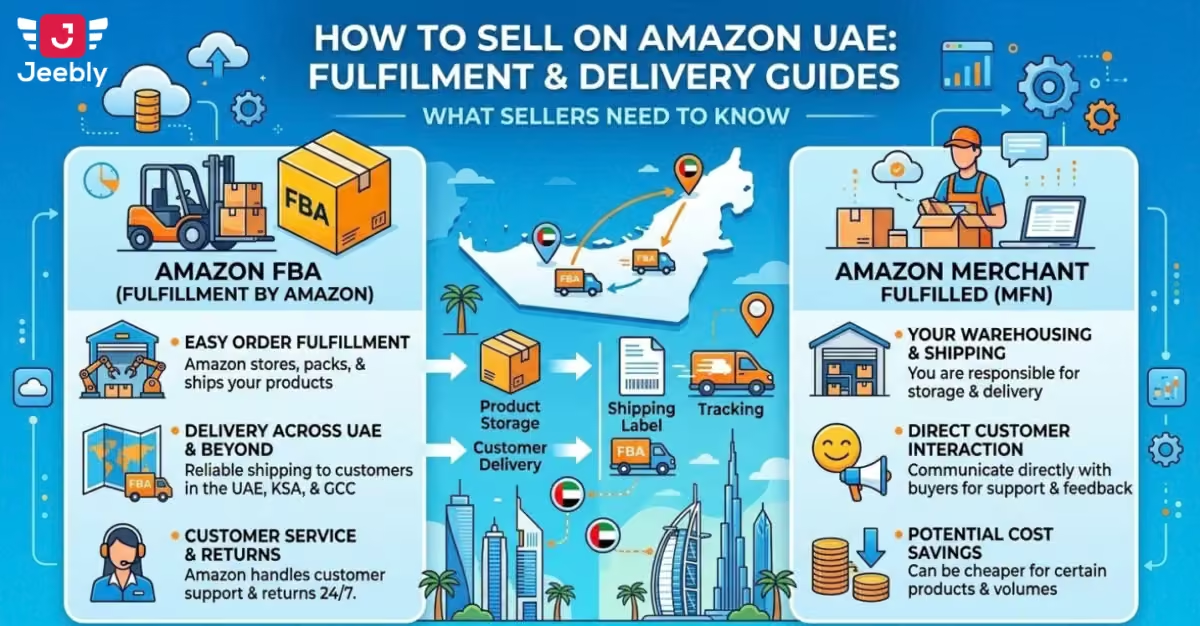
An isometric infographic detailing how to sell on Amazon UAE. The left side covers seller onboarding and listing steps like defining business activity, trade name reservation, and document preparation. The right side compares FBA (Fulfilment by Amazon) and FBM (Fulfilment by Merchant) logistics and delivery models against a Dubai skyline.
How to Sell on Amazon UAE: What Sellers Need to Know About Fulfilment and Delivery

Selling on Amazon UAE offers massive growth potential, but choosing the right logistics model can make or break your margins. Discover the step-by-step onboarding process for Amazon.ae, explore the core differences between Fulfilment by Amazon (FBA) and Fulfilment by Merchant (FBM), and learn how to optimize your delivery strategy to scale efficiently in the UAE market.

Read More

    Powered by