






Logistics around
the globe
5 Reasons why Reverse Logistics is important for your Business
Author: Vikrant, Head of Operations
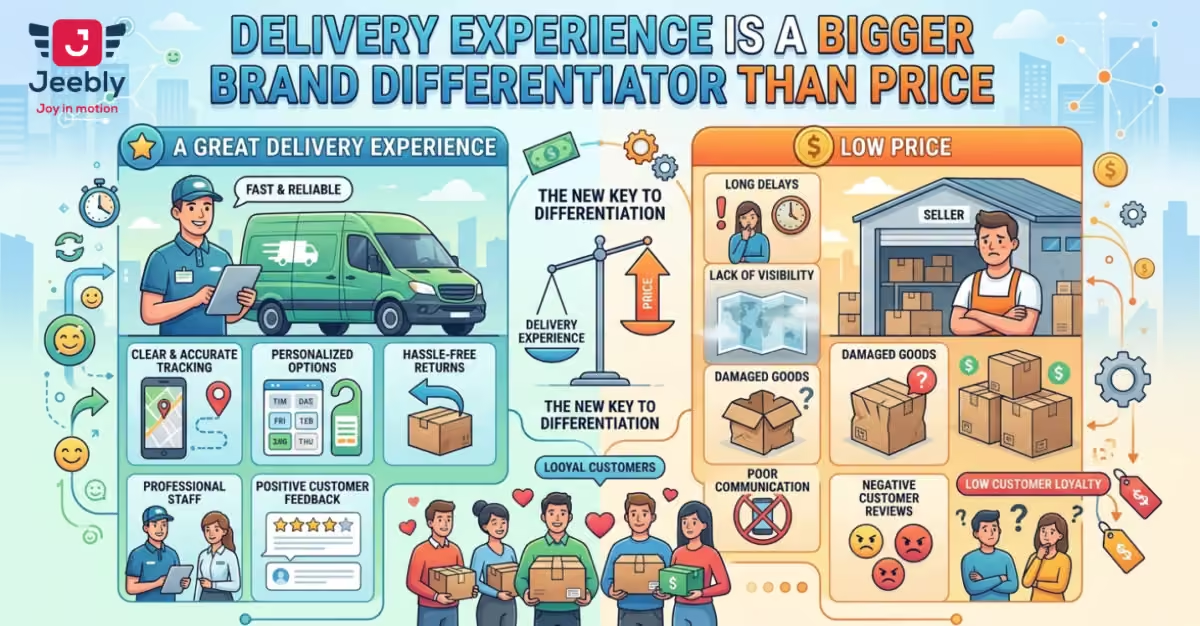
While return is always associated with customer dissatisfaction, an effective process can convert it into an opportunity to build better customer loyalty. The longer a reverse logistics pickup takes, the more agony is added to the customer. On the other hand, a quick return attempt increases the level of trust in the customer and pushes them further to stick to the platform. Many companies have now moved to a no-questions-asked policy for returns just to boost the customer’s confidence. Many companies have started seeing the return percentage as an increasing trend in their relationship with customers.
While improving every step of the supply chain, an effective reverse logistics solution can significantly impact the asset recovery of a business and, as a result, positively contribute at an operational level as well. From the time a customer raises a return request to the time the product has been returned to the seller/company, it stays as dead inventory in the chain, causing wastage in cost and inventory. So, apart from customer satisfaction, a quick return also adds the opportunity for the return product to be resold or treated as per the status.
Reverse shipments allow a company to closely monitor the quality of the product, and a high return rate acts as an alert to relook into the quality. Returns due to size issues have acted as a catalyst for improvements with features like size charts, size guides, and virtual trials. Such continuous improvements in the UI help in attracting better traffic to the platform. Additionally, companies can identify quality sourcing partners through simple data analytics to reduce returns.
Improved ROI and sustainability
A cost-effective reverse logistics system can not only help the company reduce its return cost, but the speed of returns can further help in customer retention and improved revenue. Reverse logistics is sometimes considered a dead cost and is not prioritized by e-commerce companies. However, one must remember that while half of the customer experience is drawn by the web interface and products, the other 50% of the consumer life cycle consists of fulfillment and logistics.
Routes to insightful reads

Every parcel that moves from a warehouse to a doorstep carries more than a product. It carries a carbon cost. This article covers what it entails, why it matters specifically for UAE e-commerce businesses, the real return on investment it delivers, and how to approach implementation without overhauling everything at once.

Every business shipping in the UAE asks the same question at some point: how long does delivery take? This article breaks down delivery timelines by service type, explains what makes the UAE logistics environment distinct, and covers what businesses can do to move faster and more reliably.

Returns are a predictable part of running an online store in the UAE, and how you handle them determines whether customers come back. This guide covers what UAE small sellers actually need: the legal requirements.

Shipping costs are among the few business expenses where the gap between what you expect to pay and what you actually pay can quietly erode margins. The goal of this guide is simple: to give you a clear, realistic picture of what UAE small-business shipping costs look like in 2026.

Dubai’s business environment runs on documentation. Property transactions, visa processes, business registrations, trade finance, and legal proceedings all require original, signed, physically delivered papers at various stages, often on tight timelines. This guide covers what document delivery in Dubai actually requires. Know what can go wrong, what to look for in a courier, and much more.