






Jeebly | Logistics Solutions

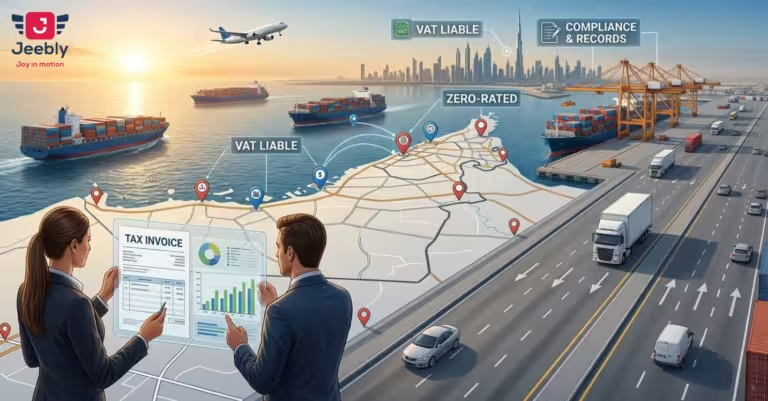
UAE VAT on imports and exports showing tax compliance, logistics, shipping and customs documentation

VAT on Shipping and Delivery Services in UAE: What Businesses Need to Know

In the UAE, most domestic courier and delivery services are subject to 5% VAT. Businesses can usually reclaim this VAT as input tax if they are VAT-registered and hold a compliant tax invoice.

This percentage is easy to overlook as it is a small percentage applied to a relatively small charge. Most businesses process it automatically without checking whether they’re applying it correctly. But if you get the VAT treatment of your shipping wrong, you’ll either be overcharging your customers at checkout, underreporting output tax to the FTA, or missing legitimate input VAT you could be reclaiming on your courier spend.

This guide covers how VAT on shipping and delivery services works, what the 2026 VAT amendments mean for your delivery operations, and how to structure your invoices and reclaim process correctly.

How UAE VAT Applies to Courier and Delivery Services

Under UAE VAT law, courier and delivery services are treated as a supply of services. The standard rule is straightforward: most taxable supplies of services are charged at 5% VAT. When a courier collects a parcel in Dubai, moves it to another emirate, or delivers to a customer, the fee is a taxable supply at the standard rate.

The applicable rate depends on the nature of the delivery, whether domestic or international, and whether the service forms part of a broader international transport arrangement.

Domestic deliveries: 5% standard rate

For most courier runs inside the UAE, VAT is charged at 5%. The same rate applies when a courier handles only a local leg linking two points within the country, even if the goods later move abroad with another supplier.

This is the rate that applies to the overwhelming majority of UAE e-commerce last-mile delivery invoices. If your courier invoice shows 5% VAT on a domestic delivery, that’s correct FTA treatment. If it doesn’t show VAT at all and your courier is VAT-registered, that’s worth investigating.

International deliveries: zero-rated under specific conditions

International door-to-door courier products can qualify for zero rating when they meet the definition of international transport of goods. Article 33 of the UAE VAT Executive Regulations allows a 0% rate when goods move between the UAE and another country, or when the domestic leg is part of a single international transport service.

However, any domestic leg can be zero-rated only when it is supplied by the same taxable person who provides the international leg. If the main carrier subcontracts the first mile to a third party and that subcontractor invoices its client separately, the subcontracted leg loses zero-rating and becomes standard-rated at 5%.

Question Answer
Domestic courier VAT 5% standard VAT.
International transport May qualify for 0% VAT, subject to UAE VAT regulations.
VAT reclaim Possible for VAT-registered businesses, provided eligibility requirements are met.
Invoice requirement A valid tax invoice displaying the supplier's Tax Registration Number (TRN).

Whether the zero-rating condition applies in practice depends on how your freight is structured. Freight Forwarding in the UAE explains how UAE freight forwarders structure multi-leg shipments and what to confirm before assuming that zero-rating applies to your invoices.

VAT on Shipping in Designated Zones and Free Zones

Courier work within free zones and designated zones is subject to specific FTA treatment. The FTA guidance on goods supplied in designated zones distinguishes between goods that remain within the zone, which are treated as outside the UAE VAT system, and goods moving between a designated zone and the UAE mainland.

The key rule for businesses using free zones as distribution hubs:

  • Supplies of goods within designated zones may receive special VAT treatment where the conditions under UAE VAT law are met. 
  • However, delivery services, mainland movements, and imports require separate assessment depending on the transaction structure.
  • Import VAT is generally calculated at 5% on the customs value plus applicable customs duties and other taxable amounts.
  • Delivery services for the mainland leg: 5% standard-rated courier service

The FTA treats the designated zone as outside the UAE VAT territory for goods purposes. The moment goods and the associated delivery service cross into the mainland, both are subject to the standard UAE VAT rate.

Incoterms and VAT Responsibility on International Shipments

When you’re shipping internationally from or to the UAE, the Incoterm you agree with your buyer or supplier directly determines who is responsible for UAE import VAT. Most businesses choose Incoterms based on shipping costs, not realising the VAT compliance obligation they’re accepting or transferring.

Incoterm Who Pays UAE Import VAT Who Handles UAE Customs Clearance
EXW (Ex Works) Buyer Buyer
FOB (Free on Board) Buyer Buyer
DAP (Delivered at Place) Buyer (at point of delivery) Buyer
DDP (Delivered Duty Paid) Seller Seller
CIF (Cost, Insurance, Freight) Buyer Buyer

Note: Actual responsibility depends on who acts as the importer of record and the customs arrangement.

DDP — the e-commerce customer experience default. Under DDP, you as the seller settle all UAE import duties and VAT before delivery. Your customer receives their order without any charges at the door.

DAP — the common operational default. Under DAP, the buyer, your UAE customer, is responsible for import duties and VAT at the point of delivery. If they weren’t expecting that charge, refusal rates spike.

The VAT liability at the point of mainland transfer is directly linked to your customs clearance process. The duty and VAT payment triggers the release order. Customs Clearance in Dubai and the UAE covers the declaration, payment, and release sequence step by step.

How to Structure Your Shipping Invoice for VAT Compliance

A courier invoice that doesn’t comply with FTA invoice requirements may affect your ability to recover input VAT and increase compliance risk. The 2026 standards have tightened, particularly with the e-invoicing mandate approaching.

What a compliant courier tax invoice must include:

  • Supplier’s legal name and address matching FTA registry exactly
  • Supplier’s Tax Registration Number (TRN)
  • Customer’s name and address
  • Unique sequential invoice number
  • Invoice issue date
  • Service description (e.g. “domestic parcel delivery, Dubai to Abu Dhabi”)
  • Quantity and rate (number of deliveries × rate per delivery)
  • VAT rate applied (5%)
  • VAT amount in AED stated separately
  • Total payable in AED

As e-invoicing becomes mandatory for B2B transactions, how well your courier integrates with your accounting or ERP system becomes a compliance question, not just an operational one.

Careem Express vs Jeebly compares the two providers on platform integration and fulfilment capabilities.

2026 UAE VAT Changes That Affect Shipping Operations

Three 2026 amendments directly affect businesses using logistics and delivery services.

1) Reverse charge mechanism: removal of self-invoicing requirement. 

From January 1, 2026, taxpayers importing “concerned goods” or “concerned services” for business purposes are no longer required to issue a tax invoice to themselves for these imports under the Reverse Charge Mechanism. Businesses now retain supplier invoices, customs documents, or evidence of imports for VAT accounting.

2) Five-year VAT credit carry-forward limit. 

From January 1, 2026, excess recoverable VAT may only be carried forward for a maximum of five years from the end of the tax period in which the excess arose. After that, unused credits expire. If your business has been carrying forward input VAT on shipping and logistics costs without claiming refunds, credits from 2021 need to be reviewed now. VAT credits from 2018 to 2020 must be claimed by December 31, 2026, or they will expire.

3) E-invoicing mandate: 2026 pilot, 2027 mandatory. 

UAE e-invoicing begins with a phased rollout. A voluntary pilot starts in July 2026, with mandatory adoption beginning from January 2027 for the first phase of businesses. Later phases will apply to additional businesses. 

E-invoices must be generated in structured XML/JSON formats and submitted via an FTA-Accredited Service Provider (ASP) using the Peppol network.

How Jeebly Handles VAT on Delivery Services

Jeebly Dash is VAT-registered and issues compliant tax invoices for all domestic delivery charges, with 5% VAT stated separately, a valid TRN, and all mandatory invoice fields included. For businesses running high delivery volumes, this means every Jeebly invoice is input-VAT reclaimable on your quarterly FTA return.

Jeebly Bizz connects your e-commerce platform (Shopify, WooCommerce, Magento) to your delivery operation. For businesses managing both domestic delivery and international inbound freight, having both handled through one platform means one consolidated record of VAT on delivery spend, rather than tracking input VAT across multiple courier accounts.

For questions about how VAT applies to your specific delivery structure, talk to the Jeebly team. We’ll walk through your shipment profile and confirm the correct VAT treatment before you file.

Frequently Asked Questions

Yes. Domestic courier and delivery services in the UAE are subject to 5% VAT under standard FTA rules. If your logistics provider is VAT-registered, their invoice will include 5% VAT on the delivery charge. If your business is also VAT-registered, you reclaim this as input tax on your quarterly VAT return.

5% for domestic deliveries. International courier services may qualify for 0% if the provider is responsible for both the domestic and international legs under a single contract. If different suppliers handle different legs with separate invoices, each domestic leg is standard-rated at 5%.

Yes, if you are VAT-registered with the FTA and the courier issues a compliant tax invoice with their valid TRN, VAT amount stated separately, and all mandatory fields included. The 5% VAT on domestic courier spend is input tax reclaimable on your VAT return.

Under DDP (Delivered Duty Paid), the seller pays UAE import VAT and customs duty before delivery. The customer receives goods without charges at the door. Under DAP (Delivered at Place), the buyer is responsible for import VAT at point of delivery. For UAE B2C shipments, DDP helps prevent delivery refusals due to unexpected import charges.

Three changes matter: the reverse charge mechanism no longer requires self-invoicing (retain supplier documents instead); excess input VAT can only be carried forward for five years (credits from 2021 start expiring in 2026); and e-invoicing becomes mandatory for B2B transactions from January 2027, with a voluntary pilot from July 2026. Courier invoices will need to be in structured digital formats from 2027.

Routes to insightful reads

UAE VAT on imports and exports showing tax compliance, logistics, shipping and customs documentation
VAT on Shipping and Delivery Services in UAE: What Businesses Need to Know

VAT can significantly impact the cost of shipping and delivery services in the UAE, making it essential for businesses to understand how it applies to domestic and international shipments. This guide explains VAT rules, zero-rated and standard-rated services, invoicing requirements, and practical compliance tips to help businesses manage logistics costs and stay compliant with UAE tax regulations.

Read More
COD fraud prevention in the UAE with secure payment verification, order authentication and logistics risk management
COD Fraud in UAE eCommerce: How to Detect, Prevent and Reduce Losses

Cash on Delivery (COD) fraud is a growing challenge for e-commerce businesses across the UAE, leading to fake orders, delivery failures and unnecessary operational costs. Learn how to identify common fraud tactics, implement effective prevention strategies and protect your business while maintaining a seamless customer experience.

Read More
UAE import and export guide featuring trade documentation, cargo ship, air freight, customs clearance and logistics operations
UAE Import and Export Guide: Trade Documentation, Logistics and Compliance

Customs clearance is a critical step in moving goods into and out of the UAE. Whether you’re importing, exporting, or shipping across borders, understanding the customs process, required documentation, and compliance requirements can help you avoid delays, reduce costs, and keep your supply chain running efficiently.

Read More
Customs clearance process in Dubai and the UAE showing document processing, port inspections and import export logistics
Customs Clearance in Dubai and UAE: Process, Documents and Business Guide

Customs clearance is a critical step in moving goods into and out of the UAE. Whether you’re importing, exporting, or shipping across borders, understanding the customs process, required documentation, and compliance requirements can help you avoid delays, reduce costs, and keep your supply chain running efficiently.

Read More
Freight forwarding in the UAE with cargo containers, port terminal and cargo aircraft at sunrise
Freight forwarding in UAE: how it works, costs and how to choose a provider

Looking for the fastest and most reliable way to ship packages across the Emirates this year? Dive into our comprehensive 2026 Comparison Guide to the Best Courier Services in the UAE. We break down the top providers based on delivery speed, cost-effectiveness, advanced tracking tech, and overall reliability. Whether you are an e-commerce business looking to scale or simply sending a personal parcel from Dubai to Abu Dhabi, find the perfect courier partner to streamline your logistics today!

Read More

    Powered by