






Jeebly | Logistics Solutions

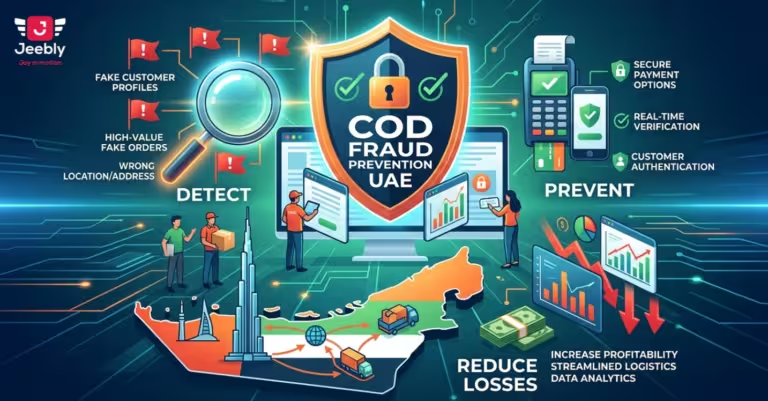
COD fraud prevention in the UAE with secure payment verification, order authentication and logistics risk management

COD Fraud in UAE eCommerce: How to Detect, Prevent and Reduce Losses

Cash on delivery is not going away in the UAE. It still accounts for nearly 35% of transactions across the Middle East and Africa.

The problem is that COD also creates a specific category of fraud risk that digital payment orders don’t carry: low-intent buyers who never planned to accept the parcel, external scammers exploiting the system’s offline nature, and a cascade of operational costs that appear as return-to-origin (RTO) losses on your courier statement.

This guide covers types of COD fraud that UAE businesses face. Know how to detect each, and the operational and technology measures that reduce losses without removing COD from your checkout.

Two Types of COD Fraud: External Scams vs Merchant Losses

1) External COD scams 

This targets your customers. Fraudsters may obtain customer details through leaked databases, phishing, public information, or other illegal sources. They dispatch parcels through legitimate logistics companies and specify a cash amount to be collected on delivery. 

When the courier arrives, the recipient assumes a family member or colleague placed the order and pays without verifying. By the time they open the parcel and discover the contents are worthless, it is difficult to reverse the transaction. This type of fraud damages your customers and, if your brand is being impersonated, directly damages your reputation.

2) Fake-order fraud & high-RTO abuse 

This targets your operations. Fraudulent COD orders placed using fake phone numbers and addresses result in guaranteed RTOs. The courier attempts delivery to a non-existent recipient and returns. 

Beyond outright fake orders, serial refusers, and customers who genuinely placed an order but later choose to refuse delivery, all incur similar operational costs. The distinction matters because the solutions differ.

Understanding which type is driving your losses determines which interventions to prioritise.

How External COD Scams Work

The mechanics follow a consistent pattern. 

Scammers obtain real addresses and phone numbers, dispatch parcels through legitimate logistics companies, and have the courier collect cash on their behalf. The delivery agent follows standard instructions with no knowledge of the contents. Once payment is made, the courier processes the funds through its standard settlement cycle and transfers the amount to the sender.

Unlike prepaid transactions, COD removes many digital payment protections such as automated payment authentication and chargeback processes, shifting more fraud risk into delivery operations.

Common external COD scam types currently active across the region:

  • The unsolicited parcel scam: A fraudster sends a package to a real address using leaked personal data. The recipient assumes a family member ordered it and pays. The parcel contains low-value or worthless items.

  • Brand impersonation: Scammers build convincing replicas of real UAE e-commerce stores, collect orders at scale, and dispatch cheap substitutes via third-party couriers. Your brand takes the fallout from customer service.

  • Fake courier impersonation: Some fraudsters pose as delivery companies, sending packages and demanding cash payments. Packages may include a QR code that, when scanned, links to a phishing site that collects additional personal data.

  • The advanced call variation: In some variations, fraudsters send advance messages or make phone calls claiming a shipment is on its way, creating a sense of legitimacy before the parcel arrives.

One protection against brand impersonation is ensuring your customers can independently verify delivery through a branded tracking page from your actual logistics partner. 

Aramex vs Jeebly: Which Is Better for UAE Last-Mile Delivery? compares how the two providers handle tracking visibility, ePOD, and customer communication. These capabilities help customers distinguish your legitimate delivery from a scam.

How Fake-Order Fraud Costs Your Business

Every failed COD delivery incurs double shipping costs: you paid for the forward attempt, and you pay for the return. The cash flow impact is separate and often underestimated. For brands with 25–30% COD RTO rates, the cash trapped in transit at any point can equal 3–5 weeks of revenue, creating a liquidity problem that grows with scale. 

When combined with Jeebly’s structured COD remittance cycle, this gap can be materially compressed compared to providers that remit fortnightly or monthly. But the RTO rate itself needs to be addressed at the source.

The total cost per RTO order is higher than most business models. A refused COD delivery carries forward shipping cost, return shipping cost, repackaging and restocking time, the COD amount that was never collected, and the customer acquisition cost spent to generate an order that never converted.

Detecting Fake Orders Before Dispatch

The most cost-effective COD fraud intervention happens before the parcel leaves your warehouse. A risk-scoring approach works better than applying the same verification to every order. 

Assess each COD order based on new-customer status, order value, address deliverability, phone-number validity, and historical RTO patterns for the same contact details. Low-risk orders proceed without friction. High-risk orders get additional verification steps.

Signals that flag a COD order as high-risk:

  • Phone number doesn’t match the delivery emirate’s prefix pattern
  • Address is incomplete, contains only a building name with no flat or office number, or matches a known high-RTO zone
  • Multiple orders from the same device or IP with different contact details
  • First-time customer placing a high-value COD order with no order history
  • Order placed outside normal hours with an unusual address format


OTP verification is one of the most effective pre-dispatch controls for reducing fake COD orders. OTP confirmation filters out fake or uncertain orders, ensuring only genuinely interested customers proceed with COD purchases.

Address validation at checkout catches genuine customers who entered incomplete or incorrect addresses. AI-powered address validation can reduce preventable delivery failures by identifying incomplete addresses, invalid locations, and delivery-risk patterns before dispatch.

The RTO lock is the most operationally precise tool for repeat offenders. RTO lock blocks customers with a history of COD refusals from accessing the COD payment option; they can still purchase with prepaid methods.

These pre-dispatch interventions are only as effective as the fulfilment partner executing them. 

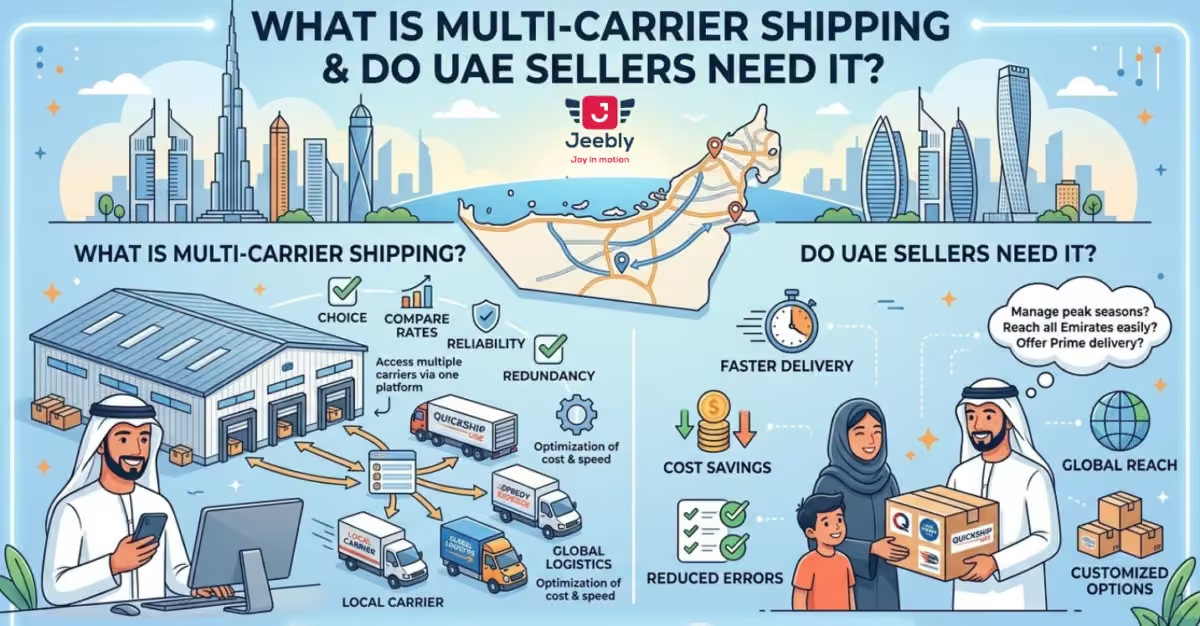
Whether your operation suits a carrier or a courier model affects which fraud prevention tools are actually available to you. Carrier vs Courier: What’s the Difference and Which Do You Need in the UAE? clarifies the distinction.

Reducing Losses After Dispatch: NDR Management

An NDR (Non-Delivery Report) is a recoverable event. An RTO is the loss. The intervention window between the two is the time when significant losses can be prevented.

When a first delivery attempt fails, most businesses leave the outcome to the courier. Automated NDR management, such as WhatsApp or SMS outreach to the customer immediately after a failed attempt to confirm a new delivery window, reduces NDR-to-RTO conversion. 

The message content matters: 

  • Include the exact COD amount 
  • The rescheduled delivery window 
  • A simple one-tap confirmation. 

Customers who confirm reschedule convert at significantly higher rates than those who receive a generic “we’ll try again” notification.

What to Look for in a Logistics Partner for COD Operations

Your courier partner is operationally central to the risk of COD fraud. The specific capabilities to confirm before committing:

  • Digital proof of delivery (ePOD) is standard. Every drop-off should be confirmed with a timestamped photo and, for high-value orders, OTP or signature capture. This creates an evidentiary record for every delivery and eliminates “I never received it” disputes without a trail to resolve them.

  • NDR workflow transparency. Ask specifically: when a delivery attempt fails, what happens next? How quickly is the NDR flagged? Is the customer contacted automatically, or does re-attempt coordination require your team’s involvement? A courier with automated NDR management recovers more failed deliveries without adding to your ops overhead.

  • Weekly COD remittance. The remittance cycle directly affects your working capital. Jeebly supports structured COD settlement workflows, with settlement schedules depending on client arrangements. Confirm the cycle with any provider before signing.

  • 98% First Day Delivery Success (FDSS). Jeebly’s published FDSS across 50,000+ daily deliveries. A high first-attempt success rate is the most direct structural reduction in your RTO exposure. It limits the number of situations where an NDR even needs to be managed.

For a broader comparison of UAE courier providers on these criteria, Best Courier Service in UAE: 2026 Comparison Guide covers FDSS, remittance cycles, and NDR handling across the major operators.

How Jeebly Handles COD Operations

Jeebly Dash builds fraud-resistant COD delivery into the standard service rather than offering it as an optional add-on. Photo ePOD is captured at every drop-off and is timestamped and geotagged. The delivery record is immediately accessible to the business through the platform, which means disputes are resolved on the basis of evidence rather than through verbal disputes.

For businesses managing high COD volumes, Jeebly Bizz integrates order management, dispatch, and delivery tracking into a single platform. COD remittance runs weekly, reducing the cash-in-transit gap that high-RTO operations typically carry.

For businesses currently experiencing elevated RTO on COD orders or concerned about brand impersonation affecting their customers, talk to the Jeebly team. A direct conversation will identify quickly where the losses are coming from and which operational changes address them.

Frequently Asked Questions

COD fraud covers two distinct problems: external scammers who exploit cash-on-delivery to send fake parcels and collect cash from unsuspecting customers, and fake-order fraud, where low-intent buyers or bots place orders with no intention of accepting delivery, creating return-to-origin losses for the merchant. Both are active in the UAE market and require different operational responses.

 COD transactions bypass digital payment safeguards like chargeback mechanisms, authentication protocols, and automated fraud detection systems. Once cash is handed over at the door, the transaction is effectively irreversible.

OTP verification at checkout is the highest-ROI single intervention. It eliminates fake orders placed with wrong or non-existent phone numbers. Address validation at checkout is the complementary layer that handles address-error RTOs.

RTO lock restricts customers with a pattern of COD refusals from accessing COD at checkout. They can still purchase using prepaid options. Many businesses introduce COD restrictions when customer behaviour shows repeated refusal patterns.

Publish your official courier partners on your website and customer communications. Instruct customers never to pay cash for a parcel they didn’t order. Build branded tracking pages so customers can verify delivery status independently, without relying on messages from unknown numbers. And ensure your logistics partner captures ePOD at every delivery.

COD losses usually include failed delivery costs, return shipping, handling costs, lost customer acquisition spend, and delayed cash flow.

Removing COD can reduce failed deliveries but may also reduce conversions from customers who prefer paying after receiving their order. Many businesses improve profitability by managing COD risk instead of eliminating it.

Routes to insightful reads

COD fraud prevention in the UAE with secure payment verification, order authentication and logistics risk management
COD Fraud in UAE eCommerce: How to Detect, Prevent and Reduce Losses

Cash on Delivery (COD) fraud is a growing challenge for e-commerce businesses across the UAE, leading to fake orders, delivery failures and unnecessary operational costs. Learn how to identify common fraud tactics, implement effective prevention strategies and protect your business while maintaining a seamless customer experience.

Read More
UAE import and export guide featuring trade documentation, cargo ship, air freight, customs clearance and logistics operations
UAE Import and Export Guide: Trade Documentation, Logistics and Compliance

Customs clearance is a critical step in moving goods into and out of the UAE. Whether you’re importing, exporting, or shipping across borders, understanding the customs process, required documentation, and compliance requirements can help you avoid delays, reduce costs, and keep your supply chain running efficiently.

Read More
Customs clearance process in Dubai and the UAE showing document processing, port inspections and import export logistics
Customs Clearance in Dubai and UAE: Process, Documents and Business Guide

Customs clearance is a critical step in moving goods into and out of the UAE. Whether you’re importing, exporting, or shipping across borders, understanding the customs process, required documentation, and compliance requirements can help you avoid delays, reduce costs, and keep your supply chain running efficiently.

Read More
Freight forwarding in the UAE with cargo containers, port terminal and cargo aircraft at sunrise
Freight forwarding in UAE: how it works, costs and how to choose a provider

Looking for the fastest and most reliable way to ship packages across the Emirates this year? Dive into our comprehensive 2026 Comparison Guide to the Best Courier Services in the UAE. We break down the top providers based on delivery speed, cost-effectiveness, advanced tracking tech, and overall reliability. Whether you are an e-commerce business looking to scale or simply sending a personal parcel from Dubai to Abu Dhabi, find the perfect courier partner to streamline your logistics today!

Read More
A Jeebly courier service delivery van filled with cardboard boxes parked outside a building in the UAE, while a courier uniform-clad driver hands over a parcel to a customer.
Best Courier Services in UAE: 2026 Comparison Guide.

Looking for the fastest and most reliable way to ship packages across the Emirates this year? Dive into our comprehensive 2026 Comparison Guide to the Best Courier Services in the UAE. We break down the top providers based on delivery speed, cost-effectiveness, advanced tracking tech, and overall reliability. Whether you are an e-commerce business looking to scale or simply sending a personal parcel from Dubai to Abu Dhabi, find the perfect courier partner to streamline your logistics today!

Read More

    Powered by