





Jeebly | Logistics Solutions

Air Freight vs Ocean Freight: Which Is Right for Your Business?

Air Freight vs Ocean Freight: Which Is Right for Your Business?

Speed costs money, and volume takes time. The moment a UAE business starts shipping internationally, this trade-off becomes a recurring decision, and the wrong default is expensive either way.

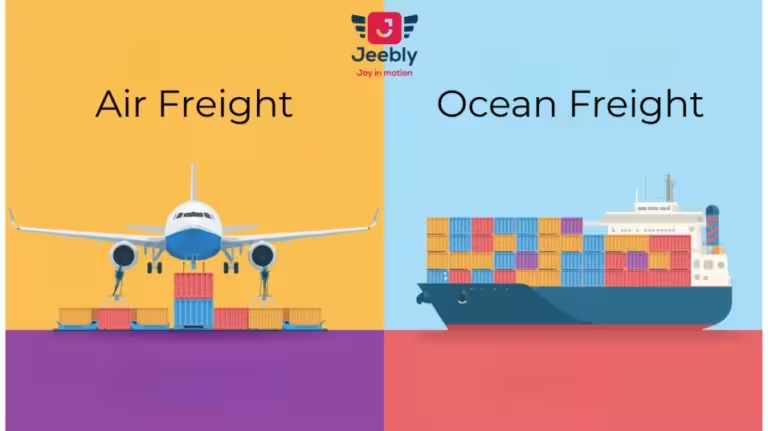
Air freight and ocean freight aren’t competing for the same cargo. They serve structurally different needs. The UAE’s position makes this decision both more consequential and more nuanced than in most markets. 

DXB alone handled 2.2 million tonnes of cargo in 2024, a 20.5% year-on-year surge, according to Dubai Airports, while Jebel Ali Port recorded its highest container throughput since 2015 at 15.5 million TEU. Both modes are running at scale. 

The choice between them comes down to your cargo profile, your timeline, and how you calculate total cost. This guide breaks down air freight vs ocean freight across all these dimensions.

Air Freight from UAE: When Speed Is the Point

Air freight moves cargo between airports via commercial and dedicated cargo aircraft. Transit times from Dubai typically run 1–5 days to most major destinations. That speed is the product, but it is priced accordingly.

High-value, lightweight cargo

Air freight pricing is based on chargeable weight: the greater of actual weight versus volumetric weight. The formula rewards shipments with high value density, such as electronics, pharmaceuticals, luxury fashion, and medical devices. You’re moving significant value per kilogram, and the freight premium is a fraction of what’s at stake.

A pharma distributor shipping temperature-sensitive medications to a hospital network in Europe has no viable ocean option. The cargo type, timeline, and regulatory requirements all converge in the air.

Urgent restocking and missed inventory windows

When stock runs out ahead of Ramadan, the Dubai Shopping Festival, or a product launch, waiting 20–30 days for an ocean shipment is a revenue problem, not a logistics preference. Air freight compresses that gap to days. For businesses managing demand spikes, that responsiveness is built into the cost.

If your supply chain is still reactive rather than planned, Jeebly’s guide on how UAE businesses scale during peak seasons covers the planning layer that prevents these situations.

Perishable goods and cold chain cargo

Products with short shelf lives, such as fresh food, cut flowers, and others, can’t survive 20+ days at sea, regardless of packaging. Air freight aligns with cold chain requirements on long-haul routes in a way that ocean freight cannot.

When holding costs offset the freight premium

High inventory carrying costs can flip the economics. Tying up working capital across 30 extra days of ocean transit plus storage sometimes costs more than the air premium. Run the full landed cost calculation before defaulting to ocean.

Ocean Freight from UAE: The Case for Cost Efficiency

Ocean freight moves cargo via container ships. Transit times range from 7 days (intra-GCC) to 30+ days for Europe and the Americas. It offers greater capacity and value, as a single container can hold 10,000 beer bottles.

Bulk, heavy, or low-value-per-kilogram cargo

For building materials, furniture, industrial equipment, and automotive parts, the cost-per-unit maths doesn’t work in the air for this profile. Ocean freight isn’t a compromise here. It’s the rational choice.

Planned procurement with sufficient lead time

Businesses operating on 60–90 day replenishment cycles have no structural need for air freight. Ocean’s slower transit is only a constraint if your procurement window is tight. Build the lead time in, and you gain significant cost efficiency with no operational downside.

LCL vs FCL: flexibility at both ends of volume

Less-than-Container Load (LCL) lets you share container space and pay for what you use. It’s practical for SMEs managing cash flow. Full Container Load (FCL) gives larger shippers dedicated space and better per-unit economics at scale. This volume flexibility doesn’t exist in air freight.

Sustainability-conscious supply chains

Air freight leaves the largest freight carbon footprint. Aeroplanes emit 500 grams of CO2 per metric ton of freight per km of transportation, while transport ships emit only 10 to 40 grams of CO2 per kilometre.

For UAE businesses with ESG commitments or international clients who audit supply chain emissions, this gap is quantifiable and increasingly relevant to procurement decisions.

Ocean Freight vs Air Freight: Comparison at a Glance

Both modes have distinct cost, speed, and cargo fit profiles. A brief comparison like the one below will help map your shipment against these dimensions.

Factor ✈ Air Freight 🚢 Ocean Freight
Transit time 1–5 days 7–30+ days
Cost High — chargeable weight Low–moderate — CBM / TEU
Cargo fit High-value, lightweight, perishable, urgent Bulk, heavy, non-perishable, planned
Volume flexibility Limited by aircraft capacity LCL and FCL options
Security and handling High — minimal touchpoints Moderate — more handling stages
Carbon footprint 500–1,500g CO₂/ton-km 10–40g CO₂/ton-km
UAE infrastructure DXB + DWC — 240+ routes Jebel Ali (top 10 globally), Khalifa Port
Hybrid option Sea-air via Dubai Logistics Corridor

How to Make the Right Call: Four Practical Filters

No comparison table makes the decision for you. These are the variables that actually determine the right answer for a given shipment:

1. Value density

Divide shipment value by weight. Above approximately AED 1,000 per kilogram, air freight economics generally work. Below that threshold, the ocean becomes increasingly attractive.

2. Delivery deadline vs procurement lead time

Work backwards from your customer commitment. Over 25 days available, the ocean is viable on most routes. Under 15 days, air freight is typically the only option. The 15–25-day window is when sea-air is worth pricing.

3. Contract or customer expectations

B2B contracts with SLA-linked penalties change the calculation. So does the customer segment. Premium retail buyers in the GCC or Europe often have delivery expectations that make ocean unviable regardless of unit economics.

4. Total landed cost, not just the freight rate

Factor in: freight cost, insurance, customs duties, storage during transit, and opportunity cost of tied capital. Air freight’s headline rate looks expensive. Its total landed cost is competitive for the right cargo profile once you account for faster inventory turnover and reduced holding time.

How Jeebly Helps Across Both Modes

For UAE businesses that need end-to-end freight management across air, sea, and road, Jeebly Haul handles the full journey: pickup, documentation, customs, and delivery. Whether you’re moving bulk cargo by container or coordinating urgent air shipments, the same network handles tracking and compliance throughout the process.

Businesses with cross-border complexity can explore Jeebly Bizz, which handles the regulatory layer, making international freight predictable rather than reactive.

If your freight question sits closer to the last mile, reducing failed deliveries, improving on-time rates, or scaling operations, Jeebly’s guide on what to look for in a reliable logistics company covers what actually differentiates logistics partners in the UAE.

Final Thoughts

The air vs ocean decision is only half the equation. The other half is execution. 

At Jeebly, we handle freight across air, sea, and road, so the mode you choose is supported by the same end-to-end network, real-time tracking, and compliance expertise. Whether you’re moving a single urgent air shipment or planning a container programme for the year, we handle the complexity so you can focus on growth. 

Talk to the Jeebly team about your freight requirements today.

Frequently Asked Questions

Yes. Air freight transit of 1–5 days consistently outpaces ocean freight. The relevant question is whether the speed premium is justified by your cargo type and deadline.

Heavy machinery, bulk raw materials, oversized cargo, and standard consumer goods with long shelf lives. The cost-per-unit economics don’t work. Ocean freight is the appropriate mode.

Yes. The Dubai Logistics Corridor (DLC) connects Jebel Ali Port and Al Maktoum International Airport via a specialised 75-km corridor. This multimodal link, encompassing sea, air, and land (including Etihad Rail), allows cargo to move from sea to air in under 45 minutes.

Less than Container Load means your cargo shares a container with other shippers. Cost-effective for small to mid-volume shipments that don’t fill a full container. As volume grows, FCL typically offers better per-unit rates.

Jebel Ali processed over 15.5 million TEU in 2024, placing it among the top ten container ports worldwide. Shipping line frequency, free-zone integration, and customs efficiency make it one of the strongest ocean-freight origins in the region.

    Powered by